Hubbry Logo
Charge conservationCharge conservationMain
Open search
Charge conservation
Community hub
Charge conservation
logo
7 pages, 0 posts
0 subscribers
Be the first to start a discussion here.
Charge conservation
Charge conservation
from Wikipedia
Not found
Revisions and contributorsEdit on WikipediaRead on Wikipedia
from Grokipedia
Charge conservation, also known as the of conservation of electric charge, is a fundamental principle in physics stating that the total in an remains constant over time; electric charge can neither be created nor destroyed, but can only be transferred from one object to another or redistributed within the system. This implies that any process producing a net charge must simultaneously produce an equal amount of opposite charge, ensuring the overall balance in closed systems. Empirically established through experiments dating back to the , charge conservation underpins the behavior of electric phenomena and has been verified to extraordinary precision in particle accelerators and observations, with no confirmed violations in standard physical processes. In , the principle manifests mathematically as the , J+ρt=0\nabla \cdot \mathbf{J} + \frac{\partial \rho}{\partial t} = 0, where ρ\rho is the and J\mathbf{J} is the ; this equation is derived directly from , particularly and the Ampère-Maxwell law, ensuring consistency across electromagnetic theory. In modern , charge conservation emerges as a consequence of applied to the global U(1) phase symmetry of the electromagnetic interaction, which is locally promoted to gauge invariance in (QED), the relativistic quantum theory of electrons and photons. This symmetry protects the conservation of as an additive , distinguishing it from other conserved quantities like or , and it holds exactly within the of , where charge is quantized in units of the ee. Charge conservation holds exactly within the Standard Model of particle physics and grand unified theories, with no observed violations experimentally.

Fundamentals

Definition

Electric charge is a fundamental physical property of that causes it to experience when placed in an . The law of conservation of charge states that the total in an remains constant over time, meaning charge is neither created nor destroyed. This principle implies that any apparent change in charge within a subsystem must be balanced by an equal and opposite change elsewhere in the system. While total charge conservation applies to the net charge of an entire , local conservation describes how charge is preserved at every point in space, expressed through the that relates the rate of change of to the of . This local form ensures that charge cannot vanish or appear spontaneously in any finite region without corresponding flow from adjacent areas. In chemical reactions, such as processes, conservation manifests when a neutral atom loses an to form a positive and a free negative , preserving the total charge of zero. Similarly, in basic electromagnetic interactions, like the attraction between a positively charged proton and a negatively charged in a , the total charge remains unchanged as particles exchange energy without altering their intrinsic charges.

Physical Significance

Charge conservation serves as a fundamental principle that unifies various domains of , ensuring consistency in , circuit theory, and dynamic phenomena by prohibiting the net creation or annihilation of charge. In electrostatic configurations, such as capacitors, charging occurs through the separation of existing positive and negative charges rather than the production of new net charge, maintaining overall balance within the system. This invariance underpins the reliability of electromagnetic interactions, from static charge distributions to time-varying fields, as observed in classical theories where charge remains a fixed total quantity in isolated systems. The principle finds critical applications in engineering and natural processes where charge balance is essential for functionality and safety. In battery design, charge conservation dictates the of ions across electrodes and electrolytes, enabling efficient electrochemical reactions that power devices without violating neutrality. Lightning protection systems rely on this to facilitate the controlled dissipation of atmospherically separated charges, preventing destructive discharges by guiding currents along conductive paths. Similarly, in particle accelerators, maintaining charge conservation ensures beam stability and precise control during high-energy collisions, where charged particles are accelerated without net charge alteration. Beyond specific uses, charge conservation has profound broader impacts on physical laws. It directly establishes Kirchhoff's current law, which mandates that the algebraic sum of currents at any circuit junction is zero, reflecting the inability of charge to accumulate or vanish instantaneously. Furthermore, it connects to in electromagnetic fields through , where the flow of field energy compensates for work performed on charges, preserving overall energetic balance. Conceptually, charge conservation distinguishes itself as a strictly and universal , unlike , which loses independent conservation in due to the equivalence of and energy allowing interconversion. While relativistic processes can create particle-antiparticle pairs that alter total yet preserve charge neutrality, electric remains invariant, underscoring its role as an absolute across all interactions. This form is encapsulated in the , linking changes to current flows.

Historical Development

Early Observations

Early demonstrations of static electricity in the 18th century revealed that rubbing materials together, such as glass rods with or with , produced attractive or repulsive effects without creating new electrical charge from nothing; instead, charge appeared to be transferred between objects, leaving one positively charged and the other negatively charged. These qualitative observations, building on ancient Greek notes of 's attraction to after rubbing, suggested a fluid-like nature to that could be redistributed but not generated or destroyed anew. Benjamin Franklin's experiments in the 1740s further supported this idea of charge conservation through his work with Leyden jars and electrostatic machines, where he demonstrated that the total electrical charge remained constant during transfers and discharges, introducing the concepts of positive and negative charges as excesses or deficits of an electrical fluid. His 1752 , conducted during a , captured and implied that involved the transfer of existing charge from the clouds to the ground via a conducting path, reinforcing the notion that charge is conserved in such natural phenomena. In the early 19th century, Michael Faraday's laws of electrolysis, formulated between 1832 and 1834, provided stronger empirical evidence by showing that the mass of substances decomposed or produced during electrolysis is directly proportional to the quantity of passed through the , indicating that charge is neither created nor destroyed but quantized in relation to chemical changes. This proportionality underscored a conservation principle, as equal charges always yielded equivalent chemical effects across different substances. Early chemists, influenced by Antoine Lavoisier's law of mass conservation in the late , began hypothesizing similar invariances in electrochemical reactions, viewing as an indestructible agent driving without net loss or gain.

Formulation in Classical Electromagnetism

In the mid-19th century, classical electromagnetism transitioned from action-at-a-distance formulations, such as those developed by and Wilhelm Weber, to a field-based theory inspired by Michael Faraday's experimental insights into lines of force. These earlier models successfully described steady-state phenomena but encountered fundamental inconsistencies when extended to time-varying situations, particularly in reconciling with the established empirical principle of charge conservation. Ampère's law, which relates the to conduction currents, implied that the divergence of the could be nonzero in regions without sources, violating the idea that cannot be created or destroyed within isolated systems. Hermann von Helmholtz played an influential role in laying mathematical groundwork for addressing these issues, with his 1847 memoir "On the Conservation of Force" providing an early rigorous statement of conservation principles applicable to electrodynamic contexts, emphasizing the indestructibility of fundamental forces including electrical ones. Building on this, Helmholtz's later vector decomposition theorem () offered a mathematical framework to express vector fields like in terms of irrotational and solenoidal components, which proved essential for integrating charge conservation into field equations. This theorem, stating that any can be uniquely decomposed as the sum of a of a and the curl of a , facilitated the separation of effects in electrodynamics and resolved ambiguities in action-at-a-distance models. James Clerk Maxwell advanced this integration decisively during the 1855–1865 period through a series of papers that culminated in his comprehensive electromagnetic theory. In his 1861 "On Physical Lines of Force" and 1865 "A Dynamical Theory of the Electromagnetic Field," Maxwell modified Ampère's law by adding a "" term proportional to the time rate of change of the , ensuring consistency with charge conservation without altering steady-state predictions. This amendment, ×B=μ0J+μ0ϵ0Et\nabla \times \mathbf{B} = \mu_0 \mathbf{J} + \mu_0 \epsilon_0 \frac{\partial \mathbf{E}}{\partial t}, implicitly embeds the ρt+J=0\frac{\partial \rho}{\partial t} + \nabla \cdot \mathbf{J} = 0, where ρ\rho is and J\mathbf{J} is , thus conserving charge across electromagnetic interactions. Maxwell's 1873 A Treatise on Electricity and Magnetism explicitly articulates that remains conserved in all field-mediated processes, solidifying charge conservation as an foundational assumption of the unified theory of electromagnetic waves.

Mathematical Formulation

Continuity Equation

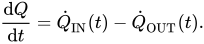
The continuity equation expresses the local conservation of electric charge in classical electromagnetism as a differential relation between the charge density ρ\rho and the current density J\mathbf{J}. It is stated mathematically as ρt+J=0,\frac{\partial \rho}{\partial t} + \nabla \cdot \mathbf{J} = 0, indicating that the time rate of change of charge density at any point in space equals the negative divergence of the current density. This equation embodies a local balance principle: any decrease in charge within a small must be accounted for by the net of current out of that , ensuring no charge is created or destroyed internally. It applies universally to any arbitrary in space, reflecting the fundamental postulate that charge is neither produced nor annihilated in isolated systems. An equivalent integral formulation connects this local law to the global constancy of total charge. For a fixed VV bounded by surface SS, the equation becomes dQdt+SJdA=0,\frac{dQ}{dt} + \oint_S \mathbf{J} \cdot d\mathbf{A} = 0, where Q=VρdVQ = \int_V \rho \, dV is the total charge enclosed, and the surface represents the net outward of current. This form demonstrates that the rate of change of enclosed charge equals the negative of the current flowing out through the boundary, directly linking local dynamics to overall charge invariance. The continuity equation assumes a classical, non-relativistic framework where charge and current are treated as three-dimensional densities without external sources or sinks, such as in vacuum or continuous media.

Derivation from Maxwell's Equations

The derivation of charge conservation from Maxwell's equations begins with the relevant differential forms in SI units. Gauss's law for electricity relates the divergence of the electric field E\mathbf{E} to the charge density ρ\rho: E=ρϵ0,\nabla \cdot \mathbf{E} = \frac{\rho}{\epsilon_0}, where ϵ0\epsilon_0 is the vacuum permittivity. Ampère's law, including Maxwell's displacement current correction, connects the curl of the magnetic field B\mathbf{B} to the current density J\mathbf{J} and the time-varying electric field: ×B=μ0J+μ0ϵ0Et,\nabla \times \mathbf{B} = \mu_0 \mathbf{J} + \mu_0 \epsilon_0 \frac{\partial \mathbf{E}}{\partial t}, with μ0\mu_0 denoting the . To obtain the , apply the divergence operator to both sides of Ampère's law: (×B)=μ0J+μ0ϵ0t(E).\nabla \cdot (\nabla \times \mathbf{B}) = \mu_0 \nabla \cdot \mathbf{J} + \mu_0 \epsilon_0 \frac{\partial}{\partial t} (\nabla \cdot \mathbf{E}). The left-hand side vanishes due to the vector calculus identity (×B)=0\nabla \cdot (\nabla \times \mathbf{B}) = 0. Substituting into the time-derivative term yields t(E)=1ϵ0ρt,\frac{\partial}{\partial t} (\nabla \cdot \mathbf{E}) = \frac{1}{\epsilon_0} \frac{\partial \rho}{\partial t}, resulting in 0=μ0J+μ0ρt.0 = \mu_0 \nabla \cdot \mathbf{J} + \mu_0 \frac{\partial \rho}{\partial t}. Dividing through by μ0\mu_0 produces the continuity equation: ρt+J=0.\frac{\partial \rho}{\partial t} + \nabla \cdot \mathbf{J} = 0. This demonstrates that charge conservation emerges directly as a consistency condition of Maxwell's equations, without requiring an independent postulate. In the framework of , the generalizes to the Lorentz-invariant form involving the four-current Jμ=(cρ,J)J^\mu = (c \rho, \mathbf{J}), where cc is the , such that μJμ=0\partial_\mu J^\mu = 0. This ensures charge conservation holds across inertial frames.

Theoretical Connections

Relation to Gauge Invariance

In , the theory is invariant under gauge transformations of the electromagnetic potentials, where the transforms as AA+χ\mathbf{A} \to \mathbf{A} + \nabla \chi and the as ϕϕχt\phi \to \phi - \frac{\partial \chi}{\partial t}, with χ\chi an arbitrary scalar function; this leaves the electric and magnetic fields E=ϕAt\mathbf{E} = -\nabla \phi - \frac{\partial \mathbf{A}}{\partial t} and B=×A\mathbf{B} = \nabla \times \mathbf{A} unchanged. This redundancy in the description of the fields underscores the gauge freedom inherent to Maxwell's equations, which ensures that physical observables are independent of the choice of gauge. In (QED), charge conservation emerges from the local U(1) gauge symmetry, where the electromagnetic interactions remain invariant under local phase transformations of the fields, ψeiα(x)ψ\psi \to e^{i \alpha(x)} \psi, with α(x)\alpha(x) a spacetime-dependent phase. To maintain this invariance, the is introduced as Dμ=μieAμD_\mu = \partial_\mu - i e A_\mu, coupling the matter fields to the gauge field AμA_\mu, and the Lagrangian density for QED is constructed to be invariant under these local transformations. This local U(1) symmetry directly implies the existence of a conserved Noether current, jμ=ψˉγμψj^\mu = \bar{\psi} \gamma^\mu \psi, associated with the electric charge, satisfying μjμ=0\partial_\mu j^\mu = 0. The Ward identity formalizes charge conservation as a direct consequence of this gauge symmetry in the Lagrangian formulation of QED, relating the vertex function to the and ensuring that the of the electromagnetic current vanishes even in quantum . Specifically, for the three-point vertex, the identity Γμ(p,p)(pp)μ=S1(p)S1(p)\Gamma^\mu(p',p) (p' - p)_\mu = S^{-1}(p') - S^{-1}(p) holds, where S(p)S(p) is the , guaranteeing current conservation off-shell. This connection was fully realized in the within QED, building on classical gauge ideas introduced by in 1918, who first proposed local invariance as a unifying for and , though the modern U(1) interpretation solidified in the development of relativistic . Charge conservation emerges as a direct consequence of Noether's first theorem, which establishes that every continuous symmetry of the action principle in a physical system corresponds to a conserved current. Formulated in 1918, the theorem states that if the action is invariant under a continuous transformation group, then there exists a conserved quantity associated with that symmetry, derived from the equations of motion. In the context of electromagnetism, this applies to the global U(1) phase symmetry of charged fields, where the invariance of the Lagrangian under phase rotations leads to the conservation of the electric charge current. For a complex scalar field ψ\psi describing charged particles, the Lagrangian density L=(μψ)(μψ)V(ψ2)\mathcal{L} = (\partial^\mu \psi^*)(\partial_\mu \psi) - V(|\psi|^2) is invariant under the global transformation δψ=iαψ\delta \psi = i \alpha \psi, where α\alpha is a constant infinitesimal phase parameter. Applying Noether's procedure yields the conserved Noether current jμ=i(ψμψψμψ)j^\mu = i (\psi^* \partial^\mu \psi - \psi \partial^\mu \psi^*), satisfying the μjμ=0\partial_\mu j^\mu = 0 on-shell, which encodes local charge conservation ρt+j=0\frac{\partial \rho}{\partial t} + \nabla \cdot \mathbf{j} = 0. This current couples to the in the full theory, ensuring the total charge remains constant. In relativistic field theories, such as (QED), generalizes charge conservation to the four-current jμj^\mu, whose vanishes covariantly, μjμ=0\partial_\mu j^\mu = 0, reflecting the underlying alongside internal ones. This framework highlights contrasts with approximate symmetries; for instance, conservation arises from an approximate global U(1)_B symmetry but is violated at high energies due to weak interactions breaking that symmetry exactly. Gauge invariance represents the local extension of this global U(1) symmetry, enforcing charge conservation through the structure of the covariant derivative. Emmy Noether's original contribution appeared in her 1918 paper addressing invariance problems in , where she proved two theorems linking variational symmetries to conservation laws, later extended by others to and gauge theories.

Experimental Evidence

Classical Verifications

In the 1830s, Michael Faraday's experiments on provided one of the first quantitative verifications of charge conservation through his two laws. establishes that the mass of a substance deposited or liberated at an during is directly proportional to the total passed through the , indicating that charge is fully transferred to drive the without net creation or destruction. The second law demonstrates that, for a fixed quantity of charge, the masses of different substances produced at the electrodes are proportional to their chemical equivalent weights, further confirming that charge-to-mass ratios remain consistent across reactions, consistent with conservation principles. Faraday's meticulous measurements, involving precise weighing of deposited metals like and silver, achieved remarkable precision for the era, sufficient to rule out measurable violations in macroscopic electrochemical systems. Building on these foundations, Robert Millikan's oil-drop experiment from 1909 to 1913 offered a precise atomic-scale confirmation by measuring the charge on individual electrons. By balancing the gravitational force on charged oil droplets with an electric field and observing their motion, Millikan determined that the charges were always integer multiples of a fundamental unit e ≈ 1.60 × 10^{-19} C, showing that charge is conserved in discrete quanta during ionization and electron transfer processes. This quantization directly supported the continuity equation's expectation that charge density changes only through current flow, with no unexplained creation or annihilation. The experiment's precision reached an uncertainty of about 0.2% by 1913, providing strong evidence against any fractional or variable charge units that would imply non-conservation. Early 20th-century investigations into , particularly Ernest Rutherford's studies on beta emissions around 1900–1910, also empirically upheld charge conservation in atomic transformations. Rutherford identified beta particles as high-speed electrons with the same charge-to-mass ratio as those from , observing that their emission from neutral atoms resulted in positively charged daughter ions whose total charge balanced the ejected electron's negative charge. In collaboration with , these experiments on decay chains of elements like and showed consistent charge balance across sequential emissions, with no net charge discrepancy in the products. Measurements of emission rates and ionization effects confirmed the charge balance with sufficient accuracy to match electrons from other sources, excluding significant creation or loss during the process.

Modern Confirmations

In high-energy particle colliders such as the (LHC) at , experiments in the 2010s have confirmed charge conservation through detailed studies of quark-gluon plasma (QGP) formed in heavy-ion collisions. Measurements of charge balance functions, which quantify correlations between oppositely charged particle pairs, show strict local conservation of , , and in Pb-Pb collisions at √s_NN = 2.76 TeV, with no observed deviations indicative of violations. These results align with expectations for QGP dynamics and provide precision tests at scales better than 10^{-21} e for fractional charge imbalances, as corroborated by limits on charge from related analyses. Ongoing LHC Run 3 data as of 2025 continue to show no deviations from charge conservation in heavy-ion collisions. Neutrino oscillation experiments, including those at since 1998, have provided stringent confirmations of charge conservation by observing without any evidence of charge-altering processes. In atmospheric and studies, oscillations between , , and neutrinos preserve total and , with no detected charge-nonconserving decays or transitions; neutrino charge limits stand at |q_ν|/e < 4 × 10^{-35}. These findings, spanning over two decades of data, rule out charge-changing mechanisms beyond the at sensitivities exceeding 10^{-30}. Cosmological observations further validate charge conservation on the largest scales, with the cosmic microwave background (CMB) and Big Bang nucleosynthesis (BBN) implying global charge neutrality preserved over the universe's 13.8 billion-year history. BBN predictions for light element abundances (e.g., ^4He and ^7Li) require a net baryon-to-photon ratio η ≈ 6 × 10^{-10} and zero net charge asymmetry to match observed primordial compositions, while CMB isotropy bounds any residual charge per baryon to q_{e-p} < 10^{-26} e under uniform distribution assumptions. These constraints demonstrate that the early universe's charged particle content equilibrated without net charge buildup, consistent with Standard Model symmetries. Apparent anomalies in early 20th-century beta decay models, where continuous electron spectra suggested violations of conservation laws, were resolved by Wolfgang Pauli's 1930 proposal of the —a neutral, low-mass particle emitted alongside the electron and antineutrino to balance , , and without altering charge. The neutrino's subsequent experimental confirmation in 1956 eliminated these discrepancies, affirming that no true charge breakdowns occur in weak interactions within the framework.

References

Add your contribution
Related Hubs
User Avatar
No comments yet.