Hubbry Logo
Northern Cheyenne ExodusNorthern Cheyenne ExodusMain
Open search
Northern Cheyenne Exodus
Community hub
Northern Cheyenne Exodus
logo
8 pages, 0 posts
0 subscribers
Be the first to start a discussion here.
Northern Cheyenne Exodus
from Wikipedia
Northern Cheyenne Exodus
Part of the American Indian Wars

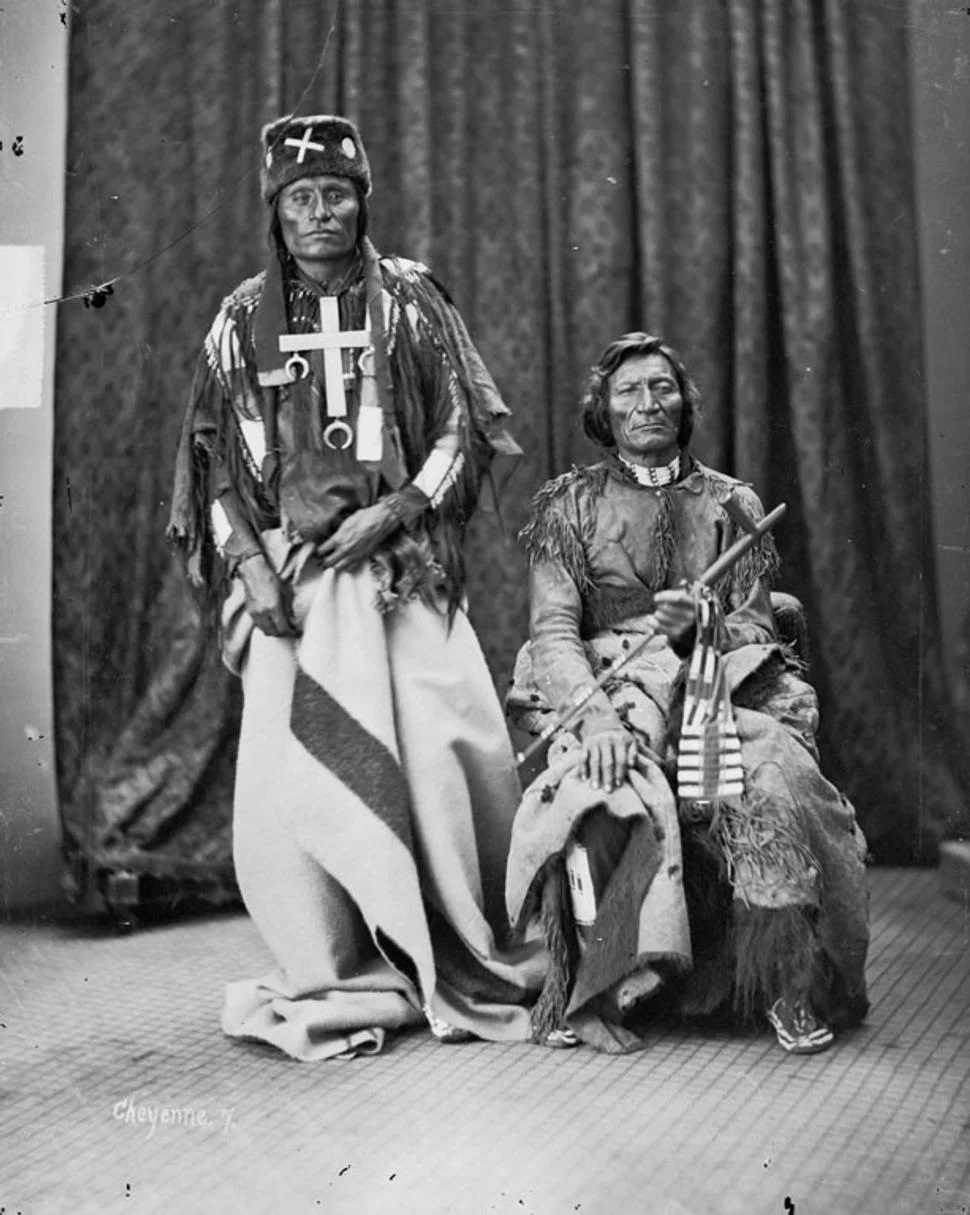
Little Wolf and Dull Knife, Chiefs of the Northern Cheyenne
DateSeptember, 1878 – April, 1879
Location
Result Northern Cheyenne Reservation created
Belligerents
Northern Cheyenne United States United States
Commanders and leaders
Dull Knife
Little Wolf Surrendered
Wild Hog
Left Hand 
Little Finger Nail 
United States William H. Lewis 
United States John B. Johnson
United States Henry W. Wessells
United States George F. Chase
United States William P. Clark
Strength
297 people ~1,000 soldiers and civilians
Casualties and losses
~50 killed, ~30 wounded, ~70 captured ~30 killed, ~20 wounded
  • Losses include civilian casualties.
    Northern Cheyenne population declined by 619[1][2] to 675[1][2] overall in the exodus due to poor reservation conditions.

The Northern Cheyenne Exodus, also known as Dull Knife's Raid,[3] the Cheyenne War,[4] or the Cheyenne Campaign,[5] was the attempt of the Northern Cheyenne to return to the northern Great Plains, after being placed on the Southern Cheyenne reservation in the Indian Territory, and the United States Army operations to stop them. In September 1878, about 300 Cheyenne men, women, and children headed north from their reservation, fighting and winning several skirmishes with the U.S. Army. In Nebraska, the Cheyenne split into two groups of about equal numbers. One group successfully reached Montana. The other group was captured and imprisoned in Fort Robinson, Nebraska. In January 1879 they escaped from their confinement and fled north. Most were captured or killed during the pursuit by the army, although a few escaped and remained on the northern plains. Seven Cheyenne warriors were tried and acquitted of killing white civilians during their flight. The Cheyenne who survived the flight were allowed to remain in the north[6][7]


Background

[edit]

Following the Battle of the Little Bighorn, attempts by the U.S. Army to subdue the Northern Cheyenne intensified. In 1877, after the previous November's Dull Knife Fight, Crazy Horse surrendered at Fort Robinson in northwestern Nebraska a few Cheyenne chiefs and their people surrendered as well. The chiefs that surrendered at the fort were Dull Knife, Little Wolf, Standing Elk, and Wild Hog with nearly one thousand Cheyenne. On the other hand, Two Moon surrendered at Fort Keogh with three hundred Cheyenne in 1877. The Cheyenne wanted and expected to live on the reservation with the Sioux in accordance with an April 29, 1868 treaty of Fort Laramie of which both Dull Knife and Little Wolf had signed.[2] However, shortly after arriving at Fort Robinson it was recommended that the Northern Cheyenne be moved to the Darlington Agency on the Southern Cheyenne and Arapaho Indian Reservation near Fort Reno in present-day Oklahoma.

Confinement in the South

[edit]

Following confirmation from Washington D.C., the Cheyenne started their move with 972 people; upon reaching the Cheyenne-Arapaho reservation on August 5, 1877 there were only 937.[1] Some elderly had perished along the way and some young men crept away and headed back north. After reaching the reservation, the Northern Cheyenne noticed how poverty-stricken it was, and began to fall sick in the late summer of 1877. When conditions did not improve after a federal investigation into reservation conditions, the Cheyenne were given authorization to hunt.[8]

When the Cheyenne attempted to hunt game they found none: by the winter of 1877–78 the territory was just a wasteland of dead buffalo remains, as the U.S. Army had sanctioned and actively endorsed the wholesale slaughter of bison herds.[9] Through the past decade the federal government had promoted bison hunting for various reasons, to allow ranchers to range their cattle without competition from other bovines, but primarily to weaken the North American Indian population by removing their main food source and to pressure them onto the Indian reservations during times of conflict;[10][11] Unfortunately in 1878 there was also a measles outbreak that struck the Northern Cheyenne, and in August 1878 the Cheyenne chiefs began preparations to move back north. On September 9, 1878 Little Wolf, Dull Knife, Wild Hog, and Left Hand told their people to organize to leave.[2] The runaways totalled 353 in all: 92 were men of fighting age, while the remaining 261 were women, children and elderly.[12]

Escape to the North

[edit]

In the early morning of September 10 the band fled up the North Canadian River. By 3 a.m. the alarm was sounded that the Cheyenne were gone. Passing the present sites of Watonga, Oklahoma and Canton, Oklahoma they crossed north over the watershed into the Cimarron Basin, crossing the Cimarron River the evening of September 10. There, near the present site of Freedom, Oklahoma they rested and then trailed 11 miles up Turkey Creek to a waterhole called Turkey Springs in hilly country near the border of Oklahoma and Kansas. After a few hours rest there, Dull Knife and a few others led the women and children on to St. Jacob's Well and The Big Basin in what is now Clark County, Kansas where they camped.[13]

Battle of Turkey Springs

[edit]

The remaining Cheyenne, anticipating pursuit, prepared an ambush at Turkey Springs.[14] While one band prepared rifle pits at the springs, other bands fanned out over the country looking for supplies. In one case, attacking and killing two cowboys nearby,[15] they obtained two mules. In another, attacking some cowboys during breakfast, they obtained both some food and a Sharps carbine.[16]

On 10 September, a veteran soldier, Captain Joseph Rendlebrock, with 85 officers and men and two Arapaho scouts had departed Fort Reno with the objective of catching and capturing the fleeing Cheyenne. Rendlebrock reported that he was on their trail and, being well-mounted, that he hoped to catch them near the Arkansas River in Kansas near Dodge City. Instead, he found them waiting for him at Turkey Springs.

On September 13, following the trail of the Cheyenne, Captain Rendlebrock saw warriors on a hilltop. He formed a skirmish line with his soldiers and sent an Arapaho scout named "Chalk" or "Ghost Man" to talk to Dull Knife and Little Wolf. Chalk conveyed the message that the Cheyenne must return to the reservation, but the Cheyenne leaders declined to return and warriors began moving around the flanks of the soldiers. The soldiers opened fire and the Cheyenne responded in kind, although the firing was sparse as the Cheyenne preserved their limited ammunition. Desultory fighting continued all day with two soldiers killed and three wounded. After dark, desperate for water, seven soldiers attempted and failed to gain access to the water in the springs.[17]

By the next morning the Cheyenne had completely surrounded the soldiers and Rendlebrock ordered a retreat through ravines with Cheyenne firing down at the soldiers. Another soldier was killed during the retreat. Rendlebrock retreated about 15 km (9.3 miles) to the Cimarron River. The Cheyenne suffered five wounded. The next day they divided themselves into several different groups to confuse pursuers attempting to track them and continued their trek northward. Rendelbrock was later court-martialed for the disorderly retreat.[17][18]

Battle of Punished Woman's Fork

[edit]
Battle of Punished Woman's Fork
Part of Northern Cheyenne Exodus
DateSeptember 27, 1878 (1878-09-27)
Location
Result Northern Cheyenne escape
Belligerents
Northern Cheyenne United States
Commanders and leaders
Dull Knife Little Wolf Ltc William H. Lewis  
Dry grassland with a small rocky canyon; pyramidal stone monument on hill nearby
Battle Canyon, site of the Battle of Punished Woman's Fork.

After crossing the Arkansas River the Cheyenne were followed closely by a mixed command of 238 soldiers of the 19th Infantry and 4th Cavalry under Lieutenant Colonel William H. Lewis of the 19th Infantry. On September 27, the Cheyenne prepared an ambush in a canyon on Punished Woman's Fork (nowadays called Ladder Creek), north of present-day Scott City, Kansas), but it was aborted due to an over-eager brave who fired on the scouts before the ambush was sprung.[citation needed]

In the ensuing battle, Lewis deployed a company of infantry to block the entrance to the canyon and attacked late in the afternoon along the rim of the canyon with four troops of dismounted cavalry, advancing by bounds, pinning the Cheyenne including their families in the closed end below. However, Lewis was unaware of the Cheyenne's marksmanship and was shot in the leg, severing his femoral artery. This left a vacuum in Cavalry Regiment's leadership which the Cheyenne were able to exploit, escaping after dark. Lewis bled to death the next day and several other soldiers were wounded. However, the Cheyenne lost 60 horses, much baggage, and all of their food when part of the pony herd was discovered by the troopers.[19]

Depredations in northwestern Kansas

[edit]

A party of drovers encountered Cheyenne camped on Prairie Dog Creek in northwestern Kansas on September 29 and lost 80 cattle. Between September 30 and October 3, in present-day Decatur County and Rawlins County near Oberlin, Kansas, then a tiny hamlet, small parties of Cheyenne foraging for horses, cattle and supplies fell on isolated settlers who had recently homesteaded along Sappa and Beaver Creeks. Some of the settlers, recent immigrants from eastern Europe, had never seen an Indian before.

Men and boys were killed; women and older girls were raped.[citation needed] Often the settlers were approached in a friendly manner, then shot point blank.[citation needed] About 41 white men and boys were killed and, according to a Kansas senate report, 25 white women and girls raped, although the latter number seems inflated given existing evidence.[citation needed]

Some observers link the autumn 1878 actions of the Cheyenne as being a response to an earlier Battle at Sappa Creek (also known as the Massacre at Cheyenne Hole), an action in the spring of 1875 in the same area when a small village of Cheyenne was surprised and destroyed by Army troops.[20] Other observers stress that this link has no basis in Cheyenne accounts and trace the depredation back to the fact that elderly or injured Cheyennes who could no longer keep up with the pace of the exodus and remained behind had been mercilessly shot or clubbed to death by white posses[citation needed] and the fleeing Cheyennes had lost most of their ponies and all of their food in the Battle of Punished Woman's Fork, which created a crisis among the tribespeople.[21]

On to Nebraska

[edit]

From Turkey Creek on it was a running battle across Kansas and Nebraska, and soldiers from all surrounding forts (Fort Wallace, Fort Hays, Fort Dodge, Fort Riley, and Fort Kearney) were in pursuit of the Cheyenne. About ten thousand soldiers and three thousand settlers chased the Cheyenne both day and night.[22] During the last two weeks of September the army had caught up to the Cheyenne five times but the Cheyenne were able to evade the army by keeping to arduous grounds where it was challenging for the army to follow.

Stump Horn and family (Northern Cheyenne); showing home and horsedrawn travois

Division

[edit]

In the fall of 1878 after six weeks of running the Cheyenne chiefs held council and it was discovered that 34 of the original 297 were missing, most had been killed but a few had decided to take other paths to the north. This is where the Cheyenne split into two groups. The ones that wished to stop running were going along with Dull Knife to Red Cloud Agency, Wild Hog and Left Hand also decided to follow Dull Knife. Little Wolf continued north intending to go to the Powder River country.

Dull Knife's band

[edit]

On October 23, 1878, Dull Knife's band of Cheyenne, only two days from Fort Robinson, were surrounded by the Army. After hearing that Lakota chiefs Red Cloud and Spotted Tail had been relocated to Pine Ridge in Dakota Territory, Dull Knife decided, due to weather and his people's condition, to go to Fort Robinson. That night the Cheyenne took apart their best guns with the women hiding the barrels under their clothing, and attaching the smaller pieces to clothes and moccasins as ornaments.

On October 25, 1878, Dull Knife, Left Hand, Wild Hog and the rest of the Cheyenne finally reached Fort Robinson. The barracks that had been built to house 75 soldiers now held 150 Cheyenne.

In December, Red Cloud was brought to Fort Robinson for a council with Dull Knife and the other chiefs. Dull Knife agreed to fight no more if the great father in Washington would let his people live on Pine Ridge that now held Red Cloud and his tribe. However, on January 3, 1879, the Cheyenne were ordered to return south to the Southern Cheyenne reservation. When the Cheyenne refused, bars were put on the windows and all rations were stopped, including wood for heat.

Fort breakout and aftermath

[edit]

On January 9, 1879, Dull Knife still refused to return south. However, Wild Hog and Left Hand agreed to talk but said their people would not go. As a result, Wild Hog was held as a prisoner and shackled. At 9:45 that night the Cheyenne tried to make a daring escape using the dismantled guns they had hidden upon arriving at the fort. The Cheyenne were immediately followed and many were killed in the Fort Robinson breakout.

After the final battle at "The Pit". Painting by Frederic Remington, 1897

By morning 65 Cheyenne, 23 of them wounded, were returned to Fort Robinson as prisoners. Only 38 Cheyenne had fully escaped, 32 of whom were together moving north pursued by the Army. Six Cheyenne were hiding only a few miles from the fort among rocks and were found during the next few days. The other 32 Cheyenne led by Little Finger Nail were discovered in a small hollow above Antelope Creek, a tributary of Hat Creek some 35 miles northwest of Fort Robinson,[23] and after a final battle only nine were left alive.[24] The dead were buried in a mass grave called "The Pit."[23]

In 1994 the Northern Cheyenne reclaimed the remains of all those killed and buried in Nebraska. They were reinterred on the Northern Cheyenne Indian Reservation, on a hill overlooking Busby, Montana.

The seven Cheyenne sent back to Kansas in 1879 for murder, before all charges were dismissed. From left to right: Tangle Hair, Wild Hog, Strong Left Hand, George Reynolds (interpreter), Old Crow, Noisy Walker, Porcupine, and Blacksmith.

In January 1879, Dull Knife reached Pine Ridge where Red Cloud was being held as a prisoner. After months of delay from Washington the prisoners from Fort Robinson were released and allowed to go to Fort Keogh where Little Wolf had ended up. However, seven of the escapees had to stand trial for the murders that had been committed in Kansas. The seven were Old Crow, Wild Hog, Strong Left Hand, Porcupine, Tangle Hair, Noisy Walker, and Blacksmith. Charges were dismissed against them after a civilian court trial in 1879 in Kansas.

Little Wolf's band

[edit]

After the council near the North Platte where the Northern Cheyenne split up, Little Wolf's band continued north to the Sand Hills of Nebraska where they wintered along Wild Chokecherry Creek where there was plentiful deer, antelope and cattle. They saw a few white men during the winter but were undisturbed. In early spring they moved north to the Powder River. There they were located by scouts attached to troops from Fort Keogh commanded by Lieutenant W. P. Clark, an army officer known as White Hat to the Cheyenne and who had been friendly with Little Wolf in the past. After negotiation with first the scouts, then later Lieutenant Clark, the band agreed to surrender and go with the troopers to Fort Keogh. There they were offered service in the army as scouts. After some discussion even Little Wolf agreed to become a scout, as did Red Armed Panther.[25]

Northern Cheyenne Reservation

[edit]

In 1884, the Northern Cheyenne Indian Reservation was established in southeastern Montana Territory, and the Northern Cheyenne were never forced to return to the south.

See also

[edit]

References

[edit]
Revisions and contributorsEdit on WikipediaRead on Wikipedia
from Grokipedia
The Northern Cheyenne Exodus was the flight of approximately 350 Northern Cheyenne—92 warriors, 120 women, and 141 children—from forced confinement on a Southern Cheyenne reservation in (modern ) beginning on September 7, 1878, as they sought to return over 1,500 miles to their traditional northern homeland spanning present-day southeastern and northeastern . Led by the chiefs and Dull Knife (also known as Morning Star), the group had been relocated southward two years earlier following military defeats, including the , into an environment ill-suited to their needs, where inadequate rations, tropical diseases, and crop failures caused widespread suffering and deaths. During the arduous trek northward through and , the subsisted on hunted game and raided settlements for food and horses, clashing with U.S. Army units and civilians in skirmishes that killed dozens on both sides, driven by survival imperatives rather than unprovoked aggression. After covering roughly 600 miles, the band splintered near the ; Little Wolf's contingent evaded capture and reached safety in Montana's Tongue River Valley by late January 1879, where they surrendered peacefully and were granted a separate reservation by 1884 after negotiations acknowledging their distinct northern identity and resilience. In contrast, Dull Knife's followers were intercepted south of , and confined at in October 1878, enduring further hardships including withheld food and water; on January 9, 1879, they broke out in a desperate nighttime dash, prompting U.S. troops to pursue and kill over 60 Cheyenne, including women and children, in the ensuing "Fort Robinson Massacre," with survivors scattering into the hills and some eventually reuniting with Little Wolf's band. This episode underscored the causal failures of U.S. assimilation policies that disregarded tribal ecological adaptations and treaty promises of northern lands, forcing relocations that precipitated resistance; empirical records from military reports and Cheyenne oral histories reveal as a calculated bid for self-preservation amid systemic neglect, ultimately pressuring federal authorities to rectify the division between Northern and Southern Cheyenne by establishing the Northern Cheyenne Reservation.

Historical Background

Cheyenne Society and Warfare Traditions

The Northern , a band of the Algonquian-speaking people, developed a nomadic society centered on buffalo hunting after acquiring in the mid-18th century, which enabled rapid mobility for pursuing herds, transporting goods via , and conducting raids. This shift from semi-sedentary farming to equestrian Plains culture emphasized self-sufficiency through seasonal migrations and intertribal alliances, such as with the , to secure hunting grounds and resources amid competition from other tribes. Survival depended on exploiting the vast grasslands, where buffalo provided food, hides for tipis and , and bones for tools, fostering a adapted to constant movement rather than permanent settlements. Warfare formed a core tradition among the , organized through fraternal societies that coordinated raids for s, captives, and revenge, serving both economic necessity and social prestige in a resource-scarce environment. Small parties of , rather than large armies, executed leveraging horse speed for surprise attacks on enemies like , Pawnee, and , capturing livestock to bolster herd sizes essential for transport and combat. These conflicts, prevalent in the , were driven by the imperative to defend or expand for buffalo access, with empirical patterns showing raids as routine survival strategies rather than isolated aggressions, as evidenced by historical accounts of annual campaigns yielding hundreds of horses per successful expedition. Leadership rested with a of Forty-Four chiefs who mediated disputes and appointed temporary war chiefs for expeditions, exemplified by figures like and Dull Knife, whose authority derived from proven prowess in battle and adherence to tribal consensus. War chiefs directed raids with tactical acumen, emphasizing deception, feints, and rapid retreats to minimize losses, reflecting a pragmatic adaptation to nomadic vulnerabilities where defeat could imperil the band's mobility and food supply. This decentralized structure preserved autonomy, allowing bands like the Northern to respond flexibly to threats, prioritizing collective endurance over hierarchical command. Sacred objects, including the Medicine Arrows (Mahuts) and associated bundles, held central ritual significance, believed by oral traditions to have been bestowed upon the prophet Sweet Medicine as divine mandates for warfare, renewal ceremonies, and tribal cohesion. These arrows, renewed every four years in ceremonies invoking success in hunts and battles, symbolized causal links between spiritual observance and material survival, motivating resistance against displacement by reinforcing cultural imperatives tied to ancestral lands. Archaeological traces of arrowheads and bundle artifacts corroborate the antiquity of these practices within Cheyenne material culture, underscoring their role in sustaining martial resolve amid existential pressures.

Treaties, Conflicts, and the Great Sioux War

The Treaty of Fort Laramie, signed on September 17, 1851, between the and multiple Plains tribes including the , delineated tribal territories north of the , granted the U.S. rights to build roads, forts, and military posts along emigrant trails like the , and promised annual annuities of $50,000 for ten years in exchange for safe passage of settlers and cessation of intertribal hostilities. These provisions aimed to facilitate westward migration but quickly eroded as emigrant numbers surged beyond treaty stipulations, leading to resource competition over grazing lands and water, while U.S. failure to restrain settler encroachments prompted Cheyenne horse-raiding parties to target livestock as reprisals and to replenish their own herds essential for nomadic warfare and sustenance. Escalating raids and retaliatory military expeditions, such as those following the 1864 against Southern Cheyenne but spilling into Northern bands, culminated in the 1868 Treaty of Fort Laramie, which recognized unceded Indian territory including the as reserved for the Nation and Northern Cheyenne-Northern Arapaho alliance, with the U.S. pledging non-interference, annual goods distributions, and agency support for a permanent homeland north of the Platte. Violations mounted after gold discoveries in the in 1874 and Lieutenant Colonel George Custer's 1874 expedition, which confirmed mineral wealth and triggered unregulated miner influxes, directly contravening treaty guarantees and igniting unified resistance as tribes viewed the incursions as existential threats to sacred lands and buffalo-dependent economies. Northern Cheyenne leaders, including Dull Knife and Little Wolf, allied with Lakota bands in the Great Sioux War of 1876–1877 to defend treaty territories against U.S. campaigns led by Generals Crook, Terry, and Custer aimed at forcing agency confinement. Cheyenne warriors, numbering several hundred from an estimated 1,200 total population, played a pivotal role in the June 25, 1876, Battle of the Little Bighorn, where they flanked and overwhelmed Custer's 7th Cavalry detachment in a combined force of Lakota, Cheyenne, and Arapaho, inflicting over 260 U.S. casualties in a tactical victory that temporarily disrupted federal operations but failed to halt broader offensives due to superior U.S. logistics and reinforcements. U.S. pressure intensified with winter campaigns; on November 25, 1876, Colonel Ranald Mackenzie's 1,100-man force, including and scouts, assaulted Dull Knife's village of about 200 lodges on the Red Fork of the Powder River, destroying it after fierce resistance, killing at least 40 including women and children, capturing survivors, and seizing 1,000 horses, which crippled Northern Cheyenne cohesion and prompted fragmented retreats into harsh conditions. By spring 1877, depleted bands totaling around 900 Northern Cheyenne surrendered at sites like Fort Keogh and Agency, yielding arms under assurances of rations and northern retention per 1868 terms, but U.S. authorities instead disarmed them fully and initiated forced relocation southward to consolidate with Southern Cheyenne at Darlington Agency in , a 1,500-mile journey by rail, wagon, and foot marred by inadequate supplies, exposure, and initial disease outbreaks that claimed lives before arrival.

Surrender and Forced Relocation to Indian Territory

Following the conclusion of the Great Sioux War, bands of Northern Cheyenne led by chiefs and Dull Knife surrendered to U.S. military authorities in and during April and May 1877, totaling approximately 972 individuals. Despite initial placements at agencies like Red Cloud Agency and , U.S. officials decided to relocate them southward to consolidate with the Southern and at the Darlington Agency near Fort Reno in (present-day ). The transport commenced in late spring and continued through summer 1877, with the groups escorted by military units via rail and overland routes, arriving by August. Verbal assurances were given during surrender negotiations that the Cheyenne could return north if the southern environment proved unsuitable, reflecting recognition of potential hardships but prioritizing federal consolidation objectives. The U.S. government's rationale centered on a long-standing policy of tribal concentration to vacate northern Great Plains lands for white settlement, ranching, and railroad expansion, accelerated by the near-extirpation of bison herds that had confined nomadic groups to agencies. This approach ignored the ecological mismatch between the arid, subtropical conditions of Indian Territory—lacking the vast grasslands and buffalo essential to Cheyenne subsistence and culture—and the cooler, expansive northern prairies, a decision driven by administrative efficiency over empirical assessment of tribal adaptability. Officials at the Interior Department and military commands proceeded despite protests from Cheyenne leaders emphasizing their northern ties and warnings from field agents about the risks of forced relocation to unfamiliar terrain devoid of traditional resources. Upon arrival at Darlington Agency, the Northern Cheyenne faced immediate environmental and logistical challenges, including sweltering heat, mosquito-infested river valleys conducive to outbreaks, and insufficient rations that exacerbated risks during the unsettled transition. Exposure to these conditions, compounded by inadequate shelter and medical provisions, led to rapid mortality; agency records document deaths from , , and related causes, reducing the from 972 to approximately 800 by late 1877. These outcomes underscored the policy's causal oversights, as the relocation prioritized territorial consolidation without accounting for the Cheyenne's dependence on northern ecosystems for and .

Conditions in Southern Confinement

Environmental and Health Challenges

The Northern Cheyenne, relocated to the Darlington Agency in (present-day ) in August 1877, encountered a subtropical climate ill-suited to their traditional lifeways on the cooler, semi-arid northern of and , where average summer temperatures rarely exceeded 80°F (27°C) and large game like sustained nomadic economies. In contrast, Indian Territory's summer highs often surpassed 100°F (38°C) with high , exacerbating and stress, while recurrent droughts limited sources and , rendering the region inhospitable for both and introduced ; herds, central to Cheyenne sustenance, had been decimated southward, forcing dependence on rations that proved chronically insufficient in quantity and nutritional value. Efforts to impose sedentary farming failed due to unsuitable soils, erratic rainfall, and the tribe's cultural resistance to abandoning mobile hunting traditions, as Northern Cheyenne leaders viewed plow-based agriculture as incompatible with their warrior-hunter identity and prior ethnographic patterns of seasonal migration rather than permanent settlement. This mismatch contributed to widespread malnutrition, with rations—intended as supplements but often delayed or spoiled—failing to offset caloric deficits, weakening immune responses amid overcrowding with Southern Cheyenne bands on shared, undersupplied lands lacking adequate sanitation infrastructure. Health crises ensued, including a endemic to the mosquito-prevalent river valleys of but novel to the northerners, compounded by poor water quality and confinement; U.S. Indian Office records and contemporary accounts document hundreds falling ill upon arrival, with at least 43 deaths in the first two months alone from and exposure. Overall mortality halved the initial contingent of approximately 937 to fewer than 400 by September 1878, as policy-driven relocation disregarded limits on tribal physiological and cultural adaptability, prioritizing containment over ecological congruence and amplifying vulnerability through enforced without viable alternatives.

Agency Administration and Resource Shortages

The Darlington Agency, under Indian Agent John D. Miles, struggled with bureaucratic inefficiencies in provisioning the Northern Cheyenne after their forced relocation to in August 1877, as the influx of approximately 1,000 additional individuals overburdened existing supplies intended for the Southern Cheyenne and . Miles' reports emphasized expectations of rapid assimilation into farming, yet he issued small rations of poor quality—often inadequate in quantity and —which drew criticism for failing to address the Northerners' nutritional needs amid their cultural resistance to sedentary agriculture. These shortfalls stemmed partly from federal underfunding and logistical delays, but Miles compounded them by withholding distributions as punishment for noncompliance, such as refusing to farm or enroll children in schools, thereby enforcing assimilation policies through resource denial rather than equitable aid. Resource mismanagement extended to operations, where graft and irregularities—common in under-resourced agencies—resulted in substitutions like corn for promised meat allotments, further eroding trust and nutritional outcomes. Desperation peaked as bands resorted to slaughtering their own horses for sustenance, a stark indicator of systemic failures in obligations for adequate beef and grain provisions, while Southern relatives exacerbated tensions through thefts of and goods from the maladapted Northerners. The Northern Cheyenne's warrior traditions, emphasizing and mobility, clashed irreconcilably with the agency's enforced passivity, fostering resentment toward Miles' administration, which prioritized cost-saving restructuring over culturally sensitive support. By summer 1878, these administrative shortcomings fueled secret tribal councils among the Northern leaders, including and Dull Knife, where they debated non-compliance and eventual departure despite Dull Knife's repeated pleas to Miles for improved rations or relocation north—pleas dismissed in favor of maintaining the status quo. Miles' correspondences to superiors documented Cheyenne allegations of shortages but attributed them to indiscipline rather than agency shortfalls, revealing a bureaucratic toward blaming indigenous resistance over internal inefficiencies or graft. This dynamic underscored causal links between under-resourced federal oversight and the erosion of Cheyenne agency autonomy, setting the stage for collective defiance without overlapping into post-departure events.

Cheyenne Resistance and Escape Planning

The Northern Cheyenne endured severe hardships in Indian Territory, prompting leaders Dull Knife and to organize resistance against confinement at Agency. By summer 1878, with numerous deaths from disease and malnutrition, internal discussions intensified among the approximately 1,000 Northern Cheyenne, focusing on rejecting assimilation and returning north to their homelands. Dull Knife, a former Dog Soldier known for bold action, emphasized immediate desperation driven by cultural incompatibility and loss of traditional lifeways, while , a Sweet Medicine Chief renowned for tactical acumen, advocated strategic timing to maximize survival chances through careful preparation. Despite these differing emphases, the of the Forty-Four, including both chiefs, unified the group, resolving to escape collectively rather than remain under agency control shared uneasily with Southern Cheyenne relatives. Preparations commenced in late August and early September 1878, involving the secretive stockpiling of essentials to enable a swift breakout. Young warriors stole horses from the agency over preceding weeks, securing mounts for the non-combatants among the roughly 353 participants—92 adult men, 120 women, 69 boys, and 72 girls. The group armed itself with a mix of captured Springfield carbines from prior battles like Little Bighorn, Henry and rifles, shotguns, pistols, and traditional bows, supplemented by ammunition obtained through agency interactions. To maintain secrecy, they requested extra rations under pretense of compliance while packing light provisions, intentionally leaving tipis standing with fires burning to deceive guards and suggest continued presence. Tactical planning drew on Cheyenne warrior traditions, prioritizing mobility, scouting, and terrain knowledge to evade detection. Little Wolf's influence emphasized light travel loads, scout networks for , and avoidance of major trails to outpace potential pursuit by U.S. from Fort Reno. On the moonlit night of September 9, 1878, the unified band slipped away undetected, covering approximately 65 miles northward in the first leg by leveraging stolen horses and disciplined movement. This preparation enabled empirical advantages in speed and stealth, reflecting the chiefs' combined desperation and caution in forging a cohesive plan rooted in historical raiding and evasion expertise.

The Great Escape Northward

Departure from Darlington Agency

On the moonlit night of September 9, 1878, approximately 353 Northern Cheyenne, including 92 men, 120 women, and 141 children under the leadership of chiefs and Dull Knife, quietly departed the Darlington Agency in (present-day ). To evade detection, they left their lodges intact and campfires burning as decoys, packed essential belongings on stolen horses and , and slipped northward over nearby hills while agency guards and soldiers slept. This initial breakout relied on surprise and minimal disruption, with no guards reported killed during the departure itself, allowing the group to cover substantial distance before dawn without alerting pursuers. The Cheyenne prioritized rapid movement and group cohesion, organizing families and warriors into a disciplined column that minimized stops for or rest to maximize speed across the open terrain. Heading north, they crossed the Canadian River shortly after departure, avoiding settled areas and using terrain for cover to maintain evasion. Warriors positioned themselves to protect the vulnerable—women, children, and elderly—while the column traveled light, relying on carried provisions and opportunistic grazing for horses rather than halting for hunts that could reveal their position. U.S. Army response was hampered by underestimation of the Cheyenne resolve and logistical delays; troops from nearby Fort Reno mounted pursuit only the morning of September 10, by which time the fugitives had gained a multi-day lead through their nocturnal start and swift pace. Telegraphic alerts to forts across and followed, but the initial gap—exacerbated by the agency's limited garrison—enabled the Cheyenne to advance unhindered for several days before first contacts. This evasion reflected traditional Cheyenne tactics of mobility and deception, honed from prior Plains warfare, adapted to preserve the band's unity amid the flight.

Early Clashes: Battle of Turkey Springs

On September 13, 1878, elements of the Northern Cheyenne band under chiefs and Dull Knife, having fled the Darlington Agency nine days earlier, established defensive positions at Turkey Springs in present-day Woods County, , anticipating pursuit by U.S. forces from Fort Reno. The Cheyenne warriors, numbering around 92 and drawing on combat experience from earlier conflicts like the Great Sioux War, prepared rifle pits near the springs while posting sentinels to guard their horse herd and noncombatants. Captain Joseph Rendlebrock, commanding Companies G and H of the 4th Cavalry along with two scouts, led approximately 86 soldiers in tracking the Cheyenne northward across the Cimarron River, engaging them upon sighting the group. The ensuing clash, spanning September 13 and 14, saw the U.S. troops advance into the , prompting disciplined from concealed positions that exploited the terrain for cover and effective marksmanship. Desultory skirmishing continued through the first day, with U.S. forces unable to dislodge the defenders despite attempts to access the vital water source; after dark, a small party of soldiers failed in a bid to reach the springs, sustaining further losses. tactics emphasized rapid, accurate rifle fire honed from prior warfare, repelling the assault with minimal disruption to their formation. Casualties included three U.S. soldiers and one scout killed, alongside three soldiers wounded; losses comprised five wounded, among them a young girl. Following the repulse, the Cheyenne disengaged strategically, securing additional army horses to bolster their remounts and supplies amid the ongoing pursuit, before resuming their northward evasion. This engagement marked a tactical success for the Cheyenne, delaying U.S. forces and allowing the band to bypass nearby forts while covering substantial distance—approximately in subsequent weeks—despite continued shadowing by detachments. The battle, the last armed conflict between U.S. troops and Native Americans in what became , underscored the Cheyenne's resolve and proficiency in guerrilla-style defense during their exodus.

Raids and Skirmishes in Kansas

In October 1878, as the Northern Cheyenne bands under and Dull Knife traversed northern en route northward, small parties were dispatched to procure essential supplies from isolated settler farms and ranches, targeting food, , and to sustain the group's mobility and amid harsh conditions and pursuit by U.S. forces. These foraging raids, conducted over areas such as the tributaries of the , involved thefts of livestock and provisions, with settler accounts reporting the killing of over 40 civilians, including instances of and destruction of property, though Cheyenne oral traditions later framed some encounters as defensive responses to armed resistance or ambushes by locals. On , near Creek in Rawlins County, one such party crossed into settlements, killing at least 13 settlers and slaughtering cattle for food before withdrawing, demonstrating the enabled by the Cheyenne's superior horsemanship and knowledge of the terrain. Skirmishes with local and ad hoc settler posses occurred sporadically during these operations, particularly in western near military outposts like Fort Wallace, where warriors leveraged their mobility to evade or outflank pursuers, avoiding decisive engagements that could deplete their limited numbers. U.S. Army reports from the period noted the difficulty in responding effectively, as the 's decentralized raiding parties dispersed quickly after strikes, frustrating organized counter-efforts by troops from forts such as Wallace and . These actions, while yielding critical resources that prevented immediate starvation or capitulation, intensified frontier alarm, prompting Governor John P. St. John to mobilize state and appeal for federal reinforcements, thereby escalating the overall military mobilization against . The raids' success in sustaining the bands without full surrender underscored the 's adaptive warfare traditions but also hardened U.S. resolve, contributing to the pattern of intensified pursuits into .

Major Engagements and Territorial Advances

Battle of Punished Woman's Fork

![Dry grassland with a small rocky canyon; pyramidal stone monument on hill nearby](./assets/Battle_Canyon_ScottCoKSScott_Co_KS On September 27, 1878, a detachment of approximately 200 to 240 U.S. Army soldiers under Lieutenant Colonel William H. Lewis, commanding from Fort Dodge, engaged a Northern Cheyenne encampment at Punished Woman's Fork (also known as Ladder Creek) in Battle Canyon near present-day Scott City, Kansas. The Cheyenne, numbering around 92 warriors with accompanying women, children, and elderly from the exodus group led by Little Wolf, had taken position in the canyon's natural defenses, including bluffs, a cave, and hastily dug rifle pits. The Cheyenne had anticipated pursuit and prepared an , but a premature shot by a young warrior alerted the approaching troops, initiating the clash in the afternoon. Lewis's command advanced from the southwest into the confined terrain, where the steep canyon walls and limited cover exposed the soldiers to defensive fire from elevated positions. The Cheyenne warriors effectively used the landscape to repel the assault, pinning down the attackers and preventing a decisive despite the numerical disadvantage in combatants. During the fighting, Lewis sustained a fatal , prompting his troops to withdraw without fully dislodging the defenders; the subsequently destroyed the Cheyenne's abandoned pony herd and provisions to hinder their northward flight. U.S. casualties included one officer killed and several soldiers wounded, while Cheyenne losses comprised several warriors wounded with no confirmed combat deaths among fighters, though the crossfire and subsequent chaos may have contributed to non-combatant hardships. The terrain's defensive advantages, combined with the 's operational constraints following prior engagements like the Little Bighorn, underscored the Cheyenne's ability to hold the field temporarily, marking this as the last significant battle between Native Americans and U.S. forces in .

Incursions into Settlements and Civilian Impacts

During their passage through western in late and early 1878, Northern groups dispatched raiding parties targeting isolated farmsteads and operations to secure provisions, ammunition, , and draft animals essential for sustaining their flight. These forays, driven by acute shortages following months of and disease in —where over half the band's original population had perished—yielded hundreds of livestock head but inflicted direct harm on non-military targets. State militia records and local tallies documented roughly 40 settler fatalities across and , the majority involving unarmed farmers, women, and children killed in home invasions or while fleeing; Decatur County, , reported 18 such deaths in a single cluster of attacks on September 29–30. Property depredations encompassed the slaughter or rustling of herds, horse thefts numbering in the dozens per raid, and arson or vandalism causing losses estimated in the tens of thousands of dollars, as adjudicated in subsequent territorial claims. While Cheyenne accounts frame these as survival imperatives—replacing travois ponies lost to exhaustion and foraging for staples absent since departure from Darlington Agency—the tactics echoed pre-reservation horse-raiding customs, amplified by the band's 1,500-mile trek under pursuit. In response, and governors authorized civilian volunteer companies, armed with state-issued rifles, to patrol frontiers and report sightings, while federal telegrams urged rapid reimbursement for verified stock claims to quell reprisals; this mobilization, coupled with inflated bounty postings for Cheyenne scalps in some counties, deepened cycles of retaliation amid sparse telegraph lines and delayed troop reinforcements. Settler diaries from the period note reciprocal Cheyenne losses to ambushes, including at least two warriors slain in a engagement near the Solomon River, underscoring the raids' role in mutual escalation rather than isolated aggression.

Crossing into Nebraska and Band Division

In late October 1878, following their crossing of the near Ogallala into , the Northern Cheyenne exodus party, numbering around 250 after prior losses from skirmishes and privation, reached a critical juncture amid the western edge of the Nebraska Sandhills. Exhaustion from over 1,500 miles of flight since September, compounded by dwindling game and reliance on sporadic raids for sustenance, prompted leaders and Dull Knife (Morning Star) to divide the group near Oglala Lakota lands. Approximately 150 Cheyenne, primarily warriors and families committed to evasion, adhered to Little Wolf's strategy of stealthy northward advance toward Montana's , avoiding direct confrontation. In contrast, about 100, led by Dull Knife and including many elders, women, and children weakened by hunger, veered toward the for potential aid from Lakota allies and U.S. authorities, reflecting divergent assessments of survival odds. Scouts' reports of U.S. Army reinforcements massing along their route, alongside the encroaching winter's first frosts and snows, accelerated the split to preserve remaining strength. Logistical strains were acute: provisions were nearly exhausted after failed hunts in arid terrain, forcing consumption of horses and hides, while exposure to sub-freezing nights initiated deaths from among the vulnerable, trimming numbers further before the division. This bifurcation underscored causal pressures of , , and pursuit, prioritizing immediate divergence over unified resistance.

Divergent Fates of the Leaders' Bands

Little Wolf's Band: Evasion and Homeland Return

After the bands separated near the in late October 1878, Little Wolf's group of approximately 150 Northern turned northward into Nebraska's Sand Hills, where they encamped for the winter to avoid detection by U.S. forces. Employing disciplined tactics, including frequent night marches and vigilant warrior scouting, the band minimized encounters with military patrols while for sustenance in the harsh conditions. These measures, combined with strategic route choices through remote terrain, enabled them to traverse over 500 miles with limited violence, sustaining autonomy amid pursuit. As spring approached in early 1879, Little Wolf's followers resumed their trek, following established trails northwest past the toward Montana's , occasionally securing provisions through informal exchanges in Lakota-inhabited regions without formal alliances that might draw attention. By late March, weakened by winter hardships but intact, the band reached the Powder River area, then pressed on to the valley near present-day Miles City. On April 1, 1879, Little Wolf led the remnants—33 warriors, 43 women, and 38 children, totaling 114 survivors— to surrender at Fort Keogh, where U.S. Army officers noted their emaciated state but relative cohesion. This evasion exemplified Cheyenne adaptive resilience, as the band's survival without capitulation en route preserved cultural continuity and pressured authorities toward negotiations, contrasting the fates of other escapees. Little Wolf's emphasis on order—prohibiting unnecessary raids and prioritizing group welfare—credited for the low attrition, with losses mainly from exposure rather than combat. ![Cheyenne using travois to illustrate travel methods during evasion][float-right]

Dull Knife's Band: Capture at Fort Robinson

Following the division of the Cheyenne exodus party in the Nebraska Sandhills during late 1878, Dull Knife (also known as Morning Star) led a smaller, more fatigued group of approximately 149 Northern —comprising men, women, and children—northward toward the Red Cloud Agency in hopes of joining Lakota allies there. Unaware that the agency had relocated to Pine Ridge, the band, suffering from hunger and exhaustion after covering over 600 miles from , encountered a U.S. Army patrol from amid a blinding snowstorm south of present-day . On October 23, 1878, after two days of tense negotiations in which the soldiers informed the Cheyenne of the agency's closure and offered no alternative but surrender, Dull Knife's group yielded without resistance at Chadron Creek to avoid further encirclement by troops. The , under orders to prevent the Cheyenne from linking with northern tribes, then marched the 149 captives approximately 28 miles to , a recently designated U.S. Army outpost established in 1874 near Crawford, , with the group arriving on October 24. Upon arrival, the Cheyenne were confined to the fort's log cavalry barracks but initially received regular provisions and limited daytime freedom, requiring only evening roll calls; several women found employment at the post. Dull Knife repeatedly petitioned authorities during councils to allow his band to remain in their northern homeland or join Lakota agencies rather than return to the disease-ridden Agency in , but U.S. officials, prioritizing containment, denied these requests while sustaining the group for about two months.

Breakout, Pursuit, and Massacres

On the night of January 9, 1879, approximately 149 Northern Cheyenne prisoners under Chief Dull Knife, confined in barracks at , , forced open the doors after killing several guards, initiating a desperate escape attempt amid subzero temperatures. U.S. Army sentries immediately opened fire, killing at least 26 Cheyenne—primarily warriors—in the initial volleys as the group fled toward nearby bluffs. Captain Henry J. Wessels, commanding the post's 3rd Cavalry and 9th Infantry troops, ordered a relentless pursuit, treating the escapees as hostiles per departmental directives emphasizing recapture over , which precluded and escalated the conflict's lethality in the harsh winter conditions. Over the ensuing 10 days, Wessels deployed patrols totaling around 200 soldiers to track the scattered bands across northwest Nebraska's snow-covered terrain, engaging in multiple skirmishes that inflicted further casualties through gunfire, with survivors additionally succumbing to exposure, starvation, and wounds. Historical analysis by Jerome A. Greene, drawing on army records and eyewitness accounts, documents 64 deaths in total from the breakout and pursuits— including 25 women and children—alongside 78 recaptures, leaving only about 38 at large, many of whom perished en route to safety. oral traditions and army reports corroborate the disproportionate toll on non-combatants, attributing amplified losses to the policy of total recapture without provisions for surrender, which ignored the prisoners' weakened state after months of confinement and forced marches. U.S. forces suffered 11 soldiers and 1 civilian killed during the clashes. The fugitives fragmented into small groups, with Dull Knife and a few dozen evading capture by heading toward the Pine Ridge Agency, though relentless scouting and blockades prevented organized resistance; by late January, most remaining free Cheyenne froze or starved in remote canyons, underscoring the causal role of winter logistics and uncompromising orders in foreclosing survival options beyond combat or flight. Empirical review of post-event army investigations, including General George Crook's board of inquiry, reveals no strategic allowance for humanitarian interception, prioritizing military containment that effectively annihilated Dull Knife's band as a fighting or migratory force. Only 32 Cheyenne ultimately reached relative sanctuary among Lakota allies at Pine Ridge, marking the episode's conclusion with near-total demographic devastation for the group.

Resolution and Reservation Establishment

Negotiations with U.S. Authorities

Following the arrival of Little Wolf's band in the Tongue River country of Montana Territory in early 1879, negotiations commenced with U.S. military authorities at Fort Keogh. On March 25, 1879, Little Wolf formally surrendered to Colonel Nelson A. Miles, the post commander, after interpreter William Rowland and scout Frank Grouard persuaded him that peaceful terms could secure a northern homeland. Miles, impressed by the band's endurance during the 1,500-mile exodus and their refusal to remain in the disease-ridden Southern Cheyenne Agency in Indian Territory, permitted them temporary provisions and hunting rights while advocating for a permanent northern placement. Miles's support extended to enlisting Northern Cheyenne warriors, including members of Little Wolf's band, as scouts, which bolstered their strategic position in policy discussions by demonstrating loyalty and utility to federal interests. He argued that the tribe held inherent claims to the Tongue River Valley, independent of formal treaties, and pressed for a separate agency to accommodate their distinct cultural and geographic ties to the northern Plains, separate from Southern Cheyenne oversight. This advocacy aligned with broader military recognition of the exodus's toll, including the band's resistance to relocation, influencing Interior Department deliberations amid reports of their scouts' effectiveness against other tribes. By 1884, sustained petitions from Miles and agency officials culminated in President Chester A. Arthur's of November 26, 1884, which reserved approximately 444,000 acres west of the Tongue River in southeastern exclusively for the Northern Cheyenne's occupation and use. The designation proceeded despite protests from Montana settlers and ranchers favoring open , as federal authorities weighed the costs of prior pursuits and relocations against establishing stable boundaries. In return, the tribe accepted confinement to fixed lands, forgoing autonomous raiding and nomadic pursuits in favor of annuity-based subsistence under supervision, marking a shift from mobile warrior traditions to sedentary reservation governance.

Creation of the Northern Cheyenne Reservation

The Northern Cheyenne Reservation was formally established by on November 26, 1884, under President , encompassing 765 square miles (approximately 489,600 acres) of land in southeastern centered on the River drainage. This tract, surveyed and delineated from former tribal territory, marked the culmination of post-exodus negotiations, providing a permanent homeland separate from the Southern Cheyenne's allotment in (present-day ). Although smaller than the expansive northern plains ranges historically utilized by the , the reservation's boundaries—roughly from the in the south to the River headwaters in the north, and eastward to the Powder River divide—offered viable grazing lands amid the ecosystem, with initial assessments noting adequate water sources from perennial streams despite aridity. By the mid-1880s, the Northern Cheyenne population on the reservation hovered around 1,000 to 1,200 individuals, survivors of the exodus hardships and agency relocations, with the Tongue River Agency headquarters sited at Lame Deer for administrative oversight. Economic adaptation involved mixed pursuits of subsistence farming, limited irrigated agriculture along river bottoms, and communal ranching of cattle introduced via government rations, though soil surveys indicated marginal fertility for crops without supplemental inputs. Autonomy from Southern Cheyenne oversight preserved distinct northern cultural practices, such as sacred arrow ceremonies tied to the locale, but persistent resource frictions arose with adjacent non-Indian settlers and Crow allotments over grazing overlaps and timber access. The reservation's early viability benefited from ecological rebounds, including scattered returns of herds in the 1880s-1890s as overhunting pressures eased on surrounding public domains, supplementing ration-dependent diets and enabling traditional hunting resumption on reservation fringes. These factors, despite initial provisioning shortfalls, facilitated a tenuous transition to semi-sedentary life, with the land's (3,000-5,000 feet) and supporting hardy forage grasses for integration.

Casualties, Demographic Losses, and Long-term Consequences

The Northern Cheyenne suffered heavy demographic losses during the relocation to Indian Territory in 1877 and the subsequent exodus of 1878–1879, with deaths primarily from disease, malnutrition, exposure, and combat totaling an estimated 200–300 individuals across these phases, exacerbating an overall tribal decline of approximately 600–700 from 1877 to 1879 when including pre-exodus mortality in the south. In Indian Territory, nearly 50 Northern Cheyenne died from illness and starvation at the Darlington Agency shortly after arrival, amid unsuitable climatic conditions and inadequate rations that fueled outbreaks of malaria and other diseases. During the exodus itself, skirmishes such as the Battle of Turkey Springs resulted in at least 5 Cheyenne wounded, while the Battle of Punished Woman's Fork claimed 1 warrior; additional losses from exposure and attrition accounted for around 34 missing from the initial group of 297–353 escapees. The Fort Robinson breakout in January 1879 proved catastrophic for Dull Knife's band, with 35 killed in the initial escape, 25 in a subsequent buffalo wallow engagement, and 3 more shortly after, totaling about 63 deaths—nearly half of the band's 149 members. U.S. and casualties were comparatively lighter, numbering around 50, including over 40 male killed in raids along tributaries like the Republican, Sappa, and Beaver Creeks in late September–early October 1878, alongside 3 soldiers at Turkey Springs, 1 officer mortally wounded at Punished Woman's Fork, and 2 guards during the Fort Robinson events. These figures, drawn from Army reports and contemporary accounts, underscore the asymmetric nature of the conflict, where Cheyenne warriors inflicted targeted strikes on isolated settlements but faced overwhelming pursuit by over 1,000 troops. Demographic recovery was slow; survivors from Little Wolf's band (approximately 123) and remnants of Dull Knife's group (around 50–60) formed the nucleus for the Northern Cheyenne Reservation established in 1884, with early populations hovering below 500 by the 1890s per agency enumerations, reflecting a sharp contraction from the pre-relocation estimate of nearly 1,000. This reduction compounded intergenerational vulnerabilities, shifting the tribe from nomadic bison hunting to forced sedentism on marginal lands, where allotment policies under the fragmented holdings and hindered communal economic structures. Culturally, the exodus reinforced a resilient ethos evident in the persistence of traditional military societies for and justice into the present, yet it exposed the unsustainability of prolonged resistance against industrialized U.S. . Long-term economic consequences included chronic and reliance on subsistence farming or wage labor, as the reservation's resource-poor environment precluded full restoration of pre-contact mobility, though it preserved core cultural practices amid policy-induced sedentarization.

Controversies and Historical Assessments

Debates on Violence and Mutual Atrocities

Historians debate the characterization of violence during the Northern Cheyenne Exodus, particularly the Cheyenne raids that resulted in approximately 40 deaths across and between September and October 1878, as either tactical imperatives for acquiring horses, food, and amid and pursuit or as unjustified attacks on civilians amounting to crimes. Cheyenne warriors, often young men acting independently, targeted isolated farms and stage stations, killing families including women and children to disrupt pursuit and seize resources essential for the bands' survival over 1,500 miles from to . Settler eyewitness accounts, preserved in contemporary newspapers and military reports, portray these as unprovoked terror raids that instilled widespread fear, with specific incidents like the murder of 11 members of the Watkins family near Fort Wallace on September 28, 1878, cited as evidence of deliberate cruelty rather than necessity. In contrast, U.S. Army actions, especially the suppression of Dull Knife's band at , , on January 9, 1879, divide opinion between justified measures to halt further raids after the Cheyennes refused repatriation to and excessive force against disarmed prisoners that constituted a preventable . Soldiers under Captain Henry Wessells fired on approximately 150 confined —many weakened by hunger and cold—killing 64, including 32 women and children, as the group broke out by force from after terms of surrender were violated by demands for return south. Primary Army dispatches justified the response as defensive against an armed breakout that killed three soldiers and two civilians, emphasizing the Cheyennes' prior raids as context for preemptive suppression, while Cheyenne oral histories, collected from survivors like Left Hand, frame it as betrayal of a truce, with troops targeting fleeing non-combatants in a ravine, underscoring mutual escalation but disproportionate state power. Scholarly analyses, such as in James N. Leiker and Ramon Powers' examination of primary documents including testimonies and affidavits, highlight reciprocal targeting of non-combatants— attacks on farmsteads mirroring Army pursuits that killed women and children in both bluffs and engagements—yet distinguish individual Cheyenne reprisals driven by desperation from institutionalized U.S. operations, without evidence meeting empirical criteria for given the targeted scale (under 100 Cheyenne deaths by violence versus broader reservation mortality from ). traditions preserved in tribal records emphasize the raids and breakout as defensive survival amid broken treaties and forced relocation, viewing losses as collateral in a war of necessity, whereas Euro-American narratives in period sources stress the raids' terror as initiating atrocities, often overlooking prior Cheyenne grievances like the 1877 Southern reservation conditions of documented in reports. These perspectives persist in modern , with empirical counts from muster rolls and burial records confirming no systematic extermination policy but rather reactive violence on both sides, complicated by biases in sources: accounts amplified in media for sympathy, memories filtered through cultural emphasis on endurance over quantification.

Criticisms of U.S. Policy versus Cheyenne Warfare Practices

U.S. relocation policies for the Northern exemplified shortsightedness in disregarding ecological and physiological mismatches between their northern Plains adaptation—suited to arid grasslands and buffalo hunting—and the humid, forested environment at Darlington Agency, where arrival in August 1877 exposed roughly 927 individuals to , , and nutritional deficiencies from poor soil and delayed supplies, resulting in an estimated 200-300 deaths by mid-1878. Bureaucratic inertia compounded these failures; despite a November 1876 surrender stipulation and a 1877 agreement permitting return north if conditions proved untenable, Indian Office delays in processing requests—amid conflicting agency reports and Washington indecision—denied timely relocation, directly precipitating the mass departure of approximately 353 survivors on September 9, 1878. Cheyenne cultural practices, centered on a ethos that valorized raiding for horses, scalps, and coup strikes as rites of passage and economic sustenance, inherently clashed with U.S. treaty frameworks confining tribes to fixed reservations; post-1867 Treaty of Medicine Lodge, continued incursions—such as 1867 disruptions of Union Pacific rail construction and sporadic settler attacks—escalated federal military enforcement, culminating in the Northern Cheyenne's alliance with Lakota forces at the June 25-26, 1876, , where about 150-200 s under leaders like inflicted key defeats on U.S. troops, including Custer's immediate command, thereby intensifying subjugation campaigns. Resistance to assimilation further entrenched this intransigence, as traditions prioritizing mobile hunting societies over imposed agriculture rendered sedentary reservation mandates unviable, perpetuating cycles of noncompliance and reprisal independent of U.S. administrative lapses. Causal analysis reveals mutual causation rather than unilateral blame: policy errors like unheeded environmental unsuitability and protracted approvals inflicted avoidable attrition, yet Cheyenne adherence to raiding paradigms—effective for intertribal dominance but provocative against expanding settler frontiers—foreclosed diplomatic off-ramps, as evidenced by pre-exodus thefts and skirmishes that justified Army pursuits; the odyssey's partial success in securing a 1884 Montana reservation for survivors validated tactical resistance but affirmed that warrior realism could not restore pre-1876 autonomy, given irreversible demographic pressures from prior conflicts and buffalo extirpation. This interplay underscores how U.S. institutional rigidities intersected with entrenched Cheyenne martial norms to render negotiated coexistence improbable without fundamental concessions neither side extended.

Modern Scholarship and Cultural Memory

Modern scholarship on the Northern Cheyenne Exodus has increasingly incorporated interdisciplinary methods to reassess the event's dynamics, emphasizing mutual violence rather than portraying it as solely a victimhood narrative. In their 2011 monograph, James N. Leiker and Ramon Powers examine primary documents alongside archaeological findings from sites like Sappa Creek and Hat Creek Stage Station to corroborate eyewitness accounts of clashes, highlighting bilateral aggression where Cheyenne warriors conducted raids on settlers while U.S. troops and militias responded with disproportionate force. Their analysis challenges earlier romanticized depictions by grounding interpretations in verifiable evidence, such as bone fragments and projectile analysis indicating sustained combat rather than fleeting skirmishes. Cheyenne cultural memory preserves the exodus through oral traditions and , framing the journey as a heroic that affirmed tribal resilience against displacement. Survivors' narratives, transmitted intergenerationally, emphasize spiritual guidance and successful evasion under leaders like , often eliding internal divisions or logistical failures. drawings by Fort Robinson participants, such as Wild Hog and Porcupine Quills, created in Dodge City jail around 1879–1880, depict battle scenes, migrations, and symbolic triumphs, serving as visual ethnographies that encode cultural continuity amid incarceration. These artifacts, analyzed in Denise Low's 2020 study, reveal connotative storytelling rooted in pre-reservation , though they selectively omit U.S. administrative incompetence—such as inadequate provisioning at Darlington Agency—that exacerbated the band's desperation more than deliberate malice. Post-2010 scholarship shows no substantial paradigmatic shifts, with works like Leiker and Powers remaining foundational for their empirical rigor over ideological reframing. Analyses underscore the causal constraints of nomadic bison hunting against encroaching railroads and fenced farmlands by the late 1870s, rendering sustained resistance untenable without adaptation to sedentary economies. Academic sources, while often institutionally inclined toward emphasizing U.S. policy flaws, are tempered here by material evidence limiting claims of genocidal intent to bureaucratic neglect rather than systematic extermination. This focus on verifiable limits avoids unverifiable activist extrapolations, prioritizing data on demographic attrition—over 100 Cheyenne deaths from the original 353—and ecological disruptions from overhunting.

References

Add your contribution
Related Hubs
User Avatar
No comments yet.