Hubbry Logo
ChilesaurusChilesaurusMain
Open search
Chilesaurus
Community hub
Chilesaurus
logo
8 pages, 0 posts
0 subscribers
Be the first to start a discussion here.
Chilesaurus
Chilesaurus
from Wikipedia

Chilesaurus
Temporal range: Late Jurassic (Tithonian)
~147 Ma
Cast of the holotype skeleton
Scientific classification Edit this classification
Kingdom: Animalia
Phylum: Chordata
Class: Reptilia
Clade: Dinosauria
Clade: Saurischia
Clade: Theropoda (?)
Genus: Chilesaurus
Novas et al. 2015
Species:
C. diegosuarezi
Binomial name
Chilesaurus diegosuarezi
Novas et al. 2015

Chilesaurus is an extinct genus of herbivorous dinosaur. While its exact classification is uncertain, many researchers believe it is a theropod, with a minority of academics suggesting that it may be an ornithischian. The type and only known species so far is Chilesaurus diegosuarezi.[1] Chilesaurus lived between 148-147 million years ago (Mya) in the Late Jurassic period of Chile.[2] Showing a combination of traits from theropods, ornithischians, and sauropodomorphs, this genus has far-reaching implications for the evolution of dinosaurs, such as whether the traditional saurischian-ornithischian split is superior or inferior to the proposed group Ornithoscelida.[3] This however, has been contested by several other authors, who believe that the weight of evidence supports its membership within Theropoda, and possibly as a member of Tetanurae.[4][5]

Discovery and naming

[edit]
Reconstructed skeleton of Chilesaurus
Illustration of the lower jaw

Chilesaurus was first discovered on 4 February 2004 by a seven-year-old named Diego Suárez. He and his parents, the geologists Manuel Suárez and Rita de la Cruz, were searching for decorative stones in the Aysén Region, and uncovered a vertebra and rib from what would later be named Chilesaurus. More specimens were found that were assigned to various dinosaur species in 2008 but were later recognized as belonging to additional individuals of Chilesaurus.[6] One reason this realization took time was that Chilesaurus has such a bizarre combination of traits, coupled with the fact that the remains were discovered alongside a few bones from an unrelated diplodocid sauropod.[7]

In 2015, the type species C. diegosuarezi was named and described by Fernando Emilio Novas, Leonardo Salgado, Manuel Suárez, Federico Lisandro Agnolín, Martín Dario Ezcurra, Nicolás Chimento, Rita de la Cruz, Marcelo Pablo Isasi, Alexander Omar Vargas, and David Rubilar-Rogers. The generic name is derived from Chile (the country where it was discovered) and the latinized Greek suffix "saurus", meaning "lizard". The specific name honors Diego Suárez.[1]

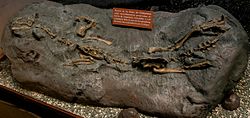
The holotype, SNGM-1935, was found in a layer of the Toqui Formation dating from the late Tithonian. It consists of an articulated, rather complete skeleton with skull of a juvenile individual, lacking the feet and most of the tail. Four other partial skeletons (specimens SNGM-1937, SNGM-1936, SNGM-1938, and SNGM-1888) and several single bones (specimens SNGM-1889, SNGM-1895, SNGM-1901, SNGM-1894, SNGM-1898, SNGM-1900, and SNGM-1903) are the paratypes. They represent juvenile and adult individuals.[1]

Description

[edit]
Life restoration of Chilesaurus, size based on holotype individual

The holotype of Chilesaurus is relatively complete. It includes a partially complete skull and mandible, a complete series of neck and back vertebrae, most of the ribcage, a complete arm and leg, most of the hips, shoulders, and a few of the front-most tail vertebrae. However, the lack of a complete tail makes a full estimation of its size imprecise. The holotype itself, which represents a skeletally immature individual, is estimated to have been about 1.6 m (5.2 ft) long in life. There are several paratypes representing at least four individuals at varying stages of ontogenetic maturity. The largest of these, believed to be an adult, was used to infer that the full length of an adult Chilesaurus would have been about 3.2 m (10.5 ft).[1]

Chilesaurus can be distinguished from all other dinosaurs by a combination of unique features. It has a very short premaxillary bone, a uniquely quadrilaterally-shaped coracoid bone with thickened outer edges, a hand with only two clawed fingers (the third finger being highly reduced) with very shortened phalanges, and several features of the hip and ankle bones that are distinct from all other theropods. However, one of the most distinctive unusual features of Chilesaurus is its spatula-shaped, elongated teeth, which protrude forwards out of their sockets. Such dentition would be unique among theropods, and is typical for a herbivore, indicating Chilesaurus was a plant-eater. If Chilesaurus was a theropod, it would be only one of a handful of non-coelurosaurian theropods to evolve herbivory, alongside Limusaurus, Berthasaura, and possibly others.[1] Another apparent adaptation for herbivory is the backward-pointing pubic bone in the pelvis, which has been interpreted as an adaptation for developing the more complex digestive apparatus necessary to digest plants. Such a pelvic arrangement is typical for ornithischians, which has led some authors to suggest that Chilesaurus may be a member of that group.[8]

Life restoration of Chilesaurus with speculative feathers

The hind limb of Chilesaurus is less adapted for running than many other groups of dinosaurs. This is inferred from the presence of a small cnemial crest on the front top of the shinbone, and a broad foot with a weight-bearing first toe. These adaptations would have made running for long periods of time much less efficient, and they are generally not present in animals which are known to have been proficcient runners. However, it is possible that Chilesaurus could defend itself using relatively strong arms which bore a large claw on the first finger.[1]

Classification

[edit]

In its original description, Chilesaurus was found to be a very basally-branching member of the theropod clade Tetanurae. An abbreviated version of the cladogram produced by the authors of that paper is shown below.[1]

Reconstructed right manus
Theropoda

In 2017, Baron and Barrett proposed that Chilesaurus may instead be a basal ornithischian. The publication in which this was proposed also resurrected the previously-discredited "Ornithoscelida hypothesis", which suggested that theropods shared a more recent common ancestor with ornithischians than with sauropodomorphs.[8][9] Less than a year later in 2018, Müller and colleagues published a reply to Baron & Barrett (2017), arguing that their phylogenetic dataset actually suggested that Chilesaurus was a basal sauropodomorph rather than an ornithischian.[10] Baron and Barrett reached out to the other team of authors to inform them that they had accidentally published a faulty early version of their dataset with many traits scored incorrectly, and that their original results were based on an edited final dataset. They corrected their original publication and supplied the final dataset to Müller and colleagues, who agreed that it supported the placement of Chilesaurus in Ornithischia as had been originally argued by Baron and Barrett in 2017.[10][3] However, Müller and colleagues also noted that Baron and Barrett did not test the original proposal of Chilesaurus as a theropod, and that its classification remained uncertain.[10] Below is a cladogram illustrating the classification proposed by Baron & Barrett (2017), which places Chilesaurus as the most basal ornithischian.[8]

In a latter re-revision of his own datasets, Baron concluded that Chilesaurus remains enigmatic and could be either a theropod or an ornithischian, while noting that its affinities as a theropod were more generally supported by other authors.[11] In his major work on theropod classification in 2024, Andrea Cau recovered Chilesaurus as a sister taxon of Tetanurae.[4] Fonseca and colleagues conducted a similar work on the classification of ornithischians, which also recovered Chilesaurus as a theropod.[5]

A full osteological description of Chilesaurus was published as part of the PhD thesis of Nicolás Roberto Chimento Ortiz in 2018. In it, he noted the likely theropod affinities of the taxon, highlighting elements such as the structure of the metatarsals, characteristics of the tibia, and the opisthopubic pelvis.[12]

References

[edit]
[edit]
Revisions and contributorsEdit on WikipediaRead on Wikipedia
from Grokipedia
Chilesaurus diegosuarezi is an extinct of small, herbivorous that lived during the , approximately 150 million years ago, in southern . Known from multiple well-preserved skeletons representing various growth stages, it measured about 3 meters in length and exhibited a bipedal posture with a long neck, small head, short forelimbs, and leaf-shaped teeth adapted for plant-eating. This unusual combination of features, including theropod-like hindlimbs alongside ornithischian-like cranial and dental traits, marks Chilesaurus as a key in understanding early evolution, though its precise classification remains debated. The fossils were discovered in 2004 in the Toqui Formation near in the of , with the first remains found by a seven-year-old boy named Diego Suárez, after whom the species is partly named. The genus name honors , reflecting its endemic occurrence in this isolated southern South American locality during the . The specimens include nearly complete skeletons, providing rare insights into ontogenetic changes and allowing for detailed anatomical reconstruction. Initially described as a basal tetanuran theropod, Chilesaurus challenged the traditional view that herbivory evolved independently in multiple lineages, suggesting an earlier origin within theropods. Subsequent phylogenetic analyses, however, repositioned it as the earliest diverging member of , potentially serving as a "missing link" that bridges theropod and ornithischian through features like retroverted pubis preceding certain craniodental adaptations. More recent evaluations highlight the instability of its position, with varying placements across datasets due to conflicting character support, underscoring the unresolved of early interrelationships.

Discovery and naming

Discovery

The first fossils of Chilesaurus diegosuarezi were discovered on February 4, 2004, by seven-year-old amateur collector Diego while hiking with his geologist parents near Cerro Negro in the of southern . Suárez spotted exposed bones eroding from marine sediments of the Upper Toqui Formation, close to Lago General Carrera (approximately 46°S latitude). This initial find consisted of a and rib, which prompted professional involvement due to their unusual morphology. Following the discovery, paleontologist Fernando E. Novas of the in led excavation efforts in collaboration with Chilean and Argentine teams, including geologist (Diego's father). Fieldwork commenced shortly after 2004 and continued through 2010, yielding over a dozen specimens from the same locality. The , cataloged as SNGM-1935 and housed at the Servicio Nacional de Geología y Minería in Santiago, Chile, represents a nearly complete, articulated juvenile approximately 1.6 meters in length, including the , partial forelimbs, and well-preserved hind limbs. Preparation of the fossils was handled by technicians Claudia Alsina, Marta Milani, Rolf Stoll, and Martín Aranciaga-Rolando, supported by grants from Argentine and Chilean funding agencies. Paratypes include four additional postcranial skeletons (SNGM-1936, SNGM-1937, SNGM-1938, and SNGM-1888), ranging from 1.2 to 3.2 meters in length and encompassing juvenile to adult ontogenetic stages, all collected from the same Toqui Formation outcrops. These specimens exhibit exquisite three-dimensional preservation, with no signs of post-mortem scavenging, transport, or disarticulation, suggesting the individuals died and were buried within the fine-grained marine deposits. The site's productivity allowed for the recovery of multiple growth stages, providing insights into the ' development without evidence of taphonomic distortion.

Etymology

The genus name Chilesaurus derives from "," the country where the fossils were found, combined with the suffix saurus (σᾶυρος), meaning "lizard" or "." The species diegosuarezi honors Diego Suárez, a seven-year-old boy who discovered the first specimen in 2004 while hiking with his family near . Chilesaurus diegosuarezi was formally described and named in 2015 by Fernando E. Novas and colleagues in the journal , establishing it as a new and of enigmatic from the Upper Toqui Formation in Aysén, southern .

Description

Overall size and build

Chilesaurus diegosuarezi represents a small to medium-sized , with known specimens exhibiting a range of body sizes from approximately 1.2 meters to 3.2 meters in total length. The specimen (SNGM-1935), a skeletally immature individual, measures about 1.6 meters long from snout to tail tip. Larger paratypes, including the most complete adult-sized individual (SNGM-1888), indicate that mature animals attained up to 3.2 meters in length, highlighting significant growth potential within the species. The overall build of Chilesaurus was distinctly bipedal, characterized by stout limb bones that suggest a robust, stable posture adapted for rather than high-speed running. It possessed a slender neck composed of long, low , a deep and broad , and proportionally short forelimbs that reached about 56% of the length, with a wide indicating strength despite their reduced size. The s were longer and more powerful, supporting the bipedal stance, while the foot was wide and short, featuring a robust metatarsal I exceeding 50% the length of metatarsal II, consistent with a three-toed pes and the reduction of the fifth toe typical of derived dinosaurs. This combination reflects a of primitive features, such as sauropodomorph-like limb robustness, and derived traits, including strong arms relative to the body and a compact overall form. Evidence of ontogenetic variation comes from at least four individuals at different growth stages, spanning from juvenile to adult sizes. The and smaller paratypes display unfused neurocentral sutures indicative of immaturity, with overall smaller dimensions and potentially more gracile proportions in early compared to the fused, more robust skeletons of adults. These growth series demonstrate proportional scaling, where juveniles had relatively longer limbs in proportion to body size, transitioning to a stockier build in maturity, though specific metric changes beyond length are limited by preservation.

Skull and dentition

The skull of Chilesaurus diegosuarezi is proportionally small relative to the body, exhibiting a short, broad, and triangular shape with a robust and the edentulous anteriorly and possibly forming a beak-like . A small is present anterior to the , consistent with basal theropod cranial architecture. The dentition is highly distinctive, featuring up to approximately 30 low-crowned, leaf-shaped teeth per maxillary tooth row, with a constriction between the crown and root throughout the dentition. These teeth are spatula-shaped and bear marginal denticles, showing strong resemblances to ornithischian leaf-like dentition, including anteroventral inclination in lateral positions and procumbency in premaxillary and anterior dentary teeth. Heterodonty is evident, with more incisor-like anterior teeth differing from the posterior ones in orientation and form.

Postcranial skeleton

The postcranial of Chilesaurus diegosuarezi exhibits a of features that combine theropod-like and herbivorous traits, particularly in the axial and appendicular elements. The vertebral column includes that are long and low, contributing to a slender , with paired septate pleurocoels present in both cervical and anterior dorsal vertebrae but absent in more posterior dorsals. 'Pectoral' vertebrae bear prominent hypapophyses, suggesting robust ventral support for thoracic structures. Neural spines are low across the presacral series, consistent with a compact axial profile adapted for quadrupedal tendencies in some postures. The forelimbs are relatively stout and short, with the characterized by a transversely wide shaft and short overall length relative to the body size. The and are robust, enabling a grasping manus composed of metacarpals I–III; digits I and II are well-developed and functional, bearing large, curved claws suitable for manipulation or defense, while digit III is notably atrophied with short phalanges. This configuration results in a three-fingered hand emphasizing strength over dexterity, differing from the more elongate forelimbs of typical early theropods. The is longer than the combined and , indicating limited reach but powerful leverage. Hindlimb elements reflect a bipedal but robust build, with the displaying a pronounced anteroposterior expansion of the , a semicircular fourth for muscle attachment, and absence of a mediodistal crest, enhancing stability during locomotion. The features a rounded cnemial crest and an anteroposteriorly compressed distal end, while the is slender, lacking a proximomedial pocket or iliofibular , and subequal in length to the . The pes is tridactyl with a wide, short ; metatarsal I is robust and exceeds 50% of metatarsal II's length, digit I is large and nearly as long as digit II, and digit V is reduced or absent, supporting a to foot posture for . The pelvic girdle underscores the dinosaur's unique adaptations, with a dolichoiliac (elongate) ilium featuring a posterodorsal prominence, robust ischiadic peduncle, and lack of a supracetabular crest, contributing to a broad pelvic basin for viscera accommodation. The pubis is fully retroverted (opisthopubic), forming a rod-like shaft that remains unexpanded distally, a condition shared with ornithischians and indicative of herbivorous gut expansion. Ischia are fused proximodistally via a medial lamina (ischial ), reinforcing the posterior . include elongate dorsal elements with uncinate processes in anterior positions, and are present, forming a ventral thoracic basket that evidences strong musculature for respiration and posture maintenance in a potentially quadrupedal stance.

Classification

Initial description

Chilesaurus diegosuarezi was formally described in 2015 by Fernando E. Novas and colleagues in a paper published in Nature, based on multiple well-preserved skeletons from the Upper Jurassic Toqui Formation in southern Chile. The authors classified it as a basal tetanuran theropod within the newly erected family Chilesauridae, highlighting its position as an early-diverging member of Tetanurae characterized by a unique mosaic of primitive and derived features. This interpretation emphasized its herbivorous adaptations, which were unexpected for a non-coelurosaurian theropod, challenging prior understandings of theropod dietary evolution. Key diagnostic traits of Chilesaurus include a short and deep with a prominent postnarial process, leaf-shaped teeth with fine apical denticulations suggestive of herbivory, a sub-quadrangular , an atrophied manual digit III, a retroverted pubis with a narrow , and a robust ischiadic peduncle. The exhibits theropod-like proportions, with an elongate and narrow frontal, a deep dentary, and features such as pleurocoels in the vertebrae indicating pneumaticity typical of theropods. The , however, resembles that of ornithischians, featuring tall, procumbent, leaf-shaped crowns adapted for plant processing, while the shows sauropodomorph-like traits in its dolichoiliac ilium and stout overall build, combined with ornithischian resemblances in the retroverted pubis and bulbous ischiadic peduncle. In comparisons, Chilesaurus was distinguished from coelophysoids—early theropods with slender, builds—by its robust limb bones, retroverted pubis, and specialized herbivorous , which contrast with the carnivorous, blade-like teeth of those taxa. It differs from ornithischians, despite shared pelvic and dental features, by retaining theropod synapomorphies such as a semilunate distal carpal and reduced manual digit III, and notably by lacking an process on the . These autapomorphic combinations justified its placement in a monotypic , underscoring its enigmatic morphology as a basal tetanuran with convergent herbivorous traits.

Phylogenetic position

Following its initial description as a basal tetanuran theropod in , subsequent phylogenetic analyses have debated the position of Chilesaurus diegosuarezi within Dinosauria, highlighting its mosaic of primitive and derived traits. In , Baron and Barrett proposed a revised phylogeny that united and in the , with Chilesaurus recovered as the earliest diverging ornithischian, potentially representing a transitional form between theropods and ornithischians based on a of 74 early taxa and 457 characters. This placement was supported by features such as leaf-shaped teeth and a reduced , interpreted as ornithischian synapomorphies, though it required additional steps to constrain Chilesaurus within . More recent studies have reaffirmed a theropod affinity using updated character matrices and broader sampling. In 2024, Cau conducted a comprehensive of predatory dinosaurs, recovering Chilesaurus as the sister to within , emphasizing its position outside more derived coelurosaurs through ontogenetic partitioning and total-evidence dating. Similarly, Fonseca et al. (2024) excluded Chilesaurus from their of early ornithischian due to limited tetanuran representation in the , while citing evidence from prior studies supporting its placement as a theropod via shared pelvic and cranial features. In contrast, Baron (2022) demonstrated that the choice of outgroups significantly affects results, with inclusion of basal ornithischians shifting Chilesaurus to an early diverging position within , underscoring the instability of its phylogenetic placement. Despite these varying results, Chilesaurus retains an enigmatic status due to its unique combination of traits, including ornithischian-like and theropod-like postcranial elements, leading to no full consensus on its exact position. Cladistic analyses highlight key synapomorphies such as a retroverted pubis, shared with maniraptorans among theropods, and leaf-shaped, teeth that converge on those of basal ornithischians, underscoring the challenges in resolving its relationships.

Paleobiology and paleoecology

Diet and lifestyle

Chilesaurus diegosuarezi is inferred to have been herbivorous, based on its dental morphology featuring leaf-shaped, spatulate teeth suited for slicing and processing rather than tearing . The presence of an edentulous supporting a rhamphotheca, or horny , further indicates adaptations for cropping low-fiber material, potentially including ferns and cycads, with mechanics allowing for a shearing action typical of early ornithischians. Its small skull and slender neck suggest it functioned as a low browser, reaching ground-level or low-lying foliage without the need for high-reaching postures. In terms of locomotion, Chilesaurus was primarily bipedal, supported by robust hind limbs with a straightened and retroverted pubis that provided balance for its herbivorous posture and body proportions. Its forelimbs, though relatively short and robust with grasping hands, likely aided in or stability during feeding rather than , indicating a non-cursorial capable of moderate speeds but not adapted for rapid pursuit. The wide, four-toed feet further imply a stable, plantigrade-like stance suited to varied in its forested . The lifestyle of Chilesaurus appears to have involved small social groups or gregarious behavior, as evidenced by the discovery of over a dozen individuals, including juveniles and adults, preserved in close association at the type locality, suggesting aggregation possibly for or . The range of ontogenetic stages represented in the assemblage points to rapid growth during juvenility, though specific bone histology data are lacking; adults likely achieved maturity within a few years, consistent with patterns in similar-sized herbivores. There is no direct evidence for , and its solitary or small-group dynamics may have minimized competition for low-level vegetation resources.

Geological context and fauna

The fossils of Chilesaurus diegosuarezi were recovered from the Toqui Formation in the of southern , near . This formation, part of the Coyhaique Group, comprises a 300–320 m thick sequence of conglomerates, sandstones, volcaniclastic breccias, lapilli tuffs, and red , reflecting active volcanism in an intra-arc basin. The unit has been precisely dated to the stage of the , approximately 147 ± 1.0 Ma, based on U–Pb SHRIMP of zircons from an underlying layer. The paleoenvironment of the Toqui Formation is interpreted as a fluvio-deltaic to shallow marine setting with tidal influences, transitioning between terrestrial freshwater systems and coastal marine deposits influenced by nearby arc . beds and shallow marine sandstones indicate periodic marine incursions, while conglomerates and breccias suggest fluvial and alluvial processes in a subtropical typical of . Associated fauna in the fossil-bearing levels is dominated by small-bodied vertebrates, with Chilesaurus co-occurring alongside fragmentary remains of diplodocoid and titanosauriform sauropods, as well as basal crocodyliforms including the mesoeucrocodylian Burkesuchus mallingrandensis. Terrestrial dinosaurs are rare in these deposits, and no direct competitors or other small herbivorous taxa have been identified, highlighting a depauperate continental assemblage amid the marine-influenced context. remains are implied by the freshwater depositional but have not been explicitly documented. Taphonomic evidence points to rapid burial in low-energy fluvial or lagoonal sediments, preserving Chilesaurus specimens as exquisitely articulated, three-dimensional skeletons within volcaniclastic sandstones and breccias, likely due to anoxic conditions that minimized scavenging and . This exceptional preservation underscores the site's role in yielding rare insights into Gondwanan ecosystems.
Add your contribution
Related Hubs
User Avatar
No comments yet.