Hubbry Logo
ChilopsisChilopsisMain
Open search
Chilopsis
Community hub
Chilopsis
logo
8 pages, 0 posts
0 subscribers
Be the first to start a discussion here.
Chilopsis
Chilopsis
from Wikipedia

Chilopsis
Scientific classification Edit this classification
Kingdom: Plantae
Clade: Tracheophytes
Clade: Angiosperms
Clade: Eudicots
Clade: Asterids
Order: Lamiales
Family: Bignoniaceae
Tribe: Catalpeae
Genus: Chilopsis
D.Don[1]
Species:
C. linearis
Binomial name
Chilopsis linearis
Natural range of Chilopsis linearis
Synonyms[2]

Bignonia linearis Cav.
Chilopsis saligna D.Don

Chilopsis is a monotypic genus of flowering plants containing the single species Chilopsis linearis. It is known commonly as desert willow[4] or desert-willow[3] because of its willow-like leaves, but it is not a true willow – being instead a member of the catalpa family.

It is a shrub or tree native to the southwestern United States and Mexico. It is commonly seen in washes and along riverbanks.

Description

[edit]

Growing up to 9 metres (29+12 ft) in height, it can take the form of a shrub or small tree.[5] The linear, curved, deciduous leaves are up to 30 centimetres (12 in) long[5] and just a few millimetres wide.

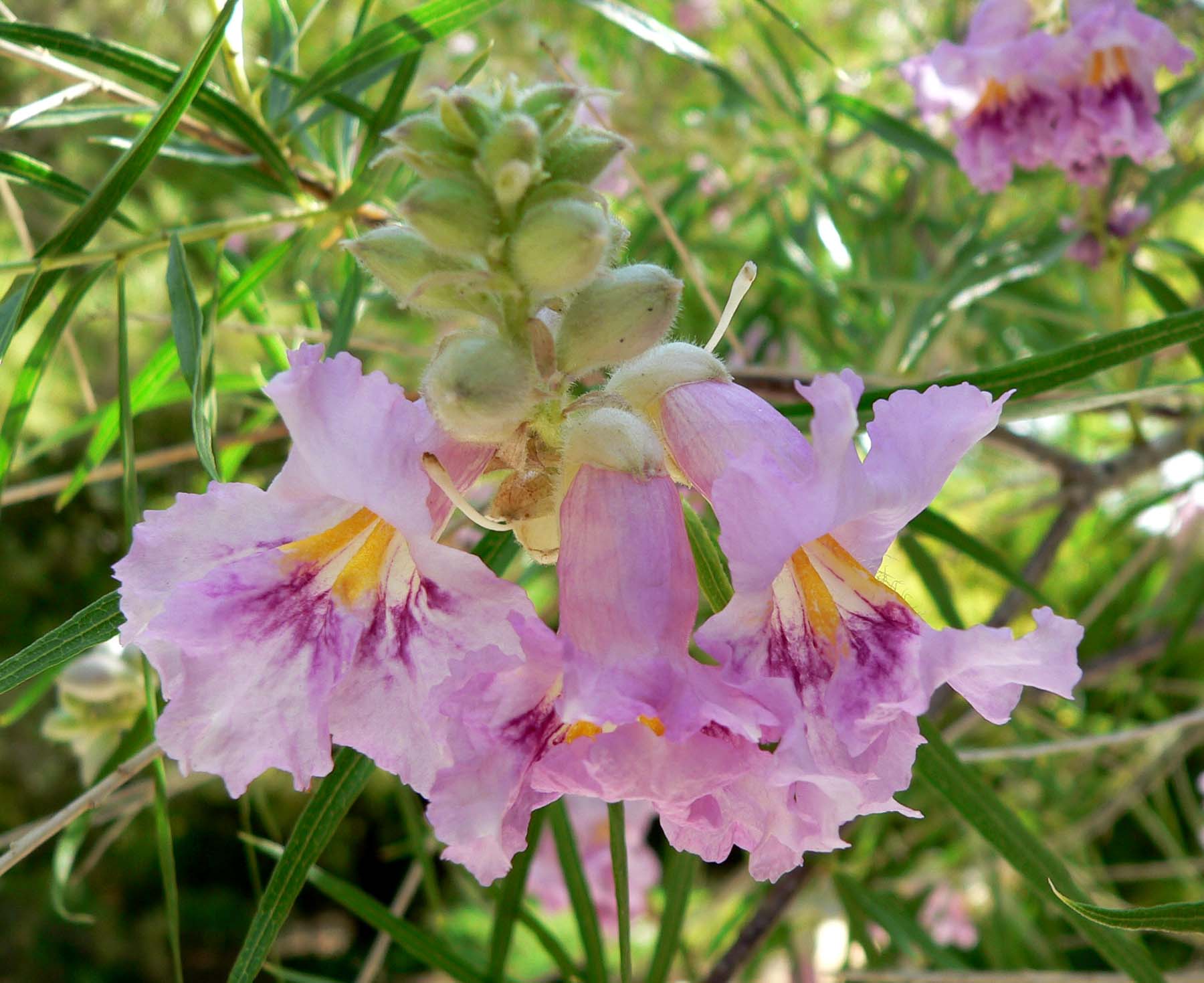
Blooming from April through September,[5] the flowers occur in a terminal panicle or raceme. About two to four flowers at a time are open in each inflorescence. The calyx is about 8–14 mm (3812 in), slightly inflated, and varying shades of purple, while the corolla is 2–5 cm (34–2 in), with colors ranging from lavender to light pink. The throat and lower lip has a pattern of yellow ridges and purple lines, and the margins are crinkled.[citation needed] The fruit is a linear pod up to 30 cm (12 in) long, containing numerous[5] winged seeds.

There are two subspecies:

  • Chilopsis linearis subsp. linearis. Utah, Arizona, New Mexico, western Texas, Mexico.
  • Chilopsis linearis subsp. arcuata. Nevada, California, Baja California.

Etymology

[edit]

The generic name is derived from the Greek words χεῖλος, (cheilos), meaning "lip," and ὄψις (opsis), meaning "resembling," referring to the flowers.

Distribution and habitat

[edit]

As a phreatophyte, it is well adapted to ephemeral desert washes and sandy streams. It can be found through much of the southwestern United States and northern Mexico. It is usually found below 1,500 m (5,000 ft).[6]

Ecology

[edit]

The species is pollinated primarily by large bees in the family Apidae, such as carpenter bees, bumblebees, Anthophora, and Centris.[citation needed] The flowers are popular with hummingbirds as well.[5]

Cultivation

[edit]

Chilopsis linearis is cultivated for its large, showy flowers, and tolerance of hot, dry climates. Although the natural growth is a very irregular shape, it can be readily pruned into a conventional tree shape. A number of cultivars have been selected. Some, such as 'Rio Salado', have dark purple or magenta flowers.

Chilopsis may survive temperatures as low as 10 degrees F (-12 °C).

Chilopsis is closely related to the genus Catalpa and hybrids can be made between the two genera. The nothogeneric hybrid between Chilopsis linearis and Catalpa bignonioides has been named × Chitalpa tashkentensis. It originated in a botanic garden at Tashkent in Uzbekistan.

Uses

[edit]

Parts of the plant have been used in traditional medicine. It has been used to treat fungal infections[7] such as candidiasis and athlete's foot, as well as wounds and cough.[8]

The wood was used to make bows and baskets.[9]

[edit]

References

[edit]
[edit]
Revisions and contributorsEdit on WikipediaRead on Wikipedia
from Grokipedia
Chilopsis is a monotypic of flowering in the family, containing the single species Chilopsis linearis, commonly known as desert willow. This small or large grows 10–30 feet (3–9 m) tall with a spread of 15–20 feet, featuring slender, flexible branches and narrow, linear-lanceolate leaves up to 10 inches long and 0.25 inches wide. It produces showy, fragrant, trumpet-shaped flowers in shades of pink to light violet, measuring about 1.5 inches long, which bloom from May to September and attract hummingbirds and other pollinators. The develops long, slender capsules (10–30 cm) filled with hairy seeds, and its deep system enables survival in arid environments. The genus name Chilopsis derives from the Greek words cheilos (lip) and opsis (resembling), referring to the distinct lip-like structure on the calyx, while the species epithet linearis describes the plant's long, narrow foliage. Taxonomically, C. linearis is recognized as the sole species in the genus, with three subspecies—subsp. linearis (characterized by erect, straight leaves in the Chihuahuan Desert), subsp. arcuata (with longer, arcuate leaves in the Sonoran and Mojave deserts), and subsp. tomenticaulis (noted for woolly stems in eastern Mexican populations). It is closely related to genera like Catalpa and Campsis but distinguished by its willow-like appearance and desert adaptations. Native to the (including , , , , , , and disjunct populations in , , and Georgia) and northern Mexico (states such as , Chihuahua, , , , and ), Chilopsis linearis thrives in desert washes, riparian zones, and arid grasslands at elevations of 450–1,830 m. It prefers full sun, well-drained soils, and is hardy in USDA zones 7–9, though it requires protection from excessive winter moisture to prevent . The plant's open, vase-shaped growth habit and prolonged flowering make it popular in and as an ornamental in hot, dry landscapes.

Taxonomy

Etymology and Classification

The genus Chilopsis belongs to the kingdom Plantae, phylum Tracheophyta, class Magnoliopsida, order , family , and is recognized as a monotypic containing only the species Chilopsis linearis. This classification aligns with the IV system, placing Chilopsis within the diverse Bignoniaceae family, which includes other ornamental trees and shrubs known for their trumpet-shaped flowers. The generic name Chilopsis derives from the Greek words cheilos (meaning "") and opsis (meaning "resembling" or "appearance"), alluding to the prominent lip-like structure of the corolla or calyx in its flowers. The specific epithet linearis comes from the Latin word for "linear," describing the long, narrow shape of the leaves. Historically, Chilopsis linearis has been known under synonyms such as Bignonia linearis (its , published by Antonio José Cavanilles in 1795) and Chilopsis saligna (described by David Don in 1823). Despite its "desert willow," which evokes the -like foliage and habitat, Chilopsis is not related to true willows in the family but is instead a member of , sharing affinities with catalpas and trumpet vines.

Species and Subspecies

The genus Chilopsis is monotypic, comprising a single species, Chilopsis linearis (Cav.) Sweet, known as the desert willow, which grows as a deciduous shrub or small tree typically reaching 3–9 meters in height. This species is the sole member of the genus, a status supported by extensive morphological and distributional analyses that distinguish it from related genera like Catalpa within the Bignoniaceae family. Chilopsis linearis is generally recognized as having two subspecies: C. linearis subsp. linearis and C. linearis subsp. arcuata (Fosberg) Henrickson, though some classifications recognize a third subspecies, C. linearis subsp. tomenticaulis Henrickson. The nominate subspecies, C. linearis subsp. linearis, is widespread across the (including , , , , and ) and northern Mexico, particularly in the region. In contrast, C. linearis subsp. arcuata has a more restricted distribution, occurring in , , southeastern , and in the Sonoran and Mojave Deserts. Subspecies tomenticaulis (sometimes treated as a variety under subsp. linearis) is found in eastern Mexican populations east of the and is characterized by woolly stems. The are delineated primarily by morphological differences, including pod shape and subtle variations in flower color intensity, as established through detailed taxonomic revision. Subsp. linearis features straight seed pods and generally paler flower tones, while subsp. arcuata exhibits arched or curved seed pods and slightly more intense lavender to pink hues in its trumpet-shaped flowers. These distinctions, combined with geographic isolation and consistent patterns in leaf orientation (erect and straight in subsp. linearis versus longer and arcuate in subsp. arcuata), provide the evidentiary basis for the classification, with no evidence of intergradation sufficient to warrant merging them.

Description

Morphology

Chilopsis linearis exhibits a growth habit as a small or large , typically reaching 3 to 9 m in with a spread of 3 to 7.5 m. It features an open, spreading crown supported by one to several slender trunks that often lean or twist, giving the a straggling appearance; the upper branches form a rounded or irregular outline with fine-textured foliage. Young twigs are green and flexible, transitioning to gray or reddish-brown with age, while the bark is thin (less than 0.6 cm), light gray, smooth on juvenile stems, and developing shallow furrows on mature trunks. The develops a deep system that enables survival in arid environments. The leaves are simple, linear to lanceolate, and willow-like, measuring 10 to 30 cm in length and 0.4 to 1.3 cm in width, with a leathery texture and gray-green coloration that aids in through a thick waxy . They are arranged alternately or suboppositely on the stems, with entire margins, tapered bases, and acute to obtuse tips; some leaves bear extrafloral nectaries. Petioles are short (0.2 to 0.5 cm) or sometimes absent, contributing to the plant's airy, drooping foliage. Reproductive structures include showy, trumpet-shaped flowers with a corolla 2 to 5 cm long and up to 3 cm in diameter at the mouth, typically lavender to pink (occasionally ), marked by two internal ridges and guide lines leading to the reproductive parts. These are borne in terminal panicles or racemes 5 to 20 cm long, with calyces 5 to 7 mm featuring nearly equal linear lobes. The is a slender, linear capsule 10 to 30 cm long and about 6 to 12 mm wide, persisting on the into winter; it dehisces along two valves to release numerous flat, elliptic seeds (2 to 3 mm long) each with wings fringed by hairs (6 to 15 mm long) for wind dispersal. exhibit minor variations, such as arcuate leaves in Chilopsis linearis subsp. arcuata.

Phenology

Chilopsis linearis, commonly known as desert willow, is , with leaves emerging in spring, typically from March to May in its range, and often producing a second flush of growth in response to summer rains in . The narrow, willow-like leaves drop in late fall or winter in response to cold temperatures below 5°C, or earlier during periods of , such as in or , allowing the to conserve water. This cycle aligns with its to arid environments, where foliage cover can vary from less than 5% during to over 95% during active growth seasons. Flowering occurs from to across much of its range, extending to in regions like the Trans-Pecos, with peaks in summer triggered by rainfall events. Individual trumpet-shaped flowers, which briefly reference the simple, alternate arrangement from its morphology, open in the late afternoon and last 1 to 2 days before senescing, contributing to prolonged blooming displays on new growth. Flower abundance can range widely, from fewer than three to over 10,000 per plant, depending on environmental conditions. Fruiting follows , with long, slender capsules developing and maturing from late summer through fall, often ripening between July and October. These capsules, which turn tan or brown and split open to release , persist on branches through winter, facilitating dispersal by , from winter floods, or mechanical means. Ripe coverage can reach 95% or more of total fruits during peak periods. The species exhibits a moderate growth rate, with seedlings potentially reaching 1 meter per year under sufficient moisture, accelerating in wet years to double that of dry conditions, though overall establishment to a mature height of 15-30 feet takes several years in native habitats. In its native range, growth is particularly responsive to rains, promoting rapid extension of branches and foliage. Chilopsis linearis enters a semi-dormant state during extreme or cold, shedding leaves and halting active growth from late fall to mid-spring, typically November to February, to survive harsh conditions.

Distribution and Habitat

Geographic Distribution

Chilopsis linearis is native to the and , with its range spanning from eastward through southern , southwestern , , southern , and western , extending southward into the Mexican states of , Chihuahua, , , , , , and . The species primarily occupies arid and semi-arid regions, including the (eastern portions), , , , and southern , at elevations of 450–1,830 m (1,500–6,000 ft), typically below 1,600 m (5,300 ft). The distribution includes two recognized subspecies with somewhat overlapping but regionally distinct ranges. Chilopsis linearis subsp. linearis occurs primarily in the eastern parts of the range, including western , (with overlap), , , and (Chihuahua, Coahuila, Zacatecas). In contrast, C. linearis subsp. arcuata is found in the western portions, encompassing southern , southern , southwestern , , northern , northern , and in Mexico, often in the Mojave and Sonoran Deserts. Beyond its native range, C. linearis has been introduced for ornamental purposes in regions with similar arid climates. It is cultivated in and . In the United States, subsp. linearis has escaped cultivation and become naturalized in southwest and western , with disjunct populations in Georgia.

Habitat Preferences

Chilopsis linearis, commonly known as desert willow, thrives in riparian and semi-riparian environments characterized by intermittent water availability, such as washes, arroyos, riverbanks, and canyon bottoms. These sites typically feature alluvial fans, gullies, and bajadas at low elevations, often below 1,600 meters, where seasonal flash floods deposit sediments and provide periodic moisture. The species prefers well-drained sandy, gravelly, or loamy soils derived from alluvial substrates, including sand, gravel, and cobble, and tolerates a range of conditions from acidic to alkaline. As a phreatophyte, it accesses via deep , enabling survival in arid settings with shallow water tables, though it is intolerant of saline soils. It withstands seasonal flooding for up to 1–3 months but cannot endure prolonged submersion. In arid to semi-arid climates of the and , Chilopsis linearis endures annual rainfall typically below 760 mm, with bimodal patterns in some regions, and extreme temperatures ranging from as low as -12°C to over 45°C. Its drought and tolerance stem from adaptations like drought-deciduous foliage, which reduces during dry periods. Within these habitats, it often associates with vegetation in riparian zones, codominating washes with mesquite ( spp.), catclaw acacia (), and (Larrea tridentata), or occurring as an understory component in mixed-deciduous woodlands alongside Fremont cottonwood (Populus fremontii), willows (Salix spp.), and saltcedar ( spp.). Key adaptations include a deep system extending up to 1.6 meters or more to reach groundwater, supplemented by extensive horizontal roots up to 15 meters, which stabilize the plant in loose alluvial soils. Additionally, it exhibits fire resilience by sprouting from the root crown following top-kill events, facilitating regeneration in post-fire riparian environments.

Ecology

Pollination and Dispersal

Chilopsis linearis exhibits hermaphroditic flowers that are self-incompatible, functioning as an obligate outcrosser to encourage through cross-. is predominantly entomophilous, with large native bees such as Sonoran bumblebees (Bombus sonorus) and (Xylocopa spp.) serving as the primary pollinators by transferring while foraging for . Hummingbirds provide secondary services, particularly in regions where their ranges overlap with the plant's distribution. The trumpet-shaped flowers of C. linearis feature prominent nectar guides, often golden lines on the lower corolla, which direct pollinators to the rewards at the floral base and facilitate effective deposition on the stigma. Flowers typically close shortly after or stigma contact, a mechanism that may limit further visits and protect reproductive structures, though they can reopen if is incomplete. This floral behavior, combined with the plant's reliance on outcrossed , underscores the importance of diverse communities for . Seed dispersal in C. linearis occurs primarily through anemochory, with lightweight seeds equipped with long, silky hairs that act as parachutes, enabling wind transport from the slender, dehiscent pods (typically 15-30 cm long) that split open upon maturation. Occasional hydrochory contributes to dispersal in riparian washes and flood-prone areas, where water currents carry the buoyant seeds downstream. Seeds of C. linearis are non-dormant and exhibit high viability, with germination rates ranging from 50% to 80% when exposed to on suitable substrates; dormancy is typically broken simply by wetting, requiring no or pretreatment. Reproductive success is closely tied to environmental conditions, particularly summer rains that synchronize flowering and fruiting, leading to larger crops in wetter years and higher overall rates.

Interactions with Fauna

_Chilopsis linearis serves as a significant nectar and pollen source for various pollinators in desert ecosystems, particularly bees and hummingbirds. Sonoran bumble bees (Bombus sonorus) are the primary pollinators, with additional visitation from hummingbirds, honeybees (Apis mellifera), and small flies. The tubular flowers provide ample nectar rewards, supporting these species during the plant's extended blooming period from spring to fall. Granivorous birds also consume the seeds, contributing to dispersal and nutrient cycling. The plant experiences limited herbivory due to its low palatability. It is generally unpalatable to livestock and of low palatability to wildlife, though mule deer (Odocoileus hemionus) occasionally browse small quantities of leaves and flowers. This resistance helps the species persist in arid environments where forage is scarce. Seed pods of C. linearis offer forage for wildlife, with granivorous birds feeding on the winged seeds dispersed from the elongated capsules. The pods, which persist on the plant through winter, attract songbirds and support avian populations in riparian zones. While rodents may interact with seeds in broader desert ecosystems, specific predation on C. linearis pods is not well-documented, emphasizing the plant's role in avian rather than mammalian seed consumption. In riparian ecosystems, C. linearis plays a key role in stabilization and resource provision. Its deep helps stabilize soils in washes and alluvial fans, reducing during flash floods common to these areas. The open, airy canopy provides light shade for plants and in hot, dry washes. As an riparian , it indicates the presence of shallow tables, often occurring where underground water is available year-round, thus serving as a marker for groundwater-dependent habitats that support diverse . However, no obligate mutualisms with fauna or microbes are known for this species.

Cultivation

Requirements and Propagation

Chilopsis linearis requires full sun exposure for optimal growth and flowering, along with well-drained soils to prevent . It performs best in neutral to slightly alkaline soils with a range of 6.0 to 8.0, tolerating clay, , or sandy textures as long as drainage is adequate. This species is well-suited to USDA hardiness zones 7b through 11, where established can withstand subzero winter temperatures (below 0°F or -18°C), and can be grown in zones as cold as 5 and 6 with proper establishment. Native to arid regions, it mirrors habitat preferences for low-precipitation areas receiving less than 30 inches annually, but in cultivation, supplemental is essential during the first 1-2 years to promote root establishment. Once established, Chilopsis linearis exhibits high due to its deep , requiring only occasional deep watering during prolonged dry spells to enhance flowering and vigor; however, it is intolerant of consistently wet conditions. should be applied sparingly, as excessive nutrients can lead to weak, leggy growth rather than compact form. Propagation of Chilopsis linearis can be achieved through or vegetative methods. For , collect mature pods in fall before they split, clean by and sieving, and sow directly ¼ inch deep in spring without or stratification; rates typically range from 40-60% under well-managed conditions. Semi-hardwood cuttings taken in summer readily, while dormant cuttings (6-12 inches) collected in late winter also succeed; suckers provide an easy means for clonal . Pruning is best performed during winter to shape the plant into a single-trunk or multi-stemmed , removing dead wood and suckers as desired to maintain form; light encourages branching and increased flowering on new growth. Common cultivation challenges include susceptibility to in poorly drained or overly wet soils, which can cause vascular blockage and branch dieback, and occasional infestations of that feed on new growth. To mitigate these, ensure proper site drainage and monitor for early pest signs, treating with if needed.

Cultivars and Hybrids

Several cultivars of Chilopsis linearis have been developed through selection for desirable traits such as flower color, bloom duration, and plant habit, with limited natural varieties primarily differing in flower pigmentation from white to deep purple. These selections focus on enhancing ornamental appeal in arid landscapes, often resulting in more compact growth or reduced seed production compared to the wild species. Notable cultivars include 'Rio Salado', which features dark purple to crimson flowers with pink shades on a compact, upright form reaching 30 feet tall and 22 feet wide, making it suitable for smaller spaces. 'Bubba' is prized for its large pink to burgundy flowers, glossy green leaves, and cold hardiness, thriving in urban arid environments; selections from this lineage, such as 'Sweet Bubba' with virtually seedless burgundy blooms and 'Bubba Jones' with a larger habit and low seeding pink flowers, were developed to improve adaptability to variable climates. 'Timeless Beauty' ('Monhews') stands out for its extended blooming period from spring to summer, producing fragrant tubular flowers in bi-colored burgundy and pale lavender without setting seed, which promotes prolonged floral display. Other selections like 'Lois Adams' are podless for reduced maintenance, while 'White Star', 'Pink Star', and 'Burgundy Lace' offer showier flowers on smaller statures. The primary hybrid is ×Chitalpa tashkentensis, an intergeneric cross between Chilopsis linearis and Catalpa bignonioides, featuring willow-like leaves, large trumpet-shaped flowers in pink or white, and sterility that prevents fruit production. This hybrid combines the drought tolerance of desert willow with the floral abundance of catalpa, resulting in a fast-growing ornamental tree adaptable to various soils. Breeding efforts for these cultivars and hybrids began in the 1960s, with ×Chitalpa tashkentensis first created in 1964 at the Uzbek Academy of Sciences through controlled cross-pollination, later introduced to the in the 1970s for landscape enhancement and disease resistance. Cultivar selections, such as those in the 'Bubba' series, originated from botanical gardens like the to extend bloom duration and hardiness. These cultivars and hybrids are widely available in nurseries specializing in arid-region plants, particularly in the , and are often propagated vegetatively—hybrids like ×Chitalpa typically via grafting to maintain sterility and vigor—facilitating their use in drought-tolerant .

Uses

Ornamental and Landscaping

Chilopsis linearis, commonly known as desert willow, is prized for its ornamental appeal in landscapes, featuring showy trumpet-shaped flowers in shades of pink, purple, or white that provide vibrant summer color from through fall. The tree's feathery, willow-like foliage adds textural interest, while its fragrant blooms attract pollinators such as hummingbirds, , and bees, making it an excellent choice for wildlife gardens. In landscaping, desert willow serves as a drought-tolerant accent , privacy screen, or patio specimen, thriving in arid urban environments and ideal for to conserve water. Its open, weeping form provides without overwhelming small spaces, and it can be shaped as a multi-trunked or single-stemmed for versatile applications. Designers recommend planting desert willows in groups to create a mass effect of colorful blooms and foliage, enhancing visual impact in desert-themed gardens. Pairing them with drought-tolerant companions like succulents, sages, or ornamental grasses complements their aesthetic while maintaining low-water requirements; space plants 3-5 meters apart to allow for mature growth of 4-6 meters in height and spread. Maintenance is minimal, with low litter production despite its deciduous nature, as the slender leaves and persistent seed pods decompose quickly without excessive mess. The tree's narrow leaves and open structure contribute to its fire resistance, making it suitable for defensible spaces in fire-prone regions. Desert willow has gained regional popularity in southwestern U.S. landscapes for its rapid growth and exceptional , with use expanding since the mid-20th century amid rising interest in water-wise . It has been recognized for these qualities in horticultural recommendations, including cultivars like '' that enhance color variety for ornamental plantings.

Traditional and Other Uses

Native American tribes, including the and , utilized various parts of Chilopsis linearis for medicinal purposes. A tea made from the bark served as an remedy for skin infections such as and , while decoctions from flowers, leaves, and bark were applied in hot poultices or consumed to alleviate coughs, bronchial issues, and . decoctions were employed as eye washes to treat infections and irritations, and floral extracts addressed and wounds. In modern herbalism, tinctures from the flowers and bark support lymphatic, digestive, and immune functions, though use remains limited due to potential misidentification with toxic plants like oleander and insufficient clinical studies on long-term safety. Indigenous groups crafted flexible branches into basketry rod foundations, bows, cradleboards, and cordage for nets, while the bark was woven into fabrics like shirts and breechclouts. The lightweight wood, though soft and less durable for heavy construction, was shaped into small tools, fence posts, house frames, granaries, and long-reaching implements for harvesting high fruits and nuts. Mature seed pods, containing papery winged seeds, were occasionally fashioned into rattles for ceremonial or play purposes. In arid regions, C. linearis provided occasional emergency forage for during droughts, as its leaves and young sprouts are browsed when other is scarce, though generally unpalatable. The tree's cultural significance in Southwestern traditions stems from its ability to thrive in harsh deserts, symbolizing resilience and in , with flowers sometimes incorporated into ceremonial practices for their vibrant hues.

References

Add your contribution
Related Hubs
User Avatar
No comments yet.