Hubbry Logo
Chords BridgeChords BridgeMain
Open search
Chords Bridge
Community hub
Chords Bridge
logo
8 pages, 0 posts
0 subscribers
Be the first to start a discussion here.
Chords Bridge
Chords Bridge
from Wikipedia
Aerial view of the bridge at night

Key Information

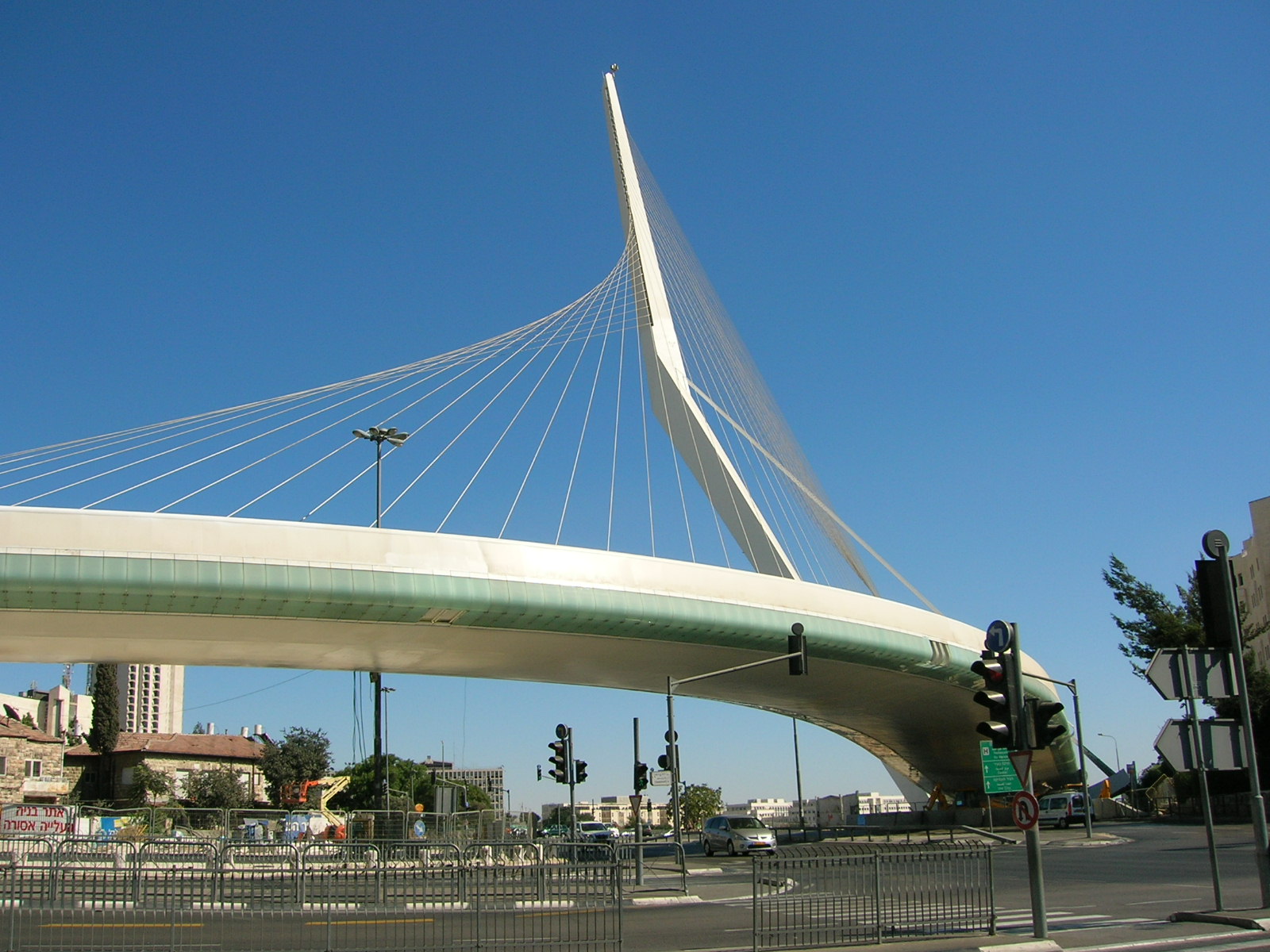
The Chords Bridge (Hebrew: גשר המיתרים, Gesher HaMeitarim), also called the Bridge of Strings or Jerusalem Light Rail Bridge, is a side-spar cable-stayed bridge in Jerusalem. The structure was designed by the Spanish architect and engineer Santiago Calatrava and is used by Jerusalem Light Rail's Red Line, which began service on August 19, 2011. Incorporated in the bridge is a glass-sided pedestrian bridge enabling pedestrians to cross from Kiryat Moshe to the Jerusalem Central Bus Station. The bridge, which cost about $70 million (NIS 246 million), was inaugurated on June 25, 2008.[2]

History

[edit]

Calatrava first visited Israel for the opening of an exhibition of his works in Haifa in 1997. During that visit, he was invited to design a pedestrian bridge in Petah Tikva, which was opened in 2005. He was invited to Jerusalem by city engineer Uri Shetrit and former mayor Ehud Olmert,[3] who, according to Calatrava, challenged him to "do the most beautiful contemporary bridge".[4]

Construction of the Chords Bridge began in 2005, with an estimated cost of NIS 129 million, far higher than the initial forecast of NIS 80 million.[5]

Design and symbolism

[edit]

The bridge was designed to add a defining visual element to the Jerusalem "skyline" at the entrance to the city, and to carry a light rail system, expected to solve some of the city's traffic problems. For Calatrava the bridge is "also the excuse to create a major plaza, to give character and unity to this delicate place".[6]

Similar to Calatrava's Puente del Alamillo in Seville, Spain, the bridge makes use of an angled cantilever tower to absorb some of the load and reduce the number of cable stays needed. The bridge consists of a single pylon counterbalancing a 160-metre (170 yd) span with lengths of cables, making a dramatic architectural statement. While this is Calatrava's 40th bridge, it is the first he has designed to carry both train and pedestrian traffic.[7]

A striking feature of the bridge is a single 118-metre (129 yd) high mast supporting the roadway via 66 steel cables[8] arranged in a parabolic shape which develops three-dimensionally in space,[6] making it the tallest structure in Jerusalem at the time of its completion. The exterior of the bridge is mostly clad in Jerusalem stone, with steel, glass and concrete detailing. Dubbed "Jerusalem's first shrine of modern design" by Time magazine,[7] the bridge has become a tourist attraction.

The form of the bridge resembles a tent in the desert or a harp, with the cables as the strings, symbolising King David's harp, according to some observers,[9] others interpret the looming pylon as the bust of a long-necked bird, a human arm or an arrow caught in a bow.[10]

Acceptance and criticism

[edit]

The project had many people concerned, but was welcomed with great controversy. Supporters, such as architectural historian David Kroyanker, said that the bridge helps developing western Jerusalem and its modern requirements.[11] Overall, however, the project has been criticized as an extravagant and costly solution to a problem that could have been solved by cheaper means.[8] The final cost of over $70 million exceeding the original budget more than twofold. The aesthetics of the bridge and its impact on Jerusalem have also sparked controversy.[12] Some say the bridge, situated at the city's crowded entrance, does not have enough space around it for people to appreciate its artistic merit, while others feel that the bridge is simply out of its element and question whether it fits visually in the city.[4] The bridge's dedication ceremony, a $500,000 extravaganza, also drew criticism, particularly as young female dancers, subsequently dubbed the "Taliban troupe",[13] were compelled to wear long skirts and cover their hair after ultra-Orthodox Jews threatened to disrupt the ceremony.[9]

References

[edit]
[edit]
Revisions and contributorsEdit on WikipediaRead on Wikipedia
from Grokipedia
The Chords Bridge, also known as the Bridge of Strings or Gesher HaMeitarim, is a cable-stayed pedestrian and bridge spanning a major highway junction at the western entrance to , . Designed by Spanish architect and engineer , the 140-meter-long structure features a curved deck supported by a side-spar mast with cables evoking strings, constructed primarily from local Ramon greystone. Inaugurated in June 2008 as a visual landmark for the city skyline, it integrates with the Red Line, which commenced operations in 2011, facilitating transit between neighborhoods while incorporating a glass-enclosed for pedestrians. The bridge's harp-like form draws inspiration from ancient musical instruments, blending modern engineering with symbolic resonance in a historically rich urban context.

Overview

Location and Purpose

The Chords Bridge, also known as the Bridge of Strings, is situated at the western entrance to , , spanning the Sderot Ben Gurion highway near the city's Central Bus Station. This positioning marks the point where the highway branches off toward key urban areas, integrating the structure into the primary access route for vehicular and transit traffic entering from the west. Primarily constructed as part of the Jerusalem Light Rail mass transit system initiated in 1999, the bridge facilitates the connection of the city center to northern neighborhoods via a dedicated rail line. It serves as a functional rail crossing over the congested intersection at the Yitzhak Navon Railway Station and adjacent roadways, alleviating ground-level traffic disruptions while enabling efficient public transport. Additionally, the design incorporates a glass-sided pedestrian walkway, allowing foot traffic to cross from the Kiryat Moshe neighborhood to the Central Bus Station, thereby enhancing local connectivity for commuters. Beyond its utilitarian role, the bridge was engineered to establish a prominent visual at Jerusalem's entry point, replacing the previously utilitarian dominated by the with a symbolic architectural feature intended to evoke the harp of King David. This dual emphasis on and underscores its purpose in modernizing urban transit while contributing to the city's symbolic identity.

Technical Specifications

The Chords Bridge employs a cable-stayed with a single spar pylon inclined at an angle, rising to a height of 118 meters, which serves as the primary support element. This pylon anchors 66 steel cables arranged in a three-dimensional parabolic configuration, forming a semi-fan system that suspends the curved deck. The deck itself features a curved profile spanning over 90 degrees to accommodate rotational alignment with the surrounding , enabling it to function as a bridge integrated into Jerusalem's system. The bridge's main span measures 160 meters, contributing to a total length of 360 meters, with a deck width of approximately 14.8 meters to support tramway traffic and ancillary elements. Structural materials consist primarily of for the cables and framework, for foundational and deck components, and cladding in local for aesthetic integration, supplemented by glass panels in select areas for transparency and light diffusion. The design prioritizes slender proportions and , with the pylon's inclination providing counterbalance against wind and seismic loads inherent to the site's valley crossing.

Historical Development

Planning and Commissioning (1999–2005)

The planning phase for the Chords Bridge, officially known as Gesher HaMeitarim or Bridge of Strings, commenced in 1999 amid the initiation of Jerusalem's mass transit system, a collaborative effort led by the Municipality of alongside Israel's Ministries of Transportation and Finance. This project envisioned a 15-kilometer initial line spanning from to , with the bridge positioned as a element at the city's western entrance near the to alleviate traffic bottlenecks in a densely developed area. The Municipality of Jerusalem directly commissioned Spanish architect and structural engineer Santiago Calatrava to conceptualize the bridge, seeking a design that would not only facilitate light rail transit but also serve as a visually distinctive gateway symbolizing modernity amid the city's historical context. Calatrava's response was a cable-stayed configuration with a solitary inclined pylon—reaching 118 meters in height—anchored by 66 cables evoking harp strings, a nod to the biblical King David's lyre, while incorporating a glass-enclosed pedestrian walkway parallel to the rail deck. This approach addressed site-specific constraints, including multi-level roadway interchanges and the need for unobstructed urban flow, through cantilevered spar elements that minimized ground-level obstructions. Throughout the 1999–2005 period, engineering assessments focused on feasibility in the constrained topography, integrating the structure with the Red Line's alignment and ensuring seismic resilience in line with Israeli standards. Initial cost projections hovered around NIS 80 million, though these would later escalate; tender processes for construction elements advanced, culminating in groundwork initiation by mid-2005 under oversight from the Moriah Jerusalem Development Corporation. The phase emphasized the bridge's role in elevating 's skyline without compromising views of sacred sites, balancing utilitarian transport demands with aesthetic aspirations.

Construction Process (2005–2008)

Construction of the Chords Bridge began in 2005 as an integral component of Jerusalem's infrastructure expansion, designed by Spanish architect and engineer to span the Begin Highway at the city's western entrance. The Gadish Group served as the primary contractor, managing planning, execution, and supervision, while clients included the Ministry of Transportation, , and Company Ltd. Initial site preparations focused on infrastructure development, traffic rerouting, and pedestrian pathways, with specific measures implemented to reduce disturbances for adjacent residential areas. The bridge's cable-stayed structure, featuring a single 118-meter-high cantilevered pylon inclined at an angle to support a 360-meter-long curved deck, relied on 66 steel cables arranged in a three-dimensional parabolic pattern for load distribution. techniques emphasized for the semi-fan cable system and the pylon's angled erection, which provided while minimizing the visual footprint through a harp-like aesthetic. The foundational work incorporated approximately 100 piles to anchor the structure amid the site's geological constraints. A pivotal phase advanced on 11-12, 2007, when the initial deck section was installed during a ceremonial laying event, marking progress toward integrating the 160-meter main span. The load-bearing elements were fabricated from steel and concrete for durability, with exterior cladding and deck flooring using local and glass panels to harmonize with the urban landscape and evoke traditional motifs. Overall, the project mobilized around 4,000 tons of materials, culminating in completion on June 25, 2008, ahead of the light rail's operational rollout.

Inauguration and Early Operations (2008–2011)

The Chords Bridge was inaugurated on June 25, 2008, as part of celebrations marking Israel's 60th anniversary of . The included a display and drew public attention to the structure's harp-like design, intended to symbolize entry into . Designed by Spanish architect , the bridge spans 118 meters in length and connects the Romema neighborhood to the city's western entrance over the Begin Highway. At the time of inauguration, the total construction cost reached approximately $70 million (NIS 246 million). From 2008 to 2011, the bridge operated primarily as a pedestrian link, facilitating foot traffic between residential areas and central while the integrated system underwent final preparations. Its glass-sided walkway allowed users to traverse the elevated structure, offering views of the surrounding urban landscape and the highway below. No major structural incidents were reported during this initial phase, though the absence of rail service limited full utilization of the bridge's dual-purpose design. The Jerusalem Light Rail Red Line, for which the bridge was partially constructed, began service on August 19, 2011, marking the transition to combined pedestrian and tram operations. Prior to this, the structure served as an architectural landmark at the city's northwest gateway, adjacent to the Yitzhak Navon Railway Station area. Early usage focused on its role in alleviating pedestrian congestion across the busy traffic junction, though actual traffic volumes remained modest pending broader transit integration.

Design and Engineering

Architectural Features

The Chords Bridge employs a spar cable-stayed design engineered by Spanish architect , featuring a single inclined pylon that rises 118 meters above the deck to counterbalance the 160-meter main span. This pylon supports the structure via 66 steel cables arranged in a semi-fan configuration, evoking the strings of a and lending the bridge its name. The overall bridge spans 360 meters in length and 14.82 meters in width, constructed primarily from for the deck and steel for the cables and pylon elements. The deck incorporates a curved alignment to navigate the urban terrain at Jerusalem's entrance, optimized for transit with provisions for vehicular and pedestrian use. Aesthetic features include cladding on abutments and portions of the structure with pale limestone, selected to harmonize with the city's historic golden-white stone buildings, while the pylon's light-toned finish blends into the landscape. Contrasting modern details, such as glass railings and walkways, enhance visibility and safety beneath the bridge. Illumination via LED lights along the cables accentuates the harp-like silhouette at night, amplifying its sculptural presence.

Structural Engineering

The Chords Bridge features a cable-stayed structural system utilizing a single inclined spar pylon to support the deck via tensioned cables, enabling efficient load distribution across the 160-meter main span. This configuration, classified as a semi-fan cable arrangement, positions the cables emanating from the pylon's apex to points along the curved deck, minimizing bending moments in the and relying on axial compression in the pylon and tension in the cables for primary force resistance. The design accommodates loads while incorporating a curved alignment to navigate the site's at Jerusalem's entrance. The pylon, fabricated from , rises 118 meters above the deck and cantilevers at an angle, functioning as a compression anchored directly to the deck's foundation to counterbalance the overhanging span without traditional backstays. It supports 66 stay cables arranged in a parabolic profile that extends three-dimensionally, enhancing both structural efficiency and the harp-like aesthetic. The deck structure combines for the primary with elements for the cable anchorages and rail integration, achieving a total bridge length of 360 meters and a clearance of 5.5 meters below to permit pedestrian and limited vehicular passage. Exterior cladding employs over the concrete and steel framework to ensure durability against local environmental factors like seismic activity and temperature fluctuations, while glass and accents in walkways provide resistance and transparency. This balances structural integrity with contextual integration, though the stone facing adds weight that the cable system must accommodate, necessitating precise prestressing during to prevent excessive deflection under live loads. The prioritizes redundancy in cable tensions and pylon bracing to mitigate wind-induced vibrations, common in asymmetric cable-stayed designs.

Symbolism and Aesthetic Intent

The Chords Bridge, designed by Spanish architect and engineer , draws its primary symbolic inspiration from the biblical harp associated with King David, evoking the instrument's strings through the structure's 66 steel cables that fan out from a single inclined pylon rising 118 meters high. has stated that this form serves as a modern emblem for , integrating the city's ancient musical and spiritual heritage with contemporary engineering to create a landmark at its western entrance. The pylon's harp-like silhouette also alludes to a in the desert, symbolizing transience and in Jewish tradition, thereby bridging biblical motifs with the bridge's functional role in urban transit. Aesthetically, Calatrava intended the bridge to embody lightness and transparency, countering Jerusalem's dense historic fabric with a sculptural, ethereal presence that enhances the without overwhelming it. The cable-stayed design, featuring an asymmetrical pylon clad in local , prioritizes visual harmony and organic flow, aligning with Calatrava's broader oeuvre of biomorphic forms derived from and anatomical references. This intent extends to the bridge's diaphanous appearance under , where the cables and minimal deck evoke musical vibration, reinforcing the symbolism while facilitating the light rail's passage as a connective into the . Critics have noted that such aesthetic choices prioritize iconic monumentality over utilitarian subtlety, yet Calatrava's approach underscores a deliberate fusion of precision with poetic evocation tailored to Jerusalem's sacred context.

Controversies

Cost Overruns and Budget Management

The Chords Bridge, designed by as part of Jerusalem's infrastructure, experienced significant cost escalations during its development. Initially budgeted at approximately NIS 80 million (around $20 million at the time), the project's expenses rose to NIS 129 million by the start of in 2005, reflecting early adjustments for complexity and materials. By completion in 2008, the total cost had ballooned to NIS 246 million (equivalent to roughly $70 million), more than tripling the original estimate due to engineering challenges, structural revisions, and the architect's signature aesthetic demands. These overruns were attributed in part to discoveries of welding cracks in foundational sections during late-stage inspections in March 2008, necessitating repairs and delays that inflated expenses. Calatrava's cantilever spar cable-stayed design, while innovative, contributed to higher-than-anticipated fabrication and assembly costs, a pattern observed in several of his bridge projects globally. Critics, including local observers, argued that a simpler functional bridge could have been constructed for a fraction of the price, highlighting deficiencies in upfront budget realism and contingency planning by the Jerusalem municipality and light rail consortium. Budget management efforts post-construction included compensatory measures for adjacent residents affected by the overruns' indirect impacts, such as noise and access disruptions, with NIS 3.5 million allocated in 2017 to 67 homeowners near Herzl Boulevard. However, broader fiscal oversight critiques emerged in municipal audits, pointing to inadequate competitive bidding and planning integration with the wider system, which itself faced parallel overruns exceeding initial projections. Despite these issues, no formal accountability mechanisms, such as penalties on the design firm, were publicly imposed, underscoring challenges in enforcing cost controls for high-profile .

Aesthetic and Cultural Clashes

The Chords Bridge, designed by Spanish architect , features a distinctive lyre-shaped mast with 66 white steel cables evoking the strings of a , intended to symbolize King David's instrument and integrate with Jerusalem's cultural heritage as an iconic entrance landmark. This aesthetic objective aimed to blend modern engineering with symbolic resonance, yet it provoked significant backlash for its stark modernism clashing with the city's ancient skyline dominated by biblical and Ottoman structures. Critics argued the 118-meter-high spire and elongated form dominate the western entrance view from Highway 1, imposing a futuristic element unsuited to Jerusalem's historical sanctity. Public and professional opposition intensified, with writers, artists, and protesting the structure as a "monstrous and purposeless installation" that undermines the capital's identity. Demonstrations highlighted fears that the bridge's bold, white silhouette detracts from rather than enhances the to sacred sites, prioritizing sculptural flair over contextual . Some contended it exacerbates urban clutter at a congested gateway, failing to respect the subdued aesthetic norms of a revered for millennia-old . These views reflect broader tensions between progressive urban development and preservationist sentiments in , where new constructions often face scrutiny for altering the revered panoramic vistas. Culturally, the harp motif sought to affirm , but detractors perceived the execution as alienating, potentially diluting the spiritual gravity of the locale rather than elevating it through tradition-aligned design. While proponents praised its ambition to modernize transit infrastructure with , the prevailing clashes underscored a among locals and experts for interventions that defer to Jerusalem's layered historical fabric over assertions. This discord mirrors ongoing debates in heritage cities, where aesthetic innovation risks cultural dissonance without rigorous alignment to established visual and symbolic precedents.

Political and Ideological Debates

The Chords Bridge, spanning from western to the neighborhood in , has been interpreted as a symbol of Israeli unification of the city following the 1967 , with its harp-like design evoking King 's instrument and intended to mark the entrance to the eternal capital. Mayor Uri Lupolianski described it as evoking "David’s Harp," aligning with Zionist narratives of historical and cultural continuity. However, critics, including some Israeli politicians and locals, have derided its form as an ungainly "clothesline," arguing it imposes an alien modernist aesthetic on a city defined by ancient religious architecture, thus clashing with traditionalist ideologies that prioritize heritage preservation over international "" interventions. Ideologically, the bridge's role in the light rail system connecting Israeli neighborhoods across the pre-1967 lines has fueled debates over Israeli versus claims of occupation, as is a Jewish settlement on land annexed by but considered occupied territory under UN resolutions. Palestinian authorities and international actors have opposed infrastructure linking to settlements, viewing it as entrenching division and discrimination; the initiated lawsuits against contractors and in French courts, alleging complicity in violations of international law. In 2006, the Dutch ASN Bank divested from citing the project's location in disputed areas, reflecting broader ideological tensions between Israeli assertions of unified under and global perspectives favoring a with as a Palestinian capital. Domestically, the project highlighted secular-religious divides, with construction work reportedly continuing on in its final stages, enraging Jerusalem city council members who decried it as a violation of Jewish law and public sensitivity in a city with a significant ultra-Orthodox population. The 2008 inauguration ceremony, costing $500,000 and featuring demands for modest dress in deference to religious norms, drew boos from attendees including former Ehud , underscoring ideological friction between progressive urban development and haredi influence on . While some assessments frame the bridge as a false symbol of " at last sight" that ignores Palestinian exclusion—despite partial service to Arab areas—Israeli public opinion remains divided, with no consensus on its contribution to intercommunal harmony.

Reception and Impact

Positive Assessments and Achievements

The Chords Bridge has been praised for its innovative engineering as a spar cable-stayed structure, featuring a 188-meter-high pylon supporting the deck via 66 steel cables arranged in a harp-like configuration, enabling a 160-meter span that curves over 90 degrees for alignment with the route. This design marked the first instance in architect Santiago Calatrava's portfolio of over 40 bridges where a single structure accommodated both rail transit and pedestrians, demonstrating advanced structural efficiency for multi-modal use in an urban setting. Functionally, the bridge integrates the Red Line, facilitating efficient transit across the Sderot Herzl corridor and connecting neighborhoods like Kiryat Moshe to the , while its glass-sided pedestrian walkway provides safe crossing and panoramic views of the city, enhancing accessibility for over 240,000 daily passengers as of early operations. The structure's robustness, weighing 4,200 tons yet stabilized by its single-mast cable system, has supported reliable service since its 2008 completion, contributing to the 's role in reducing road congestion at Jerusalem's western entrance. As a , it serves as a defining visual element in the city's , with its lyre-shaped form and nighttime LED illumination—upgraded in with 14,400 bulbs at a cost of approximately $1 million—creating a striking aesthetic that has drawn recognition for elevating in , described by TIME as the most impressive new structure there in over a . This ongoing maintenance investment underscores its enduring public and civic value as an iconic gateway feature.

Criticisms from Experts and Locals

Architect Ami Ran, editor of the "Architecture of Israel" quarterly, criticized the Chords Bridge as a "monster" that "expresses the ego of the architect and not [the] city of itself." Similarly, Jerusalem architect Arthur Spector remarked that "the thing about Calatrava bridges is that every city seems to have one," suggesting a perceived lack of contextual originality in the . Shimon Shapiro, a retired professor of architecture and , described the structure as "a bit over the top" with "something dehumanizing about the whole thing." Local residents have frequently highlighted the bridge's intrusive placement amid residential neighborhoods. Fania Rosenstrum, a retired living nearby, called it a "monster" better suited to a modern metropolis like than Jerusalem's historic entrance, arguing that its proximity to homes— with tracks running beneath windows—has decreased property values and disrupted daily tranquility. Cafe owner Yaron Kortik likened its appearance to "a giant crooked nail," while resident Ilan labeled it "one giant headache" owing to during construction and opening events, including a 10-hour closure of major routes. National poet Haim Gouri echoed these sentiments, deeming the bridge "expensive and... completely lost" in "the most inappropriate place."

Transportation and Urban Legacy

The Chords Bridge integrates with Jerusalem's network, specifically Line 1, by supporting both tram tracks and a dedicated glass-enclosed walkway, facilitating the crossing of the heavily trafficked Begin Highway (Route 1) at the city's western entrance. This design allows vehicles to connect the central with outlying neighborhoods, enhancing public transit efficiency since the system's operational start in 2011. The bridge's structure elevates rail and foot traffic above ground level, reducing conflicts with vehicular flow on the highway below and enabling a public plaza in the cleared space underneath for and urban activities. In terms of pedestrian transportation, the incorporated walkway links Kiryat Moshe residential areas directly to the , promoting safer and more direct access over what was previously a barrier of multi-lane roads and junctions. While specific ridership data for the bridge remains limited in public records, its role in the light rail has contributed to overall system usage, which serves as a backbone for intra-city mobility amid Jerusalem's growing population and tourism demands. The bridge's urban legacy lies in its function as a gateway , redefining 's western with a modern, harp-like silhouette that symbolizes the city's shift toward contemporary infrastructure amid its historical fabric. It anchors the Gateway , a 173-acre commercial and cultural development zone initiated in , which leverages the bridge's prominence to attract business investment and high-rise , positioning the area as the city's emerging economic hub. This integration has influenced by prioritizing vertical growth and transit-oriented design, though ongoing maintenance challenges, such as structural wear observed since completion in 2008, underscore tensions between iconic aesthetics and practical longevity in 's evolving landscape.

Recent Developments and Usage

In September 2020, the Chords Bridge underwent a significant , installing 14,400 LED lightbulbs along 58 of its cables at a cost of NIS 3.3 million (approximately $950,000), enhancing its nighttime visibility and aesthetic appeal as a city landmark. This upgrade addressed wear from prior exposure while maintaining the structure's original design intent, with the new lighting system programmed for dynamic displays. The bridge remains integral to Jerusalem's public transportation infrastructure, primarily serving the Red Line of the system, which carries commuters across its 118-meter span daily since operations began in 2011. An incorporated glass-sided pedestrian walkway allows foot traffic, contributing to its role in urban connectivity at the city's northern entrance, though specific ridership data for the bridge segment is not publicly detailed beyond overall usage exceeding 100,000 passengers per day citywide in recent years. In April 2025, the bridge featured in public commemorations when it was illuminated with the Israeli flag and the Hebrew word "Yizkor" (meaning "remember") to honor the fallen, aligning with broader citywide tributes on structures like the Jerusalem walls. Ongoing maintenance ensures structural integrity, with no major disruptions reported post-2020, supporting its dual function as transit hub and symbolic gateway despite historical criticisms of upkeep costs.

References

Add your contribution
Related Hubs
User Avatar
No comments yet.