Hubbry Logo
ChukaiChukaiMain
Open search
Chukai
Community hub
Chukai
logo
8 pages, 0 posts
0 subscribers
Be the first to start a discussion here.
Chukai
Chukai
from Wikipedia
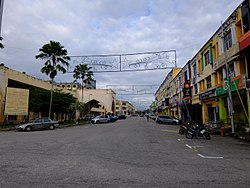
Kemaman Municipal Council building

Key Information

Chukai (Terengganu Malay: Chuka), also known by the name of Kemaman Town (Malay: Bandar Kemaman, Terengganu Malay: Bando Mamang), is a mukim and capital of Kemaman District, Terengganu, Malaysia.

The name "Chukai" (proper spelling of the Malay word: cukai) means 'taxes' in Malay. The town is so named due to its position near the estuary of the Kemaman River, whereby taxes and levies were imposed on riverine traffic, especially during the British colonial period. Chukai is the largest town in southern Terengganu, and its position between the state capitals of Kuantan and Kuala Terengganu as well as proximity to the oil town of Kerteh has turned Chukai into a major commercial hub for the region. The nearby Kemaman Port serves both as a fishing port and supply base for oil platforms off Terengganu's coast.

Attractions

[edit]

Attractions in the vicinity include:

  • The Ma’ Daerah Turtle Sanctuary Centre (near Kerteh)
  • Firefly watching along Sungai Kak Yah (Kak Yah River) in Kampung Ibok
  • The fishing village of Kuala Kemaman
  • Boating and kayaking along the Chukai River at the Bakau Tinggi Recreational Area[2]

Many beaches are within a short driving distance from Chukai. They remain idyllic, undisturbed by the fast-growing pace of development in Terengganu.

Club Med Cherating Beach is about a 15 minutes drive south away from the town centre, towards Kuantan, Pahang. Another world class resort nearby is the Resorts World Kijal (formerly Awana), about 25 minutes drive north from the town centre, towards Kuala Terengganu, the state capital.

[edit]

References

[edit]
[edit]
Revisions and contributorsEdit on WikipediaRead on Wikipedia
from Grokipedia
Chukai, also known as Cukai, is the administrative capital and principal economic hub of the , the southernmost district in the Malaysian state of . Situated along the east coast of , it borders the and lies between the state capital to the north and in neighboring to the south. The town serves as a key gateway for the region's oil and gas industry, with the nearby Kemaman Supply Base acting as a major logistics center for offshore operations. Historically, the area around Chukai has roots tracing back to the BCE, when it was referenced as "" on Ptolemy's maps, indicating early trade connections. Settlement intensified around 300 years ago, led by the explorer Che Wan Teh from , who established the town near the Kemaman River after initial stops at Bukit Mengkuang and Tanjung Geliga; an old in Chukai commemorates this founding. The discovery of oil in the 1970s significantly boosted the district's population and development, transforming Kemaman from a primarily agrarian and -based economy into a diversified one that includes extraction, alongside traditional sectors like along its 38-kilometer coastal stretch, tin , oil palm cultivation, timber production, and foothill farming. The , encompassing Chukai, spans 2,540 square kilometers and had a of approximately 226,600 as of 2023 estimates, with the majority concentrated in coastal areas including the town itself. Chukai's strategic location has fostered growth in , with attractions highlighting its coastal beaches, riverside landscapes, and cultural heritage, while its industrial zones support ongoing energy sector activities. As a vibrant coastal community, it blends Malay traditions with modern , contributing to Terengganu's broader role in Malaysia's east coast development.

History

Etymology and early settlement

The area around Chukai has historical roots tracing back to the 2nd century BCE, when it was referenced as "Kole," a trading port, on maps by the Greek geographer . The name Chukai derives from the Malay word cukai, which means "taxes" or " duties," reflecting the site's historical significance as a location for collecting levies on goods passing through the estuary of the Kemaman . This etymological link underscores the area's early role in regional , where duties were imposed on traded items like products and before formal colonial administration. Chukai was established as a in the early , approximately 300 years ago, by Che Wan Teh, a nobleman from who fled political conflict and settled at the mouth of the Kemaman River. Historical evidence for this founding includes an old in the vicinity, believed to contain the grave of Che Wan Teh himself, who reportedly died shortly after initiating the settlement. His followers subsequently expanded the area, marking the transition from transient outposts to more permanent habitation. Initial settlement patterns in Chukai were shaped by its coastal position, fostering communities centered on and fishing along the shoreline. Early inhabitants primarily comprised Malay groups drawn to the for maritime activities. These patterns emphasized linear villages hugging the riverbanks and beaches, facilitating boat-based interactions with neighboring regions. The Kemaman River was pivotal in early economic pursuits, serving as a conduit for resource extraction including , , and inland goods like and timber transported downstream for . This waterway not only supported subsistence fishing but also enabled and toll collection, laying the groundwork for Chukai's growth as a pre-colonial hub.

Colonial era and modern development

In the late 19th century, tin mining activities began in the Chukai area around the 1870s, initiated by Mandailing migrants from who sought opportunities in the resource-rich regions of Malaya. The inland areas surrounding Chukai were noted for their tin ore deposits, contributing to the town's emergence as an economic node. The establishment of British colonial administration profoundly shaped Chukai's role as a and hub during the late 19th and early 20th centuries. became a in , with Chukai serving as a key export point for local commodities, including minerals and agricultural goods, facilitating along the east . Under British oversight, expanded significantly; iron ore extraction in Kemaman commenced in 1928 under Japanese firms like Nippon Kogyo Koshi, employing nearly 1,000 workers by 1938 and integrating Chukai into broader colonial resource networks despite geopolitical tensions. This period marked infrastructural improvements, such as basic facilities, to support export activities. Following the disruptions of and Japanese occupation, Chukai experienced renewed growth in the post-1940s era. Kemaman was formally incorporated into the in 1948, solidifying its administrative status. After Malaysian independence in 1957, the town integrated fully into the state of , undergoing urban expansion as the capital of , with improved roads and settlements to accommodate growing administrative functions. Key developments in the mid-20th century included the official delineation of around 1948, which centralized governance and spurred local infrastructure projects. Initial oil exploration nearby gained momentum with the first discovery in the Malay Basin in 1969, laying the groundwork for Terengganu's emergence as an energy hub and further boosting Chukai's strategic importance.

Geography

Location and topography

Chukai serves as the capital of in the southern part of state on the east coast of , situated at approximately 4°14′N latitude and 103°26′E longitude. It lies along the coastline, approximately 156 km by road south of the state capital and 60 km north of in neighboring state. As the administrative center of the district, Chukai functions as a key coastal hub in this region. The topography of Chukai features a narrow fringing the , characterized by low-lying terrain with an average elevation of around 8 meters above . The area is dominated by the of the Kemaman River, which spans 167 km and discharges into the sea near the town center, forming a dynamic riverine mouth that shapes the local landscape. Surrounding the plain are scattered low-lying hills that rise intermittently from the flat expanse, interspersed with extensive swamps along segments and estuarine zones. Administratively, Chukai constitutes a spanning approximately 31 square kilometers, with its urban core concentrated along the waterfront where the river meets the sea. This setting exposes the area to environmental challenges, including heightened vulnerability to driven by wave action and dynamics along the shoreline. Tidal influences are significant, with ranges occasionally exceeding 2 meters during high astronomical , affecting the mangroves and low-lying zones through periodic inundation and fluctuations.

Climate and environment

Chukai experiences an equatorial climate classified as , characterized by consistently high temperatures ranging from 23°C to 32°C year-round, with average highs of 28–31°C and lows of 24–25°C. levels remain elevated at 80–90% throughout the year, contributing to a muggy atmosphere, while annual rainfall totals approximately 2,180 mm, distributed unevenly with peaks during the northeast season from to March, when monthly can exceed 400 mm. This seasonal pattern results in frequent overcast skies, particularly from to , with reaching up to 91% during the wetter months. The region's environment features extensive ecosystems along the Kemaman River, which support rich including firefly habitats, diverse insect communities, and such as the river terrapin (Batagur affinis). These , dominated by like Sonneratia caseolaris, exhibit high and serve as critical nurseries for aquatic life, with rates of 0.9–1.1 cm per year sustaining the . state, encompassing Chukai, hosts 29 true , underscoring the area's ecological significance. Environmental challenges include recurrent flooding during the northeast , which has historically affected low-lying areas like Chukai, as seen in severe events in and flooding during the 2024–2025 northeast , including over 3,700 evacuees in as of November 2024, with subsequent waves in December 2024 and January 2025 displacing tens of thousands regionally. Rising sea levels, projected to exacerbate in , further threaten these mangrove zones through increased salinity intrusion and habitat loss. These monsoons disrupt local by causing and crop inundation, while restricting operations due to rough seas and reduced catches during peak wet periods. Conservation initiatives focus on protecting coastal mangroves and , including the Conservation Society of Malaysia's releases of hundreds of river terrapin hatchlings annually into the Kemaman River since 2017, including over 600 cumulative head-started individuals by recent years and 680 in October 2025. Efforts also encompass mangrove restoration in to bolster and mitigate flood risks, with broader state-level protections covering 10% of coastal and marine areas; in 2025, these initiatives continued amid heightened flood risks from the northeast monsoon.

Demographics

According to the 2010 Population and Housing Census conducted by the Department of Statistics Malaysia, Chukai (Mukim Cukai) had a population of 52,812, accounting for about 0.18% of the national total of 28.8 million and featuring an urban density of approximately 1,710 persons per square kilometer (over 30.88 km²). The town's population grew steadily in the early 21st century, increasing to 61,557 by the 2020 census, a rise of 16.5% over the decade. This growth was primarily attributed to internal migration patterns and economic opportunities within the Kemaman District, including rural-urban migration from adjacent areas in Terengganu state as individuals sought improved living conditions and employment prospects in the urban center. As of 2025 estimates, the population of Mukim Cukai is approximately 66,000, reflecting continued demographic momentum fueled by the region's energy sector and diversification. This trajectory underscores the town's evolving role within , where ethnic compositions have indirectly shaped growth through family-based relocations, though detailed breakdowns are addressed elsewhere.

Ethnic composition and languages

Chukai's ethnic composition reflects the broader demographics of Terengganu state, where ethnic Malays, classified as Bumiputera Malay, constitute the overwhelming majority at approximately 94.4% of the . In , of which Chukai is the administrative , this Malay predominance holds, comprising the vast majority of residents, with smaller non-Malay communities adding to the multicultural fabric. A significant Chinese minority, estimated at around 1.8% statewide, is concentrated in Chukai and surrounding areas, particularly among descendants who settled in the late during the boom. These settlers, originating from Island in southern , established enduring communities like Kampung Baru Ayer Jerneh, located about 7 km from Chukai, marking the largest and oldest settlement in . Indian residents form a small group at roughly 0.2% of the state population, while indigenous , primarily from the Semaq Beri subgroup, account for about 0.3% statewide, with 284 individuals residing in two villages within . The linguistic profile of Chukai is dominated by Malay, the of , with the local dialect serving as the primary spoken by the majority ethnic Malay population. In Chinese communities, particularly those of origin, dialects such as and are commonly used alongside Mandarin, which is prominent in and business settings. English functions as a for commerce, administration, and schooling, facilitating interactions across ethnic lines. Cultural integration in Chukai is fostered through inter-ethnic in coastal and markets, as well as shared participation in national festivals, mirroring Terengganu's overall emphasis on harmonious despite the Malay majority. This diversity, rooted in historical migrations like the 19th-century Chinese influx for , contributes to a cohesive dynamic.

Economy

Primary sectors

Chukai's primary economic sectors are anchored in traditional activities that leverage the town's coastal location and inland resources, with serving as a foundational industry. The coastal areas of , where Chukai is situated, feature flat lowlands stretching approximately 38 km from Kuala Kemaman to , supporting extensive fishing operations that engage the majority of the local population. These activities include both coastal and riverine fishing, yielding key marine products such as , with operations centered around natural harbors and estuaries. A notable fishing community exists near Pantai Teluk Mak Nik, a coastal area known for its fisherman village, which contributes to the district's marine harvest alongside production and related facilities. Aquaculture complements traditional fishing, particularly through cockle (Anadara granosa) cultivation in the nutrient-rich estuaries of the region. Kuala Kemaman's estuarine environment supports bivalve populations, including cockles, which are harvested as a sustainable protein source and economic staple in Terengganu's coastal economy. Inland from the coast, small-scale agriculture thrives on hilly terrains, with oil palm and rubber plantations forming key components of land-based production; these crops are cultivated by local communities, including historical settlers who established rubber holdings in the early . Resource extraction includes eco-friendly charcoal production derived from local mangrove forests, which cover areas like Pulau Sekeping and Bakau Tinggi in Chukai-Kemaman; these forests yield high biomass, with annual litter production averaging 13.43 tons per hectare, supporting sustainable processing for domestic and export markets, including to Japan where mangrove charcoal is valued for its quality in barbecuing and purification. Tin mining represents a historical legacy transitioning to minor artisanal efforts; the inland highlands are rich in tin ore deposits, which fueled early economic development in Kemaman before large-scale operations declined, leaving small-scale extraction as a residual activity.

Energy and emerging industries

Chukai, located in the of , benefits from its proximity to major offshore oil and gas fields in the , which support extensive operations in the nearby hub. serves as a key base for ' upstream activities, downstream refining, and production, positioning Chukai as a vital support area for these capital-intensive industries. The oil and gas sector, through its , accounts for a substantial portion of 's , with the subsector—dominated by petroleum-related activities—contributing approximately 36.9% to the state's GDP in 2023. Employment in Chukai's sector revolves around refining, exploration, and ancillary services, with facilities in Kemaman attracting workers and fostering local economic activity. The Kemaman Supply Base, integral to oil and gas logistics, employs personnel in specialized roles tied to offshore operations, underscoring the sector's role in driving workforce influx and skill development in the region. These activities not only sustain thousands of direct and indirect jobs across but also stimulate related services, reinforcing Chukai's position within Malaysia's broader ecosystem. Emerging opportunities in Chukai are anchored by the East Coast Rail Link (ECRL), which includes a dual passenger and cargo station in the town, set to enhance connectivity and economic integration. This infrastructure is projected to elevate Terengganu's statewide GDP from RM34 billion in 2020 to RM48.2 billion by 2040, at an average annual growth rate of 1.8%, primarily through expanded , , and industrial investments. The cargo capabilities at Chukai will facilitate efficient freight movement, supporting energy-related exports and broader supply chain efficiencies. To mitigate over-reliance on hydrocarbons, Chukai and are pursuing diversification into eco-tourism support services and light manufacturing linked to the energy . Light manufacturing, including downstream processing, with initiatives aimed at integrating sustainable practices to bolster regional resilience. Eco-tourism efforts complement these by leveraging natural assets for low-impact economic activities, aligning with broader state goals for balanced growth beyond traditional energy dependencies. In 2025, secured RM4.3 billion in committed investments as of September, primarily led by projects, further supporting economic diversification.

Government and infrastructure

Administrative structure

Chukai serves as both a and the administrative capital of in the state of , , functioning as the central hub for district governance and economic oversight. The district itself is subdivided into 11 s, with Chukai anchoring local administration under the broader framework of state policies. Governance in Chukai is primarily managed by the Kemaman Municipal Council (MPK), which was elevated from the Council on January 1, 2002, through State Enactment No. 5 of 2002. The MPK oversees key responsibilities including and development, and public cleanliness, and safety, supervision of roads, drains, and buildings, as well as the provision of recreational spaces and markets, all in alignment with the Local Government Act 1976 and the Town and Country Planning Act 1976. The council's structure includes a president (mayor), appointed by the , a secretary, council members, and specialized committees such as those for finance and licensing, ensuring coordinated decision-making with stakeholder input. District administration integrates closely with Terengganu state directives, particularly through frameworks like the state's Draft Structure Plan 2050 and national initiatives such as the Twelfth Malaysia Plan (RMK-12) and National Urban Policy 2, emphasizing sustainable development and conservation efforts. Recent MPK initiatives focus on urban heritage protection amid ongoing physical transformations, including tourism promotion through sites like the Kemaman Museum and participation in Low Carbon City programs to balance growth with cultural preservation. This serves a population of approximately 228,000 residents across the district as of the 2024 mid-year estimate.

Transportation and utilities

Chukai's road network is primarily anchored by Federal Route 3, a major federal highway that runs along Malaysia's east coast, connecting the town to in the south and in the north, facilitating both local and intercity travel. Local public transportation includes bus services operated by companies such as Ekspres Mutiara, which provide regular routes from Chukai's bus terminal to nearby destinations like , with fares ranging from RM 21 to RM 29 for a journey of approximately 2 hours and 45 minutes. Taxis and ride-hailing options like Grab are widely available in the urban core, offering convenient short-distance mobility for residents and visitors. The East Coast Rail Link (ECRL) is set to enhance Chukai's connectivity with a dedicated station in Kemaman, designed to handle both passenger and cargo services, integrating with the network to support , particularly from the region's energy sectors. Construction progress in the area reached 93.55% as of October 2025, with the overall project at 88% complete as of November 2025; power generation works commenced on October 29, 2025, though recent cable thefts in and caused RM2.9 million in losses. The project is slated for completion by the end of 2026 and full operations commencing in January 2027. This development will link Chukai to key economic hubs, including Gombak in the west, promoting efficient for industrial outputs. Kemaman Port serves as a vital maritime facility near Chukai, accommodating small shipments alongside its primary role in oil exports and trade, while supporting local activities through waterfront access. The port handles diverse such as petroleum products, chemicals, and dry bulk, with capabilities for vessels up to 150,000 DWT, operating year-round as an all-weather deep-sea terminal. operations, including recreational and commercial catches, are prominent in the surrounding waters, contributing to . River transport along the Kemaman River, which flows through Chukai, historically facilitated regional movement but is now used primarily for limited local navigation and environmental monitoring rather than extensive commercial purposes. Utilities in Chukai are reliably provided through national and state-managed systems, with electricity distributed by via the interconnected grid, supplemented by backups from nearby facilities to ensure stability during peak demands. Water supply is sourced from treatment plants such as the upgraded Bukit Sah Water Treatment Plant in Kemaman, which has a capacity of 255 million liters per day, serving over 300,000 consumers in the district following its retrofitting in 2022. Sewerage services are undergoing improvements as part of national plans, including the Sewerage Catchment Plan for Sungai Chukai, which outlines development projects and refurbishments to enhance coverage and capacity in the Kemaman area.

Culture and tourism

Cultural heritage

Chukai's cultural heritage is predominantly shaped by Malay traditions, reflecting the town's roots in state's east coast fishing communities, with notable influences from early Chinese settlers who contributed to local crafts and commerce. Traditional architecture is evident in the shophouses and mosques that line the historic core, featuring elevated wooden structures on stilts to combat flooding, intricate wood carvings such as motifs, and steeply pitched roofs adapted to the climate. Mosques like Masjid Ahmad exemplify this style, blending with local Malay elements in their minarets and halls. Festivals and customs underscore the community's vibrant traditions, including the observance of Hari Raya Aidilfitri, marked by communal prayers, feasting on and , and open houses that reinforce social bonds among Malay residents. is similarly celebrated with lion dances, family reunions, and traditional foods like yu sheng, highlighting the multicultural fabric influenced by Chinese merchant communities. Local fishing rituals, such as the dance performed by fishermen to honor sea spirits for bountiful catches, persist in coastal areas, while performances of (a martial art with fluid, defensive movements) and (acrobatic choral poetry recitals) are showcased during community gatherings, preserving oral histories and rhythmic arts. The town's heritage sites, particularly old waterfront buildings along the Kemaman River, have undergone significant spatial transformations since the , evolving from wooden trading posts and godowns to modern structures amid . These sites, once central to and , face decline due to demolitions for commercial redevelopment, with only one of 28 identified historic buildings from remaining intact by 2021. Preservation efforts by the Kemaman Municipal Council include documentation through heritage surveys and selective restorations, such as at Kampung Tuan Mosque, to mitigate urban loss. The 2050 Draft Structure Plan designates Chukai as a heritage conservation corridor, promoting policies for mapping and protecting cultural assets, though implementation remains challenged by rapid development pressures.

Tourist attractions

Chukai, the administrative center of in , , attracts visitors with its coastal natural sites focused on and serene experiences. The Ma’ Daerah Turtle Sanctuary Centre, located between and Paka in Kemaman, spans a 1.7 km sandy backed by 70 hectares of coastal , serving as a key site for nesting and hatching from March to October. Visitors can participate in guided conservation tours, including educational sessions on protection and the release of hatchlings into the sea, emphasizing sustainable practices to safeguard . Similarly, the Teluk Mak Nik Turtle Hatchery in Geliga, just a 10-minute drive from Chukai town, offers comparable experiences with its focus on incubating green eggs laid during the nesting season, allowing tourists to observe and contribute to release programs amid basic facilities like gazebos and picnic areas. For evening eco-adventures, firefly watching tours along Sungai Yak Yah in Kampung Ibok, approximately 14 km from Chukai, provide a mesmerizing display of bioluminescent in the mangrove-lined . These silent boat rides, typically conducted from dusk onward, highlight the area's rich and support local conservation efforts by promoting low-impact tourism in the surrounding wetlands and gardens. Cultural attractions include the Kemaman District Museum, housed in a restored 1920s building blending English and Moorish architecture at Lot 132, Jalan Sulaimani in central Chukai. The museum exhibits artifacts, documents, and records honoring notable Terengganu figures in politics, sports, culture, religion, literature, and education, offering insights into the district's historical and social development. Beach activities draw crowds to Teluk Mak Nik (also known as Monica Bay), a pristine stretch along the where visitors enjoy , picnics, and casual against a backdrop of white sands and gentle waves. The site's proximity to Chukai—about 10 minutes by car—makes it ideal for day trips, with its calm waters suitable for families year-round, enhanced by the tropical climate's consistent warmth. Emerging eco-tours in nearby mangroves, such as those integrated with turtle conservation programs around Kemaman's coastal areas, allow participants to explore wetland ecosystems through guided river cruises and planting activities, fostering awareness of mangrove habitats vital to marine life. Tourism in Chukai has gained momentum with improved infrastructure, particularly the East Coast Rail Link (ECRL), which includes a station in Chukai and is expected to commence operations in January 2027, enhancing connectivity and stimulating visitor arrivals by integrating with regional trade and leisure networks. This development is projected, as of November 2025, to contribute to Terengganu's overall GDP growth to RM48.2 billion by 2040, partly through boosted eco- and cultural tourism in districts like Kemaman. As of March 2025, the East Coast Economic Region Development Council (ECERDC) has committed RM1 billion in investments to accelerate Terengganu's tourism-led growth, creating over 1,000 jobs and supporting attractions in Kemaman.

References

Add your contribution
Related Hubs
User Avatar
No comments yet.