


Community hub
Recent from talks
Contribute something
Nothing was collected or created yet.
Cessna Citation Excel
View on Wikipedia
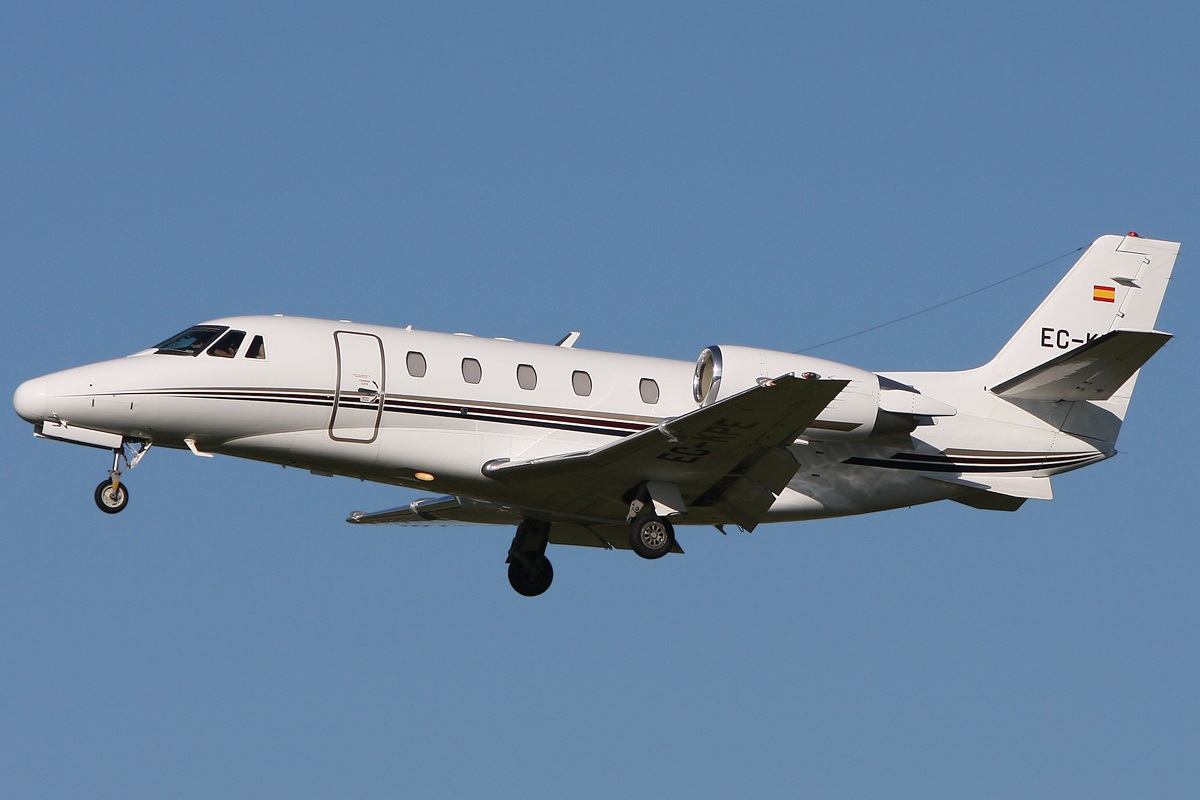
The Cessna Citation Excel is an American midsize business jet in the Cessna Citation family. Announced in October 1994, the Model 560XL first flew on February 29, 1996, certification was granted in April 1998, and over 1,000 have been delivered. The 2,100 nmi-range (3,900 km), 20,200 lb (9,200 kg) MTOW jet is powered by two 3,650–4,080 lbf (16.2–18.1 kN) PW545 turbofans, has the cruciform tail and unswept supercritical wing of the Citation V (560), and a slightly shortened Citation X stand-up cabin. The XLS 2004 update had upgraded engines and a glass cockpit and the 2008 XLS+ had upgraded engines and a revised nose. The Citation Ascend, which entered service in 2025, has interior, communications and avionics updates, a flat cabin floor, and enlarged windows.
Key Information


Development
[edit]
With the success of Cessna's high-end Citation VII, the manufacturer saw a market for an aircraft with the Citation X's features but aimed at a more traditional market, where it would chiefly compete with twin-turboprop aircraft.
The project was announced at the annual NBAA convention in October, 1994, and the prototype aircraft took off on its first flight on February 29, 1996. Federal Aviation Administration certification was granted in April 1998, by which time Cessna had over 200 orders for the aircraft. Its unit cost in 1999 was US$8.7M.[2] By the time the 100th Excel was delivered in August 2000, an aircraft was coming off the Wichita production line every three days.[3] A total of 308 were built before production switched to the Citation XLS.[1]
The Citation XLS was the first "makeover" that the Excel received, with deliveries beginning in 2004. Besides a glass cockpit based on the Honeywell Primus 1000 EFIS avionics suite, the XLS featured the upgraded PW545B engines with increased performance.[4] It was produced in 330 units.[1] By 2018, ten year old XLS models were trading near $4 million.[5]
The Citation XLS+, or simply "Plus" configuration was another upgraded version of the aircraft which began delivery in 2008, with the inclusion of FADEC engine controls, improved PW545C engines, and a completely revised nose design similar to that found on the Citation Sovereign and Citation X. The Citation XLS+ features Collins Pro Line 21 Avionics and a four screen LCD EFIS display as opposed to the three tube (CRT) Honeywell display in the XL and the three screen LCD Primus 1000 in the XLS.[6] In 2023, its equipped price was $16.11M.[7]
The Citation Ascend was announced at the EBACE industry conference in May 2023. It features new avionics, engine improvements, and an upgraded interior featuring a flat cabin floor, enlarged windows and swiveling passenger seats.[8] The Ascend entered service in December 2025.[9]
Design
[edit]
To produce the Excel, Cessna took the X's cabin fuselage (itself inherited from the Citation III), shortened it by about 2 feet (0.61 m), and mated it with an unswept wing utilising a supercritical airfoil based on the Citation S/II's wing and the tail from the Citation V.
The Excel has the roomiest cabin in its class of light corporate jets and can seat up to 10 passengers (in high-density configuration; typically the number is six to eight in a corporate configuration), while being flown by a crew of two.[3]
To power the aircraft, Cessna chose the Pratt & Whitney Canada PW500 turbofan.
The original version had two cockpit configurations involving where the landing gear was on the panel. With the gear on the left hand side, the MFD was moved to the right slightly and both radios were moved to the right of the MFD next to each other. With the gear handle on the right side, the MFD remained centered with the radios on either side. The Excel uses Honeywell avionics and an optional Auxiliary power unit also powered by Honeywell.
Operators
[edit]The aircraft is operated by private individuals, companies, fractionals, charter operators and aircraft management companies. The Swiss Air Force is an operator. NetJets is also a major operator in the United States offering fractional ownership and charter flights.
The 560's ICAO aircraft type designator is C56X.
Accidents and incidents
[edit]As of September 2021, the Citation Excel had been involved in eleven aviation accidents and incidents including six hull losses, with eleven fatalities stemming from two of the crashes.[10] On 13 August 2014, a Citation 560XLS+ transporting Brazilian presidential candidate Eduardo Campos and his entourage in the lead up to elections in October crashed in the city of Santos, São Paulo, killing all 7 on board.[11] This was the first fatal crash of a Citation Excel since entering service in 1996.[12]
Specifications (Citation XLS+)
[edit]Data from Cessna Citation XLS+ web site [6]
General characteristics
- Crew: 2
- Capacity: 9 passengers / 7,400 lb (3,357 kg) useful load
- Length: 52 ft 6 in (16.0 m)
- Wingspan: 56 ft 4 in (17.17 m)
- Height: 17 ft 2 in (5.23 m)
- Empty weight: 12,800 lb (5,806 kg)
- Max takeoff weight: 20,200 lb (9,163 kg)
- Powerplant: 2 × Pratt & Whitney Canada PW545C turbofans, 4,119 lbf (18.32 kN) thrust each
Performance
- Cruise speed: 441 kn (507 mph, 816 km/h) true airspeed
- Range: 1,858 nmi (2,138 mi, 3,441 km)
- Service ceiling: 45,000 ft (13,716 m)
- Rate of climb: 3,500 ft/min (17.78 m/s)
See also
[edit]Related development
Aircraft of comparable role, configuration, and era
References
[edit]- ^ a b c "Textron Aviation Delivers 1,000th Citation 560XL Twinjet". AIN Online. March 31, 2021.
- ^ "citation excel strives to be two jets in one". Aviation Week. February 8, 1999.
- ^ a b The Cessna 560XL Citation Excel from Airlines.net
- ^ Cessna Citation XLS web site Archived February 23, 2007, at the Wayback Machine
- ^ Mark Huber (December 2018). "For many models, market hitting the apex" (PDF). Aviation International News. pp. 20–21, 24. Archived from the original (PDF) on December 27, 2018. Retrieved December 27, 2018.
- ^ a b Cessna Citation XLS+ web site Archived February 27, 2009, at the Wayback Machine
- ^ "Purchase planning handbook - Jets table". Business & Commercial Aircraft. Second Quarter 2023.
- ^ "Textron Aviation Unveils Newest Addition to Bestselling Business Jet Family: Cessna Citation Ascend". Textron Inc. (Press release). May 22, 2023.
- ^ Ryan, Matt (January 2, 2026). "Cessna Citation Ascend Enters Service With First Customer Delivery". avweb.com. Retrieved January 14, 2026.
- ^ "Accident list: Cessna 560 Citation Excel". Aviation Safety Network. September 5, 2021. Retrieved September 5, 2021.
- ^ Gustavo Bonato (August 13, 2014). "Brazil presidential candidate Campos killed in plane crash". Reuters. Archived from the original on September 24, 2015. Retrieved June 30, 2017.
- ^ "Crash of a Cessna 560XLS+ Citation Excel in Santos: 7 killed". Bureau of Aircraft Accidents Archives. 13 August 2014. Archived from the original on 19 August 2014. Retrieved 15 August 2014.
External links
[edit]
Cessna Citation Excel
View on GrokipediaDevelopment
Initial Program
In October 1994, Cessna Aircraft Company announced the development of the Model 560XL, later known as the Citation Excel, at the National Business Aviation Association (NBAA) convention, positioning it as a midsize business jet to bridge the gap between light jets and super-midsize aircraft by offering enhanced cabin comfort and performance.[5][1] The design incorporated a shortened fuselage derived from the Citation X for a stand-up cabin, mated to a lengthened wing based on the Citation V Ultra to achieve improved range and speed while preserving short-field capabilities typical of lighter Citations.[6][7] Prototype construction began in early 1995, leading to the first flight on February 29, 1996, during which test pilots evaluated handling qualities, aerodynamic stability, and integration of the Pratt & Whitney Canada PW545A engines with the airframe systems.[8][9] The certification program involved over 1,000 hours of flight testing across multiple prototypes, focusing on stall recovery, high-speed characteristics, and single-engine operations to meet stringent safety standards. The Federal Aviation Administration (FAA) granted type certification on April 22, 1998, under Type Certificate A22CE, with concurrent approval from the Joint Aviation Authorities (JAA), enabling global operations.[10][11] Initial customer deliveries commenced in July 1998, with the first production aircraft handed over to Aviation Services International of Phoenix, Arizona, on July 2.[5] Production quickly ramped up, reaching a rate of one aircraft every three days by mid-2000, equivalent to approximately 120 units annually at peak, and surpassing 100 deliveries by August of that year.[8] By the end of 2004, when production transitioned to the upgraded XLS variant, over 300 Citation Excel units had been delivered, with an initial equipped price of around $12 million.[12][1]XLS Series Upgrades
The Cessna Citation XLS, introduced for the 2004 model year, represented a significant evolution from the original Citation Excel, incorporating a Honeywell Primus 1000 glass cockpit for enhanced situational awareness and pilot workload reduction.[13] This upgrade was paired with Pratt & Whitney Canada PW545B engines, each delivering 3,975 lbf of thrust, which improved climb performance and overall efficiency compared to the baseline model's powerplants.[14] Additionally, the maximum takeoff weight (MTOW) was increased to 20,200 lb, allowing for greater payload flexibility while maintaining the midsize jet's operational versatility.[15] Subsequent enhancements to the XLS included the integration of full-authority digital engine control (FADEC) systems in later production builds, which optimized engine performance and fuel management.[16] These changes contributed to superior hot-and-high altitude capabilities, enabling reliable operations from challenging airfields, and the aircraft achieved certification for reduced vertical separation minimum (RVSM) airspace, broadening its global accessibility.[17] Production of the XLS spanned from 2004 to 2008, with 330 units delivered, reflecting strong demand for its balanced performance in the midsize segment.[14] The Citation XLS+ was launched in 2008 as a refined iteration of the XLS, featuring Pratt & Whitney Canada PW545C engines rated at 4,119 lbf of thrust each for further gains in power and efficiency.[15] A redesigned nose contour improved aerodynamic efficiency, reducing drag and enhancing overall performance, while cabin modifications, including advanced soundproofing materials, lowered interior noise levels for greater passenger comfort.[18] Equipped with the Collins Aerospace Pro Line 21 avionics suite as standard, the XLS+ offered four-screen LCD displays and advanced navigation capabilities. Production transitioned to the XLS+ starting in 2008 and continued until the introduction of the Ascend, with approximately 700 units delivered by 2025 (including post-2021 production); the entire 560XL series, encompassing the Excel, XLS, and XLS+, exceeded 1,000 deliveries by 2021 and XLS+ production continued into 2025.[19][20] To extend the service life of earlier Citation Excel and XLS aircraft, Textron Aviation introduced retrofit programs in the 2010s, allowing owners to modernize to XLS standards, including upgrades to the Collins Pro Line 21 avionics for compliance with evolving airspace requirements and improved redundancy.[21] These options encompassed engine enhancements, structural modifications, and interior refreshes, often completed at authorized service centers to minimize downtime. Market reception for the upgrades was positive, with initial XLS pricing around $10 million in 2004 evolving to approximately $15 million for the XLS+ by 2008, underscoring the series' appeal for cost-effective midsize operations that prioritized reliability and low direct operating costs.[22][23]Citation Ascend
The Cessna Citation Ascend represents the latest evolution in the Citation XLS series. The FAA granted type certification on November 5, 2025, with initial deliveries planned for 2026. It incorporates advancements such as enhanced fuel-efficient engines and modernized avionics for improved operational efficiency. Building briefly on the heritage from the Citation XLS+, it introduces targeted upgrades for better performance and pilot workload reduction while maintaining the midsize jet's core design principles.[24][25]General Characteristics
The Citation Ascend is certified for a crew of 1–2 pilots and supports a maximum passenger capacity of 12 in its spacious cabin. Key airframe dimensions include an overall length of 52 ft 8 in (16.05 m), a wingspan of 55 ft 8 in (16.97 m), and a height of 17 ft 3 in (5.26 m). The maximum takeoff weight (MTOW) stands at 20,500 lb (9,299 kg), with a basic operating empty weight of 13,110 lb (5,948 kg). These parameters enable versatile operations on shorter runways while accommodating typical business jet payloads.[24][26][27]| Parameter | Value |
|---|---|
| Crew | 1–2 |
| Passengers | Up to 12 |
| Length | 52 ft 8 in (16.05 m) |
| Wingspan | 55 ft 8 in (16.97 m) |
| Height | 17 ft 3 in (5.26 m) |
| MTOW | 20,500 lb (9,299 kg) |
| Basic Operating Empty Weight | 13,110 lb (5,948 kg) |
Powerplant
The aircraft is powered by two Pratt & Whitney Canada PW545D turbofan engines, each delivering 4,213 lbf (18.74 kN) of thrust. These engines provide a 2025 advancement in fuel efficiency over predecessors, contributing to extended range and reduced operating costs without compromising climb performance.[24][28][29]Performance
Performance metrics for the Citation Ascend emphasize balanced speed, range, and accessibility for midsize operations. It achieves a maximum cruise speed of 441 ktas (817 km/h) and a high-speed cruise of 441 ktas, with a maximum range of 1,940 nmi (3,593 km) under NBAA IFR reserves with 4 passengers. The service ceiling reaches 45,000 ft (13,716 m), allowing efficient high-altitude flight to minimize weather disruptions. Takeoff field length is 3,800 ft (1,158 m) at MTOW, and landing distance is 3,180 ft (969 m), supporting operations at a wide array of airports.[24][30][27]| Parameter | Value |
|---|---|
| Maximum Cruise Speed | 441 ktas (817 km/h) |
| High-Speed Cruise | 441 ktas |
| Range (NBAA IFR, 4 pax) | 1,940 nmi (3,593 km) |
| Service Ceiling | 45,000 ft (13,716 m) |
| Takeoff Distance (MTOW) | 3,800 ft (1,158 m) |
| Landing Distance | 3,180 ft (969 m) |
Fuel Capacity and Endurance
The Citation Ascend features a total fuel capacity of 1,006 US gal (3,808 L), equivalent to approximately 6,740 lb (3,056 kg) at standard jet fuel density. This supports a typical endurance of about 4.5 hours during high-speed cruise missions, aligning with its range capabilities for transcontinental flights. The PW545D engines' efficiency enhancements in 2025 contribute to optimized fuel burn rates.[27][26]Avionics
The flight deck integrates the Garmin G5000 avionics suite, a key 2025 advancement featuring three 14-inch ultra-high-resolution touchscreen displays for primary flight and navigation information. Standard equipment includes autothrottle for automated power management, synthetic vision technology for enhanced situational awareness, and four touchscreen controllers for intuitive operation. These features reduce pilot workload and incorporate flight-envelope protection, marking a shift from prior Collins systems in the XLS lineage.[31][32][33]Design
Airframe and Cabin
The Cessna Citation Excel family utilizes a fuselage derived from the Citation X design, shortened to an overall length of 52 feet 6 inches to balance performance and cabin spaciousness while retaining a stand-up interior height of 5 feet 8 inches. This configuration features a circular cross-section optimized for efficient pressurization, achieving a maximum differential of 9.3 psi to maintain a comfortable cabin altitude of 6,800 feet at 45,000 feet flight level.[17] The wing assembly incorporates moderately swept supercritical airfoils adapted and lengthened from the Citation V, providing a span of 56 feet 4 inches and a surface area of 371 square feet. Single-slotted flaps enhance low-speed handling, contributing to the model's short-field capabilities on runways as short as 4,000 feet. The empennage employs a cruciform tail layout with a split rudder for effective yaw control, paired with trailing-link landing gear that ensures smoother taxiing and touchdown compared to earlier straight-leg designs.[34] Later variants, such as the XLS+ and Ascend, integrate composite materials in select components to reduce weight without compromising structural integrity.[35] Cabin accommodations center on a versatile layout typically seating 8 to 9 passengers in a club arrangement, with a total volume of 422 cubic feet for the original Excel (increasing to 461 cubic feet in XLS and later models) that includes a dedicated full lavatory and 80 cubic feet of external baggage space accessible via a dedicated compartment.[36][37] Acoustic insulation and triple-pane windows contribute to a quiet cabin environment.[1] Interior refinements have evolved across the series, with the XLS+ introducing premium leather upholstery, LED ambient lighting, and enhanced connectivity options for a more refined experience. The Citation Ascend, certified by the FAA on November 5, 2025 with entry into service planned for late 2025, advances this further with modular zoning options that support configurable work and rest areas, including electrically adjustable seats with swivel and tracking functions for greater flexibility.[35][31] Safety provisions align with FAR Part 25 transport category standards, featuring four emergency exits, an integrated fire suppression system in the lavatory and baggage areas, and a comprehensive oxygen distribution setup for rapid deployment.[38] The airframe's robust construction briefly accommodates engine integration for balanced aerodynamics and allocates cockpit space efficiently for avionics interfaces.Propulsion and Avionics
The Cessna Citation Excel is powered by two Pratt & Whitney Canada PW545A turbofan engines, each producing 3,804 pounds of thrust, providing reliable performance for midsize operations.[1][39] Subsequent variants upgraded this lineup for enhanced efficiency and power; the Citation XLS features PW545B engines at 3,975 pounds of thrust each, while the XLS+ employs PW545C engines delivering 4,119 pounds per side.[40][41][15] The Citation Ascend, certified in November 2025, introduces the PW545D engines, rated at 4,213 pounds of thrust, incorporating efficiency improvements in the compressor and turbine sections to reduce fuel burn and support sustainable aviation fuel blends up to 50%.[42][43][44][45] Propulsion systems in the Excel series emphasize automated management for operational simplicity. The original Excel uses single-channel digital electronic engine controls (DEEC) with hydromechanical backup, enabling manual fuel flow adjustments in emergencies.[46] Starting with the XLS, dual-channel full authority digital engine control (FADEC) was implemented, facilitating automatic engine starts, thrust optimization, and integration with autothrottle systems in later models.[47][48] An optional Honeywell RE100 auxiliary power unit (APU) provides ground power and engine starting capability across variants.[49] Avionics in the Citation Excel evolved from hybrid analog-digital setups to fully integrated glass cockpits. The baseline Excel and XLS models feature the Honeywell Primus 1000 electronic flight instrument system (EFIS), combining electronic primary flight displays with some analog instrumentation for essential functions, including traffic collision avoidance system (TCAS) and terrain awareness warning system (TAWS) integration.[50][48] The XLS+ transitioned to the Collins Aerospace Pro Line 21 suite, offering four landscape-oriented glass displays, enhanced situational awareness through integrated flight information, and compliance with next-generation airspace requirements.[51] In the Ascend, the Garmin G5000 avionics suite advances this further with three 14-inch high-resolution touchscreen displays, synthetic vision technology for terrain and obstacle rendering, split-screen multitasking, and predictive weather radar, alongside dual flight management systems for streamlined navigation.[25][30][52] Flight controls across the series rely on hydraulic actuators for primary surfaces, ensuring responsive handling in a conventional configuration.[34] The Excel and earlier variants use mechanical linkages with unboosted bell cranks and pushrods, augmented by the autopilot within the Primus 1000 for stability.[34] Later models, including the Ascend, incorporate digital automatic flight control systems (AFCS) with envelope protection and autothrottle integration, providing stability augmentation without full fly-by-wire implementation.[53][43] Maintenance for the propulsion systems is structured for high utilization, with the PW545 series engines requiring hot section inspections at 2,500 hours and overhauls at 5,000 hours in earlier variants.[54][46] The XLS+ extends airframe intervals to 800 hours or 12 months, supporting up to 800 cycles annually in demanding operations.[55] For the Ascend's PW545D, intervals improve to 3,000 hours for hot sections and 6,000 hours for overhauls, aided by engine health monitoring for predictive maintenance.[56]Operators
Civil Operators
The Cessna Citation Excel family, encompassing the original Excel, XLS, and XLS+ variants, is predominantly operated by civil users in fractional ownership, charter services, and corporate fleets. NetJets, the world's largest private jet operator, maintains the biggest fleet of these aircraft, with approximately 76 Citation XLS variants in service as of late 2025, supporting its fractional ownership and charter programs across North America and Europe.[57] As the launch customer for the upcoming Citation Ascend, NetJets announced a landmark agreement in 2023 for up to 1,500 Cessna Citation jets, including the Ascend model, to bolster its global operations through 2038.[58] Other prominent fractional and charter providers include VistaJet, which operates Citation XLS aircraft for on-demand charters, particularly in Europe and transatlantic routes, emphasizing the model's efficiency for midsize missions.[59] In North America, flyExclusive ranks as the second-largest operator of Cessna Citation jets, including Excel and XLS models, operating approximately 100 Citation jets as of 2025 and taking delivery of its first XLS Gen2 in September 2025, with plans to expand its fleet through new deliveries of XLS Gen2 variants.[60][61] Wheels Up has historically utilized refurbished Citation XLS aircraft in its membership-based air taxi services, and retired its Citation fleet in 2025 to transition to other midsize platforms.[62][63] Corporate users represent a significant portion of the Excel family's operators, with over 70% of the more than 1,000 delivered units in the series serving private individuals and corporate executive transport fleets.[64] For the XLS variant alone, a majority (approximately 238 of around 320 active aircraft as of 2025) are wholly owned, typically by corporations for efficient regional travel.[65][14] These fleets prioritize the aircraft's balance of range, speed, and low operating costs, making it ideal for business missions of 1,500 to 2,000 nautical miles. Globally, the Excel series fleet is concentrated in the United States with several hundred units, followed by Europe (around 24% of the XLS fleet) and a growing presence in Asia, reflecting demand for versatile midsize jets in business aviation hubs as of 2025.[14] The resale market remains active, with 5-6% of the fleet listed for sale annually, supporting transitions to upgraded models like the XLS Gen2.[65] Economically, the aircraft's appeal lies in its direct operating costs of about $3,500 per hour, including fuel, maintenance, and crew, positioning it as a cost-effective choice for frequent short- to medium-haul flights.[66] Upgrade programs, such as the Garmin G5000 avionics retrofit available since 2024, extend airframe service life into the 2030s by enhancing safety, efficiency, and compliance with modern standards.[67]Military Operators
The Swiss Air Force operates a single Cessna 560XL Citation Excel, registered as T-784, for VIP transport and liaison missions supporting government officials, federal departments, and military personnel.[68] Acquired in 2005 and based at Bern-Belp Airport, the aircraft is managed by the Lufttransportdienst des Bundes (LTDB) and has been the primary dedicated business jet in the fleet for such roles.[69] This procurement marked one of the early military adoptions of the Citation Excel series in the mid-2000s, emphasizing its versatility for short- to medium-range executive transport within Europe.[70] The T-784 features standard Citation Excel configuration adapted for government use, including secure communications, but lacks specialized reconnaissance modifications.[71] The Swiss Air Force received a Bombardier Global 7500 in December 2024, which is scheduled to enter service by the end of 2025 to replace the Citation Excel and handle expanded long-range requirements while incorporating enhanced military self-protection systems.[72] No other confirmed military operators of the Citation Excel or its XLS variants exist globally, reflecting the type's predominant civil applications over dedicated defense roles.[73]Accidents and Incidents
Notable Accidents
One of the most tragic incidents involving the Cessna Citation Excel family occurred on August 13, 2014, when Brazilian-registered Cessna 560XLS+ PR-AFA stalled and crashed during a go-around attempt at Santos Air Force Base in São Paulo, Brazil, resulting in the deaths of all seven occupants, including two pilots and five passengers.[74] The Brazilian Centre for Investigation and Prevention of Aeronautical Accidents (CENIPA) determined the primary cause as pilot error, specifically spatial disorientation and improper execution of the missed approach procedure in adverse weather conditions featuring rain, mist, reduced visibility to 3 km, and a low ceiling of 800 ft, with a minor tailwind component on a wet runway contributing to the instability.[74] Investigation revealed inadequate pilot training, including a lack of transition training for the XLS+ variant and no simulator sessions, underscoring the need for enhanced proficiency in non-standard approaches and weather-related procedures.[74] In a separate fatal event on September 2, 2021, U.S.-registered Cessna 560XLS+ N560AR failed to become airborne during takeoff from Robertson Airport in Farmington, Connecticut, crashing into a nearby building and killing all four occupants—two pilots and two passengers—while injuring four people on the ground.[75] The National Transportation Safety Board (NTSB) attributed the accident to the pilot's failure to release the parking brake, which applied continuous braking force and created a nose-down pitching moment, preventing acceleration on the 3,665-ft runway despite adequate aircraft weight and balance calculations.[75] This incident highlighted procedural lapses in pre-takeoff checklists, with the NTSB recommending design changes to include parking brake warnings in future Citation models to mitigate similar risks.[75] A non-fatal runway excursion took place on June 28, 2024, involving Austrian-registered Cessna 560XL OE-GZK operated by International Jet Management (IJM) during landing at Amsterdam Airport Schiphol, Netherlands, where the aircraft veered off runway 22, sustaining substantial damage but resulting in no injuries to the three crew members.[76] The Dutch Safety Board (DSB) is investigating potential issues with the landing gear retraction sequence, electrical systems, and hydraulics, as no warnings were reported prior to touchdown; preliminary analysis of flight data and voice recorders is ongoing.[77] This event prompted IJM to ground its Citation XLS fleet temporarily and ultimately retire the involved aircraft, reflecting operator concerns over maintenance and system reliability.[78] On August 7, 2025, Kenyan-registered Cessna 560XLS 5Y-FDM, operated by AMREF Flying Doctors, crashed shortly after takeoff from Nairobi Wilson Airport, impacting a residential area in Mwihoko, Kiambu County, resulting in the deaths of all four occupants and two people on the ground.[79] The aircraft was on an ambulance flight to Hargeisa, Somalia, when it experienced loss of control during climb. The Kenyan Aircraft Accident Investigation Department is investigating, with preliminary findings pointing to possible mechanical issues or pilot response; a final report is pending as of November 2025.[80] Post-2014 incidents with the Citation Excel family have predominantly been non-fatal, often involving runway excursions, procedural errors, or minor system malfunctions, contributing to a total of over 20 reported events by November 2025.[81] NTSB and international reports, including those from CENIPA, have consistently emphasized the importance of recurrent training for short-field operations—leveraging the type's capable 2,677-ft takeoff distance—and the reliability of its Full Authority Digital Engine Control (FADEC) system, which has shown no major failures in investigated cases but requires vigilant monitoring during high-workload phases.[75][74]Safety Record
The Cessna Citation Excel series, encompassing the original Excel, XLS, and XLS+ variants, has maintained a favorable safety record since entering service in 1998, with relatively few serious accidents given the fleet's size of over 1,000 units and millions of accumulated flight hours. Data from the Aviation Safety Network indicates 10 hull losses and 21 fatalities across 41 recorded aviation occurrences through November 2025, reflecting a low incident rate for midsize business jets that falls below the general aviation average of approximately 1.0 accidents per 100,000 flight hours.[81][82] Fatalities have been concentrated in a small number of events, with major losses including 7 in the 2014 Santos, Brazil crash attributed to pilot spatial disorientation during approach, 4 in the 2021 U.S. takeoff accident due to an unreleased parking brake, and 6 in the 2025 Kenyan crash involving loss of control shortly after departure. No fatalities have been reported in U.S.-registered operations since the 2021 event, highlighting improved outcomes in regulated environments. Common causes across incidents include pilot error in roughly 40% of cases (e.g., approach mishandling or configuration oversights), weather and icing contributing to about 30%, and mechanical issues like early-model engine failures accounting for 20%, based on analyses of Citation family accidents.[83][79][84] Safety enhancements in upgraded models have further mitigated risks. The post-2008 XLS+ introduction of full-authority digital engine control (FADEC) and glass cockpits with Collins Pro Line 21 avionics has reduced pilot-error-related incidents by enhancing situational awareness and automation, contributing to a reported 50% drop in such errors compared to earlier variants. The Citation Ascend variant incorporates advanced autoland systems to bolster safety in low-visibility operations. Regulatory measures include FAA airworthiness directives and the 2022 software updates tied to XLS Gen2 certification for improved avionics reliability. Annual insurance premiums for XLS+ models remain stable at around $21,700, reflecting the type's strong risk profile.[85][86][87] In comparison to peers like the Gulfstream G100, the Citation Excel series shows superior safety metrics, with fewer hull losses per delivered aircraft and operator-reported dispatch reliability exceeding 99%. These trends underscore ongoing improvements in design, training, and maintenance that have sustained the model's reputation in business aviation.[88]Specifications
Citation Excel
The Cessna Citation Excel (Model 560XL) represents the baseline midsize business jet in its series, certified by the FAA in 1998 and entering service that year. Designed for efficient operations on routes up to 1,800 nautical miles, it combines a roomy cabin with strong performance from twin turbofans, making it suitable for corporate travel and fractional ownership programs. The aircraft's baseline configuration emphasizes reliability and ease of maintenance, with later variants like the XLS introducing enhancements such as increased weights and range.[1]General Characteristics
The Citation Excel accommodates a crew of 2 pilots and up to 9 passengers in a standard configuration, featuring a cabin with stand-up headroom and a dropped center aisle for comfort. Its airframe measures 52 ft 6 in in overall length, with a wingspan of 56 ft 4 in and height of 17 ft 2 in. The maximum takeoff weight stands at 20,000 lb, while the typical basic empty weight is 12,150 lb.[36][2]Powerplant
Power is provided by two Pratt & Whitney Canada PW545A turbofan engines, each delivering 3,804 lbf of thrust for takeoff. These engines incorporate full-authority digital engine control (FADEC) for optimized performance and fuel efficiency, with a time between overhaul of 5,000 hours.[89][1]Performance
The Citation Excel achieves a maximum cruise speed of 441 kn and a long-range cruise speed of 367 kn at high altitudes. Its NBAA IFR range with 4 passengers and reserves is 1,800 nmi, supported by a service ceiling of 45,000 ft. Takeoff distance over 50 ft is 3,850 ft at sea level under standard conditions, while landing distance over 50 ft is 3,650 ft. These metrics enable operations from shorter runways compared to larger jets, enhancing versatility for regional airports.[89][39]Fuel Capacity and Endurance
Usable fuel capacity is 5,800 lb (862 US gal), providing a typical endurance of 3.5 hours in high-speed cruise with reserves. Fuel burn averages around 1,650 lb per hour in cruise, balancing speed and economy for transcontinental missions.[36][1]Avionics
The cockpit features the Honeywell Primus 1000 integrated avionics suite, including a 4-tube electronic flight instrument system (EFIS) for primary displays, dual flight management systems (FMS) with GPS integration, and a Primus 880 weather radar for enhanced situational awareness. This setup supports single-pilot IFR operations while maintaining redundancy for safety.[90][91]Citation XLS+
The Citation XLS+ represents a mid-2000s evolution of the Cessna Citation Excel, incorporating aerodynamic refinements such as a revised nose contour and winglets for enhanced efficiency, along with upgraded engines and avionics for better performance and pilot situational awareness.[47] These modifications extended the aircraft's range and climb capabilities while maintaining its midsize jet classification, making it suitable for transcontinental operations with up to nine passengers.[92] The model builds directly on the original Excel's straight-wing design but introduces greater thrust and fuel efficiency, paving the way for subsequent variants like the Citation Ascend.[93]General Characteristics
The Citation XLS+ accommodates a crew of two pilots and up to nine passengers in a stand-up cabin measuring 5 ft 8 in high, 5 ft 6 in wide, and 18 ft 6 in long, providing 461 cu ft of volume for comfortable executive travel.[47] Its overall dimensions include a length of 52 ft 6 in, a wingspan of 56 ft 4 in, and a height of 17 ft 2 in, contributing to its compact footprint on the ground while enabling efficient short-field operations.[47] The maximum takeoff weight (MTOW) is 20,200 lb, with a typical empty weight of 12,400 lb, allowing for a useful load of approximately 7,800 lb including fuel and payload.[92][47][94]| Parameter | Value |
|---|---|
| Crew | 2 |
| Passenger Capacity | 9 |
| Length | 52 ft 6 in (16.00 m) |
| Wingspan | 56 ft 4 in (17.17 m) |
| Height | 17 ft 2 in (5.23 m) |
| MTOW | 20,200 lb (9,163 kg) |
| Empty Weight | 12,400 lb (5,625 kg) |
Powerplant
The Citation XLS+ is powered by two Pratt & Whitney Canada PW545C turbofan engines, each producing 4,119 lbf (18.32 kN) of thrust at takeoff, an increase over the original Excel's PW545A engines for improved hot-and-high performance and reduced noise.[47] These FADEC-controlled engines feature a 3.8:1 bypass ratio, enabling reliable operation with direct maintenance costs averaging around $550 per hour under engine programs.[47][20]Performance
Performance metrics for the Citation XLS+ emphasize balanced speed, range, and short-field capability, with a maximum operating speed (Vmo/Mmo) of 514 kn (Mach 0.82) and a long-range cruise speed of 444 kn at typical altitudes.[95][92] The aircraft achieves a maximum range of 1,850 nmi under NBAA IFR reserves with four passengers, supported by a service ceiling of 45,000 ft and a single-engine ceiling of 28,600 ft. Takeoff distance over 50 ft is 3,690 ft at MTOW under standard conditions, while landing distance over 50 ft is 3,250 ft at maximum landing weight, allowing access to over 2,500 airports worldwide.[96] The rate of climb is 3,500 fpm with both engines, dropping to 800 fpm on one engine.[47]Fuel Capacity and Endurance
Fuel capacity totals 880 usable gallons (5,927 lb at 6.7 lb/gal), providing a typical endurance of 4 hours at long-range cruise with reserves, sufficient for nonstop flights between major business centers like New York to Los Angeles with reserves.[23] This configuration yields an average fuel burn of 207 gal per hour, contributing to the model's low direct operating costs of approximately $2,500 per hour.[92][20]Avionics
The flight deck integrates the Collins Pro Line 21 avionics suite with a five-tube LCD configuration, consisting of dual 10-inch primary flight displays, dual multifunction displays, and a dedicated engine indication and crew alerting system (EICAS) for enhanced redundancy and reduced pilot workload.[97] Standard features include dual flight management systems (FMS-3000), traffic collision avoidance system (TCAS II), terrain awareness warning system (TAWS), and integrated checklists, with optional synthetic vision and XM satellite weather for improved safety in low-visibility conditions.[98] This setup supports single-pilot operation under certain rules while maintaining full IFR certification.[47]Citation Ascend
The Cessna Citation Ascend represents the latest evolution in the Citation XLS series, incorporating advancements such as enhanced fuel-efficient engines and modernized avionics for improved operational efficiency in 2025. FAA certified on November 6, 2025, it builds briefly on the heritage from the Citation XLS+, introducing targeted upgrades for better performance and pilot workload reduction while maintaining the midsize jet's core design principles.[25][24]General Characteristics
The Citation Ascend is certified for a crew of 2 pilots and supports a maximum passenger capacity of 12 in its spacious cabin. Key airframe dimensions include an overall length of 52 ft 8 in (16.05 m), a wingspan of 55 ft 8 in (16.97 m), and a height of 17 ft 3 in (5.26 m). The maximum takeoff weight (MTOW) stands at 20,500 lb (9,299 kg), with a basic operating empty weight of 13,110 lb (5,948 kg). These parameters enable versatile operations on shorter runways while accommodating typical business jet payloads.[24][26][27]| Parameter | Value |
|---|---|
| Crew | 2 |
| Passengers | Up to 12 |
| Length | 52 ft 8 in (16.05 m) |
| Wingspan | 55 ft 8 in (16.97 m) |
| Height | 17 ft 3 in (5.26 m) |
| MTOW | 20,500 lb (9,299 kg) |
| Basic Operating Empty Weight | 13,110 lb (5,948 kg) |
Powerplant
The aircraft is powered by two Pratt & Whitney Canada PW545D turbofan engines, each delivering 4,213 lbf (18.74 kN) of thrust. These engines provide a 2025 advancement in fuel efficiency over predecessors, contributing to extended range and reduced operating costs without compromising climb performance.[24][28][29]Performance
Performance metrics for the Citation Ascend emphasize balanced speed, range, and accessibility for midsize operations. It achieves a maximum cruise speed of 441 ktas (817 km/h) and a high-speed cruise of 441 ktas, with a maximum range of 1,940 nmi (3,593 km) under NBAA IFR reserves with 4 passengers. The service ceiling reaches 45,000 ft (13,716 m), allowing efficient high-altitude flight to minimize weather disruptions. Takeoff field length is 3,800 ft (1,158 m) at MTOW, and landing distance is 3,180 ft (969 m), supporting operations at a wide array of airports.[24][30][27]| Parameter | Value |
|---|---|
| Maximum Cruise Speed | 441 ktas (817 km/h) |
| High-Speed Cruise | 441 ktas |
| Range (NBAA IFR, 4 pax) | 1,940 nmi (3,593 km) |
| Service Ceiling | 45,000 ft (13,716 m) |
| Takeoff Distance (MTOW) | 3,800 ft (1,158 m) |
| Landing Distance | 3,180 ft (969 m) |