Hubbry Logo
Claridge'sClaridge'sMain
Open search
Claridge's
Community hub
Claridge's
logo
8 pages, 0 posts
0 subscribers
Be the first to start a discussion here.
Claridge's
Claridge's
from Wikipedia

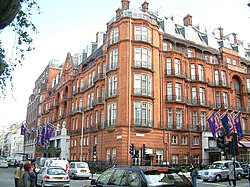
Claridge's is a 5-star hotel at the corner of Brook Street and Davies Street in Mayfair, London. The hotel is owned and managed by the Maybourne Hotel Group.

Key Information

History

[edit]

Founding

[edit]

Claridge's traces its origins to Mivart's Hotel, which was founded in 1812 in a conventional London terraced house and grew by expanding into neighbouring houses. In 1854, the founder (the father of biologist St. George Jackson Mivart) sold the hotel to William and Marianne Claridge, who owned a smaller hotel next door. They combined the two operations, and after trading for a time as "Mivart's late Claridge's", they settled on the current name.

The reputation of the hotel was confirmed in 1860, when Empress Eugenie made an extended visit and entertained Queen Victoria at the hotel.[1] In its first edition of 1878, Baedeker's London listed Claridge's as "The first hotel in London".[2]

Acquisitions

[edit]
Drawing of the current Claridge's building from 1897, the year before the reopening

Richard D'Oyly Carte, the theatrical impresario and founder of the rival Savoy Hotel, purchased Claridge's in 1893, as part of The Savoy Group, and shortly afterwards demolished the old buildings and replaced them with the present ones. This was prompted by the need to install modern facilities such as lifts and en suite bathrooms. From 1894 to 1901, Édouard Nignon was the hotel chef.

19th and 20th centuries

[edit]

The new Claridge's, built by George Trollope & Sons, opened in 1898.[3] It is a Grade II listed building.[4] The hotel has 203 rooms and suites and around 400 staff.

After the First World War, Claridge's flourished due to demand from aristocrats who no longer maintained a London house, and under the leadership of Carte's son, Rupert D'Oyly Carte, an extension was built in the 1920s. During the Second World War, it was the base of the Kingdom of Yugoslavia's government in exile and home of Peter II of Yugoslavia.

In 1996, the foyer was restored by architect Thierry Despont.[5][6]

In 1998, the group of hotels—along with the later-added Connaught—was sold for $867 million to two American private-equity funds, Blackstone and Colony Capital.[7]

21st century renovation and relaunch

[edit]

In 2005, the private-equity owners sold The Savoy Group, including Claridge's, to a group of Irish investors led by Derek Quinlan. The investors later sold the Savoy Hotel and Savoy Theatre and renamed the group Maybourne Hotel Group.[8][7][9] The Maybourne Hotel Group includes two other five-star hotels in London, The Berkeley and The Connaught.

Between 2016 and 2021, the hotel was renovated and expanded as part of a "relaunch" by co-owner Paddy McKillen. The top two floors were replaced by a four-storey, 14-bedroom extension that included a penthouse with swimming pool, gym, private lake, and 1,800 sq ft (170 m2) grand salon.[10] A 22 m-deep (72 ft) excavation was dug beneath the Art Deco 1920s extension to create a five-level basement. Construction work was largely done by hand to avoid disturbing guests, and the hotel continued in operation throughout the building work.[11] The project was recorded in a BBC documentary series, The Mayfair Hotel Megabuild.[12]

Notable guests

[edit]

Actors, directors, and entertainers who have used Claridge's include Cary Grant, Audrey Hepburn, regular visitor Alfred Hitchcock, Brad Pitt, Joan Collins, Mick Jagger, U2 and Whitney Houston.[citation needed] In his memoir The Moon's a Balloon, David Niven wrote that for film producer Alexander Korda, "Home was the penthouse at Claridge's". The hotel lobby and several guestrooms appear in Stephen Poliakoff's 2001 BBC television drama Perfect Strangers. Claridge's has hosted visiting royalty and guests of the Royal Family. The late King Hassan of Morocco travelled with his own mattress, but at the hotel he used a Savoy Mattress. Impressed by the quality, he ordered 24 identical mattresses from the Savoy for his palace.[13]

King Peter II of Yugoslavia and his wife, Queen Alexandra, spent much of the Second World War in exile at Claridge's, and suite 212 was supposedly ceded by the United Kingdom to Yugoslavia for a single day (17 July 1945) to allow their heir, Crown Prince Alexander, to be born on Yugoslav soil,[14] although no documentary evidence now exists to support the story.[15]

At the end of the Second World War, when unexpectedly defeated in the general election of 1945, Winston Churchill was temporarily without a London home and took a suite at Claridge's.[16]

In December 1951, West German chancellor Konrad Adenauer secretly met World Jewish Congress president Nahum Goldmann at Claridge's to begin negotiations on German reparations to Jewish survivors of the Holocaust.[17]

Restaurants and other facilities

[edit]

Claridge's has been described as London's most "food centric hotel".[18] It offers afternoon tea in The Foyer and Reading Room. There are three public ground floor bars; Claridge’s Bar acts as the main bar, when not being used for afternoon tea; The Fumoir, a former cigar bar until the smoking ban prohibited indoor smoking in 2007; and the Painter's Room, opened in 2021.[19] A cafe at the back of the hotel opened in 2023 called The ArtSpace Café [20] which has an extensive gallery space beneath it.

Davies and Brook, with head chef Daniel Humm, closed in 2021 after Humm proposed a vegan-only menu [21] similar to that of Eleven Madison Park, his three-star Michelin restaurant in New York.[22] The hotel received criticism for "not moving with the times".[23] In 2023, the hotel opened Claridge's Restaurant [24] in the same space.

For 12 years, the fine dining main restaurant was run by Gordon Ramsay, with various head chefs including Steve Allen and Mark Sargeant. Gordon Ramsay at Claridge's lost its Michelin status in January 2010. The restaurant closed in 2013 after having "lost its way". Harden's guide rated the restaurant second in London for "most disappointing cooking" and fourth for "most overpriced restaurant" in 2010.[25]

Claridge's later replaced Ramsay's restaurant with Fera, meaning 'Wild' in Latin, run by chef Simon Rogan. Fera was awarded a Michelin star in 2015 and Rogan left the restaurant in May 2017, leaving the restaurant's head chef Matt Starling in charge. Following Rogan's departure, the restaurant closed in December 2018.[26][27][28][29]

For 10 days in 2012, the hotel hosted the restaurant Noma, while the restaurant in Copenhagen was closed for refurbishment. Owner René Redzepi and his head chef and staff from Noma served a £195-per-head nine-course New Nordic Cuisine menu that included scones and clotted cream, Lancashire hotpot with British ingredients, and live ants foraged in Denmark and flown to London.[30][31][32]

In 2021, Claridge's opened an art deco bar in the Painter's Room featuring art work by Annie Morris.[33]

Artistic installations

[edit]
The 2015 Claridge's tree by Burberry's Christopher Bailey

Claridge's built an art gallery and started an artist in residence programme;[34] illustrator David Downton became the first artist in residence in 2011.[35] Downton created the Talking Heads Gallery, which displayed sketches from guests including Kristin Scott Thomas, Sarah Jessica Parker and Thandiwe Newton.[36]

The hotel hired artist Damien Hirst, and over 200 of his prints were installed in guest rooms. During the Frieze Art Fair in 2019, Hirst's sculptures were displayed in the lobby.[37] In 2021, a skylight designed by Hirst featuring butterflies was installed,[38][39] and Claridge's Art Space opened and included an exhibition by Hirst and others.[40][41] Since 2023, Claridge's rooftop penthouse suite has been housing 75 works by Hirst.[42]

Illustrations by artist Annie Morris are painted directly on the walls of the Painter's Room bar.[43]

The Christmas tree in the lobby is designed annually by artists, designers or fashion houses; these have included Diane von Furstenberg, Karl Lagerfeld, Christian Louboutin, Jimmy Choo, Burberry and Dolce & Gabbana.[44][8] In 2015, Christopher Bailey decorated the tree with around 100 umbrellas, and 77,000 lights triggered by passersby.[45]

See also

[edit]

References

[edit]
[edit]
Revisions and contributorsEdit on WikipediaRead on Wikipedia
from Grokipedia
Claridge's is a five-star luxury hotel situated at the corner of Brook Street and Davies Street in , , . Opened in 1856 following expansions by proprietors William and Marianne Claridge, it has since become an iconic landmark, particularly after renovations in the and that introduced elegant lobby designs and additional facilities. The hotel, owned and operated by the Maybourne Hotel Group, is renowned for its timeless glamour, exceptional service, and a history of accommodating royalty, statesmen, and celebrities such as , , and . Notable events include the 1945 declaration of Suite 212 as Yugoslavian territory for the birth of II, underscoring its role in diplomatic and royal affairs. Claridge's maintains royal warrants and has received accolades from publications like Traveller for its blend of historical elegance and modern luxury.

History

Founding and Early Operations

Claridge's originated as Mivart's Hotel, founded in 1812 by James Mivart in a conventional at 51 Brook Street in London's district. The establishment initially provided monthly accommodations for wealthy visitors to the city, operating more as an upscale than a modern , and gradually expanded by absorbing neighboring properties to accommodate growing demand. In the early 1850s, William and Marianne Claridge, proprietors of an adjacent hotel at 51 Brook Street, acquired Mivart's in an expansion effort, with the property trading under the name "Claridge's, late Mivart's" from 1854 until James Mivart's death in 1856. Following this transition, the hotel fully adopted the Claridge's name and continued to attract elite clientele through its reputation for discreet, high-quality service tailored to long-term stays by and affluent travelers. The hotel's early operations emphasized opulent yet understated hospitality amid Victorian London's social season, with expansions into adjacent buildings enabling larger suites and facilities that catered to royalty and dignitaries; notable early royal visits included those by Queen Victoria and Prince Albert in 1860, which enhanced its prestige as a preferred venue for private entertaining. By the late 1850s, Claridge's had established itself as a cornerstone of Mayfair's luxury lodging, prioritizing personalized service and privacy over transient tourism.

Acquisitions and Pre-War Expansions

In 1854, William and Marianne Claridge, proprietors of a modest adjacent hotel, acquired Mivart's Hotel—established in 1812 on Brook Street—and four additional adjoining properties, enabling a substantial expansion of the premises. The combined site reopened in 1856 as Claridge's, an independent luxury hotel that quickly gained favor among elite clientele, including European royalty following a 1860 visit by and Prince Albert. By the late 19th century, the hotel faced competitive pressures from newer establishments, prompting its purchase in 1893 by , the founder and theatrical impresario, who integrated it into his Savoy Group portfolio. immediately closed the property for a comprehensive redesign and physical expansion led by architect C. W. Stephens, known for projects like department store. The revamped Claridge's reopened in with enlarged facilities, including enhanced public spaces and guest accommodations, solidifying its status as a premier address amid London's burgeoning hotel scene. This pre-war development phase emphasized structural growth over stylistic overhaul, setting the foundation for later interwar enhancements while accommodating rising demand from international visitors and the .

Art Deco Era and Interwar Developments

During the , Claridge's solidified its status as a premier hotel, attracting the era's social elite, including the "" and flappers who frequented its spaces for performances and Charleston dancing in the existing . The hotel's transformation into an exemplar began in earnest in the mid-1920s, aligning with the global rise of the style's geometric motifs, streamlined forms, and luxurious materials, which supplanted earlier ornate designs. This shift catered to the Age's cosmopolitan clientele, including royalty and celebrities, enhancing Claridge's reputation as a cultural hub. In 1925, decorator Basil Ionides, an early proponent of interiors, redesigned the restaurant and introduced a distinctive bar area, incorporating elements that emphasized clean lines and modern elegance. By 1929, architect Oswald Milne spearheaded major expansions, including the addition of 80 new guest rooms, a new main entrance that eliminated the original carriage drive, and an extension block on the hotel's east side. Milne also redesigned the lobby into a mirrored foyer with a Roman stone facade, featuring decorative contributions from Ionides such as glass screens—some of which persist in the Foyer and Reading Room—and a glass door panel. These updates, executed under the Group's oversight, integrated bold patterns and metallic accents typical of the style. Further developments culminated in 1933 with Milne's design of a new , accommodating lavish events and reinforcing the hotel's interwar prominence. Complementary work by Ionides extended to suite renovations, blending functionality with opulent detailing like chandeliers and gold ornaments that remain fixtures today. These enhancements not only expanded capacity but also positioned Claridge's as a stylistic benchmark, drawing international acclaim for its fusion of British restraint and continental flair amid economic fluctuations.

World War II and Post-War Recovery

During , Claridge's functioned as a refuge for numerous exiled European monarchs, including the Kings of , , and , who resided there for much of the conflict. The hotel escaped significant damage from wartime bombing, allowing it to maintain operations as a social and diplomatic hub despite rationing constraints; in the early 1940s, its Grill Room was repurposed as Claridge’s Causerie, featuring a smörgåsbord menu and pay-for-drinks system to comply with food restrictions. It also equipped a state-of-the-art air-raid shelter, underscoring its strategic role amid London's . A notable wartime episode involved King and Queen Alexandra, who lived in exile at the hotel from 1941; on July 17, 1945, shortly after the war's end in Europe, Suite 212 was temporarily declared Yugoslav territory on Winston Churchill's orders to ensure the birth of their son, Crown Prince Alexander II, occurred on "national soil." Although no archival documents conclusively verify the territorial declaration, the prince received a at birth and later affirmed the event's significance. Churchill himself stayed at Claridge's following his electoral defeat in July 1945. In the post-war era, Claridge's swiftly resumed its preeminence without needing structural repairs due to its fortunate avoidance of bomb damage, attracting visiting statesmen who hosted banquets in honor of Queen Elizabeth II as a tradition. By the , the hotel drew Hollywood luminaries such as and , who adopted it as their preferred base, signaling a return to glamour amid Britain's economic recovery. This period solidified its status as an "annex to ," accommodating dignitaries and reinforcing its diplomatic legacy.

Late 20th Century Management

During the late 20th century, Claridge's operated as part of the Savoy Group, which had owned the hotel since 1893 and maintained its position as a premier luxury establishment in . The Savoy Group's management emphasized preserving the hotel's heritage while adapting to modern luxury standards, including targeted renovations to sustain occupancy rates among elite clientele such as royalty, diplomats, and celebrities. Ronald Jones served as general manager from 1984 to 1994, overseeing daily operations and guest services during a period of heightened international prestige. Jones, who began his career in hospitality as a teenager and rose through properties, was recognized as Hotelier of the Year in 1988 for his meticulous attention to personalized service, exemplified by accommodating high-profile events and refusing unreasonable demands, such as a 1987 request from a Middle Eastern king. Under his tenure, Claridge's hosted figures like Queen Elizabeth II and Prince Philip, reinforcing its reputation for discretion and excellence amid London's competitive hotel market. In 1996, the hotel underwent a significant restoration directed by French designer , which refreshed public spaces including the foyer and restaurant while retaining period details; this project, costing millions, aimed to modernize amenities without altering the core aesthetic. Ownership transitioned in 1998 when the Savoy Group, including Claridge's, was acquired in a backed by Colony Capital and The Blackstone Group, marking one of Europe's early large-scale hotel privatizations valued at over £500 million and shifting focus toward investment-driven efficiencies. This change introduced stricter financial oversight but preserved operational continuity, with room rates averaging £300–£500 per night by the decade's end to reflect premium positioning.

21st Century Renovations and Financial Realities

In the early 2000s, Claridge's initiated refurbishments under new ownership following its acquisition by Irish investors led by Derek Quinlan in 2005, focusing on updating facilities while preserving heritage, though specifics remained limited to incremental modernizations rather than wholesale overhauls. By the mid-2010s, under Maybourne Hotel Group, a transformative seven-year project commenced around 2015 and concluded in 2022, representing the most extensive upgrades in the hotel's and nearly doubling its footprint through the excavation of a five-storey beneath the fully operational structure. Engineers utilized pioneering tunneling and vertical support systems to minimize disruptions, relocating rooftop plant rooms underground and enabling additions like a Japanese-inspired subterranean with a heated pool, , and treatment rooms, which opened in 2021. These enhancements integrated modern technologies, such as contactless touch interfaces in historic elevators updated in 2023, alongside interior refreshes that balanced contemporary functionality with the hotel's legacy elegance. The project demanded intricate engineering to maintain uninterrupted service, underscoring the financial and logistical complexities of retrofitting a Grade I-listed property in . Financially, Claridge's navigated ownership turbulence and investment burdens, with control shifting through high-stakes disputes: Irish developer , holding a significant stake, engaged in prolonged legal battles against and Qatari interests in the early , ultimately securing Maybourne's independent by 2018 after repelling a attempt valued at billions. Post-renovation, the hotel reported a pre-tax loss of £5.4 million for 2024—reversing a £7.2 million profit in 2023—despite revenue rising 14.7% to £136.9 million, attributable to elevated refurbishment costs and operational scaling amid inflationary pressures. Maybourne as a group incurred a £77.8 million loss in 2023, even as luxury demand rebounded post-Covid, reflecting broader sector strains from capital-intensive expansions and debt servicing in a high-interest environment. These realities highlight the tension between heritage preservation investments and profitability in ultra-luxury hospitality, where renovations enhance long-term asset value but strain short-term balance sheets.

Architecture and Design

Site and Structural Evolution

The site of Claridge's occupies properties along Brook Street in , , initially developed as a in 1812 when James Mivart established Mivart's Hotel at number 51 in a single terraced designed for extended stays. By 1817, Mivart acquired number 57 as an annex, and by 1838, the operation expanded to encompass five consecutive houses, forming a unified larger through internal connections. In 1854, William and Marianne Claridge purchased the property, renaming it Claridge's Hotel (initially "Claridge's, late Mivart's") by 1856 after incorporating five adjoining buildings, which marked the site's transition to its namesake operation while retaining the core terraced structure. This Victorian-era configuration persisted until 1894, when hotelier acquired the site and demolished the existing buildings to construct a new purpose-built hotel, completed and reopened in 1898 under the design of architect C.W. Stephens. The Stephens structure introduced advanced features including , passenger lifts, and en-suite bathrooms, spanning addresses 47-57 Brook Street at the corner with Davies Street. Further structural extensions and alterations occurred between 1909 and 1931, incorporating additional blocks adjacent to the 1898 core. In 1929, architect Oswald Milne oversaw significant expansion, adding a new block with eighty rooms, a in by Marcel Boulanger, and a redesigned lobby featuring Roman stone facade and mirrored elements, alongside redecorations by Basil Ionides. Subsequent evolutions included a comprehensive restoration from to 1999, where designers and David Collins updated the foyer in modern Art Deco style and refurbished the ballroom, preserving historical elements while enhancing functionality. In the , a seven-year program introduced a five-storey extension without surface disruption, adding facilities such as a pool, , , wine cellar, , and , effectively doubling the site's usable space underground. Plans filed in 2018 proposed further expansion by an adjacent building to increase room capacity, with new luxury facilities targeted for completion by 2028.

Art Deco Architectural Features

In 1929, architect Oswald Milne, a proponent of the style, redesigned Claridge's main entrance by eliminating the original carriage drive and introducing a new façade clad in Roman stone, which provided a streamlined and geometric appearance emblematic of the era's machine-age aesthetic. This alteration enhanced the hotel's street presence on Brook Street, integrating bold vertical lines and simplified forms that contrasted with the more ornate Edwardian origins of the core structure. Milne's work extended to the creation of a mirrored foyer, featuring reflective surfaces and clean geometries that amplified light and space, core tenets of architecture. Milne also oversaw the addition of a cubic extension block on the hotel's east side, constructed as a simple, block-like volume externally to harmonize with the existing massing while adhering to 's emphasis on cubic forms and minimal ornamentation. Internally, this extension incorporated motifs in reception areas and guest rooms, including fluted cornices and palladium-leaf detailing, though the exterior prioritized functional over lavish decoration. Concurrently, Milne transformed the lobby, infusing it with elements such as geometric patterning and innovative spatial flow, which supported the hotel's expansion to include eighty new rooms and a that same year. Complementary architectural features from the period include Basil Ionides' contributions in the late 1920s and early 1930s, such as magnificent glass screens dividing the foyer and reading room, which employed translucent panels with etched geometric designs to create layered depth and luminosity. Ionides also integrated a door panel in the lobby, showcasing frosted glass with stylized floral and abstract motifs typical of 's fusion of luxury materials and modernist restraint. These elements, preserved through subsequent renovations, underscore Claridge's transition into an exemplar during the interwar years, blending structural innovation with decorative precision.

Interior Design and Artistic Elements

Claridge's interiors are renowned for their style, primarily established during the hotel's expansions and redecorations in the 1920s and 1930s. In 1929, architect Oswald Milne redesigned the main foyer, incorporating a mirrored with reflective surfaces and geometric motifs characteristic of the movement's emphasis on and . Concurrently, interior designer Basil Ionides oversaw transformations of the restaurant and several suites, introducing glass screens that remain in the Foyer and Reading Room, along with decorative elements blending clean lines and luxurious materials. Artistic highlights include René Lalique's frosted glass door panel, installed in 1929 as a bespoke commission, and Jacques Adnet's white ceramic dove sculptures adorning the foyer, evoking the era's stylized natural forms. The lobby features hand-woven wool rugs designed by Marion Dorn around 1930–1935, with bold geometric patterns produced by the Wilton Royal Carpet Factory, underscoring the hotel's integration of textile artistry into its flooring. Original chandeliers, gold ornaments, and friezes further enhance public spaces like the , added in 1929 with streamlined plasterwork and metallic accents. Subsequent renovations have preserved these elements while introducing complementary modern touches. The 1996 restoration by modernized the Foyer and created spaces like the Fumoir, retaining Ionides-era screens and adding a glass light sculpture for contemporary luminosity. In 2021, the ballroom underwent restoration by Blair Associates Architecture to highlight its original plaster details and proportions. Recent suites, such as those designed by David Linley in 2012, incorporate bespoke furniture echoing 1930s motifs with sustainable woods and metals, maintaining the hotel's commitment to evolving yet authentic interiors.

Ownership and Management

Historical Ownership Transitions

Claridge's traces its origins to Mivart's Hotel, established in 1812 by James Mivart at 51 Brook Street in , , initially as a lodging house that expanded into a full by acquiring adjacent properties in 1817 and 1838. In 1854, the property was purchased by and Claridge, proprietors of a smaller nearby, who rebranded it as Claridge's (late Mivart's) following Mivart's death in 1856, marking the first major ownership shift that aligned the name with its emerging luxury status. By 1881, amid Claridge's declining health, the couple sold the hotel to an anonymous consortium of investors, which introduced more impersonal management and prompted concerns over diminished personal service. The pivotal transition occurred in 1893 when , the theatrical impresario and founder of the rival , acquired Claridge's from the consortium to expand his Savoy Group portfolio; he promptly closed the premises for extensive reconstruction by architect C.W. Stephens, reopening the modernized hotel in 1898 with enhanced grandeur to compete in London's elite hospitality market. Under Carte's Savoy Group, ownership passed through family succession after his death in 1901, with his widow Helen and son Rupert managing operations until , followed by professional oversight from the Wontner family, who served as managing directors and custodians of the group's traditions for decades, preserving Claridge's as a cornerstone asset amid interwar expansions. Corporate consolidation marked later 20th-century shifts: in 1998, U.S.-based firms Blackstone Group and Colony Capital purchased the Group, including Claridge's, from the Wontner family for £786 million, initiating a phase of financial restructuring and investments exceeding £55 million in structural upgrades to modernize the aging properties without altering their heritage appeal. This era ended in 2005 when the consortium sold the Group—encompassing Claridge's, The Connaught, and —to a group of Irish investors led by financier Derek Quinlan and property developer , who aimed to leverage the hotels' prestige for further value extraction amid rising global luxury demand. These transitions reflected broader patterns in , where family stewardship yielded to institutional capital, prioritizing operational efficiencies over bespoke oversight.

Acquisition by Maybourne Hotel Group

In 2005, Maybourne Hotel Group was established to own and manage Claridge's, The Connaught, and , following their acquisition as part of the Savoy Group portfolio the previous year by a led by the Barclay brothers. This restructuring separated the three Mayfair hotels from The Savoy, which was sold to a different investor group, allowing Maybourne to focus on preserving their heritage while pursuing targeted renovations. The transaction was financed through loans from Irish banks, totaling hundreds of millions of euros, reflecting the high value placed on these landmark properties amid London's luxury hotel market. Ownership of Maybourne, and thus Claridge's, soon became embroiled in disputes after the , when the Irish lenders seized the debt amid defaults. The Barclay brothers repurchased the loans in 2011 for approximately €800 million from the (NAMA), aiming to consolidate control, but this triggered legal challenges from minority stakeholder , who argued the move violated partnership agreements. Courts ruled in McKillen's favor in key cases, including a 2014 decision blocking ' foreclosure attempts and affirming his pre-emptive rights. By 2015, McKillen, backed by Qatari investors including Sheikh Hamad bin Jassim bin Jaber Al Thani, secured majority control of Maybourne through settlements and refinancing, shifting toward Qatari interests while Maybourne retained operational management of Claridge's. This resolution stabilized the group's structure, enabling expansions like the 2019 acquisition of Montage Beverly Hills (rebranded as The Maybourne Beverly Hills), but highlighted vulnerabilities in leveraged luxury hotel investments during economic downturns. Despite the turbulence, Claridge's occupancy and revenue recovered post-2015, underscoring the enduring appeal of its brand under Maybourne's stewardship.

Business Operations and Strategic Decisions

Claridge's operates as a luxury under the Maybourne Hotel Group, generating primary revenue from room bookings and food and beverage services, with bedroom revenue reaching £95.8 million and food and beverage income rising in the following a major refurbishment, though the hotel reported a £5.4 million loss amid expansion investments. The property maintains high occupancy rates, often exceeding 95% for extended periods, supported by sophisticated systems that optimize pricing and segment allocation to maximize yields during peak demand. Strategic decisions emphasize portfolio expansion and digital enhancement, with Maybourne planning to grow from four to 15-17 hotels by 2035, targeting markets including , New York, , , and , alongside a new in . This includes the 2023 opening of The Emory in , Maybourne's first new in 50 years, and ongoing refurbishments at Claridge's to introduce enhanced facilities by 2028, despite short-term financial pressures from capital expenditures. Maybourne has pursued operational efficiencies through technology adoption, implementing advanced booking engines to boost direct reservations and unify brand experiences across properties, while fostering innovation in back-of-house processes to align with luxury standards. In 2024, the group unveiled a rebranded identity emphasizing "Stories of Distinction" to consolidate its portfolio under a cohesive luxury narrative, aiding global market positioning amid competitive challenges like entry into high-barrier destinations such as New York.

Facilities and Amenities

Accommodations

Claridge's features 269 rooms and suites divided into 26 categories, ranging in size from 35 square meters for superior rooms to 1,100 square meters for the penthouse suite. These accommodations blend heritage with contemporary furnishings, including king or emperor beds (with twin bedding options in most categories), marble bathrooms equipped with luxury toiletries, and advanced in-room technology such as plasma televisions, integrated DVD/CD sound systems, and high-speed . Entry-level superior rooms, measuring approximately 35 square meters and accommodating two guests, offer views over or internal courtyards and include bespoke furnishings with subtle Deco motifs. rooms (40 square meters) and Claridge's rooms (50 square meters) provide similar amenities but with increased space for up to three guests via twin configurations, often featuring higher ceilings and period details like original cornices. and studio variants add private outdoor terraces or compact living areas, with sizes up to 60 square meters, emphasizing tranquility through and curated artwork. Junior suites, starting at 65 square meters, introduce separate seating areas and enhanced storage, while deluxe and terrace junior suites incorporate outdoor spaces overlooking the hotel's or gardens. Suites escalate in opulence, with categories like the Suite (80 square meters) and Claridge's Suite (95 square meters) offering dedicated dressing rooms, fireplaces in select units, and panoramic city or courtyard views for up to three guests. Signature suites such as the Georgian Suite (210 square meters) and Royal Suite (225 square meters) accommodate five with multiple bedrooms, private terraces, and bespoke service including personal butlers upon request. Larger pavilions and terraces, like the Mews Pavilion (190 square meters) and Grand Terrace Suite (190 square meters), feature expansive lounges and dining areas suitable for entertaining. The hotel's pinnacle offerings include the (225 square meters), Residence (280 square meters), and Penthouse (1,100 square meters, sleeping eight with four emperor beds), which provide multi-level layouts, private elevators, and customized interiors drawing on historical motifs while incorporating modern wellness elements like air purification systems. All accommodations prioritize privacy and customization, with 24-hour and bedding available.

Dining and Beverage Options

Claridge's offers a selection of dining venues emphasizing with seasonal, locally sourced ingredients, alongside classic beverage experiences in its interiors. The primary dining outlet, Claridge's Restaurant, serves modern British fare for , , and dinner, featuring dishes that highlight fresh produce such as summer flavors in leisurely lunches and elegant evening meals. It includes a private dining room accommodating up to 16 guests, adorned with hand-painted murals, and occasional collaborations like Claridge's X Dante, which introduces American-inspired items including sliders and seafood towers with oysters, crab, scallops, and shrimp. The adjacent Claridge's Wine Cellar provides curated wine selections to complement meals. The Foyer & Reading Room functions as an all-day dining space, renowned for its afternoon tea service priced at £95 per person, which includes finger sandwiches (e.g., , , ), patisserie, warm scones with Claridge's Jam and . This venue also offers classic cuisine in a preserved setting, prepared in centralized kitchens with noted handling protocols. Beverage options center on Claridge's Bar, an Art Deco lounge serving expertly crafted cocktails, champagnes, and rare whiskeys, with a seasonal terrace for outdoor seating. The bar maintains a focus on impeccable service, drawing on the hotel's tradition of sophisticated mixology.

Additional Guest Services

Claridge's offers guests access to a dedicated spa facility, which opened in September 2022 as part of a multi-year hotel renovation, featuring a subterranean design inspired by Japanese temple architecture and onsen traditions. The spa includes a 15-meter vitality pool, steam rooms, saunas, seven treatment rooms equipped with private bathrooms, and a wellness concierge service for customizing treatments or long-term health plans. Treatments emphasize restorative bodywork and bio-innovations, with expert residencies from practitioners in modalities such as acupuncture and sound therapy. The hotel provides state-of-the-art fitness facilities integrated with the , including a gym equipped with premium brands like NOHRD, PENT, and machines, alongside personal training options arranged through the wellness team. Access to the , pool, and is complimentary for all overnight guests, with facilities designed to promote holistic wellness rather than high-intensity group classes. Concierge services at Claridge's operate through a dedicated available 24 hours, handling requests such as reservations, private tours, theater tickets, and transportation arrangements, with a focus on insider knowledge of events and venues. The Map Room, a private lounge for business or extended stays, offers complimentary machines, computers, iPads, , and discreet workspaces. Higher-tier accommodations, including suites, include 24-hour personal service for tasks like unpacking, garment pressing, and itinerary management. Standard amenities extend to , in-room dining delivery, and laundry services, ensuring comprehensive support for guest needs.

Notable Guests and Events

Prominent Visitors

Claridge's has long attracted royalty, statesmen, and entertainers, establishing its reputation as a discreet haven for the elite. In 1851, during the , it hosted foreign dignitaries including Grand Duke Alexander of and King William III of the amid an influx of international visitors to . The hotel later served as the birthplace of Prince Albert II of Monaco on March 14, 1958, when his parents, Prince Rainier III and Princess Grace Kelly, were in residence during a stay in . Winston Churchill maintained a close affinity with the hotel, dining there weekly and retreating to its suites following his defeat in the 1945 general election. Queen Elizabeth II similarly favored Claridge's for lunch, referencing it publicly as one of her preferred venues. The mid-20th century drew Hollywood icons to its elegance, with guests including , , , , , and , the latter of whom quipped that he would prefer Claridge's to heaven. visited regularly, while later luminaries such as , , and Jackie Kennedy Onassis also stayed. Contemporary celebrities continue this tradition, with as a longtime regular, alongside , , , , , , , and documented as recent guests or diners.

Key Events and Cultural Associations

Claridge's has hosted numerous significant events, particularly during periods of geopolitical upheaval. In the 1940s, amid , the hotel became a sanctuary for exiled European royalty, including the kings of , , and , as well as Queen Wilhelmina of the Netherlands. King resided there extensively, and on April 17, 1945, Suite 212 was temporarily designated as Yugoslav sovereign territory by British authorities—on Winston Churchill's orders—to facilitate the birth of his son, Crown Prince Alexander, ensuring the child's eligibility for the throne under succession laws. This wartime role underscored the hotel's status as a neutral haven for dignitaries, with multiple heads of state conducting official business from its premises. Earlier milestones include the 1860 visit by and Prince Albert, who dined with Empress Eugénie, cementing Claridge's early reputation among European monarchs. In the 1920s, it emerged as a vibrant epicenter for London's "," hosting jazz performances, Charleston dances, and extravagant treasure hunts that epitomized the era's social frivolity, with assembly points for automotive scavenger hunts organized by figures like the Jungman sisters. Postwar, the hotel accommodated high-profile gatherings, such as the 1987 ruby wedding anniversary celebration of Queen Elizabeth II and Prince Philip. Culturally, Claridge's embodies grandeur, with its 1929 lobby and ballroom renovations by Oswald Milne exemplifying the style's geometric elegance and becoming synonymous with interwar luxury. The hotel has appeared in films such as Woody Allen's (2007) and the drama Perfect Strangers (2001), showcasing its opulent interiors as backdrops for intrigue and . It has also been the subject of documentaries like the 2012 series , which illuminated its operational intricacies and enduring allure for celebrities from to modern icons. This legacy positions Claridge's as a cultural touchstone for British glamour, frequented by and statesmen alike.

Reception and Legacy

Awards and Industry Recognition

Claridge's has garnered extensive recognition from prominent hospitality evaluators for its service, facilities, and historical prestige. In 2024, the hotel received three Keys, the Michelin Guide's highest distinction for exceptional hotels, placing it among only 14 properties to achieve this level. It also earned a AAA Five Diamond Award in 2024, affirming its status in luxury standards. The property ranked 11th globally in The World's 50 Best Hotels list for 2024, highlighting its appeal to high-profile guests and consistent excellence since its 1856 origins. Travel Guide has awarded Claridge's its Five-Star rating, emphasizing the hotel's impeccable staff training and interiors. The (AA) rates it as a five-star establishment, praising its luxurious setting suitable for royalty. Additional honors include inclusion in Traveler's 2024 Gold List for standout properties. named it the top hotel in its 2024 rankings. Earlier accolades encompass a 2023 ranking of 16th in The World's 50 Best Hotels. Claridge's has been nominated for World Travel Awards categories such as World's Leading Iconic in 2025, reflecting ongoing industry esteem.

Guest Experiences and Criticisms

Guests at Claridge's consistently report high satisfaction with the hotel's service and ambiance, often describing staff as exceptionally attentive and personable. The hotel maintains a 4.7 out of 5 rating on from 3,576 reviews as of 2025, with frequent commendations for exceeding expectations in hospitality. On , it scores 9.5 out of 10 across 494 reviews, praising spacious rooms for a hotel and personalized assistance, such as from staff members like and Christof. Accommodations receive acclaim for comfort, including superior mattresses, soundproofing, and light-filled designs that enhance the heritage. Dining experiences, particularly afternoon tea, are highlighted for superb food quality and elegant atmosphere, with ratings of 10/10 for in independent assessments. Reviewers note the overall sense of timeless luxury, with one 2021 analysis describing it as among the finest city hotels for old-world charm and renovated opulence. Criticisms center on value relative to cost, with rooms often deemed overpriced—starting around £990 per night—and additional fees for services like daily cleaning, approximately £30 per instance. Some guests perceive certain rooms and corridors as dated, though defenders argue this preserves authentic character rather than detracting from appeal. Isolated service lapses include a 2013 account of being ignored by the doorman amid construction scaffolding upon arrival. The lobby has drawn complaints for lacking intimacy and joyful warmth compared to more properties. No widespread controversies or systemic issues emerge from aggregated guest feedback, which remains overwhelmingly positive despite expectations of flawless execution at premium rates.

Economic Contributions and Challenges

significantly contributes to the London economy through its role in the luxury tourism sector, generating substantial revenue from high-value international guests who spend on accommodations, dining, and ancillary services, thereby supporting local suppliers, taxes, and employment in . In 2023, the hotel's revenues reached £119.3 million, driven by a post-COVID recovery and expansion that increased bedroom revenue to £83.7 million from £68.8 million the prior year, with food and beverage adding £30.8 million, reflecting its draw for affluent visitors who bolster broader hospitality and retail ecosystems. The hotel's operations sustain hundreds of direct jobs in skilled roles, from to , while indirect employment arises from partnerships with local vendors for events and renovations, enhancing economic multipliers in . As part of the Maybourne Hotel Group, Claridge's attracts ultra-high-net-worth individuals, fueling demand for premium services and contributing to the £14.9 billion annual economic impact of inbound to the UK capital, where luxury hotels like it capture disproportionate spending from overseas markets. Despite these inputs, Claridge's faces persistent economic challenges, including high capital expenditures from ongoing refurbishments that led to a £5.4 million pre-tax loss in , even as revenues climbed 14.7% to £136.9 million, with room sales at £95.9 million and food and beverage at £35 million. The COVID-19 pandemic forced the hotel's first closure in over a century, necessitating government support for staff wages and delaying recovery amid global travel disruptions. Macroeconomic pressures, such as political instability, inflation-driven costs rising to £31.9 million in 2024, and intense in London's saturated luxury market, further strain profitability, with forecasts for 2025-2026 remaining uncertain due to volatile demand from high-net-worth travelers sensitive to geopolitical events. disputes within the Maybourne Group, involving stakeholders and valuations exceeding £5 billion for the portfolio, have occasionally diverted focus from operational efficiencies, underscoring the capital-intensive nature of maintaining heritage properties amid rising costs.

References

Add your contribution
Related Hubs
User Avatar
No comments yet.