Hubbry Logo
CleomeCleomeMain
Open search
Cleome
Community hub
Cleome
logo
8 pages, 0 posts
0 subscribers
Be the first to start a discussion here.
Cleome
Cleome
from Wikipedia

Cleome
Cleome houtteana
Scientific classification Edit this classification
Kingdom: Plantae
Clade: Tracheophytes
Clade: Angiosperms
Clade: Eudicots
Clade: Rosids
Order: Brassicales
Family: Cleomaceae
Genus: Cleome
L.
Synonyms[1]
List
    • Aldenella Greene
    • Andinocleome Iltis & Cochrane
    • Anomalostemon Klotzsch
    • Areocleome R.L.Barrett & Roalson
    • Arivela Raf.
    • Atalanta (Nutt.) Raf.
    • Aubion Raf.
    • Buhsea Bunge
    • Carsonia Greene
    • Celome Greene
    • Chilocalyx Klotzsch
    • Cleoserrata Iltis
    • Coalisina Raf.
    • Cochranella E.M.McGinty & Roalson (2020)
    • Corynandra Schrad. ex Spreng.
    • Cristatella Nutt.
    • Cyrbasium Endl.
    • Dactylaena Schrad. ex Schult. & Schult.f. (1829)
    • Decastemon Klotzsch
    • Dianthera Klotzsch
    • Diorimasperma Raf.
    • Dipterygium Decne.
    • Dispara Raf.
    • Gilgella Roalson & J.C.Hall
    • Gynandropsis DC.
    • Haptocarpum Ule
    • Hemiscola Raf.
    • Iltisiella Soares Neto & Roalson (2020)
    • Isexina Raf.
    • Jacksonia Raf. ex Greene
    • Justago Kuntze
    • Kersia Roalson & J.C.Hall
    • Lagansa Rumph. ex Raf.
    • Melidiscus Raf.
    • Micambe Adans.
    • Mitostylis Raf.
    • Neocleome Small
    • Oncufis Raf.
    • Pedicellaria Schrank
    • Pericla Raf.
    • Physostemon Mart.
    • Podandrogyne Ducke
    • Podogyne Hoffmanns.
    • Polanisia Raf.
    • Pterocleome Iltis ex E.M.McGinty & Roalson (2020)
    • Pteroloma Hochst. & Steud.
    • Puccionia Chiov.
    • Roeperia F.Muell.
    • Rorida J.F.Gmel.
    • Roridula Forssk.
    • Scolosperma Raf.
    • Sieruela Raf.
    • Siliquaria Forssk.
    • Sinapistrum Mill.
    • Stylidocleome Roalson & J.C.Hall
    • Stylista Raf.
    • Symphyostemon Klotzsch
    • Tarenaya Raf.
    • Tetratelia Sond.
    • Thulinella Roalson & J.C.Hall
    • Triandrophora O.Schwarz

Cleome is a genus of flowering plants in the family Cleomaceae, commonly known as spider flowers, spider plants, spider weeds, or bee plants.[2][3] Previously, it had been placed in the family Capparaceae, until DNA studies found the Cleomaceae genera to be more closely related to the Brassicaceae than the Capparaceae. Cleome and clammyweed (Polanisia dodecandra) can sometimes be confused.

The genus sensu stricto includes about 170 species of herbaceous annual or perennial plants and shrubs.[4] The genus has a subcosmopolitan distribution throughout the tropical and warm temperate regions of the world.[4] However, a recent DNA study failed to separate Cleome, Podandrogyne, and Polanisia from each other, so some taxonomists have abandoned the last two of these genera, treating them as part of Cleome sensu lato; in this case, Cleome contains about 275 species, the vast majority of the Cleomaceae.

The genus contains species which show an evolutionary progression from C3 to C4 photosynthesis. This, combined with it being very close to the Brassicaceae with the model plant species Arabidopsis thaliana, makes it an ideal genus in which to study the evolution of C4 photosynthesis. Morphological differences that demonstrate the transition from C3 to C4 include C3 species having leaves with more veins and larger bundle sheath cells. Also, species such as Cleome gynandra produce proteins needed for C4 photosynthesis.[5] Three species independently acquired the C4 pathway, while others are C3–C4 intermediate or C4-like.[6]

Species

[edit]

199 species are accepted.[1][4][7][8][9][10]

Cultivation and uses

[edit]
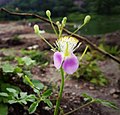
Cleome chelidonii at Pocharam Lake, Andhra Pradesh, India

Cleome gynandra is used as a vegetable crop. C. houtteana is a commonly cultivated ornamental plant with purple, pink, or white flowers.

[edit]
Stereo image
Left frame 
Right frame 
Parallel view ()
Cross-eye view ()
Cleome seeds resemble snail shells

References

[edit]
Revisions and contributorsEdit on WikipediaRead on Wikipedia
from Grokipedia
Cleome is a of approximately 200 of flowering in the family Cleomaceae, order , comprising mostly annual and perennial herbs, as well as shrubs, that are native to tropical and subtropical regions worldwide. These are characterized by their erect to sprawling habits, palmately compound leaves with 3–9 narrow leaflets, and showy, zygomorphic flowers borne in terminal racemes, featuring four sepals, four clawed petals, and numerous long-exserted stamens that give the blooms a distinctive spider-like appearance in colors ranging from white and pink to purple and yellow. The fruits are elongate, dehiscent capsules with a persistent replum, containing many reniform, often pubescent seeds. Commonly known as spider flowers, bee plants, or spider weeds, species in this genus exhibit a distribution, with some occurring as weeds in disturbed habitats and others cultivated as ornamentals for their bold, upright growth and pollinator-attracting flowers. Notable examples include Cleome hassleriana, a fast-growing annual prized in gardens for its vibrant displays, and various used traditionally for medicinal purposes, such as treating or as leafy vegetables in parts of and .

Taxonomy

Classification

Cleome is placed in the order within the plant kingdom, belonging to the family Cleomaceae, a small group of flowering comprising approximately 270 across ~27 genera. Historically, Cleomaceae was subsumed within the larger family , but molecular phylogenetic analyses using chloroplast DNA sequences and morphology in the late 1990s and early 2000s demonstrated that Cleomaceae forms a distinct monophyletic sister to , justifying its separation as an independent family. This reclassification was formally supported in systems like APG II (2003), which recognized Cleomaceae as an optional but distinct entity from the restricted . The Cleome L. was established by in in 1753, with Cleome ornithopodioides L. designated as the in 1925. No major synonyms exist for the itself, though it has been subdivided historically into subgenera such as Cleome subg. Cleome (encompassing species with simple or compound leaves) and Cleome subg. Tarenaya (characterized by American species with stipular spines), based on morphological and geographical distinctions. Phylogenetic studies have revealed the to be polyphyletic, prompting mergers and splits; for instance, in 2007, several North American species previously classified under Cleome were transferred to the resurrected Peritoma DC. following chloroplast-based analyses that resolved their distinct evolutionary lineage. A 2024 phylogenomic study resolved relationships across Cleomaceae, sampling 236 species and confirming in the traditional Cleome, leading to further generic reclassifications. Currently, as of 2025, Cleome sensu stricto encompasses approximately 22 , primarily annual or perennial herbs and shrubs distributed in and , though taxonomic boundaries continue to be refined.

Etymology

The genus name Cleome originates from the word kleos (κλέος), meaning "glory" or "renown," and was first applied by the philosopher (c. 371–287 BCE) to describe a mustard-like plant, possibly alluding to its esteemed or prominent qualities. In 1753, adopted the name for this genus in , likely in recognition of the plants' conspicuous and showy flowers. Common names for Cleome species, such as "" or "," derive from the distinctive long, thread-like stamens that protrude from the flowers, evoking the appearance of spider legs. Another widespread name, "," reflects the genus's appeal to pollinators, particularly bees, due to its abundant production. Post-Linnaean usage has seen no significant changes to the genus name's etymology, though regional common names have adapted culturally; for instance, Cleome gynandra is termed "African spider flower" in traditional African contexts, highlighting its local significance as a vegetable and medicinal plant.

Description

Morphology

Cleome species exhibit a range of growth habits, primarily as annual or perennial herbs, occasionally forming subshrubs up to 1–2 meters in height. They typically display an erect, branched form with stems that are glabrous or pubescent, often bearing glandular hairs that produce a sticky exudate. Leaves are arranged alternately on petioles and are simple or palmately , featuring 3–7 (sometimes up to 9) leaflets that are linear to lanceolate or ovate in shape, with margins that are entire or serrulate. Stipules are generally absent or reduced, though some species, such as , possess spiny stipules and prickles along the leaf midribs or petioles. Flowers are bisexual and borne in terminal, often leafy racemes or panicles, displaying zygomorphic to actinomorphic . The calyx comprises 4 green, persistent sepals that are free or shortly united and frequently glandular; the corolla consists of 4 unequal petals in white, pink, purple, or yellow hues, which are sessile or clawed. The androecium includes 6 to numerous free stamens, often elevated on an androgynophore, with declinate filaments that can extend up to 2 cm and contribute to the characteristic spider-like appearance of the blooms. The superior is 1-locular with parietal and numerous ovules, sometimes raised on a gynophore. Fruits develop as linear, dehiscent capsules with 2 valves, typically borne on a gynophore and containing numerous seeds. Seeds are reniform or discoid, measuring 0.5–4 mm, with surfaces that vary from smooth and glabrous to rugulose, ridged, reticulate-tuberculate, or pubescent; some species feature winged seeds.

Reproduction

Cleome species exhibit diverse flowering phenologies adapted to their environments. In temperate regions, many species, such as Cleome hassleriana, bloom seasonally from summer to fall, typically June through frost, with elongating as flowers open in a basipetal manner—from the base upward—allowing continuous production of new blooms while lower flowers develop into fruits. In tropical habitats, species like Cleome rutidosperma flower year-round, supporting persistent in stable climates. Pollination in Cleome is primarily entomophilous, relying on for transfer, though some show ambophily with wind assistance. Flowers produce nectar and abundant , attracting a range of pollinators including bees (Apis spp., spp.), (, ), and occasionally moths or wasps. Many , such as , , Cleome lutea, and Cleome serrulata, are self-compatible and capable of , enabling autonomous through mechanisms like protogyny or protandry with closure, which promotes when possible but ensures reproduction in pollinator-scarce conditions. Following , Cleome produces dry, dehiscent capsules that split longitudinally (septicidally) to release seeds. Each capsule typically contains 50–200 seeds, depending on species and size; for example, capsules up to 12 cm long hold numerous reniform seeds with high viability. varies, with some species like exhibiting innate dormancy broken by or environmental cues such as wet conditions during the rainy season, while others like germinate readily without pretreatment if moisture is adequate. Asexual reproduction is rare in Cleome, with no widespread reports of apomixis or vegetative ; however, some may sprout vegetatively from roots in favorable mild climates, though this is not a primary mode. The genus predominantly follows a cycle, with most being annuals that complete their cycle in one —from to flowering, fruiting, and —while perennials like certain tropical forms overwinter and persist across multiple seasons in suitable habitats.

Distribution and habitat

Geographic range

The genus Cleome has been variably circumscribed in ; recent phylogenetic studies (as of 2024) recognize Cleome sensu stricto (s.s.) with approximately 22 primarily distributed in southwestern , the , and . In the broader sensu lato (s.l.) usage, encompassing ~200 , the distribution is , native to tropical and subtropical regions across the , , , and . The center of diversity for Cleome s.s. is in southwestern , with significant concentrations in ; under s.l., representation extends to South and South , though many South American taxa are now classified in segregate genera. Biogeographic patterns reveal disjunct distributions, with the ancestral origin of Cleomaceae traced to the Palearctic and around 53 million years ago, followed by expansions to the , Indomalaya, and . Introduced ranges are extensive due to ornamental and weedy species, which have naturalized in , , , and Pacific islands. For instance, Cleome hassleriana (now classified as Tarenaya hassleriana), native to southern , has been naturalized in the United States since the 1800s following its introduction as a garden plant. The genus Tarenaya (formerly subgenus Tarenaya of Cleome) centers in the , while other lineages in Cleome s.s. show strong African and Asian affinities. Endemism is notable in certain hotspots, with several narrow endemics such as Cleome anomala restricted to .

Ecological preferences

Cleome species predominantly inhabit disturbed areas such as roadsides, waste grounds, and agricultural margins, as well as natural settings like savannas, rocky outcrops, coastal dunes, and occasionally wetlands, often functioning as ruderal that colonize poor, sandy, or gravelly substrates. These habitats reflect the genus's affinity for open, dynamic environments where competition is low and nutrient availability is limited. The thrives in warm-temperate to tropical climates, with many exhibiting tolerance to semi-arid and sub-humid conditions but preferring regions with seasonal rainfall ranging from 500 to 1500 mm annually. Cleome plants are generally frost-sensitive, with forms restricted to USDA hardiness zones 9-11, where mild winters prevent damage to overwintering structures. Soil preferences center on well-drained substrates, including sandy loams, clay loams, and even saline or alkaline soils with ranging from 5.5 to 8.0, allowing adaptation to nutrient-poor and compacted sites. Full sun exposure is essential for optimal growth across the genus, though some or marginal species demonstrate limited in dappled light conditions. Key adaptations include glandular trichomes on leaves and stems, which secrete lipophilic metabolites to deter herbivores and reduce for water retention in arid habitats. Many species employ a C4 or C3-C4 intermediate photosynthetic pathway, enhancing efficiency in high-light, hot environments by improving water and utilization.

Diversity

Number of species

The genus Cleome encompasses approximately 200–250 species of herbaceous annuals, perennials, and shrubs, though the exact count varies owing to ongoing taxonomic revisions and the historical inclusion of now-segregated taxa within Cleomaceae. Following phylogenetic analyses published in that demonstrated non-monophyly and prompted the splitting of Cleome sensu lato into multiple genera (e.g., Tarenaya and others), the current circumscription of Cleome sensu stricto as recognized by sources like POWO accepts about 203 , primarily distributed in tropical and subtropical regions. However, a 2021 phylogenetic revision proposes a narrower definition of Cleome s.s. with only 22 , centered in southwestern and , transferring many others to newly recognized genera; this narrower view has not yet been universally adopted. These revisions have refined boundaries using molecular and morphological data, reducing the scope of the type genus while elevating former sections to generic rank. Infrageneric classification within Cleome sensu stricto traditionally recognized 4–5 subgenera or sections (e.g., Cleome), distinguished primarily by structure (e.g., capsule and dehiscence) and morphology (e.g., ornamentation and testa sculpturing), though some former sections like Tarenaya and Dendroscleome have since been elevated to generic status. Such divisions reflect evolutionary adaptations to diverse habitats, with ongoing phylogenetic studies continuing to refine these groupings based on integrated evidence from nuclear and sequences. Diversity within Cleome is concentrated in biodiversity hotspots, with over 100 species in the Neotropics (particularly in , including and ) and more than 80 in the Paleotropics (spanning and ), reflecting origins and adaptations to arid and seasonal environments. In contrast, temperate regions host only 10–20 species, limited by climatic constraints and centered in southwestern as a secondary diversification area. Regarding conservation, the majority of Cleome species are widespread and not currently threatened, but several face risks from habitat loss in fragmented ecosystems; for instance, the endemic Cleome macrophylla has been assessed as near-threatened in regional evaluations due to deforestation in central and southern Africa. IUCN assessments highlight vulnerabilities for certain endemics, emphasizing the need for targeted protection in tropical dry forests and savannas.

Notable species

Tarenaya hassleriana (formerly Cleome hassleriana, also known as spider flower and synonymous with C. spinosa), is a South American annual herb native to southeastern and . It typically grows 1 to 1.5 meters tall with upright stems bearing palmately compound leaves and showy clusters of pink to purple flowers featuring long, protruding stamens that give a spidery appearance. This species has been widely cultivated as an in gardens since the due to its fast growth, heat tolerance, and ability to attract pollinators. Cleome gynandra, commonly called , is an annual herb originating from tropical and widely naturalized in . It is fast-growing, reaching up to 1.5 meters in height, with branched stems, compound leaves, and small white flowers in elongated racemes. The holds cultural and nutritional significance as a leafy in African and Indian cuisines, where young leaves are harvested for soups, stews, and salads, providing essential vitamins and minerals. Cleome rutidosperma, or fringed spiderflower, is a pantropical weed native to the and tropical , now widespread in disturbed areas worldwide. It exhibits a prostrate to ascending , growing low to the ground with sticky stems and small pinkish flowers, producing distinctive fringed or wrinkled seeds that aid in dispersal. As an , it commonly infests crops and agricultural fields, competing with cultivated plants and reducing yields in tropical regions. Cleome viscosa, the of the genus Cleome, is a sticky annual herb native to and distributed across the tropical and subtropical . It features glandular pubescence, compound leaves, and small yellow flowers in compact inflorescences, with the sticky texture serving as a defense against herbivores. Traditional medicinal uses include treatments for , fever, and joint pain, with extracts from leaves and seeds applied in Ayurvedic and folk remedies. Among other notable species, Tarenaya houtteana (formerly referred to as Cleome houtteana) represents a hybrid ornamental form valued for its compact growth and colorful flowers in settings. Peritoma serrulata (syn. Cleome serrulata), known as Rocky Mountain beeplant, is a North American native annual that grows up to 2 meters tall and serves as a key source for bees and other pollinators in and foothill habitats.

Cultivation and uses

Ornamental cultivation

Cleome species, particularly Cleome hassleriana (commonly known as spider flower), have been cultivated as ornamental plants since their introduction to European gardens in the early 1800s from their native South American habitats. By the , they gained popularity in cottage gardens and greenhouses for their tall, airy structure and long-blooming flowers, adding height and attracting pollinators to borders. Propagation is typically achieved through , which can be sown directly outdoors in spring after the last frost, when temperatures reach 21-24°C (70-75°F), or started indoors 6-8 weeks earlier under similar warm conditions. occurs in 7-14 days, with seedlings thinned to 25-38 cm (10-15 inches) apart to allow for mature heights of 60-150 cm (2-5 feet). Some cultivars, like those in the Queen series, benefit from a brief 4-5 day chilling period to enhance . Optimal growing conditions include full sun exposure for at least 6 hours daily, though is tolerated in hotter climates, paired with well-drained, average enriched with and a of 6.0-7.0. are spaced 15-76 cm (6-30 inches) apart depending on variety, with moderate watering to establish roots—once mature, they exhibit good but perform best with consistent moisture. Light fertilization using a balanced NPK formula or in spring supports growth without promoting excessive height, which can reach up to 1.8 m (6 feet) in ideal settings. Cleome is grown as an in USDA hardiness zones 2-11 but can perennialize in zones 10-11. Popular cultivars include 'Helen Campbell' for its pure white flowers on 1.2 m (4 foot) stems, 'Purple Queen' for vibrant pinkish-purple blooms, and compact hybrids like 'Senorita Rosalita' or the Sparkler series, which grow to 60-90 cm (2-3 feet) and are suited for containers or smaller gardens. These selections offer diverse colors from white to rose and are valued for their self-seeding nature, though deadheading spent flowers prevents unwanted spread. Maintenance is low, with plants requiring minimal pruning—pinching tips early in the season encourages bushier growth—but they are susceptible to , spider mites, and , which can be managed with . Fungal issues like powdery mildew or may occur in humid conditions, necessitating good air circulation and removal of affected parts. Overall, cleome's thorny stems and deer resistance make it a robust choice for mixed borders, though spent plants should be cleared after frost to tidy the .

Culinary and medicinal applications

Several species of Cleome are utilized in traditional cuisines across Africa and Asia, primarily for their nutrient-rich leaves and seeds. In Africa, the tender leaves and young shoots of C. gynandra (spider wisp) are commonly boiled and consumed as a potherb, relish, stew, or side dish, often mixed with other vegetables like cowpea or amaranth to mitigate bitterness. These greens provide high levels of vitamins A and C, as well as iron and calcium, with boiling reducing vitamin C content by up to 81%. In Asia, particularly India, the seeds of C. viscosa (known as Jakhiya) are used as a spice for tempering dishes, releasing a nutty aroma when fried in oil and serving as a substitute for mustard or cumin seeds in regional cuisines. Medicinally, Cleome species have been employed in traditional practices for their therapeutic properties. The leaves of C. viscosa are applied as poultices to treat wounds, ulcers, and skin infections, with extracts demonstrating wound-healing potential by enhancing synthesis and reducing inflammation in animal models. In Ayurvedic , C. rutidosperma is used to address digestive issues such as and to stimulate appetite, attributed to its anti-spasmodic and effects. analyses have identified glucosinolates in Cleome species, including C. gynandra, which hydrolyze to isothiocyanates with potential anticancer properties. Beyond human consumption, C. gynandra serves as for in arid regions, grazed by , camels, and due to its and . is rare, though the glandular hairs on stems and leaves can cause upon contact. Recent nutritional analyses reveal that C. gynandra leaves contain 20-27% protein on a dry weight basis, along with essential , supporting its role in , though limited commercial cultivation persists due to the inherent bitterness requiring processing or mixing.

Ecology

Pollination and dispersal

Cleome species predominantly exhibit outcrossing as a favored reproductive strategy, primarily facilitated by insect pollinators such as bees, including honeybees and bumblebees, which serve as key vectors for larger-flowered taxa like C. serrulata and C. lutea. The elongated stamens in these flowers promote efficient pollen transfer during visits by diverse bee guilds. However, some weedy species, such as C. rutidosperma, produce cleistogamous flowers that remain closed and enable self-pollination, ensuring seed production in pollinator-scarce environments. Floral rewards in Cleome are typically modest, with nectar production being scant—averaging low volumes like 0.17 µL per flower in C. violacea—while pollen remains abundant, attracting a wide array of diurnal visitors including generalist bees and wasps. Ultraviolet (UV) patterns on the petals and fluorescent nectar further guide pollinators, creating visual cues such as bull's-eye markings that direct insects toward reproductive structures. Seed dispersal in Cleome occurs mainly through autochory, where dry capsules dehisce septicidally in an explosive manner, propelling seeds a short distance from the parent to reduce competition. Anemochory supplements this in with lightweight or lanate seeds, such as C. viscosa and C. amblyocarpa, allowing to carry them farther across open habitats. Zoochory is infrequent but occurs via sticky glandular seeds adhering to fur, occasionally aided by or birds in opportunistic transport. The of Cleome supports through synchronous flowering across populations, which aligns blooming periods to maximize cross-pollination opportunities by concentrating activity. Resulting contribute to persistent soil banks, remaining viable for 2–5 years depending on environmental conditions and , thereby buffering against unfavorable cues.

Ecological interactions

Cleome species engage in various antagonistic interactions with herbivores, though many exhibit notable resistance to damage. Floral structures in species such as and are adapted to minimize herbivory, with tough petals and sepals that deter feeding, resulting in low incidence of floral damage by . In natural settings, Cleome serrulata (Rocky Mountain beeplant) faces limited herbivory, primarily from generalist like and spider mites, which occasionally infest foliage but rarely cause significant population-level impacts. Cultivated or weedy species like Cleome hassleriana may attract pests such as harlequin bugs (Murgantia histrionica), which suck sap from stems and leaves, potentially weakening plants in high-density stands. For , brassica-specialist lepidopterans, including cabbage head caterpillars, can infest leaves, though the plant's secondary metabolites provide partial . Mutualistic interactions with soil microbes are common in the genus, particularly arbuscular mycorrhizal (AM) associations that enhance nutrient uptake in nutrient-poor soils. Species like Cleome gynandra and Cleome viscosa form AM symbioses with fungi such as Glomus and Acaulospora, improving phosphorus acquisition and supporting growth in tropical and subtropical environments. These associations vary across species, occurring sporadically in Cleomaceae, and contribute to the genus's adaptability in disturbed habitats by facilitating establishment and resilience against drought. No evidence exists for symbiotic nitrogen fixation in Cleome, distinguishing it from legume relatives. In broader ecosystems, Cleome plants serve as key components of food webs, providing and that indirectly support predator-prey dynamics among . For instance, Cleome serrulata attracts a wide array of pollinators, fostering habitats for parasitic wasps and other beneficial arthropods that control populations. Seeds of certain species, such as Cleome rutidosperma, are dispersed via , where remove elaiosomes, integrating Cleome into ant-mediated nutrient cycling on floors. Overall, these interactions position Cleome as a resilient pioneer in arid and semi-arid communities, promoting through resource provision while enduring moderate biotic pressures.

References

Add your contribution
Related Hubs
User Avatar
No comments yet.