Hubbry Logo
Geography of MartiniqueGeography of MartiniqueMain
Open search
Geography of Martinique
Community hub
Geography of Martinique
logo
8 pages, 0 posts
0 subscribers
Be the first to start a discussion here.
Geography of Martinique
from Wikipedia

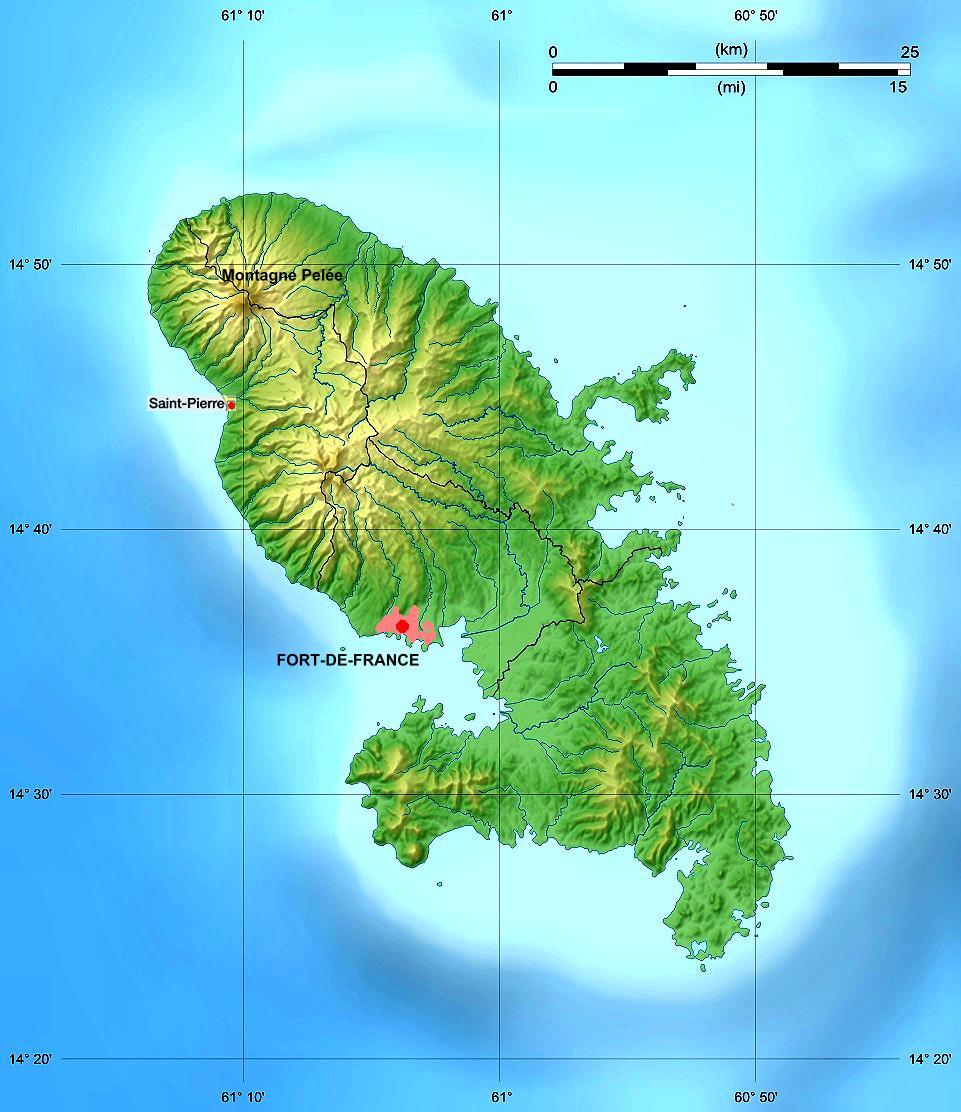
The French Overseas Department of Martinique is a Caribbean island belonging to the Lesser Antilles group in the Caribbean Sea, southeast of Cuba and north of Trinidad and Tobago. It is part of the French West Indies. It lies near the Tropic of Cancer between 14° 26' and 14°53' latitude north and 63° 9' and 63° 34' longitude west. At most some 50 miles long and 22 miles wide, Martinique covers an area of 425 square miles. Its coastline is so indented that no part of the island is more than seven miles from the sea. 14°40′N 61°00′W / 14.667°N 61.000°W / 14.667; -61.000

The "Island of flowers ", as Martinique is called, is a volcanic island with rather low mountains which form steep cliffs along the coasts. It can be divided into three natural zones: a mountainous region in the north, with its two highest points at Mount Pelée (an active volcano, 4,428 ft.) and the Pitons du Carbet (3,960 ft.); the Lamentin Plain in the center; and a hilly region in the south, composed of eroded remnants of old volcanoes and dominated by the Montagne du Vauclin (1,656 ft.) and the Morne du Diamant (1,567 ft.).

Key Information

Statistics

[edit]
An enlargeable, detailed map of Martinique

Area:
total: 1,100 km²
land: 1,060 km²
water: 40 km²

Area – comparative: slightly more than twice the size of the Isle of Man, or six times the size of the City of Washington, D.C.

Land boundaries: 0 km

Maritime claims:
exclusive economic zone: 200 nmi (370.4 km; 230.2 mi)
territorial sea: 12 nmi (22.2 km; 13.8 mi)

Natural resources: coastal scenery and beaches, cultivable land

Land use:
arable land: 8%
permanent crops: 8%
permanent pastures: 17%
forests and woodland: 44%
other: 23% (1993 est.)

Irrigated land: 40 km² (1993 est.)

Natural hazards: hurricanes, flooding, and volcanic activity (an average of one major natural disaster every five years)

Extreme points

[edit]
  • Northernmost point – headland at Macouba Beach
  • Easternmost point – Cap Ferré
  • Southernmost point – Îlet Cabrits
  • Westernmost point – unnamed headland near Anse Belleville
  • Highest point – Mont Pelée 1,397 m
  • Lowest point – Caribbean Sea 0 m

Terrain

[edit]

The mountainous, sparsely populated north, covered with dense rainsforests, contains 4 main active or extinct volcanic ranges towering around 1000 metres above sea level — Pitons du Carbet, Morne Jacob, Mount Pelée and Piton Conil. Black sand beaches predominate in northern Martinique due to volcanism.

The more populated, field-covered southern part of Martinique is occupied by lower ridges and hills, towering around 400–500 metres above sea level, with a rugged coastline including numerous white sand corallian coves. The deeply populated central part of the island, home of the vast majority of the population, and formed by the lower slopes of the Pitons du Carbet massif and the Lamentin and Rivière Salée plains, covered with sugarcane and mangroves, is a transition zone between the mountainous north and the hilly south.[1]

Martinique is surrounded by small islets and hosts three main peninsulas, the Presqu'île de la Caravelle Peninsula in the Atlantic coast, the Trois Îlets Peninsula in the Southwest Caribbean coast and the Saint Anne Peninsula in the Saint Lucia Channel.[2]

Martinique has many rivers, but owing to its size and topography, no large ones. The most important of them —the Lorrain, Galion, Capote and Lézarde—flow through the center of the island. The rivers in the south—the Salée and Pilote—are short and often dry, while in the north they are just torrents cut by numerous waterfalls.[2]

Climate

[edit]

Martinique's tropical climate is tempered by the trade winds, and the temperature averages 26 °C (79 °F) the year round. Rainfall is abundant, although unevenly distributed throughout the year, and varies according to the altitude; the annual rainfall ranges from 3988 to 4877 mm (157–192 in.) in the mountainous northern region facing the Atlantic to less than 990 mm (39 in.) in the south. Owing to this climate and the fertility of the volcanic soils, the vegetation in Martinique is luxuriant, with mangroves along the coasts and tree ferns and numerous varieties of trees in the interior.[2]

Climate data for Fort-de-France (1981–2010 averages, extremes 1932–present)
Month Jan Feb Mar Apr May Jun Jul Aug Sep Oct Nov Dec Year
Record high °C (°F) 31.5
(88.7)
32.1
(89.8)
33.6
(92.5)
33.0
(91.4)
33.9
(93.0)
33.6
(92.5)
33.6
(92.5)
33.0
(91.4)
33.8
(92.8)
33.0
(91.4)
32.1
(89.8)
31.3
(88.3)
33.9
(93.0)
Mean daily maximum °C (°F) 27.5
(81.5)
27.8
(82.0)
28.5
(83.3)
29.4
(84.9)
29.8
(85.6)
29.5
(85.1)
29.5
(85.1)
30.0
(86.0)
30.3
(86.5)
30.0
(86.0)
29.0
(84.2)
28.1
(82.6)
29.1
(84.4)
Daily mean °C (°F) 24.7
(76.5)
24.7
(76.5)
25.2
(77.4)
26.1
(79.0)
26.7
(80.1)
26.8
(80.2)
26.7
(80.1)
27.0
(80.6)
27.2
(81.0)
26.9
(80.4)
26.2
(79.2)
25.3
(77.5)
26.1
(79.0)
Mean daily minimum °C (°F) 21.9
(71.4)
21.7
(71.1)
22.0
(71.6)
22.8
(73.0)
23.6
(74.5)
24.0
(75.2)
23.9
(75.0)
24.0
(75.2)
24.0
(75.2)
23.8
(74.8)
23.4
(74.1)
22.6
(72.7)
23.1
(73.6)
Record low °C (°F) 17.8
(64.0)
17.3
(63.1)
18.6
(65.5)
18.9
(66.0)
19.9
(67.8)
20.0
(68.0)
18.4
(65.1)
19.5
(67.1)
17.9
(64.2)
20.2
(68.4)
19.7
(67.5)
17.4
(63.3)
17.3
(63.1)
Average rainfall mm (inches) 119.5
(4.70)
77.8
(3.06)
74.3
(2.93)
94.0
(3.70)
131.5
(5.18)
159.8
(6.29)
219.3
(8.63)
254.7
(10.03)
234.5
(9.23)
265.9
(10.47)
254.5
(10.02)
134.7
(5.30)
2,020.5
(79.55)
Average rainy days (≥ 1.0 mm) 18.93 13.60 12.77 11.50 12.70 16.43 20.00 19.57 17.90 18.17 19.00 17.60 198.17
Mean monthly sunshine hours 203.6 198.5 223.8 211.3 208.1 191.0 200.7 224.5 206.1 182.9 184.4 201.8 2,436.8
Source: Météo France[3][4][5]

See also

[edit]

References

[edit]
[edit]
Revisions and contributorsEdit on WikipediaRead on Wikipedia
from Grokipedia
Martinique is an island located in the archipelago of the eastern , serving as an overseas department and region of , with a total land area of 1,128 square kilometers, roughly 60 kilometers long and 30 kilometers wide at its widest points. The island's geography is defined by its volcanic origins, featuring rugged, mountainous terrain with an indented coastline, dense tropical forests, and fertile plains in the south, while the north is dominated by steep volcanic peaks including the active Mont Pelée, which rises to 1,397 meters as the island's highest point. Mont Pelée has shown increased seismic activity since 2019, with ongoing unrest as of 2025. Positioned at approximately 14°40′N latitude and 61°00′W longitude, lies between the to the west and the North to the east, situated about 100 kilometers south-southeast of to the north and north of to the south, making it part of the volcanic arc of the . The island encompasses 48 smaller islets and benefits from a subtropical tempered by , with average temperatures ranging from 24°C to 28°C year-round, moderately high humidity, and a distinct rainy season from to that brings heavy up to 360 millimeters in peak months. This supports lush , including rainforests, mangroves, and agricultural lands, though the island is vulnerable to natural hazards such as hurricanes every eight years on average, flooding, seismic activity due to its location on a tectonic plate boundary, and volcanic eruptions from Mont Pelée, which last occurred in 1932 but devastated the town of Saint-Pierre in 1902, killing around 30,000 people. Ecologically, Martinique's geography includes diverse habitats from coastal swamps to high-altitude montane forests, with limited natural resources primarily consisting of for crops like bananas and , marine fisheries, and minor potential, while environmental concerns involve , from agricultural runoff, and the impacts of , such as rising sea levels and intensified storms. The island's protected areas, including the Martinique Regional Natural Park established in 1976, cover significant portions of its interior to preserve amid ongoing geological activity and tropical weather patterns.

Location and Physical Extent

Geographical Coordinates and Position

Martinique is situated in the , with its central geographic coordinates at 14°40′N 61°00′W. The island spans a range of 14°26′N to 14°53′N and a range of approximately 60°50′W to 61°10′W, positioning it firmly within the tropical zone just north of the . As one of the in the archipelago, occupies a strategic location in the eastern . It lies directly north of , separated by about 22 km across the Saint Lucia Channel; south of , approximately 90 km away; and northwest of , at a distance of approximately 230 km. This placement places Martinique at the heart of the volcanic arc of the , influencing its environmental and climatic characteristics. Politically, Martinique functions as an overseas territorial collectivity and single territorial authority of , integrating it as an outermost region of the with full application of EU law. Its exclusive economic zone (EEZ) covers approximately 47,800 km², extending into both the Atlantic Ocean and the , supporting maritime activities such as fishing and resource exploration under French and EU jurisdiction. The island's eastern coastline borders the Atlantic Ocean, characterized by stronger winds and waves, while its western shore faces the calmer , creating diverse coastal environments.

Size, Area, and Boundaries

Martinique covers a total area of 1,128 square kilometers, consisting entirely of land with no significant inland water bodies accounted for in official measurements. This makes it one of the smaller islands in the archipelago. As a French territorial collectivity, its territorial extent is defined under French administrative jurisdiction, emphasizing its compact size relative to neighboring . The island measures approximately 80 kilometers in length from north to south and up to 35 kilometers in width from east to west at its broadest point. Its coastline stretches for 350 kilometers, featuring a highly irregular profile with numerous bays, peninsulas, and coves that enhance its maritime accessibility. As an isolated island territory, Martinique has no land borders and is surrounded by the Caribbean Sea to the west and the Atlantic Ocean to the east. Its maritime boundaries are governed by the United Nations Convention on the Law of the Sea (UNCLOS), under which France exercises sovereignty over a 12-nautical-mile territorial sea and an exclusive economic zone (EEZ) extending 200 nautical miles from the baselines. The EEZ overlaps or is delimited with those of adjacent territories such as Dominica to the north and Saint Lucia to the south, managed through bilateral agreements and French maritime policy. Population density stands at approximately 315 people per square kilometer as of January 2025, based on an estimated population of 355,459 inhabitants, reflecting ongoing demographic decline due to emigration and aging.

Topography and Extreme Points

Terrain and Landforms

Martinique's terrain is characterized by a predominantly mountainous with an indented coastline, resulting from its volcanic origins that have produced fertile soils across much of the island. The island's surface features vary significantly, reflecting its geological history of volcanic activity and , which has created a diverse from steep slopes to low-lying plains. This supports a range of ecosystems, with elevations generally rising from coastal lowlands to interior highlands. The island can be broadly divided into three distinct zones based on terrain variations. In the north, volcanic mountains dominate, featuring rugged peaks and dense rainforests on slopes formed by ancient lava flows and ash deposits. The central region encompasses the flat to gently rolling Lamentin Plain, a former swamp area that has been drained and transformed into prime . To the south, the landscape transitions to lower hilly terrains with undulating valleys and sheltered coves along the coast. Key landforms include the Pitons du Carbet range in the northwest, a series of prominent volcanic domes and peaks that represent some of the island's oldest geological features. The Lamentin Plain in the center serves as a transitional lowland, extensively utilized for plantations and fringed by wetlands. In the south, rolling hills interspersed with small valleys create a more subdued relief, dotted with coastal coves that occasionally feature pockets of white sand amid predominantly volcanic beaches. Volcanic peaks such as Montagne Pelée exemplify the island's active , though detailed volcanic features are addressed elsewhere. Elevations across Martinique range from at the coast to a maximum of 1,397 meters. The soils, primarily andosols formed from weathered , are renowned for their high fertility due to rich mineral content, including allophane and imogolite, which enhance nutrient retention and support intensive ; however, these soils are prone to under heavy rainfall and poor practices.

Extreme Points of the Island

Martinique's extreme points define the island's geographic boundaries, spanning a compact area in the . The northernmost point is Pointe Macouba at 14°52′00″N 61°09′00″W. The southernmost point is Îlet Cabrits at 14°23′19″N 60°52′02″W. The easternmost point is Cap Ferré at 14°27′37″N 60°48′30″W, facing the Atlantic Ocean. The westernmost point is an unnamed near Anse Belleville at 14°49′21″N 61°13′45″W, facing the . These cardinal extremes reflect the island's roughly rectangular shape, oriented northwest to southeast, with a total span of about 60 km north-south and 30 km east-west. The highest elevation on Martinique is Montagne Pelée at 1,397 m, an active detailed further in the Mountains and Volcanoes section. The lowest elevation is , occurring along the extensive coastlines bordering the and .

Geology and Natural Features

Geological Formation and

Martinique forms part of the , which originated from the of the South American Plate beneath the overriding Caribbean Plate along a convergent margin. This tectonic interaction initiated arc volcanism approximately 40 million years ago during the Eocene, with the island itself emerging through Miocene volcanic activity around 20-25 million years ago. The process drives ongoing compression and uplift, contributing to the island's dynamic geological framework. The island's features dominantly andesitic and basaltic lavas, reflecting the calc-alkaline series typical of settings, with subordinate dacitic compositions in some volcanic units. Older plutonic rocks, including gabbroic and dioritic intrusions, are exposed or inferred in central areas through xenoliths entrained in younger lavas, indicating crystallization in the underlying arc crust during earlier magmatic episodes. Martinique lies directly on this plate boundary, resulting in frequent seismic activity from both crustal faults and deeper slab processes, with often reaching intermediate depths of 50-150 km. Volcanic phases span from the , with initial arc edifices dated to 24-21 Ma, through multiple Miocene-Pliocene cycles of construction and erosion, to active volcanism. The period has seen intensified activity, culminating in catastrophic events such as the , which generated a nuée ardente that destroyed the city of Saint-Pierre and killed nearly 30,000 people. This eruption exemplifies the arc's potential for explosive, gas-rich events driven by subduction-related fluid fluxing.

Mountains and Volcanoes

Martinique's mountainous terrain is dominated by volcanic origins, with the northern region featuring the island's most prominent peaks and the active volcano Montagne Pelée. Rising to 1,397 meters, Montagne Pelée is a located at the northern tip of the island, known for its explosive history. Its most devastating eruption occurred in 1902, when a nuée ardente—a searing pyroclastic flow—devastated the nearby town of Saint-Pierre, resulting in approximately 30,000 deaths. The volcano's last major magmatic activity took place from 1929 to 1932, involving formation, after which it entered a period of dormancy, though it remains potentially active with ongoing monitoring by the Observatoire Volcanologique et Sismologique de Martinique (OVSM). In the northwest, the Pitons du Carbet form a non-volcanic composed of older volcanic remnants, including lava domes from ancient eruptions. This range, stretching across the central-northern part of the , reaches its highest point at Piton Lacroix, elevating to 1,197 meters. The Pitons du Carbet exhibit steep, rugged profiles shaped by viscous magmas, contributing to the dense cover on their slopes. These formations, predating the current Montagne Pelée by hundreds of thousands of years, highlight the 's prolonged volcanic evolution. The southern portion of Martinique features lower hills, such as the Vauclin Hills, with Montagne du Vauclin as the highest at 504 meters. These gentler elevations contrast with the dramatic northern massifs, forming a transition to the more arable coastal plains. Overall, Martinique's is predominantly mountainous, with rugged terrain covering much of the northern two-thirds of the island, influencing local ecosystems and accessibility. These mountains and volcanoes not only define the island's physical landscape but also played a central role in its geological formation through successive volcanic episodes.

Hydrology and Coastline

Rivers, Lakes, and Water Resources

Martinique's hydrology is characterized by short, steep rivers that originate from the island's mountainous interior, particularly the Pitons du Carbet and Montagne Pelée, and flow radially toward the coasts. These rivers are influenced by the , with high annual rainfall recharging surface and systems, though seasonal variations in can lead to periods of abundance followed by scarcity. The terrain's steep gradients result in rapid runoff, making the rivers prone to flash flooding during intense rain events, which can cause significant and downstream. The longest river is the Lézarde River, approximately 36 km in length, which originates in the central highlands, receives the Rivière Blanche (about 20 km long) as a , and empties into the near Le Lamentin. Other notable rivers include the Rivière Salée in the central region, which supports agricultural through managed withdrawals and distribution networks, and the Rivière Pilote in the south, draining the southeastern slopes into the Atlantic. These rivers, typically under 20 km long due to the island's compact size, serve as vital conduits for freshwater but have limited navigability owing to their rocky beds and swift currents. Natural lakes are scarce on Martinique, with the island's volcanic favoring riverine rather than lacustrine features; instead, storage relies on man-made reservoirs, such as those in the central and southern areas, which capture rainfall for municipal and agricultural supply. plays a crucial role, drawn from heterogeneous aquifers in the central plain, including paleo-valley formations that store infiltrated rainwater and support potable water extraction near urban centers like . These aquifers are recharged primarily by the island's abundant , estimated at 2,600 mm annually across 1,128 km². However, quality is compromised by contamination from the banned pesticide , used historically in banana plantations, which has polluted soils and aquifers, reducing available potable resources and necessitating treatment. To address dry periods and uneven distribution, supplements freshwater supplies, particularly in southern coastal areas where surface sources are limited; plants treat to produce potable water, integrating with the overall framework. The interplay of seasonal rainfall influences river flows, with wetter months enhancing recharge and reducing reliance on alternative sources.

Coastal Geography

Martinique's coastline spans approximately 450 kilometers, characterized by stark contrasts between its eastern and western shores due to exposure to differing oceanic conditions. The eastern Atlantic-facing coast is predominantly rugged, with steep cliffs rising directly from the and narrow beaches derived from volcanic sediments, creating a dramatic and wave-exposed landscape. In contrast, the western coast is gentler and more indented, featuring sheltered white sand bays that invite calm waters and recreational activities. Prominent coastal features highlight these variations, including the Presqu'île de la Caravelle, a northeast peninsula that juts into the Atlantic and encompasses mangrove ecosystems alongside rocky outcrops and saline ponds. Further south along the southwest coast, the Anses d'Arlet region comprises a chain of scenic coves with curving bays and accessible sandy stretches, ideal for exploration along the Route des Anses. On the eastern side, Cap Salée exemplifies the island's cliff-dominated terrain, where basalt formations form sheer drops overlooking turbulent waters. Marine interfaces play a crucial role in shaping the western coastline, where fringing coral reefs extend up to 3 kilometers offshore, acting as natural barriers that reduce wave energy and foster protected lagoons. These reefs, developed on a submerged platform influenced by long-term geological processes, contribute to the formation of shallow bays. Tectonic , driven by along the arc, has affected coastal stability at rates of up to 0.3 millimeters per year since the , leading to gradual submergence in some areas. The indented nature of the coastline supports several natural harbors, with Baie de serving as the primary deepwater port and economic hub on the western side, accommodating large vessels and facilitating trade. This configuration of bays and coves enhances navigational safety and supports maritime activities across the island.

Climate and Weather

Climate Classification and Patterns

Martinique's climate is classified as a tropical monsoon climate under the Köppen-Geiger system (Am), characterized by high temperatures, significant rainfall, and distinct seasonal variations. This classification reflects the island's location in the tropics, where precipitation exceeds potential evapotranspiration annually, but with a pronounced dry period. The climate is further modified by persistent northeast trade winds, which provide cooling and influence moisture distribution across the island. Martinique lies within the Atlantic hurricane belt, exposing it to periodic tropical cyclone activity that can disrupt normal weather patterns. The island's weather is primarily influenced by the seasonal migration of the (ITCZ), a band of low pressure and converging near the that drives convective activity. During the dry season from December to May, the ITCZ shifts southward, allowing steady northeast to dominate and suppress widespread rainfall, resulting in clearer skies and more stable conditions. In contrast, the from June to November sees the ITCZ migrate northward overhead, promoting intense convectional rainfall through upward air motion and cloud formation. Dominant wind systems consist of persistent easterly , typically blowing at 28-37 km/h (15-20 knots), which originate from the and provide a consistent ventilation effect. These winds occasionally interact with tropical waves—westward-moving troughs of low pressure embedded in the trade wind flow—that can introduce instability and increased cloudiness. Microclimates vary significantly due to topography and wind exposure: the windward (eastern) side experiences higher humidity and more frequent orographic precipitation from rising over volcanic slopes, leading to wetter and relatively cooler conditions in elevated areas. The leeward (western) side, sheltered by the central mountains, receives drier air in a effect, resulting in warmer and less humid environments along the coast.

Temperature, Precipitation, and Seasons

Martinique maintains a consistently warm , with an annual average temperature of 26.5°C influenced by its maritime position and steady . Monthly temperatures typically range between 24°C and 28°C, exhibiting minimal seasonal variation due to the moderating effects of surroundings. Daytime highs can reach up to 32°C during the warmer months from to , while nighttime lows occasionally dip to 20°C in the cooler period from December to May. Annual precipitation across the island averages 1,500 to 2,000 mm, though it varies markedly by and location. Northwestern coastal regions receive around 1,000 mm per year, whereas the northern mountainous areas, such as near , experience up to 5,000 mm or more due to from prevailing winds. Roughly 70% of the total rainfall occurs during the , with the remainder distributed more evenly in drier periods. The dry season, known locally as carême, spans December to May and is characterized by lower humidity levels, abundant sunshine, and reduced rainfall of 60 to 90 mm per month. In contrast, the wet season, or hivernage, from June to November, features high humidity, frequent afternoon showers, and increased cloud cover, with monthly totals often exceeding 200 mm. Transitional months of May and October bridge these periods with variable weather patterns. Trade winds provide consistent moderation throughout the year. Extreme temperature records include a high of 36.1°C recorded in Fort-de-France and a low of 15°C in the same location, reflecting the island's overall thermal stability despite occasional deviations.

Environmental Geography

Biodiversity and Ecosystems

Martinique's biodiversity is characterized by a rich array of ecosystems shaped by its volcanic terrain and tropical climate, supporting a high concentration of endemic species within a relatively small land area of approximately 1,128 square kilometers. The island's northern region is dominated by humid rainforests, which cover about 46% of the territory and feature tall trees exceeding 40 meters, epiphytes such as orchids and bromeliads, tree ferns, and parasitic plants that thrive in the moist, shaded understory. In contrast, the southern lowlands host drier forests adapted to less precipitation, consisting of drought-resistant shrubs and deciduous trees that transition into savanna-like habitats. Coastal ecosystems include mangroves spanning roughly 1,800 hectares, with tangled root systems providing nurseries for juvenile fish and habitats for wading birds, while western fringing coral reefs extend over about 5,500 hectares, forming vibrant underwater structures teeming with diverse marine invertebrates and algae. The flora of Martinique encompasses more than 3,000 species, of which approximately 6% are endemic to the island or the , reflecting its status as part of a hotspot. Prominent trees in the rainforests include the endemic gommier (Dacryodes excelsa), a tall canopy species valued for its durable wood, and introduced (Swietenia mahagoni), which has naturalized in disturbed areas. Highland regions, influenced by elevation and humidity, harbor specialized epiphytes like orchids (e.g., species) and bromeliads (e.g., utriculata), which contribute to the lush, layered vegetation and play key roles in water retention and networks. Faunal diversity includes over 200 bird species, among them endemics such as the Martinique oriole (Icterus bonana), a striking yellow-and-black restricted to forested habitats in the northern pitons and threatened by habitat loss. Reptilian fauna features the venomous fer-de-lance (Bothrops lanceolatus), an endemic adapted to both forests and agricultural edges, alongside lizards like the Martinique anole (Anolis roquet). Marine ecosystems support nesting populations of sea turtles, including the green turtle (Chelonia mydas), hawksbill (Eretmochelys imbricata), and leatherback (Dermochelys coriacea), which utilize coral reefs and beaches for foraging and reproduction. However, like the (Urva auropunctata), brought in the to control rats, have negatively impacted native fauna by preying on birds, reptiles, and turtle eggs, exacerbating declines in endemic populations. To safeguard this , over 50% of 's land area is designated as protected through reserves and regional parks that encompass key habitats. The Regional Nature Park, established in 1970 and covering over 63,000 hectares (more than half the island), integrates the Montagne Pelée area and was recognized in 2021 for its volcanic forests, with further World Heritage inscription in 2023 highlighting its global significance for endemic species conservation. Other reserves, such as the Caravelle Peninsula and Salines Pond, protect mangroves and reefs, ensuring connectivity across terrestrial and marine ecosystems.

Natural Hazards and Environmental Issues

Martinique, located in the Lesser Antilles, faces significant natural hazards due to its position in a seismically active subduction zone and tropical cyclone belt. Hurricanes pose the most frequent threat, with the peak season occurring from August to October. For instance, Hurricane Allen in 1980 passed approximately 30 miles north of the island, generating sustained winds exceeding 170 km/h and causing extensive coastal damage through storm surges and wave action. Volcanic activity at Mount Pelée, the island's active stratovolcano, presents risks of pyroclastic flows, ash falls, and lahars, particularly during eruptions or heavy rainfall; historical lahars in the Prêcheur River have been frequent non-eruptive events triggered by rain, exacerbating downstream flooding. Earthquakes are common owing to the island's location in a high seismic zone, with notable events including the 1839 magnitude 6.5 quake near Martinique that killed about 400 people and caused severe damage in Saint-Pierre. Flooding from intense rainfall, often associated with tropical storms, further compounds risks, leading to flash floods and landslides on steep terrains. Environmental issues in Martinique stem largely from historical and practices. has reduced forest cover, with current estimates indicating about 43% of the land (roughly 46,000 hectares) remains forested, showing minimal net change between 1990 and 2000 but ongoing losses of 3.1 thousand hectares of tree cover from 2001 to 2024 due to and . This has intensified on the island's volcanic slopes, where poor agricultural methods and heavy rains accelerate loss, contributing to runoff into rivers and coastal areas. is another pressing concern, accelerated by human activities such as sand extraction and removal, alongside natural wave action; approximately two-thirds of the coastline is eroding, with rates influenced by a historical relative of 2.0–3.5 mm/year recorded over the past two centuries. , particularly from runoff, contaminates waterways and sediments; the banned chlordecone, used extensively on plantations until 1993, persists in soils and has led to widespread environmental and impacts, including elevated cancer rates. Climate change amplifies these hazards in , with projections indicating increased intensity of tropical storms due to warmer sea surface temperatures. events, driven by elevated temperatures, have severely affected reefs; the 2023–2024 episode impacted 95% of , resulting in 34% mortality across monitored sites. , currently at about 2.4 mm/year based on long-term , is expected to reach approximately 65 cm by 2100 under regional scenarios, potentially inundating low-lying coastal areas and exacerbating erosion along 10–20% of the shoreline, including key tourist and residential zones. Mitigation efforts focus on resilience-building measures. A well-developed regional early warning system for hurricanes, supported by Doppler radars and satellite monitoring, provides timely alerts across the , including , enabling evacuations and preparations. Reforestation initiatives, such as the "Péyi Vert" project aiming to plant one million native trees, seek to restore forest cover, combat , and enhance while offsetting carbon emissions.

References

Add your contribution
Related Hubs
User Avatar
No comments yet.