Hubbry Logo
ClitoriaClitoriaMain
Open search
Clitoria
Community hub
Clitoria
logo
8 pages, 0 posts
0 subscribers
Be the first to start a discussion here.
Clitoria
Clitoria
from Wikipedia

Clitoria
Clitoria ternatea
Scientific classification Edit this classification
Kingdom: Plantae
Clade: Tracheophytes
Clade: Angiosperms
Clade: Eudicots
Clade: Rosids
Order: Fabales
Family: Fabaceae
Subfamily: Faboideae
Clade: Millettioids
Tribe: Phaseoleae
Subtribe: Clitoriinae
Genus: Clitoria
L.[1]
Species

66; see text.

Synonyms[2]
  • Clitoriastrum Heist. (1748), not validly publ.
  • Macrotrullion Klotzsch (1849), nom. nud.
  • Martia Leandro (1819 publ. 1821), nom. illeg.
  • Martiusia Schult. (1822)
  • Nauchea J.T.Descourt. (1826)
  • Neurocarpum Desv., (1813)
  • Rhombifolium Rich. ex DC. (1825)
  • Ternatea Mill., (1825), not validly publ.
  • Vexillaria Eaton (1817), nom. superfl.

Clitoria is a genus of mainly tropical and subtropical,[1] insect-pollinated flowering pea vines.

Taxonomy

[edit]

Naming of the genus

[edit]

This genus was named after the human clitoris, for the flowers bear a resemblance to the vulva. The first reference to the genus, which includes an illustration of the plant, was made in 1678 by Jakób Breyne, a Polish naturalist, who described it as Flos clitoridis ternatensibus, meaning 'Ternatean flower of the clitoris'.[3][4] Many vernacular names of these flowers in different languages are similarly based on references to female external genitalia.[5]

Controversies existed in the past among botanists regarding the good taste of the naming of the genus. The analogy drew sharp criticism from botanists such as James Edward Smith in 1807, Amos Eaton in 1817, Michel Étienne Descourtilz in 1826, and Eaton and Wright in 1840. Some less explicit alternatives, like Vexillaria (Eaton 1817) and Nauchea (Descourtilz 1826), were proposed, but they failed to prosper, and the name Clitoria has survived to this day.[6]

Species

[edit]
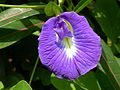
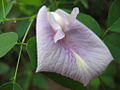
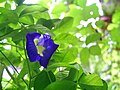
Blue and white varieties of Clitoria ternatea

As of June 2021, Plants of the World Online accepted the following species:[1]

Distribution

[edit]

These plants are native to tropical, subtropical and temperate areas of the world, ranging through the temperate and tropical Americas, sub-Saharan Africa, Arabian Peninsula, Indian Subcontinent, Indochina, southern China, and Western Australia and the Northern Territory.[1]

Uses

[edit]

The most widely known species of the genus is Clitoria ternatea, also known as butterfly pea. It is used as an herbal medicine,[7][8] and it is used as food, as well.[9][10] Its roots are used in ayurveda Hindu medicine.[11]

[edit]

See also

[edit]

References

[edit]

Further reading

[edit]
Revisions and contributorsEdit on WikipediaRead on Wikipedia
from Grokipedia
Clitoria is a of approximately 60 species of flowering plants in the family , primarily consisting of climbing vines, shrubs, lianas, or herbaceous perennials native to tropical and subtropical regions worldwide. These plants are characterized by imparipinnate leaves with 3–9 leaflets, large papilionaceous flowers that are often resupinate and colored in , violet, white, or , and linear dehiscent containing subglobose or reniform seeds. The genus is notable for its ornamental and medicinal value, particularly in species like , which produces vivid blue flowers used in herbal teas and natural dyes due to their content. The native range of Clitoria spans the and , with the greatest diversity in the , where most species occur, alongside about 10 species in , several in , and one endemic to . Species are adapted to a variety of habitats, including dry open forests, wet tropical biomes, and seasonally dry areas, often thriving in sandy or disturbed soils. Many Clitoria species have pubescent stems and are perennials, with some functioning as evergreen climbers reaching up to 5 meters in length. Morphologically, Clitoria species feature a 5-lobed tubular calyx and zygomorphic pea-shaped flowers borne singly or in pairs, blooming from summer to fall in many cases. The flowers attract pollinators and, in some species like Clitoria mariana, display a distinctive butterfly-like appearance with corollas and or greenish centers. Fruits are typical of the , developing into pods that dehisce to release multiple seeds, aiding in dispersal across their distribution. The genus name Clitoria, derived from the Latinized Greek word kleitoris meaning clitoris, reflects the provocative resemblance of the flower structure to female genitalia, a established by in 1753. Among the most prominent species is , a climber originating from and but widely cultivated globally for its and potential pharmacological properties, including and neuroprotective effects supported by studies. Other notable taxa, such as Clitoria mariana in , contribute to local in southeastern U.S. ecosystems, where they serve as native wildflowers in pine-oak woodlands.

Taxonomy

Etymology and history

The genus Clitoria was first referenced in a botanical context in 1678 by the Polish naturalist Jakób Breyne, who described a plant specimen from the island of as Flos clitoridis ternatensibus, or "Ternatean flower of the ," owing to the flower's and overall structure resembling human female genitalia. This pre-Linnaean naming highlighted the plant's distinctive morphology and set the stage for its formal taxonomic recognition. Breyne's illustration and description appeared in his work Exoticarum aliarumque minus cognitarum plantarum centuria prima, marking an early European encounter with the tropical . The etymology of the genus name directly stems from the Latin clitoris, reflecting the same anatomical analogy noted by Breyne and later botanists for the flower's shape. adopted and retained this provocative nomenclature when he established Clitoria as a distinct in the family in his seminal (1753), where he included several species based on specimens from various tropical regions. Linnaeus's decision to preserve the name, despite its explicit connotations, aligned with his systematic approach to but drew immediate scrutiny in botanical circles for its impropriety. The suggestive etymology provoked ongoing historical throughout the 18th and 19th centuries, as prudish botanists sought to relegate the name to obscurity amid evolving standards of scientific . For example, American botanist Amos Eaton proposed the alternative Vexillaria in 1817, emphasizing flag-like floral features to avoid anatomical references, while French botanist Michel Étienne Descourtilz introduced Nauchea in 1826 as a more neutral substitute. Despite these efforts and broader debates on naming propriety—exacerbated by the era's Victorian sensibilities—these synonyms failed to supplant Clitoria, which endured due to nomenclatural priority and Linnaeus's foundational authority.

Classification

Clitoria is classified in the kingdom Plantae, phylum , class Equisetopsida, subclass Magnoliidae, order , family , subfamily , tribe , and subtribe Clitoriinae. The genus has several historical synonyms, including Clitoriastrum Heist. ex Fabr., Martiusia Schult., Ternatea Mill., Nauchea Descourt., and Vexillaria Raf. Molecular phylogenetic studies, including analyses of chloroplast DNA sequences like rbcL, confirm Clitoria's placement within the Phaseoleae tribe and support the monophyly of the genus.

Diversity and species

The genus Clitoria comprises approximately 65 accepted species (as of 2024), primarily consisting of vines or herbaceous plants, though a few are shrubs or small trees. This count reflects current taxonomic assessments, with the majority of species exhibiting climbing or trailing habits adapted to tropical environments. Among the most notable species is , a widely distributed across , , and the , often naturalized in disturbed habitats. In , Clitoria mariana stands out as the only widespread native species, occurring from the to in open woodlands and grasslands. A distinctive example is Clitoria fairchildiana, a small to medium-sized tree native to , representing one of the few arborescent forms in the genus. Diversity within Clitoria is concentrated in the tropical regions of the and , where the highest occurs, including endemics in areas like the and . Some species extend into subtropical or temperate zones, such as parts of and , though these are less common and often at the margins of the genus's range. The genus belongs to the subfamily , reflecting its papilionoid flower structure across taxa.

Description

Morphology

Clitoria species exhibit a range of growth habits, predominantly as herbaceous vines or climbers with twining stems, though some are shrubs or arborescent trees reaching up to 15 m in height, as seen in C. fairchildiana. The stems are typically slender and pubescent, facilitating their climbing nature in many . Roots form nitrogen-fixing nodules, a characteristic feature of the family, enabling symbiotic relationships with bacteria for atmospheric . Leaves are and imparipinnate, with 3–9 leaflets that are elliptic to ovate in shape. Flowers are pea-like, typically 2-4 cm in diameter, while fruits develop as linear pods approximately 5-10 cm long.

Reproduction

The flowers of Clitoria species are papilionaceous, characteristic of the family, featuring a large standard petal, two wing petals, and a formed by fused petals that encloses the reproductive organs; this structure, often elongated and boat-shaped, gives the blooms a distinctive appearance reminiscent of certain anatomical forms, from which the genus name derives. Flowers are typically resupinate. Blooms typically measure 2-5 cm in length and occur in , , or white, with the corolla exceeding the calyx in size and the standard petal being nearly flat or hooded, minutely hairy on the underside, and clawed at the base without auricles. Inflorescences are axillary, arising as solitary flowers or short racemes of 1-2 blooms, accompanied by persistent, stipule-like bracts and bracteoles. Many Clitoria species produce chasmogamous flowers adapted for pollination, while some also produce cleistogamous flowers that are small, closed, and self-pollinating to ensure seed set in varying conditions. of chasmogamous flowers occurs primarily via such as bees and , which are attracted to the vibrant colors and must force entry into the to access and , facilitating cross-pollination; species are self-compatible but exhibit mechanisms like floral morphology that promote for . Following , fruits develop as stipitate that are linear to linear-oblong, typically 3-10 cm long and 0.5-0.8 cm wide, compressed or slightly inflated, dehiscent along both sutures, and often bearing ribs or a raised midrib; each pod contains 4-10 , though numbers vary by , such as 3-9 in C. heterophylla. are subglobose to , compressed, dark brown, and hard-coated with a small central or subcentral hilum lacking a strophiole, providing physical that restricts water uptake. Dispersal is mainly ballistic, with dry pods dehiscing explosively to propel up to several meters, supplemented by or occasional animal-mediated via and in dung, as observed in C. ternatea. requires overcoming the impermeable seed coat through —mechanical nicking, chemical treatment, or prolonged soaking—to allow , achieving rates up to 80% under optimal conditions like 21°C substrate temperature.

Distribution and habitat

Geographic range

The genus Clitoria is native to tropical and subtropical regions worldwide, with its distribution spanning the , , , and . In the , species are particularly diverse in tropical areas such as , , and other parts of Central and South , including countries like , , , and . hosts several species across nations including , , , , , , , , , and . The and represent additional centers of native diversity, with species occurring in , , , , , , and . In , Clitoria australis is native, while some species like Clitoria mariana extend into temperate zones of , including the central and and northern . Centers of highest species diversity for Clitoria are found in , , and , where the genus exhibits significant and variation, contributing to its overall coverage across more than 30 countries in its native range. The genus comprises approximately 60 , predominantly adapted to tropical climates. Introduced ranges are , facilitated by cultivation for ornamental, medicinal, and agricultural purposes; for instance, has been widely naturalized in the Pacific Islands (such as , , and ), parts of (including the ), and other regions like the , , and .

Preferred environments

Clitoria species predominantly thrive in tropical and subtropical climates, where temperatures typically range from 20°C to 30°C, with optimal growth occurring above 27°C. These tolerate seasonal dry periods, including droughts lasting up to 7–8 months, but are generally susceptible to frost, limiting their persistence in cooler regions. While most species are confined to warmer zones, some, such as Clitoria mariana, can occur in temperate areas with mild winters, such as the . Regarding soil preferences, Clitoria adapts to a variety of well-drained substrates, including sands, loams, and clays, with a range of 5.5 to 8.9. Their ability to fix atmospheric through symbiotic relationships with enables robust growth in nutrient-poor soils, enhancing fertility in marginal areas. However, they perform poorly in waterlogged conditions, requiring good drainage to prevent . In terms of habitats, Clitoria species are commonly found in forest edges, open woodlands, grasslands, savannas, and disturbed areas, often functioning as climbers or trailing vines amid sparse . These environments provide ample and moderate , supporting their twining growth in association with shrubs and grasses. Native to regions in the and , they favor sites with partial canopy cover that balances light exposure and humidity.

Ecology

Pollination and interactions

Species of the genus Clitoria primarily rely on insect pollination, with chasmogamous flowers adapted for cross-pollination by various visitors, though many species also exhibit autogamy or cleistogamous self-fertilization for reproductive assurance. Long-tongued bees, such as Xylocopa latipes and X. aestuans, along with butterflies like Jamides celeno, serve as key pollinators for C. ternatea, accessing nectar through the flower's specialized structure. In C. mariana, bees are the main cross-pollinators, compelled by the flower's morphology to contact reproductive organs while foraging. Nectar guides on the petals, visible as contrasting markings, direct these pollinators to the nectar reward, enhancing pollination efficiency. Beyond , Clitoria species experience primarily by , which can significantly impact ; for instance, in C. mariana, reduces survival, though predator cues like scat can decrease predation rates by up to 50%. Occasional fungal pathogens, such as Cercospora and Rhizoctonia species, infect leaves of C. ternatea in humid conditions, causing leaf spots and reduced vigor. Additionally, Clitoria forms symbiotic associations with bacteria in root nodules, enabling biological that supplies the plant with essential nutrients in nitrogen-poor soils. These interactions include mutualistic relationships where Clitoria provides forage, such as and , supporting populations including its pollinators. Certain species, like C. mariana, serve as larval host for such as the long-tailed skipper (Urbanus proteus), hoary edge (Achalarus lyciades), and southern cloudywing (Thorybes bathus), contributing to lepidopteran cycles.

Role in ecosystems

Species of the genus Clitoria, particularly C. ternatea, play a significant role in enhancing through symbiotic with rhizobial in their nodules, contributing up to 200-300 kg of per annually in legume-dominated and facilitating natural succession in nutrient-poor soils. This process improves overall ecosystem productivity by increasing available for associated communities without external inputs. In terms of biodiversity support, Clitoria species provide essential habitat and forage in grasslands, open woodlands, and disturbed areas, attracting pollinators such as bees and butterflies while offering seeds and foliage as food sources for herbivores and earthworms that enhance soil structure. Their presence in diverse tropical and subtropical environments promotes pollinator populations and contributes to trophic interactions within these habitats. As , Clitoria aids in revegetation efforts for and restoration of degraded sites, such as mine tailings, due to its rapid and tolerance of poor soils, though it exhibits invasive potential in introduced regions by altering nutrient cycling and outcompeting native .

Human uses

Medicinal and pharmacological

Clitoria ternatea, commonly known as butterfly pea, has been utilized in traditional Ayurvedic medicine for centuries as a agent to enhance , alleviate anxiety, and reduce stress. Practitioners employ various plant parts, including and seeds, for their purported antidiabetic effects, with formulations aimed at regulating blood glucose levels in conditions like . These traditional applications stem from ancient texts and folk practices, where the herb is valued for its calming and cognitive-boosting properties without notable adverse effects in moderate doses. The pharmacological potential of C. ternatea is largely attributed to its rich profile of bioactive compounds, particularly such as ternatins, which are anthocyanins contributing to its and anti-inflammatory activities. Cyclotides, a class of stable cyclic peptides found in the plant, exhibit properties by disrupting microbial cell membranes and have shown insecticidal efficacy in extracts. and have demonstrated that these compounds scavenge free radicals, inhibit pro-inflammatory cytokines, and protect against , supporting the plant's role in mitigating inflammation-related disorders. Modern research has explored C. ternatea's effects through preclinical models, revealing anticholinesterase activity that enhances levels, potentially benefiting cognitive function in conditions like . Studies from the 2010s using models of cerebral hypoperfusion and diabetes-induced cognitive decline have indicated neuroprotective outcomes, including reduced neuronal damage and improved retention following root extract administration. Limited studies, such as those assessing acute ingestion of flower extracts, confirm increased plasma capacity without inducing , suggesting safe tolerability and preliminary support for its traditional cognitive claims. Further clinical trials are warranted to validate these effects in neurodegenerative contexts.

Culinary and dye

The flowers of Clitoria ternatea, commonly known as butterfly pea, are widely used in Southeast Asian cuisines for their vibrant color derived from , particularly ternatins, which serve as a coloring. In Thai and Malaysian dishes, the dried flowers are infused into sticky rice, giving it a striking hue, or incorporated into desserts like custards and cakes to enhance visual appeal. A popular application is butterfly pea , where the flowers steep in hot water to produce a deep blue infusion that shifts to purple or pink upon addition of acidic ingredients like lemon juice due to pH-dependent changes in the structure. Beyond beverages, the same pigments from C. ternatea flowers extract into blue to violet dyes suitable for textiles and additional food colorings, offering an eco-friendly alternative to synthetic options. Traditionally in , the flowers have been boiled to dye fabrics and rice, while in , extracts color textiles and ceremonial foods, leveraging the pigment's stability in neutral to slightly alkaline conditions. These dyes bind effectively to natural fibers like and when mordants such as are used, producing shades ranging from to deep . Human uses of the genus Clitoria are predominantly associated with C. ternatea, with minimal documented applications for other species. The leaves of Clitoria ternatea are consumed as a in some tropical regions or used as high-quality for , providing substantial nutritional benefits. Fresh leaves offer approximately 21% crude protein on a basis, making them a digestible (up to 80%) source of at 3.0% for foliage. The seeds, rich in protein at approximately 40% on a dry weight basis, also contribute to and animal diets, though they require processing to reduce antinutritional factors like inhibitors.

Ornamental and agricultural

Clitoria ternatea is widely cultivated as an ornamental vine for its striking blue flowers, which bloom prolifically and add vibrant color to gardens, trellises, fences, and arbors. The plant's rapid growth, reaching up to 15 feet, makes it suitable for vertical spaces, where it can be trained along supports to create living screens or decorative features. It thrives in full sun, requiring 6-10 hours of direct sunlight daily, and prefers well-draining, fertile soil with a pH of 6.0-8.0, though it tolerates slightly sandy or clay-heavy conditions. Low-maintenance once established, it needs minimal pruning to maintain shape—simply trim vine tips regularly—and benefits from occasional fertilization with a balanced NPK formula high in phosphorus and potassium to encourage flowering. In agricultural settings, serves as a valuable for , prized for its high and nutritional quality, with whole-plant crude protein content typically ranging from 15-20%. It is grazed by ruminants such as and or harvested as hay and , yielding 2-15 tons of per annually depending on management and conditions, and its vining habit allows it to be intercropped with grasses to boost overall protein without reducing grass yields. As a , it enhances by fixing 280-300 pounds of per acre and increasing , making it particularly useful in tropical and subtropical rotations with crops like or under plantations such as . The plant's deep roots help suppress weeds and alleviate compaction on heavy clay soils, promoting sustainable practices in humid, low-input systems. Propagation of is straightforward via or cuttings, with recommended in spring after the last for optimal establishment. should be scarified by nicking or soaking for 24 hours to improve rates of 80% within 6-21 days, then planted 1-2 inches deep at 2-12 kg per , often inoculated with for better nodulation. Stem cuttings, taken as 3-8 inch semi-woody sections and dipped in rooting , root in 2-6 weeks when kept moist in well-draining medium. Once established, the drought-tolerant perennial withstands dry periods of 5-6 months with minimal , though young require consistent moisture; it can be cut back periodically and incorporated as to further enrich soils.

References

Add your contribution
Related Hubs
User Avatar
No comments yet.