Hubbry Logo
CollinsportCollinsportMain
Open search
Collinsport
Community hub
Collinsport
logo
8 pages, 0 posts
0 subscribers
Be the first to start a discussion here.
Collinsport
Collinsport
from Wikipedia

Collinsport is the fictional setting of Dark Shadows, the 1960s Dan Curtis Productions Gothic horror soap opera.

Key Information

Fictional location

[edit]

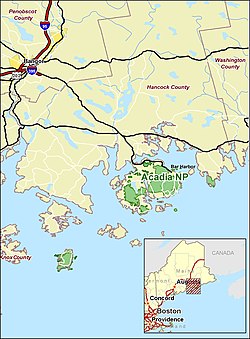
In the series, Collinsport is a small, coastal fishing village located in Hancock County in the U.S. state of Maine, on the coast about 50 miles (80 km) southeast of Bangor which would be Bar Harbor area, Mt. Desert Island are where the mansions are. Characters on the show sometimes visit or refer to Bangor or Portland, Maine. The village is, according to the TV documentation, north of Frenchman Bay which would be Mt. Desert Island and near Bucksport, Maine about 40 miles north west. However, this location can not be reconciled with the location of 50 miles southeast of Bangor, Mt. Desert Island is about 50 miles South East of Bangor. Also, the location of the Collinwood Estate is mentioned numerous times as being located on the ocean, not on a river or bay. Bucksport's history and reputation for witchcraft tourism appears to have most directly inspired the fictional Collinsport. The train makes regular runs from Boston, and brought Victoria Winters (Alexandra Moltke) to Collinsport, one stormy night. The local newspaper, The Collinsport Star, is published daily. Population has never been confirmed but is enough to support a cannery and keep the Collins family living in high style. Others speculate that it is Stonington, Deer Isle, Bar Harbor, or Winter Harbor.

Fictional history

[edit]

Isaac Collins crossed the ocean in a small sailing ship in 1690 and landed in Frenchman Bay. He eventually found a small harbor nearby and started building what would become the town of Collinsport. The town prospered throughout the 18th and 19th centuries, but suffered greatly during the Great Depression of the 1930s. Only the influx of summer visitors and artists during the 1950s and 1960s kept the town from going under completely. Recently the local fishing fleet has been hurt badly by the over-fishing of the Grand Banks.

Fixtures

[edit]

The Collinsport Inn

[edit]

The Collinsport Inn is a three-story inn located on the main street in downtown Collinsport. It is well liked and used by both tourists and locals alike. There is also a small café downstairs off the lobby. It is probably based on the Jed Prouty Tavern and Inn in Bucksport, Maine, but exterior footage was filmed at The Griswold Inn in Essex, Connecticut.

The Blue Whale

[edit]

The Blue Whale is a tavern in Collinsport. It was a very popular hang-out for most of the town's citizens. It also has a reputation for some of the very best seafood in the area, and is located right on the water. It is based on the Black Pearl Restaurant in downtown Newport, Rhode Island.

Braithwaite & Sons

[edit]

Braithwaite & Sons are the local jewelers and silversmiths. They have been in business for well over 100 years, and have filled many custom orders for the Collins family during that time. One of the more notable family members was Ezra Braithwaite (Abe Vigoda). Ezra began working in the family business as a young man (played by Edward Marshall) sometime shortly before 1897. Ezra actually died in the Collinwood drawing room in 1969 on a business visit.

Brewster's

[edit]

Brewster's is a local department store. Another long-standing name in the community, the Brewster surname has been mentioned as long ago as the 1840s, no doubt an ancestor of the current family.

Collins General Store

[edit]

Nestled in the heart of the village, the cool, high-ceilinged store is recessed from the street with an office on one end, and adjoining warehouses.[citation needed] The Collins General Store is known for its wide variety of wares — notably its bulk supply of pickles and cheeses.[citation needed]

Collinsport Hospital

[edit]

While not as large as a major New York City hospital, Collinsport can certainly hold its own as far as patient care and medical technology with the generous donations of the Collins family and, progressive doctors, such as David Woodard (played by Richard Woods, Robert Gerringer and Peter Turgeon) and Eric Lang (Addison Powell) as well as Cyrus Longworth (Christopher Pennock) in Parallel Time.

Cranshaw House

[edit]

This was a large, Gothic estate built upon the beach near Widow's Hill. It is located a very short distance away from the equally impressive Collinwood estate and a small footpath existed connecting the two properties together. A mariner named Captain Cranshaw built the house some time in the 1800s. (Note: This relates to continuity established by the Marilyn Ross novels.)

The Eagle (1795)

[edit]

A tavern in the village of Collinsport in the late 18th century.

The Eagle (1970 Parallel Time)

[edit]

The Eagle is a tavern in Collinsport, but in parallel time, which runs concurrent to our own. In our time line it is known as The Blue Whale. This alternate reality Blue Whale appears exactly as our own, only the name has changed.

Eagle Hill Cemetery

[edit]

Eagle Hill Cemetery is one of the larger graveyards to be found in the town. For the past two centuries, the esteemed Collins family had virtually all of their loved ones laid to rest at Eagle Hill. The cemetery’s most infamous landmark was the Collins family mausoleum. It is here that the vampire Barnabas Collins (Jonathan Frid) was entombed in a secret room at the rear of the mausoleum. The room is accessible by pulling the ring in the lion's mouth over the center grave plaque, which opens the panel to enter the room. This room was originally used to covertly store weapons and ammunition during the Revolutionary War. Sleepy Hollow Cemetery just outside Tarrytown, New York was used in the movies.

The Beach Road

[edit]

The Beach Road is a small highway that passes through the village. It is thought to be the local part of U.S. 1, or Maine state highway 33.

Lookout Point

[edit]

A beach located between Collinwood and the Collinsport Cannery. A little too rocky for sunbathing, it is usually used for a relaxing stroll along the water's edge, or a short-cut on foot to the cannery. In 1966, tragedy struck when the body of Bill Malloy (Frank Schofield), the well-liked manager of the Collins' fishing fleet, was found in the water, up the coast a short distance from here. Sheriff George Patterson (Dana Elcar) later determined that he had been killed at Lookout Point.

Loomis House

[edit]

The Loomis House is what the Old House is called in the alternate reality world of Parallel Time. In Parallel Time, writer William H. Loomis (John Karlen) is married to Carolyn Stoddard (Nancy Barrett). They were given the Old House on the Collins estate, and the residence has since become known as "Loomis House".

Rose Cottage

[edit]

Rose Cottage was a house near the Collinwood estate. It was the home of Flora Collins (Joan Bennett), Desmond Collins (John Karlen), Gerard Stiles (James Storm), and Leticia Faye (Nancy Barrett) in 1840.

Saint Eustace Island

[edit]

Saint Eustace Island is a small, fog-enshrouded island located off of the North Cove near Widows' Hill. Upon the island was an ancient castle, which contained the ruins of an abandoned chapel. The land surrounding the castle is difficult to traverse and consists of dense thickets, slippery embankments and heavy marshlands. (Note: This factoid only relates to the House of Dark Shadows movie version locale.) This is the Lockwood-Matthews Mansion in South Norwalk, Connecticut.

The Todds' Antique Shop

[edit]

It was the dream of Philip (Christopher Bernau) and Megan Todd (Marie Wallace) to one day open their own antique shop. In December 1969, they did just that and opened their business here in Collinsport. Carolyn Stoddard discovered the store and took an interest in it early on and voluntarily worked part-time at the shop for a while. Finding and buying their treasures from area estates and auctions was a short-lived endeavor for the Todds however. The antique shop burned to the ground in mid-February 1970, one in a string of "unfortunate events" that also took the lives of Philip and Megan shortly thereafter.

Weatherby Farm

[edit]

A property bordering the Collinwood estate to the south, owned by Mordecai Grimes (Thayer David) in the early 19th century (circa 1840). The Collins' had been trying to acquire this property for quite some time, but Mordecai always declined to sell. He didn't want to give up the land his father had left to him. One day his cattle broke through the fences between the farm and the Collins property. A week later, all his cattle were dead. Mordecai accused Quentin Collins (David Selby) of killing them with witchcraft.

Widow's Hill

[edit]

Widows' Hill is a high elevation point outside of the village and the location of the Collinwood estate. It was one 100 feet (30 m) from the edge of the cliff to the water below, and on a cloudless day, one could see 20 miles (32 km) out to sea from the cliff along the water. Widows' Hill acquired its name because women used to wait on the cliff and look out to sea, watching for their ill-fated husbands' ships to return. When Jeremiah Collins (Anthony George) decided to build Collinwood on the hill in 1796, he turned the widows away and told them to go home and keep their grief to themselves.

Some people in Collinsport claimed that the widows still walked the hill 150 years later as ghosts. The wailing sounds coming from the hill were believed to be the sobbing widows, rather than the wind, and some old-timers in town claimed to have seen them walking the hill from a distance.

By 1967, three people had thrown themselves off the cliff. Josette du Pres Collins (Kathryn Leigh Scott) jumped to her death because she was being pursued by her "lover" Barnabas Collins and would rather die than welcome his attentions, and the two others were Collinwood governesses. Legend told of a third governess who would one day be found dead at the bottom of the cliff. Some have speculated that this is Cadillac Mountain in Acadia National Park, just outside Bar Harbor, Maine. Others believe this is nearby Thunder Hole.

Windcliff Sanitarium

[edit]

Although not located in Collinsport, the Windcliff Sanitarium should be mentioned here due to its ties to the community. Windcliff is actually located about 100 miles (160 km) away. Dr. Julia Hoffman (Grayson Hall), a psychiatrist and blood specialist, is Chief of Staff. Several of the Collins' family and friends have spent some time here after experiencing various "traumatic events".

Collinwood Mansion

[edit]

Collinwood Mansion is a gloomy forty-room mansion located near Widows' Hill. The house was built in 1795 by Joshua Collins (Louis Edmonds). By 1897, it was connected to the electricity grid. The east wing of Collinwood was closed off around 1916 and most of the house fell into disuse. Elizabeth Collins Stoddard (Joan Bennett) successfully petitioned to have the property tax reduced due to most of the house being closed. The house was more of a liability than an asset and by 1967 it was only Collins-owned property without a mortgage. The road leading up to Collinwood from town is steep, with many turns. Several people have died going down the hill in bad weather. Collinwood is reputed to be haunted by Josette Collins as well as several other members of the ancient Collins Family.

Several actual mansions were used for Collinwood. The Carey Mansion (Seaview Terrace) in Newport, Rhode Island, now part of the Salve Regina University campus, was used for the original series. The Lyndhurst estate in Tarrytown, New York was used for the films House of Dark Shadows and Night of Dark Shadows. In the 1991 NBC revival, Greystone Mansion in Beverly Hills was utilized, with nearby Griffith Park as the forest surrounding Collinwood.

The Old House

[edit]

The Old House was once the provincial mansion of the Collins family up until 1796. Located on the Collins estate near Widows' Hill, it was formerly known as Collinwood. Joshua Collins was the patriarch of the last generation of Collins family members to be raised there. In 1796, construction was completed on a larger family home on the same property and this first known as the Great House. Later, it would come to be known as Collinwood. When it was first built, the original family mansion began to be referred to as the Old House. With the passing of generations, this off-hand phrase became the official nomenclature for the regal estate.

The filming location was the former Spratt Mansion on the Lyndhurst estate, destroyed by fire in 1969. Originally built in the 1850s, it was acquired by Russell Hopkins in 1907. Called "Veruselle", it was better known as The Colonnades.

Television and film locations

[edit]

References

[edit]
Revisions and contributorsEdit on WikipediaRead on Wikipedia
from Grokipedia
Collinsport is a fictional coastal town in the U.S. state of , serving as the primary setting for the gothic horror , which aired from 1966 to 1971. Located approximately 50 miles southeast of Bangor on Frenchman’s Bay, Collinsport is depicted as a small founded in 1690 by the patriarch Isaac Collins, with its economy historically tied to the influential Collins family cannery and seasonal tourism. The town features rugged shorelines, frequent harsh weather, and a pervasive atmosphere of mystery and the , centered around the grand Manor—a 40-room estate built in 1795 by Joshua Collins, complete with eerie elements like a haunted stairway capable of . Iconic local landmarks include the tavern, a waterfront pub renowned for its affordable drinks and , and Widow’s Hill, a sheer 100-foot cliff haunted by ghostly apparitions overlooking the sea. In , Collinsport is home to the wealthy Collins family, whose lives intertwine with vampires, werewolves, witches, and other phenomena, driving the series' blend of romance, , and horror that captivated audiences during its original run. The town's isolated, timeless quality amplifies themes of family curses and hidden secrets, making it a quintessential gothic locale in American television history.

Fictional Setting

Description and Geography

Collinsport is a fictional coastal town in the U.S. state of , depicted as a small situated approximately 50 miles from Bangor. As an isolated seaside community, it centers around a harbor supporting a local fleet, with weather-beaten shops lining deserted, wet streets that evoke a sense of timeless seclusion. The town's compact layout is emphasized in the series, where character Burke Devlin describes it as so small it would not fill four square blocks of , underscoring its intimate scale relative to urban centers. Geographically, Collinsport hugs the shoreline, characterized by rugged rocky coastlines battered by crashing waves and dramatic cliffs rising from the sea. Inland, dense forests with thick canopies of trees envelop dark, winding roads leading to the outskirts, creating a moody, enclosed environment that blends natural beauty with foreboding isolation. Beaches and forested areas provide additional backdrops, enhancing the town's position as a quintessential coastal enclave where the ocean's proximity influences daily life and landscape. The climate of Collinsport is marked by frequent fog, mist, and stormy weather, often portrayed under overcast skies and nighttime tempests that amplify the gothic tone of the narrative. These atmospheric conditions, including foggy nights illuminated by a full moon, are recurrent elements that contribute to the eerie ambiance, with the persistent dampness and tempests mirroring the turbulent undercurrents of the town's fictional world. The Collins family has played a pivotal role in shaping the town's layout over generations.

Economy and Society

Collinsport's economy revolves primarily around the , shipping, and associated operations, which form the backbone of the town's livelihood. The Collins family cannery stands as the central employer, controlling the largest fleet and facilities that sustain a significant portion of the local workforce. This dominance ensures steady employment but also ties the community's prosperity closely to the family's decisions, with limited diversification into other sectors. Socially, Collinsport exhibits a pronounced class divide, with the affluent Collins occupying the elite stratum as landowners and business magnates, while the working-class majority comprises fishermen, cannery laborers, and small-scale shopkeepers who depend on -owned enterprises for survival. This fosters a sense of toward the Collinses, tempered by underlying resentments over stagnant wages and opportunities. The town's insularity reinforces traditional roles, where loyalties and personal connections often dictate social interactions. Demographically, Collinsport is depicted as a predominantly , small-town community in , characterized by close-knit but gossip-prone networks that amplify rumors and superstitions, contributing to a pervasive atmosphere of suspicion and . Economic tensions peaked in the 1960s amid perceived decline, exemplified by external challengers like Burke Devlin, who sought to disrupt the Collins monopoly through rival ventures offering better pay and profit-sharing, heightening community divisions over loyalty and progress.

Fictional History

18th and 19th Centuries

Collinsport's origins trace back to the late , when Isaac Collins, a nobleman and wealthy landowner from , arrived by ship in 1690 with his wife Annabella and their infant son, landing in Frenchman's Bay and establishing a small fishing settlement that would become the town. He founded the Collins fishing fleet, which formed the economic backbone of the community, and claimed the land for the Collins family, laying the groundwork for their enduring influence in the region. Prior to this, the area likely saw Native American habitation by groups such as the , as well as early colonial explorations in during the 17th century, though specific interactions with the Collins settlers remain undocumented in primary accounts. By the mid-18th century, Collinsport had evolved into a modest port town reliant on the and limited , with the Collins family consolidating their holdings through strategic marriages and ventures. The arrival of Joshua Collins in the marked a pivotal expansion for the family estate; as patriarch, he oversaw the construction of the grand manor in the mid-1790s atop Widows' Hill, symbolizing the family's rising prominence and shifting from the original Old House to a more opulent residence. This period saw early non-supernatural challenges, including shipwrecks that plagued the coastal waters, such as those affecting local vessels during stormy seasons, contributing to the town's folklore of misfortune without delving into later paranormal interpretations. In the , Collinsport experienced steady growth driven by the expansion of its and burgeoning trade routes with ports, leading to economic booms that attracted laborers and merchants to the area. The completion of , initially referenced in early records as finalized around 1830 under Jeremiah Collins' designs before later attributions to , further solidified the estate as a cultural and economic hub. Family tragedies persisted, including devastating shipwrecks like the loss of vessels in the early 1800s that claimed Collins relatives and local fishermen, underscoring the perils of maritime life. Key institutions emerged, such as the inaugural issue of the local newspaper The Collinsport Star in the mid-, which chronicled trade successes and community events, though earlier publications like mentions in 1795 logs hint at rudimentary news dissemination via taverns such as The Eagle. These developments positioned Collinsport as a resilient coastal settlement before the upheavals of the .

20th Century and Supernatural Era

The narrative of Collinsport in the mid-20th century shifted dramatically with the arrival of , an orphaned from New York, who journeyed to the town on June 27, 1966, to take up residence at as tutor to young David Collins. Her quest to uncover her own mysterious origins intertwined with the reclusive Collins family's secrets, including the 18-year seclusion of matriarch Elizabeth Collins Stoddard and tensions with local businessman Burke Devlin, who sought retribution against the family for past grievances. This arrival marked the onset of escalating strange occurrences at , blending everyday family dramas with hints of the uncanny, such as David's troubling behavior and unexplained hauntings. The supernatural elements intensified on April 18, 1967, with the introduction of , a long-lost family member awakened from a chained in the Eagle Hill by local artist Willie Loomis. Cursed nearly two centuries earlier in 1795 by the vengeful witch Angelique Bouchard, who transformed him into a after he rejected her love in favor of Josette DuPres, returned seeking to reclaim his lost life while preying on the townsfolk. Posing as a distant , he ingratiated himself into society, but his nocturnal attacks on women like Maggie Evans and Carolyn Stoddard sowed terror across Collinsport, drawing in Dr. , who attempted to cure his vampirism through experimental treatments. Werewolf attacks further plagued the town starting in late 1968, beginning with assaults linked to newcomer Chris Jennings, whose transformations under full moons led to brutal killings at establishments like the tavern. The curse spread to Quentin Collins, a ghostly figure from the whose spirit haunted before manifesting as a in the present, terrorizing residents and prompting desperate searches for ancient cures involving silver bullets and exorcisms. These incidents compounded the fear, with multiple victims reported in Collinsport's outskirts and public spaces, heightening suspicions among the populace. In 1969, the emerged as a sinister force, an ancient group revived by Nicholas Blair to summon elder beings and reshape the world, using as an unwitting pawn through a mysterious antique box that induced visions and compelled obedience. The 's rituals at sites like the Seawitch Restaurant and the old house on the Collins estate led to possessions, shape-shifting serpents, and the birth of a heir, culminating in leader Jeb Hawkes' reign of manipulation over the Collins family. Their influence sparked a wave of disturbances, including failed resurrections and demonic alliances, straining the town's fragile social fabric. By , the storyline delved into parallel time dimensions, accessed via a hidden playroom in 's , where and others shifted to an alternate reality marked by heightened intrigue and tragedy among variant Collins family members. In this band, figures like the scheming Gerard Stiles and the tragic Daphne Harridge orchestrated events like the "Destruction of Collinwood" prophecy, involving fires, murders, and time loops that echoed back to the primary timeline. The arc explored doppelgangers and forbidden romances, amplifying the supernatural chaos as characters navigated between realities to avert looming catastrophes. These events inflicted profound town-wide repercussions, including a series of unsolved attributed to vampires and werewolves, numerous disappearances tied to abductions, and economic pressures from scandals engulfing the influential Collins family, such as failed business ventures and public distrust of Collinwood's isolation. The fishing port's reputation suffered, with locals whispering of curses that deterred visitors and strained resources for investigations by figures like Sheriff Patterson. Attempts at resolution spanned exorcisms performed by experts like Professor Stokes, interventions via to alter past events—such as ' journeys to —and alliances against otherworldly threats, though many efforts only deepened the entanglements. The era culminated in the 1971 , where Quentin Collins and his band confronted the ultimate unraveling of through prophetic visions and sacrificial acts, leaving Collinsport forever scarred by its brush with the .

Key Locations

Collins Family Estate

The Collins Family Estate serves as the ancestral stronghold of the Collins family in Collinsport, encompassing a collection of historic properties that symbolize their enduring legacy and influence. Spanning interconnected grounds overlooking the cliffs of Widows' Hill, the estate functions as the family's power center, where generations converge amid wealth, intrigue, and misfortune. Secret passages weave through the landscape, linking the structures and enabling clandestine movements that underscore the estate's role in safeguarding family secrets. At the heart of the estate stands the , constructed in as a towering Gothic edifice designed to reflect the Collins family's rising prominence. Perched dramatically on the seaside cliffs, its imposing architecture—with pointed arches, intricate stonework, and expansive wings—evokes both grandeur and foreboding, making it a focal point for family gatherings, celebrations, and tragic occurrences. The mansion's interiors, including vast drawing rooms and shadowed corridors, have witnessed pivotal moments in the family's saga, often serving as the epicenter of hauntings and disturbances that bind the living to their forebears. Adjacent to the mansion lies the Old House, a colonial-style residence dating to 1767 that originally housed early Collins patriarchs, including as his primary home during that era. Situated on the estate grounds, this weathered structure fell into ruin over time but was meticulously restored in , reviving its timber-framed facade and period furnishings to evoke the family's 18th-century roots. The restoration transformed it into a of Collins history, where echoes of past events—particularly those involving —continue to resonate, drawing inhabitants back to confront unresolved legacies. Rose Cottage, a more modest and secluded dwelling within the estate, contrasts the mansion's scale with its intimate, isolated charm, often depicted as a quaint yet eerie retreat amid the grounds' wooded fringes. Integrated into parallel time narratives, it provides a distinct backdrop for alternate realities and personal isolations, hosting key interactions that reveal hidden facets of family dynamics without the mansion's overwhelming presence. These properties, united by their shared terrain and hidden interconnectivity, reinforce the estate's status as more than mere —it is the narrative core of the Collins lineage, where power, heritage, and the supernatural inextricably entwine.

Public Establishments

The serves as Collinsport's iconic waterfront tavern and bar, functioning as a central hub for social interactions among residents and visitors alike. Opened in the mid-20th century, it attracts locals with affordable 15-cent beer and is renowned for offering what Devlin described as the best lobster in the world, making it a frequent setting for character gatherings, live music performances, and pivotal plot revelations throughout the series. The Collinsport Inn, a three-story situated on , provides essential lodging for newcomers such as upon her arrival in town. Featuring a off the lobby that serves 10-cent coffee, the inn doubles as a communal space where staff like clerk Mr. Wells dispense local gossip and secrets for a modest fee, underscoring its role in facilitating early episode encounters and transient social exchanges. Collins General Store operates as the primary everyday shopping destination for Collinsport's isolated residents, stocking basic supplies on and serving as an informal source of town gossip amid daily transactions. Braithwaite & Sons, a longstanding jeweler and in business for over a century, caters to the community's finer needs by crafting custom silver items, including those bearing the Collins family crest, while minor establishments like Brewster's offer broader for local , though rarely featured in depth.

Medical and Institutional Sites

Collinsport Hospital serves as the primary medical facility in the fictional town, providing care for routine injuries, accidents, and births amid the coastal community's challenges. It features prominently in scenes involving emergency treatments, such as when is admitted following a car crash, where physicians like Dr. Eric Lang monitor his condition closely. The hospital also appears in recovery scenarios, including post-surgical care for characters like Tom Jennings after violent incidents. Windcliff Sanitarium, situated approximately 100 miles north of Collinsport, functions as a remote psychiatric institution specializing in mental health and specialized blood-related treatments. Under the direction of Dr. , a and blood specialist, it treats patients exhibiting severe psychological regressions, notably Maggie Evans, who arrives in a child-like state after a traumatic abduction and . The facility plays a central role in experimental therapies, including memory alteration procedures aimed at suppressing traumatic recollections linked to encounters. The residence of Dr. Dave Woodard, the town's and , operates as an informal site for medical consultations and private experiments outside formal institutions. Woodard, who maintains a marked with his professional , conducts examinations and there, often delving into unusual cases that strain conventional . This setting underscores personal involvement in patient care, contrasting with the more structured environments of the hospital and sanitarium. These institutions collectively address both physical and crises in Collinsport, frequently grappling with conditions attributed to family curses, such as induced or from influences. Treatments raise ethical concerns, including coercive wipes and unorthodox experiments on unwilling subjects, highlighting tensions between medical duty and the town's undercurrents.

Shops and Media Outlets

Collinsport's commercial landscape included specialized shops dealing in antiques and curios, which frequently intersected with the town's undercurrents by serving as conduits for enchanted or cursed items. The Todds' Antique Shop, operated by and Megan Todd in the late 1960s, exemplified this niche, stocking artifacts like a painted by Delaware Tate that concealed mystical secrets and advanced key plot developments involving ancient entities known as the Leviathans. The Todds, initially unaware of their inventory's darker implications, became entangled in dealings through these objects, underscoring the shop's role in blending mundane retail with eerie intrigue. The town's primary media outlet was the Collinsport Star, a that chronicled local scandals, historical events, and unexplained phenomena, thereby amplifying rumors and preserving the community's lore. Editions of the Star appeared in narratives spanning from early 19th-century flashbacks to contemporary storylines, reporting on arrivals of enigmatic figures and disturbances that shaped public perception in Collinsport. In parallel timeband scenarios set in 1970, the paper documented alternate historical twists, including family curses and ghostly manifestations, further embedding it in the documentation of the town's layered past. Cranshaw House, while primarily a Gothic seaside estate near Widow's Hill, occasionally functioned as a site for curio and item transactions in extended narratives, facilitating dealings in relics tied to maritime hauntings and family secrets. These establishments collectively fueled by disseminating information through print media and distributing artifacts that triggered events, from relic-induced possessions to scandalous exposés that rippled through Collinsport's society.

Cemeteries and Natural Landmarks

Eagle Hill Cemetery serves as the primary burial ground for the Collins family and other prominent residents of Collinsport, featuring a prominent that has been the site of numerous occurrences, including tomb openings and séances conducted to commune with the dead. The cemetery, located approximately five miles north of the town center, is overseen by a caretaker known for his superstitious warnings about lingering evil within its grounds. In one notable event, Dr. Peter Guthrie and Joe Haskell attempted to exhume the remains of Laura Murdoch Collins from her crypt there, only to be deterred by the caretaker's fears of unleashed malevolence. The site also played a central role in resurrections, such as the unearthing of from his chained coffin in the family , marking a pivotal moment in the town's history. Widow's Hill, a dramatic cliffside rising sharply above the Atlantic Ocean, derives its name from a tragic legend of women who, awaiting the return of lost loved ones at sea, ultimately took their own lives by leaping from its heights. Positioned near , the overlook provides sweeping views of the coastline and the distant lighthouse, often shrouded in fog that amplifies its ominous atmosphere. Collins, a 19th-century figure whose from the hill haunts the area, frequently appears as a ghostly apparition, her cries echoing warnings tied to past tragedies. The location has witnessed multiple attempts at , including Elizabeth Collins Stoddard's near-jump in a moment of despair, intercepted just in time. Lookout Point, a secluded seashore expanse accessible via a narrow path descending from Widow's Hill, functions as a romantic vantage for local teenagers and a strategic spot for clandestine observations overlooking the turbulent ocean waves. In the early days of the series, Victoria Winters discovered a lost there, inadvertently linking it to intrigue surrounding Collins and a fatal car accident. The area's isolation makes it ideal for youthful rendezvous, though its proximity to the cliffs adds an undercurrent of peril, as seen when characters like Carolyn Stoddard frequent it for stolen moments amid the town's mysteries. The Beach Road, a winding coastal highway connecting the village of Collinsport to the Collins estate, skirts steep embankments and offers scenic walks along the shoreline, though it has been marred by shipwrecks visible from its path during stormy weather. This route passes near artist ' studio and has served as the backdrop for urgent searches, such as the hunt for young David Collins after he wandered miles from town. Tragically, it was also the site of a vampire attack where preyed upon Nancy Hodiak, drawing Sheriff George Patterson's investigation to its foggy stretches. Weatherby Farm, situated on the rural outskirts south of , represents an isolated agricultural holding frequently embroiled in eerie events, including livestock intrusions onto estate grounds and sightings of otherworldly figures. Owned by Mordecai Grimes in the 1840 storyline, the property's fences were breached by cows, prompting confrontations with Quentin Collins over potential land sales. Its remote fields and barns provided a setting for supernatural disturbances, such as werewolf-like apparitions that heightened tensions during time narratives. Hauntings at these sites often stem from 19th-century tragedies, like the Collins family's curses, manifesting as restless spirits.

Islands and Outlying Areas

St. Eustace Island is a small, fog-shrouded offshore location near the northern cove of , positioned close to Widows' Hill. It serves as a remote site associated with shipwrecks and isolation, enhancing the gothic atmosphere of the region. In the 1970 film House of Dark Shadows, the island hosts an abandoned that uses as a lair after abducting Maggie Evans, underscoring its role as a place of concealment and supernatural intrigue. The island's structures, including remnants of early 20th-century constructions like the Stormcliff mansion built by Peter Collins in the 1920s, contribute to its reputation for hauntings and abandonment following Collins's suicide. This edifice, later renovated but left unoccupied, exemplifies the island's narrative function as a haunted refuge and site of paranormal activity within the broader Collinsport lore. Parallel time variants in the Dark Shadows television series introduce alternate realities that alter dynamics in outlying areas like St. Eustace Island, where events such as ghostly presences or shifted historical outcomes can manifest differently. These dimensions, first explored in the 1970 parallel time arc starting around episode 969, amplify the isolation of offshore sites, turning them into portals for supernatural conflicts and hidden threats. The 1841 parallel time storyline, introduced in episode 1187, further extends these variations to peripheral locations, affecting their accessibility and eerie significance. Beyond the island, outlying farms and rural roads encircling Collinsport provide secluded settings for plot developments, including hidden coves along the coastline historically linked to operations by the Collins family fishing fleet. These areas function as escape routes for characters evading pursuit and as concealed lairs for entities, such as vampires or werewolves, emphasizing the town's permeable boundaries with the unknown. For instance, remote coastal coves near the mainland cliffs facilitate clandestine activities, connecting to the broader narrative of secrecy and peril in the series.

Real-World Production

Filming Locations for the Original Series

The original television series (1966–1971) was primarily produced in , where most interior scenes were filmed on constructed sets at ABC's Studio 16 in . These sets included key locations such as the grand drawing room of Collinwood Manor, the atmospheric interior of the tavern, and various rooms within the Old House, allowing for the show's signature gothic atmosphere within the constraints of a daytime schedule. Exterior shots were limited due to the production's modest budget, focusing on a handful of sites to evoke the fictional coastal town of Collinsport, Maine. The imposing facade of Collinwood Manor was represented by , also known as the Carey Mansion, a Spanish Revival-style estate in , which appeared in numerous establishing shots throughout the series. Similarly, the exterior of the dilapidated Old House—home to —was filmed at the former Spratt Mansion (also called Veruselle or the Colonnades) in , a neoclassical structure that burned down in 1969, after which its remnants were used sparingly before took over. Town scenes depicting downtown Collinsport, including the exterior of the Collinsport Inn, were captured in , whose quaint architecture provided an authentic small-town feel for driving and walking shots. The exterior of the tavern was shot at the Black Pearl on Bannister's Wharf in , integrating seamlessly with the harbor setting to suggest a bustling fishing port. Oceanic and coastal elements, such as crashing waves and rocky shores near Widow's Hill, were primarily filmed along Newport's Cliff Walk and at Ochre Point adjacent to mansion, capturing the dramatic Atlantic coastline essential to the show's supernatural tone. The production's tight budget of approximately $14,000 per episode led to heavy reliance on these reused locations, supplemented by stock footage of landscapes for broader establishing shots, minimizing on-location travel from the New York base.

Locations in Revivals and Adaptations

The feature films House of Dark Shadows (1970) and Night of Dark Shadows (1971), produced by the same team during the original series' run, featured extensive on-location shooting in the New York area. exteriors of Collinwood Manor were filmed at the Lyndhurst Mansion in Tarrytown, New York, while interior scenes utilized the Lockwood-Mathews Mansion in Norwalk, Connecticut, and additional footage was captured at Sleepy Hollow Cemetery for atmospheric graveyard sequences. The 1991 revival series of primarily utilized studio sets in for interior scenes, with key exteriors filmed at in Beverly Hills, which served as the stand-in for Manor. This Tudor Revival estate, located at 905 Loma Vista Drive, provided the grand architectural backdrop for the Collins family home, allowing for on-location shooting that enhanced the gothic atmosphere despite the series' limited 12-episode run. Additional facilities handled much of the production to keep costs manageable, reflecting the era's television constraints. The 2012 Tim Burton film adaptation expanded production to multiple international sites, emphasizing larger-scale sets and natural landscapes to depict Collinsport's coastal setting. Principal filming occurred at in Iver Heath, , , where the fishing port of Collinsport and interiors like were constructed using the studio's for maritime scenes. Exteriors included the rocky beaches at Great Mattiscombe Sands near Start Point in , , for coastal cliffs and shorelines, while the Isle of Mull in captured remote, misty New England-inspired vistas. In , Trafalgar Castle School in , stood in for the Collins family business offices, adding a period-appropriate institutional feel. Audio dramas and novels based on Dark Shadows lack physical filming locations, relying instead on sound design and narration to evoke the original series' sets and New England ambiance. Big Finish Productions' full-cast audio series, launched in 2006, draw inspiration from the 1960s television aesthetics, incorporating atmospheric soundscapes of foggy coasts and creaking mansions without on-site shooting. Similarly, tie-in novels published by HarperCollins in the 1990s recreate Collinsport through descriptive prose, referencing the canonical locations from the TV show rather than new real-world sites. Revivals and adaptations post-1971 benefited from increased budgets, enabling diverse global locations and elaborate sets that contrasted with the original series' reliance on East Coast studios and modest exteriors. This shift allowed for more immersive coastal and architectural authenticity, though still augmented by CGI for elements like dramatic cliffs.

Appearances in Other Media

1991 Revival Series

The 1991 revival of , a primetime series developed by original creator , reimagined Collinsport as a contemporary coastal town steeped in gothic horror and supernatural intrigue. The fictional seaport retained its eerie, isolated atmosphere, with serving as the central Gothic mansion perched on a cliff overlooking the ocean, drawing in newcomers like Victoria upon her arrival. This modern setting incorporated everyday elements of the era, such as telephones, while preserving the town's core mystique of family curses and shadowy secrets that terrorized its residents. Key adaptations emphasized heightened family dynamics and interpersonal conflicts within the Collins clan, amplifying the intrigue surrounding their legacy and supernatural entanglements compared to the original series' slower build. , portrayed by , was positioned as a more central and romantically pivotal figure, serving as ' primary love interest and of Josette du Prés, which empowered her role in unraveling the town's mysteries. Iconic locations like the tavern remained focal points for social interactions and plot revelations, but benefited from the revival's $20 million budget, featuring redesigned interiors and enhanced visuals for a polished television aesthetic. The series' abbreviated run of 12 episodes, airing from to March 22, 1991, constrained deeper exploration of Collinsport's broader landscape, prioritizing core mysteries like vampirism and over expansive town lore. Cancellation stemmed from declining ratings—exacerbated by news pre-emptions—and a darker, more violent tone that struggled to capture a wide , leaving the portrayal of Collinsport as a tantalizing but unfinished gothic backdrop.

2012 Film and Beyond

In Tim Burton's 2012 film adaptation of Dark Shadows, Collinsport is reimagined as a coastal Maine town in the 1970s, presenting a comedic contrast to its 18th-century origins through Barnabas Collins' (Johnny Depp) awakening after nearly two centuries of burial. The town evolves into a vibrant yet decaying hub influenced by the counterculture era, featuring hippies, rock music scenes at the Blue Whale tavern, and a rival fishing business that has overshadowed the Collins family's cannery, highlighting themes of decline and supernatural revival. This portrayal expands Collinsport beyond its soap opera roots, incorporating modern elements like drive-in theaters and family dysfunction to underscore Barnabas' fish-out-of-water return to a transformed port community. Following the film's release, Collinsport continued to appear in expanded media, including Entertainment's comic series from 2011 to 2013, which depicted the town as a site of ongoing supernatural intrigue, such as a bloodthirsty monster terrorizing its streets and navigating vampiric threats amid local murders. ' audio dramas, spanning the 2000s through the 2020s, further developed Collinsport with new stories like the 2015 Bloodlust serial, where brutal killings disrupt the town, and the 2018 Welcome to Collinsport collection, introducing fresh supernatural elements tied to its landmarks and residents. These adaptations fleshed out the port's backstory and outlying areas, such as islands, through serialized narratives that built on the film's gothic-comedic tone while adding layers of horror. By the 2020s, Collinsport's legacy persisted primarily through fan-driven projects and conventions rather than new official television series, with podcasts like Terror at Collinwood exploring the town's lore in episodes discussing its cultural impact up to 2025. Annual Dark Shadows gatherings, such as the July 2025 Meet & Greets at Lyndhurst Mansion in Tarrytown, New York, drew attendees to celebrate Collinsport's enduring role in the horror genre, often referencing its film-era expansions. A notable official addition came in 2025 with Hermes Press' Curse of Dark Shadows graphic novel, which revisited the town's supernatural threats in a visually expanded format, reinforcing its status as a foundational gothic setting.

References

Add your contribution
Related Hubs
User Avatar
No comments yet.