
Recent from talks
Nothing was collected or created yet.
Comma category
View on WikipediaThis article includes a list of general references, but it lacks sufficient corresponding inline citations. (March 2016) |
In mathematics, a comma category is a construction in category theory. It provides another way of looking at morphisms: instead of simply relating objects of a category to one another, morphisms become objects in their own right. This notion was introduced in 1963 by F. W. Lawvere (Lawvere, 1963 p. 36), although the technique did not[citation needed] become generally known until many years later. Several mathematical concepts can be treated as comma categories, such as the special case of a slice category. Comma categories also guarantee the existence of some limits and colimits. The name comes from the notation originally used by Lawvere, which involved the comma punctuation mark. The name persists even though standard notation has changed, since the use of a comma as an operator is potentially confusing, and even Lawvere dislikes the uninformative term "comma category" (Lawvere, 1963 p. 13).
Definition
[edit]The most general comma category construction involves two functors with the same codomain. Often one of these will have domain 1 (the one-object one-morphism category). Some accounts of category theory consider only these special cases, but the term comma category is actually much more general.
General form
[edit]Suppose that , , and are categories, and and (for source and target) are functors:
We can form the comma category as follows:
- The objects are all triples with an object in , an object in , and a morphism in .
- The morphisms from to are all pairs where and are morphisms in and respectively, such that the following diagram commutes:

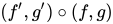
Morphisms are composed by taking to be , whenever the latter expression is defined. The identity morphism on an object is .
Slice category
[edit]The first special case occurs when , the functor is the identity functor, and (the category with one object and one morphism). Then for some object in .
In this case, the comma category is written , and is often called the slice category over or the category of objects over . The objects can be simplified to pairs , where . Sometimes, is denoted by . A morphism from to in the slice category can then be simplified to an arrow making the following diagram commute:

Coslice category
[edit]The dual concept to a slice category is a coslice category. Here, , has domain and is an identity functor.
In this case, the comma category is often written , where is the object of selected by . It is called the coslice category with respect to , or the category of objects under . The objects are pairs with . Given and , a morphism in the coslice category is a map making the following diagram commute:

Arrow category
[edit]and are identity functors on (so ).
In this case, the comma category is the arrow category . Its objects are the morphisms of , and its morphisms are commuting squares in .[1]

Other variations
[edit]In the case of the slice or coslice category, the identity functor may be replaced with some other functor; this yields a family of categories particularly useful in the study of adjoint functors. For example, if is the forgetful functor mapping an abelian group to its underlying set, and is some fixed set (regarded as a functor from 1), then the comma category has objects that are maps from to a set underlying a group. This relates to the left adjoint of , which is the functor that maps a set to the free abelian group having that set as its basis. In particular, the initial object of is the canonical injection , where is the free group generated by .
An object of is called a morphism from to or a -structured arrow with domain .[1] An object of is called a morphism from to or a -costructured arrow with codomain .[1]
Another special case occurs when both and are functors with domain . If and , then the comma category , written , is the discrete category whose objects are morphisms from to .
An inserter category is a (non-full) subcategory of the comma category where and are required. The comma category can also be seen as the inserter of and , where and are the two projection functors out of the product category .
Properties
[edit]For each comma category there are forgetful functors from it.
- Domain functor, , which maps:
- objects: ;
- morphisms: ;
- Codomain functor, , which maps:
- objects: ;
- morphisms: .
- Arrow functor, , which maps:
- objects: ;
- morphisms: ;
Examples of use
[edit]Some notable categories
[edit]Several interesting categories have a natural definition in terms of comma categories.
- The category of pointed sets is a comma category, with being (a functor selecting) any singleton set, and (the identity functor of) the category of sets. Each object of this category is a set, together with a function selecting some element of the set: the "basepoint". Morphisms are functions on sets which map basepoints to basepoints. In a similar fashion one can form the category of pointed spaces .
- The category of associative algebras over a ring is the coslice category , since any ring homomorphism induces an associative -algebra structure on , and vice versa. Morphisms are then maps that make the diagram commute.
- The category of graphs is , with the functor taking a set to . The objects then consist of two sets and a function; is an indexing set, is a set of nodes, and chooses pairs of elements of for each input from . That is, picks out certain edges from the set of possible edges. A morphism in this category is made up of two functions, one on the indexing set and one on the node set. They must "agree" according to the general definition above, meaning that must satisfy . In other words, the edge corresponding to a certain element of the indexing set, when translated, must be the same as the edge for the translated index.
- Many "augmentation" or "labelling" operations can be expressed in terms of comma categories. Let be the functor taking each graph to the set of its edges, and let be (a functor selecting) some particular set: then is the category of graphs whose edges are labelled by elements of . This form of comma category is often called objects -over - closely related to the "objects over " discussed above. Here, each object takes the form , where is a graph and a function from the edges of to . The nodes of the graph could be labelled in essentially the same way.
- A category is said to be locally cartesian closed if every slice of it is cartesian closed (see above for the notion of slice). Locally cartesian closed categories are the classifying categories of dependent type theories.
Limits and universal morphisms
[edit]Limits and colimits in comma categories may be "inherited". If and are complete, is a continuous functor, and is another functor (not necessarily continuous), then the comma category produced is complete,[2] and the projection functors and are continuous. Similarly, if and are cocomplete, and is cocontinuous, then is cocomplete, and the projection functors are cocontinuous.
For example, note that in the above construction of the category of graphs as a comma category, the category of sets is complete and cocomplete, and the identity functor is continuous and cocontinuous. Thus, the category of graphs is complete and cocomplete.
The notion of a universal morphism to a particular colimit, or from a limit, can be expressed in terms of a comma category. Essentially, we create a category whose objects are cones, and where the limiting cone is a terminal object; then, each universal morphism for the limit is just the morphism to the terminal object. This works in the dual case, with a category of cocones having an initial object. For example, let be a category with the functor taking each object to and each arrow to . A universal morphism from to consists, by definition, of an object and morphism with the universal property that for any morphism there is a unique morphism with . In other words, it is an object in the comma category having a morphism to any other object in that category; it is initial. This serves to define the coproduct in , when it exists.
Adjunctions
[edit]William Lawvere showed that the functors and are adjoint if and only if the comma categories and , with and the identity functors on and respectively, are isomorphic, and equivalent elements in the comma category can be projected onto the same element of . This allows adjunctions to be described without involving sets, and was in fact the original motivation for introducing comma categories.
Natural transformations
[edit]If the domains of are equal, then the diagram which defines morphisms in with is identical to the diagram which defines a natural transformation . The difference between the two notions is that a natural transformation is a particular collection of morphisms of type of the form , while objects of the comma category contains all morphisms of type of such form. A functor to the comma category selects that particular collection of morphisms. This is described succinctly by an observation by S.A. Huq[3] that a natural transformation , with , corresponds to a functor which maps each object to and maps each morphism to . This is a bijective correspondence between natural transformations and functors which are sections of both forgetful functors from .
References
[edit]- ^ a b c Adámek, Jiří; Herrlich, Horst; Strecker, George E. (1990). Abstract and Concrete Categories (PDF). John Wiley & Sons. ISBN 0-471-60922-6.
- ^ Rydheard, David E.; Burstall, Rod M. (1988). Computational category theory (PDF). Prentice Hall.
- ^ Mac Lane, Saunders (1998), Categories for the Working Mathematician, Graduate Texts in Mathematics 5 (2nd ed.), Springer-Verlag, p. 48, ISBN 0-387-98403-8
- Comma category at the nLab
- Lawvere, W (1963). "Functorial semantics of algebraic theories" and "Some algebraic problems in the context of functorial semantics of algebraic theories". http://www.tac.mta.ca/tac/reprints/articles/5/tr5.pdf
External links
[edit]- J. Adamek, H. Herrlich, G. Stecker, Abstract and Concrete Categories-The Joy of Cats
- Interactive Web page which generates examples of categorical constructions in the category of finite sets.
Comma category
View on GrokipediaMotivation and history
Historical introduction
The comma category was introduced by F. William Lawvere in his 1963 PhD thesis, Functorial Semantics of Algebraic Theories and Some Algebraic Problems in the Context of Functorial Semantics of Algebraic Theories, where it served as a key tool for redefining adjoint functors in a way that avoided assuming smallness conditions.[2] This work was summarized and presented by Lawvere at the 1963 International Symposium on the Theory of Models held at Berkeley, California.[4] In its early applications, the comma category facilitated the modeling of algebraic theories through functors in universal algebra, enabling a precise categorical treatment of varieties of algebras and their semantics without traditional set-theoretic foundations.[2] Lawvere's construction emphasized the comma category's utility in capturing relational structures between functors, laying groundwork for functorial approaches to logic and algebra. Although introduced in 1963, the comma category construction did not become generally known until many years later.[2] During the 1970s, the concept evolved through contributions by Ross Street and R. F. C. Walters. Their 1973 paper on the comprehensive factorization of a functor demonstrated how generalizations involving comma categories yield orthogonal factorization systems in the category of categories.[5] They further formalized aspects of comma categories within the framework of Yoneda structures in their 1978 paper, extending applicability to bicategories and higher-dimensional category theory and influencing developments in enriched and internal category theory.[6] Slice categories, as special cases of comma categories, had earlier served as precursors in work on fibered categories during the late 1950s and early 1960s.Conceptual origins
The comma category emerged as a conceptual tool to generalize the notion of slice categories, which organize objects over a fixed base within a single category, to scenarios involving functors between distinct categories. This extension allows for the systematic comparison of structures mapped into a common codomain category, thereby facilitating the analysis of relational mappings across different domains. In particular, it enables the study of "morphisms between functors" by constructing a category whose objects encode compatible arrows between the images of these functors, a key step in understanding functorial relationships without restricting to endofunctors. Central to this motivation is the role of comma categories in capturing relational structures induced by parallel functors and , where the resulting category organizes all possible "comparisons" or mediating arrows between elements of the images and within . This construction provides a categorical framework for exploring how functors encode dependencies and transformations between categories, underpinning the interdefinability of universal concepts in category theory such as limits, adjoints, and algebraic semantics. By formalizing these relations, comma categories serve as a bridge for investigating compatibility and coherence in functorial data, essential for broader applications in algebraic and topological contexts. Prior to the formal development of fibration theory, comma categories provided an early mechanism for modeling variable sets and indexed categories, representing families of objects parameterized by elements of a base category in a way that anticipates fibrations over bases. This motivation arose from the need to handle "variable quantities" or indexed families within spaces, where the comma construction organizes parts and fibers as objects in an enriched category, laying groundwork for extensive and intensive magnitudes in geometric and algebraic settings.Definition
General construction
The comma category of two functors and , denoted , is a category constructed to capture compatible morphisms between the images of objects under and .[1] This general setup provides a framework for studying relationships between functors in arbitrary categories. The objects of are triples , where is an object of , is an object of , and is a morphism in .[1] A morphism from to in is a pair consisting of a morphism in and a morphism in , such that the following diagram commutes in : That is, .[1][3] The notation reflects the directional arrow from to , and a common special case arises when is the identity functor on , yielding the notation for the comma category.[1] Regarding variance, the construction yields a bifunctor that is contravariant (opposing) in and covariant in .[3] Composition of morphisms in is defined componentwise: for morphisms and , the composite is , with commutativity ensured by the functoriality of and .[1] The identity morphism on is .[3]Objects and morphisms
In the comma category formed by functors and , the objects are triples consisting of an object , an object , and a morphism in . A morphism from to is a pair where in and in , such that the following diagram commutes in : This ensures that the structure respects the actions of and . The identity morphism on an object is the pair , where and are the identity morphisms in and , respectively. This pair satisfies the commutativity condition trivially, as . Composition of morphisms is defined componentwise: if follows , then the composite is . This inherits the associativity and unit laws directly from the categories and , as the componentwise operations preserve the required commutative squares in . Objects of the comma category can be reinterpreted as morphisms in the arrow category of , specifically those arrows whose domain lies in the image of and codomain in the image of . Morphisms in then correspond to commutative squares in induced by the pairs , aligning with the structure of restricted over these images. This perspective highlights the comma category as a subcategory of the arrow category, facilitating analysis of its internal relations.[3] The standard comma category is covariant in both functors, with arrows oriented as . In contrast, the oplax comma category reverses this direction, featuring objects with and morphisms satisfying , thus flipping the variance in the arrow components while maintaining the overall categorical structure.Slice category
In category theory, the slice category for a category and an object is a comma category specialized to the case where the "lower" functor is fixed at .[7] Its objects are precisely the morphisms in , with ranging over all objects of .[8] A morphism in from an object to an object is a morphism in such that the following diagram commutes: \begin{tikzcd} x \arrow[r, "g"] \arrow[dr, "f"'] & x' \arrow[d, "f'"] \\ & c \end{tikzcd} That is, .[8] This construction is equivalent to the comma category , where denotes the constant functor with value (from the terminal category to ).[9] In terms of the general comma category construction, it arises by taking the identity functor and the constant functor with value (from the terminal category to ).[7] The slice category is dual to the coslice category, with the arrows reversed.[8] It provides a framework for modeling families of objects parameterized over the base object , or more generally, fibered structures above .Coslice category
The coslice category of a category under an object , denoted , is a special case of the comma category construction. Its objects are all morphisms in , where ranges over the objects of . A morphism in from an object to an object is a morphism in such that the triangle commutes, i.e., .[10] This construction is equivalent to the comma category formed by the constant functor with value (from the terminal category to ) and the identity functor . Specifically, yields the same objects and morphisms as , capturing the structure of arrows emanating from the fixed base object .[3] By duality in category theory, the coslice category is isomorphic to the opposite of the slice category , where the latter consists of arrows into . This isomorphism highlights the contravariant nature of the coslice, interchanging sources and targets while reversing morphism directions.[10][3] The coslice category is particularly useful for studying "arrows from a base" in categories that are cocomplete, where it facilitates the analysis of cocones and colimits relative to the base object .[10]Arrow category
The arrow category of a category , often denoted or , arises as the comma category in the special case where both projection functors are the identity .[1][11] This construction treats morphisms of as objects, enabling the study of arrows in their own right while preserving the underlying categorical structure.[1] The objects of are all morphisms in , where .[11] Morphisms in from an object to another object are pairs of morphisms in such that the following diagram commutes: That is, .[1][11] Composition of such morphisms proceeds componentwise in , with identities given by the pairs of identity morphisms .[11] A canonical functor projects each object to the pair of its domain and codomain, and each morphism to the pair .[11] This forgetful functor embeds the arrow category into the product category, facilitating connections to limits and other constructions in .[1] As with the general comma category involving identical functors, exhibits covariant variance in both components.[3]Other variations
The oplax comma category, denoted (G ↓ F) for functors F: C → E and G: D → E, generalizes the standard comma category by reversing the direction of the structure morphisms. Its objects consist of triples (c, d, α), where c is an object of C, d is an object of D, and α: G(d) → F(c) is a morphism in E. A morphism from (c, d, α) to (c', d', α') is a pair (u: c → c' in C, v: d → d' in D) such that F(u) ∘ α = α' ∘ G(v) in E.[3] This construction is dual to the standard comma category and appears in contexts where co-limits or opposite structures are emphasized, such as in the study of cocomma objects in 2-categories.[12] The twisted arrow category of a category C, also known as the category of factorizations, provides a variation where the focus is on non-commutative squares relating arrows. Its objects are the morphisms f: a → b in C. A morphism from f: a → b to f': a' → b' is a pair (v: a → a', u: b → b') such that f' ∘ v = u ∘ f. This differs from the standard arrow category, where squares commute in the usual sense, by twisting the composition to model factorizations directly.[13] The twisted arrow category plays a key role in higher category theory, including operads and Segal conditions, where it admits Segal presheaves that decompose objects into simpler components.[14] Seminal work traces its use to studies of natural systems and cohomology, with applications in Kan extensions.[12] Profunctor commas extend the comma construction to the bicategory Prof of categories, profunctors, and natural transformations, generalizing beyond ordinary functors to (C, D)-profunctors. In Prof, a profunctor P: C ↛ D is a functor P: C^{op} × D → Set, and the comma object (P ↓ Q) for profunctors P: A ↛ E and Q: B ↛ E is defined via the universal property in this bicategory, involving coends for composition. This captures relations between categories more flexibly than strict functors, enabling representations of discrete fibrations as comma categories.[15] The foundational development of profunctors as distributors appears in Bénabou's work, where they form the 1-cells of Prof, allowing comma-like limits to model generalized morphisms. In 2-categorical settings, comma categories generalize to bicategories with 2-cells ensuring associativity and coherence. For functors in a bicategory K, the 2-categorical comma (F ↓ G) includes objects as 1-morphisms α: F c → G d and 2-cells for morphisms, with projections as lax or oplax functors. Lax comma 2-categories, in particular, arise when structure 2-cells satisfy lax commutativity, inducing 2-adjunctions between lax and strict comma 2-categories.[16] This variation is crucial for Janelidze-Galois theory in higher dimensions and admissible 2-functors, where morphisms lift to comma-type structures preserving limits.[17]Properties
Forgetful functors
In the comma category , where and , there is a domain forgetful functor that sends each object to and each morphism to .[3] This functor projects away the structure over and , preserving the -component while ensuring compatibility via the commuting condition . Under suitable conditions on , , and the functors (such as having an initial object and having relevant colimits), admits a left adjoint that freely extends objects from to the comma category.[18] Dually, the codomain forgetful functor sends each object to and each morphism to .[3] This projection retains the -component, and under conditions such as the existence of a terminal object in and products in , it admits a right adjoint that forms dependent products along the structure morphisms.[18] In the special case of the arrow category , whose objects are morphisms in and whose morphisms are commutative squares, there is a forgetful functor to the product category that sends each arrow to the pair and each square to the pair of its vertical legs.[1] This double projection captures the source and target structure of arrows in , facilitating the study of relational properties without altering the underlying objects.Limits and colimits
In category theory, the comma category , where and , inherits completeness from its base categories under suitable conditions on the functors. Specifically, if and are complete and is continuous (i.e., preserves limits), then is complete.[3][19] Limits in are constructed componentwise: for a diagram assigning to each an object and compatible morphisms, the limit object is the triple , where in , in , and is the unique morphism in mediating the cone formed by the projections and via the universal property of limits in , ensured by the continuity of .[19] For instance, the product in of a family of objects over a discrete index set is given by , where is the morphism induced by the family for each , leveraging the product universal properties in , , and along with 's preservation of products.[3] This construction extends to general limits by duality from the colimit case, as the opposite category is isomorphic to .[19] Dually, for colimits, if and are cocomplete and is cocontinuous (i.e., preserves colimits), then is cocomplete.[3] Colimits are formed similarly: for a diagram as above, the colimit object is , where in , in , and is the unique morphism such that for the colimit inclusions and , guaranteed by the cocontinuity of which ensures .[19] The universal property of this cocone follows from those of the component colimits in and . Comma categories often possess colimits even when the base categories or lack them, through constructions analogous to Kan extensions that yield cocones over arbitrary diagrams.[3] These Kan-style methods, which involve colimits weighted by representables in the comma category, are detailed in the context of extensions and adjunctions.Applications
Notable examples
One notable example of a comma category is the category of pointed sets, denoted as , where represents the singleton category with one object and the identity morphism, and the functor from to selects the singleton set . The objects of this category are pairs , consisting of a set equipped with a distinguished element (the basepoint), while the morphisms are functions such that , preserving the basepoint. This construction captures the structure of sets with a canonical choice of element, useful in algebraic topology and pointed spaces.[1] Another significant example is the category of directed graphs, whose objects are triples , where is a set of vertices, is a set of edges, and assigns to each edge its ordered pair of source and target vertices. Morphisms are pairs of functions such that the endpoint assignment commutes, i.e., , ensuring compatibility of edges with vertices. This formulation models directed graphs (or quivers) and their homomorphisms, foundational in combinatorics and category theory. The comma category , with the category of monoids and the forgetful functor sending a monoid to its underlying set, provides a framework for monoid actions on sets. Here, objects are triples , where is a set, is a monoid, and is a function from to the carrier set of ; when interpreted via the left multiplication action of on itself, this equips with an -action through composition with . Morphisms are pairs of functions such that the action diagram commutes, yielding equivariant maps that preserve the structure. This category encapsulates varying monoids acting on sets, relevant in representation theory and dynamical systems.[1] In the category of abelian groups , the arrow category —formed using identity functors on both sides—consists of objects that are group homomorphisms between abelian groups, equivalent to two-term chain complexes . Morphisms are pairs of homomorphisms such that , forming commutative squares. This structure models short exact sequences and differential maps in homological algebra, serving as a building block for longer chain complexes used in computing homology.[1]Universal morphisms
In category theory, comma categories provide a framework for encoding universal properties, particularly those involving factoring morphisms or constructing limits in structured settings. The slice category , a special case of the comma category where the first functor is the constant functor to an object , exemplifies this through its relation to pullbacks. Specifically, given two morphisms and in , their pullback is the universal object in consisting of the comma object with mediating triangle , , and the induced morphism , such that for any other object with , there exists a unique mediating morphism in the slice category.[1] This construction ensures the pullback inherits the universal property of mediating all compatible pairs over , with the projection functor from the slice creating such limits when has them. Equalizers in comma categories are similarly universal, often computed componentwise via the base category's structure. For parallel morphisms in the comma category , where and , an equalizer of a pair of morphisms that commute over the projections to and is formed by the equalizer in of the induced maps on the comma arrows, yielding a universal subobject for commuting pairs in the domain categories.[1] The projection functors and create these equalizers, meaning the equalizer in the comma category projects to the pair of equalizers in and , with the comma arrow being the unique mediator satisfying the commuting condition.[1] This componentwise universality holds provided has equalizers, ensuring the comma category inherits the property for pairs of arrows compatible with the structure maps and .[20] A key universal morphism in comma categories arises from insertions of factors, where the category models the universal way to factor a natural transformation through the functors and . The forgetful functors and , together with the natural transformation defined by , form a universal span: for any categories , functors , , and natural transformation , there exists a unique functor such that , , and .[3] This property positions the comma category as the "lax pullback" classifying factorizations, with arrows in as spanning morphisms that uniquely mediate compatible transformations.[1] Via the Yoneda lemma, universal arrows from the comma category to representables further illuminate these properties. For instance, the hom-functor in satisfies for suitable representables, where the fiber product encodes the compatibility of comma arrows with the Yoneda embedding .[21] This isomorphism, derived by applying Yoneda to the projections, shows how morphisms in the comma category correspond to natural transformations factoring through the representable , preserving the universal mediating role.[1]Adjunctions
One fundamental application of comma categories arises in the characterization of adjoint functors. Given functors and , is left adjoint to , denoted , if and only if there is a natural isomorphism of categories .[1] This isomorphism commutes with the forgetful functors to , providing a diagrammatic reformulation of the classical hom-set bijection that defines adjunctions.[1] The objects of the comma category consist of triples where , , and is a morphism in , with morphisms being pairs such that the evident triangle commutes. Under the isomorphism, these correspond to objects of , where is a morphism in . This equivalence is induced by the unit and counit of the adjunction, which provide the bijection between the morphism classes in these comma categories; specifically, each corresponds to the composite , and conversely, each corresponds to , wait no, properly: the correspondence maps to and to .[1][22] The unit-counit bijection extends to an isomorphism of categories because the naturality of and ensures that morphisms in map bijectively to those in , preserving composition and identities via the triangular identities of the adjunction.[1] This theorem underscores the categorical equivalence between the two perspectives on adjointness.[22] In the special case where and are posets viewed as categories, adjunctions correspond to Galois connections (monotone pairs with if and only if ). Here, the comma category has objects as pairs with , modeling the lower sets in the Galois correspondence, where each such pair identifies the extent to which bounds the image of from below.[23] This specializes the general isomorphism to order-theoretic terms, with the unit and counit becoming the closure and interior operators induced by the connection.[7]Natural transformations
In category theory, the comma category for parallel functors provides a structure that encodes potential components of natural transformations between and . Specifically, a natural transformation determines a functor defined by on objects and on morphisms in , where the pair forms a morphism in the comma category because the naturality squares ensure . Conversely, any functor such that the domain and codomain projection functors and arise from a unique natural transformation with as the mediating morphism at each . This establishes a bijection between the set of natural transformations and the set of such "diagonal" functors from to .[24] When is a discrete category (i.e., containing only identity morphisms), the naturality condition is vacuous, so consists simply of families of morphisms without further compatibility requirements, forming a discrete category isomorphic to the product category . In this case, the comma category has objects with no non-trivial morphisms between distinct objects, and the diagonal subcategory—comprising only those objects where and —is isomorphic to as discrete categories.[1] In the general case, the set is given by the end which formalizes the universal family of morphisms satisfying the naturality condition for all morphisms in . This end construction relates to the comma category via the above functorial correspondence, as the diagonal functors precisely capture the equalizers enforcing naturality. Each component of such a natural transformation can be viewed as the mediating morphism in the object of , with the full structure adjusted by the functor to ensure coherence across .[1] The Yoneda embedding further illuminates this connection: the comma category consists of objects , where each natural transformation corresponds bijectively to a morphism in by the Yoneda lemma. Thus, is equivalent to the arrow category of , whose objects are morphisms in (the representable functors) and whose morphisms are commutative squares, modeling transformations between representables in a way that generalizes the diagonal structure for arbitrary functors.[1] In the 2-categorical setting, such as the 2-category of categories, functors, and natural transformations, the hom-category collects the 1-cells (natural transformations) between and , while 2-cells are modifications between those transformations. The comma category , equipped with its projection functors and together with the canonical comparison natural transformation , satisfies a 2-categorical universal property: it is initial among categories equipped with functors , , and a natural transformation . This universality underscores how comma categories provide the 1-dimensional framework for the 2-cells in .[24]Kan extensions
In category theory, comma categories provide a foundational framework for constructing pointwise Kan extensions, which extend a functor along another while preserving universal properties. Specifically, for functors and , the right Kan extension at an object can be defined using the comma category . This category's structure encodes the necessary compatibility conditions for the extension.[1] The objects of the comma category are pairs where and is a morphism in ; a morphism from to is a morphism in such that the triangle commutes, i.e., . The right Kan extension is then given by , where represents the "identity" object in the comma category (the functor from the terminal category picking the pair involving ), and is the constant functor on with value . This hom-set formulation captures the universal property: for any functor , natural transformations correspond bijectively to natural transformations , where is the projection, via the counit of the extension. Equivalently, via the end formula, , where denotes the internal hom in .[25][1] Dually, the left Kan extension is constructed as a colimit over the opposite of the comma category , whose objects are pairs with and morphisms such that . Specifically, , where projects to the domain. This yields the coend formula , assuming copowers exist in . The universal property ensures that is left adjoint to under suitable conditions, with the extension mediating transformations from to any other functor composed with .[25][1] Pointwise Kan extensions exist if the relevant comma categories admit the necessary limits or colimits; for instance, exists whenever has all small limits and is complete, as the end can then be computed as a limit in the comma category. A canonical example arises with the Yoneda embedding , where the left Kan extension , reflecting the density of and establishing that representables generate the functor category under colimits. This construction underlies the free-forgetful adjunction in presheaf categories, where the forgetful functor from presheaves to sets is right adjoint to the free functor induced by the Kan extension along the Yoneda embedding.[25][1]References
- https://proofwiki.org/wiki/Slice_Category_is_Isomorphic_to_Comma_Category


