Hubbry Logo
Compaq PortableCompaq PortableMain
Open search
Compaq Portable
Community hub
Compaq Portable
logo
8 pages, 0 posts
0 subscribers
Be the first to start a discussion here.
Compaq Portable
Compaq Portable
from Wikipedia
Compaq Portable
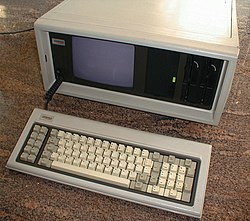
A Compaq Portable with the keyboard detached ready for use. This machine has an aftermarket hard disk and floppy disk drives added.
ManufacturerCompaq Computer Corporation
Product familyCompaq Portable series
TypePortable computer
Release dateMarch 1983; 42 years ago (1983-03)
Introductory priceUS$2,995 (equivalent to $9,460 in 2024)
Operating systemMS-DOS
CPUIntel 8088, 4.77 MHz
Memory128 KB (expandable to 640 KB)
StorageTwo 5.25" floppy disk drives or, optionally, one floppy drive and a 10 MB hard drive
DisplayBuilt-in 9" green screen monitor
GraphicsUnique CGA-compatible video card
Weight28 lb (13 kg)
Backward
compatibility
IBM PC compatible
SuccessorCompaq Portable Plus

The Compaq Portable is an early portable computer which was one of the first IBM PC–compatible systems. It was Compaq Computer Corporation's first product, to be followed by others in the Compaq Portable series and later Deskpro series. It is not simply an 8088-CPU computer that runs a Microsoft DOS as a PC "work-alike", but contains a reverse-engineered BIOS and Compaq DOS compatible with IBM's PC DOS. The computer is also an early variation on the idea of an "all-in-one".

It became available two years after the similar, but CP/M-based, Osborne 1 and Kaypro II. Columbia Data Products' MPC 1600 "Multi Personal Computer", the first IBM PC compatible system, had come out in June 1982.[1][2]

Production and sales

[edit]

The Compaq Portable was announced in November 1982 and first shipped in March 1983,[3] priced at US$2,995 (equivalent to $9,500 in 2024) with a single half-height 5+14" 360 KB diskette drive or US$3,590 for dual, full-height diskette drives. The 28 lb (13 kg)[4] Compaq Portable folds up into a luggable case the size of a portable sewing machine.

IBM responded to the Compaq Portable with the IBM Portable PC, developed because its sales force needed a comparable computer to sell against Compaq.[5]

Compaq sold 53,000 units in the first year with a total of US$111 million in revenue, an American Business record. In the second year revenue hit US$329 million setting an industry record. Third year revenue was at US$503.9 million, another US business record.[3]

Design

[edit]

The Compaq Portable has basically the same hardware as an IBM PC, with Compaq's BIOS instead of IBM's, transplanted into a luggable case specifically designed to fit as carry-on luggage on an airplane.[3] (An engineer said that the Portable fits under an airplane seat if no one too heavy sat above it.)[6] All Portables shipped with 128KB of RAM and 1-2 double-sided double-density 360 KB disk drives. Like the non-portable IBM PC, the Compaq Portable runs on power from an AC outlet only; it has no battery.

The machine has a hybrid of the IBM MDA and CGA which supports the latter's graphics modes, but uses the former's high-quality character set in 80x25 text mode.[4] (When Mitch Kapor saw the Portable use both standards while demonstrating Lotus 1-2-3 to Sears Business Centers, he stopped the presentation to explain his amazement at Compaq's achievement.[6]) When using the internal monochrome monitor the 9×14 font is used, and the 8×8 one when an external monitor is used (the user switches between internal and external monitors by pressing Ctrl+Alt+>). With a larger external monitor, the graphics hardware is also used in the original Compaq Deskpro desktop computer.

Compaq used a "foam and foil" keyboard from Keytronics. The foam pads the keyboards use to make contact with the circuit board when pressed disintegrate over time, due to both the wear of normal use and natural wear. The CRT display also suffers from a low refresh rate and heavy ghosting.

Software

[edit]
Running WordPerfect 5.0

Compaq's efforts were possible because IBM had used mostly off-the-shelf parts for the PC and published full technical documentation for it, and because Microsoft had kept the right to license MS-DOS to other computer manufacturers. The only difficulty was the BIOS, because it contained IBM's copyrighted code. Compaq solved this problem by producing a clean room workalike that performs all documented functions of the IBM PC BIOS, but was completely written from scratch.

Although numerous other companies soon also began selling PC compatibles, few matched Compaq's achievement of essentially-complete software compatibility with the IBM PC (typically reaching "95% compatibility" at best) until Phoenix Technologies and others began selling similarly reverse-engineered BIOSs on the open market.[7]

Compaq shipped the Portable with Compaq DOS, its own version of MS-DOS.[8] The first Portables use version 1.10,[citation needed] essentially identical to PC DOS 1.10 except for having a standalone BASIC that did not require the IBM PC's ROM Cassette BASIC, but this was superseded in a few months by DOS 2.00 which added hard disk support and other advanced features.

Aside from using DOS 1.x, the initial Portables are similar to the 16 KB – 64 KB models of the IBM PC in that the BIOS was limited to 544 KB of RAM and did not support expansion ROMs, thus making them unable to use EGA/VGA cards, hard disks, or similar hardware. After DOS 2.x and the IBM XT came out, Compaq upgraded the BIOS. Although the Portable was not offered with a factory hard disk, users commonly installed them. Starting in 1984, Compaq began offering a hard disk-equipped version, the Portable Plus, which also featured a single half-height floppy drive. The hard disk offered would be 10 to 21 megabytes, although bad sectors often reduced the space available for use.

In 1985, Compaq introduced the Portable 286, but it was replaced by the more compact Portable II in a redesigned case within a few months. The Portable 286 featured a full-height hard disk, and the options of one half-height floppy drive, two half-height floppy drives, or a half-height floppy drive and a tape backup drive.

Competitors

[edit]

Other IBM PC "work-alikes" included the MS-DOS and 8088-based, but not entirely IBM PC software compatible, Dynalogic Hyperion,[9] Eagle Computer's Eagle 1600 series, including the Eagle Spirit portable,[10] and the Corona personal computer.[11] The latter two companies were threatened by IBM for BIOS copyright infringement, and settled out of court, agreeing to re-implement their BIOS.[12]

There was also the Seequa Chameleon, which had both 8088 and Z80 CPUs to alternately run MS-DOS or CP/M.[13][14][15] Unlike Compaq, many of these companies had previously released computers based on Zilog's Z80 and Digital Research's CP/M operating system. Like Compaq, they recognized the replicability of the IBM PC's off-the-shelf parts, and saw that Microsoft retained the right to license MS-DOS to other companies. Only Compaq was able to fully capitalize on this, by aiming for complete IBM PC and PC DOS software compatibility, while reverse-engineering the BIOS to head off copyright legal claims.

Other contemporary systems include the portable Commodore SX-64, also known as the Executive 64, or VIP-64 in Europe, a briefcase/suitcase-size "luggable" version of the popular Commodore 64 home computer built with an 8-bit MOS 6510 (6502-based) CPU microprocessor, and the first full-color portable computer.[16] Like the Z80 and "work-alike" portables, its sales fell into insignificance in the face of the Compaq Portable series.

Reception

[edit]

BYTE wrote, after testing a prototype, that the Compaq Portable "looks like a sure winner" because of its portability, cost, and high degree of compatibility with the IBM PC. Its reviewer tested IBM PC DOS, CP/M-86, WordStar, SuperCalc, and several other software packages, and found that all worked except one game.[4] "Compaq", InfoWorld said, "deserves the success it enjoys ... an excellent, convenient machine designed and priced for professional use".[17] PC Magazine also rated the Compaq Portable very highly for compatibility, reporting that all tested applications ran. It praised the "rugged" hardware design and sharp display, and concluded that it was "certainly worth consideration by anyone seeking to run IBM PC software without an IBM PC".[18]

Successors

[edit]
Compaq Portable Plus

Upgrades

[edit]

Compaq Portable Plus

[edit]

Released in 1983 upgraded version; The Compaq Portable Plus simply had a hard drive to replace one floppy disk drive, and logos and badges with gold backgrounds instead of silver. Independent computer stores were previously doing this upon request of users, and Compaq saw this as a lost revenue opportunity.[19]

Compaq Portable 286

[edit]

The Compaq Portable 286, Compaq's version of the PC AT, was offered in the original Compaq Portable chassis;[20] it was equipped with a 6/8 MHz 286 and a high-speed 20 MB hard drive.

Compaq Portable series

[edit]

The Compaq Portable machine was the first of a series of Compaq Portable machines. The Compaq Portable II was smaller and lighter version of Compaq Portable 286; it was less expensive but with limited upgradability and a slower hard drive, The Compaq Portable III, Compaq Portable 386, Compaq Portable 486 and Compaq Portable 486c were later in the series.

References

[edit]
[edit]
Revisions and contributorsEdit on WikipediaRead on Wikipedia
from Grokipedia
The Compaq Portable was a pioneering luggable computer introduced by Computer Corporation in March 1983, recognized as the first fully IBM PC-compatible portable system that could run all existing PC software. It featured an clocked at 4.77 MHz, 128 KB of RAM (expandable to 640 KB), two 5.25-inch 360 KB drives, and a 9-inch CRT display supporting 80x25 text and CGA-compatible graphics. Weighing 28 pounds and encased in a rugged, suitcase-style chassis, the device ran and included expansion slots for peripherals like a , making it a practical "luggable" alternative to desktop PCs for business users. Priced at approximately $2,995 to $3,590 depending on configuration, it sold 53,000 units in its debut year, generating $111 million in revenue and setting a record for the fastest startup to reach $100 million in sales. Developed in just 15 months by a team led by , the Compaq Portable emerged from a clean-room reverse-engineering effort to replicate IBM's without infringing copyrights, a legal strategy that legitimized third-party PC cloning and spurred industry competition. Announced in November 1982, the system addressed the limitations of earlier portables like the Osborne 1 by ensuring full compatibility with IBM's ecosystem, including software and peripherals, which broadened the appeal of personal computing beyond fixed desktops. This innovation helped establish the open PC architecture as an industry standard, powered by components like the 8088 processor, and paved the way for Compaq's dominance in the PC market during the 1980s and 1990s. The Compaq Portable's success influenced subsequent models in the series, such as the 1983 Compaq Plus with its integrated 10 MB hard drive, and contributed to the broader shift toward portable computing that eventually led to modern laptops. By enabling mobile access to PC applications, it accelerated the PC revolution and supported Compaq's growth until its acquisition by in 2002.

Development and Launch

Company Founding

Compaq Computer Corporation was established in February 1982 by , James "Jim" Harris, and William "Bill" Murto, all of whom were senior executives at prior to leaving the company. The idea for the venture originated during an informal dinner meeting in , where the founders sketched initial concepts for a new computer on a restaurant placemat, driven by their expertise in and computing technologies gained at . This founding marked the beginning of Compaq's focus on entering the rapidly evolving industry. The company secured its initial funding of $2.5 million from venture capitalist Ben Rosen of Sevin-Rosen Partners, which provided the capital necessary to develop and launch their first products. Headquartered in , , Compaq benefited from the region's growing tech ecosystem and proximity to talent from nearby institutions like , allowing it to establish operations efficiently. The motivation behind Compaq's formation stemmed from the transformative impact of 's launch in , which standardized the PC market and created demand for compatible alternatives. The founders aimed to address a key limitation of the IBM PC by developing portable, fully compatible systems that could appeal to business users seeking mobility without sacrificing performance or software compatibility. This vision positioned Compaq to capitalize on the burgeoning PC sector, where compatibility with IBM's architecture was essential for market success.

Product Engineering

The development of the Compaq Portable involved overcoming key technical challenges in balancing portability with full compatibility to the IBM PC architecture, a goal pursued by the engineering team under the leadership of co-founder Rod Canion. The team, drawn from experienced engineers including those previously at Texas Instruments, prioritized innovations that allowed the device to run existing IBM PC software while fitting into a transportable form factor. This effort began in mid-1982, following the company's founding earlier that year by Canion, Jim Harris, and Bill Murto, and culminated in a functional prototype by November 1982. Central to the engineering process was the reverse-engineering of IBM's proprietary to enable software compatibility without direct code duplication. Compaq employed a clean-room , where engineer Garry Stimac analyzed IBM's behavior through testing software interactions and documentation—without accessing the source code—to produce detailed functional specifications. These specifications were then provided to an isolated team of software engineers tasked with writing an original implementation from scratch, ensuring no copyrighted material was used. This rigorous approach yielded a achieving approximately 95% compatibility with IBM's version and was completed in nine months. To safeguard against legal risks, Compaq's engineering process was closely guided by attorneys, confirming that the reverse-engineered constituted original work and avoided . This strategy not only protected the company from potential lawsuits by but also set a legal for the broader industry, enabling subsequent PC efforts through verified clean-room techniques.

Release and Pricing

The Portable was announced in November 1982, introducing Compaq Computer Corporation's inaugural product as the first fully IBM PC-compatible and sparking widespread industry attention for its potential to extend PC functionality to mobile users. The Compaq Portable entered the market in March 1983, arriving after Columbia Data Products' MPC but achieving the first substantial commercial breakthrough among PC clones through its superior compatibility and engineering focus on business portability. To target professional users while undercutting premium competitors, set the base price at $2,995 for the model with a single 5.25-inch floppy drive and $3,590 for the dual-drive configuration—figures equivalent to about $9,460 and $11,340 in 2024 dollars. This strategy balanced affordability with perceived quality, enabling rapid and establishing the Portable as a benchmark for luggable computing in enterprise environments.

Design and Hardware

Core Components

The Compaq Portable featured an microprocessor operating at 4.77 MHz, which served as the and enabled full compatibility with PC software by executing the same instruction set. This processor, clocked to match the original PC, provided reliable performance for business applications of the era without requiring speed enhancements that could disrupt compatibility. Memory in the Compaq Portable consisted of 128 KB of RAM as standard, sufficient for running and typical at launch. It supported expansion up to 640 KB through internal slots on the system board, allowing users to add memory modules for multitasking or larger applications without external peripherals. This expandability addressed the limitations of base configurations while adhering to the PC architecture's memory addressing constraints. Storage was handled by two standard 5.25-inch drives, each with a 360 KB capacity, providing dual-drive operation for , data transfer, and software installation. The system incorporated an internal switching-mode , designed to deliver regulated voltages (+5 VDC, +12 VDC, -5 VDC, and -12 VDC) directly within the chassis, eliminating the need for external adapters and supporting the unit's luggable form factor. This self-contained power design operated on 90-132 VAC or 180-264 VAC inputs, ensuring reliable operation in various electrical environments without compromising portability.

Display and Input

The Compaq Portable incorporated a 9-inch cathode-ray tube (CRT) display utilizing a green phosphor for high-persistence output, designed to minimize with an etched surface. This display supported an 80×25 character in high-resolution configuration (720×350 ) and was fully compatible with CGA standards, enabling 640×200 graphics modes for color-set 0 or 320×200 for color sets 0 and 1 when connected to an external monitor. Integrated directly into the unit beneath the flip-up keyboard lid, the CRT operated at dual scan frequencies of 15.7 kHz and 18.5 kHz to accommodate both and signals, with a of 50/60 Hz and a maximum video bandwidth of 18.981 MHz. The keyboard served as the primary and formed the protective flip-up lid for transport, featuring a full-sized 83-key capacitive layout that included a separate , alphanumeric keys, function keys, and typematic repeat functionality on most keys except controls. Measuring approximately 21.9 inches in length, 8.5 inches in depth, and 1.8 inches in height, it connected via a retractable cable to the main unit, providing an ergonomic typing experience akin to desktop PC keyboards of the era while ensuring compatibility with standard PC software inputs. The design emphasized durability for portability, with user-definable keys for customization. Input and output interfaces were limited to essentials for the time, including a standard accessed via the integrated floppy/printer adapter board, which supported direct connection to printers and other parallel devices. was not included as a standard feature and required an optional asynchronous communications card ( compatible, supporting 50–9600 rates) installed in one of the expansion slots. Audio output consisted of a basic internal speaker assembly connected to the processor board, primarily for generating system beeps and simple tones without advanced capabilities.

Expansion and Portability

The Compaq Portable featured a luggable that prioritized transportability over true mobility, enclosing all components within a rugged, suitcase-like clamshell case measuring approximately 19 by 8.5 by 17.5 inches (including the handle). This flip-top enclosure allowed the 9-inch monochrome display to fold down over the keyboard, which could be secured in place with latches for safe carrying, eliminating the need for detachable parts during transit. A built-in handle on the case further facilitated movement, making it suitable for users transporting the system between locations such as offices or client sites. Despite its portability innovations, the system weighed 28 pounds (13 kg), underscoring its classification as a "luggable" rather than a lightweight portable. It lacked battery power and required connection to an AC outlet for operation, limiting its use to environments with reliable electrical access. For expandability, the Compaq Portable provided three ISA expansion slots, enabling users to add peripherals such as modems, additional memory boards up to 640 KB total RAM, or other PC-compatible cards while maintaining full enclosure integrity. This modularity mirrored desktop PC capabilities, allowing customization without compromising the system's integrated form factor.

Software and Compatibility

Operating System

The Compaq Portable was shipped with Compaq DOS 1.10 as its primary operating system, an OEM adaptation of 1.25 that closely mirrored the functionality of 1.10 while incorporating Compaq-specific modifications. It also included a standalone version of (BASICA.COM) to provide compatibility with applications requiring BASIC, without needing ROM-based BASIC. This version provided essential command-line operations for file handling, program execution, and system configuration, tailored for the Portable's hardware architecture. Users could upgrade to Compaq DOS 2.00, which introduced enhanced support for hard disk drives and improved utilities for and management, reflecting the evolution of 2.00 standards. The operating system supported the Portable's 360 KB 5.25-inch floppy drives, enabling reliable data storage and transfer with double-sided, double-density formatting. Basic file management features, such as directory navigation and copy commands, formed the core of its interface, without graphical elements. The process relied on floppy disks, where the 's ROM BIOS performed initial hardware initialization and before loading the from the primary floppy drive. DOS was pre-installed on factory-provided floppy disks, allowing users to directly upon setup without requiring additional installation steps beyond inserting the system disk. This configuration ensured compatibility with the Portable's limited onboard storage, prioritizing portability and simplicity.

PC Compatibility Features

The Compaq Portable achieved full PC compatibility primarily through its custom , which was developed via a clean-room reverse-engineering process to avoid infringing on 's copyrighted code. This involved one team analyzing the functional behavior of the without examining its , while a separate "clean" team implemented an equivalent ROM based solely on the documented inputs, outputs, and calls. The resulting 8 KB ROM ensured identical responses to all standard interrupts, such as those for disk I/O, keyboard input, and video operations, enabling the Portable to behave indistinguishably from the original PC at the level. This approach, costing Compaq approximately $1 million in development, set a legal for third-party PC clones. Extensive compatibility testing confirmed the Portable's ability to run unmodified IBM PC software, with reviewers verifying operation of key applications that directly invoked BIOS routines. For instance, productivity programs like and executed flawlessly, performing spreadsheet calculations and word processing tasks without errors or adaptations. Such tests underscored the Portable's status as the first 100% software-compatible IBM clone, allowing users to migrate seamlessly from desktop PCs. On the hardware side, the Portable emulated critical IBM components to maintain interoperability. Its integrated CGA graphics adapter supported the full range of IBM PC color graphics modes, including 640x200 resolution with four colors and 320x200 with 16 colors, rendering identical output on compatible displays. Similarly, the floppy disk controller adhered to IBM's double-density standards, handling 360 KB 5.25-inch disks with the same timing and error-handling protocols, ensuring data interchangeability. These emulations were validated through side-by-side comparisons with IBM hardware, confirming no deviations in performance or compatibility. The system's five-slot ISA expansion bus further enhanced hardware compatibility, mirroring the IBM PC's architecture to accept standard add-on cards without modification. This included support for memory expansion up to 640 KB, additional peripherals like parallel printers, and even early networking adapters designed for the IBM platform. Users could thus integrate IBM-sourced components directly, preserving the ecosystem's modularity while adapting it to a portable form factor.

Production and Market Performance

Manufacturing Process

The Compaq Portable's initial production began in early 1983 in Houston, Texas, where the company assembled its first units from prototypes developed by a small team of former executives. Assembly was handled in-house by an initial staff of around 20 experienced professionals, starting with approximately 200 machines in January 1983 and rapidly scaling to levels by mid-year to meet surging demand following the product's launch. Component sourcing for the Compaq Portable emphasized off-the-shelf, industry-standard parts to maintain IBM PC compatibility while controlling costs, including microprocessors and other core electronics from established suppliers like for the operating system. This approach allowed Compaq to leverage existing supply chains without custom fabrication, ensuring rapid integration and scalability in production. Quality control was a cornerstone of the manufacturing process, with rigorous testing protocols implemented by the company's seasoned team to verify reliability and under portable conditions. These measures, drawing on expertise from prior roles at and , resulted in superior build quality compared to many contemporaries, contributing to the Portable's reputation for durability and low field failure rates in its early deployment. Production volume ramped up significantly to address market demand, with Compaq shipping over 53,000 units in 1983 alone—rising from 2,200 in the first quarter to around 9,000 by December—and reaching quarterly outputs of 48,000 by late . To support this growth, the company expanded its facilities in , initiating construction on a 55-acre Compaq Center site for additional office and manufacturing space northwest of the city.

Sales and Revenue

The Compaq Portable achieved strong initial sales upon its release, with 53,000 units sold in , generating $111 million in revenue and marking a record for a U.S. startup in its first year. This success was driven by the product's appeal as an PC-compatible , capitalizing on the growing demand for business computing solutions. In subsequent years, Compaq's revenue continued to surge, reaching $329 million in 1984 and $503.9 million in 1985, reflecting the Portable's role in expanding the company's product lineup and market presence. These figures positioned Compaq as one of the fastest-growing companies in , outselling many established competitors and achieving unprecedented growth for a newcomer in the industry. The Portable was distributed primarily through a network of authorized dealers, which facilitated rapid market penetration with an initial strong focus on the U.S. market. This dealer strategy supported high-volume sales while aligning with Compaq's pricing at around $3,000 per unit to target professional users.

Reception and Legacy

Critical Reviews

In its January 1983 review, BYTE magazine hailed the Compaq Portable as the first truly portable personal computer, emphasizing its full compatibility with IBM PC software and hardware, robust build quality, and innovative design that allowed it to function as a complete system in a transportable form factor. Reviewer Mark Dahmke noted the machine's 28-pound weight but affirmed its portability, stating, "The Compaq computer is designed to be portable, and although it weighs 28 pounds, it achieves that goal." The review also praised the standard inclusion of features like 128 KB RAM (expandable to 640 KB), dual 360 KB floppy drives, monochrome and color-graphics adapters, and a parallel printer port at a base price of $2,995—less than a comparable IBM PC configuration costing around $3,735. InfoWorld's contemporary coverage highlighted the Compaq Portable's compatibility with PC software and its achievement in reverse-engineering the . Similarly, PC Magazine's June 1983 evaluation rated the system highly for compatibility, lauding its expansion capabilities through internal slots for add-ons like additional or peripherals, while confirming seamless performance with all tested PC applications. The review commended the "rugged" construction suitable for travel, though it critiqued the overall heft as a drawback for frequent movers. Common criticisms across reviews focused on the Compaq Portable's high cost relative to non-portable desktops, with the $3,000 starting price seen as steep for consumers despite its feature set, limiting appeal beyond corporate buyers. Additionally, the absence of a battery was a frequent point of contention, as the system required a constant AC power connection, restricting true mobility compared to later portables and tying it to outlets much like a desktop. Reviewers noted the weight exacerbated this issue, making it more of a "luggable" than a lightweight traveler, though its enclosed CRT display and full keyboard were still viewed as advancements.

Industry Impact

The Compaq Portable played a pivotal role in pioneering PC by demonstrating that third-party manufacturers could legally produce IBM-compatible systems without infringing on , thereby enabling a competitive market that challenged IBM's dominance in the early . By reverse-engineering IBM's through clean-room development and leveraging off-the-shelf components, Compaq created the first fully compatible portable PC, which opened the floodgates for other companies to enter the market and commoditize personal computing hardware. This shift pressured IBM to adopt more open standards, ultimately eroding its control over the PC ecosystem as clones captured a majority of sales by the mid-. As a milestone in portable computing, the Compaq Portable was the first "luggable" PC to achieve significant volume sales, with over 53,000 units shipped in its debut year of 1983, setting records for startup revenue at $111 million. Its design, which combined full IBM PC compatibility with a transportable form factor weighing 28 pounds, influenced the evolution toward lighter laptops by proving demand for mobile business and inspiring subsequent innovations in portability. The economic impact was profound, exemplified by Compaq's 1983 initial public offering, which raised $67 million—the largest for a technology startup at the time—and valued the company at approximately $275 million post-IPO. This influx of capital fueled rapid expansion and underscored investor confidence in the cloning model, accelerating the adoption of open PC architectures that by 1985 saw clones outselling IBM's own PCs and transforming the industry into a multibillion-dollar .

Successors and Evolution

Portable Upgrades

The Compaq Portable Plus, introduced in October 1983, served as a direct enhancement to the original Portable by integrating a 10 MB MFM , replacing one of the two 5.25-inch floppy drives for improved and accessibility. This upgrade maintained compatibility with PC software while addressing the limitations of floppy-only systems, and the model retained the original's processor at 4.77 MHz, 128 KB RAM (expandable to 640 KB), and 9-inch CRT display. Priced at $3,590, the Portable Plus was positioned as a more capable transportable solution for business users requiring persistent storage without sacrificing portability. Building on this foundation, the Portable II, released in and often referred to as the Portable 286, marked a significant hardware evolution with an processor switchable between 6 MHz and 8 MHz speeds, enabling multitasking and faster execution of applications. It offered a standard 10 MB or optional 20 MB hard drive, along with MDA/CGA-compatible graphics supporting 720×350 text and 640×200 graphics modes. Weighing approximately 24 pounds, the Portable II was only marginally lighter than its predecessor despite internal refinements, and it started at a price of $3,499, with higher configurations exceeding $4,000 to include expanded RAM up to 640 KB and dual 360 KB 5.25-inch floppy drives. To extend the lifespan of early Portable models, provided official upgrade kits, including ROM revisions that ensured compatibility with 3.x by supporting advanced features such as hard disk partitioning and ROM extensions for peripherals. These kits, typically involving socketed replacements, allowed users to update without full hardware replacement, preserving investment in the original design while accommodating evolving software requirements.

Broader Portable Series

The Portable III arrived in 1987 as a more refined 80286-based system clocked at dual speeds of 8 MHz and 12 MHz, emphasizing enhanced portability with a weight of 18 to 20 pounds and a compact suitable for . It featured a dual-mode gas capable of x resolution for both text and , along with options for 20 MB or 40 MB hard drives and a full-size detachable keyboard. The design incorporated improved expandability through an optional chassis supporting ISA slots, allowing integration of peripherals like modems, while maintaining the series' reputation for ruggedness and PC compatibility. The Portable 386, also released in 1987, marked a significant leap by incorporating a 20 MHz Intel 80386 processor, which delivered substantially faster processing for multitasking and early Windows applications in a portable form. This model retained the series' luggable architecture with a gas plasma display but added support for up to 16 MB of RAM and VGA-compatible graphics through optional adapters, weighing around 20 pounds. Subsequent iterations, such as the Portable 486 in 1991 with a 25 MHz 80486SX CPU and the Portable 486c in late 1991, introduced color LCD options displaying up to 256 simultaneous colors from a palette of over 4,000, along with battery operation for limited untethered use—features that weighed 17.6 pounds and catered to professionals requiring on-site computing. By the early 1990s, the Portable series was phased out as pivoted toward slimmer, battery-dependent laptops like the LTE line introduced in 1989, reflecting broader industry trends toward true mobility over heavy luggables. The final models, including the 486c, underscored the series' progression from bulky transports to semi-portable workstations, but in weight reduction and rising competition from integrated designs hastened its end around 1992.

References

Add your contribution
Related Hubs
User Avatar
No comments yet.