Hubbry Logo
ConnexonConnexonMain
Open search
Connexon
Community hub
Connexon
logo
8 pages, 0 posts
0 subscribers
Be the first to start a discussion here.
Connexon
Connexon
from Wikipedia
Connexon
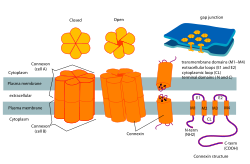
Connexon and connexin structure
Details
Identifiers
Latinconnexona
THH1.00.01.1.02025
Anatomical terminology

In biology, a connexon, also known as a connexin hemichannel, is an assembly of six proteins called connexins that form the pore for a gap junction between the cytoplasm of two adjacent cells. This channel allows for bidirectional flow of ions and signaling molecules.[1] The connexon is the hemichannel supplied by a cell on one side of the junction; two connexons from opposing cells normally come together to form the complete intercellular gap junction channel. In some cells, the hemichannel itself is active as a conduit between the cytoplasm and the extracellular space, allowing the transference of ions and small molecules lower than 1-2 KDa. Little is known about this function of connexons besides the new evidence suggesting their key role in intracellular signaling.[2] In still other cells connexons have been shown to occur in mitochondrial membranes and appear to play a role in heart ischaemia.[3]

Connexons made of the same type of connexins are considered homomeric, while connexons made of differing types of connexins are heteromeric.[4]

Structure

[edit]

Assembly

[edit]

The assembly of connexins destined for gap junction plaques begins with synthesis of connexins within the cell and ends with the formation of gap junction channel plaques on the cell membrane. The connexin subunit proteins that make up connexons are synthesized on the membranes of the cell's endoplasmic reticulum. These subunits are then oligomerized, or combined with other smaller parts, into connexons in the golgi apparatus.[5] The connexons are then delivered to their proper location on the plasma membrane.[6] Connexons then dock with compatible connexons from the neighboring cell to form gap junction channel plaques.[5] A large part of this process is mediated by phosphorylation of different enzymes and proteins, allowing and preventing interaction between certain proteins.[5] The connexons forming channels to the cell exterior or in mitochondria will require a somewhat altered path of assembly.

General

[edit]

Connexons contribute to the formation of gap junctions, and are an essential component of the electric synapses in neural pathways.[5] In a single gap junction, connexons will assemble around an aqueous porous membrane, forming a hemi-channel that is composed of connexins. Connexins are the smaller protein molecules that make up connexons and play a crucial part to the formation of gap junctions. Structurally, connexins are made up of 4 alpha helical transmembrane domains connected by two extracellular loops and one cytoplasmic loop, while both N and C terminals reside intracellularly. Connexin types can be further differentiated by using their predicted molecular weight (ex: Connexin 43 is Cx 43 due to its molecular weight of 43 kDa). Connexons will form the gap junction by docking a hemi-channel to another hemi-channel in an adjacent cell membrane.[2] During this phase, the formation of intercellular channels spanning both of the plasma membranes occurs. Subsequently, this process leads to a better understanding of how electric synapses are facilitated between neurons.[2] Early research identified connexons through their presence in gap junctions. Since then, connexons have been increasingly detected forming channels in single membranes considerably broadening their functionality in cells and tissues.[7]

Degradation

[edit]

Connexon structure is degraded by its removal from the plasma membrane. Connexons will be internalized by the cell itself as a double membrane channel structure (due to the docking of hemi-channels).[5] This is called internalization or endocytosis. Research suggests that gap junctions in general may be internalized using more than one method, but the best known and most studied would be that of clathrin-mediated endocytosis.[5] In simple terms this process consists of a ligand binding to a receptor signaling for a certain part of the membrane to be coated in clathrin.[5] This part of the membrane then buds into the cell forming a vesicle. Now present in the cell membrane, connexons will be degraded by lysosomal pathways.[5] Lysosomes are able to break down the proteins of the connexon because they contain specific enzymes that are made specifically for this process. It is thought that ubiquitination signals degradation within the cell.[5]

Cellular functions

[edit]

Properties

[edit]

The properties of individual connexin proteins determine the overall properties of the whole connexon channel. The permeability and selectivity of the channels is determined by its width as well as the molecular selectivity of connexins such as charge selectivity.[2] Research shows connexons are particularly permeable to soluble second messengers, amino acids, nucleotides, ions and glucose.[2] Channels are also voltage sensitive. The connexon channels have voltage-dependent gates that open or close depending on the difference in voltage between the interiors of the two cells.[2] Gates can also show voltage sensitivity depending on the difference in voltage from the interior and exterior of the cell (i.e. membrane potential).[2]

Modulation

[edit]

Communication between gap-junctions can be modulated/regulated in many ways. The main types of modulation are:

  • Chemical – one common type of chemical modulation is through the interaction of Ca2+ and certain domains of connexins. It is not completely understood, however, it is suggested that this interaction causes Ca2+ to block the pore of the channel. Another form of chemical modulation is through the response of the channel to acidification (decrease of intracellular pH). It has been found that intracellular acidification causes a change in the C-terminal domain of connexins which then reduces the channel activity.[2]
  • Protein Phosphorylation – protein phosphorylation regulates the communication between channels in multiple ways by controlling: connexin trafficking from the Golgi Apparatus, accumulation of connexons to certain areas, and degradation of unnecessary channels. The process of these actions is very complex but involvement of protein phosphorylation is known.[2]
  • Humoral – humoral modulation of gap junction communication is done through many biomolecules such as neurotransmitters, growth factors, and various bioactive compounds. Neurotransmitters such as epinephrine and norepinephrine work in neuronal gap-junctions causing propagation of action potentials down neurons. These types of gap-junctions with this type of modulation are often found in neurons in cardiac tissue and vertebrate retina.[2]

Overall functions

[edit]

Connexons play an imperative role in behavior and neurophysiology. Many of the details surrounding their pathological functions remain unknown as research has only begun recently. In the central nervous system (CNS), connexons play a major role in conditions such as epilepsy, ischemia, inflammation, and neurodegeneration.[1] The molecular mechanism as to how connexons play a role in the conditions listed above has yet to be fully understood and is under further research. Along with their key role in the CNS, connexons are crucial in the functioning of cardiac tissues. The direct connection allows for quick and synchronized firing of neurons in the heart which explains the ability for the heart to beat quickly and change its rate in response to certain stimuli.[2] Connexons also play an essential role in cell development. Specifically, their role in neurogenesis dealing with brain development as well as brain repair during certain diseases/pathologies and also assisting in both cell division as well as cell proliferation. The mechanism by which connexons aid in these processes is still being researched however, it is currently understood that this mechanism involves purinergic signaling (form of extracellular signaling mediated by purine nucleotides and nucleosides such as adenosine and ATP) and permeability to ATP.[1] Other important roles of connexons are glucose sensing and signal transduction. Connexons cause changes in extracellular glucose concentrations affecting feeding/satiety behavior, sleep-wake cycles, and energy use.[1] Further studies indicate that there is an increase in glucose uptake mediated by connexons (whose mechanism is still not fully understood) and under times of high stress and inflammation.[1] Recent research also indicates that connexons may affect synaptic plasticity, learning, memory, vision, and sensorimotor gating.

[edit]

Some of the diseases associated with connexons are cardiovascular disease and diabetes, which is the inability of the body to produce insulin for glucose uptake by cells and degradation in the smaller units of connexons, called connexins, possibly leading to the onset of heart disease. Cardiovascular disease and diabetes, type I and II, affects similar locations within cells of the heart and pancreas. This location is the gap junction, where connexons facilitate rapid cell-to-cell interactions via electrical transmissions. Gap junctions are often present at nerve endings such as in cardiac muscle and are important in maintaining homeostasis in the liver and proper function of the kidneys. The gap junction itself is a structure that is a specialized transmembrane protein formed by a connexon hemichannel.[8] Cardiovascular disease and possibly type I and II diabetes, are each associated with a major protein connexin that makes up the gap junction.

In cardiovascular disease, Cx43 (connexin 43), a subunit of a connexon, is a general protein of the gap junction stimulating cardio myocyte muscle cells of intercalated discs facilitating synchronized beating of the heart. In the occurrence of cardiovascular disease the Cx43 subunit begins to show signs of oxidative stress, the ability of the heart to counteract the buildup of harmful toxins due to age or diet leading to reduced vascular functions.[8] Additionally, reduced Cx43 expression in vascular tissue, which plays a part in ventricular remolding and healing of wounds after a myocardial infarction, are present in structural heart disease.[9] However, the mechanisms of Cx43 in the heart are still poorly understood.[9] Overall, these changes in Cx43 expression and oxidant stress can lead to abnormalities in the coordinated beating of the heart, predisposing it to cardiac arrhythmias.[8]

Connexons are also associated with both Type I and Type II diabetes. Cx36 (connexin 36) subunit mediates insulin excretion and glucose-induced insulin release from gap junctions of the liver and pancreas.[4] Homeostasis in the liver and pancreatic organs are supported by an intricate system of cellular interactions called endocrine signaling. The secretion of hormones into the blood stream to target distant organs. However, endocrine signaling in the pancreas and liver operates along short distances in the cellular membrane by way of signaling pathways, ion channels, G-protein coupled receptors, tyrosine-kinase receptors, and cell-to-cell contact.[4] The gap junctions in these tissues supported by endocrine signaling arbitrate intracellular signals between cells and larger organ systems by connecting adjacent cells to each other in a tight fit. The Tight fit of the gap junction is such that cells in the tissue can communicate more efficiently and maintain homeostasis. Thus the purpose of the gap junction is to regulate the passage of ions, nutrients, metabolites, second messengers, and small biological molecules.[4] In diabetes the subsequent loss or degradation of Cx36 substantially inhibits insulin production in the pancreas and glucose in the liver which is vital for the production of energy for the entire body. A deficiency of Cx36 adversely affects the ability of the gap junction to operate within these tissues leading a reduction in function and possible disease. Similar symptoms associated with the loss or degradation of the gap junction have been observed in type II diabetes, however, the function of Cx36 in Type 1 and type II diabetes in humans is still unknown. Additionally, the Cx36 connexin is coded for by GJD2 gene, which has a predisposition on the gene locus for type II diabetes, and diabetic syndrome.[4]

References

[edit]

Further reading

[edit]
Revisions and contributorsEdit on WikipediaRead on Wikipedia
from Grokipedia
A connexon, also known as a connexin hemichannel, is a hexameric composed of six subunits that forms one half of a channel, enabling direct intercellular communication between adjacent animal cells by permitting the passage of ions and small molecules up to approximately 1.5 kDa. These hemichannels dock with complementary connexons from neighboring cells to create a complete , characterized by a central pore of about 1.5 nm in and a 2–4 nm extracellular gap between the plasma membranes. Each subunit features four transmembrane domains, two extracellular loops for docking, a cytoplasmic loop, and N- and C-terminal domains that contribute to regulation and assembly. In biological systems, connexons play a pivotal role in coordinating cellular activities across tissues, particularly in the central nervous system (CNS), heart, and lens, where they facilitate electrical and metabolic coupling essential for synchronized signaling and homeostasis. There are over 20 identified connexin isoforms in mammals (e.g., Cx36 in neurons for electrical synchronization, Cx43 in astrocytes for metabolic support), classified into alpha, beta, gamma, delta, and epsilon groups based on sequence homology and tissue-specific expression. Unapposed connexons in the plasma membrane can also function independently, releasing signaling molecules like ATP or calcium into the extracellular space, influencing processes such as inflammation and cell migration. Dysfunction or mutations in connexons and their constituent connexins are implicated in a range of pathologies, including congenital deafness, peripheral neuropathies, cardiac arrhythmias, and certain tumors, underscoring their critical importance in development and tissue integrity. First observed in neurons in 1953 and later detailed in mammalian systems during the and , research on connexons has evolved to reveal their multifaceted roles beyond traditional gap junctions, including interactions with cytoskeletal elements and contributions to neurophysiological behaviors like .

Overview

Definition and composition

A connexon, also known as a hemichannel, is a hexameric assembly composed of six (Cx) protein subunits that forms a transmembrane pore approximately 1.5 nm in diameter, permitting the passage of ions and small molecules up to approximately 1.5 kDa in molecular weight. The permeability cutoff can vary depending on the isoform. These structures serve as the fundamental building blocks of gap junctions in cells. Connexins form a multigene family with 21 members identified in the , each encoding proteins with molecular weights ranging from 26 to 60 kDa. Notable examples include (encoded by GJA1), the most widely expressed isoform across various tissues, and Cx26 (encoded by GJB2), which is particularly abundant in epithelial cells. The topological structure of each connexin subunit is conserved, featuring four transmembrane α-helices, two extracellular loops (EL1 and EL2), a single intracellular loop (IL), and both N-terminal (NT) and C-terminal (CT) cytoplasmic domains. Unlike pannexins or the invertebrate-specific innexins, which assemble into distinct channel types, connexons are unique to vertebrates and specifically mediate formation between adjacent cells.

Types and classification

Connexons are classified based on their subunit composition and the nature of their docking with opposing hemichannels. A homomeric connexon consists of six identical subunits, such as those formed by connexin 43 (Cx43) in cardiac myocytes. In contrast, heteromeric connexons incorporate a mixture of different connexin isoforms within the hexamer, for example, combinations of Cx43 and Cx45 observed in vascular tissues. When a connexon docks with a hemichannel of differing composition from the adjacent cell, the resulting is termed heterotypic. Connexins, the building blocks of connexons, follow a standardized where "Cx" is prefixed to the approximate molecular weight in kilodaltons, such as Cx32 for the 32 kDa isoform. These proteins are phylogenetically grouped into subfamilies, primarily α (GJA, e.g., Cx43) and β (GJB, e.g., Cx26), with additional γ (GJC), δ (GJD), and ε (GJE) groups in humans, based on , gene structure, and evolutionary relationships. This classification reflects the diversification of connexin genes across vertebrates. Tissue distribution of connexons varies widely, contributing to specialized intercellular communication. Cx43 is prominently expressed in cardiac and neural tissues, facilitating rapid signal propagation in the heart and . Cx26 predominates in epithelial layers of the skin and , supporting barrier functions and sensory transduction in the . Cx36 is largely restricted to neuronal populations, enabling precise synaptic coordination. Additionally, certain connexons, such as those involving Cx43, localize to the , where they influence cellular energy dynamics. Mammals express approximately 20-21 connexin isoforms, with humans possessing 21 and mice 20, underscoring the conservation of this family among . Homologs are present in other chordates, but connexins are absent in , highlighting their emergence and refinement in vertebrate for diverse physiological roles.

Molecular structure

Connexin subunits

Connexins are integral membrane proteins characterized by four transmembrane α-helical domains (TM1–TM4), which span the and form the core structural scaffold of the subunit. TM1 and TM2 typically bundle together, while TM3 and TM4 form a separate bundle, contributing to the overall that positions the extracellular and intracellular regions appropriately. The central pore of the connexon, when assembled, is primarily lined by the TM2 helices from each subunit, which create a hydrophilic pathway for and passage. The two extracellular loops (EL1 and EL2) connect the transmembrane domains and are highly conserved across isoforms, playing essential roles in inter-subunit and inter-cellular interactions. Both EL1 (the longer loop between TM1 and TM2) and EL2 (positioned between TM3 and TM4, shorter in length) contain three conserved residues each that form intramolecular bonds within each subunit, stabilizing the structure critical for docking between apposed connexons during formation. EL2 contributes to isoform-specific recognition and alignment, ensuring selective heterotypic channel formation. Intracellular domains include a short N-terminal (NT) region, an intracellular loop (IL), and a variable-length C-terminal (CT) tail, all facing the cytoplasm. The NT, typically 9–22 amino acids long, serves as a site for potential acylation modifications that may influence stability. The IL, connecting TM2 and TM3, harbors phosphorylation motifs that regulate trafficking and gating. The CT tail varies significantly in length among connexins—for instance, approximately 131 residues in Cx43—and contains multiple regulatory sites for protein interactions and modifications. Atomic-level insights into connexin architecture derive from crystallographic and cryo-EM studies. The seminal crystal structure of the human Cx26 channel (PDB: 2ZW3), resolved at 3.5 in , revealed the dodecameric arrangement of 12 subunits and detailed the transmembrane helices, loops, and pore geometry. More recent cryo-EM structures of Cx43, achieved at resolutions better than 3 in the 2020s (e.g., 2.26 in 2023), have illuminated conformational dynamics and isoform-specific features of the full-length protein in near-native states. Post-translational modifications profoundly influence connexin function and turnover, with phosphorylation and ubiquitination prominent on intracellular domains. Phosphorylation occurs at multiple sites, such as Ser368 in the CT of Cx43, mediated by (PKC), which modulates channel permeability and assembly. Ubiquitination primarily targets lysine residues in the CT tail, promoting and lysosomal degradation to control connexin levels at the plasma membrane.

Hexameric assembly

Oligomerization into hexameric connexons occurs primarily post-ER, often in the ER-Golgi intermediate compartment (ERGIC) or trans-Golgi network (TGN), with partial assembly possibly initiating in the ER for some isoforms like Cx32, while Cx43 typically forms hexamers in the TGN. This process ensures connexons assemble before proceeding further, preventing premature insertion of incomplete oligomers. The hexameric assembly consists of six connexin subunits arranged in a symmetrical, cone-shaped approximately 10 nm long, with the narrower end facing the . This structure exhibits , with conserved residues in the extracellular loops (EL1 and EL2) forming intramolecular bonds that stabilize each subunit's conformation, facilitating the overall hexameric assembly through non-covalent interactions. ER quality control involves chaperones such as , which binds to glycosylated connexins to facilitate folding and retain misfolded proteins, while misfolded or mutant connexins (e.g., in Charcot-Marie-Tooth disease) are targeted for degradation via ER-associated degradation (ERAD). For Cx43, the chaperone ERp29 further stabilizes monomers in the ER, dissociating in the Golgi to permit hexamerization. Heteromeric connexons form when compatible connexins co-assemble, governed by structural compatibility in their intracellular and extracellular loops; for instance, Cx43 and Cx40, both α-class connexins co-expressed in cardiac tissue, can form heteromers due to sequence similarity in their domains. Not all pairs are compatible, as mismatches in loop regions prevent stable oligomerization across subfamilies.

Biogenesis and dynamics

Synthesis and trafficking

Connexin proteins, the building blocks of connexons, are synthesized through a tightly regulated process beginning with the transcription of connexin genes, such as GJA1, which encodes and exhibits tissue-specific expression patterns, including high levels in cardiac and neural tissues driven by promoters responsive to factors like Sp-1 and AP-1. Translation occurs co-translationally at the , where nascent polypeptides are inserted into the membrane, and mRNA stability is modulated by microRNAs (miRNAs), such as miR-1 and miR-206, which target Cx43 transcripts to reduce expression, particularly in cancer contexts where Cx43 acts as a tumor suppressor. In the ER, connexins undergo folding assisted by chaperones like ERp29, with some isoforms featuring N-linked sites in their extracellular loops that aid in and stability. Initial oligomerization steps begin here, though full hexamer assembly occurs later; the transmembrane and cytoplasmic domains of connexin subunits contribute to efficient folding. Most connexins, including Cx43, have short half-lives of 1-5 hours, reflecting rapid turnover that ensures dynamic regulation of intercellular communication. From the ER, connexins are packaged into COPII-coated vesicles for anterograde transport to the Golgi apparatus, where further modifications prepare them for integration. events, such as Akt-mediated modification of Cx43 at serine 373, enhance this trafficking by promoting forward movement and reducing retention in intracellular compartments. Delivery to the plasma involves vesicle fusion mediated by SNARE proteins, which facilitate the insertion of connexons into the , forming a dynamic pool that can rapidly exchange with stable plaques at cell-cell contacts. This process supports quick adaptation to cellular needs, with connexons initially appearing as small, mobile units before incorporation into larger structures. Synthesis and trafficking of connexins are further regulated by external signals, including hormones like , which upregulates Cx43 transcription and protein levels in responsive tissues such as the and , and growth factors like (EGF), which modulate synthesis rates via phosphorylation-dependent pathways. These mechanisms ensure precise control over connexon availability, tailoring intercellular coupling to physiological demands.

Docking and degradation

Docking of connexons from adjacent cells occurs through the alignment of their extracellular loops, particularly the first extracellular loop (EL1), where conserved residues in the extracellular loops form intramolecular bonds that provide structural stability, enabling docking through non-covalent interactions and alignment of EL1 and EL2 from opposing connexons. The hexameric assembly of connexons facilitates this precise docking interface. Once docked, individual connexons aggregate laterally to form extensive plaques containing hundreds to thousands of channels, providing robust intercellular connectivity. The intermembrane gap in these junctions measures approximately 30-40 Å, maintained by the extracellular domains. Zonula occludens-1 (ZO-1) protein anchors these plaques to the at their periphery, regulating plaque size and stability by controlling connexon accretion. Undocking can occur in a voltage-dependent manner, where transjunctional voltage (Vj) induces conformational changes leading to channel closure and potential separation of hemichannels under physiological stress. Internalization of gap junctions begins with the of entire plaques or fragments, primarily via clathrin-mediated pathways that form double-membrane annular structures within one of the coupled cells. Caveolin-mediated also contributes, particularly for specific connexins like Cx36, facilitating the uptake of these structures. Degradation of internalized connexons proceeds through lysosomal and proteasomal pathways, with ubiquitination playing a key role; for instance, the E3 ligase Nedd4 targets the C-terminal domain of Cx43, marking it for lysosomal degradation. further degrades annular gap junctions, ensuring efficient turnover. In dynamic tissues, connexins exhibit a short of 1-3 hours, reflecting rapid assembly and disassembly. This process is regulated by environmental cues, such as decreased and elevated Ca²⁺ levels, which trigger channel closure prior to internalization and enhance degradation rates. In pathological conditions like ischemia, turnover accelerates due to altered and trafficking, leading to rapid remodeling of gap junctions.

Functional properties

Hemichannel activity

Hemichannels formed by undocked connexons function independently in the plasma membrane, where they are primarily maintained in a closed state under normal physiological conditions but can open in response to specific stimuli. These channels are gated by transjunctional voltage (V_j), with promoting opening, as well as by intracellular calcium (Ca²⁺) elevations and acidification (low ), which trigger conformational changes leading to channel closure or modulation. Extracellular Ca²⁺ concentrations typically inhibit hemichannel opening, whereas reductions in extracellular Ca²⁺ facilitate their , enabling the release of signaling molecules such as ATP and glutamate into the . The permeability of hemichannels is selective, allowing passage of small ions including Na⁺, K⁺, and Ca²⁺, along with metabolites like ATP, NAD⁺, and glutamate. These channels exhibit a of approximately 1 , permitting of hydrophilic molecules up to this size while excluding larger ones. Hemichannels composed of Cx43 display greater permeability to such as ATP and AMP compared to those formed by Cx32, which show suppressed passage of these metabolites. In physiological contexts, hemichannel opening mediates ATP release from , supporting intercellular and propagation of glial networks. This mechanism also contributes to by facilitating autocrine and through ATP and other mediators at injury sites. Pathologically, excessive hemichannel activity during ischemia leads to uncontrolled ATP and glutamate efflux, culminating in Ca²⁺ overload and exacerbated cellular damage. Pharmacological inhibition of hemichannels has been achieved using mimetic peptides, such as Gap19, a nonapeptide derived from the Cx43 cytoplasmic loop (L2 domain), which selectively blocks Cx43 hemichannel opening without affecting gap junctions. Other Cx43 mimetic peptides, including Gap26 and Gap27, similarly inhibit hemichannel activity by targeting specific intracellular domains, offering potential therapeutic avenues for conditions involving aberrant hemichannel function. Cx43 hemichannels are also present in the , where they contribute to cellular by modulating fluxes. These mitochondrial hemichannels can facilitate the release of during apoptotic signaling or (ROS) under stress conditions, influencing mitochondrial dynamics and cell fate.

Gap junction formation

Gap junction channels form through the docking of two opposing connexons (hemichannels), creating a dodecameric structure composed of twelve subunits that spans the between adjacent cells. This assembly results in an aqueous pore approximately 15 Å in , enabling direct cytoplasmic continuity. The unitary electrical conductance of these channels typically ranges from 50 to 100 pS, though it varies by connexin isoform and regulatory state, reflecting the pore's capacity for ion flux. These channels exhibit selective permeability to small molecules up to about 1 kDa, including ions such as K⁺, Na⁺, Ca²⁺, and Cl⁻, as well as second messengers like (IP₃) and (cAMP). Fluorescent dyes such as Lucifer yellow (~457 Da) readily pass through most connexin-based channels, serving as a common for functional connectivity. Permeability is connexin-type dependent; for instance, Cx36 channels, prevalent in neuronal synapses, display relatively low permeability to larger solutes despite maintaining electrical coupling for synchronization, with a pore size exclusion around 1.2 nm. Gating mechanisms regulate channel openness in response to physiological cues. Transjunctional voltage (Vⱼ) sensitivity induces closure when the voltage difference across the junction exceeds ~50 mV, with fast and slow gates contributing to this response; the fast gate often involves N-terminal domain occlusion. Chemical gating occurs via intracellular acidification from CO₂ or low , which protonates residues to close channels, while alcohols like heptanol uncouple junctions by partitioning into the and altering gating kinetics. In heterotypic channels (formed by different connexins), rectification arises from asymmetric voltage sensitivity, where current flow is favored in one direction due to differential gating polarities. Modulation of channel activity is achieved through post-translational modifications, notably . (MAPK) phosphorylation of Cx43 at Ser²⁵⁵ reduces channel open probability and promotes closure, contributing to dynamic regulation of intercellular communication during stress or signaling. Additionally, binds to the C-terminal domain of various connexins in a Ca²⁺-dependent manner, inhibiting conductance by stabilizing a closed conformation, with binding affinities in the nanomolar to micromolar range depending on the isoform. The dynamics of plaques, which aggregate hundreds to thousands of channels, are assessed through measurements of electrical coupling. Electrophysiological techniques, such as dual patch-clamp recording, quantify junctional conductance by injecting current into one cell and measuring voltage spread to coupled neighbors. Dye transfer assays, involving microinjection of permeable tracers like Lucifer yellow, visualize the extent and speed of across plaques, revealing coupling efficiency in living tissues.

Physiological roles

Intercellular communication

Connexons, as hemichannels formed by proteins, dock to form complete gap junctions that provide direct cytoplasmic continuity between adjacent cells, enabling the passage of ions and small metabolites up to approximately 1.5 in size. This intercellular communication facilitates rapid synchronization of cellular activities without reliance on extracellular or receptor-mediated signaling. In particular, gap junctions composed of connexin 43 (Cx43) are prevalent in many tissues and support the transfer of second messengers and ions, such as calcium (Ca²⁺), which propagate waves across coupled cell networks to coordinate responses like contraction or . Electrical coupling through these junctions is critical in excitable cells, where it synchronizes potentials. For instance, Cx43 gap junctions in cardiomyocytes propagate action potentials by allowing direct flow of ions like and sodium, ensuring coordinated heartbeats and preventing arrhythmias at the cellular level. Similarly, in neurons, 36 (Cx36) forms gap junctions that transmit spikelets—small electrical signals—between coupled cells, enabling precise temporal of firing patterns in networks such as the glomeruli or hippocampal . Uncoupling of these Cx36 junctions disrupts spike synchrony, contributing to altered network excitability observed in conditions like gap junction-related epilepsies. Metabolic coupling complements this by permitting the exchange of energy-related molecules; Cx43 channels efficiently transfer nucleotides such as ATP, ADP, and AMP, while also supporting glucose sharing in avascular tissues like , where it aids ATP recycling and nutrient distribution among cells lacking vascular supply. Non-electrical aspects of this communication are often assessed using dye-coupling assays, where fluorescent dyes like are microinjected into donor cells and their diffusion to acceptor cells quantifies junctional permeability and extent. In immune cells, Cx43 gap junctions play a key role in coordination; for example, they accumulate at the between T cells and antigen-presenting cells, allowing bidirectional transfer of signaling molecules to enhance and effector functions. However, inflammatory signals can impair this at the cellular level; pro-inflammatory cytokines activate (PKC), which phosphorylates Cx43 at serine 368, reducing channel conductance and leading to decreased ion and metabolite transfer.

Developmental and homeostatic functions

Connexons formed by connexin 43 (Cx43) play a in embryonic patterning, particularly in cell migration and limb bud formation. During early embryogenesis, Cx43-mediated gap junctions facilitate intercellular communication that coordinates cell motility and from the , ensuring proper migration to peripheral tissues. Disruption of Cx43 in mice leads to impaired migration, resulting in conotruncal heart defects such as pulmonary outflow tract malformations, which cause neonatal lethality. Similarly, Cx43 expression in developing limb buds supports mesenchymal cell coordination necessary for proper limb outgrowth and patterning, with antisense inhibition in chick embryos demonstrating reduced Cx43 protein levels and altered limb development. In , connexons contribute to tissue-specific maturation processes. Cx26 connexons are essential for epidermal stratification, where they regulate proliferation and barrier formation during development, as evidenced by conditional knockout models showing disrupted epidermal and impaired remodeling. Cx43 connexons, in turn, mediate osteoblast-osteoclast coupling in differentiation; they regulate the expression of signaling molecules like and OPG, balancing formation and resorption, with osteoblast-specific Cx43 deletion leading to altered skeletal architecture and reduced mass. Connexons maintain tissue through coordinated signaling in specialized organs. In the vasculature, Cx37 and Cx40 connexons regulate endothelial cell coupling, influencing basal release and vascular tone by modulating sensitivity to vasodilators like . In the lens, Cx46 and Cx50 connexons ensure and metabolite exchange critical for fiber cell and transparency, with their absence causing cataracts due to disrupted internal circulation. Additionally, during , Cx43 hemichannels release ATP from damaged cells, promoting and keratinocyte migration to facilitate tissue repair. In neurogenesis, Cx43 connexons support neuronal migration and synapse formation in the developing brain. Cx43 gap junctions enable electrical synchrony among migrating neurons in the neocortex, facilitating radial migration and layer formation, while also promoting chemical synapse assembly through transient coupling during circuit maturation. With aging, reduced Cx43 expression impairs gap junctional coupling in tissues like the heart and lens, leading to diminished intercellular communication and increased susceptibility to functional decline, as observed in aged rodent models with downregulated Cx43 protein levels.

Pathological implications

Genetic disorders

Mutations in genes encoding connexins, the protein subunits of connexons, lead to a variety of inherited disorders primarily through loss-of-function or gain-of-function mechanisms that disrupt or hemichannel activity. These mutations affect connexon assembly, trafficking, or channel properties, resulting in tissue-specific phenotypes due to the expression patterns of different connexin isoforms. Over 100 mutations across various connexin genes have been identified in human genetic disorders, with many causing dominant-negative effects or retention in the (ER). Mutations in the GJB2 gene, encoding connexin 26 (Cx26), are the most common cause of inherited and are responsible for approximately 50% of cases of autosomal recessive nonsyndromic (DFNB1). These often involve recessive loss-of-function variants, such as deletions or , that abolish formation in the , leading to impaired recycling essential for auditory function. In contrast, dominant missense in GJB2, such as D50N or G45E, cause gain-of-function phenotypes including keratitis-ichthyosis- (KID) syndrome, characterized by skin , corneal , and due to aberrant hemichannel opening and increased ATP release. Connexin 43 (Cx43), encoded by GJA1, mutations are associated with oculodentodigital dysplasia (ODDD), a multisystem disorder featuring craniofacial abnormalities, dental anomalies, and . Many ODDD-causing variants involve C-terminal truncations that impair connexon trafficking and assembly, reducing intercellular communication in neural crest-derived tissues. Additionally, certain GJA1 point mutations have been linked to visceroatrial heterotaxy, a involving abnormal organ situs, through disrupted during embryonic left-right axis formation. X-linked Charcot-Marie-Tooth disease (CMTX), the second most common form of Charcot-Marie-Tooth neuropathy, results from mutations in GJB1 encoding connexin 32 (Cx32). These variants, numbering over 400 identified to date, primarily cause demyelination in peripheral nerves by blocking Cx32 trafficking to the plasma membrane, leading to ER retention and loss of gap junction function between Schwann cells and axons. This disrupts myelin maintenance and nutrient transport, manifesting as progressive muscle weakness and sensory loss. Congenital cataracts arise from in lens-specific connexins, including Cx46 (GJA3) and Cx50 (GJA8), which form essential gap junctions for lens fiber cell communication and . Missense in GJA3 are linked to nuclear or zonular pulverulent cataracts, where disrupted connexon docking impairs metabolite exchange, leading to lens opacification. Similarly, GJA8 variants cause zonular pulverulent cataracts through altered channel gating or assembly defects, resulting in autosomal dominant inheritance patterns. Common pathogenic mechanisms across these disorders include ER retention of mutant connexons, preventing their delivery to the cell surface, and dominant-negative interference where mutant subunits incorporate into wild-type hexamers, impairing overall function. These effects often stem from alterations in the connexon structure, such as in transmembrane domains or intracellular loops, leading to misfolding or unstable hemichannels.

Acquired diseases and therapeutic targets

In cardiovascular diseases, dysregulation of connexin 43 (Cx43) contributes to pathological remodeling, particularly in where altered Cx43 expression and disrupt coupling, leading to heterogeneous conduction and increased arrhythmia susceptibility. During ischemia-reperfusion , aberrant opening of Cx43 hemichannels exacerbates cellular damage by promoting ATP and glutamate release, which amplifies and in cardiomyocytes. In , Cx43 uncoupling reduces intercellular communication, impairing synchronized contraction and contributing to contractile dysfunction. Neurological disorders involve Cx43 hemichannel hyperactivity, as seen in where Cx43 in and facilitates amyloid-β oligomer-induced ATP and glutamate release, propagating and neuronal toxicity. Recent studies from 2024 highlight Cx43 hemichannel-mediated ATP release from in depression models, where triggers excessive extracellular ATP signaling, exacerbating mood disorders via activation. In cancer, particularly , Cx43 hemichannels drive tumor invasion by enabling extracellular vesicle-mediated migration of cancer cells, with 2025 blockade studies demonstrating reduced dissemination through Cx43 inhibition. Conversely, connexin 26 (Cx26) often acts as a tumor suppressor in epithelial cancers, such as mammary tumors, by enhancing communication that limits proliferation and . Other acquired conditions include skin disorders like , where Cx26 upregulation in promotes hyperproliferation and inflammatory signaling, contributing to plaque formation. In , loss of connexin 36 (Cx36) in pancreatic β-cells impairs electrical coupling, leading to heterogeneous insulin secretion and accelerated β-cell under hyperglycemic stress. Therapeutic strategies target connexon dysregulation, with the Gap19 selectively blocking Cx43 hemichannels in models to mitigate and improve neurological outcomes by reducing ATP release. approaches, such as viral delivery of Cx26 or Cx30, have shown promise in restoring auditory function in acquired models by enhancing cochlear networks. The small-molecule tonabersat inhibits Cx43 hemichannels, exhibiting anti-arrhythmic effects in cardiac models by preventing inflammatory propagation and stabilizing conduction. Recent research from 2023 to 2025 emphasizes Cx43's role in , particularly in where hemichannel blockade shifts reactive states toward anti-inflammatory phenotypes, reducing pathology in Alzheimer's models. Additionally, Cx43 facilitates mitochondrial transfer between glial cells and neurons, supporting bioenergetic rescue in neurodegeneration and highlighting its potential in therapies for Parkinson's and related disorders.

History and research advances

Discovery and early characterization

The discovery of gap junctions, the intercellular structures composed of connexons, began in the 1960s through electron microscopy (EM) studies. In 1961 and 1963, J.D. Robertson described hexagonal arrays of protein subunits, approximately 90 Å in diameter, in synaptic membranes of and , suggesting close membrane apposition for potential communication. In 1967, Jean-Paul Revel and Morris Karnovsky used lanthanum staining in EM to reveal an approximately 18-20 Å extracellular gap between apposed membranes in mouse pancreas and heart, coining the term "gap junction" to distinguish it from tight junctions. The term "connexon" was introduced in 1974 by Daniel A. Goodenough and Nigel Unwin, based on negatively stained EM images showing hexagonal assemblies of approximately 70-80 diameter cylinders protruding from isolated liver gap junctions, interpreted as half-channels or hemichannels. In the , freeze-fracture EM by Goodenough and others revealed intramembrane particles arranged in hexagonal lattices, confirming connexons as integral membrane proteins spanning both plasma membranes in gap junctions. A key structural milestone came in 1979, when Unwin and Guido Zampighi isolated two forms of connexons from liver gap junctions and formed two-dimensional crystals, enabling early low-resolution reconstructions via X-ray diffraction and EM. Molecular characterization advanced in the 1980s with the first . In , Nandan M. Kumar and Norton B. Gilula isolated cDNA encoding 32 (Cx32), the major 32 kDa protein from rat liver, revealing a four-transmembrane domain . Shortly after, in 1987, Eric C. Beyer, Donald L. Paul, and Goodenough cloned 43 (Cx43) from rat heart, identifying it as a 43 kDa homolog of Cx32 and the predominant cardiac connexin. The 1990s saw expansion of the connexin family to over 20 members through from diverse tissues, establishing a multigene family with conserved motifs essential for hexamerization into connexons. mice generated in this era provided early functional insights; for instance, Cx43-null mice exhibited lethal cardiac malformations, including conotruncal defects and pulmonary outflow obstruction, underscoring connexons' role in . Structural progress culminated in 2009 with the first near-atomic model of a connexon, derived from of human Cx26 at 3.5 Å resolution, revealing the pore architecture and subunit arrangement. Key figures in these foundational studies include Revel for ultrastructural identification, Goodenough for protein isolation and nomenclature, and Paul for molecular cloning contributions, whose work established connexons as central to without earning a .

Recent developments (post-2020)

Recent advances in have significantly enhanced the understanding of connexon architecture, particularly for connexin 43 (Cx43), the most abundant cardiac and neuronal connexin. In 2023, cryo-electron microscopy (cryo-EM) structures of human Cx43 gap junctions were resolved at approximately 2.3 Å, revealing detailed atomic models of the dodecameric channel assembly and its interactions within the membrane bilayer. These structures captured multiple conformational states, including open and partially closed forms, supporting dynamic gating models where N-terminal domains and pore-lining residues mediate voltage- and pH-sensitive transitions. Such insights have clarified how connexons transition from hemichannel to full gap junction configurations, informing simulations of channel permeability to ions and metabolites. Functional studies post-2020 have expanded the roles of Cx43 hemichannels beyond canonical intercellular communication, highlighting their involvement in pathological signaling. In depression models, stress-induced opening of astrocytic Cx43 hemichannels promotes excessive ATP release, exacerbating and behavioral deficits; pharmacological blockade of these hemichannels mitigates ATP efflux and ameliorates depressive symptoms in . Similarly, in , inhibiting microglial Cx43 hemichannels shifts reactive toward a neuroprotective , reducing amyloid-beta-induced cognitive impairments in mouse models. Emerging disease associations underscore connexons as therapeutic targets in and . For , Cx43 hemichannel inhibitors like abEC1.1 suppress tumor invasion and hyperexcitability by disrupting ATP-mediated signaling in preclinical models, suggesting potential for combination therapies. In cardiovascular contexts, Cx43 remodeling—characterized by hemichannel hyperactivity—contributes to arrhythmogenesis in ischemic hearts; targeting these hemichannels preserves conduction while reducing ectopic beats. Non-canonical functions of connexons have gained attention, particularly in organelle-specific roles and responses. Mitochondrial Cx43 facilitates ATP transfer and protects dopaminergic neurons from in Parkinson's models, with hemichannel inhibition preserving mitochondrial integrity and levels. During viral , SARS-CoV-2 spike protein activates Cx43 hemichannels, leading to uncoupling and exacerbated inflammation in endothelial and neuronal cells. Therapeutic strategies have progressed toward clinical translation. Cx43-mimetic peptides, such as those targeting the C-terminal domain, demonstrate cardioprotection in and models by selectively blocking hemichannels without disrupting . For genetic disorders like connexin-linked , CRISPR-based base editing of GJB2 mutations (encoding Cx26) restores cochlear function in mouse models, paving the way for gene therapies. Omics integration has addressed knowledge gaps in connexon regulation. Single-cell RNA sequencing studies since 2022 reveal heterogeneous expression of connexins in developing cardiac and other tissues, highlighting dynamic transcriptional control. In 2025, in situ cryo-EM analyses of Cx43 gap junction plaques in human cells have further elucidated native structural arrangements, advancing understanding of tissue-specific functions.

References

Add your contribution
Related Hubs
User Avatar
No comments yet.