Hubbry Logo
Cornus drummondiiCornus drummondiiMain
Open search
Cornus drummondii
Community hub
Cornus drummondii
logo
8 pages, 0 posts
0 subscribers
Be the first to start a discussion here.
Contribute something
Cornus drummondii
Cornus drummondii
from Wikipedia

Cornus drummondii
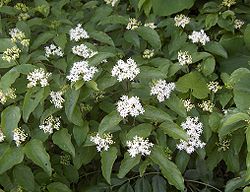
Flowers
Scientific classification Edit this classification
Kingdom: Plantae
Clade: Tracheophytes
Clade: Angiosperms
Clade: Eudicots
Clade: Asterids
Order: Cornales
Family: Cornaceae
Genus: Cornus
Subgenus: Cornus subg. Kraniopsis
Species:
C. drummondii
Binomial name
Cornus drummondii
Natural range of Cornus drummondii
Flower cluster detail

Cornus drummondii, commonly known as the roughleaf dogwood, is a small deciduous tree that is native primarily to the Great Plains and Midwestern regions of the United States. It is also found around the Mississippi River.[3] It is uncommon in the wild, and is mostly found around forest borders.[citation needed] The roughleaf dogwood is used as a buffer strip around parking lots, in the median of highways and near the decks and patios of homes. It can grow to a height of 15 to 25 feet (4.6 to 7.6 m) with a spread of 10 to 15 feet (3.0 to 4.6 m). The roughleaf dogwood flowers during the summer months. It produces near-white four-petaled flowers that are followed by small white fruits, which ripen from August to October. These dogwoods can form a dense thicket that is used as cover for wildlife. Over forty species of birds are known to feed on the fruits.[4]

Description

[edit]

Cornus drummondii is a deciduous tree in the Cornaceae family. Cornus drummondii produces fruit that ripens from August to October. It is uncommon in the wild, and is mostly found around forest borders.[citation needed] The roughleaf dogwood flowers during the summer months.[5] Leaf description: petiole 8–25 mm; blade lanceolate to ovate, 2–12 × 1.2–7.7 cm, base cuneate, truncate, or cordate, apex abruptly acuminate, abaxial surface pale green, hairs curved upward, dense, adaxial surface gray-green, hairs curved upward or appressed; secondary veins 3–4(–5) per side, most arising from proximal 1/2. The leaf is ovate shaped and has a pinnate venation. The leaves are an olive green color. The flowers bloom white and bloom in the months April to July.[6]

Cornus drummondii has low water requirements and grows in shaded or partially shaded areas. Will grow in dry or moist alkaline soil. Cornus drummondii can be grown in sandy, sandy loam, medium loam, clay loam, and clay soils. Unlike many other dogwoods, roughleaf dogwood is very adaptable and can grow in a multitude of conditions.[5][7]

The native habitats for Cornus drummondii are wetlands, mesic and dry-mesic woodlands, riparian forests and on limestone topography.[8][9] It commonly forms thickets.[10]

Taxonomy

[edit]

The species name drummondii is named for Scottish naturalist Thomas Drummond by Carl Anton Von Mey in 1845. Drummond's collection of 750 plant species has been shared throughout museums and scientific institutions throughout the world. The genus name Cornus comes from the Latin word for horn, "Cornu" which is likely in reference to the tree's dense wood.[5]

Horticultural use

[edit]

Cornus drummondii should be grown in full sunlight and well drained soil. The roughleaf dogwood does not require much water to grow. The roughleaf dogwood is used as a buffer planting around parking lots, in the medians of highways and near the decks and patios of homes. The roughleaf dogwood is used as an ornamental tree because of its ability to survive with little care once mature because of its tolerance to pests, low water requirements and tolerance to shade. It can grow to a height of 15 to 25 feet (4.6 to 7.6 m) with a spread of 10 to 15 feet (3.0 to 4.6 m). Cornus drummondii is often planted to attract birds as birds tend to favor the roughleaf dogwood fruit.[8]

Distribution

[edit]

Cornus drummondii can be found in the United States of America as far west and south as Texas, as far east as New York, and as far north as Ontario in Canada.[5][11]

Ethnobotany

[edit]

Cornus drummondii was used by the Iroquois to treat gonorrhea by infusing switches mixed with the fruit from the tree.[12]

Wetland Indicator Status

[edit]

Cornus drummondii is considered Facultative (FAC) meaning it can occur in wetland and non-wetland environment.[13]

Wildlife use

[edit]

There are over 40 species of bird that eat the roughleaf dogwood fruit such as mockingbirds (Mimus polyglottos), bluebirds (Sialia sialis), and cardinals (Cardinalis cardinalis).[14] Other fruit eating animals that use roughleaf dogwood include raccoons, squirrels, deer, rabbits, skunks, and black bears. Birds such as the wood warbler, yellow-rumped warbler, kinglets, and flycatchers are known to feast on the fruits in flocks in the fall and winter. Frugivory by birds is a how C. drummondii is commonly dispersed.[15]

Conservation status

[edit]

Cornus drummondii is critically imperiled (S1) in Georgia, Minnesota, and New York. C. drummondii is secure (S5) in the states Iowa, Indiana, and Kentucky.[16] There is no status rank (SNR/SU/SNA) for Cornus drummondii in Texas, Oklahoma, Louisiana, Mississippi, Alabama, Arkansas, Tennessee, Kansas, Nebraska, South Dakota, Missouri, Illinois, Ohio, Pennsylvania, and Michigan. At the global scale Cornus drummondii is listed as "Least Concern" on the IUCN Red List of Threatened Species.[17]

References

[edit]
[edit]
Revisions and contributorsEdit on WikipediaRead on Wikipedia
from Grokipedia
Cornus drummondii, commonly known as roughleaf dogwood or rough-leaved dogwood, is a or small in the dogwood family Cornaceae, native to central and eastern from and northward to , , , and . It typically reaches heights of 6 to 25 feet with a spread of 6 to 16 feet, forming dense thickets through root suckers and , and features opposite, elliptic to ovate leaves up to 5 inches long that are rough and green on the upper surface with a lighter, hairy underside, turning purplish-red in fall. In spring, it produces clusters of small, creamy-white to yellowish-white flowers from to , followed by white drupes in late summer that persist into fall and serve as a source for birds and small mammals. This species thrives in a variety of habitats, including and woodlands, moist prairies, savannas, thickets, banks, and glades, tolerating conditions from full sun to deep shade and soils ranging from wet and loamy to dry and . Ecologically, C. drummondii supports diverse : its flowers attract pollinators such as bees, , and moths, while the fruits are consumed by species including songbirds, wood ducks, thrushes, and small mammals like deer and bears; the dense thickets provide nesting cover for birds like . It exhibits moderate to rapid growth, is adaptable to poor soils, and is valued for , enhancement, and as an informal or screen in naturalistic landscapes, though it can become weedy in disturbed areas due to its suckering habit. Generally hardy in USDA zones 5 to 8, it faces few serious pests or diseases, with minor issues like or borers occasionally reported.

Taxonomy

Classification

Cornus drummondii is classified within the kingdom Plantae, phylum Tracheophyta, class Magnoliopsida, order Cornales, family Cornaceae, genus , subgenus Kraniopsis, and species C. drummondii. This placement situates it among the flowering plants, specifically the dicotyledonous dogwoods, which are characterized by their woody habit and inflorescence structures. Phylogenetically, C. drummondii resides in the blue- or white-fruited dogwoods (BW) clade of the genus Cornus, specifically within the Kraniopsis , which encompasses species with opposite leaves and summer-blooming inflorescences lacking showy bracts. This positions it distinctly from flowering dogwoods such as C. florida, which belongs to the big-bracted dogwoods (BB) clade in subgenus Cynoxylon, reflecting divergent evolutionary lineages shaped by intercontinental dispersals during the and . The BW clade, including Kraniopsis, exhibits adaptations suited to diverse North American habitats, contrasting with the BB clade's emphasis on bract-derived floral displays. No subspecies are widely recognized for C. drummondii, though some classifications treat midwestern populations as a variety of the related C. asperifolia, specifically C. asperifolia var. drummondii, based on subtle differences in leaf texture and growth form. This varietal distinction highlights regional morphological variation within the species, particularly in and ecotones.

Nomenclature and etymology

The scientific name Cornus drummondii belongs to the genus , which derives from the Latin word cornu, meaning "horn," in reference to the exceptionally hard and dense wood of dogwood species, historically utilized for making tools, skewers, and other implements. The specific epithet drummondii honors the Scottish botanist and plant collector Thomas Drummond (c. 1790–1835), who gathered specimens of this species during his expeditions in the , including , in the early 1830s. The species was formally described and named by the German-Russian Carl Anton Meyer (Carl Anton von Meyer) in 1845, based on Drummond's collections from ; the original publication appeared in Meyer's monograph Über einige Cornus-Arten aus der Abtheilung Thelycrania, where it was established as a distinct species. Historically, drummondii has been subject to several nomenclatural changes and synonyms, reflecting taxonomic revisions within the genus; notable ones include Cornus asperifolia var. drummondii (C. A. Meyer) J. M. Coulter & W. H. Evans, Cornus priceae Small, Swida drummondii (C. A. Meyer) Soják, and Swida priceae (Small) Small, some of which arose from misapplications or broader circumscriptions of related taxa like swamp dogwood (C. foemina). The currently accepted name remains Cornus drummondii C. A. Meyer, as recognized by major botanical authorities such as the USDA Plants Database and the of .

Description

Vegetative characteristics

Cornus drummondii is a or small that typically reaches heights of 15 to 25 feet (4.6 to 7.6 meters) with a spread of 10 to 15 feet (3 to 4.6 meters). It exhibits an upright to spreading growth habit, forming dense thickets through suckering from the roots, which contributes to its irregular, oval-shaped crown. This rapid growth rate allows it to establish quickly in suitable environments, often resulting in intertwined branches that provide effective screening or cover. The leaves of C. drummondii are opposite and simple, ovate to elliptic in shape, measuring 2 to 5 inches (5 to 13 centimeters) in length. They feature an olive-green upper surface that is rough due to scabrous hairs, with a paler, velvety underside covered in denser pubescence; the margins are entire, and the venation is pinnate with conspicuously bowed veins. In autumn, the foliage turns shades of reddish-purple, adding ornamental value before deciduous leaf drop. Stems of C. drummondii are slender and pubescent when young, transitioning from green to reddish-brown with maturity. The bark on mature branches and trunks is grayish-brown, developing shallow fissures that form short, thin plates or rough, flat scales over time. The is fibrous and primarily shallow, facilitating clonal through rhizomes and root suckers that enable the to spread vegetatively in disturbed soils. This structure supports thicket formation while generally avoiding aggressive surface rooting issues in landscapes.

Flowers and fruits

The flowers of Cornus drummondii are small, bisexual, and radially symmetric, measuring approximately 6.5–10 mm in diameter. Each flower features four lanceolate petals that are creamy-white to near-white, along with four prominent stamens and a central pistil with a single style; the calyx is four-lobed and minimally developed. These flowers are primarily pollinated by insects, including bees, butterflies, and moths, which are attracted to the nectar. The consists of open, flat-topped cymes that are terminal on branches, typically measuring 4–8 cm in width and containing numerous individual flowers. These clusters may occasionally arise from axillary positions as well. The fruits are globose white drupes, each about 6 mm in diameter, borne in dense clusters atop reddish peduncles. They develop from green to white upon ripening and feature a single-seeded stone, with the fruits ripening in late summer to early fall.

Distribution and habitat

Geographic range

Cornus drummondii is native to central and eastern , occurring from in southward to and eastward to Georgia and New York, with an elevation range of 0–1500 m. It is documented in the following U.S. states: , , Georgia, , , , , , , , , , , New York, , , , , , , and . The species' range centers on the and the drainage, where it forms part of the regional flora in wooded and open habitats. Beyond its native distribution, C. drummondii is occasionally introduced through plantings for ecological restoration and wildlife enhancement, though such expansions are limited and rare in western outside the core range. The current distribution shows a short-term increase relative to historical records, though it is fragmented in some areas due to alterations such as agricultural conversion and ; comprehensive mapping is provided by the USDA Database and the Biota of Program (BONAP).

Habitat requirements

Cornus drummondii exhibits broad adaptability to diverse conditions, thriving in moist to dry environments across various textures. It tolerates a wide range of 4.5 to 7.5, including acidic to slightly alkaline soils, encompassing sandy, loamy, and clay types, and can tolerate poor drainage while preferring well-drained sites for optimal growth. This versatility allows it to establish in nutrient-poor or rocky substrates, contributing to its presence in both settings. The species requires full sun to partial shade for best development, with moderate moisture needs that decrease once established, rendering it drought-tolerant in suitable conditions. It commonly occurs along edges, prairies, streambanks, and in disturbed areas, where it benefits from intermediate light levels and occasional water availability. In terms of associated plant communities, C. drummondii integrates into oak-hickory woodlands, tallgrass prairies, and riparian zones, often forming dense thickets via suckering. Climatically, Cornus drummondii is hardy in USDA zones 4 through 8, enduring cold winters and hot summers characteristic of its native range across the central United States. This resilience to temperature extremes, combined with its soil and moisture tolerances, enables widespread colonization in transitional habitats.

Wetland indicator status

Cornus drummondii is designated as Facultative (FAC) in the Northcentral & Northeast and Great Plains regions, and Facultative Wetland (FACW) in the Midwest and Southeast on the National Wetland Plant List (NWPL). FAC indicates occurrence in both wetland and non-wetland environments with an estimated frequency of 34–66% in wetlands, while FACW indicates 67–99% frequency in wetlands. This classification reflects its adaptability to varying hydrologic conditions without a strong preference for either habitat type. Regionally, it is rated as FACW in the Midwest (MW) and FAC in the (GP), where it is evaluated under the NWPL's standardized ratings. These designations guide regulatory assessments for delineation and inform the ' inclusion in restoration and projects, where it helps meet hydrophytic criteria in mixed hydrologic settings. Ecologically, the FAC and FACW indicators underscore Cornus drummondii's tolerance for periodic flooding while allowing persistence in drier uplands, positioning it as a non-obligate that bolsters in transitional zones between aquatic and terrestrial ecosystems.

Ecology

Wildlife interactions

_Cornus drummondii plays a significant role in supporting wildlife through its fruits, which are consumed by numerous animal species. The white drupes are eaten by at least 40 species of birds, including the wood duck (Aix sponsa), northern bobwhite (Colinus virginianus), wild turkey (Meleagris gallopavo), greater prairie-chicken (Tympanuchus cupido), American crow (Corvus brachyrhynchos), thrushes, flycatchers, vireos, woodpeckers, and various songbirds. Mammals such as squirrels (Sciurus spp.), chipmunks (Tamias spp.), white-footed mice (Peromyscus leucopus), and American black bears (Ursus americanus) also consume the fruits, providing them with a high-energy food source in late summer and fall. The plant further supports wildlife through browsing and habitat provision. Twigs and leaves are browsed by (Odocoileus virginianus) and cottontail rabbits (Sylvilagus floridanus), particularly in winter when other forage is scarce. Thickets formed by this clonal shrub offer excellent cover and nesting sites for birds, including and other small songbirds, while hosting a variety of insects such as , leafhoppers, sawflies, and moth larvae that serve as food for insectivorous birds like warblers and flycatchers. Seed dispersal for C. drummondii occurs primarily through frugivory by birds, which excrete seeds away from the parent plant, facilitating long-distance spread and contributing to the species' clonal expansion via root sprouts. Mammals provide short-distance dispersal by consuming fruits and depositing seeds nearby. The flowers of C. drummondii attract a range of pollinators, including native bees (e.g., Ceratina, Megachile, Halictidae), butterflies, moths, and flies, which feed on nectar and pollen.

Phenology

Cornus drummondii, a deciduous shrub, initiates its growth cycle with bud break typically occurring in early spring, from March to April, depending on regional climate. This is followed by rapid vegetative expansion, with full leaf development and new shoot growth reaching completion by May in its central North American range. Active growth continues through spring and summer, supporting the plant's thicket-forming habit via rhizomatous spread and upright branching. Flowering commences in and extends through , with peak bloom in to early summer; timing varies by , earlier in southern populations and later northward. The small, creamy-white flowers appear in flat-topped clusters, marking the reproductive phase after leaf expansion. Fruit development begins in to , as green drupes form from pollinated flowers, ripening to white by through October. These berry-like fruits often persist into winter, providing extended visual and ecological interest on reddish pedicels after leaf fall. As autumn progresses, sets in with leaf drop from to , accompanied by striking reddish to purplish autumn coloration that enhances the plant's ornamental value. This fall conspicuousness signals the transition to winter , during which the plant relies on its woody structure for survival.

Uses

Horticultural and ornamental use

_Cornus drummondii, a thicket-forming or small , serves multiple roles in due to its adaptability and spreading habit via . It is commonly employed for creating property line screens, informal hedges, and shrub borders, providing dense cover that enhances privacy and structure in garden designs. Additionally, its aids in along stream banks, in riparian zones, and around farmsteads, making it suitable for stabilizing slopes and preventing loss in vulnerable areas. In urban settings, it functions effectively as a and near highways or parking lots, tolerating a range of conditions from moist to dry. The ornamental value of C. drummondii lies in its seasonal interest, featuring clusters of creamy-white flowers from April to July that attract pollinators such as butterflies and bees, followed by white drupes in late summer that draw birds. Its foliage turns shades of purple and red in fall, adding vibrant color to landscapes, while the overall low-maintenance nature—requiring minimal care once established—makes it ideal for naturalistic plantings in partial shade or full sun. Adaptable to poor soils and urban pollution, it thrives in rain gardens and woodland edges, offering ecological benefits alongside aesthetic appeal without the need for extensive pruning beyond shaping for hedges. In restoration projects, C. drummondii contributes to reconstructions, riparian buffers, and habitats by supporting and providing nesting cover for species like the Bell’s . It is planted in edges, bogs, and pond margins to enhance native ecosystems, promoting habitat while controlling erosion in degraded areas. For , it pairs well with native grasses, forbs, and trees such as or in mixed borders, creating balanced, low-water designs that mimic natural thickets.

Cultivation and propagation

_Cornus drummondii thrives in full sun to part shade and prefers moist, well-drained soils, though it adapts well to drier conditions, clay, poor soils, and alkaline substrates. It is hardy in USDA zones 5 to 8, tolerating extreme cold and occasional flooding while establishing colonies via . Propagation is primarily achieved through seeds, which should be collected in autumn and stratified at 40°F for 60–120 days before in fall or spring; may be required for hard-coated seeds to improve rates of up to 89%. Vegetative methods include or semi-hardwood cuttings taken in summer (rooting in 6–8 weeks with IBA ), hardwood cuttings in winter, layering in early spring, division, or suckers for clonal reproduction. Once established, C. drummondii requires low watering, as it develops , and minimal fertilization to avoid excessive growth that could attract pests. Pruning in late winter helps shape thickets or maintain a form by removing surplus shoots and older canes, promoting vigorous regrowth. The species is generally resistant to pests and diseases when grown in suitable conditions, with cultural practices like proper spacing and watering preventing most issues. Occasional problems include leaf spots, powdery mildew, stem cankers, and twig blights, particularly in humid environments; and scale insects may appear but rarely cause significant damage.

Ethnobotanical uses

Native American tribes have utilized Cornus drummondii, known as roughleaf dogwood, for various medicinal purposes. The prepared an infusion from the switches of the plant to treat . Small stems, stripped of bark, served as chew sticks to stimulate gums and prevent among indigenous groups and early settlers in the Midwest. The Lakota made a from the plant for general consumption, potentially for its tonic effects. The wood of C. drummondii provided durable material for tools and weapons. The Osage referred to it as morjOa hi ("arrow tree") and used the straight stems to craft arrows. Plains Apache communities employed the wood in various material culture applications, such as tool handles, leveraging its hardness and flexibility.

Conservation

Status assessments

According to NatureServe, the species holds a global rank of G5, indicating it is secure at the global scale due to its widespread abundance as a or small in midwestern and south-central U.S. states and adjacent regions. National ranks are N5 (secure) in the United States and N4 (apparently secure) in . Subnational ranks vary significantly; it is secure (S5) in , , and , but critically imperiled (S1) in Georgia, , and New York, reflecting localized rarity at the edges of its range. Population trends for C. drummondii are generally stable to increasing in the short term, with NatureServe reporting an overall increase exceeding 10% in recent assessments, supported by its prevalence in diverse habitats and ongoing field surveys. Monitoring occurs through records, surveys, and ecological studies that track abundance in native ranges. The species is not federally listed under the U.S. Endangered Species Act, nor assessed as at risk by the Committee on the Status of Endangered Wildlife in Canada (COSEWIC). However, it receives legal protection in certain state natural areas where it is rare, such as in New York, where it is classified as endangered and safeguarded under state environmental conservation laws.

Threats

Cornus drummondii faces primary threats from driven by agricultural expansion, , and fire suppression in ecosystems, which allow competing woody species to encroach and alter suitable open habitats. In areas, water diversion for human use has reduced flows, leading to channel narrowing and destruction of riparian zones critical for the species. Invasive non-native plants pose secondary competition risks by outcompeting seedlings in disturbed sites, while occasional overbrowsing by limits juvenile recruitment and population regeneration. Climate change exacerbates these pressures through potential range shifts in the , where increased drought frequency and altered precipitation patterns could stress populations adapted to mesic conditions, despite the species' demonstrated via deep root access to . Conservation responses include restoration plantings using native to reestablish populations in degraded prairies and floodplains, such as the USDA-released Corinth Germplasm selected for and wildlife habitat enhancement. Seed banking efforts by the USDA National Plant Germplasm System preserve genetic material from across the range, supporting long-term viability amid habitat loss. Promotion within conservation easements protects key sites, as seen with one New York population safeguarded on state Department of Environmental Conservation land. Ongoing research examines to inform resilient restoration strategies, while state-level monitoring tracks declines in imperiled areas, including five-year cycle surveys in New York since 2017 and recommended assessments in Minnesota's S1-ranked habitats.

References

Add your contribution
Related Hubs
Contribute something
User Avatar
No comments yet.