


Community hub
Recent from talks
Contribute something
Nothing was collected or created yet.
Vireo
View on Wikipedia
| Vireos | |
|---|---|

| |
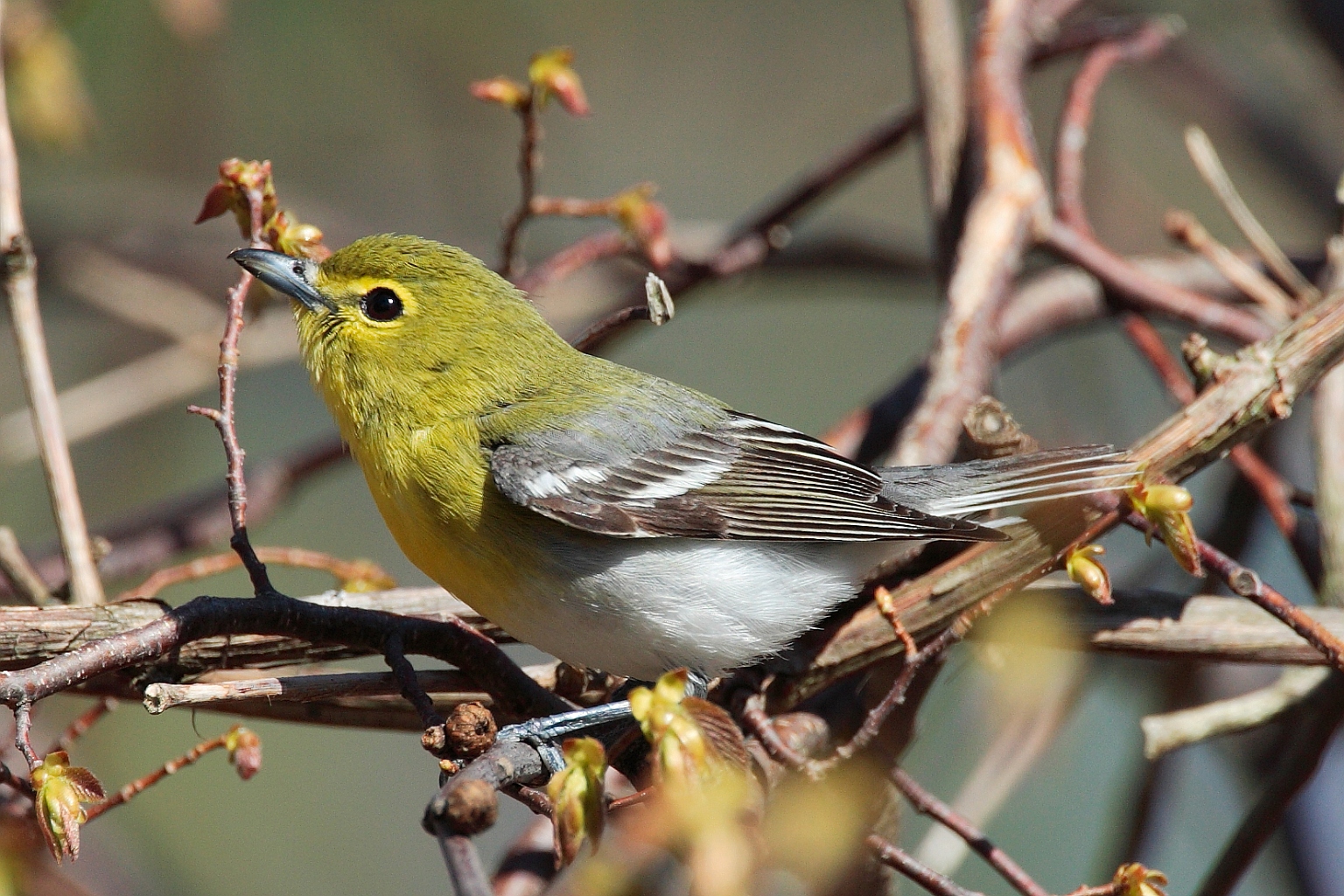
| Yellow-throated vireo (Vireo flavifrons) | |
Scientific classification 
| |
| Kingdom: | Animalia |
| Phylum: | Chordata |
| Class: | Aves |
| Order: | Passeriformes |
| Superfamily: | Orioloidea |
| Family: | Vireonidae Swainson, 1837 |
| Genera | |
The vireos /ˈvɪrioʊz/ make up a family, Vireonidae, of small to medium-sized passerine birds found in the New World (Canada to Argentina, including Bermuda and the West Indies) and Southeast Asia. The family contains 62 species and is divided into eight genera. "Vireo" is a Latin word referring to a green migratory bird, perhaps the female golden oriole, possibly the European greenfinch.[1][2]
They are typically dull-plumaged and greenish in color, the smaller species resembling wood warblers apart from their heavier bills. They range in size from the Chocó vireo, dwarf vireo and lesser greenlet, all at around 10 cm and 8g, to the peppershrikes and shrike-vireos at up to 17 cm and 40g.[3]
Distribution and habitat
[edit]Most species are found in Middle America and northern South America. Thirteen species of true vireos occur farther north, in the United States, Bermuda[4] and Canada; of these all but Hutton's vireo are migratory. Members of the family seldom fly long distances except in migration.[5] They inhabit forest environments, with different species preferring forest canopies, undergrowth, or mangrove swamps.[3]
A few species in the genus Vireo have appeared on the eastern side of the Atlantic as vagrants to the Western Palearctic.[6]
Behaviour
[edit]The resident species occur in pairs or family groups that maintain territories all year (except Hutton's vireo, which joins mixed feeding flocks). Most of the migrants defend winter territories against conspecifics. The exceptions are the complex comprising the red-eyed vireo, the yellow-green vireo, the black-whiskered vireo, and the Yucatan vireo, which winter in small wandering flocks.[5]
Voice
[edit]
Males of most species are persistent singers. Songs are usually rather simple, monotonous in some species of the Caribbean littoral and islands, and most elaborate and pleasant to human ears in the Chocó vireo and the peppershrikes.[5]
Breeding
[edit]The nests of many tropical species are unknown. Of those that are known, all build a cup-shaped nest that hangs from branches. The female does most of the incubation, spelled by the male except in the red-eyed vireo complex.[5]
Feeding
[edit]All members of the family eat some fruit but mostly insects and other arthropods. They take prey from leaves and branches; true vireos also flycatch, and the gray vireo takes 5 percent of its prey from the ground.[5]
Systematics
[edit]_in_Bermuda.jpg)
The family Vireonidae is related to the crow-like birds in family Corvidae and the shrikes in family Laniidae as part of superfamily Corvoidea. As currently circumscribed the family is made up of eight genera.[7][8]
Traditionally the family was considered to include four New World genera containing the true vireos (Vireo), the greenlets (Hylophilus), the shrike-vireos (Vireolanius) and the peppershrikes (Cyclarhis). However, phylogenetic studies found Hylophilus to be polyphyletic, with the greenlets split into three distinct groups: the "scrub" greenlets in a restricted Hylophilus, the "canopy" greenlets in resurrected genus Pachysylvia and the tawny-crowned greenlet in new genus Tunchiornis.[9][10][11]
In addition, biochemical studies have identified two babbler genera (Pteruthius and Erpornis) which may be Old World members of this family.[12] Observers have commented on the vireo-like behaviour of the Pteruthius shrike-babblers, but apparently no-one suspected the biogeographically unlikely possibility of vireo relatives in Asia. Some recent taxonomic treatements, such as the IOC taxonomy followed here, include Pteruthius and Erpornis in Vireionidae,[7][8] whereas other place them in their own families Pteruthidae and Erpornidae.[13]
Species in taxonomic order
[edit]| Image | Genus | Species |
|---|---|---|
 |
Pteruthius - shrike-babblers[12] Swainson, 1832 |
|
 |
Erpornis [14] Hodgson, 1844 |
|
_(17359710466).jpg) |
Cyclarhis Swainson, 1824, the peppershrikes |
|
 |
Vireolanius Bonaparte, 1850, the shrike-vireos |
|
 |
Hylophilus Temminck, 1822 |
|
_(7222935148).jpg) |
Tunchiornis Slager & Klicka, 2014 |
|
.jpg) |
Pachysylvia Bonaparte, 1850 |
|
 |
Vireo Vieillot, 1808, the true vireos. |
|
References
[edit]- ^ Jobling, James A (2010). The Helm Dictionary of Scientific Bird Names. London: Christopher Helm. p. 402. ISBN 978-1-4081-2501-4.
- ^ "Vireo". Oxford English Dictionary (Online ed.). Oxford University Press. (Subscription or participating institution membership required.)
- ^ a b Forshaw, Joseph & Parkes, Kenneth C. 1991. Encyclopaedia of Animals: Birds, p. 209. Merehurst Press, London. ISBN 1-85391-186-0
- ^ White-eyed vireo Archived 2018-12-30 at the Wayback Machine, Audubon Society of Bermuda
- ^ a b c d e Salaman, Paul & Barlow, Jon C. 2003. Vireos. Pp. 478–479 in; Perrins, C. ed. The Firefly Encyclopedia of Birds. Firefly Books, Oxford. ISBN 1-55297-777-3
- ^ "Western Palearctic". Avibase. Retrieved 27 February 2017.
- ^ a b Gill, Frank; Donsker, David; Rasmussen, Pamela C. (eds.). "Vireos, shrike-babblers". IOC World Bird List. 14.2. Retrieved 18 January 2025.
- ^ a b "Vireonidae. Vireos, Shrike-Babblers, and Erpornis". Birds of the World Online. Cornell Lab of Ornithology, Ithaca, NY. Retrieved 18 January 2025.
- ^ Slager, David L.; Battey, C.J.; Bryson, Robert W.; Voelker, Gary; Klicka, John (2014). "A multilocus phylogeny of a major New World avian radiation: The Vireonidae". Molecular Phylogenetics and Evolution. 80: 95–104. Bibcode:2014MolPE..80...95S. doi:10.1016/j.ympev.2014.07.021. PMID 25109651.
- ^ Slager, David L.; Klicka, John (2014). "Polyphyly of Hylophilus and a new genus for the Tawny-crowned Greenlet
(Aves: Passeriformes: Vireonidae)". Zootaxa. 3884 (2): 194–196. doi:10.11646/zootaxa.3884.2.8. PMID 25543778. - ^ "Proposal (661). Revise the linear sequence of Vireonidae". South American Classification Committee. Retrieved 18 January 2025.
- ^ a b Reddy, Sushma; Cracraft, Joel (2007). "Old World Shrike-babblers (Pteruthius) belong with New World Vireos (Vireonidae)". Molecular Phylogenetics and Evolution. 44 (3): 1352–1357. doi:10.1016/j.ympev.2007.02.023.
- ^ Sangster, George; Cibois, Alice; Reddy, Sushma (2022). "Pteruthiidae and Erpornithidae (Aves: Corvides): Two new family-group names for babbler-like outgroups of the vireos (Vireonidae)". Bulletin of the British Ornithologists' Club. 142 (2). doi:10.25226/bboc.v142i2.2022.a8.
- ^ Barker, F. Keith; Cibois, Alice; Schikler, Peter A.; Feinstein, Julie; Cracraft, Joel (2004). "Phylogeny and diversification of the largest avian radiation" (PDF). PNAS. 101 (30): 11040–11045. doi:10.1073/pnas.0401892101. PMID 15263073. Supporting information
External links
[edit]- Vireos (Vireonidae) information, including 33 species with videos and 40 with photographs at the Internet Bird Collection
 Texts on Wikisource:
- "Vireo". The New Student's Reference Work. 1914.
- Gilman, D. C.; Peck, H. T.; Colby, F. M., eds. (1905). "Vireo". New International Encyclopedia (1st ed.). New York: Dodd, Mead.
- Ripley, George; Dana, Charles A., eds. (1879). "Vireo". The American Cyclopædia.

| National | |
|---|---|
| Other | |

Vireo
View on GrokipediaTaxonomy
Etymology and classification history
The genus name Vireo derives from the Latin vireō, a term used by ancient authors like Pliny the Elder to denote a small green bird, ultimately from the verb virēre meaning "to be green," in reference to the typically olive-green plumage of these birds.[7][8] Early taxonomic descriptions of vireo species predated the formal genus establishment; for instance, the red-eyed vireo (V. olivaceus) was initially described by Carl Linnaeus in 1766 as Muscicapa olivacea within the flycatcher genus Muscicapa, reflecting its placement among oscine passerines based on limited morphological data.[9] The genus Vireo itself was formally established by Louis Jean Pierre Vieillot in 1808 in his Histoire naturelle des oiseaux de l'Amérique septentrionale, incorporating several New World species characterized by their small size, hooked bills, and arboreal habits, distinguishing them from Old World counterparts.[10] In the early 19th century, vireos were variably classified within the warbler (Parulidae) or flycatcher (Tyrannidae) families due to superficial similarities in foraging behavior and plumage, but accumulating specimen evidence highlighted their distinct robust bills and weaker legs compared to those groups.[11] The family Vireonidae was proposed by William Swainson in 1837 to encompass these birds as a cohesive New World clade, emphasizing their shared osteological features and vocal traits.[12] Throughout the 20th century, classifications within Vireo underwent revisions driven by morphological analyses, particularly focusing on bill structure (e.g., thicker, more hooked bills in certain subgroups) and leg strength, which helped delineate subgenera like Vireosylva for eye-lined species and Lanivireo for eye-ringed ones, as proposed in studies like those by Eugene Eisenmann in the 1950s and Robert W. Storer in the 1960s.[13] Protein electrophoresis in the 1980s, such as the work by Ned K. Johnson et al. (1988), further challenged the monophyly of Vireo by identifying four genetic clusters, prompting debates on generic splits.[11] Molecular studies in the 2000s solidified the taxonomic framework; a 2001 mitochondrial DNA analysis by Thomas B. Smith et al. confirmed the monophyly of Vireonidae, supporting its close affinity to Old World corvoids and indicating a single New World colonization event, while resolving Vireo as monophyletic within the family but distinct from basal genera like Cyclarhis.[14] Subsequent multilocus phylogenies, including Slager et al. (2014), reinforced Vireo's monophyly, separating it from shrike-vireos (Pteruthius) and greenlets (Hylophilus), and traced its diversification to Middle American radiations followed by northward expansions.[15] As of pre-2025 assessments, the genus comprised approximately 33 species, with ongoing debates centered on historical conspecificity, such as the yellow-green vireo (V. flavoviridis), once lumped with the red-eyed vireo (V. olivaceus) but now recognized as distinct based on vocal, morphological, and genetic differences.[16][17]Current species list
The genus Vireo currently recognizes 34 species, reflecting post-2025 taxonomic updates by the American Ornithological Society (AOS) North American Classification Committee and the eBird/Clements Checklist v2025, which incorporate advances in genetic, vocal, and morphological analyses.[18][19] A key change in this update was the split of the former Warbling Vireo (Vireo gilvus) into two full species, justified by consistent differences in mitochondrial DNA sequences, song structure, and subtle plumage variations, with minimal hybridization in overlap zones.[18][20] The Eastern Warbling Vireo (V. gilvus) primarily breeds east of the Rocky Mountains in deciduous woodlands, while the Western Warbling Vireo (V. swainsoni) occurs in Pacific Coast and interior western regions, often in coniferous habitats.[18] Other species, such as the Yellow-green Vireo (V. flavoviridis), have faced occasional debate regarding potential splits but remain unified due to overlapping traits and gene flow across their range.[21] These species are listed below in approximate taxonomic order, based on phylogenetic relationships derived from molecular studies.[20]| Common Name | Scientific Name | Notes |
|---|---|---|
| Mangrove Vireo | Vireo pallens | Restricted to coastal mangroves in Central America and northern South America. |
| Black-capped Vireo | Vireo atricapilla | Endemic to southwestern U.S. and Mexico; known for secretive behavior. |
| White-eyed Vireo | Vireo griseus | Widespread in eastern North America; distinctive yellow "spectacles." |
| Thick-billed Vireo | Vireo crassirostris | Bahamian endemic; adapted to pine woodlands. |
| Black-whiskered Vireo | Vireo altiloquus | Migratory from eastern North America to Caribbean. |
| Yellow-green Vireo | Vireo flavoviridis | Neotropical; debated inclusion maintained due to vocal and plumage continuity.[21] |
| Red-eyed Vireo | Vireo olivaceus | Abundant migrant across North America; monotonous song. |
| Yellow-throated Vireo | Vireo flavifrons | Eastern North American breeder; bright yellow throat. |
| Blue-headed Vireo | Vireo solitarius | Northeastern breeder; formerly lumped with similar western forms. |
| Philadelphia Vireo | Vireo philadelphicus | Rare migrant; yellow underparts distinguish it from look-alikes. |
| Eastern Warbling Vireo | Vireo gilvus | 2025 split; eastern breeding range east of Rockies.[18] |
| Western Warbling Vireo | Vireo swainsoni | 2025 split; western breeding in Pacific and Rocky Mountain areas.[18] |
| Plumbeous Vireo | Vireo plumbeus | Western breeder; drab plumage aids camouflage. |
| Cassin's Vireo | Vireo cassinii | Pacific Northwest breeder; greenish upperparts. |
| Hutton's Vireo | Vireo huttoni | Resident in southwestern U.S. and Mexico; complex subspecies variation. |
| Gray Vireo | Vireo vicinior | Arid southwestern U.S.; inconspicuous in scrub. |
| Dwarf Vireo | Vireo nelsoni | Mexican endemic; smallest in genus. |
| Cozumel Vireo | Vireo coeruleus | Island endemic off Yucatan Peninsula. |
| Yucatan Vireo | Vireo magister | Peninsula of Yucatan; similar to Black-whiskered but resident. |
| Bell's Vireo | Vireo bellii | Southwestern U.S. and Mexico; habitat specialist in riparian areas. |
| Black-bellied Vireo | Vireo latimeri | Caribbean endemic; restricted to St. Vincent and Grenadines. |
| Chivi Vireo | Vireo chivi | South American; recently split from Red-eyed Vireo. |