Hubbry Logo
Coronal sutureCoronal sutureMain
Open search
Coronal suture
Community hub
Coronal suture
logo
8 pages, 0 posts
0 subscribers
Be the first to start a discussion here.
Coronal suture
Coronal suture
from Wikipedia
Coronal suture
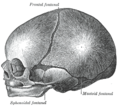
Anterolateral view of coronal suture (red)
Details
Part ofSkull
SystemSkeletal
NerveTrigeminal nerve
Identifiers
Latinsutura coronalis
TA98A03.1.02.002
TA21575
FMA52928
Anatomical terminology

The coronal suture is a dense, fibrous connective tissue joint that separates the two parietal bones from the frontal bone of the skull.

Structure

[edit]

The coronal suture lies between the paired parietal bones and the frontal bone of the skull.[1] It runs from the pterion on each side.

Nerve supply

[edit]

The coronal suture is likely supplied by a branch of the trigeminal nerve.[2]

Development

[edit]

The coronal suture is derived from the paraxial mesoderm.

Clinical significance

[edit]

If certain bones of the skull grow too fast then premature fusion of the sutures, craniosynostosis, may occur.[1] This can result in skull deformities.[1] These deformities include:[3]

References

[edit]

Additional images

[edit]
[edit]
Revisions and contributorsEdit on WikipediaRead on Wikipedia
from Grokipedia
The coronal suture is a dense and fibrous syndesmosis, or immovable joint, that connects the frontal bone to the two parietal bones across the superior aspect of the human skull. It extends transversely from the pterion on each side, where it meets the sphenoparietal suture, to the midline bregma, where it intersects the sagittal suture, forming an oblique line that runs approximately from ear to ear. In newborns, this suture allows for flexibility and slight movement of the skull plates during birth, while also permitting the cranium to expand symmetrically as the brain grows rapidly in infancy. Derived embryologically from the paraxial mesoderm, the suture fuses around 24 years of age, after which it provides structural stability to the adult skull. Structurally, the coronal suture consists of interlocking bony edges bound by dense fibrous , overlaid by the and the , and it lies in close proximity to critical neurovascular structures such as the , which it helps protect. Functionally, it plays a key role in accommodating volume increase during early development, contributing to the overall shaping of the calvaria. Clinically, premature fusion of the coronal suture, known as coronal synostosis or , is the second most common form of this condition and can lead to anterior , characterized by a flattened on the affected side, an elevated eye socket, and a deviated ; bilateral involvement results in with a short, broad head shape. Such early closure restricts cranial growth, potentially causing increased , developmental delays, or neurological complications if untreated, often requiring surgical intervention in the first year of life to allow proper expansion. Additionally, the region near the along the coronal suture represents one of the skull's weakest points, making it vulnerable to trauma that could result in .

Anatomy

Description and Location

The coronal suture is a dense fibrous , known as a syndesmosis, that forms the immovable articulation between the anteriorly and the paired parietal bones posteriorly. This suture serves as a key component of the , providing structural integrity while permitting limited flexibility during early development. It follows an oblique transverse course across the superior aspect of the , originating laterally at the on each side—where it intersects the sphenoparietal suture—and extending medially to meet the at the , thereby dividing the calvaria into an anterior frontal region and a posterior parietal region. In adults, the suture typically measures 20 to 30 cm in length, with variations by sex and population; for instance, studies report mean lengths of approximately 24.8 cm in males and 22.7 cm in females among Egyptian adults. The marks the junction with the sagittal suture, while the represents the thinnest region of the laterally, involving additional contributions from the sphenoid and temporal bones. The suture exhibits a serrated, interlocking morphology characterized by jagged, interdigitating bone edges that enhance mechanical stability and resist shearing forces across the cranium. This complex, fractal-like pattern develops postnatally, evolving from straighter edges in infancy to more intricate notching with age.

Relations and Attachments

The coronal suture interdigitates anteriorly with the and posteriorly with the paired parietal bones through dense fibrous , forming a serrated, interlocking that provides stability to the anterior vault. Laterally, the suture is overlaid by the , which originates from the and inserts onto the coronoid process of the , while superiorly it lies beneath the , the tendinous sheet connecting the frontal and occipital bellies of the . The pericranium, the outer periosteal layer of the cranial bones, attaches firmly along the suture lines, facilitating the integration of the suture within the and providing a protective covering that is continuous with the underlying bone surfaces. In its medial aspect near the —the intersection with the —the coronal suture is in close relation to the , the largest dural venous sinus that drains blood from the brain's superficial structures. Intracranially, the suture overlies the meningeal layers, particularly the , which adheres to the inner table of the adjacent to the suture, separating it from the underlying arachnoid and . The suture maintains proximity to the frontal lobes of the brain superiorly, accommodating their expansion during growth, and indirectly relates to the temporal lobes laterally through its posterior termination at the pterion, a key H-shaped junction involving the frontal, parietal, sphenoid, and temporal bones that forms the anterior border of the middle cranial fossa. This positioning underscores the suture's role in delineating the boundaries of the anterior and middle cranial fossae while integrating with the broader calvarial architecture.

Development

Embryology

The coronal suture originates at the interface between tissues derived from distinct embryonic sources: the primordia arise primarily from cells, while the primordia develop from paraxial . This boundary forms a mixed population of mesenchymal cells that will constitute the suture, reflecting the heterogeneous cellular origins of the calvarial vault during early craniofacial development. During , the coronal suture first appears around the 8th gestational week as a mesenchymal between the emerging frontal and primordia. This represents the initial patterning of the suture site, where undifferentiated mesenchymal cells aggregate to delineate the future . By the 12th gestational week, these cells differentiate into dense fibrous , establishing the patent suture line that persists into postnatal life. The patterning of the coronal suture site involves interactions between the overlying and the underlying , which provides inductive signals to maintain suture patency during embryogenesis. Molecular pathways such as (FGF) and (BMP) signaling mediate these interactions, with FGF ligands expressed in the dura and osteogenic fronts to regulate mesenchymal and inhibit premature differentiation, while BMPs contribute to boundary specification in the adjacent tissues. These signals ensure the precise positioning and maintenance of the mesenchymal zone prior to later events.

Ossification

The frontal and parietal bones adjacent to the coronal suture undergo during embryonic development. The parietal bones initiate from multiple centers around gestational weeks 7–8, originating from . The frontal bone follows shortly after, with primary centers appearing at the frontal eminences during week 8, derived from cells. Throughout this process, the intervening coronal suture remains unossified as a fibrous syndesmosis, preventing premature fusion of the bone fronts. The coronal suture maintains patency from birth through childhood to accommodate expansion and growth. Interdigitations—finger-like bony projections along the suture edges—begin to develop postnatally, with partial complexity increasing during to enhance mechanical interlocking without compromising flexibility. This patency is sustained by dural attachments to the suture , which provide , and molecular inhibitory signals such as Noggin, TWIST1, and GDF6 that suppress osteogenic differentiation in the sutural tissue. In adulthood, the coronal suture becomes increasingly rigid due to progressive mineralization and deepening interdigitations. Estimates of fusion timing vary across studies; traditional anatomical references suggest closure around 24–40 years of age, while recent imaging-based research indicates complete fusion may occur much later, often beyond 70 years and with a mean age of approximately 91 years in one 2023 CT study of older adults. Complete fusion is variable, contributing to cranial stability in .

Function and Physiology

Role in Cranial Growth

The coronal suture functions as a key growth site in postnatal cranial development, enabling the expansion of the vault through appositional growth at its margins during infancy and childhood. This process involves osteoblastic activity at the osteogenic fronts of the adjacent frontal and parietal , where new is deposited along the suture edges, allowing the bones to separate and accommodate increasing intracranial volume without premature fusion. Such growth is critical for maintaining the patency of the suture, which remains fibrous and flexible to support dynamic enlargement. This expansion is closely coordinated with the rapid increase in volume, which reaches approximately 80% of adult size by age 2 years, necessitating proportional skull growth to prevent compression. The coronal suture specifically facilitates anteroposterior widening of the cranium, contributing to the overall calvarial dimensions that parallel development and ensuring adequate for neural tissue proliferation. Without this mechanism, restrictions in skull growth could impair maturation. The suture's activity persists beyond the closure of the , which typically occurs between 7 and 19 months of age, allowing continued cranial accommodation into later childhood; full fusion of the coronal suture generally happens between ages 20 and 30, marking the end of significant growth potential. Hormonal regulation plays a vital role, with and insulin-like growth factor-1 (IGF-1) stimulating proliferation and bone deposition at the suture edges, thereby promoting controlled expansion while delaying .

Biomechanics

The coronal suture, primarily composed of dense fibrous , provides essential flexibility to the cranium, distinguishing it from the more rigid adjacent . In infants, this tissue exhibits a tensile strength of approximately 4.4 ± 0.5 MPa and an of 7.6 ± 1.4 MPa under high-rate loading conditions, enabling substantial deformation (ultimate strain of 1.46 ± 0.42 mm/mm) relative to cranial . These properties allow the suture to accommodate minor displacements during physiological activities such as mastication or low-impact events, contributing to overall cranial compliance in early development. In terms of load distribution, the coronal suture acts as a biomechanical , effectively transferring forces from the to the parietal bones while mitigating peak stresses. Its interdigitated morphology enhances resistance to shear forces, with studies on analogous cranial sutures showing that higher interdigitation correlates with up to 100% greater absorption per unit volume during bending or impact compared to non-interdigitated regions or solid . This mechanism helps maintain integrity by dissipating and preventing propagation across the calvaria. Age-related changes significantly alter the suture's , with progressive leading to increased stiffness. The rises from around 8 MPa in infants under 1 year to 355 ± 45 MPa in 1- to 2-year-olds, reflecting maturation of the fibrous matrix and partial bridging; in adults, fused sutures approach bone-like properties with moduli exceeding 50 MPa in modeling contexts. Finite element modeling of the coronal suture reveals distinct patterns during cranial deformation, such as under impact or tensile loading, where stresses concentrate at suture margins (up to 296 kPa in complex morphologies) but are redistributed globally to reduce overall strain. These simulations underscore the suture's role in optimizing load-bearing without equations, highlighting how its compliance in transitions to rigidity in adulthood for enhanced protection.

Blood Supply and Innervation

Vascular Supply

The arterial supply to the coronal suture and its adjacent tissues primarily arises from the , a branch of the that enters the cranium through the foramen spinosum. The anterior division of the ascends along the greater wing of the and follows the path of the coronal suture, supplying the , of the inner calvarial tables, and the suture's fibrous via its perforating branches. On the frontal aspect, contributions come from the supraorbital and supratrochlear arteries, which are terminal branches of the (itself derived from the ); these vessels provide blood to the frontal bone's and overlying soft tissues near the suture's anterior extent. Posteriorly, the parietal branches of the 's posterior division extend along the parietal bones, supporting the suture's posterior segments and adjacent . Venous drainage from the coronal suture region occurs through a network of embedded within the cancellous bone of the frontal and parietal bones, which communicate with the via passing through suture-adjacent foramina. These valveless , particularly abundant near the coronal suture, facilitate drainage from the calvarial and adjacent dura, with the frontal and anterior parietal showing high density in this area. also connect this system to extracranial veins, aiding overall venous return. The vascular at the coronal suture plays a critical role in supporting osteogenesis along its edges, where increased precedes and facilitates formation during cranial growth phases. Studies on experimentally expanded sutures demonstrate that vascular proliferation begins within 24 hours of mechanical stimulus, coinciding with heightened osteogenic activity by 48 hours, underscoring the suture's reliance on surrounding microvasculature for nutrient delivery to proliferating osteoprogenitor cells. Anastomoses between the branches and scalp vessels, such as the , occur via accessory meningeal and emissary pathways, enhancing collateral circulation across the calvaria.

Nerve Supply

The coronal suture receives sensory innervation primarily from branches of the (cranial nerve V). The anterior portion of the suture is supplied by the supraorbital and s, which are divisions of the (V1). The supraorbital nerve emerges from the and provides sensory fibers to the , upper , and , extending posteriorly toward the coronal suture and beyond to the . Similarly, the supplies the medial and adjacent regions overlying the anterior coronal suture. Laterally, the , a branch of the mandibular division (V3), innervates the temple and areas near the posterior extension of the coronal suture toward the . Autonomic innervation to the coronal suture includes sympathetic fibers originating from the , traveling via the carotid plexus to regulate vascular tone in the surrounding dura and . These fibers, often positive for (VIP), interact with calvarial tissues to modulate blood flow and support , though they are less dense in the suture proper compared to adjacent bony structures. Irritation or inflammation of the coronal suture can lead to along the distribution, manifesting as discomfort in the or temporal regions due to the somatotopic organization of V1 and V3 branches. This referral pattern arises from convergent sensory inputs in the trigeminal nucleus, where suture-related nociceptive signals mimic primary facial pain. Pain or tenderness in the coronal suture area is not typical of normal anatomy and may result from soft tissue irritation, such as inflammation of the scalp, pericranium, or overlying muscles like the frontalis or temporalis due to tension, minor trauma, or strain. Headache syndromes, including cranial suture headache originating from nociceptors in the suture lines, can cause localized tenderness elicited by palpation, often following head trauma, post-infectious conditions, or idiopathic factors. Tension-type headaches may also affect the crown or frontal regions overlying the suture, while referred pain from nearby structures like the sinuses can contribute. Rarely, underlying bone changes, metabolic conditions, or prior trauma may be involved. Nerve density is notably higher within the interdigitations of the coronal suture, particularly in developing calvaria, where sensory fibers from the provide proprioceptive feedback during skull expansion and subtle movements. These fibers, including (CGRP)-positive unmyelinated axons, traverse the fibrous suture tissue and periosteum, facilitating mechanosensory roles in cranial growth regulation.

Variations

Normal Variations

The coronal suture displays several benign anatomical variations that contribute to individual diversity in skull morphology without affecting function or indicating . One such variation involves the presence of accessory ossicles, commonly known as , which are small, irregular supernumerary bones embedded within the suture line. These ossicles arise from additional centers and are typically multiple and triangular in shape when occurring as normal variants; in the coronal suture, they are less frequent than in posterior sutures like the lambdoid but still represent a common incidental finding on imaging. The overall incidence of at least one anywhere in the is estimated at 8-15% in the general population, with isolated cases in the coronal region often appearing as minor spurs or isolated ossicles along the serrated edges. Another normal variation is mild asymmetry between the left and right sides of the coronal suture, particularly evident in neonates and young children where suture width can range from 4-7 mm and interdigitation patterns may differ slightly in depth or alignment. This is typically resolves or stabilizes with age as the suture narrows and matures, without leading to deformational changes. Such differences arise from natural fluctuations in and growth rates across the midline. Occasional metopic-like extensions may also occur anteriorly along the coronal suture, manifesting as partial bony bridging or near the frontal region without complete fusion. These extensions, sometimes accompanied by accessory parietal sutures adjacent to the coronal line, enhance interdigitation complexity and are considered non-pathologic, aiding in distinguishing anatomy from traumatic or diastatic fractures on radiographic evaluation.

Pathological Variations

Pathological variations of the coronal suture encompass structural alterations driven by disease processes, distinct from benign anatomical diversity. These changes can compromise cranial integrity and growth, often requiring differentiation from normal variants through imaging or histological analysis. Premature partial fusion, or synostosis variants, involves asymmetric closure of the coronal suture, typically unilateral, which can result in anterior . Accessory sutures represent rare persistent extensions or additional fibrous junctions, which can mimic pathological on radiographs due to their linear appearance and sclerotic margins. These anomalies often extend from various sutures and potentially lead to misdiagnosis in trauma evaluations unless zigzag interdigitations confirm their sutural nature. Trauma-induced changes to the coronal suture include that traverse the suture line or cause diastasis, an abnormal widening (e.g., >10 mm at birth, >3 mm by age 2 years, >2 mm by age 3 years), resulting from high-impact forces that separate the frontal and parietal bones. Such diastasis may occur without overt , as seen in vertex impacts, and can lead to associated epidural hematomas if venous structures are disrupted, with incidence higher in accidental pediatric trauma than cases. Post-injury resorption at suture edges may further alter morphology, though healing often restores partial continuity.

Clinical Significance

Craniosynostosis

involving the coronal suture refers to the premature fusion of one or both coronal sutures, leading to abnormal skull growth and shape distortion. This condition is classified into unicoronal synostosis, affecting a single side, and bicoronal synostosis, involving both sutures bilaterally. Unicoronal synostosis accounts for approximately 20-25% of all nonsyndromic cases, with an estimated incidence of about 1 in 10,000 live births, while bicoronal synostosis is rarer, comprising 5-10% of nonsyndromic cases. The etiology of coronal craniosynostosis includes both genetic and sporadic factors. Genetic causes are identified in about 20% of cases, often linked to mutations in the FGFR2 gene, particularly in syndromic forms such as , which typically presents with bicoronal fusion due to gain-of-function mutations like Ser252Trp or Pro253Arg. Nonsyndromic cases, which represent around 75-80% of instances, are usually sporadic but can have a familial component in 8-10% of coronal synostosis occurrences, suggesting autosomal dominant inheritance with variable penetrance. Environmental influences, such as maternal smoking or medication exposure, may contribute to sporadic cases, though the precise mechanisms remain under investigation. Premature fusion restricts transverse cranial expansion, compensating with growth in other directions and resulting in characteristic deformities. In bicoronal synostosis, restricted anterior-posterior and transverse growth leads to , a short and wide head shape often accompanied by turribrachycephaly—a tower-like appearance with frontal bossing and shallow orbits. Unicoronal synostosis causes anterior , with ipsilateral forehead flattening, contralateral frontal bossing, and facial including a Harlequin eye where the ipsilateral eye appears elevated and smaller. These changes can also involve pathological structural alterations, such as shallow anterior cranial fossae, though these are secondary to the fusion process. Diagnosis relies primarily on clinical of head shape and palpable ridging along the fused suture, typically evident in infancy. Coronal craniosynostosis shows a female predominance, occurring in 60-75% of cases, contrasting with the male bias in other suture involvements like sagittal synostosis. Early recognition is crucial, as untreated fusion may elevate in up to 30% of bicoronal cases.

Pain or Tenderness

Pain or tenderness when touching the area of the coronal suture is not typical of normal anatomy. Potential explanations include soft tissue irritation, such as inflammation of the scalp, pericranium, or overlying muscles like the frontalis or temporalis, due to tension, minor trauma, or strain. Headache syndromes, such as cranial suture headache originating from nociceptors in the suture lines, may present with localized pain or tenderness elicited by palpation along the coronal suture; causes include head trauma, post-infectious events, post-craniotomy, or idiopathic factors. Tension-type headaches can affect the crown or frontal regions, overlapping the coronal suture area, often due to muscle contraction in response to stress. Post-injury effects or referred pain from nearby structures, such as the frontal sinuses in cases of sinusitis, may also contribute. Rarely, underlying bone changes, metabolic conditions, or prior trauma can lead to such symptoms.

Surgical and Diagnostic Approaches

Diagnosis of coronal suture disorders, particularly premature fusion leading to , relies on imaging modalities to confirm suture patency and assess associated effects. Skull X-rays serve as an initial screening tool, providing a cost-effective overview of cranial shape and suture status in suspected cases. Three-dimensional computed (3D CT) scans are the gold standard for definitive , offering detailed visualization of suture fusion through bone bridging and enabling precise preoperative planning. (MRI) complements CT by evaluating brain involvement, such as anomalies or raised , without exposure. Surgical intervention for coronal suture fusion aims to release the synostosis and promote normal cranial growth. For infants under 6 months, endoscopic strip craniectomy is preferred, involving small incisions and endoscope-guided removal of the fused suture segment, often followed by helmet therapy to guide skull reshaping. In older children, typically beyond 6 months, open fronto-orbital advancement is utilized, where the and orbital rims are advanced and remodeled to correct asymmetry and expand the . These techniques address the restricted growth patterns associated with coronal synostosis symptoms like . Surgical outcomes demonstrate significant improvements in cranial morphology and function. Procedures typically increase intracranial volume by approximately 15-25%, alleviating pressure and supporting development. Complication rates range from 4-6%, with risks including , , and the need for transfusion, though endoscopic approaches often reduce blood loss and operative time compared to open methods. Management of coronal suture disorders requires a multidisciplinary approach involving neurosurgeons, surgeons, and craniofacial specialists to optimize outcomes. Timing of surgery is critical, with interventions ideally performed before age 1 year to leverage the malleability of for superior and growth normalization. As of 2025, guidelines from the American Society of Craniofacial Surgery recommend early multidisciplinary intervention and evidence-based surgical timing to optimize long-term outcomes.

References

Add your contribution
Related Hubs
User Avatar
No comments yet.