Hubbry Logo
Cossus cossusCossus cossusMain
Open search
Cossus cossus
Community hub
Cossus cossus
logo
8 pages, 0 posts
0 subscribers
Be the first to start a discussion here.
Cossus cossus
Cossus cossus
from Wikipedia

Goat moth
Scientific classification Edit this classification
Kingdom: Animalia
Phylum: Arthropoda
Class: Insecta
Order: Lepidoptera
Family: Cossidae
Genus: Cossus
Species:
C. cossus
Binomial name
Cossus cossus
Synonyms
  • Phalaena cossus Linnaeus, 1758
  • Bombyx unguiculatus Fabricius, 1793
  • Cossus ligniperda Fabricius, 1794
  • Cossus balcanicus Lederer, 1863
  • Cossus cossus stygianus Stichel, 1908
  • Cossus cossus ab. subnigra O. Schultz, 1911
  • Cossus cossus f. aceris Greip, 1918
  • Cossus cossus f. nigra Dietze, 1919
  • Cossus cossus altensis B. Hua, 1990
  • Cossus araraticus Teich, 1896
  • Cossus giganteus Schwingenschuss, 1938
  • Cossus lucifer Grum-Grshimailo, 1891
  • Cossus chinensis Rothschild, 1912
  • Cossus cosso Püngeler, 1898

Cossus cossus, the goat moth, is a moth of the family Cossidae. It is found in Northern Africa, Asia and Europe.

Biology

[edit]

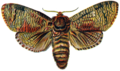
This is a large heavy moth with a wingspan of 68–96 mm. The wings are greyish brown and marked with fine dark cross lines. The moth flies from April to August depending on the location.

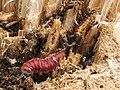
The caterpillars have a red/purple stripe across the back and a black head. They reach a length of 9–10 cm. The caterpillars feed in the trunks and branches of a wide variety of trees (see list below), taking three to five years to mature. The caterpillar holes can be found low on the stem (maximum 1.0–1.5 m above the ground). When ready to pupate the caterpillar leaves the tree to find a suitable spot.

The species prefer humid environments. Both the larva and moth have a smell reminiscent of goat, hence its name.[1]

As a food

[edit]

Pliny reported in Natural History that a grub which he gives the name cossus was considered a Roman delicacy after it was fed with flour. Some writers have equated this with Cossus cossus, but Pliny specifies that his cossus is found in oak trees, which makes this identification unlikely. Pliny's cossus is more likely to have been the larva of the beetle Cerambyx heros. [2]

Recorded food plants

[edit]

Taxonomy

[edit]

Cossus balcanicus Lederer, 1863 from Bulgaria is probably a hybrid between C. cossus and Lamellocossus terebrus (Denis & Schiffermüller, 1775).

Subspecies

[edit]
  • Cossus cossus cossus
  • Cossus cossus albescens Kitt, 1925 (Kazakhstan, Russia)
  • Cossus cossus araraticus Teich, 1896 (Georgia, Azerbaijan, Turkey, Iran)
  • Cossus cossus armeniacus Rothschild, 1912 (Turkey)
  • Cossus cossus chinensis Rothschild, 1912 (China: Shaanxi)
  • Cossus cossus dauricus Yakovlev, 2007 (Russia: Transbaikal)
  • Cossus cossus dersu Yakovlev, 2009 (Russia: southern Ussuri, Primorsky Krai)
  • Cossus cossus deserta Daniel, 1953 (Mongolia)
  • Cossus cossus gueruenensis Friedel, 1977 (Asia Minor)
  • Cossus cossus kopetdaghi Yakovlev, 2009 (Turkmenistan)
  • Cossus cossus kossai Wiltshire, 1957 (Iraq, Jordan)
  • Cossus cossus lucifer Grum-Grshimailo, 1891 (Tibet)
  • Cossus cossus mongolicus Erschoff, 1882 (Mongolia)
  • Cossus cossus omrana Wiltshire, 1957 (Iraq, Iran)
  • Cossus cossus tianshanus Hua, Chou, Fang & Chen, 1990 (Kazakhstan, Kyrgyzstan, Uzbekistan, Tajikistan, Afghanistan)
  • Cossus cossus uralicus Seitz, 1912 (Uralsk)
[edit]

References

[edit]
[edit]
Revisions and contributorsEdit on WikipediaRead on Wikipedia
from Grokipedia
Cossus cossus, commonly known as the goat moth or , is a large of wood-boring belonging to the family within the order . It features adults with a of 75–100 mm and greyish-brown wings, while its larvae are robust, pink to reddish caterpillars up to 100 mm long with a black head that bore extensively into trunks. This species exhibits a univoltine life cycle lasting 2–4 years, beginning with females laying clusters of 12–70 oval, light-brown eggs in bark crevices on the lower trunks of host trees, which hatch after about 14 days. The newly hatched larvae initially feed in the before tunneling deeper into the wood, creating galleries up to 100 cm long and 15 mm wide, overwintering multiple times and causing a characteristic vinegar-like odor from fermenting sap. Pupation occurs within a cocoon in the wood or nearby , with adults emerging to mate; the name "goat " derives from the goatskin-like scent emitted by the larvae. Native to temperate regions, C. cossus is widely distributed across , , and parts of , where it infests a variety of trees including poplars ( spp.), willows (Salix spp.), oaks (Quercus spp.), alders (Alnus spp.), and fruit trees such as apples ( spp.) and pears (Pyrus spp.). As a polyphagous pest, it poses significant threats to and orchards by weakening tree structure, reducing timber quality, and potentially killing hosts through extensive boring damage. Taxonomically, it was first described by in 1758 as Phalaena cossus and includes several , such as C. c. cossus and C. c. albescens, reflecting regional variations.

Taxonomy

Nomenclature

The binomial name of this species is Cossus cossus (Linnaeus, 1758), with the species placed in the family Cossidae. It was originally described by as Phalaena (Bombyx) cossus in the 10th edition of Systema Naturae. The type locality is , based on specimens available to Linnaeus at the time of description. Several synonyms have been proposed over time due to historical taxonomic revisions, including Onychia cossus Germar, 1810; Phalaena cossus Linnaeus, 1758; Cossus similis Herrich-Schäffer, 1851; Cossus variolosa Hübner, 1823; and Bombyx unguiculatus Fabricius, 1793. The generic name Cossus derives from the Latin term for a type of wood-boring or grub found under tree bark, reflecting the species' larval habits. This name has ancient roots, as referenced "cossus" in his (circa 77 CE) as a prepared by feeding the grubs on , esteemed in particularly among the lower classes.

Subspecies

The goat moth, Cossus cossus, exhibits significant intraspecific variation across its wide Palaearctic range, leading to the recognition of multiple based primarily on morphological traits such as wing coloration, size, and genitalia structure, as well as geographic isolation. These are distinguished in modern lepidopteran catalogs, though some have been debated or elevated to full status due to genetic and morphological evidence. Recognition criteria emphasize subtle differences in forewing patterns (e.g., intensity of dark lines and spotting), body size, and larval markings, often corroborated by molecular data in recent studies. Potential hybridization with closely related like Cossus balcanicus has been noted in overlap zones, complicating boundaries in southeastern . The following table summarizes key recognized subspecies, drawing from comprehensive taxonomic reviews. It includes representative examples highlighting geographic distributions and primary morphological distinctions; not all minor variants are listed to focus on well-established forms.
SubspeciesAuthority and YearGeographic RangeKey Morphological Differences
C. c. cossus (nominate)Linnaeus, 1758 (including , to Urals), , western to Siberia and Grayish-brown wings with distinct dark crosslines; wingspan 68–96 mm; variable polymorphism in spotting; standard genitalia with elongate transtilla processes.
C. c. albescensKitt, 1925 (, possibly )Paler wings with blurred, lighter forewing patterns; smaller overall size compared to nominate form.
C. c. chinensis, 1912Eastern (: Shandong, Shaanxi provinces; Korea, )Darker wing bases; proposed as a distinct species in some analyses due to genitalia differences, but retained as subspecies in catalogs; associated with eastern host plants.
C. c. uralicusSeitz, 1912Southern Urals, NW , ()Smaller stature; brownish wings with reduced spotting; shorter transtilla processes in male genitalia distinguishing it from western populations.
C. c. araraticusTeich, 1896 region (, , Georgia, NE , NW )Subtle variations in wing line intensity; no major genitalia differences from nominate, but geographic isolation supports subspecies status.
C. c. kossai, 1957 (, southern , , , )Gray wings with fine dark lines; minimal morphological divergence from adjacent forms, but distinct in arid-adapted populations.
C. c. tianshanusHua et al., 1990 ( mountains: , , , , NW , N )Larger size; paler dorsal markings on larvae; adapted to high-altitude steppes.
Taxonomic status remains stable for most subspecies in recent Cossidae catalogs, with C. c. cossus as the widespread nominate form extending into . However, forms like C. c. afghanistana (Daniel, 1953; ) have been elevated to full species (C. afghanistana) based on pronounced wing color differences (darker overall) and genitalia structure, while C. c. orientalis (Gaede, 1929; eastern , Korea) is now treated as a separate species (C. orientalis) due to molecular distinctions. Debated taxa, such as C. c. chinensis, highlight ongoing revisions informed by and phylogeny.

Description

Adults

The adult Cossus cossus, commonly known as the goat moth, is a robust characterized by a of 68–96 , making it one of the larger moths in its family. Males are slightly smaller than females, though is otherwise minimal. The body is stout and densely scaled, with the featuring a velvety brown-grey appearance accented by a distinctive black transversal stripe. The forewings exhibit a greyish-brown coloration, overlaid with fine, indistinct dark crosslines and subtle white flecks forming wavy patterns that provide against tree bark. In contrast, the hindwings are lighter grey-brown with darker borders and minimal additional markings, contributing to the moth's overall subdued, cryptic appearance. Males possess feathery, pectinate antennae adapted for detecting female pheromones, while females have simpler antennal structures; both sexes lack a functional , rendering the adults non-feeding and short-lived after emergence. Adults are nocturnal, exhibiting a strong, deliberate flight pattern primarily during summer months, though they are infrequently observed at light traps.

Immature Stages

The eggs of Cossus cossus are and reddish-brown, measuring approximately 1.7 mm in length. They are laid in clusters within bark crevices. The larvae exhibit a cylindrical, segmented body with a robust and wrinkled texture. Newly hatched larvae are pink, transitioning to pinkish-white or reddish-brown with yellowish sides and a darker dorsal stripe marked by a row of black spots in later stages; the head is brown to black. Fully mature larvae reach lengths of 7–10 cm, featuring three pairs of true legs, prolegs, and prominent strong mandibles adapted for wood-boring. Larvae undergo multiple instars, progressively increasing in size. The pupae are elongated and exarate, with visible appendages, measuring 4.5–6 cm in length. They are stout and reddish-brown to dark brown, flattened ventrally with a rounded dorsal region, a sharp projecting on the head, and spines on the abdominal segments. Pupation occurs in a silken cocoon within soil or under bark, lasting 2–4 weeks before adult emergence.

Distribution and Habitat

Geographic Range

Cossus cossus is native to the Palearctic region, exhibiting a broad distribution across , , and . In , the species ranges from the and westward to eastward, encompassing countries including , , , , , , , , the , and . In , it occurs from and through to . Across , the range extends from and the (including and ) through (Kazakhstan, Kyrgyzstan, Uzbekistan, Tajikistan, Turkmenistan), , , Korea, , and into (provinces such as , , and ). The is prevalent in temperate zones within its range but is absent from extreme northern latitudes, such as the northernmost parts of beyond regions like in , and from hyper-arid desert interiors. Records document its presence in urban and semi-urban settings like parks and woodlands across these areas. Since its original description by Linnaeus in 1758, the geographic range of C. cossus has remained largely stable, with no evidence of major invasive expansions; however, localized range extensions have been attributed to human activities such as trade in host plants. The species' distribution shows considerable overlap with the ranges of deciduous trees in the genus Populus, and population densities are notably higher in central European regions compared to peripheral areas. Subspecies distributions vary regionally, with forms such as C. c. afghanistanus restricted to parts of Afghanistan and adjacent areas in Asia.

Habitat Preferences

_Cossus cossus primarily inhabits deciduous woodlands, riverbanks, and damp forests, showing a strong preference for ecosystems rich in broadleaved trees such as willows, poplars, and oaks. These environments provide the necessary host plants for larval development, with the species thriving in areas characterized by high humidity and proximity to water bodies like rivers and lakes. The larvae occupy microhabitats within the trunks and heartwood of mature trees, boring tunnels under the bark where they feed and overwinter, while adults are active near host plants during in these same damp, vegetated settings. This association with humid, temperate climates is evident in its occurrence across riparian zones, wetlands, , marshes, and edges, where moist conditions support the prolonged larval stage. Optimal conditions include mild winters and wet summers, allowing for the 2-3 year life cycle, with the species tolerating altitudes up to 1,500 m in suitable forested areas. Habitat threats from significantly impact Cossus cossus by reducing mature host trees, though the species demonstrates adaptability, persisting in urban parks, gardens, hedgerows, and even quarries with sallow vegetation. Such flexibility helps mitigate losses in natural woodlands, enabling survival in modified landscapes where host plant availability remains.

Biology and Ecology

Life Cycle

The life cycle of Cossus cossus, commonly known as the goat moth, spans 2–4 years and is univoltine, producing one per year. The majority of this duration is dominated by the larval stage, which accounts for the extended development time characteristic of many cossid moths. Eggs are laid during the summer, typically in June or July, in batches of 12–70 within crevices or directly on the bark of host trees near existing damage or burrows. The egg stage lasts about 14 days, after which the young larvae hatch and begin boring into the bark. The larval stage is the longest, enduring 2–4 years, during which the caterpillars bore deeply into the wood of trunks and branches, passing through 5–8 instars. Larvae overwinter multiple times—typically 3–4—within their galleries, resuming feeding in spring. Mature larvae eventually exit the , often in late summer or autumn, to form pupation chambers. Pupation occurs in spring, from April to May, either in silken cocoons within the or in or litter nearby, lasting 2–4 weeks. The pupa measures about 45 mm in length and features a stout, flattened form with a projecting head . Adults emerge in summer, with the flight period extending from April to August and peaking in June or July, depending on local conditions. The adult stage is brief, lasting 1–2 weeks, during which moths are non-feeding and rely on larval fat reserves; they are nocturnal and rarely attracted to .

Host Plants

The larvae of Cossus cossus, known as the goat moth or carpenter moth, are highly polyphagous, feeding on the wood of over 20 species of trees and shrubs, primarily in damp or moist habitats where broadleaved trees predominate. Primary hosts include species in the genera (poplars and aspens, such as ), Salix (willows, including , , and ), and Quercus (oaks, notably ), which are favored due to their fast-growing nature and softer wood that facilitates larval boring. These preferences align with the species' in riparian zones, forests, and orchards, where larvae preferentially attack weakened or damaged trees to establish feeding galleries. Secondary hosts encompass a broader array of deciduous trees, particularly fruit and ornamental species, such as Malus domestica (apple), Prunus spp. (including cherry Prunus avium and plum Prunus domestica), Pyrus communis (pear), Alnus glutinosa (alder), Fagus sylvatica (beech), and Vitis vinifera (grapevine). Other recorded secondary hosts include Acer spp. (maples), Betula spp. (birches, such as Betula pendula and Betula pubescens), Fraxinus excelsior (ash), Juglans regia (walnut), Ulmus spp. (elms), and Tilia spp. (limes), among others like Castanea sativa (sweet chestnut) and Sorbus spp. (rowans). Larvae exhibit flexibility in host selection, often migrating between trees or within a single host, but show less affinity for slow-growing hardwoods like oak compared to softer, faster-developing species. The feeding mechanism involves young larvae initially consuming and tissue under the bark before older instars bore deep into the sapwood and heartwood, creating extensive galleries up to 100 cm long and 15–20 mm wide. This wood-boring behavior is exclusive to the larval stage, as adults do not feed upon emergence and rely solely on energy reserves from the pupal stage.

Behavior and Interactions

Adult Cossus cossus moths exhibit nocturnal behavior, with females displaying calling activity 1.5 to 2 hours after lights-off during the first 6 hours of darkness to release sex pheromones for mate attraction. The species' sex pheromone blend consists primarily of (Z)-7-tetradecenyl acetate (Z7-14:OAc) and (Z)-5-tetradecenyl acetate (Z5-14:OAc) in a 10:4 ratio, with minor components including (Z)-7-tetradecen-1-ol (Z7-14:OH) and (Z)-9-hexadecenyl acetate (Z9-16:OAc); this blend synergistically attracts males, as demonstrated by field trapping and electroantennographic responses where Z7-14:OAc elicited the strongest antennal depolarization (4.73 mV). There is no evidence of migratory behavior in C. cossus adults, which remain localized near host trees during their short adult lifespan. Larvae of C. cossus are solitary borers, each constructing individual galleries up to 100 cm long and 15 mm wide in the and sapwood of host trees, where they feed and develop over 2 to 4 years with multiple overwintering periods in the tunnels. These larvae produce a characteristic goat-like from their secretions or , which may function as a defensive chemical cue against predators. Larval waste and exuding sap from galleries create microhabitats that indirectly support other , such as feeding on the fermented liquids. In ecological interactions, C. cossus larvae serve as prey for birds, including woodpeckers that probe galleries for borers, and small mammals that access near-surface tunnels. Parasitoids, particularly ichneumonid wasps such as Lissonota setosa, target the larvae internally, laying eggs within the galleries to develop on the host. Through wood boring and production, larvae contribute to processes in webs, facilitating cycling in dead or decaying timber. Symbiotic relationships in C. cossus primarily involve , with bacteria like Bacillus circulans producing enzymes to aid digestion of lignocellulosic wood substrates, enabling nutrient extraction from otherwise indigestible material. Sensory adaptations include detection in adults via antennal receptors tuned to specific blends and production in larvae, potentially from thoracic-associated secretions, enhancing chemical communication and defense in their cryptic habitat.

Economic and Cultural Significance

As a Pest

Cossus cossus, commonly known as the goat moth, is a polyphagous wood-boring pest whose larvae cause significant damage to orchards, including apple, , and cherry trees, as well as timber species such as poplar and . The larvae create extensive galleries within trunks and branches, compromising structural integrity and often resulting in tree breakage or mortality. This pest is particularly impactful in and parts of , where it affects operations, production, and by reducing growth, yields, and timber quality, leading to notable economic losses from orchard decline and replanting needs. Heavy infestations can cause widespread tree mortality, exacerbating losses in commercial plantations. Detection of infestations relies on visual signs such as piles of (wood chips mixed with excrement) accumulating at the tree base and emergence holes measuring about 2 cm in diameter, typically located 1–1.5 m above ground level on the trunk. Additional indicators include exudation from boreholes and a strong vinegar-like from fermenting wood within the galleries. Control measures encompass cultural, chemical, and biological approaches. Sanitary practices involve removing and destroying infested wood to prevent spread. Pheromone-based strategies, including synthetic sex pheromones in delta traps at densities of 4–6 per , enable monitoring and mass trapping of adult males to disrupt mating. Insecticides can target young larvae via trunk injections or sprays, while biological options like formulations address early instars, and entomopathogenic nematodes offer potential for soil or injection applications against larvae. The pest status of C. cossus has been documented in Mediterranean regions since the 19th century, with early entomological records highlighting its damage to olive groves and fruit trees in southern Europe.

Use as Food

The larvae of Cossus cossus, known as the goat moth, have been consumed by humans primarily in historical contexts, with limited documentation of contemporary use. In ancient Rome, Pliny the Elder described the Cossus grub (the larva of a large wood-boring insect, likely Cerambyx heros but sometimes attributed to C. cossus) as a prized delicacy among the elite, which were fattened on a diet of flour and wine to enhance their tenderness and flavor before consumption. Similarly, Aristotle in ancient Greece noted that C. cossus caterpillars were roasted or boiled as a rural delicacy, prized for their sweet, nutty, and mushroom-like taste, appealing to both common folk and the affluent. In the , French entomologist Jean-Henri Fabre experimented with mature larvae (initially identified as a cerambycid but akin to Cossus in preparation), salting them to achieve a golden crispness, and found the inner flesh palatable with flavors reminiscent of roasted almonds and , supporting ancient accounts of their appeal. These historical practices highlight the larvae's role in Mediterranean diets, where they were valued for their substantial size and ease of harvesting from infested trees. Modern consumption of C. cossus larvae remains rare and poorly documented, though the species is recognized as edible in literature. Related Cossus species are noted as nutritional supplements in , Korea, and , suggesting potential for C. cossus in similar contexts, but specific uses are scarce. Preparation typically involves , , or grinding into pastes to yield a nutty flavor, aligning with historical methods. Nutritionally, C. cossus larvae are high in protein and fat, comparable to other , providing essential and minerals like iron and , which positions them as a potential sustainable amid global protein needs, though empirical data specific to this species is limited. Culturally, their use has faded in contemporary diets, overshadowed by Western aversion to , but they represent an underutilized resource in sustainable studies.

References

Add your contribution
Related Hubs
User Avatar
No comments yet.