


Community hub
Recent from talks
Contribute something
Nothing was collected or created yet.
| Elm Temporal range: Maastrichtian[1]–Recent
| |
|---|---|

| |
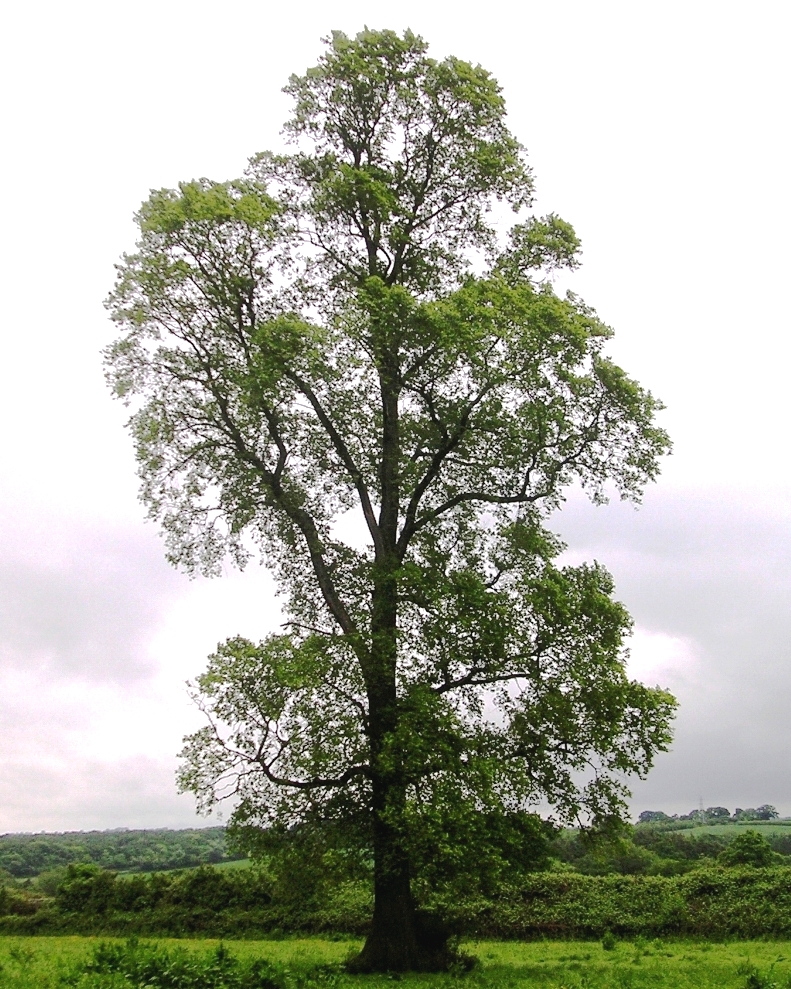
| U. minor, East Coker | |
Scientific classification 
| |
| Kingdom: | Plantae |
| Clade: | Tracheophytes |
| Clade: | Angiosperms |
| Clade: | Eudicots |
| Clade: | Rosids |
| Order: | Rosales |
| Family: | Ulmaceae |
| Genus: | Ulmus L. |
| Species | |
|
See | |
Elms are deciduous and semi-deciduous trees comprising the genus Ulmus in the family Ulmaceae. They are distributed over most of the Northern Hemisphere, inhabiting the temperate and tropical-montane regions of North America and Eurasia, ranging southward in Western Asia to Iran, in Africa to Libya, and in Southeast Asia into Indonesia.[2]
Elms are components of many kinds of natural forests. Moreover, during the 19th and early 20th centuries, many species and cultivars were also planted as ornamental street, garden, and park trees in Europe, North America, and parts of the Southern Hemisphere, notably Australasia. Some individual elms reached great size and age. However, in recent decades, most mature elms of European or North American origin have died from Dutch elm disease, caused by a microfungus dispersed by bark beetles. In response, disease-resistant cultivars have been developed, capable of restoring the elm to forestry and landscaping.
Description
[edit]The genus is hermaphroditic, having apetalous perfect flowers which are wind-pollinated. Elm leaves are alternate, with simple, single- or, most commonly, doubly serrate margins, usually asymmetric at the base and acuminate at the apex. The fruit is a round wind-dispersed samara flushed with chlorophyll, facilitating photosynthesis before the leaves emerge.[3] The samarae are very light, those of British elms numbering around 50,000 to the pound (454 g).[4] (Very rarely anomalous samarae occur with more than two wings.[5]) All species are tolerant of a wide range of soils and pH levels but, with few exceptions, demand good drainage. The elm tree can grow to great height, the American elm in excess of 30 metres (98 feet),[6] often with a forked trunk creating a vase profile.
-
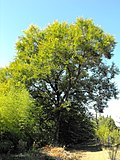 'Sapporo Autumn Gold', Antella, Florence
 -
 Wych elm (Ulmus glabra) leaves and seeds
 -
 Asymmetry of leaf, slippery elm U. rubra
 -
 Mature bark, slippery elm U. rubra
 -
 Flowers of the hybrid elm cultivar 'Columella'
 -
 Corky wings, Cedar elm, U. crassifolia
 -
 U. laciniata samara
 -
 U. americana, Dufferin St., Toronto, c. 1914
 -
 Ulmus parvifolia bark


Taxonomy
[edit]There are about 30 to 40 species of Ulmus; the ambiguity in number results from difficulty in delineating species, owing to the ease of hybridization between them and the development of local seed-sterile vegetatively propagated microspecies in some areas, mainly in the field elm (Ulmus minor) group. Oliver Rackham[7] describes Ulmus as the most critical genus in the entire British flora, adding that 'species and varieties are a distinction in the human mind rather than a measured degree of genetic variation'. Eight species are endemic to North America and three to Europe, but the greatest diversity is in Asia with approximately two dozen species.[8] The oldest fossils of Ulmus are leaves dating Paleocene, found across the Northern Hemisphere.[9]
The classification adopted in the List of elm species is largely based on that established by Brummitt.[10] A large number of synonyms have accumulated over the last three centuries; their currently accepted names can be found in the list of Elm synonyms and accepted names.
Botanists who study elms and argue over elm identification and classification are called "pteleologists", from the Greek πτελέα (elm).[11]
As part of the order Urticales, they are distantly related to cannabis, mulberries, figs, hops, and nettles.
Ecology
[edit]Propagation
[edit]
Elm propagation methods vary according to elm type and location, and the plantsman's needs. Native species may be propagated by seed. In their natural setting, native species, such as wych elm and European white elm in central and northern Europe and field elm in southern Europe, set viable seed in "favourable" seasons. Optimal conditions occur after a late warm spring.[12] After pollination, seeds of spring-flowering elms ripen and fall at the start of summer (June); they remain viable for only a few days. They are planted in sandy potting soil at a depth of 1 cm, and germinate in three weeks. Slow-germinating American elm will remain dormant until the second season.[13] Seeds from autumn-flowering elms ripen in the fall and germinate in the spring.[13] Since elms may hybridize within and between species, seed propagation entails a hybridisation risk. In unfavourable seasons, elm seeds are usually sterile. Elms outside their natural range, such as English elm U. minor 'Atinia', and elms unable to pollinate because pollen sources are genetically identical, are sterile and are propagated by vegetative reproduction. Vegetative reproduction is also used to produce genetically identical elms (clones). Methods include the winter transplanting of root suckers; taking hardwood cuttings from vigorous one-year-old shoots in late winter,[14] taking root cuttings in early spring; taking softwood cuttings in early summer;[15] grafting; ground and air layering; and micropropagation. A bottom heat of 18 °C[16] and humid conditions are maintained for hard- and softwood cuttings. The transplanting of root suckers remains the easiest and most common propagation method for European field elm and its hybrids. For specimen urban elms, grafting to wych-elm rootstock may be used to eliminate suckering or to ensure stronger root growth. The mutant-elm cultivars are usually grafted, the "weeping" elms 'Camperdown' and 'Horizontalis' at 2–3 m (7–10 ft), the dwarf cultivars 'Nana' and 'Jacqueline Hillier' at ground level. Since the Siberian elm is drought tolerant, in dry countries, new varieties of elm are often root-grafted onto this species.[17]
-
 Ripe samarae of field elm
 -
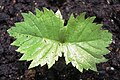 Rock elm Ulmus thomasii germinating
 -
 Seedling of wych elm U. glabra
 -
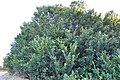 Root-suckers spreading from field elm U. minor
 -
 Root cuttings of U. 'Dodoens'
 -
 Rooted hardwood elm cutting
 -
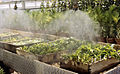 Rooting of softwood cuttings under mist
 -
 Mutant variegated smooth-leafed elm graft
 -

-
 In vitro propagation of U. chenmoui by bud meristem
 -
 Aerial roots, hybrid elm cultivar


._Royal_Terrace,_Edinburgh_(5).jpg)
Associated organisms
[edit]-
 Pouch leaf galls on a wych elm (aphid Tetraneura ulmi), Germany
 -
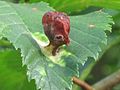 Pouch leaf gall on elm leaf (aphid T. ulmi), the Netherlands
 -
 Cockscomb leaf galls (aphid Colopha compressa), Poland
 -
 Bladder leaf galls on elm leaves (aphid Eriosoma lanuginosum), Italy
 -
 Bladder leaf galls on a narrow-leaved elm (aphid E. lanuginosum), Italy
 -
 Aphids in leaf gall, Poland
 -
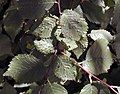 Pimple leaf galls on a field elm (mite Eriophyes ulmi), Spain
 -
 White-letter hairstreak Satyrium w-album, on Lutece, Sweden: The larvae feed only on elm.
 -
 Egg of Satyrium w-album near flower-bud of an elm
 -
 Elm-bark beetle Scolytus multistriatus (size: 2–3 mm), a vector for Dutch elm disease
 -
 Scolytus multistriatus galleries under elm bark
 -
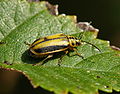 Elm-leaf beetle Xanthogaleruca luteola, which causes serious damage to elm foliage
 -
 Xanthogaleruca luteola caterpillar on elm leaf, Germany
 -
 Elm-leaf damage caused by X. luteola, Germany
 -
 Bacterial infection Erwinia carotovora of elm sap, which causes slime flux (wetwood) and staining of the trunk (here on a 'Camperdown' elm)

_gall,_Elst_(Gld),_the_Netherlands.jpg)


Pests and diseases
[edit]Dutch elm disease
[edit].jpg)
Dutch elm disease (DED) devastated elms throughout Europe and much of North America in the second half of the 20th century. It derives its name "Dutch" from the first description of the disease and its cause in the 1920s by Dutch botanists Bea Schwarz and Christina Johanna Buisman. Owing to its geographical isolation and effective quarantine enforcement, Australia has so far remained unaffected by DED, as have the provinces of Alberta and British Columbia in western Canada.
DED is caused by a microfungus transmitted by two species of Scolytus elm-bark beetles, which act as vectors. The disease affects all species of elms native to North America and Europe, but many Asiatic species have evolved antifungal genes and are resistant. Fungal spores, introduced into wounds in the tree caused by the beetles, invade the xylem or vascular system. The tree responds by producing tyloses, effectively blocking the flow from roots to leaves. Woodland trees in North America are not quite as susceptible to the disease because they usually lack the root grafting of the urban elms and are somewhat more isolated from each other. In France, inoculation with the fungus of over 300 clones of the European species failed to find a single variety that possessed of any significant resistance.
The first, less aggressive strain of the disease fungus, Ophiostoma ulmi, arrived in Europe from Asia in 1910, and was accidentally introduced to North America in 1928. It was steadily weakened by viruses in Europe and had all but disappeared by the 1940s. However, the disease had a much greater and longer-lasting impact in North America, owing to the greater susceptibility of the American elm, Ulmus americana, which masked the emergence of the second, far more virulent strain of the disease Ophiostoma novo-ulmi. It appeared in the United States sometime in the 1940s, and was originally believed to be a mutation of O. ulmi. Limited gene flow from O. ulmi to O. novo-ulmi was probably responsible for the creation of the North American subspecies O. novo-ulmi subsp. americana. It was first recognized in Britain in the early 1970s, believed to have been introduced via a cargo of Canadian rock elm destined for the boatbuilding industry, and rapidly eradicated most of the mature elms from western Europe. A second subspecies, O. novo-ulmi subsp. novo-ulmi, caused similar devastation in Eastern and Central Europe. This subspecies, which was introduced to North America, and like O. ulmi, is thought to have originated in Asia. The two subspecies have now hybridized in Europe where their ranges have overlapped.[18] The hypothesis that O. novo-ulmi arose from a hybrid of the original O. ulmi and another strain endemic to the Himalayas, Ophiostoma himal-ulmi, is now discredited.[19]
No sign indicates the current pandemic is waning, and no evidence has been found of a susceptibility of the fungus to a disease of its own caused by d-factors: naturally occurring virus-like agents that severely debilitated the original O. ulmi and reduced its sporulation.[20]
Elm phloem necrosis
[edit]Elm phloem necrosis (elm yellows) is a disease of elm trees that is spread by leafhoppers or by root grafts.[21] This very aggressive disease, with no known cure, occurs in the Eastern United States, southern Ontario in Canada, and Europe. It is caused by phytoplasmas that infect the phloem (inner bark) of the tree.[22] Infection and death of the phloem effectively girdles the tree and stops the flow of water and nutrients. The disease affects both wild-growing and cultivated trees. Occasionally, cutting the infected tree before the disease completely establishes itself and cleanup and prompt disposal of infected matter has resulted in the plant's survival via stump sprouts.
Insects
[edit]
Most serious of the elm pests is the elm leaf beetle Xanthogaleruca luteola, which can decimate foliage, although rarely with fatal results. The beetle was accidentally introduced to North America from Europe. Another unwelcome immigrant to North America is the Japanese beetle Popillia japonica. In both instances, the beetles cause far more damage in North America owing to the absence of the predators in their native lands. In Australia, introduced elm trees are sometimes used as food plants by the larvae of hepialid moths of the genus Aenetus. These burrow horizontally into the trunk then vertically down.[23][24] Circa 2000, the Asian Zig-zag sawfly Aproceros leucopoda appeared in Europe and North America, although in England, its impact has been minimal and it is no longer monitored.[25]
Birds
[edit]Sapsucker woodpeckers have a great love of young elm trees.[26]


Cultivation
[edit]

One of the earliest of ornamental elms was the ball-headed graft narvan elm, Ulmus minor 'Umbraculifera', cultivated from time immemorial in Persia as a shade tree and widely planted in cities through much of south-west and central Asia. From the 18th century to the early 20th century, elms, whether species, hybrids, or cultivars, were among the most widely planted ornamental trees in both Europe and North America. They were particularly popular as a street tree in avenue plantings in towns and cities, creating high-tunnelled effects. Their quick growth and variety of foliage and forms,[27] their tolerance of air-pollution, and the comparatively rapid decomposition of their leaf litter in the fall were further advantages.
In North America, the species most commonly planted was the American elm (U. americana), which had unique properties that made it ideal for such use - rapid growth, adaptation to a broad range of climates and soils, strong wood, resistance to wind damage, and vase-like growth habit requiring minimal pruning. In Europe, the wych elm (U. glabra) and the field elm (U. minor) were the most widely planted in the countryside, the former in northern areas including Scandinavia and northern Britain, the latter further south. The hybrid between these two, Dutch elm (U. × hollandica), occurs naturally and was also commonly planted. In much of England, the English elm later came to dominate the horticultural landscape. Most commonly planted in hedgerows, it sometimes occurred in densities over 1000/km2. In south-eastern Australia and New Zealand, large numbers of English and Dutch elms, as well as other species and cultivars, were planted as ornamentals following their introduction in the 19th century, while in northern Japan Japanese elm (U. davidiana var. japonica) was widely planted as a street tree. From about 1850 to 1920, the most prized small ornamental elm in parks and gardens was the 'Camperdown' elm (U. glabra 'Camperdownii'), a contorted, weeping cultivar of the wych elm grafted on to a nonweeping elm trunk to give a wide, spreading, and weeping fountain shape in large garden spaces.
In northern Europe, elms were among the few trees tolerant of saline deposits from sea spray, which can cause "salt-burning" and die-back. This tolerance made elms reliable both as shelterbelt trees exposed to sea wind, in particular along the coastlines of southern and western Britain[28][29] and in the Low Countries, and as trees for coastal towns and cities.[30]
This belle époque lasted until the First World War, when the elm began its slide into horticultural decline. The impact of the hostilities on Germany, the origin of at least 40 cultivars, coincided with an outbreak of the early strain of DED, Ophiostoma ulmi. The devastation caused by the Second World War, and the demise in 1944 of the huge Späth nursery in Berlin, only accelerated the process. The outbreak of the new, three times more virulent, strain of DED Ophiostoma novo-ulmi in the late 1960s, brought the tree to its nadir.
Since around 1990, the elm has enjoyed a renaissance through the successful development in North America and Europe of cultivars highly resistant to DED.[3] Consequently, the total number of named cultivars, ancient and modern, now exceeds 300, although many of the older clones, possibly over 120, have been lost to cultivation. Some of the latter, however, were by today's standards inadequately described or illustrated before the pandemic, and a number may survive, or have regenerated, unrecognised. Enthusiasm for the newer clones often remains low owing to the poor performance of earlier, supposedly disease-resistant Dutch trees released in the 1960s and 1970s. In the Netherlands, sales of elm cultivars slumped from over 56,000 in 1989 to just 6,800 in 2004,[31] whilst in the UK, only four of the new American and European releases were commercially available in 2008.

Efforts to develop DED-resistant cultivars began in the Netherlands in 1928 and continued, uninterrupted by World War II, until 1992.[33] Similar programmes were initiated in North America (1937), Italy (1978) and Spain (1986). Research has followed two paths:
Species and species cultivars
[edit]In North America, careful selection has produced a number of trees resistant not only to DED, but also to the droughts and cold winters that occur on the continent. Research in the United States has concentrated on the American elm (U. americana), resulting in the release of DED-resistant clones, notably the cultivars 'Valley Forge' and 'Jefferson'. Much work has also been done into the selection of disease-resistant Asiatic species and cultivars.[34][35]
In 1993, Mariam B. Sticklen and Mark G. Bolyard reported the results of experiments funded by the US National Park Service and conducted at Michigan State University in East Lansing that were designed to apply genetic engineering techniques to the development of DED-resistant strains of American elm trees.[36] In 2007, A. E. Newhouse and F. Schrodt of the State University of New York College of Environmental Science and Forestry in Syracuse reported that young transgenic American elm trees had shown reduced DED symptoms and normal mycorrhizal colonization.[37]
In Europe, the European white elm (U. laevis) has received much attention. While this elm has little innate resistance to DED, it is not favoured by the vector bark beetles. Thus it becomes colonized and infected only when no other elms are available, a rare situation in western Europe. Research in Spain has suggested that it may be the presence of a triterpene, alnulin, which makes the tree bark unattractive to the beetle species that spread the disease.[38] This possibility, though, has not been conclusively proven.[39] More recently, field elms Ulmus minor highly resistant to DED have been discovered in Spain, and form the basis of a major breeding programme.[40]
Hybrid cultivars
[edit]Owing to their innate resistance to DED, Asiatic species have been crossed with European species, or with other Asiatic elms, to produce trees that are both highly resistant to disease and tolerant of native climates. After a number of false dawns in the 1970s, this approach has produced a range of reliable hybrid cultivars now commercially available in North America and Europe.[41][42][43][44][45][46][47] Disease resistance is invariably carried by the female parent.[48]
Some of these cultivars, notably those with the Siberian elm (Ulmus pumila) in their ancestry, lack the forms for which the iconic American elm and English elm were prized. Moreover, several exported to northwestern Europe have proven unsuited to the maritime climate conditions there, notably because of their intolerance of anoxic conditions resulting from ponding on poorly drained soils in winter. Dutch hybridizations invariably included the Himalayan elm (Ulmus wallichiana) as a source of antifungal genes and have proven more tolerant of wet ground; they should also ultimately reach a greater size. However, the susceptibility of the cultivar 'Lobel', used as a control in Italian trials, to elm yellows has now (2014) raised a question mark over all the Dutch clones.[49]
Several highly resistant Ulmus cultivars have been released since 2000 by the Institute of Plant Protection in Florence, most commonly featuring crosses of the Dutch cultivar 'Plantijn' with the Siberian elm to produce resistant trees better adapted to the Mediterranean climate.[42]
Cautions regarding novel cultivars
[edit]Elms take many decades to grow to maturity, and as the introduction of these disease-resistant cultivars is relatively recent, their long-term performance and ultimate size and form cannot be predicted with certainty. The National Elm Trial in North America, begun in 2005, is a nationwide trial to assess strengths and weaknesses of the 19 leading cultivars raised in the US over a 10-year period; European cultivars have been excluded.[50] Meanwhile, in Europe, American and European cultivars are being assessed in field trials started in 2000 by the UK charity Butterfly Conservation.[51]
Landscaped parks
[edit]Central Park
[edit]
The oldest American elm trees in New York City's Central Park were planted in the 1860s by Frederick Law Olmsted, making them among the oldest stands of American elms in the world. Along the Mall and Literary Walk four lines of American elms stretch over the walkway forming a cathedral-like covering. A part of New York City's urban ecology, the elms improve air and water quality, reduce erosion and flooding, and decrease air temperatures during warm days.[52]
While the stand is still vulnerable to DED, in the 1980s the Central Park Conservancy undertook aggressive countermeasures such as heavy pruning and removal of extensively diseased trees. These efforts have largely been successful in saving the majority of the trees, although several are still lost each year. Younger American elms that have been planted in Central Park since the outbreak are of the DED-resistant 'Princeton' and 'Valley Forge' cultivars.[53]
National Mall
[edit]
Several rows of American elm trees that the National Park Service (NPS) first planted during the 1930s line much of the 1.9-mile-length (3.1-kilometer) of the National Mall in Washington, DC. DED first appeared on the trees during the 1950s and reached a peak in the 1970s. The NPS used a number of methods to control the epidemic, including sanitation, pruning, injecting trees with fungicide, and replanting with DED-resistant cultivars. The NPS combated the disease's local insect vector, the smaller European elm bark beetle (Scolytus multistriatus), by trapping and by spraying with insecticides. As a result, the population of American elms planted on the Mall and its surrounding areas has remained intact for more than 80 years.[54]
Uses
[edit]Wood
[edit]


Elm wood is valued for its interlocking grain, and consequent resistance to splitting, with significant uses in wagon-wheel hubs, chair seats, and coffins. The bodies of Japanese Taiko drums are often cut from the wood of old elm trees, as the wood's resistance to splitting is highly desired for nailing the skins to them, and a set of three or more is often cut from the same tree. The elm's wood bends well and distorts easily. The often long, straight trunks were favoured as a source of timber for keels in ship construction. Elm is also prized by bowyers; of the ancient bows found in Europe, a large portion are elm. During the Middle Ages, elm was also used to make longbows if yew was unavailable.
The first written references to elm occur in the Linear B lists of military equipment at Knossos in the Mycenaean period. Several of the chariots are of elm ("πτε-ρε-ϝα", pte-re-wa), and the lists twice mention wheels of elmwood.[55] Hesiod says that ploughs in Ancient Greece were also made partly of elm.[56]
The density of elm wood varies between species, but averages around 560 kg/m3.[57]
Elm wood is also resistant to decay when permanently wet, and hollowed trunks were widely used as water pipes during the medieval period in Europe. Elm was also used as piers in the construction of the original London Bridge, but this resistance to decay in water does not extend to ground contact.[57]
Viticulture
[edit]The Romans, and more recently, Italians, planted elms in vineyards as supports for vines. Lopped at 3 m, the elms' quick growth, twiggy lateral branches, light shade, and root suckering made them ideal trees for this purpose. The lopped branches were used for fodder and firewood.[58] Ovid in his Amores characterizes the elm as "loving the vine": ulmus amat vitem, vitis non deserit ulmum (the elm loves the vine, the vine does not desert the elm),[59] and the ancients spoke of the "marriage" between elm and vine.[60]
Medicinal products
[edit]The mucilaginous inner bark of the slippery elm (Ulmus rubra) has long been used as a demulcent, and is still produced commercially for this purpose in the US with approval for sale as a nutritional supplement by the Food and Drug Administration.[61]
Fodder
[edit]Elms also have a long history of cultivation for fodder, with the leafy branches cut to feed livestock. The practice continues today in the Himalaya, where it contributes to serious deforestation.[62]
Biomass
[edit]As fossil fuel resources diminish, increasing attention is being paid to trees as sources of energy. In Italy, the Istituto per la Protezione delle Piante is (2012) in the process of releasing to commerce very fast-growing elm cultivars, able to increase in height by more than 2 metres (6.6 feet) per year.[63]
Food
[edit]Elm bark, cut into strips and boiled, sustained much of the rural population of Norway during the great famine of 1812. The seeds are particularly nutritious, containing 45% crude protein, and less than 7% fibre by dry mass.[64]

Alternative medicine
[edit]Elm has been listed as one of the 38 substances that are used to prepare Bach flower remedies,[65] a kind of alternative medicine.
Bonsai
[edit]
Chinese elm (Ulmus parvifolia) is a popular choice for bonsai owing to its tolerance of severe pruning.
Genetic resource conservation
[edit]In 1997, a European Union elm project was initiated, its aim to coordinate the conservation of all the elm genetic resources of the member states and, among other things, to assess their resistance to Dutch elm disease. Accordingly, over 300 clones were selected and propagated for testing.[66][67][68]
Culture
[edit]Notable elm trees
[edit]Many elm trees of various kinds have attained great size or otherwise become particularly noteworthy.
In art
[edit]Many artists have admired elms for the ease and grace of their branching and foliage, and have painted them with sensitivity. Elms are a recurring element in the landscapes and studies of, for example, John Constable, Ferdinand Georg Waldmüller, Alfred East, George Clausen, Frederick Childe Hassam, Karel Klinkenberg,[69] and George Inness.
-
![John Constable, Elm trees in Old Hall Park, East Bergholt [1817] (Ulmus × hollandica[12])](//upload.wikimedia.org/wikipedia/commons/thumb/d/d7/Constable_-_Elm_trees_in_Old_Hall_Park%2C_East_Bergholt%2C_320-1891.jpg/120px-Constable_-_Elm_trees_in_Old_Hall_Park%2C_East_Bergholt%2C_320-1891.jpg) John Constable, Elm trees in Old Hall Park, East Bergholt [1817] (Ulmus × hollandica[12])
John Constable, Elm trees in Old Hall Park, East Bergholt [1817] (Ulmus × hollandica[12]) -
![John Constable, Study of an Elm Tree [1821]](//upload.wikimedia.org/wikipedia/commons/thumb/0/03/Constable_-_Study_of_an_Elm_Tree_-_c1821.jpeg/120px-Constable_-_Study_of_an_Elm_Tree_-_c1821.jpeg) John Constable, Study of an Elm Tree [1821]
John Constable, Study of an Elm Tree [1821] -
![John Constable, The Cornfield [1826] (Ulmus × hollandica[12])](//upload.wikimedia.org/wikipedia/commons/thumb/5/5e/John_Constable_008.jpg/120px-John_Constable_008.jpg) John Constable, The Cornfield [1826] (Ulmus × hollandica[12])
John Constable, The Cornfield [1826] (Ulmus × hollandica[12]) -
![Constable, Salisbury Cathedral from the Bishop's Garden [1823 version] (Ulmus × hollandica[12])](//upload.wikimedia.org/wikipedia/commons/thumb/f/f5/John_Constable_017.jpg/120px-John_Constable_017.jpg) Constable, Salisbury Cathedral from the Bishop's Garden [1823 version] (Ulmus × hollandica[12])
Constable, Salisbury Cathedral from the Bishop's Garden [1823 version] (Ulmus × hollandica[12]) -
![Jacob George Strutt, Elms at Mongewell, Oxfordshire [1830] (U. minor 'Atinia')](//upload.wikimedia.org/wikipedia/commons/thumb/5/52/Jacob_George_Strutt_elms.jpg/120px-Jacob_George_Strutt_elms.jpg) Jacob George Strutt, Elms at Mongewell, Oxfordshire [1830] (U. minor 'Atinia')
Jacob George Strutt, Elms at Mongewell, Oxfordshire [1830] (U. minor 'Atinia') -
![Ferdinand Georg Waldmüller, Alte Ulmen im Prater (Old Elms in Prater) [1831]](//upload.wikimedia.org/wikipedia/commons/thumb/d/d3/Waldm%C3%BCller_-_Partie_aus_dem_Prater1.jpeg/120px-Waldm%C3%BCller_-_Partie_aus_dem_Prater1.jpeg) Ferdinand Georg Waldmüller, Alte Ulmen im Prater (Old Elms in Prater) [1831]
Ferdinand Georg Waldmüller, Alte Ulmen im Prater (Old Elms in Prater) [1831] -
 James Duffield Harding, The Great Exhibition of 1851 (U. minor 'Atinia', centre)
 -
![Arthur Hughes, Home from Sea [1862] (U. minor 'Atinia'[12])](//upload.wikimedia.org/wikipedia/commons/thumb/1/10/Arthur_Hughes_-_Back_from_Sea.jpg/120px-Arthur_Hughes_-_Back_from_Sea.jpg) Arthur Hughes, Home from Sea [1862] (U. minor 'Atinia'[12])
Arthur Hughes, Home from Sea [1862] (U. minor 'Atinia'[12]) -
![Ford Madox Brown, Work [1863] (U. minor 'Atinia'[12])](//upload.wikimedia.org/wikipedia/commons/thumb/1/14/Ford_Madox_Brown_-_Work_-_artchive.com.jpg/120px-Ford_Madox_Brown_-_Work_-_artchive.com.jpg) Ford Madox Brown, Work [1863] (U. minor 'Atinia'[12])
Ford Madox Brown, Work [1863] (U. minor 'Atinia'[12]) -
![[unknown artist] The American Elm [1879] (U. americana)](//upload.wikimedia.org/wikipedia/commons/thumb/9/92/AmCyc_Elm_-_American_Elm_%28tree%29.jpg/120px-AmCyc_Elm_-_American_Elm_%28tree%29.jpg) [unknown artist] The American Elm [1879] (U. americana)
[unknown artist] The American Elm [1879] (U. americana) -
![Vincent van Gogh, Road Menders at Saint-Rémy [1889], old elms miscalled planes by the artist[70]](//upload.wikimedia.org/wikipedia/commons/thumb/d/d4/The_Large_Plane_Trees_%28Road_Menders_at_Saint-R%C3%A9my%29%2C_by_Vincent_van_Gogh%2C_Cleveland_Museum_of_Art%2C_1947.209.jpg/120px-The_Large_Plane_Trees_%28Road_Menders_at_Saint-R%C3%A9my%29%2C_by_Vincent_van_Gogh%2C_Cleveland_Museum_of_Art%2C_1947.209.jpg) Vincent van Gogh, Road Menders at Saint-Rémy [1889], old elms miscalled planes by the artist[70]
Vincent van Gogh, Road Menders at Saint-Rémy [1889], old elms miscalled planes by the artist[70] -
![Johannes Karel Christiaan Klinkenberg, Amsterdam [1890] (Ulmus x hollandica ‘Belgica' )](//upload.wikimedia.org/wikipedia/commons/thumb/0/08/Glaspalast_M%C3%BCnchen_1890_165.jpg/120px-Glaspalast_M%C3%BCnchen_1890_165.jpg) Johannes Karel Christiaan Klinkenberg, Amsterdam [1890] (Ulmus x hollandica ‘Belgica' )
Johannes Karel Christiaan Klinkenberg, Amsterdam [1890] (Ulmus x hollandica ‘Belgica' ) -
![Frederick Childe Hassam, Champs Elysées, Paris [1889] (Ulmus × hollandica, 'orme femelle'[12])](//upload.wikimedia.org/wikipedia/commons/thumb/a/a1/Childe_Hassam_-_Champs_Elys%C3%A9es%2C_Paris.JPG/120px-Childe_Hassam_-_Champs_Elys%C3%A9es%2C_Paris.JPG) Frederick Childe Hassam, Champs Elysées, Paris [1889] (Ulmus × hollandica, 'orme femelle'[12])
Frederick Childe Hassam, Champs Elysées, Paris [1889] (Ulmus × hollandica, 'orme femelle'[12]) -
![Frederick Childe Hassam, Washington Arch, Spring [1893] (U. americana)](//upload.wikimedia.org/wikipedia/commons/thumb/a/aa/Hassam_Washington_Arch_Spring.jpg/120px-Hassam_Washington_Arch_Spring.jpg) Frederick Childe Hassam, Washington Arch, Spring [1893] (U. americana)
Frederick Childe Hassam, Washington Arch, Spring [1893] (U. americana) -
![Alfred East, 'Autumn in Gloucestershire' [c.1900] (U. minor in Upper Swell)[71]](//upload.wikimedia.org/wikipedia/commons/thumb/9/95/Alfred_East_%281844-1913%29_-_Autumn_in_Gloucestershire_-_KETTKM_%2C_24_-_Kettering_Museum_and_Art_Gallery.jpg/120px-Alfred_East_%281844-1913%29_-_Autumn_in_Gloucestershire_-_KETTKM_%2C_24_-_Kettering_Museum_and_Art_Gallery.jpg) Alfred East, 'Autumn in Gloucestershire' [c.1900] (U. minor in Upper Swell)[71]
Alfred East, 'Autumn in Gloucestershire' [c.1900] (U. minor in Upper Swell)[71] -
![Frederick Childe Hassam, Church at Old Lyme [1905] (U. americana)](//upload.wikimedia.org/wikipedia/commons/thumb/a/a7/Church_at_Old_Lyme_Childe_Hassam.jpeg/120px-Church_at_Old_Lyme_Childe_Hassam.jpeg) Frederick Childe Hassam, Church at Old Lyme [1905] (U. americana)
Frederick Childe Hassam, Church at Old Lyme [1905] (U. americana) -
![Frederick Childe Hassam, The East Hampton Elms in May [1920] (U. americana)](//upload.wikimedia.org/wikipedia/commons/thumb/b/b1/Childe_Hassam%27s_1920_oil%2C_The_East_Hampton_Elms_in_May.jpg/120px-Childe_Hassam%27s_1920_oil%2C_The_East_Hampton_Elms_in_May.jpg) Frederick Childe Hassam, The East Hampton Elms in May [1920] (U. americana)
Frederick Childe Hassam, The East Hampton Elms in May [1920] (U. americana) -
 George Inness, Old Elm at Medfield (U. americana)
 -
 Unknown artist, The Cam near Trinity College, Cambridge, England (U. atinia)
![John Constable, Elm trees in Old Hall Park, East Bergholt [1817] (Ulmus × hollandica[12])](https://en.wikipedia.org/wiki/File:Constable_-_Elm_trees_in_Old_Hall_Park,_East_Bergholt,_320-1891.jpg)
![John Constable, Study of an Elm Tree [1821]](https://en.wikipedia.org/wiki/File:Constable_-_Study_of_an_Elm_Tree_-_c1821.jpeg)
![John Constable, The Cornfield [1826] (Ulmus × hollandica[12])](https://en.wikipedia.org/wiki/File:John_Constable_008.jpg)
![Constable, Salisbury Cathedral from the Bishop's Garden [1823 version] (Ulmus × hollandica[12])](https://en.wikipedia.org/wiki/File:John_Constable_017.jpg)
![Jacob George Strutt, Elms at Mongewell, Oxfordshire [1830] (U. minor 'Atinia')](https://en.wikipedia.org/wiki/File:Jacob_George_Strutt_elms.jpg)
![Ferdinand Georg Waldmüller, Alte Ulmen im Prater (Old Elms in Prater) [1831]](https://en.wikipedia.org/wiki/File:Waldm%C3%BCller_-_Partie_aus_dem_Prater1.jpeg)

![Arthur Hughes, Home from Sea [1862] (U. minor 'Atinia'[12])](https://en.wikipedia.org/wiki/File:Arthur_Hughes_-_Back_from_Sea.jpg)
![Ford Madox Brown, Work [1863] (U. minor 'Atinia'[12])](https://en.wikipedia.org/wiki/File:Ford_Madox_Brown_-_Work_-_artchive.com.jpg)
![[unknown artist] The American Elm [1879] (U. americana)](https://en.wikipedia.org/wiki/File:AmCyc_Elm_-_American_Elm_(tree).jpg)
![Vincent van Gogh, Road Menders at Saint-Rémy [1889], old elms miscalled planes by the artist[70]](https://en.wikipedia.org/wiki/File:The_Large_Plane_Trees_(Road_Menders_at_Saint-R%C3%A9my),_by_Vincent_van_Gogh,_Cleveland_Museum_of_Art,_1947.209.jpg)
![Johannes Karel Christiaan Klinkenberg, Amsterdam [1890] (Ulmus x hollandica ‘Belgica' )](https://en.wikipedia.org/wiki/File:Glaspalast_M%C3%BCnchen_1890_165.jpg)
![Frederick Childe Hassam, Champs Elysées, Paris [1889] (Ulmus × hollandica, 'orme femelle'[12])](https://en.wikipedia.org/wiki/File:Childe_Hassam_-_Champs_Elys%C3%A9es,_Paris.JPG)
![Frederick Childe Hassam, Washington Arch, Spring [1893] (U. americana)](https://en.wikipedia.org/wiki/File:Hassam_Washington_Arch_Spring.jpg)
![Alfred East, 'Autumn in Gloucestershire' [c.1900] (U. minor in Upper Swell)[71]](https://en.wikipedia.org/wiki/File:Alfred_East_(1844-1913)_-_Autumn_in_Gloucestershire_-_KETTKM_,_24_-_Kettering_Museum_and_Art_Gallery.jpg)
![Frederick Childe Hassam, Church at Old Lyme [1905] (U. americana)](https://en.wikipedia.org/wiki/File:Church_at_Old_Lyme_Childe_Hassam.jpeg)
![Frederick Childe Hassam, The East Hampton Elms in May [1920] (U. americana)](https://en.wikipedia.org/wiki/File:Childe_Hassam%27s_1920_oil,_The_East_Hampton_Elms_in_May.jpg)


In mythology and literature
[edit]
.png)
In Greek mythology, the nymph Ptelea (Πτελέα, Elm) was one of the eight hamadryads, nymphs of the forest and daughters of Oxylos and Hamadryas.[72] In his Hymn to Artemis, poet Callimachus (third century BC) tells how, at the age of three, the infant goddess Artemis practised her newly acquired silver bow and arrows, made for her by Hephaestus and the Cyclopes, by shooting first at an elm, then at an oak, before turning her aim on a wild animal:
- πρῶτον ἐπὶ πτελέην, τὸ δὲ δεύτερον ἧκας ἐπὶ δρῦν, τὸ τρίτον αὖτ᾽ ἐπὶ θῆρα.[73]
The first reference in literature to elms occurs in the Iliad. When Eetion, father of Andromache, is killed by Achilles during the Trojan War, the mountain nymphs plant elms on his tomb ("περί δὲ πτελέας ἐφύτευσαν νύμφαι ὀρεστιάδες, κoῦραι Διὸς αἰγιόχoιo").[74] Also in the Iliad, when the River Scamander, indignant at the sight of so many corpses in his water, overflows and threatens to drown Achilles, the latter grasps a branch of a great elm in an attempt to save himself ("ὁ δὲ πτελέην ἕλε χερσὶν εὐφυέα μεγάλην").[75]
The nymphs also planted elms on the tomb in the Thracian Chersonese of "great-hearted Protesilaus" ("μεγάθυμου Πρωτεσιλάου"), the first Greek to fall in the Trojan War. These elms grew to be the tallest in the known world, but when their topmost branches saw far off the ruins of Troy, they immediately withered, so great still was the bitterness of the hero buried below, who had been loved by Laodamia and slain by Hector.[76][77][78] The story is the subject of a poem by Antiphilus of Byzantium (first century AD) in the Palatine Anthology:
- Θεσσαλὲ Πρωτεσίλαε, σὲ μὲν πολὺς ᾄσεται αἰών,
- Tρoίᾳ ὀφειλoμένoυ πτώματος ἀρξάμενoν•
- σᾶμα δὲ τοι πτελέῃσι συνηρεφὲς ἀμφικoμεῦση
- Nύμφαι, ἀπεχθoμένης Ἰλίoυ ἀντιπέρας.
- Δένδρα δὲ δυσμήνιτα, καὶ ἤν ποτε τεῖχoς ἴδωσι
- Tρώϊον, αὐαλέην φυλλοχoεῦντι κόμην.
- ὅσσoς ἐν ἡρώεσσι τότ᾽ ἦν χόλoς, oὗ μέρoς ἀκμὴν
- ἐχθρὸν ἐν ἀψύχoις σώζεται ἀκρέμoσιν.[79]
- [:Thessalian Protesilaos, a long age shall sing your praises,
- Of the destined dead at Troy the first;
- Your tomb with thick-foliaged elms they covered,
- The nymphs, across the water from hated Ilion.
- Trees full of anger; and whenever that wall they see,
- Of Troy, the leaves in their upper crown wither and fall.
- So great in the heroes was the bitterness then, some of which still
- Remembers, hostile, in the soulless upper branches.]
Protesilaus had been king of Pteleos (Πτελεός) in Thessaly, which took its name from the abundant elms (πτελέoι) in the region.[80]
Elms occur often in pastoral poetry, where they symbolise the idyllic life, their shade being mentioned as a place of special coolness and peace. In the first Idyll of Theocritus (third century BC), for example, the goatherd invites the shepherd to sit "here beneath the elm" ("δεῦρ' ὑπὸ τὰν πτελέαν") and sing. Beside elms, Theocritus places "the sacred water" ("το ἱερὸν ὕδωρ") of the Springs of the Nymphs and the shrines to the nymphs.[81]

Aside from references literal and metaphorical to the elm and vine theme, the tree occurs in Latin literature in the Elm of Dreams in the Aeneid.[82] When the Sibyl of Cumae leads Aeneas down to the Underworld, one of the sights is the Stygian Elm:
- In medio ramos annosaque bracchia pandit
- ulmus opaca, ingens, quam sedem somnia vulgo
- uana tenere ferunt, foliisque sub omnibus haerent.
- [:Spreads in the midst her boughs and agéd arms
- an elm, huge, shadowy, where vain dreams, 'tis said,
- are wont to roost them, under every leaf close-clinging.]
Virgil refers to a Roman superstition (vulgo) that elms were trees of ill-omen because their fruit seemed to be of no value.[83] It has been noted[84] that two elm-motifs have arisen from classical literature: (1) the 'Paradisal Elm' motif, arising from pastoral idylls and the elm-and-vine theme, and (2) the 'Elm and Death' motif, perhaps arising from Homer's commemorative elms and Virgil's Stygian Elm. Many references to elm in European literature from the Renaissance onwards fit into one or other of these categories.
There are two examples of pteleogenesis (:birth from elms) in world myths. In Germanic and Scandinavian mythology the first woman, Embla, was fashioned from an elm,[85] while in Japanese mythology Kamuy Fuchi, the chief goddess of the Ainu people, "was born from an elm impregnated by the Possessor of the Heavens".[86]

The elm occurs frequently in English literature, one of the best known instances being in Shakespeare's A Midsummer Night's Dream, where Titania, Queen of the Fairies, addresses her beloved Nick Bottom using an elm-simile. Here, as often in the elm-and-vine motif, the elm is a masculine symbol:
- Sleep thou, and I will wind thee in my arms.
- ... the female Ivy so
- Enrings the barky fingers of the Elm.
- O, how I love thee! how I dote on thee![87]
Another of the most famous kisses in English literature, that of Paul and Helen at the start of Forster's Howards End, is stolen beneath a great wych elm.
The elm tree is also referenced in children's literature. An Elm Tree and Three Sisters by Norma Sommerdorf is a children's book about three young sisters who plant a small elm tree in their backyard.[88]
In politics
[edit]The cutting of the elm was a diplomatic altercation between the kings of France and England in 1188, during which an elm tree near Gisors in Normandy was felled.[89]
In politics, the elm is associated with revolutions. In England after the Glorious Revolution of 1688, the final victory of parliamentarians over monarchists, and the arrival from Holland, with William III and Mary II, of the Dutch elm hybrid, planting of this cultivar became a fashion among enthusiasts of the new political order.[90][91]
In the American Revolution, the Liberty Tree was an American white elm in Boston, Massachusetts, in front of which, from 1765, the first resistance meetings were held against British attempts to tax the American colonists without democratic representation. When the British, knowing that the tree was a symbol of rebellion, felled it in 1775, the Americans took to widespread Liberty Elm planting, and sewed elm symbols on to their revolutionary flags.[92][93] Elm planting by American Presidents later became something of a tradition.
In the French Revolution, too, Les arbres de la liberté (Liberty Trees), often elms, were planted as symbols of revolutionary hopes, the first in Vienne, Isère, in 1790, by a priest inspired by the Boston elm.[92] L'Orme de La Madeleine (:the Elm of La Madeleine), Faycelles, Département de Lot, planted around 1790 and surviving to this day, was a case in point.[94] By contrast, a famous Parisian elm associated with the Ancien Régime, L'Orme de Saint-Gervais in the Place St-Gervais, was felled by the revolutionaries; church authorities planted a new elm in its place in 1846, and an early 20th-century elm stands on the site today.[95] Premier Lionel Jospin, obliged by tradition to plant a tree in the garden of the Hôtel Matignon, the official residence and workplace of Prime Ministers of France, insisted on planting an elm, so-called 'tree of the Left', choosing the new disease-resistant hybrid 'Clone 762' (Ulmus 'Wanoux' = Vada).[96] In the French Republican Calendar, in use from 1792 to 1806, the 12th day of the month Ventôse (= 2 March) was officially named "jour de l'Orme", Day of the Elm.
Liberty Elms were also planted in other countries in Europe to celebrate their revolutions, an example being L'Olmo di Montepaone, L'Albero della Libertà (:the Elm of Montepaone, Liberty Tree) in Montepaone, Calabria, planted in 1799 to commemorate the founding of the democratic Parthenopean Republic, and surviving until it was brought down by a recent storm (it has since been cloned and 'replanted').[97] After the Greek Revolution of 1821–32, a thousand young elms were brought to Athens from Missolonghi, "Sacred City of the Struggle" against the Turks and scene of Lord Byron's death, and planted in 1839–40 in the National Garden.[98][99] In an ironic development, feral elms have spread and invaded the grounds of the abandoned Greek royal summer palace at Tatoi in Attica.
In a chance event linking elms and revolution, on the morning of his execution (30 January 1649), walking to the scaffold at the Palace of Whitehall, King Charles I turned to his guards and pointed out, with evident emotion, an elm near the entrance to Spring Gardens that had been planted by his brother in happier days. The tree was said to be still standing in the 1860s.[100]
-
 Planting a Liberty Tree (un arbre de la liberté) during the French Revolution. Jean-Baptiste Lesueur, 1790
 -
![Balcony with elm symbol, overlooking the 'Crossroads of the Elm', Place Saint-Gervais, Paris[95]](//upload.wikimedia.org/wikipedia/commons/thumb/0/0d/Balcony_St-Gervais.jpg/120px-Balcony_St-Gervais.jpg) Balcony with elm symbol, overlooking the 'Crossroads of the Elm', Place Saint-Gervais, Paris[95]
Balcony with elm symbol, overlooking the 'Crossroads of the Elm', Place Saint-Gervais, Paris[95] -
 President George W. Bush and Laura Bush planting a disease-resistant 'Jefferson' Elm before the White House, 2006
 -
 Elm suckers spreading before the abandoned summer royal palace in Tatoi, Greece, Μarch 2008

![Balcony with elm symbol, overlooking the 'Crossroads of the Elm', Place Saint-Gervais, Paris[95]](https://en.wikipedia.org/wiki/File:Balcony_St-Gervais.jpg)


In local history and place names
[edit]The name of what is now the London neighbourhood of Seven Sisters is derived from seven elms which stood there at the time when it was a rural area, planted a circle with a walnut tree at their centre, and traceable on maps back to 1619.[101][102]
See also
[edit]References
[edit]- ^ Kobayashi, Yoshitsugu; Takasaki, Ryuji; Kubota, Katsuhiro; Fiorillo, Anthony R. (27 April 2021). "A new basal hadrosaurid (Dinosauria: Ornithischia) from the latest Cretaceous Kita-ama Formation in Japan implies the origin of hadrosaurids". Scientific Reports. 11 (1): 8547. doi:10.1038/s41598-021-87719-5. ISSN 2045-2322. PMC 8076177. PMID 33903622.
- ^ "Plants of the World Online | Kew Science". Plants of the World Online. Retrieved 8 October 2025.
- ^ a b Heybroek, H. M., Goudzwaard, L, Kaljee, H. (2009). Iep of olm, karakterboom van de Lage Landen (:Elm, a tree with character of the Low Countries). KNNV, Uitgeverij. ISBN 9789050112819
- ^ Edlin, H. L. (1947). British Woodland Trees, p.26. 3rd. edition. London: B. T. Batsford Ltd.
- ^ J.-F. Leroy, 'Note sur quelques anomalies des fleurs et des fruits dans le genre Ulmus ', Bulletin de Muséum national d'histoire naturelle, 2nd Ser., Vol.17, p.326
- ^ Neeland, R.W. Important Forest Trees of the Eastern United States, United States Department of Agriculture Forest Service. p.68.
- ^ Rackham, Oliver (1980). Ancient woodland: its history, vegetation and uses. Edward Arnold, London
- ^ Fu, L., Xin, Y. & Whittemore, A. (2002). Ulmaceae, in Wu, Z. & Raven, P. (eds) Flora of China Archived 10 November 2006 at the Wayback Machine, Vol. 5 (Ulmaceae through Basellaceae). Science Press, Beijing, and Missouri Botanical Garden Press, St. Louis, US.
- ^ Zhang, Qiu-Yue; Huang, Jian; Jia, Lin-Bo; Su, Tao; Zhou, Zhe-Kun; Xing, Yao-Wu (December 2018). "Miocene Ulmus fossil fruits from Southwest China and their evolutionary and biogeographic implications". Review of Palaeobotany and Palynology. 259: 198–206. Bibcode:2018RPaPa.259..198Z. doi:10.1016/j.revpalbo.2018.10.007. S2CID 135184883.
- ^ Brummitt, R. K. (1992). Vascular Plant Families & Genera. Royal Botanic Garden, Kew, London, UK.
- ^ Marren, Peter, Woodland Heritage (Newton Abbot, 1990).
- ^ a b c d e f g h Richens, R. H. (1983). Elm. Cambridge University Press.
- ^ a b forestry.about.com/od/treeplanting/qt/seed_elm.htm
- ^ "Propagation: Root an Elm Tree Cutting | DoItYourself.com". Archived from the original on 3 December 2013. Retrieved 30 November 2013.
- ^ cru.cahe.wsu.edu/CEPublications/pnw0152/pnw0152.html
- ^ resistantelms.co.uk/elms/ulmus-morfeo/
- ^ Clouston, B., Stansfield, K., eds., After the Elm (London, 1979)
- ^ Webber, J. (2019). What have we learned from 100 years of Dutch Elm Disease? Quarterly Journal of Forestry. October 2019, Vol. 113, No.4, p.264-268. Royal Forestry Society, UK.
- ^ Brasier, C. M. & Mehotra, M. D. (1995). Ophiostoma himal-ulmi sp. nov., a new species of Dutch elm disease fungus endemic to the Himalayas. Mycological Research 1995, vol. 99 (2), 205–215 (44 ref.) ISSN 0953-7562. Elsevier, Oxford, UK.
- ^ Brasier, C. M. (1996). New horizons in Dutch elm disease control. Pages 20-28 in: Report on Forest Research Archived 28 June 2007 at the Wayback Machine, 1996. Forestry Commission. HMSO, London, UK.
- ^ "Elm Yellows Archived 4 October 2011 at the Wayback Machine". Elmcare.Com. 19 March 2008.
- ^ Price, Terry. "Wilt Diseases Archived 28 September 2011 at the Wayback Machine". Forestpests.Org. 23 March 2005. 19 March 2008.
- ^ Rines, George Edwin, ed. (1920). . Encyclopedia Americana.
- ^ Gilman, D. C.; Peck, H. T.; Colby, F. M., eds. (1905). . New International Encyclopedia (1st ed.). New York: Dodd, Mead.
- ^ Elm zigzag sawfly (Aproceros leucopoda)
- ^ "Sapsucker Vs Woodpecker: How To Tell The Difference". Forest Wildlife. 10 May 2022. Retrieved 1 July 2022.
- ^ Elwes, H. J. & Henry, A. (1913). The Trees of Great Britain & Ireland Archived 3 March 2016 at the Wayback Machine. Vol. VII. 1848–1929. Republished 2004 Cambridge University Press, ISBN 9781108069380
- ^ Edlin, H. L., Guide to Tree Planting and Cultivation (London, 1970), p.330, p.316
- ^ 'Salt-tolerant landscape plants', countyofdane.com/myfairlakes/A3877.pdf
- ^ dutchtrig.com/the_netherlands/the_hague.html
- ^ Hiemstra, J.A.; et al. (2007). Belang en toekomst van de iep in Nederland [Importance and future of the elm in the Netherlands]. Wageningen, Netherlands: Praktijkonderzoek Plant & Omgeving B.V. Archived from the original on 28 September 2014. Retrieved 26 October 2017.
- ^ "Elm Tree Lawn Begins New Life". Scripps College News. Scripps College. 14 April 2008. Retrieved 18 February 2021.
- ^ Burdekin, D.A.; Rushforth, K.D. (November 1996). "Elms resistant to Dutch elm disease" (PDF). Arboriculture Research Note. 2/96. Revised by J.F. Webber. Alice Holt Lodge, Farnham: Arboricultural Advisory & Information Service: 1–9. ISSN 1362-5128. Archived (PDF) from the original on 26 October 2017. Retrieved 26 October 2017.
- ^ Ware, G. (1995). Little-known elms from China: landscape tree possibilities. Journal of Arboriculture Archived 30 November 2007 at the Wayback Machine, (November 1995). International Society of Arboriculture, Champaign, Illinois, US.
- ^ Biggerstaffe, C., Iles, J. K., & Gleason, M. L. (1999). Sustainable urban landscapes: Dutch elm disease and disease-resistant elms. SUL-4, Iowa State University
- ^ Bolyard, Mark G.; Sticklen, Mariam B. (1993). "Chapter 13: Strategies for the Production of Disease-Resistant Elms". In Sticklen, Mariam B.; Sherald, James L. (eds.). Dutch Elm Disease Research: Cellular and Molecular Approaches. New York: Springer-Verlag. pp. 171–183. ISBN 9781461568728. LCCN 93017484. OCLC 851736058. Retrieved 26 December 2024 – via Google Books.
- ^ Newhouse, A. E.; Schrodt, F; Liang, H.; Maynard, C. A.; Powell, W. A. (2007). "Transgenic American elm shows reduced Dutch elm disease symptoms and normal mycorrhizal colonization". Plant Cell Rep. 26 (7): 977–987. Bibcode:2007PCelR..26..977N. doi:10.1007/s00299-007-0313-z. PMID 17310333. S2CID 21780088.
- ^ Martín-Benito D., Concepción García-Vallejo M., Pajares J. A., López D. 2005. "Triterpenes in elms in Spain Archived 28 June 2007 at the Wayback Machine". Can. J. For. Res. 35: 199–205 (2005).
- ^ Pajares, J. A., García, S., Díez, J. J., Martín, D. & García-Vallejo, M. C. 2004. "Feeding responses by Scolytus scolytus to twig bark extracts from elms Archived 7 October 2008 at the Wayback Machine". Invest Agrar: Sist Recur For. 13: 217–225.
- ^ Martín, JA; Solla, A; Venturas, M; Collada, C; Domínguez, J; Miranda, E; Fuentes, P; Burón, M; Iglesias, S; Gil, L (1 April 2015). "Seven Ulmus minor clones tolerant to Ophiostoma novo-ulmi registered as forest reproductive material in Spain". IForest - Biogeosciences and Forestry. 8 (2). Italian Society of Sivilculture and Forest Ecology (SISEF): 172–180. doi:10.3832/ifor1224-008. hdl:10662/4688. ISSN 1971-7458.
- ^ "Scientific Name: Ulmus x species" (PDF). Archived from the original (PDF) on 17 December 2008. Retrieved 26 May 2018.
- ^ a b Santini A., Fagnani A., Ferrini F., Mittempergher L., Brunetti M., Crivellaro A., Macchioni N., "Elm breeding for DED resistance, the Italian clones and their wood properties Archived 26 October 2007 at the Wayback Machine". Invest Agrar: Sist. Recur. For (2004) 13 (1), 179–184. 2004.
- ^ Santamour, J., Frank, S. & Bentz, S. (1995). Updated checklist of elm (Ulmus) cultivars for use in North America. Journal of Arboriculture, 21:3 (May 1995), 121–131. International Society of Arboriculture, Champaign, Illinois, US
- ^ Smalley, E. B. & Guries, R. P. (1993). Breeding Elms for Resistance to Dutch Elm Disease. Annual Review of Phytopathology Vol. 31 : 325–354. Palo Alto, California
- ^ Heybroek, Hans M. (1983). Burdekin, D.A. (ed.). "Resistant elms for Europe" (PDF). Forestry Commission Bulletin (Research on Dutch Elm Disease in Europe) (60). London: HMSO: 108–113. Archived (PDF) from the original on 15 February 2017.
- ^ Heybroek, H.M. (1993). "The Dutch Elm Breeding Program". In Sticklen, Mariam B.; Sherald, James L. (eds.). Dutch Elm Disease Research. New York, USA: Springer-Verlag. pp. 16–25. ISBN 978-1-4615-6874-2. Archived from the original on 26 October 2017. Retrieved 26 October 2017.
- ^ Mittempergher, L; Santini, A (2004). "The history of elm breeding" (PDF). Investigacion Agraria: Sistemas y Recursos Forestales. 13 (1): 161–177. Archived (PDF) from the original on 11 February 2017.
- ^ Martin, J., Sobrina-Plata, J., Rodriguez-Calcerrada, J., Collada, C., and Gil, L. (2018). Breeding and scientific advances in the fight against Dutch elm disease: Will they allow the use of elms in forest restoration? New Forests, 1-33. Springer Nature 2018. [1]
- ^ Mittempergher, L., (2000). Elm Yellows in Europe. In: The Elms, Conservation and Disease Management. pp. 103-119. Dunn C.P., ed. Kluwer Academic Press Publishers, Boston, USA.
- ^ (1) "National Elm Trial". Bioagricultural Sciences & Pest Management. Fort Collins, Colorado: Colorado State University College of Agricultural Sciences: Department of Agricultural Biology. 2018. Archived from the original on 30 March 2018. Retrieved 8 February 2021..
(2) Griffin, Jason J.; Jacobi, E., William R.; McPherson, Gregory; Sadof, Clifford S.; et al. (2017). "Ten-Year Performance of the United States National Elm Trial" (PDF). Arboriculture & Urban Forestry. 43 (3). International Society of Arboriculture: 107–120. doi:10.17660/ActaHortic.2018.1191.5. ISSN 0567-7572. OCLC 7347020445. Retrieved 7 February 2021. - ^ Brookes, A. H. (2013). Disease-resistant elm cultivars, Butterfly Conservation trials report, 2nd revision, 2013. Butterfly Conservation, Hants & IoW Branch, England. "Archived copy" (PDF). Archived from the original (PDF) on 29 May 2014. Retrieved 30 January 2014.
{{cite web}}: CS1 maint: archived copy as title (link) - ^ Central Park Conservancy. The Mall and Literary Walk Archived 10 May 2016 at the Wayback Machine.
- ^ Pollak, Michael. The New York Times. "Answers to Questions About New York Archived April 1, 2016, at the Wayback Machine." 11 January 2013.
- ^ Sherald, James L (December 2009). Elms for the Monumental Core: History and Management Plan (PDF). Washington, D.C.: Center for Urban Ecology, National Capital Region, National Park Service. Natural Resource Report NPS/NCR/NRR--2009/001. Archived (PDF) from the original on 29 November 2010. Retrieved 14 October 2010.
- ^ Michael Ventris and John Chadwick, Documents in Mycaenean Greek, Cambridge 1959
- ^ Hesiod, Works and Days, 435
- ^ a b Elm Archived 3 October 2012 at the Wayback Machine. Niche Timbers. Accessed 19-08-2009.
- ^ Columella, De Re Rustica
- ^ Ovid, Amores 2.16.41
- ^ Virgil, Georgica, I.2: ulmis adiungere vites (:to marry vines to elms); Horace, Epistolae 1.16.3: amicta vitibus ulmo (the elm clothed in the vine); and Catullus, Carmina, 62
- ^ Braun, Lesley; Cohen, Marc (2006). Herbs and Natural Supplements: An Evidence-Based Guide (2nd ed.). Churchill Livingstone. p. 586. ISBN 978-0-7295-3796-4., quote:"Although Slippery Elm has not been scientifically investigated, the FDA has approved it as a safe demulcent substance."
- ^ Maunder, M. (1988). Plants in Peril, 3. Ulmus wallichiana (Ulmaceae). Kew Magazine. 5(3): 137-140. Royal Botanic Garden, Kew, London.
- ^ Santini, A., Pecori, F., Pepori, A. L., Ferrini, F., Ghelardini, L. (In press). Genotype × environment interaction and growth stability of several elm clones resistant to Dutch elm disease. Forest Ecology and Management. Elsevier B. V., Netherlands.
- ^ Osborne, P. (1983). The influence of Dutch elm disease on bird population trends. Bird Study, 1983: 27-38.
- ^ D. S. Vohra (1 June 2004). Bach Flower Remedies: A Comprehensive Study. B. Jain Publishers. p. 3. ISBN 978-81-7021-271-3. Archived from the original on 31 December 2013. Retrieved 2 September 2013.
- ^ Solla, A., Bohnens, J., Collin, E., Diamandis, S., Franke, A., Gil, L., Burón, M., Santini, A., Mittempergher, L., Pinon, J., and Vanden Broeck, A. (2005). Screening European Elms for Resistance to Ophiostoma novo-ulmi. Forest Science 51(2) 2005. Society of American Foresters, Bethesda, Maryland, USA.
- ^ Pinon J., Husson C., Collin E. (2005). Susceptibility of native French elm clones to Ophiostoma novo-ulmi. Annals of Forest Science 62: 1–8
- ^ Collin, E. (2001). Elm. In Teissier du Cros (Ed.) (2001) Forest Genetic Resources Management and Conservation. France as a case study. Min. Agriculture, Bureau des Ressources Genetiques CRGF, INRA-DIC, Paris: 38–39.
- ^ Johannes Christiaan Karel Klinkenberg Archived 21 January 2012 at the Wayback Machine
- ^ Teio Meedendorp, 'Yew, Elm or Plane: Exactly Which Tree Did Van Gogh Paint?', Van Gogh Museum, Amsterdam; vangoghmuseum.nl
- ^ Mark Seddon and David Shreeve, Great British Elms (Kew Gardens, 2024), p.92
- ^ Athenaeus, Δειπνοσοφισταί, III
- ^ Callimachus, Hymn to Artemis, 120-121 [:First at an elm, and second at an oak didst thou shoot, and third again at a wild beast]. theoi.com/Text/CallimachusHymns1.html
- ^ 'and all about were elm trees planted by nymphs of the mountain, daughters of Zeus that beareth the aegis.' http://www.perseus.tufts.edu/hopper/text?doc=Perseus:text:1999.01.0134:book=6:card=414&highlight=elm Iliad, Ζ, 419–420, www.perseus.tufts.edu] Archived 26 May 2013 at the Wayback Machine
- ^ Iliad, Φ, 242–243, www.perseus.tufts.edu Archived 26 May 2013 at the Wayback Machine
- ^ Philostratus, ̔Ηρωικός, 3,1 perseus.tufts.edu/hopper/text?doc=Perseus%3Atext%3A2008.01.0597%3Aolpage%3D672
- ^ Quintus Smyrnaeus, Τα μεθ' `Ομηρον, 7.458–462
- ^ Pliny the Elder, Naturalis Historia, 16.88
- ^ Anth. Pal., 7.141
- ^ Lucas, F. L., From Olympus to the Styx (London, 1934)
- ^ Theocritus, Eιδύλλιo I, 19–23; VII, 135–40
- ^ Vergil, Aeneid, VI. 282–5
- ^ Richens, R. H., Elm (Cambridge 1983) p.155
- ^ Richens, R. H., Elm, Ch.10 (Cambridge, 1983)
- ^ Heybroek, H. M., 'Resistant Elms for Europe' (1982) in Research on Dutch Elm Disease in Europe, HMSO, London 1983
- ^ Wilkinson, Gerald, Epitaph for the Elm (London, 1978), p.87
- ^ Shakespeare, A Midsummer Night's Dream, Act 4, Scene 1
- ^ Janssen, Carolyn. "An elm tree and three sisters (Book Review)". ebscohost. Retrieved 21 September 2012.
- ^ "Priory of Sion". Crystalinks. Retrieved 15 March 2020.
- ^ Rackham, O. (1976). Trees and Woodland in the British Landscape J. M. Dent, London.
- ^ Armstrong, J. V.; Sell, P. D. (1996). "A revision of the British elms (Ulmus L., Ulmaceae): the historical background". Botanical Journal of the Linnean Society. 120: 39–50. doi:10.1111/j.1095-8339.1996.tb00478.x. Archived from the original on 26 October 2017. Retrieved 26 October 2017.
- ^ a b Richens, Elm (Cambridge, 1983)
- ^ elmcare.com/about_elms/history/liberty_elm_boston.htm
- ^ L'Orme de La Madeleine, giuseppemusolino.it Archived 26 February 2014 at the Wayback Machine
- ^ a b L'Orme de St-Gervais: biographie d'un arbre, www.paris.fr Archived 6 September 2013 at the Wayback Machine
- ^ Ulmus 'Wanoux' (Vada)) freeimagefinder.com/detail/6945514690.html
- ^ calabriaonline.com Archived 30 May 2013 at the Wayback Machine
- ^ Ο μοναδικός Εθνικός μας Κήπος, paidevo.gr/teachers/?p=859
- ^ Νίκος Μπελαβίλας, ΜΥΘΟΙ ΚΑΙ ΠΡΑΓΜΑΤΙΚΟΤΗΤΕΣ ΓΙΑ ΤΟ ΜΗΤΡΟΠΟΛΙΤΙΚΟ ΠΑΡΚΟ ΕΛΛΗΝΙΚΟΥ, courses.arch.ntua.gr/fsr/112047/Nikos_Belavilas-Mythoi_kai_Pragmatikotites
- ^ Elizabeth and Mary Kirby, Talks about Trees: a popular account of their nature and uses, 3rd edn., p.97-98 (1st edn. titled Chapters on Trees: a popular account of their nature and uses, London, 1873)
- ^ Tottenham: Growth before 1850', A History of the County of Middlesex: Volume 5: Hendon, Kingsbury, Great Stanmore, Little Stanmore, Edmonton Enfield, Monken Hadley, South Mimms, Tottenham (1976)
- ^ "London Gardens Online". www.londongardensonline.org.uk. Archived from the original on 27 January 2018. Retrieved 26 January 2018.
Monographs
[edit]- Richens, R. H. (1983). Elm. Cambridge University Press. ISBN 0-521-24916-3. A scientific, historical and cultural study, with a thesis on elm-classification, followed by a systematic survey of elms in England, region by region. Illustrated.
- Heybroek, H. M., Goudzwaard, L, Kaljee, H. (2009). Iep of olm, karakterboom van de Lage Landen (:Elm, a tree with character of the Low Countries). KNNV, Uitgeverij. ISBN 9789050112819. A history of elm planting in the Netherlands, concluding with a 40 – page illustrated review of all the DED – resistant cultivars in commerce in 2009.
Further reading
[edit]- Clouston, B.; Stansfield, K., eds. (1979). After the Elm. London: Heinemann. ISBN 0-434-13900-9. A general introduction, with a history of Dutch elm disease and proposals for re-landscaping in the aftermath of the pandemic. Illustrated.
- Coleman, M., ed. (2009). Wych Elm. Edinburgh. ISBN 978-1-906129-21-7.
{{cite book}}: CS1 maint: location missing publisher (link) A study of the species, with particular reference to the wych elm in Scotland and its use by craftsmen. - Dunn, Christopher P. (2000). The Elms: Breeding, Conservation, and Disease-Management. New York: Boston, Mass. Kluwer academic. ISBN 0-7923-7724-9.
- Wilkinson, G. (1978). Epitaph for the Elm. London: Hutchinson. ISBN 0-09-921280-3. A photographic and pictorial celebration and general introduction.
External links
[edit]
- "Elm trials". Northern Arizona University.
- Tree Family Ulmaceae Archived 4 January 2015 at the Wayback Machine Diagnostic photos of Elm species at the Morton Arboretum
- "Late 19th and early 20th-century photos of Elm species in Elwes & Henry's Trees of Great Britain & Ireland, v. 7" (PDF). 1913. Archived from the original (PDF) on 3 March 2016. Retrieved 18 February 2008.
- "Elm Photo Gallery".
- Eichhorn, Markus (May 2010). "Elm – The Tree of Death". Test Tube. Brady Haran for the University of Nottingham.
 Texts on Wikisource:
- . Encyclopædia Britannica. Vol. VIII (9th ed.). 1878. p. 151.
- "Elm". The American Cyclopædia. Vol. 6. 1879.
- "Elm". New International Encyclopedia. 1905.
- "Elm". Encyclopædia Britannica (11th ed.). 1911.
- "Elm". Encyclopedia Americana. 1920.
- "Elm". Collier's New Encyclopedia. 1921.


| International | |
|---|---|
| National | |
| Other | |

Description and Morphology
Physical Characteristics
Elms comprise deciduous or semi-deciduous trees in the genus Ulmus, typically reaching heights of 15 to 40 meters, with trunk diameters up to 2 meters in mature specimens, though sizes vary by species and habitat.[7][8] Many species exhibit a vase-shaped or umbrella-like crown formed by ascending branches that spread outward, supported by a straight central trunk.[7] Twigs are slender, often pubescent when young, and some species develop corky wings on younger branches.[9] The bark is generally gray to dark brown, developing deep furrows with intersecting ridges or diamond-shaped patterns as the tree ages, providing a distinctive textured appearance.[7] Inner bark in certain species, such as slippery elm (U. rubra), is mucilaginous when moistened.[8] Leaves are alternate, simple, ovate to elliptic, measuring 5 to 15 cm in length, with doubly serrate margins and characteristically asymmetrical bases, a diagnostic trait for the genus; the upper surface is rough to the touch in many species, while the underside may be pubescent.[7][10] Flowers are small and inconspicuous, typically greenish-red or purplish, borne in drooping clusters or fascicles of 3 to 10, emerging in late winter or early spring before leaf expansion; they are wind-pollinated and lack petals, consisting of a calyx and 4-9 stamens.[7] The fruit is a single-seeded samara, flat and elliptic to obovate, 1 to 2 cm long, with a papery wing surrounding the seed, maturing in spring and dispersing by wind.[7]Growth and Lifecycle
Elms (genus Ulmus) exhibit a lifecycle characterized by rapid juvenile growth, early reproductive maturity, and potential longevity exceeding two centuries in undisturbed conditions. Flowering occurs in early spring, typically 2-3 weeks before leaf flush, with inconspicuous wind-pollinated flowers producing samaras that mature and disperse within weeks.[11] For U. americana, seed production commences as early as age 15, becoming abundant after age 40, with trees remaining productive up to 300 years.[11] Across species, reproductive maturity varies from 8 years in U. pumila to 30-40 years in U. glabra.[12] Samaras, containing single seeds, are wind-dispersed up to 0.4 km and exhibit minimal dormancy; germination is epigeal and rapid, peaking in 6-12 days for U. americana under alternating temperatures of 20°C night/30°C day, with viability persisting on flooded soils for a month.[11] [12] Most Ulmus species require no pretreatment, though U. americana and U. rubra benefit from 2-3 months cold stratification; full germination may extend to 60 days.[12] Seedlings establish best in partial sunlight (one-third full exposure) initially, transitioning to full sun after 1-2 years, and develop slowly in saturated or shaded soils.[11] Juvenile elms demonstrate vigorous growth, with U. americana achieving 30-38 m height and 122-152 cm diameter at breast height on optimal sites, classified as fast to moderate overall.[11] [7] Rock elm (U. thomasii) seedlings reach 27 cm in 5 years and 52 cm in 10 years post-planting.[12] Vegetative propagation via stump sprouting is common in young trees, with root suckering in dense stands, enabling persistence post-disturbance.[11] Maturity brings canopy dominance in early-successional habitats, though growth slows in sapling-to-pole stages for species like U. rubra.[8] Lifespan ranges from 175-200 years typically, with exceptional individuals surpassing 300 years; factors like site quality and pathogen absence dictate duration, as elms invest in height and breadth for light capture before prioritizing reproduction.[11] Annual cycles involve winter dormancy, spring flush and reproduction, summer vegetative expansion, and autumn senescence, with seed crops recurring every 2-4 years.[12] Senescence accelerates under stress, but healthy specimens sustain multi-century lifecycles through iterative sprouting and seeding.[11]Taxonomy and Phylogeny
Classification and Species
The genus Ulmus L., commonly known as elm, is placed in the family Ulmaceae Mirbel, order Rosales, class Magnoliopsida (flowering plants), phylum Tracheophyta, kingdom Plantae.[13][14] This classification reflects molecular and morphological analyses confirming Ulmaceae's position within Rosales, distinct from related families like Cannabaceae or Moraceae based on floral and fruit characteristics such as apetalous flowers and samara fruits.[15] The genus encompasses 20 to 45 species of mostly deciduous trees, with the range arising from ongoing taxonomic revisions driven by extensive hybridization, which blurs species boundaries through intermediate forms and gene flow.[16] The Plants of the World Online database accepts 37 species as of its latest compilation, prioritizing nomenclatural stability and phylogenetic evidence from DNA sequencing.[14] Species are often divided into subgenera such as Ulmus (with typically asymmetrical leaf bases) and Orya (symmetrical leaves), though sectional delimitations remain debated due to convergent evolution in traits like leaf serration and bark texture.[16] Key accepted species include:- Ulmus americana L. (American elm), characterized by large, vase-shaped crowns and serrated leaves up to 15 cm long.[13]
- Ulmus rubra Muhlenberg (slippery elm), distinguished by mucilaginous inner bark and asymmetrical leaves.[13]
- Ulmus thomasii Sarg. (rock elm), with corky wings on branches and doubly serrated leaves.[13]
- Ulmus alata Michaux (winged elm), featuring prominent corky ridges on twigs.[13]
- Ulmus crassifolia Nuttall (cedar elm), noted for small, thick leaves and early autumn coloration.[13]
- Ulmus glabra Hudson (wych elm), with large, rounded leaves and no corky wings.[16]
- Ulmus minor J. Miller (field elm), exhibiting variable leaf shapes and tolerance to wet soils.[16]
- Ulmus procera Salisbury (English elm), often clonal via root suckering with upright branches.[16]
- Ulmus pumila L. (Siberian elm), fast-growing with small leaves and invasive potential outside native range.[16]
- Ulmus parvifolia Jacquin (Chinese elm), semi-evergreen with exfoliating bark and heat tolerance.[16]
Evolutionary History
The genus Ulmus first appears in the fossil record during the early Eocene epoch, approximately 50 million years ago, represented by leaf and fruit impressions from deposits in China.[15] These early fossils indicate an Asian origin for the genus, with subsequent dispersal to North America evidenced by middle to late Eocene specimens of leaves and fruits from northwestern regions.[15] The broader Ulmaceae family, encompassing Ulmus, exhibits a more ancient lineage, with macrofossils from the early Paleocene (~66-56 million years ago) across the Northern Hemisphere and molecular clock estimates placing its crown group diversification in the Early Cretaceous (ca. 110-125 million years ago).[17][15] Diversification of Ulmus species accelerated during the Miocene epoch (23-5 million years ago), a period marked by the proliferation of temperate deciduous forests amid global cooling and tectonic uplift in Eurasia and North America.[18] Fossil fruits and woods from Miocene strata in Southwest China and other Northern Hemisphere sites document this radiation, with diversity peaking before a Pliocene-Quaternary decline linked to aridification, glaciation, and habitat fragmentation.[19][18] Biogeographic centers of endemism emerged in eastern Asia (particularly China) and the southeastern United States, reflecting vicariance and long-distance dispersal facilitated by winged samaras.[15] Molecular phylogenetic analyses, incorporating phylogenomics, chloroplast genomes, and nuclear markers, delineate Ulmus into clades aligned with continental distributions—Eurasian and North American— with intraspecific divergences often dated to the late Miocene-Pliocene transition (ca. 5-6 million years ago).[20][17] These studies corroborate fossil evidence of adaptive radiations in response to climatic oscillations, including the evolution of traits like asymmetric leaves and corky bark for temperate resilience, though ongoing refinements in dating and sampling continue to refine interclade relationships.[15]Distribution and Ecology
Geographic Range
The genus Ulmus encompasses 20–40 species native predominantly to the temperate zones of the Northern Hemisphere, with concentrations in Eurasia and extensions into North America; some taxa extend into subtropical and montane tropical areas.[21] Highest species diversity occurs in eastern Asia, particularly China, where endemics such as U. chenmoui and U. prunasepala are restricted to specific provinces, alongside widespread species like U. parvifolia (native to central and southern China, Korea, Japan, Taiwan, and Vietnam).[15] In western and central Asia, U. pumila spans a vast area from eastern Siberia and Mongolia westward to the Caucasus, including northern India, Tibet, and northern Iran, thriving in arid steppes and river valleys. Himalayan species such as U. wallichiana occupy elevations from 1,000 to 3,300 meters across Afghanistan, Pakistan, India, and Nepal.[15] In Europe, three primary native species dominate: Ulmus glabra (wych elm), with the broadest distribution from Ireland eastward to the Ural Mountains and from the Arctic Circle south to the Caucasus; U. minor (field elm), common in western and southern Europe including the Mediterranean basin; and U. laevis (European white elm), centered in central and eastern Europe along rivers and floodplains from France to Russia.[21] [22] These species favor riparian and woodland habitats, though their ranges have been fragmented by historical deforestation and disease. North American natives are concentrated in the eastern and central United States and adjacent Canada, with U. americana (American elm) extending from Nova Scotia and New Brunswick westward to Alberta and eastern Montana, southward to Florida and central Texas, often in floodplains and bottomlands.[11] Other eastern species include U. rubra (slippery elm) in similar ranges from Quebec to northern Florida and Texas, and U. thomasii (rock elm) in northern hardwoods from New Brunswick to Minnesota and south to Tennessee.[23] Southern extensions feature U. crassifolia (cedar elm) in Texas and Oklahoma, while Mexican species like U. mexicana occur in northeastern Mexico and adjacent southwestern U.S. borders. Isolated populations and hybrids reflect post-glacial migrations, but many ranges overlap in riparian zones.[24]Habitat and Environmental Adaptations
Elms of the genus Ulmus primarily inhabit temperate regions across the Northern Hemisphere, favoring riparian zones, floodplains, river valleys, and moist forest edges where fertile soils support rapid growth.[15] Species such as U. americana (American elm) commonly occupy bottomlands and terraces with clay or silty-clay loams, achieving medium growth on wetter sites and optimal development on well-drained uplands.[25] In Europe, U. minor (field elm) and U. glabra (wych elm) associate with lowland woodlands and alluvial soils, often along watercourses that provide seasonal moisture.[26] These habitats reflect elms' ecological role in stabilizing sediments and filtering runoff in dynamic fluvial environments.[27] Elms demonstrate versatile adaptations to soil variability, tolerating textures from clay and loam to sand, and pH extremes including alkaline conditions, as seen in U. parvifolia (Chinese elm).[28] Shallow root systems in wet soils enable widespread lateral spread for anchorage, conferring windfirmness despite reduced depth, a trait prominent in U. americana.[11] Many species exhibit moderate flood tolerance, enduring infrequent, short-duration inundation—up to several weeks in U. americana—via physiological mechanisms that mitigate anaerobic stress in saturated roots.[29] However, prolonged waterlogging can impair growth, underscoring limits to this adaptation. Drought resistance varies across species and populations, with U. americana and U. parvifolia showing reasonable tolerance through efficient water-use strategies and deep rooting in drier contexts, though U. minor proves vulnerable, experiencing heightened stress and susceptibility to secondary pathogens under deficit conditions.[11][30] Climatic adaptations include local genetic variation for cold hardiness; genotypes from northern latitudes in U. americana exhibit greater mid-winter tolerance, reflecting evolutionary tuning to regional temperature gradients via traits like enhanced freezing resistance in xylem tissues.[31] Such plasticity supports elms' persistence in transitional zones but highlights species-specific constraints amid intensifying environmental variability.[32]Reproduction and Population Dynamics
Elms in the genus Ulmus primarily reproduce sexually through wind-pollinated flowers that emerge in early spring before leaf expansion, with most species being monoecious and producing both staminate and pistillate flowers in small clusters.[12] Pollination occurs exclusively via anemophily, with effective pollen dispersal limited to short distances averaging around 50 meters, as demonstrated in studies of U. minor.[33] Following pollination, female flowers develop into single-seeded samaras—winged achenes—that ripen within a few weeks and are primarily dispersed by wind over short ranges, typically less than 30 meters in species like U. laevis.[34] [12] Samaras exhibit orthodox storage behavior in some species, maintaining viability for up to 5 years at low temperatures (1-3°C), though germination rates decline thereafter, with fresh seeds showing 90-100% viability in tests of U. thomasii.[12] [23] Germination requires cold stratification in many cases and occurs rapidly upon dispersal in spring, but seeds remain viable only for days to weeks post-maturity unless conditions are optimal, limiting long-term seed bank persistence.[35] Seedling establishment can be abundant under favorable moist, shaded conditions, yet success is constrained by herbivory, competition, and pathogen exposure.[35] Vegetative reproduction via root suckering is prevalent, particularly in European species like field elm (U. minor), where adventitious shoots arise from lateral roots, enabling clonal spread and persistence of genotypes even after bole death.[36] This mode forms dense thickets and maintains population structure through ramets connected to a shared root system, with suckers capable of developing into mature trees.[37] Population dynamics of elms are characterized by episodic regeneration cycles influenced heavily by Dutch elm disease (Ophiostoma novo-ulmi), which has reduced mature tree densities by over 90% in affected North American and European landscapes since the 1970s, shifting reliance toward juvenile cohorts from suckers and seedlings.[38] In unmanaged stands, such as those of wych elm (U. glabra), disease-induced mortality promotes clonal proliferation via suckering, leading to reduced genetic diversity over decades as sexual recruitment declines relative to vegetative regrowth.[39] This results in patchy distributions with high sucker densities near parent clones but vulnerability to synchronous die-off, as ramets inherit susceptibility; however, heterogeneous landscapes foster pockets of persistence through variable disease pressure and occasional seedling input from surviving reproductives.[38] Restoration efforts emphasize propagating disease-resistant genotypes to bolster sexual reproduction and diversify populations beyond clonal dominance.[40]Interactions with Other Organisms
Elms are wind-pollinated (anemophilous), producing small, clustered flowers in early spring that release large quantities of lightweight pollen dispersed by air currents, enabling cross-pollination across populations.[41] Although animal vectors are not essential, honey bees and select native bees forage on this pollen, utilizing it as an early-season protein source amid limited floral alternatives.[42][43] Species in the genus Ulmus form mutualistic associations with arbuscular mycorrhizal fungi (Glomeromycotina), which colonize roots to facilitate phosphorus and other nutrient acquisition from soil, enhancing seedling establishment and drought resilience.[44] Inoculation experiments with Ulmus parvifolia have shown AMF symbiosis increases biomass and alleviates salt stress effects, underscoring its role in soil microbial networks.[44] Urban studies of hybrid elms like U. × hollandica confirm persistent AMF communities along urbanization gradients, linking fungal diversity to tree health.[45] Foliage and twigs support diverse non-pest invertebrate communities, with over 500 North American insect species utilizing elms for feeding, reproduction, or hibernation; notable examples include elm-specialist lepidopteran larvae such as the double-toothed prominent moth (Phlogophora iris).[3] Leaves, characterized by low carbon-to-nitrogen ratios and elevated pH, are palatable to browsing vertebrates, historically harvested as livestock forage in Europe and North America.[3] Samaras, maturing abundantly in late spring, function as soft mast, furnishing essential nutrition for granivorous birds (e.g., cardinals) and small mammals (e.g., squirrels, chipmunks) during seasonal food scarcity.[3][42] In floodplain habitats, this seed crop bolsters early breeding populations of seed-dependent species.[3] The branching architecture offers nesting substrates for songbirds and refuge for canopy-dwelling arthropods, while submerged logs in riparian zones provide durable woody debris for aquatic macroinvertebrates due to elm's decay resistance.[3][42] In temperate forests, early leaf-out supports migratory passerines during spring stopovers, integrating elms into broader trophic dynamics.[3]Threats and Pathogens
Dutch Elm Disease
Dutch elm disease (DED) is a lethal vascular wilt disease primarily affecting elm trees in the genus Ulmus, caused by the ascomycete fungi Ophiostoma ulmi and the more virulent Ophiostoma novo-ulmi.[46][37] The fungi invade the tree's xylem vessels, producing mycelia and toxins that block water conduction, leading to wilting and eventual death.[46] American elm (U. americana) is highly susceptible, while species like Siberian elm (U. pumila) show greater tolerance.[47] Symptoms typically emerge in early summer, beginning with wilting and yellowing of leaves on one or more outer crown branches, progressing to browning and curling while leaves remain attached to stems—a phenomenon known as "flagging."[46][48] Internal diagnostic signs include dark streaking in the sapwood under the bark, visible upon peeling, confirming fungal invasion.[49] Infected trees may die within a single growing season if symptoms appear early, or decline over 1–3 years if infection occurs later.[46] The pathogens spread via elm bark beetles (Scolytus spp.), which carry fungal spores from overwintering galleries in infected wood to feeding sites on healthy twigs, inoculating the tree during the adult beetle's spring emergence.[50] Root grafts between adjacent elms enable belowground transmission over distances up to 30 meters, amplifying local outbreaks.[51] Human activities, such as moving untreated firewood or logs, further disseminate the fungus.[47] Originating in Asia, DED was first documented in northwest Europe around 1910, with significant research in the Netherlands from 1914–1919 identifying the fungal cause.[52] It reached the United States in the 1930s via imported elm logs from Europe, sparking epidemics that spread eastward from New Jersey and westward to the Pacific Coast by 1973.[53] A second, more destructive wave in the 1960s–1970s, driven by O. novo-ulmi, intensified mortality across North America and Europe.[37] The disease has killed over 40 million American elms in the U.S. alone, representing more than 75% of urban and forest populations in affected areas, and approximately 30 million elms in the UK during the 1970s outbreak.[53][54] European losses from the initial epidemic reached 10–40% in multiple countries by the 1940s.[37] Ecologically, it altered forest canopies, reduced biodiversity dependent on elms, and reshaped urban landscapes where elms were dominant street trees.[5] Management relies on sanitation—prompt removal and destruction (burning, chipping, or debarking) of infected trees to eliminate beetle breeding sites and break transmission cycles—which is the most effective and cost-efficient strategy when implemented community-wide.[55][56] Trenching to depths of 1–1.5 meters severs root grafts between healthy and infected trees.[51] Insecticides targeting beetles, such as carbaryl sprays or systemic injections, provide short-term suppression but require annual reapplication.[55] Preventive fungicide injections (e.g., propiconazole or thiabendazole) can protect high-value trees for 1–3 years but are expensive, labor-intensive, and ineffective for trees with >5% canopy infection. Planting resistant elm cultivars or hybrids offers long-term resilience, though no method eradicates the pathogen entirely.[57]Other Diseases and Phytoplasma
Verticillium wilt, caused by the soilborne fungi Verticillium dahliae and V. albo-atrum, affects elms by invading the vascular system, leading to wilting and yellowing of leaves on individual branches or the entire crown, often with vascular discoloration appearing as brown streaks in the sapwood.[58] Symptoms typically emerge in spring or early summer, progressing to branch dieback, and infected trees may survive but remain weakened, with mortality rates varying by species and environmental stress.[59] The pathogen persists in soil for years via microsclerotia, and no effective chemical controls exist, though resistant cultivars like certain Asian elms show reduced susceptibility.[58] Canker diseases, induced by fungi such as Neofabraea ulmi or Physalospora ulmi, produce sunken, discolored lesions on branches and trunks, often following wounds, resulting in dieback and gum exudation.[59] These infections are more prevalent in stressed trees and can girdle branches, but they are generally less lethal than vascular wilts, managed through pruning and sanitation.[59] Elm yellows, also known as elm phloem necrosis, represents a severe phytoplasma disease caused by 'Candidatus Phytoplasma ulmi', a wall-less, phloem-limited bacterium that disrupts nutrient transport by necrosing the inner phloem, which turns yellowish-brown to caramel-colored.[60] [61] Symptoms initiate in mid- to late summer with chlorosis, epinasty (downward curling) of leaves, premature defoliation, and branch dieback, culminating in tree death within one to two years for susceptible species like Ulmus americana.[62] [58] The pathogen is vectored primarily by the elm leafhopper (Scaphoideus luteus in Europe, Scaphytopius luteolus in North America), with transmission occurring during feeding on phloem sap, and root grafts between trees facilitating spread.[63] [64] First documented in the United States in the 1930s, elm yellows has caused significant mortality in the eastern U.S. and parts of Europe, though underreported due to symptom overlap with Dutch elm disease.[63] [64] No curative treatments are available; confirmed infections require immediate tree removal and destruction to prevent vector transmission, with PCR-based diagnostics essential for accurate identification given the pathogen's quarantine status in the European Union.[61] [63] Asian elm species exhibit partial resistance, informing breeding efforts.[65]Insect and Vertebrate Pests
Elm trees face damage from various insect pests, primarily defoliators and sap feeders, which can weaken trees through foliage loss or physiological stress. The elm leaf beetle (Xanthogaleruca luteola), an invasive species from Europe, is a major defoliator; its larvae skeletonize leaves by feeding on the lower surface between veins, causing brown, lacy foliage that may drop prematurely, while adults chew irregular round holes.[66][67] Repeated defoliation over years reduces tree vigor, branch dieback, and growth, though single-year outbreaks rarely kill mature trees.[68][69] Sap-feeding insects, including aphids and scales, induce curling, galls, or sooty mold from honeydew excretion. Aphids such as the woolly elm aphid (Eriosoma spp.) and elm sack gall aphid (Tetraneura ulmi) cause leaf rolling or pouch-like galls, with limited direct damage but potential for secondary issues like reduced photosynthesis.[70][71] European elm scale (Eulccanium tiliae) and calico scale suck sap from twigs and branches, leading to yellowed leaves, premature drop, and dieback in heavy infestations.[72][73] Bark beetles (Scolytus spp.), including the European and native elm bark beetles, bore into phloem, creating galleries that girdle branches and weaken trees, though their impact is often compounded by disease transmission elsewhere documented.[74] Other occasional pests include Japanese beetles, gypsy moths, and leafminers, which contribute to foliage loss but are not elm-specific.[75] Vertebrate pests of elms are less commonly reported and typically affect young or stressed trees through browsing or girdling, with deer (Odocoileus spp.) occasionally consuming foliage or rubbing antlers against bark, causing wounds that invite secondary infections.[76] Squirrels may chew bark or consume seeds, but such damage remains minor compared to insect impacts in most ecosystems.[77] Overall, vertebrate herbivory does not pose a widespread threat to established elms.Abiotic Stressors Including Climate Impacts
Elms exhibit varying degrees of tolerance to abiotic stressors, with drought being a primary limiter of growth and survival across species. Riparian field elm (Ulmus minor) demonstrates sensitivity to drought, particularly under spring dry-warm conditions and reduced river flows, leading to decreased radial growth and elevated wood δ¹³C values indicative of water stress.[30] Saplings of this species respond acutely to short-term drought, with declines in leaf water potential, net photosynthesis, and stomatal conductance as key physiological indicators.[78] Siberian elm (Ulmus pumila) varieties from arid regions show intraspecific variation in drought tolerance, assessed through morphological, physiological, and transcriptional responses, where provenances from severe drought zones maintain higher survival rates via enhanced osmotic adjustment and antioxidant activity.[79] Such stress often exacerbates biotic vulnerabilities, as water-deficient or compacted soils increase susceptibility to Dutch elm disease in multiple Ulmus species.[80] Flooding represents another significant stressor, though some elms adapted to wetland margins exhibit partial resilience. U. minor displays functional adjustments to prolonged flooding, including altered root aeration and nutrient uptake, but prolonged submersion reduces overall vigor and predisposes trees to secondary decay.[81] American elm (Ulmus americana) in floodplain forests can endure periodic inundation from storms and ice-melt, contributing to their role in stabilizing riparian ecosystems, yet excessive or prolonged flooding disrupts gas exchange and root health.[82] Soil-related abiotic factors, including compaction, salinity, and nutritional imbalances, further compound these effects; for instance, heavy metal toxicity tolerance varies by genotype, with no universal resistance across metals.[83] Mechanical injuries from wind, lightning, or frost also impair survival, as documented in European elm populations where such events account for notable mortality alongside drought.[84] Temperature extremes influence elm hardiness, with evidence of local climatic adaptation. Genotypes of U. americana from northern latitudes exhibit superior cold tolerance, as measured by electrolyte leakage assays, reflecting evolutionary adjustments to regional winters rather than broad phenotypic plasticity.[85] Heat stress, often coupled with drought, impairs photosynthetic efficiency, though select cultivars in national trials demonstrate moderate resilience to combined thermal and water deficits.[86] Climate change amplifies these stressors through intensified droughts, erratic flooding, and shifting temperature regimes, potentially contracting elm ranges in vulnerable areas. Projections indicate that drought-sensitive species like U. minor face heightened decline risks in Mediterranean and riparian zones, where reduced precipitation and warmer soils synergize with biotic threats to lower population viability.[30] In North America, U. americana may benefit from habitat specificity in cooler, mesic environments but faces challenges from expanded extreme weather, including frost events outside typical hardening periods.[87] Breeding programs prioritize abiotic tolerance screening, with trials evaluating Ulmus hybrids for performance under simulated climate scenarios, emphasizing genotypes that sustain growth amid projected increases in aridity and thermal variability.[88] Overall, while elms possess adaptive traits like deep rooting for water access, unmitigated climate shifts could override these, underscoring the need for provenance-based restoration to match local abiotic profiles.[31]Cultivation and Breeding
Traditional Cultivation Practices
In Europe, species such as field elm (Ulmus minor) and English elm (Ulmus procera) were traditionally cultivated for hedgerows through propagation via root suckers, enabling rapid establishment of dense barriers for livestock and field boundaries from medieval periods onward. This suckering habit facilitated natural spread without extensive planting, with trees integrated into mixed hedgerows alongside shrubs like hawthorn. Hedgerows were laid or pleached periodically to maintain structure, providing both timber and leaf fodder through coppicing practices.[89][90][91] Seed propagation was the primary method across elm species, particularly for woodland and ornamental planting. Samaras, ripening in spring or fall, were collected by sweeping from the ground or stripping from branches shortly after dispersal to avoid viability loss. For species like American elm (U. americana), seeds required cold stratification at 5°C for 2-3 months to break dormancy, followed by shallow sowing (0-6.4 mm depth) in nurseries, yielding densities of about 5 seedlings per square meter. One-year-old nursery stock was then field-planted for shade, windbreaks, or street avenues, a common practice in North America during the 18th and 19th centuries.[12] Management involved periodic coppicing or pollarding to harvest wood and foliage sustainably, with cuts promoting resprouting for fodder in summer "lammas" growth. These techniques, rooted in pre-20th-century European silviculture, supported elm's role in agroforestry systems yielding tough, elastic timber for tools, wheels, and furniture.[91]Cultivars and Hybrids
Numerous cultivars and hybrids of Ulmus species have been developed through selective breeding programs since the 1930s to counter the impacts of Dutch elm disease (DED), prioritizing resistance derived from Asian species, vase-shaped growth forms suitable for urban planting, and tolerance to environmental stresses. In North America, programs at institutions like the Morton Arboretum and the USDA have focused on interspecific hybrids, crossing susceptible native species such as U. americana with resistant Asian elms like U. davidiana var. japonica and U. parvifolia, yielding clones with superior vascular defenses against the Ophiostoma novo-ulmi pathogen. European efforts, including Italy's program initiated in 1975 by the Institute of Plant Protection, have similarly produced hybrids from local U. minor and U. glabra crossed with Asian germplasm, though field trials indicate variable long-term survival rates influenced by local pathogen strains and climate.[92][93][94] Asian hybrids dominate resistant selections due to evolutionary co-adaptation with DED-like pathogens, with North American cultivars like 'Accolade' (U. davidiana var. japonica 'Morton', selected 1990) demonstrating over 90% foliage retention post-inoculation in trials and a mature height of 40-50 feet with upright branching. 'Sapporo Autumn Gold' (U. pumila × U. davidiana var. japonica, released 1970s by the Sapporo Research Station) offers rapid growth to 40 feet, golden fall color, and consistent DED resistance in USDA zones 3-7, though it may suffer from Siberian elm's susceptibility to elm leaf beetle. Other notable hybrids include 'Frontier' (U. hybrids, USDA breeding, 1970s), which reaches 40-50 feet with a broad canopy and high resistance confirmed in multi-year field tests, and 'Commendation' (Ulmus 'Morton Stalwart', Morton Arboretum, 2000s), valued for its stalwart trunk and resistance to both DED and elm yellows.[94][93][95] Pure U. americana cultivars exhibit tolerance rather than full resistance, with selections like 'Valley Forge' (released 1995 by USDA) showing less than 10% canopy loss in artificial inoculations and a classic vase form maturing at 50-70 feet, derived from progeny of naturally surviving trees in Ohio. 'New Harmony' (U. americana, USDA, 1995) similarly tolerates DED with minimal wilting in zone 3-9 trials but requires vigilant pruning to prevent vector spread. European hybrids such as 'Columella' (U. minor × U. glabra, Dutch breeding, 1980s) form narrow, columnar trees to 30 meters with moderate DED resistance, while 'Lutece' (Ulmus 'Nanguen', Dutch, 2000s) provides upright growth and enhanced tolerance in complex hybrid lineage. Despite these advances, no cultivar achieves complete immunity, and efficacy depends on early detection and integrated management, as evidenced by ongoing monitoring in arboreta where some hybrids show 20-30% infection rates under high disease pressure.[96][95][97]| Cultivar | Parentage | Key Traits | Origin |
|---|---|---|---|
| Accolade | U. davidiana var. japonica | Vase-shaped, 40-50 ft, >90% DED resistance | Morton Arboretum, USA[93] |
| Valley Forge | U. americana | Vase form, 50-70 ft, DED tolerance | USDA, USA[96] |
| Frontier | U. hybrids (incl. U. parvifolia) | Broad canopy, 40-50 ft, high resistance | USDA, USA[98] |
| Lutece | Complex Ulmus hybrid | Upright, moderate resistance | Netherlands[97] |
Recent Resistance Breeding Efforts
Efforts to breed elm resistance to Dutch elm disease (DED) have intensified since the 2010s, focusing on hybridizing susceptible species like Ulmus americana with resistant Asian species such as U. pumila and U. parvifolia, alongside screening natural survivors for heritable tolerance.[94][99] These programs emphasize empirical inoculation trials to quantify resistance, measuring metrics like foliage wilting percentages rather than relying on anecdotal survival.[99] By 2022, controlled crosses from moderately resistant parents yielded three genotypes exhibiting less than 30% average wilting after two years of Ophiostoma novo-ulmi inoculation, outperforming parental lines and indicating polygenic resistance traits amenable to selection.[99] In the United States, the U.S. Forest Service and partners like the Minnesota Invasive Terrestrial Plants and Pests Center have advanced field-based screening since 2020, identifying DED-tolerant U. americana selections from wild populations and propagating them via cloning for multi-site trials.[100][101] As of August 2025, over a dozen tolerant selections were planted across eight sites in four states to monitor genotype-by-environment interactions, revealing that resistance efficacy varies by regional pathogen strains and climate, with some genotypes showing reduced defense activation in warmer conditions.[101][102] The Morton Arboretum's program, continuing George Ware's hybrid work, integrates pest resistance screening, producing cultivars like the 2010s-era 'Triumph' (U. 'Morton Glossy') with demonstrated DED tolerance alongside moderate elm leaf beetle resistance.[103][104] European initiatives, such as Italy's long-term program, have released cultivars like 'Morfeo' (U. 'Morfeo') in the 2010s, validated through repeated inoculations showing superior vascular compartmentalization against fungal invasion compared to susceptible controls.[99] Challenges persist, including unintended trade-offs like heightened susceptibility to secondary stressors in hybrids and the need for diverse germplasm to counter evolving pathogen virulence, as evidenced by genotype-specific failures in deployment trials.[105][102] Despite these, propagation of resistant selections has scaled, with over 18 DED-tolerant cultivars available by 2023, four pure U. americana and the rest hybrids, enabling urban and restoration plantings.Propagation and Management Techniques
Elms are primarily propagated vegetatively to preserve desirable traits such as Dutch elm disease resistance in cultivars, using methods like stem cuttings, root cuttings, and grafting. Softwood stem tip cuttings of Ulmus americana taken in June, treated with indolebutyric acid, root effectively under mist propagation systems.[11] Hardwood cuttings from dormant branches, stored at 35°F for 2-12 weeks, achieve rooting rates when planted in perlite or similar media, often requiring bottom heat and shade during summer.[106] Root cuttings, 2-6 inches long from large-diameter roots, are collected in late fall or winter and induced to sprout indoors before outdoor transplanting, succeeding in species like Ulmus alata.[106] Bench grafting onto seedling rootstocks facilitates clonal multiplication of resistant hybrids, as demonstrated in breeding programs testing for pathogen tolerance.[107] Seed propagation occurs naturally via wind-dispersed samaras maturing in spring, but requires cold stratification at 35-41°F for 30-90 days to break dormancy and achieve germination rates exceeding 50% in controlled settings.[108] However, due to variable offspring susceptibility to diseases, seeds are less favored for commercial cultivation of specific genotypes, with tissue culture emerging for elite selections like Chinese elm (U. parvifolia), yielding plantlets in 6 months via shoot proliferation on media with cytokinins.[109] Air layering and mound layering supplement field propagation for mature trees, promoting adventitious roots on girdled branches buried in moist soil.[110] Management emphasizes site selection in well-drained, loamy soils with pH 5.8-8.0 and full sun exposure to support vigorous growth up to 100 feet in height.[111] Young elms require deep, infrequent watering to establish roots, transitioning to drought tolerance after 2-3 years, while mulching suppresses weeds and conserves moisture without exceeding 3 inches depth to prevent rot.[112] Pruning occurs in late fall after leaf drop or early spring before bud break to minimize sap flow and disease vector entry, focusing on removing co-dominant stems and water sprouts to enhance structural integrity.[113] Fertilization applies balanced NPK formulas sparingly in spring for nutrient-poor sites, avoiding excess nitrogen that promotes weak growth susceptible to pests.[114] Integrated pest management prioritizes sanitation by promptly removing infected branches and injecting thiabendazole fungicide into vascular tissue for Dutch elm disease suppression, achieving up to 90% efficacy in early-stage infections when applied annually.[115] Trees should be spaced at least 50 feet apart to reduce root grafting transmission of pathogens, with monitoring for elm bark beetle vectors via pheromone traps in urban settings.[116] In forestry contexts, selective thinning maintains canopy diversity, while avoiding mechanical injury to bark preserves natural defenses against canker fungi.[117] Resistant cultivars like 'Valley Forge' demand vigilant scouting, as no technique guarantees immunity amid evolving pathogen strains.[107]Conservation and Restoration
Genetic Conservation Strategies
Genetic conservation strategies for elm species (Ulmus spp.) prioritize ex situ methods to preserve genetic diversity eroded by Dutch elm disease (DED) pandemics, which have caused widespread mortality since the 20th century.[118] These approaches focus on capturing genotypes from remnant populations, including putative resistant individuals, to support future resistance breeding and restoration efforts.[119] In situ dynamic conservation complements ex situ by managing natural populations to facilitate adaptation through natural selection, though ex situ dominates due to DED threats.[118] Ex situ conservation relies on clone banks established via vegetative propagation, such as grafting and softwood cuttings, to replicate and store specific genotypes without genetic recombination. In France, the National Programme for the Conservation of Native Elm Genetic Resources, launched in 1987, maintains 441 clones at the Guémené-Penfao nursery, including 205 U. minor, 107 U. × hollandica, 29 U. glabra, and 100 U. laevis.[119] This collection, supplemented by 181 clones from seven European countries at Nogent-sur-Vernisson since 2000–2001 under the EU RESGEN-78 project, serves as a core resource for hedgerow restoration and evaluation, with a defined core subset of 195 clones.[119] EUFORGEN networks coordinate similar efforts across Europe, emphasizing seed and cutting collections for species like field elm (U. minor), wych elm (U. glabra), and white elm (U. laevis), while recommending habitat protection to bolster small, fragmented populations.[118] Advanced techniques like micropropagation and cryopreservation enable long-term, space-efficient storage of genetic material, particularly for northern-adapted elms vulnerable to climate shifts. In Finland, micropropagation of U. laevis and U. glabra uses Driver and Kuniyuki walnut medium with gibberellic acid and 6-benzylaminopurine for shoot initiation, followed by indole-3-butyric acid for rooting, though contamination challenges persist.[120] Cryopreservation via slow cooling of dormant buds in liquid nitrogen yields 64% regeneration for U. laevis, comparable to fresh buds, offering pathogen-free, genetically stable preservation superior to traditional methods for recalcitrant species traits.[120] In France, cryopreservation covers 100 native and 400 European clones, enhancing viability for decades-long storage.[119] In situ strategies include designating dynamic conservation units, such as France's Val d’Allier (>500 U. laevis individuals) and Ramier de Bigorre (>700 U. laevis), alongside one U. glabra unit at Saint-Pé-de-Bigorre, where silvicultural practices stimulate regeneration despite DED pressure.[119] These units, integrated into EUFORGEN frameworks since the mid-1990s, prioritize protecting seedlings and resprouts in hedgerows and floodplains to maintain evolutionary potential.[118] Challenges include limited true DED resistance in collections and poor natural regeneration in some species, necessitating ongoing evaluation with molecular markers to ensure representativeness and avoid inbreeding depression.[119][120]Field Restoration Initiatives
Field restoration initiatives for elm species primarily target the reintroduction of Ulmus americana and other native elms into forests and natural landscapes decimated by Dutch elm disease (DED), caused by the fungus Ophiostoma novo-ulmi. These efforts emphasize clonal propagation of survivor trees—those exhibiting natural tolerance—and the planting of hybrids or cultivars with verified resistance, often sourced from long-term breeding programs. In the United States, the Nature Conservancy's Connecticut River Program has led one of the largest such undertakings, planting over 1,900 disease-tolerant American elm ramets across 76 sites in four New England states since the early 2000s, focusing on riparian and forested areas to restore ecological roles like canopy cover and wildlife habitat.[82][121] Similar projects in the Upper Midwest involve identifying DED-survivor elms in wild populations, cloning them via tissue culture, and outplanting progeny into forest understories. For instance, collaborations between the Ruffed Grouse Society and regional partners have established test plantations in states like Minnesota, where resilient clones are trialed in sites such as Big Woods State Park and Elm Creek Park Reserve to evaluate long-term survival and growth under field conditions. The U.S. Forest Service supports these through systematic screening of survivors and field trials of tolerant selections, aiming to reintegrate elms into diverse woodland ecosystems while monitoring for genotype-by-environment interactions that affect resistance efficacy.[122][100][123] In Europe, initiatives like those by the UK's Future Trees Trust conduct field trials of Asian-European hybrids, such as 'Resista' cultivars ('New Horizon' and others), planting them in woodland edges and hedgerows to assess timber quality and DED tolerance over decades. These programs prioritize native or near-native genotypes to minimize genetic pollution, with trials demonstrating survival rates exceeding 90% for select clones after 10–20 years of exposure. Challenges persist, including variable local adaptation and the need for ongoing fungicide applications or vector control, but successes in sites like Germany's Eisele nurseries have informed scalable reforestation models. Restoration metrics often track metrics like seedling establishment (e.g., >70% in controlled field plots) and canopy recruitment, with genetic surveys ensuring diversity to counter evolving pathogen strains.[91][102][124] Public-private partnerships, such as the U.S. National Park Service's genetic restoration efforts, further advance field planting by propagating resistant U. americana for wetland and floodplain reforestation, as seen in projects replacing ash-dominated stands with elm seedlings post-emerald ash borer decline. These initiatives underscore a shift from urban-centric plantings to broader ecological restoration, with survivor surveys ongoing to identify new candidates for clonal field deployment.[40][125][126]Biotechnology Applications and Debates
Biotechnological applications in elm (Ulmus spp.) primarily focus on tissue culture techniques for micropropagation and conservation, as well as genetic engineering to enhance resistance to Dutch elm disease (DED) caused by Ophiostoma novo-ulmi. Micropropagation protocols enable the clonal propagation of mature, DED-resistant elm genotypes from dormant buds, achieving high multiplication rates under in vitro conditions optimized with cytokinins and auxins.[127] Somatic embryogenesis has been induced from zygotic embryos of species like Ulmus minor and U. glabra, facilitating mass production of uniform planting material for restoration efforts.[128] Cryopreservation methods, including slow cooling of shoot tips, support long-term storage of genetic diversity in endangered European elms such as U. glabra and U. laevis.[120] Genetic transformation efforts target DED resistance by introducing antifungal genes, such as the synthetic peptide ESF39A, into American elm (U. americana), resulting in transgenic lines that exhibit reduced vascular streaking and symptom severity in greenhouse inoculations.[129] Researchers at institutions like SUNY ESF have developed protocols for Agrobacterium-mediated gene insertion, confirming stable integration and expression in regenerated plants without disrupting mycorrhizal associations essential for tree health.[130] Genomic resources, including chromosome-level assemblies of U. parvifolia and de novo transcriptomes of resistant U. minor genotypes, identify candidate genes for stress tolerance and pathogen response, informing marker-assisted breeding and CRISPR-based editing strategies.[131][132] Debates surrounding these applications center on the ecological risks and regulatory barriers to deploying genetically modified (GM) elms in natural ecosystems. Proponents argue that GM trees could restore decimated populations, as lab-tested transgenics show promise against DED, a pathogen that has killed billions of elms since the 1930s.[133] Critics, including voices from the UN Convention on Biological Diversity, highlight uncertainties in gene flow to wild relatives, potential non-target effects on biodiversity, and the need for rigorous long-term field data, given trees' longevity and mobility via pollen and seeds.[133] In the UK, early 2000s trials of GM English elm (U. procera) faced political opposition despite reduced disease symptoms, delaying commercialization and underscoring tensions between biotechnology-driven revival and precautionary environmental principles.[134] While tissue culture remains uncontroversial for clonal propagation, GM releases require balancing empirical evidence of safety against hypothetical risks, with no widespread field deployment as of 2025.[105]Economic and Practical Uses
Timber Production and Wood Properties
Elm wood exhibits moderate density, with specific gravity typically ranging from 0.40 (green) to 0.54 at 12% moisture content across Ulmus species.[135] The heartwood is light brown to dark brown, often with a coarse texture and interlocked grain that enhances shock resistance but complicates splitting and machining, leading to potential fuzzy surfaces during planing.[136] Mechanically, it is hard and stiff, with Janka hardness values of 810 lbf for English elm (Ulmus procera), 830 lbf for American elm (U. americana), and up to 1,320 lbf for rock elm (U. thomasii); modulus of elasticity averages 9.2 GPa, and modulus of rupture 65 MPa under compression parallel to grain.[137][138][135] These properties confer excellent bending and steam-bending capabilities, making elm suitable for curved furniture components, barrels, and boat parts historically.[136] It glues and finishes well, though surface preparation is essential due to grain irregularities, and its toughness supports uses in flooring, boxes, crates, and tool handles, particularly for denser species like rock elm.[139] Elm seasons with minimal degrade but is prone to decay if not properly dried, limiting outdoor applications without treatment.[136] Commercial timber production peaked prior to Dutch elm disease (DED) outbreaks, with elm ranking as the second most important broadleaf species in Britain by volume before the 1970s epidemic, which killed over 25 million trees and collapsed mature stands.[91] In the United States, DED introduction around 1930 similarly devastated urban and rural populations of American elm, reducing harvestable volumes from millions of board feet annually to negligible commercial scales by the late 20th century, as infected trees were removed to curb spread.[140] Current production relies on scattered resistant individuals, hybrids, or non-native species like Siberian elm (U. pumila), yielding specialty lumber or veneer rather than bulk timber, with annual U.S. harvests under 1 million board feet as of recent forestry inventories.[139] Restoration efforts prioritize disease-resistant cultivars, but economic viability remains low due to inconsistent supply and competition from more stable hardwoods.[140]Agricultural and Industrial Applications
Elms have been employed in agricultural systems primarily for environmental protection roles, such as windbreaks and shelterbelts that mitigate wind erosion, reduce soil desiccation, and enhance crop yields by creating microclimates. In the Great Plains region of the United States, American elm (Ulmus americana) was historically a dominant species in multi-row windbreaks, often combined with other hardwoods and conifers to provide long-term barriers against prevailing winds, with studies indicating yield increases of up to 20-30% for sheltered crops like wheat and corn.[141][142] These plantings, established as early as the 1930s under federal conservation programs, leveraged elm's rapid initial growth and dense foliage for effective wind reduction up to 10-15 times the height of the trees.[142] Certain elm species contribute to soil stabilization in agroforestry contexts, particularly on marginal lands prone to erosion. Siberian elm (Ulmus pumila), for instance, has been utilized in arid and semi-arid regions of China for dune fixation and erosion control, where its extensive root systems and tolerance to poor soils help bind sandy substrates, reducing sediment loss by facilitating vegetation succession and decreasing wind speeds at ground level.[143] In North American applications, elms like winged elm (Ulmus alata) support naturalized areas and woodland edges in farming landscapes, aiding in slope stabilization and biodiversity enhancement without requiring intensive management.[144] Industrially, the inner bark of slippery elm (Ulmus rubra) serves as a key raw material for mucilage-based products, harvested sustainably from wild stands in the eastern United States for extraction of its polysaccharide-rich gum, which is processed into powders, lozenges, and emulsions used in pharmaceuticals as demulcents for soothing irritation in the throat and gastrointestinal tract.[145][146] Commercial production, peaking in the mid-20th century with annual harvests exceeding 500 tons, incorporates the bark into nutritional supplements and topical ointments, valued for its emollient properties that form a protective coating upon hydration; however, overharvesting concerns have prompted regulations limiting stripping to trees over 10 inches in diameter.[146] Additionally, elm bark fibers, particularly from slippery and American elms, have been processed into cords and ropes for agricultural tying and netting, exploiting the tensile strength derived from bast processing techniques documented in Native American practices and early industrial milling.[145][25]Fodder, Biomass, and Other Utilizations
Elm leaves and young branches have historically served as fodder for livestock in regions where elms are native or naturalized, particularly in Europe and Asia. Species such as Ulmus glabra (wych elm) and Ulmus wallichiana (Himalayan elm) provide nutritious foliage that ruminants like cattle, sheep, and goats consume, with leaf meal from U. wallichiana demonstrating potential as a protein supplement in broiler diets at up to 10% inclusion without adverse effects on growth performance.[147] In traditional European agroforestry, pollarded elms supplied leaves for winter fodder, enhancing milk quality and animal dental health due to the foliage's abrasive texture.[148] Inner bark from young elms has also been fed to pigs, horses, and calves, offering a digestible emergency feed during shortages.[148] These uses persist in some silvopastoral systems, though modern nutritional analyses emphasize balancing elm fodder with other feeds to avoid potential anti-nutritional factors like tannins.[149] Elm wood, particularly from fast-growing species like Siberian elm (Ulmus pumila), exhibits properties suitable for biomass energy production, including high calorific value and gasification potential comparable to other hardwoods.[150] Studies on U. pumila indicate its biomass yields energy efficiently via thermochemical conversion, with low ash content facilitating combustion or pyrolysis for heat and electricity.[150] While not a primary commercial biomass crop, invasive elm populations in North America present opportunities for harvesting residues for biofuel, potentially mitigating spread while generating renewable energy; for instance, samaras from Siberian elm have been explored as a supplementary feedstock for sustainable bioenergy.[151] Empirical data from gasification trials confirm elm's viability in mixed woody feedstocks, though scalability depends on local availability and disease resistance.[150] Beyond fodder and biomass, elm bark—especially inner bark from slippery elm (Ulmus rubra)—finds use in traditional medicine for its mucilage content, which forms a soothing gel when hydrated, aiding conditions like sore throats and gastrointestinal irritation.[152] Harvested sustainably from wild or cultivated trees, the bark's demulcent properties stem from polysaccharides that coat mucous membranes, with historical applications including topical wound treatment and nutritive porridges.[153][154] Other non-timber applications include emergency human food from boiled leaves or bark meal, as documented in historical European famines, though such uses are limited by palatability and nutritional completeness.[148] Conservation concerns arise from overharvesting U. rubra for herbal markets, prompting calls for cultivated alternatives to preserve wild stocks.[154]Cultural and Symbolic Roles
Historical and Notable Specimens
The Washington Elm in Cambridge, Massachusetts, was an American elm (Ulmus americana) traditionally associated with George Washington's assumption of command of the Continental Army on July 3, 1775; the tree, estimated to have germinated in the 1720s or 1730s, stood for approximately 210 years before falling in 1923.[155] Descendant trees propagated from cuttings have been planted at sites including the University of Washington campus.[156] Another Washington Elm, located near the U.S. Capitol in Washington, D.C., was reportedly planted under George Washington's direction and survived until 1948.[157] In Corydon, Indiana, the Constitution Elm (U. americana) provided shade for delegates drafting the state's first constitution during the summer of 1816, when heat made indoor work untenable; this massive tree succumbed to Dutch elm disease in 1925, but its trunk was preserved in a sandstone monument.[157][158] The Great Elm on Boston Common, also an U. americana, predated European settlement and stood for over 200 years as a site for public hangings, civic gatherings, and military musters before being felled on February 15, 1876, due to decay.[159][160] In Europe, the Beauly Elm, a wych elm (Ulmus glabra) at Beauly Priory in the Scottish Highlands, was documented in medieval records and estimated at over 800 years old, making it one of the continent's oldest known specimens until it collapsed in January 2023 from Dutch elm disease.[161] Sapling replacements derived from its lineage were planted at the site in April 2024.[162] A surviving American elm on the Smithsonian grounds in Washington, D.C., planted around the 1860s—predating the adjacent museum by decades—continues to thrive as of 2022, having endured urban development and disease pressures.[163] ![U. americana, Dufferin St., Toronto, c. 1914][float-right]Many historic elms, once ubiquitous in urban and ceremonial landscapes, were decimated by Dutch elm disease outbreaks starting in the 1930s, reducing North American populations by over 90% in some regions, though resistant cultivars and conservation efforts have preserved genetic lineages from notable trees.[164]
Representations in Art, Literature, and Mythology
In mythology, the elm has been symbolically tied to the underworld and transitions between life and death. Celtic traditions associate elms with elves guarding burial mounds and aiding passage to the afterlife, reflecting their role as liminal guardians.[165] Ancient Greek sources similarly link elms to Hades, with plane and elm saplings used in sacred groves near the underworld's entrance, as described in Homeric and later classical texts.[166] This recurring motif underscores the tree's perceived connection to mortality, evidenced by its wood's historical use in coffins due to durability and symbolic resonance.[167] In literature, elms frequently embody themes of support, melancholy, and human emotion. The classical "elm and vine" topos, originating in Catullus' Carmen 62 (c. 84–54 BCE) and echoed in Virgil's Georgics (29 BCE) and Ovid's works, depicts the elm as a sturdy husband propping the clinging vine-wife, symbolizing marital interdependence rooted in agricultural practice.[168] This image persisted into English Renaissance drama, as in Shakespeare's Titus Andronicus (c. 1594), where a character invokes it to convey spousal unity amid strife: "You are an elm, my husband, I a vine / Whose weakness, married to thy stronger state, / Makes me with thy strength to communicate."[169] Modern examples include Sylvia Plath's poem "Elm" (1965), which anthropomorphizes the tree as a prophetic, anguished presence tormented by visions, drawing on its form to explore psychological fragmentation.[170] Representations in visual art often highlight elms' aesthetic grandeur and textural details in natural settings. English Romantic painter John Constable rendered the species' rugged bark in "Study of the Trunk of an Elm Tree" (c. 1821), an oil sketch executed in Hampstead that prioritizes empirical observation for lifelike fidelity.[171] In American landscape art, George Inness' "The Elm Tree" (c. 1880) integrates the motif into tonalist compositions, evoking spiritual harmony through the tree's vaulting silhouette against ethereal skies.[172] These works reflect elms' cultural status as emblems of enduring rural beauty prior to widespread 20th-century decline from disease.Political and Local Significance
The Liberty Tree, an American elm (Ulmus americana) located at the corner of Essex and Orange Streets in Boston, served as a central symbol of colonial resistance against British taxation policies. On August 14, 1765, Sons of Liberty protesters gathered beneath it to oppose the Stamp Act, hanging effigies of tax officials from its branches and igniting a wave of similar actions across the colonies.[173][174] The tree hosted rallies, celebrations, and flag raisings until British forces felled it in 1775 during the Siege of Boston, after which a liberty pole was erected on its stump to perpetuate the symbol of defiance.[175] This event underscored elms' role in early American political symbolism, representing liberty and collective action against perceived tyranny.[176] In Philadelphia, the Shackamaxon Elm marked the site of William Penn's 1682 treaty with Lenape leaders, embodying Quaker ideals of peaceful coexistence and fair dealing between settlers and indigenous groups, though the tree's exact involvement remains tied to foundational myths of the city's origin.[177] Similarly, the Washington Elm in Cambridge, Massachusetts, entered national lore through tradition claiming General George Washington assumed command of the Continental Army beneath it on July 3, 1775; while historical evidence for the event is inconclusive, the tree—felled in 1923—shaped public memory and patriotic narratives for over a century.[178][179] These instances highlight elms' integration into pivotal political moments, often amplified by oral histories despite evidentiary debates. Locally, American elms defined urban landscapes in mid-20th-century North America, lining streets in cities like Detroit and Syracuse where their uniform canopies contributed to aesthetic and economic value, fostering community identity until Dutch elm disease (DED) epidemics from the 1930s onward prompted aggressive municipal responses.[180][181] DED's spread, killing tens of millions of trees, spurred cross-jurisdictional policies including quarantines, felling mandates, and federal research funding under the U.S. Plant Quarantine Act, though direct eradication efforts remained largely local due to political and logistical hurdles.[182][183] In Europe, the Netherlands' 1921 Forest Law enabled royal decrees for widespread elm condemnation and sanitation, illustrating early state intervention in forest pathology with lasting precedents for environmental governance.[184] Preservation controversies persist, as seen in Monterey, California, where debates over removing a century-old American elm in 2021 pitted public attachment against disease risks, reflecting tensions between heritage and practical arboriculture.[185]References
- https://commons.wikimedia.org/wiki/File:George_Inness_-_The_Elm_Tree_%28ca.1880%29.jpg