


Community hub
Recent from talks
Contribute something
Nothing was collected or created yet.
Costa Granadina
View on Wikipedia
Key Information


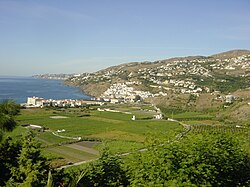
Costa Granadina (Spanish: [ˈkosta ɡɾanaˈðina]; "Granadan Coast") is a comarca in southern Spain, corresponding to the Mediterranean coastline of the province of Granada. It is also but less frequently called the Costa Tropical or Costa de Granada. This comarca was established in 2003 by the Government of Andalusia.[2][3]
It is crossed by the N-340 coastal highway that runs southwest–northeast along Spain's Mediterranean coast, to the border with France. Within the last 4 years the A7 motorway has been extended along the coast from Nerja in the Málaga province to Motril where it links the A7 motorway to the A44 motorway which heads north from Motril to the city of Granada.
Geography
[edit]The Costa Granadina is made up mostly of agricultural zones and small resort towns and villages. What makes the Costa Granadina unique in comparison to the rest of the Spanish coast is that the mountains of the Sierra Nevada range fall to the very edge of the Mediterranean Sea on the rugged coastline. Except for la vega de Motril, there are no flat areas for large urban sprawl.[4]
Climate
[edit] | This article needs additional citations for verification. (April 2021) |
The area east of Málaga is less dry and more lush than the surrounding areas. This is because the Sierra Nevada mountain range that serves as a backdrop to the Costa Granadina catches more rain and thus supplies the area with abundant irrigation. This same mountain backdrop provides a shelter from northerlies and creates a pleasant microclimate of very mild winters and mild summers compared to the interior of Spain, with temperature differences of 10 °C (18 °F) relative to the area on the other side of the mountains – so it could be 38 °C (100 °F) on a summer day in the city of Granada and only around 28 °C (82 °F) on the Costa Granadina. In the winter, it can be snowing in Granada and around 17 °C (63 °F) on the Costa Granadina.[5] The Costa Granadina, with more than 320 sunny days and more than 3000 sunshine hours a year, has an unusual borderline subtropical microclimate. The Sierra Nevada mountain range, protects this coast from the cold north winds due to the Föhn effect that creates a subtropical frost-free microclimate with very mild winter temperatures. The average annual temperature ranges between 18 and 20 degrees: While summers are warm, hovering the maximums between 27 and 31 degrees while winters are very mild, with maximums between 17 and 19 degrees and minimums between 10 - 12 degrees, with the annual rainfall of around 500 mm/year (however, Motril has a warm semi-arid climate (BSh) due to its low annual rainfall 378.9mm).
The climatic conditions of the Costa Granadina supports a cultivation of exotic tropical fruits unique in Europe. This is the case of cherimoya, which has a designation of origin and has made Spain the world's leading producer of this fruit. There are also crops of papayas, avocados, mangoes, guavas, litchi, etc.
Another typical farming on the Costa Granadina is sugar cane that is only grown here in the entire European continent.
Municipalities
[edit]The main towns of the Costa Granadina are Motril, Almuñécar and Salobreña. Motril is principally a manufacturing and agricultural center (horticulture, vegetables, tropical fruits and some sugar cane, although the last is declining). Motril also possesses the main seaport in the Costa Granadina. Almuñécar is primarily a resort town and agricultural center (tropical fruits), with the summer-time vacation population more than tripling the town's population. Like the rest of the Spanish coast, it recently underwent a housing and construction boom with some environmental degradation. This housing boom was not as severe as on other parts of the Spanish coastline due to the townships of Almuñécar and La Herradura being unable to agree the terms of their new Urban plan (PGOU) since 2002.
There are 18 municipalities, running along this coast or inland behind the coast, and listed below from west to east:
| Arms | Municipality | Area (km2) |
Population (2023)[6][7] |
Density (/km2) | Includes localities of |
|---|---|---|---|---|---|
.svg) |
Albondón | 34.5 | 735 | 21,3 | |
.svg) |
Albuñol | 62.9 | 7,391 | 117,5 | La Rabita |
_3.svg) |
Almuñécar | 83.4 | 27,305 | 327,4 | La Herradura, Velilla-Taramay |
.svg) |
Los Guájares | 89.3 | 1,157 | 13,0 | Guájar Alto, Guájar-Faragüit, Guájar Fondón |
_2.svg) |
Gualchos | 31.0 | 5,308 | 171,2 | Castell de Ferro |
.svg) |
Ítrabo | 19.0 | 960 | 50,5 | |
.svg) |
Jete | 13.9 | 994 | 71,5 | |
.svg) |
Lentegí | 23.8 | 339 | 14,2 | |
.svg) |
Lújar | 36.9 | 480 | 13,0 | |
.svg) |
Molvízar | 21.5 | 2,752 | 128,0 | |
.svg) |
Motril | 109.8 | 58,939 | 536,8 | El Varadero, Carchuna, Calahonda |
.svg) |
Otívar | 57.5 | 1,034 | 18,0 | |
.svg) |
Polopos | 26.6 | 1,644 | 61,8 | La Mamola, Castillo de Baños, La Guapa, Haza del Trigo |
.svg) |
Rubite | 28.6 | 406 | 14,2 | Caserones |
.svg) |
Salobreña | 34.9 | 12,562 | 359,9 | Alfa Mar, Clsta Aguilera, El Pargo, Lobres |
.svg) |
Sorvilán | 34.3 | 524 | 15,3 | Alfornón |
.svg) |
Torrenueva Costa | 7 | 3,115 | 445 | |
.svg) |
Vélez de Benaudalla | 79.1 | 3,013 | 38,1 | |
| Totals | 786.9 | 125,988 | 159,5 |
Points of interest
[edit]The Costa Granadina has many historical sights, including prehistoric cave paintings in nearby Nerja; many Roman ruins including roads, bridges, buildings, fish salting factories, and irrigation systems used to this day; and abundant remains of the many-centuries domination of the region by the Arab conquerors. In fact, Almuñécar served as the entry point to Iberia and establishment of a power base for Abd ar-Rahman I in 755, who came from Damascus and was the founder of an independent Muslim dynasty that ruled the greater part of the Iberian Peninsula for nearly three centuries thereafter.
References
[edit]- ^ Estimate at 1 January 2023: National Statistics Institute (Spain)
- ^ "ORDEN de 14 de marzo de 2003, por la que se aprueba el mapa de comarcas de Andalucía a efectos de la planificación de la oferta turística y deportiva". www.juntadeandalucia.es (in Spanish). 27 March 2003. Archived from the original on 8 February 2014. Retrieved 18 May 2025.
- ^ "CORRECCION de errores de la Orden de 14 de marzo de 2003, por la que se aprueba el mapa de comarcas de Andalucía a efectos de la planificación de la oferta turística y deportiva (BOJA núm. 59, de 27.3.2003)". www.juntadeandalucia.es (in Spanish). 7 May 2003. Archived from the original on 18 May 2025. Retrieved 2025-05-18.
- ^ Guide to Granada & the Costa Tropical
- ^ Costa Tropical Tourist Information Archived 2014-05-02 at the Wayback Machine
- ^ Estimate at 1 January 2023: National Statistics Institute (Spain)
- ^ "Granada: Population by municipality and sex. (2871)". INE. Retrieved 2024-10-02.
External links
[edit] Media related to Costa Granadina at Wikimedia Commons
- CostaTropical.com - Your essential online guide to the Costa Tropical de Granada)
- Seaside Gazette - English magazine and news website for Costa Tropical, Lecrin Valley and Alpujarras

| National | |
|---|---|
| Other | |

Costa Granadina
View on GrokipediaIntroduction
Definition and Location
The Costa Granadina is a comarca located in southern Spain, encompassing the Mediterranean coastline of Granada province in the autonomous community of Andalusia. It is also commonly referred to as the Costa Tropical or Costa de Granada, reflecting its distinctive environmental characteristics.[5][6] This coastal region stretches approximately 73 kilometers along the shore, from the provincial border with Málaga near Salobreña in the west to the provincial border with Almería near La Rábita in the east. It is bordered by the province of Málaga to the west, the province of Almería to the east, the Sierra Nevada mountain range to the north, and the Mediterranean Sea to the south.[7][8] The comarca covers a total area of 786.88 km² and features a unique geographical convergence where the rugged southern slopes of the Sierra de Almijara, Sierra de Lújar, and Sierra de la Contraviesa descend to the coastal plain, forming dramatic cliffs and fertile valleys. This positioning fosters a subtropical microclimate that enables the cultivation of exotic crops uncommon in mainland Europe.[9][10]Administrative Status and Significance
The Costa Granadina was established in 2003 by the Government of Andalusia through an order approving the map of comarcas for the planning of tourist and sports offerings, aiming to promote coordinated regional development.[11] This administrative framework recognizes the area as a distinct comarca within the province of Granada, part of the broader autonomous community of Andalusia, to enhance inter-municipal cooperation on infrastructure, services, and economic initiatives.[11] Administratively, the comarca comprises 17 municipalities that operate under the Mancomunidad de la Costa Granadina, a local government association formed to manage shared responsibilities.[12] This entity oversees essential services, including water supply and sanitation from reservoirs like Rules and Béznar, as well as joint efforts in tourism promotion, waste management, and regional planning to address common challenges in this coastal zone. The Mancomunidad ensures efficient resource allocation across municipalities such as Motril, Almuñécar, and Salobreña, fostering unified governance without altering the individual autonomy of each local council.[13] The Costa Granadina's significance lies in its role as Europe's southernmost subtropical coast on mainland Spain, providing a vital subtropical microclimate that supports unique agricultural production and bolsters Andalusia's tourism sector.[14] This positioning enables the cultivation of exotic crops like mangoes, avocados, and cherimoyas, making it the continent's primary European hub for high-quality tropical fruits and contributing substantially to Granada province's economy through specialized farming.[14] In tourism, the region draws a significant share of Granada's visitors, drawn to its mild climate, beaches, and cultural offerings, while serving as a key gateway for sustainable development in southern Andalusia.[15]Geography
Topography and Landscape
The Costa Granadina features a dramatic topography characterized by the steep descent of the Sierra Nevada's lower flanks directly to the Mediterranean Sea, forming rugged coastal ranges such as the Contraviesa, Lújar, and Almijara sierras that create abrupt cliffs and deep ravines.[16][1] These sierras, part of the Alpujárride Complex, rise sharply from the coastline with elevations reaching up to approximately 1,000 meters near the shore, resulting in a landscape of high gradients and erosive landforms like barrancos and cañones that limit flat terrain and channel water toward narrow coastal outlets.[16][17] In contrast, the only significant flat coastal plain is the fertile vega of Motril, formed by the alluvial deposits of the Guadalfeo River, which provides a narrow band of level ground amid the otherwise mountainous backdrop.[1][16] This vega, along with smaller plains at other river mouths like the Jate and Verde, supports intensive agriculture but is hemmed in by the encircling sierras, restricting urban expansion and preserving a patchwork of terraced hillsides sculpted for cultivation.[1] The narrow valleys dissecting these hills, often lined with steep slopes, further define the region's intimate scale and visual diversity, where human-modified terraces integrate with natural denudation patterns.[16][1] Geologically, this terrain owes its form to the Betic Orogeny—a phase of the broader Alpine orogeny—driven by the convergence of the African and Eurasian plates, which metamorphosed and uplifted the underlying rocks beginning around 20 million years ago.[17][16] Predominant rock types include calcareous formations such as dolomitic marbles and limestones from the Triassic period (200–230 million years old), alongside schists and phyllites, which contribute to the steep cliffs through differential erosion and karstic dissolution processes.[16] Ongoing tectonic activity, including coastal uplift evidenced by abrasion terraces on cliffs like Cerro Gordo, continues to influence erosion patterns and maintain the dynamic relief.[16][17]Coastline and Beaches
The Costa Granadina encompasses approximately 73 km of Mediterranean shoreline, presenting a varied coastal morphology shaped by the interplay of rocky cliffs and sediment deposition. In the eastern sector, near the border with Almería, the coast features secluded pebbly coves such as Playa de La Rijana, a 250-meter inlet with gravel substrate ideal for snorkeling. Toward the west, the landscape transitions to broader sandy expanses, including the prominent Playa de La Herradura, a 2 km horseshoe-shaped beach composed of fine dark sand and occasional gravel.[18][19][20] Beaches along the Costa Granadina are diverse in classification, blending urbanized sands, protected natural zones, and tranquil sheltered bays. Urban beaches dominate in areas like Motril, where 16 km of dark sand shores, including Playa Granada (1.3 km) and Calahonda (1.4 km), frequently earn Blue Flag awards for water quality and facilities. Natural reserves, such as the Maro-Cerro Gordo Cliffs Natural Area spanning 12 km of dramatic limestone formations and hidden coves, preserve untouched coastal ecosystems with minimal intervention. Sheltered bays, like the Ensenada de los Berengueles near La Herradura, offer calm waters ranging from 18–25°C, conducive to swimming and influenced by regional sea currents.[21][22][23][24][25] Coastal hazards in the region primarily involve episodic erosion driven by winter storms, which can displace sediments and narrow beach widths, as observed in areas like Cotobro and Velilla. Mitigation efforts include the construction and repair of breakwaters, particularly in resort zones such as Almuñécar, where structures protect against wave impact and stabilize the shoreline. The mountainous backdrop of the Sierra Nevada and Almijara ranges further accentuates this rugged profile, constraining linear development and preserving the coast's natural contours.[26][27][15]Climate and Environment
Climate Characteristics
The Costa Granadina, also known as the Costa Tropical, features a borderline Mediterranean subtropical climate classified under the Köppen system as Csa, characterized by hot, dry summers and mild, wetter winters moderated by its coastal position.[28] The region enjoys over 320 sunny days annually and more than 3,000 hours of sunshine per year, contributing to its reputation as one of Europe's sunniest coastal areas.[29] The average annual temperature ranges from 18°C to 20°C, with minimal seasonal extremes due to the influence of the Mediterranean Sea.[30] Summers, spanning June to September, bring average high temperatures of 27°C to 31°C during the day, with mild nighttime lows around 19°C to 22°C, fostering comfortable conditions without oppressive heat.[31] Winters from December to February are temperate, with daytime highs of 17°C to 19°C and nighttime lows of 10°C to 12°C; frosts are rare, thanks to the sea's moderating effect that keeps minimums above freezing most years.[31] Annual rainfall totals approximately 400 mm, concentrated primarily in autumn and winter months, with November often seeing the peak at around 40-50 mm, while summers remain largely dry.[32][33] The region's microclimate is shaped by the Sierra Nevada mountains, which shelter the coast from cold northerly winds, resulting in warmer and drier conditions compared to inland areas of Granada province, where winter temperatures can drop 5-10°C lower.[10] Local wind patterns, such as the levante—an easterly wind originating from the Mediterranean—can introduce periods of higher humidity and occasional Saharan dust, influencing coastal moisture levels during transitional seasons.[34] This topographic protection enhances the subtropical traits, supporting consistent mildness year-round. As of 2025, climate change has contributed to slightly warmer average temperatures and more variable rainfall patterns in the region.[15]Biodiversity and Agricultural Adaptation
The Costa Granadina features rich subtropical ecosystems that support a diverse array of flora, with the broader region encompassing over 2,100 vascular plant species, many adapted to the Mediterranean coastal environment.[35] Key habitats include coastal dunes stabilized by species such as Juniperus phoenicea, a resilient evergreen shrub that thrives in sandy, saline conditions and helps prevent dune erosion. Wetlands, particularly the salinas near Motril, serve as critical stopover sites for migratory birds, hosting over 160 species including greater flamingos (Phoenicopterus roseus), which utilize these shallow, brackish waters for feeding during seasonal migrations.[36] These ecosystems are enhanced by the mild, sunny climate that fosters subtropical vegetation along the coastline.[37] Marine habitats further bolster the area's biodiversity, with extensive Posidonia oceanica seagrass meadows forming underwater forests along the Costa Granadina's shores, providing shelter and nursery grounds for various marine organisms.[38] These meadows, endemic to the Mediterranean, contribute to coastal stability and oxygen production while supporting a high level of marine life diversity in the Alboran Sea, influenced by warm Atlantic currents entering via the Strait of Gibraltar. Fauna highlights include endemic mammals in adjacent sierras, such as the Iberian ibex (Capra pyrenaica), which inhabits rocky terrains near the coast, alongside marine biodiversity featuring over 200 recorded fish species in local waters, including commercially important ones like sardines and swordfish.[37] Agricultural adaptations in the Costa Granadina leverage the subtropical climate to cultivate tropical crops across approximately 3,400 hectares of greenhouses, enabling year-round production of fruits like avocados and mangoes in a frost-free environment.[39] Irrigation from the Rules Reservoir, with a capacity exceeding 110 cubic hectometres, supplies essential water to coastal farmlands, supporting efficient resource use amid variable rainfall. On sloping terrains, traditional soil terracing prevents erosion by reducing runoff and stabilizing soil, a practice particularly vital for subtropical orchards where unchecked erosion could degrade productive lands.[40][41]History
Ancient and Medieval Periods
The earliest evidence of human settlement in the Costa Granadina region dates to the Neolithic period, around 6000–3000 BCE, when communities transitioned to sedentary lifestyles supported by agriculture and animal husbandry. Archaeological remains, including polished stone tools, ceramic vessels, and flint sickles used for harvesting cereals, indicate the cultivation of crops and raising of ovicaprines in coastal caves and open settlements. Local sites such as Cueva de los Murciélagos in Albuñol reveal extensive Neolithic occupation with artifacts like early archery tools, demonstrating cultural continuity across the southeastern Iberian coast.[42] Adjacent to the area, the Nerja Caves in nearby Málaga province reveal extensive Neolithic occupation, with artifacts demonstrating cultural continuity across the southeastern Iberian coast.[43] During the Bronze Age (c. 2200–1550 BCE), the region fell under the influence of the Argaric culture, characterized by fortified hill settlements (hillforts) that served as defensive and economic centers. These sites, such as those in the Granada uplands, exploited local copper resources through mining and smelting, enabling bronze production and trade networks across the Iberian Peninsula. The Argaric society's hierarchical structure is evident in burial practices and metallurgical artifacts found in necropolises near the coast, highlighting the area's role in early metalworking economies.[44][45] The Roman period, from the 2nd century BCE to the 5th century CE, marked significant urbanization and economic integration into the province of Hispania Baetica. The port of Sexi (modern Almuñécar), established as a municipium named Sexi Firmum Iulium, became a key hub for maritime trade, particularly in garum—a fermented fish sauce produced in coastal factories using local tuna and anchovy stocks. Supporting this industry, an extensive 8 km aqueduct system, constructed in the 1st century CE with bridges, tunnels, and siphons, channeled water from inland springs to processing facilities and villas, while nearby lead mines in the Granada hinterlands supplied materials for Roman construction and export. Elite rural villas dotted the landscape, facilitating agricultural production and oversight of mining operations that contributed to imperial wealth.[46][47][48] Following the Muslim conquest in 711 CE, the Islamic era (8th–15th centuries) transformed the arid coastal landscape through advanced hydraulic engineering. Arab engineers introduced acequias—open irrigation channels derived from earlier Persian and North African techniques—that diverted rivers like the Guadalfeo to cultivate subtropical crops such as sugarcane, citrus, and silk, boosting agricultural productivity in the Costa Granadina. In 755 CE, Abd ar-Rahman I, a Umayyad survivor of the Abbasid overthrow, landed at Almuñécar as a refugee, using the port as a base to rally supporters and establish the Emirate of Córdoba, which unified al-Andalus under Umayyad rule. After the caliphate's collapse in 1031 CE, the region fragmented into taifa kingdoms, including the Taifa of Granada founded by the Berber Zirid dynasty in 1013 CE, which maintained these irrigation networks amid political instability. The Reconquista culminated in the Granada War (1482–1492), with Christian forces capturing Almuñécar in 1489 and the Nasrid Kingdom signing the Treaty of Granada in 1491, leading to its surrender in 1492 and ending Muslim rule in the area.[49][50])Modern Development and Challenges
In the 19th century, the Costa Granadina underwent significant industrialization driven by a sugar cane production boom, particularly in Motril, where the introduction of steam-powered mills marked the advent of modern factories on mainland Spain. By 1860, up to seven such factories operated in Motril alone, equipped with advanced industrial technology that transformed traditional processing methods inherited from earlier Islamic irrigation systems. This sector became the region's economic engine, providing employment for thousands of workers in manufacturing, harvesting, and related activities across the coastal plain. Infrastructure developments, including ambitious railway projects to connect Motril and the coast to Granada, were pursued in the early 20th century to facilitate transport of goods like sugar, though full realization faced delays and modifications. Following the Spanish Civil War (1936–1939), the area's agricultural recovery emphasized cooperative structures to rebuild production, with sugar factories like those in Motril resuming operations under state-supported frameworks amid postwar economic hardship. The 1960s heralded the onset of tourism as a new growth driver, with initial beach developments attracting visitors to the subtropical coastline and fostering complementary infrastructure such as promenades and accommodations, though the region avoided the most intense speculation seen elsewhere in Andalusia. The late 20th and early 21st centuries brought challenges, including the decline of the sugar industry due to European Union reforms that restructured subsidies and quotas, leading to the closure of the last factory in Salobreña in 2006 and the end of commercial cane cultivation after nearly a millennium. The 2000s housing boom exacerbated urban sprawl along the coast, straining water resources through increased residential demand and inefficient usage patterns typical of Spain's Mediterranean expansions. In response, sustainability initiatives have gained momentum, including renewable energy projects like photovoltaic installations in Granada province and enhanced coastal protection measures under Spain's Shores Act, which was strengthened after severe 2010 floods that inundated low-lying areas of the Costa Tropical.Municipalities and Demographics
Key Municipalities
The Costa Granadina, also known as the Costa Tropical, encompasses 18 municipalities spanning approximately 73 kilometers of coastline in the province of Granada, Andalusia, Spain.[8][13] These municipalities are coordinated through the Mancomunidad de Municipios de la Costa Tropical, a local government association that facilitates joint services such as tourism promotion, waste management, and infrastructure development. Among the largest municipalities, Motril serves as the administrative capital and primary industrial-agricultural hub, featuring a significant port that supports maritime trade and local commerce. Almuñécar stands out as a major tourist resort, renowned for its historical Roman ruins and expansive beaches that attract visitors seeking coastal relaxation. Salobreña, with its prominent hilltop castle overlooking the Mediterranean, functions as a picturesque town blending traditional architecture and scenic coastal positioning.[51][52][53] Mid-sized municipalities include Vélez de Benaudalla, which represents an agricultural valley community centered on fertile lands suitable for subtropical crops. Castell de Ferro, a quiet fishing village within the Gualchos municipality, maintains a serene maritime character focused on traditional coastal activities.[53][54] Smaller municipalities such as Ítrabo and Lentegí are situated in the inland sierras, characterized by terraced olive groves that define their rural landscapes and contribute to the area's agricultural heritage. These communities, along with others like Albondón, Albuñol, Jete, Lújar, Molvízar, Otívar, Polopos, Sorvilán, Torrenueva Costa, Los Guájares, Gualchos, and Turón, provide a diverse mosaic of coastal and mountainous settings under the mancomunidad's unified administrative framework.[55][13]Population and Settlement Patterns
The Costa Granadina has a resident population of 128,658 inhabitants as of 2023, according to data from the Instituto Nacional de Estadística (INE), with a population density of 163.5 inhabitants per square kilometer across its 786.88 km² area.[56][57] This density reflects the region's compact coastal geography, where human settlements are predominantly concentrated along the shoreline and immediate hinterland. The demographic profile features an aging population, a trend exacerbated by historical emigration of younger cohorts to urban centers elsewhere in Spain and Europe.[1] Population growth in the Costa Granadina has been robust, increasing by about 15% since 2000, driven primarily by migration linked to tourism development and the appeal of the mild subtropical climate to retirees and seasonal residents from northern Europe.[57] This influx includes a significant seasonal component, temporarily boosting the effective population during winter months and straining local infrastructure and services. Such dynamics contribute to a fluctuating demographic, where permanent growth is tempered by the return migration of younger workers seeking opportunities beyond the region's seasonal economy. Settlement patterns in the Costa Granadina are markedly linear and coastal-oriented, with roughly 80% of the population residing in urbanized strips along the Mediterranean shoreline, including key towns like Motril. Inland areas, particularly the sierras, feature dispersed rural fincas dedicated to agriculture, creating a dual urban-rural divide. This concentration poses socioeconomic challenges, as employment in tourism and related services wanes during the off-season, highlighting vulnerabilities in the region's demographic structure.[1]Economy
Agriculture and Primary Industries
Agriculture plays a central role in the economy of Costa Granadina, particularly through the cultivation of subtropical fruits, which benefit from the region's unique microclimate. In normal years, the Granada coastline produces approximately 100,000 tonnes of these fruits, including avocados, cherimoyas, and mangoes.[58] Andalusia leads Europe in tropical fruit production, with over 30,000 hectares dedicated to such crops across its coastal areas as of 2025, a significant portion of which falls within Costa Granadina.[59] Avocados represent a key export, with Andalusian production reaching around 73,000 tonnes annually as of 2024/25, including contributions from the Costa Tropical where cultivation covers approximately 2,700 hectares.[60][61] Cherimoyas, protected under the Chirimoya de la Costa Tropical de Granada-Málaga PDO, saw 45,000 tonnes produced in the 2023/24 season from roughly 3,000 hectares, primarily in the region.[62][63] Mango production, though smaller, has been recovering; in 2025, the harvest in Málaga and Granada provinces tripled to around 35,000 tonnes due to favorable rainfall, with varieties like Osteen and Keitt grown on dedicated plots contributing to the area's diverse output.[64] Irrigation relies on a historic network of acequias, traditional open channels totaling over 24,000 km in the provinces of Granada and Almería, including those in the Granada coastal zone, which distribute water from Sierra Nevada snowmelt to support these intensive crops.[65] Water scarcity poses ongoing challenges, mitigated since the 2010s by desalination initiatives, such as portable plants deployed in the Costa Tropical to supplement supplies for agriculture.[66] The legacy of sugar cane cultivation, once dominant, has diminished to negligible levels, now representing less than 1% of regional agricultural output.[67] Other primary industries include fishing from Motril port, where annual landings in the northern Alboran Sea average around 2,500 tonnes, focusing on species like tuna and sardines.[68] The port also handles significant cargo such as chemicals and metals, contributing to industrial activities. Olive oil production features the Contraviesa-Alpujarra area under the Aceite de Granada DOP, yielding high-quality extra virgin oils from local varieties like Verraco and Carrasqueño, though exact volumes remain modest compared to subtropical fruits.Tourism and Service Sector
The tourism sector in Costa Granadina plays a pivotal role in the regional economy, contributing to Granada province's approximately 2.7 million hotel visitors in 2023 and supporting around €500 million in provincial revenue that year.[69] In 2024, the province saw a record 6.7 million visitors overall, a 4.4% increase, with the coast benefiting from this growth.[70] During peak summer months, hotel occupancy rates reach up to 90% across more than 7,000 available beds in the region, reflecting the area's strong appeal as a coastal destination.[71][72] This influx supports seasonal employment and underscores the region's recovery from pandemic-related disruptions, with international arrivals in the province growing 21.69% in 2023.[73] Key infrastructure facilitates access and enhances visitor experiences, including proximity to Málaga Airport, located about 80 km away, which serves as the primary gateway for international flights. The Port of Motril accommodates cruise ships, with 34 calls and over 60,000 passengers expected in 2024, enabling maritime tourism and connecting to broader Mediterranean routes.[74] Popular activities include scuba diving at over 200 sites along the clear waters, golfing at facilities such as the Motril Golf Club, and limited agritourism on local farms highlighting subtropical cultivation. These offerings capitalize on the area's mild climate and diverse coastal landscapes to attract adventure and leisure seekers year-round. The service sector, encompassing hospitality and retail, accounted for about 40% of Granada's local GDP as of 2020, driven by tourism-related businesses that employ a substantial portion of the workforce.[75] Post-2010 growth in eco-tourism has been bolstered by European Union funds allocated for sustainable infrastructure, such as improved coastal paths and environmental preservation projects. However, challenges persist, including overtourism pressures in areas like Almuñécar, where high seasonal crowds strain resources and prompt calls for better management strategies.[76]Cultural Heritage and Attractions
Historical and Archaeological Sites
The Costa Granadina region preserves several significant Roman archaeological sites, reflecting its role as a key Mediterranean port in antiquity. The Aqueduct of Almuñécar, constructed in the 1st century CE, spans approximately 8 km and supplied water to the ancient city of Sexi Firmum Iulium, supporting its vital fish-salting industry through advanced engineering features such as bridges, tunnels, and siphons built from local mica schist.[46] Remnants of this aqueduct, including visible sections in urban areas like Torrecuevas, highlight Roman hydraulic expertise adapted to challenging terrain.[77] Archaeological excavations at El Majuelo in Almuñécar reveal elements of the Roman municipality of Sexi Firmum Iulium, a settlement developed during the Roman period on earlier Phoenician foundations and named for its loyalty to the Julio-Claudian dynasty.[78] The site includes a salted-fish factory and port structures, such as stone bollards for securing vessels, underscoring the city's economic importance in trade and processing.[79] The Castillo de la Herradura, located in La Herradura near Almuñécar, features ruins of an 18th-century fortress built by Charles III in 1771 as part of coastal defenses against pirates, connecting watchtowers along the Granada shoreline.[80] Islamic heritage in Costa Granadina is exemplified by the Alcazaba of Salobreña, a 10th-century hilltop fortress that evolved into a Nasrid summer residence and royal prison during the 13th–15th centuries.[81] Perched on a rocky promontory overlooking the Mediterranean, it features robust walls, towers, and strategic architecture that defended the Nasrid Kingdom of Granada against incursions.[82] The Baños Árabes in Almuñécar, dating to the 11th century, represent well-preserved public baths from the Islamic period, located in the upper esplanade of the San Miguel Castle. These facilities include vaulted chambers and decorative elements, with some mosaics illustrating hydraulic and architectural sophistication typical of al-Andalus.[83] Prehistoric evidence is evident in sites like the Cueva de Siete Palacios in Almuñécar, an underground complex with Roman-era vaults housing artifacts from prehistoric periods, including a Bronze Age Egyptian urn (17th–16th century BCE) and Phoenician items from the 8th century BCE onward, through classical periods.[84] Now serving as an archaeological museum, it displays coins, ceramics, and tools that trace human occupation from prehistoric eras through classical periods.[85] In Motril, 19th-century sugar mills stand as industrial heritage from the region's cane production boom, when up to seven factories operated using steam-powered machinery introduced in the early 1800s.[67] Several have been repurposed into museums, such as the Preindustrial Sugar Cane Museum at the 16th-century Ingenio de la Palma site, which recreates grinding, pressing, and refining processes with original hydraulic mills and archaeological remnants, illustrating the transition from artisanal to industrial methods.[86] Moorish irrigation systems, known as acequias, remain integral to Costa Granadina's landscape, channeling water from the Sierra Nevada since the 8th–10th centuries to support agriculture in the arid coastal valleys.[65] Conservation efforts focus on restoring these networks, part of broader initiatives to preserve al-Andalus hydraulic engineering amid modern climate challenges.[87]Natural and Recreational Points of Interest
The Costa Granadina features several protected natural areas that highlight its diverse ecosystems, from mountainous foothills to coastal wetlands. The southern foothills of the adjacent Parque Natural de Sierra Nevada offer hiking trails through oak and pine forests in the lower elevations, ascending to altitudes exceeding 3,000 meters where alpine meadows and endemic flora thrive. These trails, such as those near the Guadalfeo River valley, provide access to viewpoints overlooking the Mediterranean while showcasing the park's biodiversity, including Iberian ibex and various bird species.[88] In the coastal plains, the wetlands of the Guadalfeo River delta, including the Reserva Natural de la Charca de Suárez near Motril, form vital habitats for migratory and resident birds, making them prime spots for birdwatching. This area supports species like flamingos, herons, and waders, with observation hides facilitating non-intrusive viewing amid salt marshes and reed beds that filter into the Alboran Sea.[89] Recreational opportunities abound in secluded coves and beaches tailored to water-based activities. Cala Izquierda, a small, rocky inlet near Almuñécar, is favored for snorkeling due to its clear waters teeming with octopus, sea bream, and colorful anemones clinging to submerged boulders. Further east, Playa Granada in Motril stands out as a premier kitesurfing venue, with consistent winds from the east and west enabling sessions for beginners to advanced riders across its wide, sandy expanse. Complementing these aquatic pursuits, the Jardín Botánico El Majuelo in Almuñécar displays over 150 subtropical plant species, including palms from South America and ferns from Southeast Asia, arranged in thematic sections that evoke tropical rainforests.[90][91] The region's outdoor pursuits are enhanced by extensive trail networks and marine excursions. The Sendero GR-92, part of the Senda Litoral coastal path, spans over 100 kilometers along the Costa Granadina's cliffs and beaches, offering scenic walks through pine groves and past hidden bays for hikers and cyclists. Whale-watching tours departing from ports like Motril and Almuñécar explore the Alboran Sea, where sperm whales occasionally surface alongside more common dolphins and pilot whales, guided by spotters to minimize disturbance. Many of these sites, including the Maro-Cerro Gordo cliffs and Guadalfeo wetlands, hold protected status within the European Union's Natura 2000 network, ensuring conservation of habitats like Posidonia seagrass meadows and coastal dunes.[92][93][94]References
- https://commons.wikimedia.org/wiki/Category:Costa_Granadina