


Community hub
Recent from talks
Contribute something
Nothing was collected or created yet.
Motril
View on Wikipedia
 | This article has multiple issues. Please help improve it or discuss these issues on the talk page. (Learn how and when to remove these messages)
|

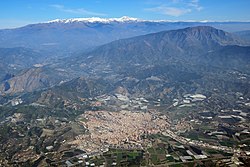
Motril (Spanish pronunciation: [moˈtɾil]) is a town and municipality of Spain belonging to the province of Granada, in the autonomous community of Andalusia.
Key Information

.jpg)
.svg)
.svg)


The main settlement is located a few kilometers inland, separated from the Port of Motril by the Guadalfeo delta. Motril is the second most populated municipality in the province, with 60,368 inhabitants as of 2016.[2]
Population
[edit]Motril has 61,171 inhabitants across an area of 110km2 as of 2012[update]. Over the last several centuries the population has risen from 4,300 in 1610, with migration the most significant factor especially in earlier periods.
History
[edit]Although its exact origins remain unclear, Motril started as a Phoenician enclave,[3] and continued to exist in Roman times.
Sugarcane was brought to the area by Arabs as a result of the Muslim conquest of the Iberian Peninsula.
The area yielded to the Catholic Monarchs in 1489. The settlements of Pataura (an alquería featuring irrigated land) and Jolúcar (featuring mainly cattle pasture) belonged to Motril.[4] At the turn of the 16th century, its population was still overwhelmingly Muslim, and so King Ferdinand prohibited Christians from living in Motril and ruled that those Christians who owned possessions there were to relocate to Salobreña.[5] After the mass conversion of the population in 1500, the town subsequently featured a majority of New Christians,[4] or Moriscos. After the Rebellion of the Alpujarras (1568–1571), most moriscos were expelled from the Kingdom of Granada as had been decreed in 1570. This exodus halved the population of Motril.[6] Due to this, in 1573 the Crown encouraged 60 Old Christian settlers to move to the area with their families.[7] By 1574 there were however only 56 registered settlers, accounting for 254 people (a high ratio presumably justified by the number of servants accompanying the settlers' families).[8]
The Church of the Incarnation was built in the 16th century on the site of a mosque. The building formed part of the defences which protected the town centre, and incorporated defensive features which are still visible today.[9]
Sugarcane was the staple crop in Motril, and after its harvest it was processed into sugar in local refineries. The most important of these was "La Casa de la Palma", the remains of which are on display at the Museo Preindustrial de la Caña de Azúcar (English: The Pre-Industrial Sugar Cane Museum).
By the end of the 1600s, the Nuestra Señora de la Cabeza church had been built.
In 1657, Philip IV granted Motril the title of city, separating its jurisdiction from Granada.
At the beginning of the next century, Philip V distinguished Motril as "Muy Noble y Leal" (Very Noble and Loyal), the motto shown on the Motril's current coat of arms.
19th century
[edit]After the War of Independence, during which Motril was occupied by French troops, the city's sugar industry entered a new era with the introduction of steam technology for sugar production. After a few years, due to an increase in the number of sugar refineries, it became the largest producer in Granada.
During the short-lived First Spanish Republic, the cantonal rebellion took place. Various places declared themselves independent cantons including Motril between July 22 and 25 in 1873.
The most traditional ride in the city, "Las Explanadas", opened to the public in the mid-19th century.
Monuments
[edit]Sugar cane refineries
[edit]Motril has long been synonymous with sugar and sugar cane. The process from sugar cane transformation into various types of sugar, even liquors like the cherished rum of Motril, has always been the basis of the local economy.
Sugar cane refineries in Motril include:
- Nuestra Señora del Pilar. This refinery is undergoing restoration as an industrial museum.
- Nuestra Señora de la Almudena.
- Azucarera de San Luis.
- Nuestra Señora de Lourdes.
- Nuestra Señora de la Cabeza (Alcoholera).
- Nuestra Señora de las Angustias (Fabriquilla).
- Azucarera de San Fernando (sólo queda la chimenea).
- Ingenio de San José, El Varadero (sólo queda una nave).
Individual refineries
[edit]Nuestra Señora de la Cabeza (Alcoholera)
[edit]The refinery is located next to the public swimming pool and the Parque de las Américas.
It has been declared of historic value by the Andalusian Government with the chimney, store, distillery and terrain protected.
History
[edit]It was founded by the Larios family in 1885, a family which founded a company based on the production of sugar and alcohol. At present, the company makes gin.
The refinery was later burned down by workers frustrated with their low salaries.
Nuestra Señora de las Angustias (La Fabriquilla)
[edit]Leaving Motril and moving towards Puntalón and La Garnatilla is the sugar refinery of Nuestra Señora de las Angustias, built in 1868. Some of its premises have been restored and are now intended for municipal usage, highlighting the magnificent "Nave de los Arcos". Juan Ramón La Chica owned two refineries called "Nuestra Señora de las Angustias", with one in Granada and the other in Motril. He gained full ownership over the latter in 1874. He also owned another sugar cane refinery called "Nuestra Señora del Carmen" in Pinos Puente, Granada.
Religious buildings
[edit]- Iglesia Mayor de la Encarnación, The Church of the Incarnation, was erected in the 16th century on the site of a mosque.
- Santuario de Nuestra Señora de la Cabeza (known as "El Cerro de la Virgen")
- Iglesia de la Divina Pastora (Capuchinos).
- Santuario de Nuestra Señora de la Victoria.
- Ermita de la Virgen del Carmen.
- Iglesia del Convento de las Nazarenas.
- Ermita de Nuestra Señora de las Angustias.
- Ermita de San Antonio de Padua.
- Ermita de San Nicolás.
- Ermita del Señor de Junes.
- Capilla del Santo Rosario
Santuario de Nuestra Señora de la Cabeza
[edit]This church is one of the most important and emblematic monuments in Motril. Located on a hill called Virgin's Hill, the church was built on the ruins of a Nasrid fortress in the 17th century by the architect Isidro de la Chica. The building was damaged during the Civil War in the 20th century and it was restored by the sculptor Manuel Gonzales, a sculptor from Motril, in the 1960s. Inside the church is the patron saint of Motril, the Virgen de la Cabeza. The church's modern day surroundings include the Parque de los Pueblos de América and the first fountain built in Motril, featuring a large Spanish flag.
Economy
[edit]Agriculture
[edit]The cultivation of sugarcane was for a long time important in the countryside, but commercial growing ended in 2006. Once the cane had been harvested, it was brought to Motril's sugar refineries including:
- "Nuestra Señora del Pilar"
- "Nuestra Señora de la Almudena"
- "Azucarera de San Luis"
- "Nuestra señora de Lourdes"
- "Nuestra Señora de la Cabeza"
- "Nuestra Señora de las Angustias"
- "Azucarera de San Fernando"
- "Ingenio de San José, El Varadero"
These refineries are now abandoned.
The potato was also a significant crop. Situated on the south coast of Andalusia, Motril grows crops like avocado, custard apple, guava, mango, and banana, as well as greenhouse cultivation. Motril and the villages of its municipality, Carchuna, Calahonda, Castel de Ferro and others, live off of crops grown in greenhouses. Of these crops grown in greenhouses, tomatoes and cucumbers are the most significant although others such as custard apples, beans and peas are also grown.
Industry
[edit]Motril's geographical location makes it a commercial and industrial center. One of the essential industries in Motril besides greenhouse agriculture is the paper mill, which provides 400 jobs and produces around 250 tons of paper per year. The Port of Motril is both a commercial and fishing port.
Climate
[edit]The climate in Motril is determined by two important geographic factors:
- The Sierra de Lújar blocks cold winds from the north (Granada and Sierra Nevada).[citation needed]
- The Mediterranean Sea, to the south, functions as a thermal regulator.
The combination of both factors allows the presence of a subtropical microclimate. The annual average temperature is between 18 and 20 degrees Celsius. Summers are hot, with high temperatures between 27 and 31 degrees and low temperatures between 18 and 22 degrees while winters are mild, with high temperatures usually over 17-18 degrees and low temperatures between 9-10 degrees. The African continent helps to cushion the hard effects of Atlantic and Mediterranean climate, providing warm breezes from the south.[citation needed]
Motril has a hot semi-arid climate (Köppen: BSh) with very mild winters and hot, very dry summers. On 16 July 2022, a maximum temperature of 44.5 °C (112.1 °F) was registered in Motril.[10]
| Climate data for Motril, 1981–2010 | |||||||||||||
|---|---|---|---|---|---|---|---|---|---|---|---|---|---|
| Month | Jan | Feb | Mar | Apr | May | Jun | Jul | Aug | Sep | Oct | Nov | Dec | Year |
| Mean daily maximum °C (°F) | 17.6 (63.7) |
18.3 (64.9) |
20.0 (68.0) |
21.5 (70.7) |
23.7 (74.7) |
27.0 (80.6) |
29.5 (85.1) |
30.1 (86.2) |
27.4 (81.3) |
24.2 (75.6) |
20.7 (69.3) |
18.6 (65.5) |
23.2 (73.8) |
| Daily mean °C (°F) | 13.3 (55.9) |
14.1 (57.4) |
15.8 (60.4) |
17.2 (63.0) |
19.4 (66.9) |
22.7 (72.9) |
25.2 (77.4) |
25.7 (78.3) |
23.3 (73.9) |
20.0 (68.0) |
16.6 (61.9) |
14.5 (58.1) |
19.0 (66.2) |
| Mean daily minimum °C (°F) | 9.0 (48.2) |
9.9 (49.8) |
11.5 (52.7) |
12.9 (55.2) |
15.1 (59.2) |
18.4 (65.1) |
20.9 (69.6) |
21.2 (70.2) |
19.1 (66.4) |
15.8 (60.4) |
12.5 (54.5) |
10.3 (50.5) |
14.7 (58.5) |
| Average precipitation mm (inches) | 49.2 (1.94) |
40.4 (1.59) |
28.6 (1.13) |
30.8 (1.21) |
19.7 (0.78) |
6.1 (0.24) |
0.8 (0.03) |
1.9 (0.07) |
21.4 (0.84) |
46.2 (1.82) |
63.8 (2.51) |
70.0 (2.76) |
378.9 (14.92) |
| Average precipitation days (≥ 1 mm) | 5.6 | 5.3 | 4.2 | 4.9 | 2.8 | 0.9 | 0.5 | 0.6 | 2.9 | 5.5 | 5.8 | 6.4 | 45.4 |
| Source: World Meteorological Organization (WMO)[11] | |||||||||||||
Culture
[edit]Theatre
[edit].jpg)
There is a 19th-century theatre, the Teatro Calderón de la Barca, which is protected as a Bien de Interés Cultural. It is built in Italian style with many boxes. It organises many shows such as plays, exhibitions, concerts and monologues.
Music and dance
[edit]There is a local orchestra, the "Joven Orquesta Ciudad de Motril". In Motril, there is a strong music development. Young people study several instruments at the professional conservatory and there is a local music school too.
Flamenco is also performed here in dance academies and exhibitions along the whole year, especially in the Cruces. Flamenco is the most prominent dance style but other styles are also practised, like ballet.
Youth Area provides many activities organised by local associations that contribute to the city's leisure like video games tournaments, crafts workshops and once a year, an event called Encuentro Joven where young people and children meet and these association prepares games to pass a journey all together and meet new people. This area has a centre called the Centro Joven where expositions of young local artists draws are passed so it helps to get to know their work.[12]
Holy Week
[edit]
The Holy Week in Motril has been declared a National Tourist Interest, It consist of 12 brotherhood, 23 pasos and more than 6000 followers. There are processions every day. The Holy Week in Motril started in 1600 with the eldest brotherhood, called Vera Cruz. After the Spanish Civil War every brotherhood had to restore its patrimony.[13]
Almost all the statues in Motril are made by some artists from the province of Granada. Processions of note include:
- The starting procession is on Palm Sunday. In this procession we can see two different pasos.
- On Easter Sunday there is a procession called "Dulce Nombre de Jesus". It consists on a group of children carrying the statue. It is accompanied by a lot of little children carrying bells.
Nowadays, the members of the brotherhood accompany the image with special clothes that cover their face.
In Spain there is a tradition of not to eat meat on Holy Thursday and on Good Friday. Each city has their own stew. The typical menu in Motril is the stew made with chickpeas and cod, the cod with tomato, and some cod omelette. Also, there are different desserts like rice pudding, torrija ... In these days it's common meeting the family.
Cuisine
[edit]The most popular dish from Motril is migas (crumbs), made of bread. Fish is also very popular in Motril, due to the town's important fisheries. The most popular fish are anchovy (locally named boquerón), sardines and shrimp. The most famous drink, exclusive to the area, is ron pálido which is a locally produced rum.
Leisure
[edit]Beaches
[edit]Motril is within the Costa Tropical, a large tourist region on the coast. Motril has small beaches (bays) and large beaches (like Playa Granada). They are popular during the summer with people from the surrounding as well as the interior regions.[citation needed]
Beaches in the area include Playa de Poniente (a large gravel/shingle beach), Playa Granada (shingles), Playa Carchuna (gravel and pebbles), and Playa Calahonda (gravel).[citation needed] Many of the area's beaches include car parking facilities, first aid stands, showers, beach cleaning, bars and restaurants, typical beach facilities (such as beach umbrellas and hammocks) and S.O.S. telephones.[citation needed]
Transport
[edit]Motril is served by autovías A-7 to Málaga and Almería, and A-44 to Granada. The Port of Motril offers ferries to Melilla, Nador, Tanger-Med, and Al-Hoceima and shipped 2.8 million tonnes of cargo in 2019.[14] Motril is the only Spanish Mediterranean port that lacks a rail service; building a line which would take 25 minutes to travel to Granada railway station was estimated to cost €400 million in 2017.[15] The link to Granada was rejected in 2010 by the Ministry of Development on the basis of being unsuitable for freight railway transport due to the steep slope.[16] From 1925 to 1950, Motril was connected to Granada by means of a cable way that spanned from Motril to Dúrcal.[17]
Time capsule
[edit]On July 22, 2008, a second time capsule in Spain was buried as part of an official event organized to commemorate the 135th anniversary of the cantonal movement in Motril, which began on July 22, 1873, and ended on 25 March. The president of the canton was Ruperto Vidaurreta de la Camara. This time capsule will be opened on July 22, 2023,[needs update] to celebrate the 150th anniversary of this event. It is located at coordinates 36°45′03″N 3°30′44″W / 36.75076°N 3.51226°W.
Festivities
[edit]- January 13 – Earthquake Day
- Its story is particularly tragic: On 13 January 1804 there was a very strong earthquake which had devastating effects: it caused the partial destruction of the city and the death of two people. Currently it recalls a vote conducted by the neighborhood because of the misfortunes suffered by hundreds of families during these disastrous years.
- February 28 – Día de Andalucía
- This day, Andalusia's flag is hoisted at Puchilla's roundabout and the Andalusian anthem is sung. On this day there are numerous acts of civil and military authorities. A popular race is also celebrated in which the runners go from the square of the "Explanadas" to the fire station in the port. After this race there are numerous sports-related activities.
- May 3 – Festivities of "Las Cruces"
- Motril is considered the second most famous city of "Las Cruces", after Córdoba. It's an important festivity considered National Tourist Interest. During the three days of celebration there are several types of singing and dancing shows. There are carriages decorated with traditional objects of the popular culture around the town and in some special squares neighbours make big crosses decorated with flowers. The most typical clothing for this day is the flamenco outfit.
- June 13 – Romería de San Antonio
- It is celebrated on 13 June and it is celebrated in the north of Motril, in the neighbourhood where there is the old chapel of the Saint. The neighbourhood helps with the organization of this event.
- June 24 – San Juan
- Bonfires are lit on the beach, and people are allowed to camp, there is a tradition by which you throw three wishes written on a piece of paper into the fire and throw three negatives ideas into the sea for the tide to take them.[citation needed]
- July 16 – Festivities of "La Virgen del Carmen", on the port.
- These are the festivities of the neighbourhood "El Varadero", on Motril's port. There, a mass in the "Lonja Pesquera" is celebrated and fishermen sing a Salve Mariner. At sunset, after a procession in the streets, the virgin is boarded and leaves from the port followed by all the fleet, decorated for the events. In this festivity show fireworks.
- August 15 – Patronal festivities of Motril
- In the first half of August the patronal festivities of Motril in honour of the "Virgen de la Cabeza" are celebrated. On these weeks, different events are celebrated in the "Ferial del Cortijo del Conde", with some concerts, night fair, dances, sport shows, fireworks with music on the beach, morning fair ... On the 15th, the Virgin goes through the city streets.
- October
- These two popular neighbourhoods of Motril celebrate their patronal celebrations during the month of October. Both the "Virgen de Las Angustias" and the "Virgen de la Pastora" leave their churches and they go all over the neighbourhoods with the fervour of their neighbours.
Sister cities
[edit]


Sports
[edit]The town has a football team, Motril CF.
Notable people
[edit]- Catalina of Motril (fl. 1501–1531), enslaved bedchamber servant of Catherine of Aragon during her marriage to Henry VIII.
- José Callejón (born 1987), professional footballer.
See also
[edit]References
[edit]- ^ National Statistics Institute (13 December 2025). "Municipal Register of Spain of 2025".
- ^ "Instituto de Estadística y Cartografía de Andalucía. SIMA – Motril (Granada)". www.juntadeandalucia.es.
- ^ "Motril: discover what to see and do with our destination guide". NetFerry. Retrieved 24 December 2023.
- ^ a b Malpica Cuello 1983, p. 174.
- ^ Malpica Cuello 1983, pp. 173–174.
- ^ Rodríguez Gálvez 2021, p. 695.
- ^ Rodríguez Gálvez 2021, pp. 695–696.
- ^ Rodríguez Gálvez 2021, p. 697–699.
- ^ "Iglesia Mayor de la Encarnación" (in Spanish). Retrieved 26 April 2024.
- ^ "08485: Motril - club Náutico (Spain)". ogimet.com. OGIMET. 16 July 2022. Retrieved 17 July 2022.
- ^ "World Weather Information Service. Motril". World Meteorological Organization. Retrieved 14 January 2021.
- ^ "Official website". www.elculturalmotril.es.
- ^ Turismo Granada Archived 2013-03-19 at the Wayback Machine
- ^ Alcántara, Rebeca (29 January 2020). "El puerto mueve casi 2,8 millones de toneladas en 2019, una de las mejores cifras de su historia". Ideal.
- ^ "Granada-Motril: un viaje en tren de 25 minutos". Granada Hoy. 22 November 2017. Retrieved 4 April 2020.
- ^ "La orografía hace 'imposible' un tren mercancías entre Granada y Motril". Diario Jaén. 4 February 2010.
- ^ Calvo Poyo, Francisco J.; Oña López, J. de. "Rails in the wind: el cable Dúrcal-Motril" (PDF).
Bibliography
[edit]- Malpica Cuello, Antonio (1983). "La villa de Motril y la repoblación de la costa de Granada (1489–1510)" (PDF). Cuadernos de Estudios Medievales y Ciencias y Técnicas Historiográficas. 10–11: 169–206.
- Rodríguez Gálvez, Jesús (2021). "El repartimiento y la población de Motril a finales del siglo XVI: ¿éxito o fracaso?" (PDF). : Los Fernández de Córdoba: nobleza, hegemonía y fama: segundo congreso: homenaje a Miguel Ángel Ladero Quesada. pp. 695–704. ISBN 978-84-17592-15-8.
.svg)
| International | |
|---|---|
| National | |
| Geographic | |
| Other | |

Motril
View on GrokipediaGeography and Environment
Location and Topography
Motril is a coastal municipality in the Province of Granada, Andalusia, Spain, positioned along the Mediterranean Sea within the Costa Tropical region. Its central coordinates are 36.751° N latitude and 3.518° W longitude.[8] The town lies at the estuary of the Guadalfeo River, marking the southernmost extent of Granada Province, approximately 56 kilometers southeast of the city of Granada.[9][10] The topography of Motril features a low-elevation coastal plain averaging 65 meters (213 feet) above sea level, characterized by fertile alluvial soils formed by river deposits.[11] This plain transitions inland to the foothills of the Sierra de Lújar, a rugged mountain range with peaks rising to 1,878 meters, acting as a barrier to continental influences from the north.[12][3] The urban core sits on undulating terrain near the coast, with nearby elevations varying from sea level to over 500 meters in the surrounding hills, supporting diverse microclimates and agricultural zones.[13]Climate and Natural Features
Motril features a subtropical variant of the Mediterranean climate (Köppen Csa), with mild, wetter winters and hot, arid summers moderated by the proximity to the Mediterranean Sea. Average annual temperatures hover around 17.3 °C, with January highs reaching 12.8 °C and lows of 8.9 °C, while August averages exceed 30 °C during the day.[14][15] Precipitation totals approximately 416 mm annually, concentrated between October and March, with July averaging just 0.3 wet days and negligible rainfall.[14][8] The area enjoys over 300 sunny days per year, fostering year-round outdoor activities and agriculture.[16] The local microclimate, shielded by the Sierra de Lújar mountains to the north—which rise to an average elevation of 1,000 meters—blocks continental cold fronts, enabling cultivation of subtropical crops such as sugarcane, avocados, mangoes, and cherimoyas on the surrounding fertile plains.[5][9] These mountains form a stark topographic contrast to the coastal lowlands, where the Guadalfeo River delta creates alluvial soils ideal for intensive farming.[9] Coastally, Motril borders the Costa Tropical stretch of the Mediterranean, characterized by sandy beaches, rocky coves, and clear waters supporting diverse marine ecosystems, though urban development has impacted some habitats. The interplay of sea breezes and orographic effects from the sierras maintains relative humidity levels around 64-70% annually, contributing to the region's appeal for tourism and horticulture.[17][18]History
Ancient and Medieval Periods
The region surrounding Motril exhibits evidence of prehistoric human settlement, with archaeological sites indicating occupation from approximately 4400 to 2700 years before present (BP), corresponding to the Neolithic and Chalcolithic periods, and additional activity between 2400 and 700 BP during the Iron Age and early historic eras.[19] These early communities likely exploited the fertile Guadalfeo River plain for agriculture and coastal resources, though specific artifacts from Motril itself remain sparse compared to nearby sites like Almuñécar.[20] Motril emerged as a Phoenician trading enclave around the 8th century BCE, leveraging its coastal position for maritime commerce in metals and goods, a pattern consistent with other Iberian outposts such as those in the Costa Tropical.[5] This settlement persisted into the Roman era (from the 2nd century BCE onward), where it functioned as a minor port and agricultural hub within the province of Hispania Baetica, potentially linked—though not definitively—to the ancient toponym Murgis mentioned in classical sources like Ptolemy's Geography.[21] Roman infrastructure, including roads and villas, facilitated continuity, but Motril lacked the prominence of larger centers like Salobreña.[20] Following the Visigothic period, Motril fell under Muslim control after the Umayyad conquest of Iberia in 711 CE, integrating into the Caliphate of Córdoba and later the Taifa kingdoms.[5] By the Nasrid era (13th–15th centuries), it had grown into a modest walled town (madīna) in the Kingdom of Granada, defended by a small palatial fortress built by Nasrid rulers to safeguard against Christian incursions and piracy; this structure, atop a hill overlooking the plain, incorporated typical Islamic defensive architecture with towers and gates.[22] The local economy emphasized irrigated agriculture, including early sugarcane cultivation introduced via Arab networks, alongside silk and fruit production, supported by the Guadalfeo's water systems.[23] Elite Muslim infrastructure, such as baths (ḥammām) attributed to Aixa al-Hurra (mother of Boabdil) in the late 15th century, underscores Motril's role as a regional administrative and cultural node.[23] In 1489, during the final stages of the Reconquista, Motril was captured by the Catholic Monarchs' forces under the command of the Count of Tendilla, ending Nasrid dominion and initiating Christian repopulation (repoblación) with settlers from northern Spain; the conquest involved minimal resistance due to the town's strategic but isolated position.[9] Post-conquest inventories documented around 200 Muslim households, reflecting a depopulated landscape after emigration, with the fortress repurposed for Christian defense.[24] This transition preserved some Islamic hydraulic legacy while shifting land tenure toward feudal grants.Early Modern Era and Sugar Industry Origins
Following the incorporation of the Nasrid Kingdom of Granada into the Crown of Castile in 1492, Motril transitioned to Christian administration while preserving its agricultural base centered on sugarcane, a crop introduced to the Iberian Peninsula by Muslim rulers centuries earlier.[25] The Guadalfeo Valley's subtropical climate and irrigation systems sustained cultivation, with sugar processing conducted in traditional mills known as aduanas azucareras or ingenios.[26] By the late 15th century, at least six such mills operated in Motril under Muslim ownership, utilizing animal-powered stone grinding mechanisms.[27] The early 16th century marked a pivotal shift as the forced exodus of Muslims in 1507 led to the transfer of mill ownership to Christian proprietors; for instance, in 1493, Ali Alazaraque sold a two-thirds share in the Aduana Nueva mill to Fernando de Jiménez for 22,500 maravedíes, with full acquisition by Francisco Ramírez de Madrid occurring by 1495.[27] Historical records indicate up to 14 mills may have existed, though documentation confirms six, supporting an economy increasingly oriented toward sugar export via Motril's coastal position.[27] This period solidified the sugar industry's foundational role, with production peaking in the 16th century at around 15 ingenios, employing 200–300 workers in manufacturing and nearly 500 in harvesting.[26] Throughout the 17th century, the sector faced mounting pressures from competition with American sugar plantations and disease outbreaks, culminating in a severe crisis triggered by the 1679 Black Death epidemic, which decimated labor and nearly eradicated local production.[26] A modest revival occurred in the 18th century through technological improvements in milling and refining, though the pre-industrial model persisted until the 19th-century shift toward steam-powered factories.[28] This early modern trajectory established sugarcane as Motril's economic cornerstone, influencing land use, labor patterns, and trade networks despite recurrent vulnerabilities.[26]19th-Century Industrialization
In the early 19th century, sugar cane cultivation and production in Motril's Guadalfeo Valley had largely declined due to competition from beet sugar, economic disruptions from the Napoleonic Wars, and shifts in colonial trade, reducing the number of active mills to near extinction by the 1820s.[29] A revival began in the mid-century, driven by local entrepreneurs investing in improved irrigation from the Guadalfeo River and adoption of steam-powered machinery, which enabled higher yields and more efficient extraction processes. This marked Motril's transition from preindustrial artisanal sugar making to mechanized operations, aligning with Andalusia's broader expansion where up to 20 cane sugar factories operated by the 1850s.[30] By 1860, Motril supported seven sugar factories equipped with industrial technology, including grinding mills, centrifuges, and boilers imported from Britain and adapted for local cane processing; these facilities processed thousands of tons annually, employing 200–300 workers per mill in refining and supporting nearly 500 in field labor.[31] [26] The industry's growth fueled population influx and infrastructure development, such as rail connections to Granada by 1871, facilitating export of refined sugar to national markets and reducing reliance on subsistence agriculture.[27] The Nuestra Señora del Pilar refinery, established in 1881 by the Viñolas family, epitomized this era's engineering advances with its multi-story iron framework, vacuum pans for crystallization, and capacity to produce 1,000 tons of sugar per campaign; it operated until the mid-20th century, symbolizing Motril's peak as a sugar hub amid global competition from colonies.[32] [33] [34] Despite tariffs protecting domestic production, such as the 1837 sugar duties, vulnerabilities to phylloxera outbreaks and beet sugar subsidies foreshadowed later challenges, though the sector briefly sustained Motril's economy through diversified byproducts like rum and molasses.[28]20th Century and Economic Shifts
In the early 20th century, Motril's economy remained heavily reliant on the sugar cane industry, with five operational sugar factories by 1900, including Nuestra Señora de la Cabeza and Nuestra Señora del Pilar.[35] [30] However, competition from beet sugar production elsewhere in Spain initiated a gradual decline, exacerbated by social unrest such as the intentional arson of the Nuestra Señora de la Cabeza factory in 1901 amid protests over low wages.[35] The Spanish Civil War (1936–1939) inflicted severe damage on Motril's infrastructure and economy, with the city serving as a Republican stronghold before Nationalist capture, leading to widespread destruction including the repurposing of buildings for military use and a 1938 munitions explosion that devastated local sites.[36] [37] Post-war recovery under Franco's regime was hampered by autarkic policies and ongoing agricultural challenges, yet the sugar sector persisted as a key employer until the mid-20th century.[38] By the 1980s, intensified global competition and shifts in EU agricultural policies prompted the closure of major facilities, notably the Nuestra Señora del Pilar factory in 1984 after a century of operation, marking the effective end of large-scale sugar processing in Motril.[39] This decline reduced sugar cane cultivation from its historical peaks, with only 1,165 hectares remaining by 2004.[40] Economic diversification accelerated in the latter half of the century, particularly from the 1970s onward, as expanded irrigation systems enabled the expansion of subtropical agriculture, including avocados, mangoes, and cherimoyas in greenhouse complexes suited to Motril's mild climate.[41] [42] These crops replaced diminishing sugar cane fields, bolstering primary production and exports via the Port of Motril, which grew in importance for trade.[40] Complementary shifts included nascent manufacturing and service sectors, laying groundwork for reduced dependence on monoculture agriculture by century's end.[9]Recent Developments Since 2000
In 2006, commercial sugar cane cultivation in the Motril region, which had persisted for over a millennium, definitively ceased, marking the end of a historically dominant agricultural sector that had shaped the local economy since medieval times.[26] This closure reflected broader European Union reforms on sugar production quotas and subsidies, leading to the shutdown of the last mills and a pivot toward diversified agriculture, including tropical fruits like avocados and mangos, alongside fishing and emerging tourism.[31] The Port of Motril underwent significant modernization starting in the mid-2000s, with the construction of the Azucenas dock completed in 2007 to enhance cargo handling capacity for containers and bulk goods, followed by further extensions in 2015 to support intermodal transport.[43] These upgrades transformed the port from a primarily fishing and sugarcane export facility into a key Mediterranean hub for trade with North Africa, particularly Morocco via ferry routes, handling increased volumes of imports such as phosphates and exports of agricultural products.[44] By the 2020s, the port authority pursued sustainability initiatives, including the GreenMotril project launched in 2022, aimed at enabling off-grid operations through renewable energy integration to maintain essential services during disruptions.[45] In August 2025, architectural firm Chapman Taylor was commissioned to design Marina Motril, a major waterfront redevelopment within the existing port precinct, with construction slated to commence in March 2026.[46] The project will replace the outdated Club Náutico with a 700-berth marina, incorporating a commercial village, zoco-inspired market, underground parking, marine research center, and nautical club facilities including pools and a gym, effectively doubling local mooring capacity and boosting tourism infrastructure on the Costa Tropical.[47] This development addresses longstanding gaps in high-end leisure amenities, positioning Motril to attract more international yachting traffic amid regional plans for additional marinas in Granada province.[48]Demographics
Population Trends and Statistics
As of 1 January 2024, Motril's population stood at 59,632 inhabitants, according to data from the Instituto Nacional de Estadística (INE) via municipal registers, marking a modest increase of 693 from the previous year.[49] The sex distribution was approximately balanced, with 49.1% males (29,404) and 50.9% females (30,463), consistent with patterns observed in the Instituto de Estadística y Cartografía de Andalucía's 2024 figures of 59,867 total residents.[50] Municipal records reported a further rise to 61,820 empadronados by early 2025, an increase of 1,953 over 2024, attributed to ongoing registrations and potential inflows from economic sectors like the port and agriculture.[1] Historically, Motril's population has exhibited long-term growth, accelerating after mid-20th-century industrialization tied to the sugar sector and coastal development. From 18,528 in 1900, it doubled to around 39,784 by 1981, then surged past 50,000 by 2000 amid Spain's economic boom and immigration.[49] A peak of 61,194 occurred in 2013, followed by contraction to 58,020 by 2019, likely reflecting out-migration during the post-2008 recession when employment in construction and related fields waned.[49] Stabilization and recent upticks suggest recovery, though growth rates remain below national averages for coastal municipalities, with annual changes hovering between -0.5% and +1% since 2015.[49] Key decadal population figures, drawn from INE censuses and padrón data, illustrate this trajectory:| Year | Population |
|---|---|
| 1900 | 18,528 |
| 1950 | 23,420 |
| 2000 | 50,172 |
| 2010 | 60,884 |
| 2020 | 58,460 |
| 2024 | 59,632 |
Migration and Social Composition
Motril's resident foreign population stood at 5,630 individuals in 2022, representing approximately 9.5% of the total municipal population.[50] This figure marked a slight decline from 5,745 foreigners recorded in 2021, equivalent to 9.8% of residents, which remained below the Andalusian average of 11.4%.[51] The foreign segment has contributed to overall population stability, offsetting stagnant natural growth rates driven by low fertility among native Spaniards. Romanian nationals form the largest immigrant group, consistent with labor demands in Motril's agricultural and service sectors.[50] Earlier data from 2009 indicated Romanians as the majority among immigrants, comprising over half of the foreign census, followed by Moroccans at 732 individuals (12% of foreigners), reflecting geographic proximity and seasonal migration across the Mediterranean.[52] Latin American origins, including Argentinians (293), Bolivians (277), and Colombians (262), also feature prominently in historical records, often tied to historical ties and economic opportunities in processing industries.[53] Migration patterns emphasize economic pull factors, with inflows from Eastern Europe and North Africa supporting greenhouse agriculture and port-related activities since the early 2000s.[54] The foreign population's growth has accelerated since the 1990s, rising from negligible levels to the current share, though recent stagnation aligns with post-2008 economic constraints and stricter EU border policies. Socially, immigrants tend toward younger working-age cohorts, enhancing labor force participation but straining integration in housing and education, as evidenced by municipal reports on rising non-EU registrations.[54] No significant refugee subgroups, such as Sahrawis, register in official tallies, suggesting minimal impact on composition despite occasional humanitarian transits via the port.[55]Economy
Agriculture and Primary Production
Motril's agricultural economy centers on subtropical fruit cultivation, enabled by the Costa Tropical's microclimate, characterized by mild winters averaging 12–18°C, warm summers, and protection from northerly winds by the Sierra de Lújar mountains, which trap humidity from the Mediterranean Sea. This environment supports year-round production without frost risk, distinguishing it from mainland Spain's continental climate. Key crops include avocados (Persea americana), mangoes (Mangifera indica), cherimoyas (Annona cherimola), loquats (Eriobotrya japonica), bananas (Musa spp.), guavas (Psidium guajava), and emerging exotics like litchis (Litchi chinensis), pitahayas (Hylocereus spp.), and carambolas (Averrhoa carambola).[56][57][58] The region positions Motril as Europe's primary hub for high-quality tropical fruits, with intensive greenhouse and open-field systems covering thousands of hectares; Spain's national subtropical acreage reached 34,771 hectares by 2023, dominated by Andalusia's Granada-Málaga coast, where Motril concentrates production. In normal conditions, the Costa Tropical yields around 100,000 metric tons annually, generating significant export value—tropical fruits contributed €408 million to Spain's output in 2023, or 12% of total fruit production value—though localized data for Motril underscore its role in supplying EU markets via nearby ports. Organic variants are expanding, with certified farms emphasizing sustainable practices amid soil salinization risks from irrigation.[59][60][61] Production has faced volatility from water scarcity; prolonged droughts reduced mango and avocado harvests by 80–90% in 2024, dropping regional output to 20,000 tons and impacting 2,000+ farming families through crop failures tied to irregular rainfall and over-reliance on groundwater. Recovery signals emerged in 2025, with national avocado forecasts exceeding 100,000 tons due to replenished aquifers, enhanced flowering from 2024 rains, and varietal innovations like drought-tolerant hybrids; mango campaigns similarly project stabilization. Fisheries complement primary output via Motril's port, landing 1,500–2,000 tons yearly of Mediterranean species like anchovies and sardines, though agriculture predominates in GDP contribution.[62][63][64]Industry and Historical Processing Sectors
Motril's historical processing sectors centered on sugar cane milling and refining, with origins tracing to medieval Muslim-era facilities known as aduanas that utilized water-powered atahonas or edge-runner mills for grinding cane.[27] These pre-industrial operations, documented from the 15th century, processed local cane harvests into raw sugar and molasses using rudimentary hydraulic systems fed by irrigation canals.[65] By the mid-19th century, industrialization transformed the sector, with seven steam-powered sugar factories operational in Motril by 1860, marking a shift to mechanized refining capable of higher yields.[31] A pivotal development occurred in 1881 with the construction of the Fábrica de Azúcar Nuestra Señora del Pilar, an engineering landmark featuring advanced boilers, centrifuges, and rail-integrated logistics that exemplified 19th-century industrial innovation in southern Spain.[34] This facility, along with others, processed thousands of tons of cane annually until competition from tropical colonies and agricultural pests led to sector decline in the 20th century, culminating in the abandonment of large-scale refining by the late 20th century.[66] Remnants of these operations persist in preserved sites, including the Preindustrial Sugar Cane Museum, which reconstructs 13th- to 18th-century milling techniques with scale models of presses and trapsiches, and the ongoing restoration of the Pilar factory into a dedicated Industrial Sugar Museum opened in phases starting April 2025.[67][68] Beyond sugar, ancillary processing emerged from mill infrastructure near canals, including flour and early paper production reliant on water for grinding and pulping.[69] In 1963, the Empresa Nacional de Celulosa established operations near Motril's port, leveraging excess bagasse—a fibrous sugar cane residue—as feedstock for cellulose and paper manufacturing, sustaining a processing niche tied to the legacy agro-industry.[70] Contemporary sectors retain elements of this heritage through rum distillation, where imported cane or local molasses yields non-crystallized liquids processed into products like Ron Montero, a brand emblematic of Motril's distilled output.[26] These activities underscore a transition from dominant historical refining to specialized, smaller-scale processing amid broader economic diversification.[28]Port, Trade, and Modern Commerce
The Port of Motril functions as the principal maritime outlet for Granada province and the surrounding Costa Tropical, enabling efficient handling of bulk, general, and containerized cargo through its multipurpose facilities. Equipped with berths accommodating vessels up to 300 meters in length and drafts of 10.5 meters, the infrastructure supports intermodal connections via rail and road, facilitating trade flows between the Mediterranean, Atlantic routes, and key partners in Europe and North Africa. Annual merchandise throughput exceeds 2 million tons, encompassing a diverse range of goods that underpin regional industrial and agricultural sectors.[71][72][73] Exports dominate the port's activity, representing over 40% of total traffic, with non-metallic minerals—including dolomite, celestite, gypsum, kaolins, and silicates—accounting for 63% of outbound volumes, supplemented by general cargo such as textiles, automotive components, foodstuffs, and olive oil. Imports focus on essential bulk commodities like cereals, fertilizers, biomasses, and paper pulp, often sourced from international suppliers to support local processing industries. Trade routes emphasize connections to ports in Morocco (e.g., Casablanca, Safi, Tanger Med), the Canary Islands (Las Palmas), and broader EU markets, with recent additions like the Morocco-Spain freight and passenger line enhancing bilateral commerce in perishables and manufactured goods.[74][71][75][76] Cargo volumes surged 18.6% in 2023, the highest growth among Spain's state-managed ports, driven by expansions in general cargo (up 305% to 313,000 tons in the first eight months) and Ro-Ro traffic, reflecting robust demand for export-oriented logistics. This momentum persisted into 2024, with first-quarter throughput reaching 720,860 tons—a 27.8% year-over-year increase—and April alone handling a record 290,277 tons, primarily in solid bulks. Modern commerce benefits from specialized shipments, such as over 5,000 wind turbine blades exported via dedicated lines, alongside European-funded decarbonization and efficiency upgrades that integrate the port into sustainable supply chains, fostering ancillary services like warehousing and distribution in Motril's logistics zones.[77][78][79][80][81]Tourism and Service Growth
Tourism in Motril has expanded significantly in recent years, driven by its subtropical climate, Mediterranean beaches such as Playa Granada and Playa de Motril, and position within the Costa Tropical region. The local Tourist Office recorded over 10,000 visitors during the summer months of 2024, marking the highest occupancy rates in accommodations—exceeding 80% in August—for the past decade, with 54% of inquiries from domestic travelers and 46% from foreigners.[82] [83] This growth reflects investments in beach infrastructure and diverse activities, including water sports and cultural events, positioning Motril as a key destination for both sun-seekers and day-trippers from nearby Granada.[84] Cruise tourism has been a primary catalyst for service sector expansion, with the Port of Motril achieving record figures in 2024: 58,848 passengers across 38 calls, a 70.36% increase from 2023.[85] This surge follows a 290% rise in cruise passengers in 2023, including 400% growth in large vessels carrying over 2,000 passengers each, establishing Motril as Andalusia's third-busiest cruise port.[86] [87] The influx, predominantly from British and American markets, has boosted local commerce, with projections for over 15,390 additional passengers in the final quarter of 2025 alone, generating an estimated €3 million in economic impact and supporting around 90 jobs.[88] Anticipated infrastructure projects are set to further accelerate service sector growth, particularly in hospitality, retail, and marine services. The Marina Motril development, with construction slated to begin in March 2026 and completion by spring 2028, will provide 700 berths (450 wet and 250 dry) alongside facilities for yacht repair, a marine research center, and commercial spaces, at a cost exceeding €30 million.[89] [46] Expected to create over 150 direct jobs, the project aims to enhance nautical tourism and integrate with the existing port, diversifying Motril's economy beyond agriculture toward year-round service-oriented activities.[47]Government and Administration
Local Governance Structure
The Ayuntamiento de Motril serves as the primary local government body, structured in accordance with Spain's Organic Law 5/1985 on the Regime of Local Public Administrations, which delineates the roles of the plenary assembly, executive board, and administrative delegations. The Pleno Municipal, the legislative organ, comprises 25 concejales elected every four years through proportional representation in municipal elections; the most recent occurred on May 28, 2023, resulting in the following seat distribution: Partido Popular (PP) with 11 seats (34.96% of votes), Partido Socialista Obrero Español (PSOE) with 6 seats (20.79%), Partido Más Costa Tropical (PMAS) with 4 seats (13.60%), Unión de Andalucía (UA) with 2 seats (8.63%), and Izquierda Unida-Los Verdes Equo with 2 seats (6.31%).[90][91] The executive authority is vested in the alcalde or alcaldesa, currently Luisa María García Chamorro of the PP, who was invested following the 2023 elections through a coalition agreement securing a majority of 15 seats (PP plus PMAS), enabling governance without reliance on opposition support.[92][93] The Junta de Gobierno Local, the primary executive body, includes the alcaldesa and seven concejales appointed from the governing coalition, convening weekly to handle urgent administrative matters and preparatory decisions for plenary approval.[94] Supporting this are comisiones informativas for policy review and an equipo de gobierno with delegated concejalías covering areas such as urbanism (led by Antonio Escámez Rodríguez of PMAS), economy, social services, and security, totaling around 15 specialized delegations as approved in the post-election plenary on June 17, 2023.[95][93] Autonomous entities under the ayuntamiento include the Organismo Autónomo de Recaudación for tax collection and the Residencia de Ancianos San Luis for elderly care, operating with semi-independent administrative structures to enhance efficiency in specialized functions. The overall organigrama funcional outlines hierarchical services under these delegations, with technical directorates for areas like personnel, finance, and urban planning, ensuring operational alignment with plenary directives.[96]Political and Economic Policies
The local government of Motril has been led by the Partido Popular (PP) since 2019, with Luisa García Chamorro serving as mayor following elections that year and a subsequent agreement with the Mas Motril group to maintain the coalition into subsequent terms.[97][98] This administration emphasizes fiscal prudence and infrastructure enhancement as core political tenets, contrasting with prior socialist-led governance that accumulated significant debt.[99] Economically, the PP-led council has prioritized debt elimination and surplus generation, achieving zero municipal debt and a record €15 million treasury surplus by February 2025, enabling targeted investments without new borrowing.[99] Annual budgets, such as the €64.7 million approved for 2024, allocate substantial funds to public works and urban renewal, reflecting a strategy to leverage fiscal stability for growth in trade, tourism, and services.[100] Key initiatives include the €2.2 million Integral Asphalt Plan launched in October 2025, resurfacing over 14 kilometers of roads to improve connectivity and attractiveness for commerce.[101] The administration pursues sustainable economic development through the EDUSI Motril SI2 strategy, funded partly by European Regional Development Funds, aiming to regenerate urban areas via green infrastructure and private-public partnerships projected to exceed €64 million in 2025 investments.[102][103] Policies also support port expansion and marina projects, such as Marina Motril, to boost maritime trade and tourism while incorporating renewable energy elements for long-term viability.[46] These efforts align with a broader commitment to local employment and resource efficiency, though critics from opposition parties question maintenance priorities and transparency in select expenditures.[104]Culture and Heritage
Monuments and Industrial Legacy
Motril's monuments include religious and architectural landmarks tied to its historical development under Moorish and Christian rule. The Iglesia Mayor de la Encarnación, dating to the 16th century, exemplifies Renaissance-style construction and anchors the Plaza de la Calvario, alongside the adjacent town hall.[105][9] The Church of Nuestra Señora de la Cabeza, a Baroque structure from the 17th century, features ornate interiors and serves as a focal point in the old town.[106][107] The Casa de la Palma, erected in the 16th century as a sugar mill, represents an early fusion of residential and industrial architecture, highlighting Motril's role in early modern processing.[108] Nearby, the Preindustrial Sugar Cane Museum occupies ruins of a contemporaneous mill, displaying replicas of hydraulic presses and mills used from the 13th to 18th centuries to extract and refine cane juice into sugar and molasses.[67][109] Motril's industrial legacy centers on sugar cane cultivation and refining, introduced by Nasrid rulers in the 13th century and expanded post-Reconquista through irrigation canals. By 1860, seven factories employed 200-300 workers each in processing, with nearly 500 more in harvesting across the Vega plain, driving exports via the port.[31][26] Sites like Fábrica del Pilar, a 19th-century facility, preserve steam-powered machinery and vats, underscoring the shift to mechanized production before decline from foreign competition and pests in the early 20th century.[28][110] Remnants of mills and aqueducts, such as those along former cane fields, testify to this era's economic dominance, which shaped local infrastructure and labor patterns until diversification into fruits post-1930s.[69][111]Religious Sites and Traditions
Motril's religious landscape is dominated by Roman Catholicism, with key sites centered in the historic core. The Iglesia Mayor Parroquial de la Encarnación, constructed between 1510 and 1514 on the foundations of the former Alixara mosque from the Nasrid period, exemplifies a fusion of Mudejar, late Gothic, Renaissance, and Baroque architectural elements. [112] This church serves as the canonical seat for several brotherhoods and hosts major liturgical events. The Santuario de Nuestra Señora de la Cabeza, dedicated to Motril's patron saint, stands as a prominent devotional site offering panoramic views of the town. Our Lady of the Head (Virgen de la Cabeza) is venerated through annual patronal fiestas from August 8 to 16, featuring solemn masses, floral offerings, and a grand procession where the crowned image is carried through streets lined with thousands of devotees.[113] [114] Semana Santa processions form a cornerstone of local traditions, characterized by penitential brotherhoods (cofradías) parading ornate pasos depicting Passion scenes. The Cofradía del Santísimo Cristo de la Buena Muerte "El Silencio," founded in 1981 and based at the Encarnación Church, processes at midnight on Jueves Santo, emphasizing solemn silence to evoke Christ's moment of death; its titular image, a 1954 polychrome wood sculpture by Domingo Sánchez Mesa, draws particular reverence.[115] Other notable devotions include fiestas for Nuestra Señora de las Angustias on October 12, with processions and fairs, and the Divina Pastora celebrations in the Capuchinos neighborhood from October 17 to 19, blending religious rites with community activities.[116] [117]Local Festivities and Customs
Motril's local festivities emphasize religious devotion and communal gatherings, often tied to Catholic traditions and agricultural heritage. The principal event is the Fiestas Patronales in honor of Nuestra Señora de la Virgen de la Cabeza, celebrated from August 9 to 16 each year, coinciding with the Feast of the Assumption on August 15. These include a solemn novena beginning August 6, floral and food offerings to support social services, masses accompanied by choirs, and a grand procession of the Virgin's image through the streets on August 15. The program extends to fairground casetas offering local cuisine and beverages, concerts in the bullring, daytime fairs in historic plazas with live music, and fireworks displays.[118][119][120] Semana Santa, or Holy Week, features 13 processions organized by 12 hermandades y cofradías, commencing on Palm Sunday with the blessing of palms and culminating in the Resurrection on Easter Sunday. Key images include the Santísimo Cristo de la Buena Muerte, carried in solemn nighttime processions accompanied by nazarenos in hooded habits, candles, and incense, reflecting penitential customs dating back centuries. These events draw local participation through saetas (flamenco-style religious songs) and elaborate throne floats depicting biblical scenes.[121][122] Other notable customs include the Romería de San Antonio on June 13 in the northern San Antonio neighborhood, revived in recent years with a pilgrimage procession of the saint's image, boules tournaments, and communal meals honoring the patron of animals. The Fiesta de la Taramela marks the end of the sugar cane harvest in late summer, a tradition involving the decorated transport of the final cane loads to the mill, followed by feasts with music and dance to celebrate laborers' efforts. Neighborhood-specific fiestas, such as those for San José in March or Santa Adela in late August, feature local processions, fireworks from the sea, and sports events, fostering community bonds.[123][124][125]Cuisine and Culinary Traditions
Motril's cuisine draws from its Mediterranean coastal setting and subtropical agriculture, emphasizing fresh seafood caught in local waters, preserved fish preparations, and confections tied to the region's historic sugarcane cultivation. Seafood forms a cornerstone, with staples like quisquillas de Motril—small, translucent prawns harvested daily from the Costa Tropical—served simply boiled to highlight their naturally sweet flavor and tender texture, often as a tapas or in rice dishes.[126][127] These prawns, captured using traditional nets, represent a key economic and gastronomic asset, with peak seasons yielding high volumes for immediate consumption.[128] Preserved seafood traditions include espichás (dried anchovies or boquerones), threaded on strings after salting and grilling over open flames, a method originating from pre-refrigeration eras that imparts a smoky, concentrated taste; this dish remains a fixture at local festivals and home meals.[127] Motril sardines, abundant due to the nutrient-rich waters, feature in moraga de sardinas, where fresh fish are grilled en masse on esparto grass grates, a communal preparation linked to coastal fishing communities.[129] Inland influences appear in vegetable-based fare, such as the cazuela de San Juan, a pumpkin stew simmered with local herbs, reflecting agrarian roots amid the Guadalfeo valley's produce.[130] Sugarcane legacy shapes sweets and beverages, with torta real—an Arabic-derived almond paste layered into dense, honey-sweetened cakes—served at celebrations for its rich, marzipan-like profile derived from high-quality local almonds.[131] Accompanying drinks include ron pálido, a light rum distilled from Motril's sugarcane since the 19th century, often sipped neat or in cocktails to complement seafood.[131] Subtropical fruits like chirimoya, mango, and avocado, grown in coastal greenhouses, integrate into fresh salads or simple desserts, adding creamy, exotic notes to the otherwise seafood-centric palette.[128] These elements underscore a cuisine prioritizing seasonality and locality over elaborate innovation.Leisure and Recreation
Beaches and Outdoor Activities
Motril's beaches line the Costa Tropical shoreline, characterized by dark sand, gravel substrates, and clean, crystal-clear waters supported by the region's mild subtropical climate, which averages over 300 sunny days annually. Key beaches include Playa Poniente and Playa Granada, the closest to the urban center; Playa Poniente spans approximately 1.5 kilometers with developed infrastructure like promenades, showers, and chiringuitos (beach bars), while Playa Granada offers similar amenities but with a more expansive feel.[132][133] Further east, Playa Calahonda extends over 4 kilometers in a scenic residential area, equipped with lifeguards, parking for 500 vehicles, and accessibility ramps, earning consistent Blue Flag awards for water quality, environmental management, and safety since the program's inception in Spain.[134][135] Playa del Cable, another prominent stretch, features fine gravel and is popular for its length exceeding 2 kilometers, though it has fewer facilities compared to urban-adjacent sites.[133] Carchuna and Torrenueva beaches also receive Blue Flag certifications, highlighting their cleanliness, but like most in Motril, they consist primarily of pebbles rather than fine sand, with typical widths of 20-30 meters.[134] Outdoor pursuits leverage the coastal and inland topography, including water sports such as kayaking, snorkeling, and stand-up paddleboarding offered by operators like AWA WaterSports at Playa Granada, where equipment rentals and lessons cater to beginners and experienced participants amid calm bays.[136] Surfing and windsurfing draw enthusiasts to exposed sections during seasonal winds, while scuba diving explores nearby reefs and underwater caves accessible via certified centers along the Costa Tropical.[137] Paragliding launches from coastal cliffs provide aerial views of the Mediterranean, with tandem flights available through Parapente Tropical.[136] Inland, hiking trails traverse subtropical orchards and low hills, with AllTrails documenting seven routes in the Motril vicinity ranging from 2 to 10 kilometers, such as paths through cane fields and to viewpoints overlooking the sea, suitable for moderate fitness levels.[138] Golfing at Los Moriscos Club de Golf, an 18-hole course designed in 1993 amid tropical vegetation, accommodates players year-round with greens maintained to professional standards.[136] Horseback riding and cycling paths connect beaches to rural areas, emphasizing the blend of marine and agrarian landscapes without reliance on high-altitude Sierra Nevada excursions.[137]Sports and Community Events
CF Motril, the city's primary football club, competes in Tercera Federación Group 9, the fifth tier of Spanish football, and plays home matches at Estadio Escribano Castilla, which has a capacity of approximately 2,000 spectators.[139] Founded in 2012 following the dissolution of its predecessor club, CF Motril maintains an affiliated women's team and operates the Motril Sport Academy, an international program focused on youth soccer development and leadership training.[140] Other local sports entities include Club Atletismo Ciudad de Motril, which organizes track and field activities, and Puerto de Motril Club de Fútbol, supporting grassroots youth and amateur teams.[141] The Motril municipal sports department, under the Ayuntamiento, promotes widespread participation through recreational and competitive events, emphasizing health, solidarity, and community integration across age groups.[142] Annual highlights include the Media Maratón Ciudad de Motril, a half-marathon event that drew participants in its 41st edition on October 19, 2024, fostering local athletic engagement.[143] Summer programming such as 'Alégrate el Verano' features over 100 free activities blending sports like yoga, pilates, and team games with cultural elements, held across beaches and public spaces from June to August.[144] Community-oriented initiatives often tie sports to charitable causes, exemplified by solidarity runs and tournaments benefiting organizations like Down Granada, organized via the Área de Deportes.[145] Fitness spectacles such as the Tropical Championship, held during Fiesta de la Primavera in May, combine competitions in disciplines like calisthenics and dance with public demonstrations, attracting regional participants and emphasizing physical vitality.[146] These events underscore Motril's emphasis on accessible, festive athletics amid its coastal setting, though participation data remains limited to municipal reports without independent verification of attendance figures.[142]Infrastructure and Transport
Transportation Networks
The principal artery of Motril's road network is the Autovía A-44 (Sierra Nevada-Costa Tropical), a dual-carriageway motorway spanning approximately 190 kilometers from Bailén in Jaén province to the Costa Tropical near Motril, providing direct linkage to Granada city center—about 60 kilometers inland—via a route traversing the Sierra Nevada foothills.[147] This infrastructure supports heavy freight and passenger traffic, integrating with the A-7 (Autovía del Mediterráneo) for coastal connectivity eastward to Almería and westward toward Málaga, though periodic maintenance, such as the 2025 closure of the Rules viaduct between kilometers 165 and 175 for structural repairs, has disrupted north-south access until December.[148] Local roads, including the N-340 and urban arterials, handle intra-city movement and feeder traffic to industrial zones. Public bus services form the backbone of intra- and interurban transport, operated by Grupo Fajardo-Autedia, S.L. under municipal concession, with lines such as Línea 1 (circulating the city center), Línea 2 (serving western neighborhoods and the Polígono Industrial Vadillo), and Línea 3 (connecting to Hospital de Motril and eastern outskirts) running daily from early morning to evening.[149] The Estación de Autobuses de Motril facilitates regional routes, primarily via ALSA, to Granada (journey time around 1 hour for the 49-kilometer distance), Málaga, and other Andalusian hubs, with fares starting at €7 for short hauls.[150] Motril lacks a passenger railway station, with historical proposals for a Granada-Motril line—intended to transport sugar, minerals, and goods to the port—never materializing despite advocacy dating back over a century, leaving rail access dependent on Granada's ADIF-managed station, 49 kilometers away.[151] Air travel relies on nearby airports: Granada-Jaén (GRX), the closest at 53 kilometers (about 52 minutes by car), followed by Málaga-Costa del Sol (AGP) at 87 kilometers; no dedicated aerodrome serves the city directly.[152] Taxis and ride-sharing supplement these networks, though private vehicles dominate due to the terrain and service gaps.Port Facilities and Connectivity
The Port of Motril features specialized infrastructure for handling dry and liquid bulk cargoes, Ro-Ro vehicles, breakbulk goods, and passengers, with channel depths of 11 to 12.2 meters, anchorage depths up to 15.2 meters, and cargo pier drafts of 9.4 to 10 meters.[153] Maximum vessel drafts reach 12 meters for breakbulk, Ro-Ro, and bulk operations, accommodating ships up to 86,273 gross tons and 285 meters in length overall, while tankers are limited to 190 meters LOA and 10.5 meters draft.[154] The port includes two dedicated passenger and cargo terminals supporting Ro-Pax services, alongside an underutilized Azucenas terminal with 12-meter draft for potential dry bulk expansion.[155] Connectivity emphasizes regular ferry routes to Moroccan ports, including Tangier Med (with crossings of 6.5 to 7 hours and up to 14 weekly sailings prior to recent operator changes), Nador, Al Hoceima, and Melilla.[156] [157] Operators such as Balearia and Armas Trasmediterránea facilitate these links, handling significant Ro-Ro traffic like 13,946 lorries or intermodal units in the first nine months of 2023 alone on the Tangier Med line.[158] Balearia's suspension of the Tangier Med route in September 2025 prompted the port authority to seek a new operator, reflecting ongoing adjustments in service reliability amid demand from seasonal migrations like Operation Paso del Estrecho.[159] Passenger volumes peaked at 51,260 outbound during a single 2025 OPE weekend, marking a 13.4% year-over-year increase and underscoring the port's role in regional mobility.[160] Cargo throughput has shown robust growth, with a 15.5% rise in the third quarter of 2023 driven by exports of subtropical produce such as avocados and mangoes from the surrounding Costa Tropical.[158] The port supports containerized and bulk shipments, positioning it as Andalusia's closest facility to Madrid for efficient hinterland links via road and rail.[161] Emerging cruise operations are set for expansion with a planned €30 million terminal to boost capacity beyond current limits, capitalizing on the scenic coastal setting for international itineraries.[162] Future enhancements include the €8 million GreenMotril solar hub generating 3 megawatts for off-grid ferry and port operations by late 2025, alongside a new 700-berth marina (450 wet, 250 dry) slated for completion in 2028 to address recreational and yacht repair needs.[163] [47]Notable Individuals
Historical Figures
Luis Antonio de Belluga y Moncada (1662–1743), born in Motril on November 30, 1662, was a Spanish Catholic prelate who rose to prominence as Bishop of Cartagena, Archbishop of Valencia, and cardinal.[164] He served as Viceroy of Sicily from 1713 to 1714 during the War of the Spanish Succession and was known for his administrative reforms in the Kingdom of Valencia, including promoting education and infrastructure.[165] Belluga's ecclesiastical career culminated in his appointment to the College of Cardinals in 1719 by Pope Clement XI, reflecting his influence in both religious and political spheres under the Bourbon monarchy.[164] Francisco Javier de Burgos (1778–1848), born in Motril on October 22, 1778, was a Spanish politician, journalist, and reformer who served as Minister of Grace and Justice and Interior under Ferdinand VII.[166] He is best known for the 1833 territorial division of Spain into 49 provinces, which established the modern administrative framework still in use today, replacing the fragmented feudal jurisdictions with centralized governance.[166] Burgos also contributed to liberal reforms, including the suppression of monastic orders and the promotion of secular education, amid Spain's transition from absolutism.[166] Catalina of Motril (fl. 1501–1531), a Moorish woman born in Motril in the late 15th century, was enslaved during the Reconquista and brought to England as a bedchamber servant to Catherine of Aragon upon her marriage to Prince Arthur in 1501.[25] As one of the few documented individuals of North African descent at the Tudor court, she may have witnessed whether the marriage was consummated, a detail central to Henry VIII's later annulment proceedings against Catherine.[167] Catalina returned to Motril following her service, with records ceasing after her husband's death around 1531.[167]Contemporary Personalities and Controversies
Luisa García Chamorro, a member of the Partido Popular, has served as mayor of Motril since June 2017, overseeing local governance amid economic challenges tied to agriculture and port activities.[168] José Callejón, born in Motril on 11 February 1987, is a professional footballer who began his career at Real Madrid's youth academy and later played for Serie A club Napoli from 2013 to 2019, scoring 61 goals in 279 appearances before returning to Spanish clubs including Granada CF.[169] García Chamorro faces ongoing judicial scrutiny for alleged embezzlement of public funds. In a ruling dated prior to June 2025, a Motril court processed her as the sole defendant, citing evidence that between 2019 and 2020 she directed payments from the Partido Popular's municipal group funds and provincial allocations to cover a personal fine, constituting potential malversación de caudales públicos.[170] The case, originating from leaked documents in 2021 involving alleged misuse by party members, has progressed slowly, prompting criticism from Izquierda Unida (IU), a left-wing group, which in June 2025 urged the courts to expedite proceedings against what they described as prolonged impunity.[171][172][168] Motril has been a focal point for irregular sea migration from North Africa, with frequent arrivals of small boats (pateras) straining local resources and sparking community tensions. In August 2025, an incident at a Costa Tropical beach saw holidaymakers physically tackling fleeing migrants to prevent their escape from authorities, highlighting grassroots frustration with enforcement perceived as lax by residents.[173] Human Rights Watch documented substandard detention conditions for disembarked migrants in Motril as of 2017, including overcrowding and inadequate facilities for women and children, though Spanish authorities have disputed some claims while expanding temporary centers.[174] These arrivals, numbering thousands annually in the region, have fueled debates over border management, with local Vox party affiliates advocating stricter controls amid reports of petty crime spikes in areas like Cerro de la Virgen.[175]References
- https://granadawiki.org/wiki/Castillo_de_Motril