



Community hub
Recent from talks
Contribute something to knowledge base
Content stats: 0 posts, 0 articles, 1 media, 0 notes
Members stats: 0 subscribers, 0 contributors, 0 moderators, 0 supporters
Subscribers
Supporters
Contributors
Moderators
Hub AI
Crested caracara AI simulator
(@Crested caracara_simulator)
Hub AI
Crested caracara AI simulator
(@Crested caracara_simulator)
Crested caracara
The crested caracara (Caracara plancus) is a bird of prey (raptor) in the falcon family, Falconidae. It was formerly placed in the genus Polyborus before being given in its own genus, Caracara. It is native to and found in the southern and southeastern United States, Mexico (where it is present in every state) and the majority of mainland Latin America, as well as some Caribbean islands. The crested caracara is quite adaptable and hardy, for a species found predominantly in the neotropics; it can be found in a range of environments and ecosystems, including semi-arid and desert climates, maritime or coastal areas, subtropical and tropical forests, temperate regions, plains, swamps, and even in urban areas. Documented, albeit rare, sightings have occurred as far north as Minnesota and the Canadian provinces of Alberta, Ontario, and Prince Edward Island. The southern extent of the crested caracara's distribution can reach as far as Tierra del Fuego and Magallanes Region, Chile.
The word "caracara" ultimately traces its origins to Old Tupi karakará. Further etymology is uncertain, but it is assumed to be onomatopoeic, imitating the bird's call.
The crested caracara is also known as the Mexican eagle, although it is not a true eagle. This stems from a 1960 proposal by Rafael Martín del Campo, supposedly based on an analysis of pre-Conquest imagery, that the "bird atop a prickly pear" associated with the mythical founding of Tenochtitlan was a caracara, and not a golden eagle (which is a rare sight in Mexico, especially as far south as Tenochtitlan) as is traditionally depicted. Nonetheless, since at least the Spanish Conquest, the golden eagle has been the bird irrevocably associated with the founding myth, featuring prominently in independent Mexico's national insignia as well as being its national animal.
In 1777, English illustrator John Frederick Miller included a hand-coloured plate of the crested caracara in his Icones animalium et plantarum ("icons of the animal and plant world"). He coined the binomial name Falco plancus and specified the type locality as Tierra del Fuego. The specific epithet plancus is Latin for "eagle". The crested caracara is now placed in the genus Caracara (which was introduced in 1826 by German naturalist Blasius Merrem).
Two subspecies are recognised:
The subspecies C. p. cheriway was formerly classed as a separate species, with the common English name of the northern crested caracara.
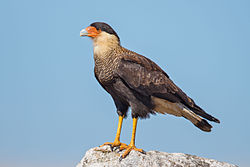
The crested caracara has a total length of 50–65 cm (20–26 in) and a wingspan of 120–132 cm (47–52 in). Its weight is 0.9–1.6 kg (2.0–3.5 lb), averaging 1,348 g (2.972 lb) in seven birds from Tierra del Fuego. Individuals from the colder southern part of its range average larger than those from tropical regions (as predicted by Bergmann's rule) and are the largest type of caracara. In fact, they are the second-largest species of falcon in the world by mean body mass, second only to the gyrfalcon. The cap, belly, thighs, most of the wings, and tail tip are dark brownish, the auriculars (feathers surrounding the ear), throat, and nape are whitish-buff, and the chest, neck, mantle, back, upper tail coverts, crissum (the undertail coverts surrounding the cloaca), and basal part of the tail are whitish-buff barred dark brownish. In flight, the outer primaries show a large conspicuous whitish-buff patch ('window'), as in several other species of caracaras. The legs are yellow and the bare facial skin and cere are deep yellow to reddish-orange. (The facial color can change depending on the bird's mood.) Juveniles resemble adults, but are paler, with streaking on the chest, neck, and back, grey legs, and whitish, later pinkish-purple, facial skin and cere.
A bold, opportunistic raptor, the crested caracara is often seen walking around on the ground looking for food. It mainly feeds on carcasses of dead animals, but it also steals food from other raptors, raids bird and reptile nests, and takes live prey if the possibility arises; mostly this is insects or other small prey, such as small mammals, small birds, amphibians, reptiles, fish, crabs, other shellfish, maggots, and worms, but it can include creatures up to the size of a snowy egret. It may also eat fruit. It is dominant over the black and turkey vulture at carcasses. Furthermore, it also pirates food from them and buteos, as well as from brown pelicans, ibises, and spoonbills, chasing and harrying until they regurgitate or drop food. The crested caracara takes live prey that has been flushed by wildfire, cattle, and farming equipment. Locally, it has even learnt to follow trains or cars for food thrown out. The opportunistic nature of this species means that the crested caracara seeks out the phenomena associated with its food, e.g. wildfires and circling vultures. It is typically solitary, but several individuals may gather at a large food source (e.g. dumps). Breeding takes place in the Southern Hemisphere spring/summer in the southern part of its range, but timing is less strict in warmer regions. The nest is a large, open structure, typically placed on the top of a tree or palm, but sometimes on the ground. The typical clutch size is two eggs.
Crested caracara
The crested caracara (Caracara plancus) is a bird of prey (raptor) in the falcon family, Falconidae. It was formerly placed in the genus Polyborus before being given in its own genus, Caracara. It is native to and found in the southern and southeastern United States, Mexico (where it is present in every state) and the majority of mainland Latin America, as well as some Caribbean islands. The crested caracara is quite adaptable and hardy, for a species found predominantly in the neotropics; it can be found in a range of environments and ecosystems, including semi-arid and desert climates, maritime or coastal areas, subtropical and tropical forests, temperate regions, plains, swamps, and even in urban areas. Documented, albeit rare, sightings have occurred as far north as Minnesota and the Canadian provinces of Alberta, Ontario, and Prince Edward Island. The southern extent of the crested caracara's distribution can reach as far as Tierra del Fuego and Magallanes Region, Chile.
The word "caracara" ultimately traces its origins to Old Tupi karakará. Further etymology is uncertain, but it is assumed to be onomatopoeic, imitating the bird's call.
The crested caracara is also known as the Mexican eagle, although it is not a true eagle. This stems from a 1960 proposal by Rafael Martín del Campo, supposedly based on an analysis of pre-Conquest imagery, that the "bird atop a prickly pear" associated with the mythical founding of Tenochtitlan was a caracara, and not a golden eagle (which is a rare sight in Mexico, especially as far south as Tenochtitlan) as is traditionally depicted. Nonetheless, since at least the Spanish Conquest, the golden eagle has been the bird irrevocably associated with the founding myth, featuring prominently in independent Mexico's national insignia as well as being its national animal.
In 1777, English illustrator John Frederick Miller included a hand-coloured plate of the crested caracara in his Icones animalium et plantarum ("icons of the animal and plant world"). He coined the binomial name Falco plancus and specified the type locality as Tierra del Fuego. The specific epithet plancus is Latin for "eagle". The crested caracara is now placed in the genus Caracara (which was introduced in 1826 by German naturalist Blasius Merrem).
Two subspecies are recognised:
The subspecies C. p. cheriway was formerly classed as a separate species, with the common English name of the northern crested caracara.
The crested caracara has a total length of 50–65 cm (20–26 in) and a wingspan of 120–132 cm (47–52 in). Its weight is 0.9–1.6 kg (2.0–3.5 lb), averaging 1,348 g (2.972 lb) in seven birds from Tierra del Fuego. Individuals from the colder southern part of its range average larger than those from tropical regions (as predicted by Bergmann's rule) and are the largest type of caracara. In fact, they are the second-largest species of falcon in the world by mean body mass, second only to the gyrfalcon. The cap, belly, thighs, most of the wings, and tail tip are dark brownish, the auriculars (feathers surrounding the ear), throat, and nape are whitish-buff, and the chest, neck, mantle, back, upper tail coverts, crissum (the undertail coverts surrounding the cloaca), and basal part of the tail are whitish-buff barred dark brownish. In flight, the outer primaries show a large conspicuous whitish-buff patch ('window'), as in several other species of caracaras. The legs are yellow and the bare facial skin and cere are deep yellow to reddish-orange. (The facial color can change depending on the bird's mood.) Juveniles resemble adults, but are paler, with streaking on the chest, neck, and back, grey legs, and whitish, later pinkish-purple, facial skin and cere.
A bold, opportunistic raptor, the crested caracara is often seen walking around on the ground looking for food. It mainly feeds on carcasses of dead animals, but it also steals food from other raptors, raids bird and reptile nests, and takes live prey if the possibility arises; mostly this is insects or other small prey, such as small mammals, small birds, amphibians, reptiles, fish, crabs, other shellfish, maggots, and worms, but it can include creatures up to the size of a snowy egret. It may also eat fruit. It is dominant over the black and turkey vulture at carcasses. Furthermore, it also pirates food from them and buteos, as well as from brown pelicans, ibises, and spoonbills, chasing and harrying until they regurgitate or drop food. The crested caracara takes live prey that has been flushed by wildfire, cattle, and farming equipment. Locally, it has even learnt to follow trains or cars for food thrown out. The opportunistic nature of this species means that the crested caracara seeks out the phenomena associated with its food, e.g. wildfires and circling vultures. It is typically solitary, but several individuals may gather at a large food source (e.g. dumps). Breeding takes place in the Southern Hemisphere spring/summer in the southern part of its range, but timing is less strict in warmer regions. The nest is a large, open structure, typically placed on the top of a tree or palm, but sometimes on the ground. The typical clutch size is two eggs.
Recent media
Recent media