Hubbry Logo
NantwichNantwichMain
Open search
Nantwich
Community hub
Nantwich
logo
8 pages, 0 posts
0 subscribers
Be the first to start a discussion here.
Nantwich
Nantwich
from Wikipedia

Nantwich (/ˈnæntwɪ/ NAN-twitch) is a market town and civil parish in the unitary authority of Cheshire East in Cheshire, England. It has among the highest concentrations of listed buildings in England, with notably good examples of Tudor and Georgian architecture. At the 2021 census, the parish had a population of 14,045 and the built up area had a population of 18,740.

Key Information

History

[edit]

The origins of the settlement date to Roman times,[3] when salt from Nantwich was used by the Roman garrisons at Chester (Deva Victrix) and Stoke-on-Trent as a preservative and a condiment. Salt has been used in the production of Cheshire cheese and in the tanning industry, both products of the dairy industry based in the Cheshire Plain around the town. Nant comes from the Welsh for brook or stream. Wich and wych are names used to denote brine springs or wells. In 1194 there is a reference to the town as being called Nametwihc, which would indicate it was once the site of a pre-Roman Celtic nemeton or sacred grove.[4]

In the Domesday Book of 1086, Nantwich is recorded as having eight salt houses. It had a castle and was the capital of a barony of the earls of Chester, and of one of the seven hundreds of medieval Cheshire. Nantwich is one of the few places in Cheshire to be marked on the Gough Map, which dates from 1355 to 1366.[5] It was first recorded as an urban area at the time of the Norman Conquest, when the Normans burnt the town to the ground,[6] leaving only one building standing.

Nantwich Castle was built at the crossing of the Weaver before 1180, probably near where the Crown Inn now stands. Although nothing remains of the castle above ground, it affected the town's layout.[7][8] During the medieval period, Nantwich was the most important salt town and probably the second most important settlement in the county after Chester.[9][10] By the 14th century, it was holding a weekly cattle market at the end of what is now Beam Street, and it was also important for its tanning industry centred in Barker Street.[11]

Churche's Mansion, one of the few buildings in Nantwich to survive the fire of 1583

A fire in December 1583 destroyed most of the town to the east of the Weaver.[12][13] Elizabeth I contributed funds to the town's rebuilding and made an England-wide appeal for support for the rebuilding fund which thereby received funds from many successful medieval towns, including Bury St Edmunds in Suffolk. The rebuilding occurred rapidly and followed the plan of the destroyed town.[14] Beam Street was so renamed to reflect the fact that timber (including wood from Delamere Forest) to rebuild the town was transported along it. A plaque marking the 400th anniversary of the fire and of Nantwich's rebuilding was unveiled by the Duke of Gloucester on 20 September 1984.[15]

From the time of the Henrician Reformation, the town had trouble finding good Protestant preachers. An example of the problem was Stephen Jerome, a puritanical preacher, who in 1625 nonetheless tried to rape one of his maidservants, Margaret Knowsley. Rumours of this spread across the town, eventually leading to Knowsley's imprisonment and public shaming in 1627. A few years later, Jerome went to Ireland to continue his preaching career.[16]

During the English Civil War Nantwich declared for Parliament and was besieged several times by Royalist forces. A final six-week siege was lifted after a Parliamentary victory in the Battle of Nantwich on 26 January 1644. This has been re-enacted as "Holly Holy Day" on every anniversary since 1973 by Sealed Knot, an educational charity. The name is taken from commemorative sprigs of holly worn by townsfolk in caps or on clothing in the years after the battle.[17]

The salt industry peaked in the mid-16th century, with about 400 salt houses in 1530, but had almost died out by the end of the 18th century; the last salt house closed in the mid-19th century.[18][19][20] Nikolaus Pevsner considered the salt-industry decline to have been critical in preserving the town's historic buildings.[18] The last tannery closed in 1974. The town's location on the London–Chester road meant that Nantwich began to serve the needs of travellers in medieval times.[9][21] This trade declined in the 19th century with the opening of Telford's road from London to Holyhead, which offered a faster route to Wales, and later with the Grand Junction Railway, which bypassed the town.[19]

Nantwich Mill

[edit]

The presence of a watermill south of Nantwich Bridge was noted in 1228[22] and again about 1363,[23] through the cutting of a mill race or leat and creation of an upstream weir. The resulting Mill Island was ascribed to the 16th century,[22][23] possibly after the original mill was destroyed in the 1583 Great Fire of Nantwich.

In the mid-17th century, the mill was acquired by local landowners, the Cholmondeleys, who retained it until the 1840s.[22] Originally a corn mill, it became a cotton mill (Bott's Mill) from 1789 to 1874,[22][23][24] but reverted to being a corn mill and was recorded as such on the Ordnance Survey First Edition map of Nantwich in 1876.[23] A turbine was installed in about 1890 to replace the water wheel.[22]

The mill was demolished in the 1970s after a fire[22] and then landscaped, with further stabilisation of the mill foundations in 2008.[25] Today it forms part of a riverside park area. Proposals, so far unfollowed, have been made for small-scale hydropower generation using the mill race.[26][27] Nantwich Mill Hydro Generation Ltd was incorporated in April 2009, but dormant in December 2016.[28]

Brine baths

[edit]

Nantwich's brine springs were used for spa or hydrotherapy purposes at two locations: the central Snow Hill swimming pool inaugurated in 1883,[23][29] where the open-air brine pool is still in use,[30] and the Brine Baths Hotel, standing in 70 acres (28 ha) of parkland south of the town from the 1890s to the mid-20th century.[31] The hotel was originally a mansion, Shrewbridge Hall,[23] built for Michael Bott (owner of Nantwich Mill) in 1828. It was bought by Nantwich Brine and Medicinal Baths Company in 1883, extended and opened as a hotel in 1893,[31] with "a well-appointed suite of brine and medicinal baths,"[32] – also described as the "strongest saline baths in the world".[31] These were used to treat patients with ailments that included gout, rheumatism, sciatica and neuritis, using two suites of baths.[33][34]

The hotel's grounds included gardens, tennis courts, a nine-hole golf course and a bowling green. The last survives today as the Nantwich Park Road Bowling Club founded in 1906.[35]

The hotel served as an auxiliary hospital during the First World War.[36] In the Second World War it became an army base and then accommodated WAAF personnel. It closed as a hotel in 1947 and in 1948 became a convalescent home for miners. In 1952 that closed and the building was unsuccessfully put up for sale and demolished in 1959.[32] The grounds were later developed for housing – the Brine Baths Estate[31] – and schools (Brine Leas School and Weaver Primary School).

Governance

[edit]
The Nantwich Civic Hall

There are two tiers of local government covering Nantwich, at civil parish (town) and unitary authority level: Nantwich Town Council and Cheshire East Council. The town council is based at the Civic Hall on Market Street.[37] Parts of the built up area extend into neighbouring parishes, notably Stapeley and District to the south-east.[38]

For national elections, the town is mostly in the Crewe and Nantwich constituency, though some western parts are in the Chester South and Eddisbury constituency.[38] A Nantwich constituency covering the town and surrounding rural areas existed between 1955 and 1983.

Administrative history

[edit]

Nantwich was anciently part of the parish of Acton.[39] Nantwich had a chapel of ease from at least the 12th century, which was rebuilt as the current St Mary's Church in the 14th century.[40] It is unclear exactly when Nantwich became a separate parish from Acton, although it was treated as a separate parish by 1677.[41]

The parish of Nantwich contained the townships of Alvaston, Leighton and Woolstanwood, as well as a Nantwich township covering the town itself and adjoining areas, plus western fringes of the township of Willaston.[42][43] From the 17th century onwards, parishes were gradually given various civil functions under the poor laws, in addition to their original ecclesiastical functions. In some cases, including Nantwich, the civil functions were exercised by each township separately rather than the parish as a whole. In 1866, the legal definition of 'parish' was changed to be the areas used for administering the poor laws, and so the townships also became civil parishes.[44]

In 1850, the Nantwich township was also made a local board district, administered by an elected local board. Such districts were reconstituted as urban districts under the Local Government Act 1894.[45] The urban district was enlarged in 1936, taking in areas from several neighbouring parishes.[46]

Nantwich Urban District Council moved its offices to Brookfield House on Shrewbridge Road in 1949.[47] It also built the Civic Hall on Market Street to serve as a public hall and entertainment venue, opening in 1951.[48][49] The town's previous main public hall had been the privately owned Town Hall beside Nantwich Bridge on the High Street, which was built in 1868 and closed by 1945; it was demolished in 1972.[50]

Nantwich Urban District was abolished in 1974 under the Local Government Act 1972. The area became part of the larger borough of Crewe and Nantwich, also covering the nearby town of Crewe and surrounding rural areas. The government originally proposed calling the new borough Crewe, but the shadow authority elected in 1973 to oversee the transition changed the name to 'Crewe and Nantwich' before the new arrangements came into effect.[51][52][53] A successor parish covering the area of the former Nantwich Urban District was created at the same time, with its parish council taking the name Nantwich Town Council.[54]

In 2009, Cheshire East Council was created, taking over the functions of Crewe and Nantwich Borough Council and Cheshire County Council, which were both abolished.[55]

Places of interest

[edit]
Crown Hotel
46 High Street

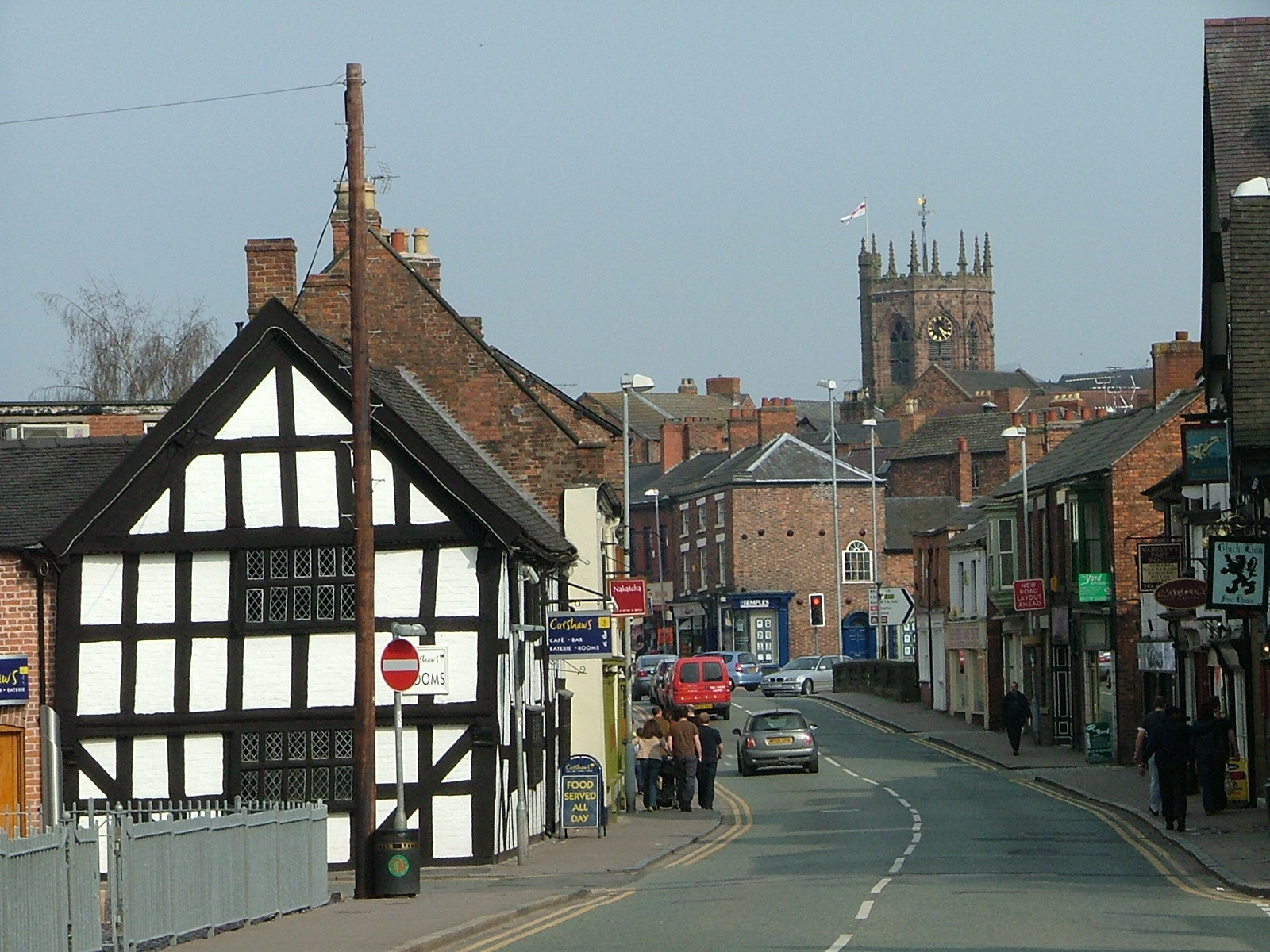
Nantwich has one of the county's largest collections of historic buildings, second only to Chester.[56] These cluster mainly in the town centre on Barker Street, Beam Street, Churchyard Side, High Street and Hospital Street, and extend across the Weaver on Welsh Row. Most are within the 38 hectares (94 acres) of conservation area, which broadly follows the bounds of the late medieval and early post-medieval town.[10][57]

The oldest listed building is the 14th-century St Mary's Church, which is listed Grade I. Two other listed buildings are known to predate the fire of 1583: Sweetbriar Hall and the Grade I-listed Churche's Mansion, both timber-framed Elizabethan mansion houses. A few years after the fire, William Camden described Nantwich as the "best built town in the county".[58] Particularly fine timber-framed buildings from the town's rebuilding include 46 High Street and the Grade I-listed Crown coaching inn. Many half-timbered buildings, such as 140–142 Hospital Street, have been concealed behind brick or rendering. Nantwich contains many Georgian town houses, good examples being Dysart Buildings, 9 Mill Street, Townwell House and 83 Welsh Row. Several examples of Victorian corporate architecture are listed, including the former District Bank by Alfred Waterhouse. The most recent listed building is 1–5 Pillory Street, a curved corner block in 17th-century French style, which dates from 1911. Most of the town's listed buildings were originally residential, but churches, chapels, public houses, schools, banks, almshouses and workhouses are represented. Unusual listed structures include a mounting block, twelve cast-iron bollards, a stone gateway, two garden walls and a summerhouse.

Dorfold Hall is a Grade I listed Jacobean mansion in the nearby village of Acton,[59] considered by Pevsner to be one of the two finest Jacobean houses in Cheshire.[60] Its grounds accommodate Nantwich Show each summer, including, until 2021, the International Cheese Awards.

Nantwich Museum, in Pillory Street, has galleries on the history of the town, including Roman salt-making, Tudor Nantwich's Great Fire, the Civil War Battle of Nantwich (1644) and the more recent shoe, clothing and local cheese-making industries. Hack Green Secret Nuclear Bunker, a few miles outside the town, is a once government-owned nuclear bunker, now a museum. Also in Pillory St is the 82-seat Nantwich Players Theatre, which puts on about five plays a year.[61]

The Nantwich Millennium Clock, located in Cocoa Yard between Pillory Street and Hospital Street, is an art installation with a free-standing mechanical clock inside a glass case. The clock was made by Paul Beckett around 2001 to celebrate the new millennium.[62]

The name of Jan Palach Avenue in the south of the town commemorates the self-immolation of a student in Czechoslovakia in 1969.

Geography

[edit]
St Mary's Church

Nantwich is on the Cheshire Plain, on the banks of the River Weaver. The Shropshire Union Canal runs to the west of the town on an embankment, crossing the Acton lane on the western boundary of the town via an iron aqueduct. There is a basin nearby which is a frequent mooring for visitors to the town. It joins the Llangollen Canal at Hurleston to the north. The town is some 4 miles (6.4 km) south-west of Crewe, 20 miles (32 km) miles south-east of Chester and 22 miles (35 km) east of Wrexham. The town is served by a by-pass to the north and west into which, directly or indirectly, the A51, A500, A529, A530 and A534 roads all feed.

The stretch of A534 from Nantwich to the Welsh border is seen as one of the ten worst stretches of road in England for road safety.[63]

The tower of St Mary's Church was the origin (meridian) of the 6-inch and 1:2500 Ordnance Survey maps of Cheshire.[64]

Public transport

[edit]

Nantwich railway station is on the line between Crewe and Whitchurch, Shrewsbury and other towns along the Welsh border. It is served mainly by Transport for Wales trains running from Manchester Piccadilly and Crewe to Shrewsbury and onwards to stations in South Wales.

D&G Bus, Stagecoach and Mikro Coaches operate bus routes from Nantwich Bus Station and in and around Nantwich, some with funding from Cheshire East council.

Education

[edit]

The town has eight primary schools (Highfields Community, Willaston Primary Academy, Millfields, Pear Tree, St Anne's (Catholic), Stapeley Broad Lane (Church of England), The Weaver and Nantwich Primary Academy) and two secondary schools, Brine Leas School and Malbank School and Sixth Form College. Reaseheath College runs further education and higher education courses in conjunction with Harper Adams University and the University of Chester. A sixth-form college at Brine Leas opened in September 2010.

For the London 2012 Olympic Games, Malbank School and Sixth Form College was nominated to represent the North West.

Sport

[edit]
The Weaver Stadium

The town's football club, Nantwich Town, competes in and in 2006 won the FA Vase. It plays at the Weaver Stadium, opened in 2007.[65]

Rugby union is played at two clubs. Crewe and Nantwich RUFC, founded in 1922, is based at Vagrants Sports Club in Newcastle Road, Willaston, and runs four senior teams including a ladies team; the first XV play in the Midlands 1 West (Level 6). It holds Club Mark and RFU Seal of Approval accreditations and has a mini and junior section of over 250 young people aged 5–18 taking part every Sunday, with a girls section. Acton Nomads RFC, founded in 2009, won the 2010 RFU Presidents XV "This is Rugby" Award;[66][67] it operates two senior sides.

In rugby league, Crewe & Nantwich Steamers play at the Barony Park, Nantwich, also the home ground for Acton Nomads RFC.

The town's cricket club in Whitehouse Lane won the ECB-accredited Cheshire County Premier League title in 2010, 2011, 2012 and 2018. It regularly hosts Cheshire Minor County cricket matches. Midway through the 2017 season, bowler Jimmy Warrington became the first player in the history of the Cheshire County Premier League to take 500 wickets.[68] In 2019, Nantwich reached the final of the ECB National Club Cricket Championship.[69] In the final, played at Lord's, it met Swardeston and lost by 53 runs.[70]

Media

[edit]

The daily Sentinel, weekly Nantwich Chronicle and Crewe and Nantwich Guardian, and monthly Dabber cover the town.[71]

Local TV coverage is provided by BBC North West and ITV from the Winter Hill TV transmitter.

Radio stations for the Nantwich area include BBC Radio Stoke, Cheshire's Silk Radio from Macclesfield, Hits Radio Staffordshire & Cheshire and Greatest Hits Radio Staffordshire & Cheshire from Stoke-on-Trent, Crewe-based The Cat 107.9 community radio, and Nantwich-based online radio and networking organisation RedShift Radio.

The Nantwich News is a hyperlocal blog for local events and issues. The inNantwich website gives Nantwich information, including shops, firms, schools, wifi spots, car parking and toilets.

Events

[edit]

Cheese awards

[edit]

Until 2019, the annual International Cheese Awards were held in July each year during Nantwich Show, at the Dorfold Hall estate.[72][73] In 2021 it was announced the Awards would be moving to the Staffordshire Show Grounds and would no longer be part of the Nantwich Show event.[74]

Jazz and blues

[edit]

Since 1996, Nantwich has hosted an annual Nantwich Jazz and Blues Festival over the Easter Bank Holiday weekend. Jazz and blues artists from around the country perform in pubs and venues.[75][76]

Food festival

[edit]

The annual Nantwich Food Festival is held in the town centre on the first weekend of September. Re-established as a free-entry festival in 2010, it attracts numerous artisan producers from the local area and further afield, and offers chef demonstrations, family activities and entertainment. It draws some 30,000 visitors a year.[77]

Notable people

[edit]

Public service

[edit]
Sir Ranulph Crewe
David Beatty, 1st Earl Beatty, 1917

Politics

[edit]
Gwyneth Dunwoody, 2008

Science

[edit]
Joseph Priestley, 1794

Arts

[edit]
Peter Bayley, c.1810

Sport

[edit]
A. N. Hornby

See also

[edit]

References

[edit]
[edit]
Revisions and contributorsEdit on WikipediaRead on Wikipedia
from Grokipedia
Nantwich is a and in , , situated on the River Weaver and historically renowned for salt production from local springs that dates to Roman times in the 2nd and 3rd centuries AD. The town's name reflects this heritage, possibly deriving from Welsh "Nant yr Heledd Wen," meaning "the stream of the white salt pit." With a population of 14,045 as recorded in the 2021 census, Nantwich maintains a compact of about 5 square kilometers. The town features one of England's highest concentrations of listed historic buildings, particularly timber-framed structures from the Tudor and Georgian eras, many rebuilt following the Great Fire of 1583 that destroyed much of the medieval center. Economically tied to salt-making for over 1,600 years—with up to 216 salt houses operating by the late —Nantwich transitioned from industrial extraction to a focus on , , and centered on its preserved and market traditions. During the , Nantwich functioned as a Parliamentarian , enduring a siege over 1643 before relief forces under Sir Thomas Fairfax decisively defeated the besiegers in the on 25 January 1644, securing the northwest for and halting advances in . Later challenges included a outbreak in 1849, underscoring the town's evolution through industrial and trials while retaining its core identity as a resilient settlement.

History

Roman and Early Medieval Origins

Archaeological excavations at Kingsley Fields on the western outskirts of Nantwich in 2002 uncovered the most substantial evidence to date of a Roman-period settlement, dating to the 1st to 4th centuries AD, centered on salt production from local springs. The site revealed a Roman road linking to broader networks, timber-built tanks—the finest preserved examples in —along with associated buildings, enclosures, a well, and infrastructure for collection, storage, and evaporation into salt. Waterlogged conditions preserved organic materials, including structural timbers, while a small number of burials indicated a modest focused on this industrial activity, which supplied salt to Roman garrisons at sites like and . Following the Roman withdrawal around 410 AD, salt production continued in the early medieval period amid Anglo-Saxon settlement in the region, part of the Mercian kingdom. The site's name, deriving from an term denoting a salt-working settlement ("wic") associated with the nearby River Nant, reflects this economic continuity. Limited archaeological evidence, such as sparse late Saxon pottery, suggests the urban core emerged in the as a specialized industrial center within the Acton parish chapelry, rather than as an ancient estate hub. The of 1086 records Nantwich as a key salt-producing locale among 's "wiche" towns, with eight operational salthouses yielding significant —valued at £21 in 1066 (tempore regis Edwardi)—through regulated tolls on salt sales and production boilings, which varied seasonally to meet demand for preservation, such as in autumn. The settlement was demarcated by a and defensive , with local officials enforcing penalties like fines or salt forfeitures for infractions, underscoring its administered economic role under royal and earldom oversight, though lacking a dedicated hundredal (held instead at Warmundestrou). This documentation highlights Nantwich's pre-Norman prominence in salt extraction, without evidence of Norse disruption seen elsewhere in .

Salt Trade and Economic Foundations

Nantwich's salt production originated in the Roman period, during the 2nd and 3rd centuries AD, when from natural springs associated with the River Weaver was evaporated using lead pans to produce salt for local garrisons at and . Archaeological evidence, including a Roman at Reaseheath and remnants of potential salt works west of the Weaver, underscores the industry's early establishment, with salt serving essential roles in and as a . By the time of the in 1086, Nantwich supported eight operational , reflecting its status as a key production center amid Cheshire's brine-rich formed from Triassic-era evaporites. The town's name, deriving from elements meaning "salt town on the Weaver," highlights this foundational activity, which persisted through the medieval era using methods like storing in hollowed-out trunks known as "salt ships." Production expanded significantly during the , peaking in the late with 216 drawing from the communal "Old Biot" pit adjacent to the river, fueling economic growth through increased output and regional demand. Salt making involved in iron pans over furnaces, initially fueled by wood and later by after access improved around 1636, enabling higher yields and broader . By 1675, Nantwich output reached approximately 100 tons per week, supporting exports via to , , and , while locally sustaining industries like cheese production—requiring salt for and preservation—and tanning. This salt trade formed the bedrock of Nantwich's economy, generating wealth that financed urban development, trade infrastructure, and ancillary occupations, positioning the town as a vital node in pre-industrial England's preservation and commodity networks despite competition from coastal and other inland producers. The industry's scale, evidenced by the proliferation of specialized "wych houses," underscores its causal role in attracting settlement, fostering self-sufficiency in , and establishing Nantwich's reputation as a commercial hub in Cheshire's "salt towns."

Tudor Disasters and Reconstruction

The Great Fire of Nantwich began on December 10, 1583, when a brewer in the Waterlode area accidentally ignited a blaze that rapidly spread through the town's predominantly timber-framed structures. The conflagration persisted for 20 days, ultimately destroying approximately 150 houses, inns, and other buildings, while rendering 900 residents homeless out of a pre-fire population of around 2,000. Despite the extensive destruction, which consumed most buildings on the eastern side of the River Weaver, only two fatalities were recorded, attributed in part to the efforts of in sheltering evacuees. The fire prompted a coordinated national relief effort, with Queen Elizabeth I contributing £1,000 toward reconstruction and authorizing timber supplies from the royal Delamere Forest to facilitate rebuilding with black-and-white timber-framed architecture characteristic of the era. Donations from across supported the recovery, marking one of the earliest instances of widespread charitable response to an urban disaster in the realm. Reconstruction efforts transformed Nantwich's urban landscape, replacing lost medieval structures with durable Tudor-style half-timbered buildings featuring wattle-and-daub infill, many of which survive today and contribute to the town's high concentration of listed historic properties. Notable survivals from before the fire, such as Churche's Mansion constructed in the 1570s, underscore the selective devastation and subsequent emphasis on resilient framing techniques during the rebuild. This post-fire renewal solidified Nantwich's reputation for salt-derived prosperity, as economic activities resumed amid the renewed infrastructure, setting the stage for its role in later historical events.

Civil War Significance

Nantwich served as a key Parliamentarian garrison in during the , established in 1643 amid control of nearby . Its strategic value stemmed from its position on the River Weaver, facilitating supply lines and serving as a bulwark against advances from the Welsh borders and , which was a major base under . By late December 1643, Royalist forces under Sir William Brereton's regional command had isolated Nantwich, prompting a siege that intensified in January 1644 as Byron assembled around 3,000-4,000 troops to capture the town, the last significant Parliamentarian foothold in Cheshire. The defenders, numbering about 2,000 under Colonel Robert Steele, endured harsh winter conditions, with the River Weaver freezing and allowing Royalist assaults, but held out through fortifications and local support. On 25 January 1644, a Parliamentarian relief force of approximately 3,000-4,000 men, led by Sir Thomas Fairfax and including under George Monck, arrived from the west, forcing Byron to divide his army. The ensuing battle, fought in snow-covered fields south and east of Nantwich, lasted about two hours and resulted in a decisive Parliamentarian victory, with Royalists suffering heavy casualties—estimated at 500 killed and many captured—while Fairfax reported minimal losses. Byron retreated toward , abandoning siege equipment and allowing the town to be relieved. The battle's significance lay in securing Parliamentarian dominance in , disrupting Royalist supply routes to and the north, and preventing a potential link-up with Scottish or other allies. It boosted Parliamentarian morale early in 1644, contributing to broader momentum toward the , while exposing Royalist overextension in the northwest; contemporaries noted it as a that ended hopes of Royalist consolidation in the region. Local commemorations, such as the annual "Holly Holy Day" reenactment, underscore its enduring role in Civil War memory.

Industrial Decline and Modern Transitions

The salt industry, which had dominated Nantwich's economy since medieval times, experienced a marked decline starting in the early 17th century, driven by competition from cheaper rock salt mining in nearby Northwich and Winsford, as well as frequent fires destroying wooden salt works and shifts in production methods favoring evaporated sea salt from elsewhere. Records indicate 400 salt houses operating in 1530, reducing to 216 by 1605, and further to just one by the 1850s. By the early 20th century, industrial salt production in the town had contracted to nine works from over 100 in the 13th century, reflecting broader inefficiencies in open-pan boiling techniques compared to underground mining. This contraction forced economic diversification into ancillary trades like leather tanning, dyeing, and , with the leather sector reaching its in the when thousands of shoes were manufactured weekly for domestic and export markets. However, these industries similarly faded amid rising overseas competition and elsewhere; the final tannery ceased operations in the mid-20th century, leaving Nantwich without dominant bases akin to those in adjacent . The relative absence of heavy industrialization—spared by the salt sector's early collapse—prevented widespread demolition for factories, thereby conserving the town's Tudor and as a legacy of . Post-1945, Nantwich transitioned toward a service-oriented , emphasizing retail, , and , bolstered by its preserved heritage drawing visitors and its role as a commuter hub to rail-linked and . and cheesemaking persist as agricultural holdovers, but employment now skews toward wholesale, retail (around 14% of jobs), and knowledge-based sectors, with the town's independent shops and market supporting local amid broader regional contraction from overseas imports. This shift aligns with 's profile, where accounts for 11.3% of jobs, down from historical peaks, yielding higher employment rates than regional averages at over 75% in recent years.

Geography and Environment

Topography and Location

Nantwich is located in Cheshire East unitary authority, within the ceremonial county of Cheshire, northwestern England, at coordinates 53°4′04″N 2°31′15″W. The town occupies a position on the Cheshire Plain, a predominantly flat, low-elevation landscape formed by glacial and fluvial deposits, supporting extensive dairy farming and agriculture across the region. Positioned approximately 4 miles (6 km) southwest of and 20 miles (32 km) southeast of , Nantwich benefits from proximity to major transport routes while maintaining a rural setting. Its elevation averages 40 metres (131 feet) above , with surrounding terrain exhibiting gentle undulations typical of , ranging from 31 to 70 metres in the immediate vicinity. The River Weaver forms a key geographical feature, with Nantwich situated along its banks; the river's meandering course through the plain has shaped local , enabling in lower reaches and contributing to periodic flooding events. The extends westward of the town centre, enhancing the waterway network and historical connectivity in this part of .

Hydrology and Environmental Features

The River Weaver, originating in the Hills and flowing northwest through Nantwich before joining the Mersey, dominates the town's , providing primary drainage for the surrounding . This river, part of the Weaver-Gowy catchment characterized by intensive dairy farming upstream, has historically supported navigation and milling but also poses flood risks due to its meandering course and impermeable underlying clays that limit infiltration. In the 25-26 October 2019 event, prolonged heavy rainfall caused the Weaver to overtop banks in Nantwich, with flooding mechanisms including main river overflow and localized surface water ponding in low-lying areas adjacent to the channel, affecting residential and infrastructural zones. Subsurface features high tables, sustained by Group rocks—predominantly red mudstones and sandstones with low permeability—that impede vertical drainage and promote lateral flow. Historical brine pumping for salt production, exploiting Permian and deposits up to 400 meters thick beneath the town, has induced and maintained saturated conditions, creating zones of waterlogged alluvial deposits 3-4 meters deep that preserve organic archaeological materials. Natural springs, remnants of ancient lagoonal environments from 220 million years ago, further influenced early features, though extraction has depleted surface expressions while exacerbating karstic dissolution hazards like ground collapse. Environmental characteristics reflect the Cheshire Basin's low-relief topography, with flat, fertile plains underlain by salt prone to instability from dissolution, mitigated today through regulated pumping limits since the 19th-century crises. These geological traits support but constrain development, with waterlogged zones designated for archaeological under policies to prevent drainage-induced degradation. Broader ecological elements include riparian habitats along the Weaver fostering wetland species, though urban proximity limits hotspots; conservation efforts prioritize integrated management of floodplains to balance hydrological function and habitat integrity amid climate-driven rainfall variability.

Climate Data and Patterns

Nantwich exhibits a (Köppen Cfb ), characterized by mild temperatures year-round, moderate seasonal variations, and evenly distributed without extreme droughts or monsoonal influences. This pattern aligns with broader northwest conditions, influenced by Atlantic bringing consistent moisture and moderating extremes via proximity to the , approximately 40 km west. Annual average temperatures hover around 9–10 °C, with summers rarely exceeding 25 °C and winters seldom dropping below freezing for prolonged periods. totals approximately 800–860 mm annually, occurring on about 140–150 days, predominantly as , though light or sleet features in 10–20 winter days per year.
MonthAvg. High (°C)Avg. Low (°C) (mm)
January7162
February7148
March10245
April13450
May16748
June191054
July211256
August211260
September181059
October14777
November10473
December7272
Data derived from interpolated historical observations (1991–2020 period), with nearest station influences from and regional models; July marks the warmest month with peaks occasionally reaching 30 °C in heatwaves, while November sees the highest rainfall at 60–75 mm. Winters feature skies 60–70% of the time, with frost on 40–50 nights but minimal snowfall accumulation (average 5–10 cm annually). Summer averages 70–80%, contributing to muggy conditions during occasional warm spells, though (5–10 m/s from southwest) provide ventilation. Long-term trends indicate slight warming of 0.5–1 °C since 1980, consistent with UK-wide patterns, but no significant shifts in volume, though intensity may increase in autumn storms. Extreme events, such as the 2012 wet summer (exceeding 150% normal rainfall) or 2022 (35 °C+), remain outliers influenced by large-scale atmospheric blocking rather than local topography.

Demographics

Population Dynamics

The population of Nantwich parish has exhibited steady long-term growth since the early , driven initially by agricultural and salt-related economic activity, though rates have decelerated markedly in recent decades. In 1801, the parish recorded 3,463 residents; this rose to 5,579 by , reflecting expansion tied to industrializing trade networks. By 1901, the figure reached 7,722, and it continued to 8,843 in 1951, supported by stability in functions. The 2001 census marked 12,516 inhabitants, indicating a cumulative increase of over 260% from 1801 amid broader urbanization trends in .
Census YearParish Population
18013,463
18515,579
19017,722
19518,843
200112,516
201113,964
202114,045
From 2001 to 2011, the grew by approximately 11.6%, outpacing regional averages and attributable to inward migration from nearby urban centers like . However, the 2011–2021 decade saw minimal expansion to 14,045, a mere 0.6% rise or 0.06% annually, contrasting with East's 7.7% district-wide growth fueled by broader commuter and retirement influxes. This stagnation aligns with constrained housing development and limited high-growth employment sectors in Nantwich proper, though the wider built-up area reached 18,734 by 2021, incorporating adjacent suburbs. No specific projections for Nantwich are available, but regional forecasts suggest modest continued increases tied to aging demographics and selective in-migration.

Socioeconomic Indicators

Nantwich displays socioeconomic characteristics indicative of relative affluence within . The town's Lower Super Output Areas (LSOAs) contribute to the unitary authority's overall low deprivation profile, with ranked 228th out of 317 local authorities in the Indices of Multiple Deprivation (IMD), where a higher rank denotes lower deprivation levels across domains including , , health, education, and . No Nantwich LSOAs fall within the most deprived deciles nationally, reflecting limited pockets of multiple deprivation compared to nearby urban centers like . Employment data from the 2021 Census reveals 58.29% of Nantwich residents aged 16 and over in , comprising 74.53% full-time and 25.47% part-time roles, with an rate of 2.91% among the economically active . This aligns with East's claimant count of 2.4% as of March 2023, underscoring robust local labor market participation driven by sectors such as retail, , and commuting to nearby commercial hubs. Educational attainment exceeds national benchmarks, with 43.15% of adults holding Level 4 qualifications (degree level or equivalent) per the Census, contrasted against 11.85% with no formal qualifications. Household income estimates for Nantwich LSOAs average £39,500 to £41,600 annually, surpassing the median of £35,800 and the median of £30,800. Housing tenure reinforces economic stability, with 73.39% owner-occupation in the Nantwich South and Stapeley ward, ranking it 33rd out of 52 wards in Cheshire East for home ownership prevalence. These indicators collectively position Nantwich as a low-deprivation locale with strong educational and employment foundations, though reliant on broader regional economic dynamics.

Cultural and Ethnic Composition

The ethnic composition of Nantwich is markedly homogeneous, reflecting its status as a historic market town in rural Cheshire. In the 2021 census, the parish population stood at 14,045, with 13,589 residents (96.7%) identifying as White, predominantly White British. Minority ethnic groups are limited, comprising Asian residents (155, or 1.1%), Black residents (39, or 0.3%), those of mixed or multiple ethnicities, Arabs (21, or 0.1%), and other ethnic groups (small numbers totaling under 1%). This profile exceeds the White population share in Cheshire East (94.4%) and England and Wales overall (81.0%), indicating lower levels of immigration and ethnic diversification compared to urban centers. Religiously, Nantwich maintains a Christian cultural foundation tied to its medieval heritage, including landmarks like , but has advanced. The 2021 showed 5,143 residents (36.6%) reporting no , mirroring broader declines in affiliation across the region where "no religion" rose from 22.7% in 2011 to 37.7% in by 2021. predominates among those affirming a faith, consistent with 54.3% of residents identifying as Christian, though exact parish figures align with this trend given minimal non-Christian minorities (e.g., 44 , 48 Buddhists, 11 ). Non-religious and unspecified responses underscore a shift toward cultural , while community events retain English traditions like church fêtes and seasonal festivals without significant multicultural influences.

Economy

Traditional Industries' Legacy

Nantwich's economy historically revolved around salt production, cheesemaking, and goods manufacturing, particularly , which capitalized on local brine springs, fertile dairy pastures, and tanning byproducts from saltworks. These industries drove prosperity from the medieval period onward, employing much of the population and funding civic developments like timber-framed buildings that survived the Great Fire of 1583. By the , they accounted for the bulk of trade, with salt enabling preservation for cheese and hides processing for . Salt extraction, utilizing open-pan evaporation of brine from natural springs, originated in Roman times and intensified under Saxon influence, as indicated by the town's name from the Old English wic denoting a saltworking site. Production peaked in the medieval era for food preservation and export, supporting regional trade networks, but waned by the 1850s due to depleted shallow deposits and competition from rock salt mining in nearby Northwich. The legacy endures in heritage interpretations at local museums, architectural remnants like salt warehouses, and the foundational role in ancillary sectors such as tanning, which supplied leather for shoes and sustained employment into the industrial age. Cheesemaking leveraged Cheshire's grassland for milk production and local salt for brining, with Nantwich serving as a distribution hub by the 17th century when inventories document widespread farm-based operations. Cheshire cheese, known for its crumbly texture, gained national prominence through markets and shipments to London, peaking in output during the 18th and 19th centuries amid enclosure-driven dairy intensification. Though industrialized production shifted elsewhere post-1900, the legacy includes ongoing small-scale farmhouse traditions, cultural festivals showcasing the product, and economic ties to modern branding that evoke Nantwich's pastoral heritage. Shoemaking industrialized from cottage crafts in the early , with formal factories emerging by 1825 and reaching a zenith in the , when approximately one-third of male and one-sixth of female workers participated, producing boots for domestic and markets using tanned local hides. The sector employed over 1,000 by but declined sharply after to cheap imports, elsewhere, and two wars disrupting supply chains, with most factories closing by the . Remnants include repurposed mill , oral histories in local archives, and a skilled artisanal base that influenced vocational training, underscoring Nantwich's transition from manual trades to service-oriented economy.

Contemporary Sectors and Employment

Nantwich's contemporary economy centers on , with retail, , and forming key employment sectors. Traditional and extractive activities, such as salt production, have ceased to provide significant jobs, leaving a reliance on local services and residual agricultural connections. businesses occupy prominent spaces in the town, serving as important local employers amid demand for office facilities that outstrips available supply as of recent assessments. Developments like Business Park and Cocoa Yard accommodate these operations, alongside retail outlets that sustain commerce through small-scale enterprises and independent shops. Within the encompassing authority, which influences Nantwich's labor market, the employment rate for ages 16-64 stood at 83.3% in the year ending December 2023, reflecting robust participation above regional averages, though specific ward-level data for Nantwich indicates alignment with service-driven patterns rather than . The town council collaborates with bodies like the South Cheshire Chamber of Commerce to foster growth in these areas, emphasizing viability over large-scale industry. The average house price in Nantwich over the last year stood at £296,616, with detached properties averaging £443,478, at £288,269, terraced houses at £196,401, and flats at £118,863 based on sales from July 2024 to July 2025. Prices in the Nantwich postcode sector CW5 5 rose 1.3% nominally in the last year but declined 2.5% after adjusting for , reflecting subdued local growth amid broader regional increases in where averages reached £302,000 in August 2025, up 7.6% year-over-year. Early 2025 data indicated a robust market start in Nantwich, driven by buyer confidence, competitive rates, and heightened activity among first-time buyers and movers. New residential developments have accelerated to meet demand, aligned with Council's local plan allocating approximately 2,050 homes for Nantwich through 2030. Key projects include Kingsley Fields, targeting up to 1,100 homes with a mixed-use local centre, and Maylands Park, encompassing Phase 1A (189 homes approved) and Phase 2 (around 400 homes, including 30% affordable units and ecological provisions). Recent proposals encompass Seddon Homes' 275-home scheme in adjacent Stapeley submitted in October 2025, David Wilson Homes' up to 90 dwellings off the outlined in February 2025, and a 40-home development approved in May 2025 featuring 12 affordable units integrated across the site. Affordability initiatives include council-managed shared equity and discounted sale schemes for low-cost home ownership, though much development occurs on greenfield sites, prompting scrutiny over capacity. Overall, supply expansion aims to address pressures but has not fully offset modest stagnation in Nantwich relative to trends.

Governance and Politics

Administrative Framework

Nantwich functions as a within the of , which was established on 1 April 2009 through the merger of the former Cheshire County Council and the borough councils of and Nantwich, , and . This structure consolidates most local government responsibilities, including planning, education, social services, and highways, under , eliminating the previous two-tier county-district model. The council, comprising 83 members as of 2025, operates via a committee system for decision-making, though reforms announced in 2025 mandate a shift to a leader-and-cabinet model to streamline . Nantwich-specific representation at this level falls under the Cheshire East wards of Nantwich North and West, each electing three councillors. At the parish level, Nantwich Town Council serves as the lowest tier of local , established in 1974 as the successor to the Nantwich Urban District Council under the Local Government Act 1972. The council consists of 15 elected members, divided equally among three wards—North, South, and West—following boundary changes implemented for the May 2023 elections. These councillors, serving four-year terms with the next election in 2027, handle devolved functions such as community facilities, allotments, markets, and cultural events, funded primarily through a precept levied on within the . The town council collaborates with on broader issues but maintains autonomy over hyper-local matters, including the operation of Nantwich Civic Hall. This framework reflects England's post-2009 local government reorganization, prioritizing efficiency in unitary authorities while preserving councils for grassroots representation in towns like Nantwich, where the 's precept represents the highest Band D rate among parishes. Coordination between tiers occurs through joint committees and shared services, though tensions have arisen over , as evidenced by town council efforts to assert greater control over local assets like Brookfield Hall in 2025.

Local Elections and Representation

Nantwich is governed at the parish level by , which comprises 15 elected representing three wards: North, South, and West. The council, established in 1974, handles local amenities, events, and community services, with held every four years. The most recent town council occurred on 4 May 2023, alongside polls, resulting in a mix of Independent, Conservative, and Labour representatives across the wards. In the North Ward, Stuart Robert Bostock (Independent, 650 votes) and Daniel Thomas Bull (Conservative, 509 votes) were elected. The South Ward elected William Riddell Graham (Labour, 799 votes), with Eddie George (Labour) receiving 661 votes but not securing a seat. In the West Ward, Loic Claude Charles Charbonneau (Labour, 697 votes) was elected. Mary Slinn (North Ward) was appointed in May 2025. At the upper tier, Nantwich falls within , where local representation is provided through the Nantwich North and West ward (electing one councillor) and the Nantwich South and Stapeley ward (electing two councillors). The council's 82 members were last elected in full on 4 May 2023, with achieved; Labour formed a minority administration. In Nantwich North and West, Anna Burton (Labour) won with 1,109 votes, defeating challengers including Stuart Robert Bostock (Independent, 593 votes). Specific results for Nantwich South and Stapeley in 2023 reflect competitive races among major parties, though exact vote tallies for elected members align with the ward's two-seat structure. Elections for occur every four years, with the next in 2027; by-elections or casual vacancies may arise interim, as seen in a West Ward poll on 12 December 2024. Local representation emphasizes community-focused issues, such as precept setting for services; in December 2024, Nantwich approved a 7% precept increase for 2025-26 amid internal debates on fiscal priorities. in the 2023 town council elections varied by ward but remained modest, consistent with parish-level polls nationally. Residents elect these bodies to oversee planning, maintenance of public spaces, and liaison with the on broader infrastructure.

Administrative Controversies and Criticisms

In January 2025, Nantwich Town dismissed its official , , following complaints about posts that a claimed brought the authority into disrepute; the posts reportedly criticized local and included satirical content targeting decisions. The decision drew backlash from residents who viewed it as an overreach on free speech, with some arguing it reflected broader tensions over accountability in small-town administration. Cheshire East Council, the unitary authority overseeing Nantwich, faced resident opposition in late 2024 over proposed changes to parking charges, including new Sunday and evening fees set to take effect on December 2, 2024, which critics argued would deter shoppers and burden local businesses without adequate consultation. Local traders and drivers warned of economic impacts, highlighting perceived insensitivity to Nantwich's market-town economy amid rising operational costs. The council's upgraded planning portal, implemented in 2025, has been criticized for unreliability, with delays in processing applications and public comments affecting Nantwich developments; council officers admitted in October 2025 to ongoing technical issues, prompting MP to label it "not fit for purpose" and a mockery of . Residents reported frustration over inaccessible feedback mechanisms, exacerbating disputes in areas like expansions near historic sites. Broader administrative critiques of have indirectly impacted Nantwich services, including its designation as the UK's worst council for repairs with 17,191 open reports as of March 2025, leading to safety concerns on local roads. A July 2024 external review warned of potential due to low reserves, historic overspending, and unmet savings targets, with governance failures cited as root causes affecting to towns like Nantwich. investigations into , such as a 2015 contract award probe dropped in 2020, have fueled perceptions of systemic issues in procurement and oversight.

Culture and Heritage

Architectural and Historical Landmarks

Nantwich features a high concentration of historic buildings, particularly timber-framed structures from the , many of which survived the Great Fire of 1583 that destroyed over 150 properties in the town. The fire, ignited on December 10, 1583, by a brewer in Waterlode, raged for 20 days amid harsh winter conditions, yet key landmarks endured due to their robust construction or fortunate positioning. This survival underscores the town's architectural resilience, with examples blending medieval, Tudor, and Georgian styles that reflect its historical prosperity from the salt trade. St Mary's Church, constructed primarily in the 14th century from red sandstone, stands as the town's most prominent ecclesiastical landmark, exemplifying the transition from Decorated to styles. Its interior boasts intricate fan vaults and a set of 20 misericords dating to the late 14th or early , carved with detailed motifs including mythical creatures and foliage. The church served as a refuge during the 1583 fire, highlighting its central role in community endurance. Churche's Mansion, a Grade I listed timber-framed house completed in 1577 by builder Thomas Clease for merchant Richard Churche, exemplifies with its black-and-white facade and cross-wing plan. Located on the town's edge, it escaped the 1583 that razed much of central Nantwich east of the River Weaver. Other notable survivors include Sweetbriar Hall, a late 15th-century timber-framed building originally for family, which predates the fire and retains medieval features. These structures, alongside post-fire rebuilds incorporating and stone, contribute to Nantwich's over 130 listed buildings, preserving a tangible link to its pre-industrial heritage.

Festivals and Community Events

Nantwich hosts a variety of annual festivals and community events that highlight its agricultural heritage, culinary traditions, and musical , drawing thousands of visitors each year. These gatherings, often organized by local volunteers and the town council, foster and showcase regional produce and performances. The Nantwich , & , held over the weekend—such as April 17 to 21 in 2025—features over 150 live acts across 17 venues throughout the town, transforming Nantwich into a hub for , , and diverse music genres. Established in the 1990s, the event now in its 25th year or more, attracts performers and attendees with wristband access to multiple stages, emphasizing local and national talent. The Nantwich Food Festival, a free three-day event in , celebrates local produce with live cooking demonstrations, performances, and stalls from regional producers, operated entirely by volunteers and recognized with awards for its quality. It promotes Cheshire's farming output, including cheeses and artisan foods, while integrating family-friendly activities. Agricultural traditions are prominent at the Nantwich Show, occurring on the last of —July 30 in 2025—at Reaseheath College, where livestock competitions, trade stands, and family entertainment draw crowds to honor British farming practices. A highlight is the inaugural Nantwich Cheese Awards, showcasing local and artisan cheeses in recognition of the town's historic cheesemaking legacy. Historical reenactments feature in the , an annual January event commemorating the 1644 clash, with costumed participants and educational displays organized by local heritage groups to engage the community in the town's parliamentary victory. Additional cultural events include the Words and Music Festival in , blending and performances, and seasonal gatherings like the Nantwich Lights Switch-On in , which initiates holiday illuminations with public festivities. Community-oriented activities, such as the monthly Nantwich Film Club and Luncheon Club, supplement these larger festivals by providing regular social opportunities for residents.

Arts, Media, and Local Traditions

Nantwich supports a modest but active scene centered on community-driven initiatives. The Nantwich Players, an amateur dramatic society established in the town, operates its own 120-seat theatre at One Love Lane and stages six productions annually, including award-winning youth and adult performances across genres such as drama and musicals. The Civic Hall, a multi-purpose venue managed by Nantwich , hosts live music events, shows, and performances, featuring lineups in 2024 that included rock tributes like Lizzy and blues acts such as Troy Redfern, alongside broader genres to attract diverse audiences. are represented through local galleries like Warmwalls on Hospital Street, which exhibits contemporary works, and periodic artisan markets at Nantwich Castle that showcase crafts, jewelry, and original art from regional makers. The Nantwich Museum holds a collection of local paintings, notably scenes of town life by 19th-20th century artist Herbert St John Jones, contributing to public appreciation of regional heritage through temporary exhibitions. Local media primarily consists of independent online and print outlets focused on town-specific reporting. Nantwich News, an online platform launched around 2010, provides daily coverage of local events, , and incidents, including recent stories on arrests and business certifications as of 2025. Nantwich Nub News, another digital service, delivers hyper-local updates on , jobs, and happenings, emphasizing user-submitted content via its "Nub It" feature. Print traditions persist through the Nantwich Chronicle, a with roots traceable to the , offering subscriptions for coverage of regional affairs, though circulation has declined with digital shifts. The Nantwich Guardian, historically a free-sheet distributed locally, supplemented these with and brief summaries until its absorption into broader regional media. Local traditions emphasize market culture and historical commemorations tied to the town's medieval and Civil War past. Nantwich's traditional market, held three days weekly on the Square, upholds customs of open-air trading in produce and goods, with vendors competing nationally for recognition, as evidenced by its 2025 entry for Britain's Favourite Market award against towns like Oxford. A distinctive custom, Holly Holy Day, originates from the 1644 Royalist siege during the English Civil War, when townsfolk wore holly sprigs in their hats to symbolize resistance; this practice endures in informal observances and links to annual reenactments, reinforcing communal identity without formal institutionalization. Such traditions foster social continuity, blending everyday commerce with echoes of historical resilience, though they face modern pressures from retail evolution.

Education and Community Services

Primary and Secondary Education

Nantwich is served by several state-funded catering to children aged 3 to 11, primarily under the local authority and including and church-affiliated institutions. Key establishments include Nantwich Primary Academy, an with approximately 300 pupils, rated Good by in its most recent inspection focusing on quality of and . Weaver Primary School, a community school emphasizing community engagement, serves around 200 pupils and maintains a focus on foundational skills. St Anne's Catholic Primary School provides faith-based to about 250 pupils, integrating with the . Acton Church of England Primary Academy, located on the town's edge, educates roughly 150 pupils and received an inspection in November 2023 highlighting strengths in early years provision. These schools collectively address local demand, with admission priorities often favoring proximity and siblings, though oversubscription occurs in higher-performing ones. Secondary education for ages 11 to 18 is dominated by two comprehensive schools: Brine Leas School, an academy converter with 1,411 pupils, rated Good overall by in 2022 for quality of education, behavior, and leadership. The school offers a broad including GCSEs and A-levels via its , with 64% of pupils achieving grade 5 or above in English and maths in recent assessments. Malbank School and College, a with 1,271 pupils, also holds a Good rating from June 2022, noting effective personal development and provision as strengths. It serves a similar catchment, with 32% of pupils attaining grade 5 or higher in core GCSEs, and emphasizes vocational pathways alongside academics. Both institutions operate under the national framework, with catchment areas encompassing Nantwich and surrounding villages, and they report attendance rates above national averages alongside targeted support for disadvantaged pupils.

Higher Education and Libraries

University Centre Reaseheath, situated on the Reaseheath College campus in Nantwich, serves as the primary provider of higher education in the town, offering undergraduate and foundation degrees in land-based disciplines such as agriculture, equine management, veterinary nursing, and zoo management. These programs, validated by the University of Chester, emphasize practical skills, sustainability, and industry relevance, with facilities including working farms, equestrian centers, and animal collections to support hands-on learning. Reaseheath College, established as a specialist land-based institution, integrates higher education offerings with further education and apprenticeships, attracting students focused on rural and environmental sectors. Nantwich lacks a traditional university campus, with most residents pursuing higher education at nearby institutions like the or , though local access is facilitated through Reaseheath's targeted programs. Nantwich Library, managed by and located at Beam Street (CW5 5LY), functions as the town's main , providing free access to books, periodicals, digital resources, and computer facilities. It houses specialized local history collections, including archives on Nantwich's heritage, with staff available to assist in genealogical and historical research. Community events, such as reading groups and workshops, are hosted there, supporting in a facility accessible to wheelchair users.

Healthcare and Social Services

Nantwich residents primarily access healthcare through local (GP) surgeries, with Nantwich Health Centre at Church View Primary Care Centre, Beam Street, serving as a key facility offering services such as asthma and clinics, for hearing aids, childhood immunisations, contraception and , , and heart disease monitoring. Additional GP practices include Tudor Surgery, Kiltearn Medical Centre, and nearby Wrenbury Medical Centre, all integrated into the local network under NHS oversight. Specialist outpatient care is available at facilities like Spire Nantwich Clinic, which focuses on for local patients, and The Nantwich Clinic, providing treatments including and wellness programs tailored for care homes. For acute and secondary care, the nearest hospital is Leighton Hospital in , approximately 8 miles northwest, operated by Mid Cheshire Hospitals , which delivers emergency, surgical, and inpatient services across . Community health support includes the Nantwich and Rural team under the Community Services Cheshire Integrated Care Partnership, offering therapies, out-of-hours GP access, and home-based care coordination via telephone at 01270 27 8430. Social services in Nantwich fall under Council's adult and children's care frameworks, with adult provisions encompassing home-based care, financial assistance, energy efficiency support for housing, community activities, and carer respite programs accessible through a central contact line at 0300 123 5012. Children's services provide assessments, early intervention, , support for looked-after children, youth programs, and post-care leaver aid, coordinated via the same council authority. Integrated care community teams, comprising professionals, collaborate with local GPs to deliver at-home support for vulnerable residents, emphasizing preventive and holistic needs. options, such as the Crewe & Nantwich Network, are council-managed for adults requiring ongoing assistance, located at Macon House in but serving the Nantwich area.

Transport and Infrastructure

Road Networks and Connectivity

Nantwich's road network is anchored by several key A-roads that integrate the town into the regional and national transport system. The serves as the primary east-west link, connecting Nantwich directly to and extending to Junction 16 of the , approximately 10 miles east, which provides efficient access to the broader motorway network for travel to , Birmingham, and beyond. The trunk road runs through the town, offering connectivity to westward and eastward, while the Nantwich Bypass (incorporating sections of the and A500) diverts heavier through-traffic away from the historic town centre to mitigate congestion. Supporting local and inter-town links, the A529 provides a southern route toward , the A530 connects northward to , and the A534 facilitates access to and surrounding rural areas. These roads handle significant commuter and commercial traffic, with peak-hour delays common in the town centre due to narrower historic streets and junctions such as those at and Cheerbrook roundabouts. Overall, the infrastructure supports Nantwich's role as a with good regional ties, though capacity constraints persist amid ongoing development pressures. Cheshire East Council maintains these highways, with recent commitments including £53 million in 2025/26 for borough-wide road improvements, potentially benefiting Nantwich's network through resurfacing and junction enhancements. Specific schemes outlined in the 2022 Nantwich Local Transport Development Plan target corridor upgrades and optimizations to enhance flow and safety.

Rail and Public Transport

Nantwich railway station, opened on 2 September 1858 by the London and North Western Railway on the and Railway, provides essential rail connectivity for the town. The station, located on Pillory Street (CW5 5SS), is managed and served primarily by , operating on the line with services northbound to and southbound to , enabling onward connections to and other regions via Crewe hub. Trains run regularly, with approximately every 30–33 minutes to during peak periods, though the station remains unstaffed with facilities limited to a card-only ticket machine, seating, customer help points, and 18 cycle storage spaces. Accessibility includes step-free access to platforms via ramps, but no lifts, toilets, or waiting rooms are available. Public bus services in Nantwich, coordinated by , offer local and regional links, with routes connecting residential areas, , and nearby towns like . Operators including D&G Bus run key services such as 51, 52, and 53, which link Nantwich to Leighton Hospital and , with adjustments implemented on 27 July 2025 to improve routing based on user feedback. operates enhanced frequencies, such as half-hourly services to starting 28 July 2025, while smaller operators like Mikro revised route 39 in September 2025 to serve new estates like Willowbrook Grange. An on-demand , go-too, supplements fixed routes by providing flexible travel in rural areas southwest of Nantwich. Integration between rail and buses is facilitated by the proximity of Nantwich Bus Station to the railway station and comprehensive maps covering and Nantwich areas, updated as of September 2025. These services support daily and regional access, though reliance on for broader rail connections underscores Nantwich's role as a secondary hub in Cheshire's transport network.

Active Travel and Sustainability Efforts

Cheshire East Council has developed a Local Cycling and Walking Infrastructure Plan (LCWIP) for Nantwich as part of its broader Active Travel Strategy, with a draft undergoing refinement following from 7 July to 31 August 2025, and formal adoption targeted for 2026. The plan aims to enhance and walking networks to promote healthier choices and reduce reliance on cars. Complementing this, the Nantwich Local Transport Development Plan, revised in July 2022, identifies 36 schemes focused on active , including improvements to paths and connectivity. A key infrastructure project is the Connect2 Crewe to Nantwich Greenway, a 5-mile off-road route completed as part of the national Connect2 initiative funded by the Big Lottery Fund through Sustrans. The sealed-surface path accommodates walkers, cyclists, and horse riders on its central section from Sainsbury's roundabout to the Rising Sun, offering safer commuting options, health benefits such as stress relief and , and access to shops, schools, and areas while traversing countryside views. Community grants are also available through Travel Cheshire to support local groups in and Nantwich promoting walking and events. Sustainability efforts in Nantwich include the volunteer-led Sustainable Nantwich network, established in January 2020 to address , , and through local actions. It coordinates initiatives such as the Plastic Free Nantwich campaign launched in March 2019 and advocated for the town's during the . The Nantwich Hydro Mill project generates hydroelectric power from the River Weaver, converting clean energy output into funding streams for community benefits. Additionally, the Nantwich Environmental organizes clean-up activities, such as revitalizing neglected allotments in February 2025, while the town council emphasizes recycling, composting expansion, and reuse practices. These align with Cheshire East's policy framework encouraging modal shifts to non-motorized transport for lower emissions.

Notable Individuals

Political and Public Figures

Sir Ranulph Crewe (1558–1646), born near Nantwich in , served as an English judge and of the King's Bench from 1624 to 1625. Of modest origins, with his father reportedly a tanner, Crewe rose through legal ranks, becoming Speaker of the in 1621 and playing key roles in notable trials, including those involving royal privileges. Admiral David Beatty (1871–1936), born at Howbeck Lodge in Stapeley near Nantwich, was a prominent officer who commanded the Grand Fleet during and later served as First Sea Lord. His leadership in the in 1916, despite tactical controversies, contributed to Britain's naval strategy against Germany, earning him elevation to the peerage as Earl Beatty. In modern politics, the Crewe and Nantwich constituency, encompassing Nantwich, has seen figures like Connor Naismith, who became the Labour MP in July 2024 following the general election. Prior holders include Laura Smith (Labour, 2017–2019) and (Conservative, 2019–2024), reflecting the area's competitive electoral history. Locally, figures such as Lieutenant-Colonel Sir John Wesley Emberton (1896–1967), a long-serving Nantwich councillor and public servant, contributed to town governance.

Scientific and Intellectual Contributors

Sir William Bowman, born in Nantwich on 20 July 1816, advanced the fields of and through pioneering use of to study tissue structures. As a surgeon and researcher, he identified in the kidney in 1842, elucidating renal filtration mechanisms, and contributed to understanding eye , including the cornea's layered organization. His work, detailed in publications like The Physiological Anatomy and Physiology of Man (1845–1856), emphasized empirical observation over speculative theory, earning him fellowship in the Royal Society in 1841 and a baronetcy in 1884. Joseph Priestley, while not born in Nantwich, resided there from 1758 to 1761 as a Unitarian minister and established a local school that introduced experimental science to pupils through hands-on demonstrations with instruments like air pumps and electrical devices. This period marked the inception of his scientific pursuits, including early observations of electrical phenomena and the composition of his grammar text The Rudiments of English Grammar (1761), which funded equipment purchases and laid groundwork for his later isolation of oxygen in 1774. Priestley's Nantwich tenure fostered a rational, dissenting educational approach integrating natural philosophy with theology, influencing subsequent Enlightenment science education.

Cultural and Sporting Personalities

Peter Bayley (1778–1823), an English poet and writer born in Nantwich to a local solicitor, published collections including Poems in 1803, noted for themes of nature and sentiment. (1847–1925), nicknamed "Monkey Hornby," was a leading 19th-century sportsman whose family resided at Shrewbridge Hall in Nantwich; he captained in both and , one of only two individuals to achieve this, and led from 1880 to 1893. Ashley Westwood, born in Nantwich on 23 April 1990, is a professional footballer who began his career at Alexandra, later playing over 200 matches for Aston Villa in the and 134 for before moving to the MLS with in 2023.

References

Add your contribution
Related Hubs
User Avatar
No comments yet.