
Croat Muslims
View on Wikipedia
 | This article needs attention from an expert in Ethnic groups. See the talk page for details. (February 2014) |
Croat Muslims (Croatian: Hrvatski muslimani) or Croat Mohammedans (Croatian: Hrvatski Mohammedanci) are Muslims of Croat ethnic origin. They consist primarily of the descendants of the Ottoman-era Croats.
Key Information


Overview
[edit]Croats are a South Slavic people. According to the published data from the 2021 Croatian census, 10,841 Muslims in Croatia declared themselves as ethnic Croats.[1] The Islamic Community of Croatia is officially recognized by the state.[4] After World War II, thousands of Croats (including those with the Islamic faith) who had supported the Ustaše fled as political refugees to countries such as Canada, Australia, Germany, South America and Islamic countries.[citation needed] The descendants of those Muslim Croats established their Croatian Islamic Centre in Australia in 36 Studley St. Maidstone, Victoria[5] and the Croatian Mosque in Toronto, which is now named Bosnian Islamic Centre,[6] headed by Mr. Kerim Reis.[7][8]
Croatian Muslims, who had been affiliated with the Ustaše, also fled to the Arab world, in particular Syria.[9]
History
[edit]| Part of a series on |
| Croats |
|---|
 |
Ottoman period
[edit]The Turkish Ottoman Empire conquered part of Croatia from the 15th to the 19th century and left a deep civilization imprint. Numerous Croats converted to Islam, some after being taken prisoners of war, some through the devşirme system. The westernmost border of Ottoman Empire in Europe became entrenched on Croatian soil. In 1519, Croatia was called the Antemurale Christianitatis ("bulwark of Christendom") by Pope Leo X.

The fall of Bosnia to the Ottomans in 1463 resulted in increasing pressure on Croatian borders and continual losses of the territory, little by little moving the border line to the west. Permanent warfare during the Hundred Years' Croatian–Ottoman War (1493–1593) drastically reduced Croatian population in affected southeastern regions. Until the end of the 16th century the whole area of Turkish Croatia was occupied by the sultanate. The remaining Croats were converted to Islam and recruited as devşirme (blood tax). A part of the Croatian population managed to flee though, settling down in the northwestern regions of the country or abroad, in the neighbouring Hungary or Austria.


From the 16th to 19th century Turkish Croatia bordered Croatian Military Frontier (Croatian: Hrvatska vojna Krajina, German: Kroatische Militärgrenze), a Habsburg Empire-controlled part of Croatia, which was administered directly from Vienna's military headquarters. In the 19th century, following the Habsburg–Ottoman war in 1878 and the fall of the Bosnia Vilayet, Turkish Croatia remained within the borders of Bosnia and Herzegovina, who 1908 became a new Crown land of the Habsburg Monarchy. Although the (recently renamed) old Croatian territory was liberated, there were very few Croatian population left, i.e. population who actually lived in it registered as Catholics and Croats.
The historical names of many officials in the Ottoman Empire reveal their origin (Hirwat = Hrvat or Horvat, which is a Croatian name for Croat): Veli Mahmud Pasha (Mahmut Pasha Hirwat), Rüstem Pasha (Rustem Pasha Hrvat – Opuković), Piyale Pasha (Pijali Pasha Hrvat), Memi Pasha Hrvat, Tahvil Pasha Kulenović Hrvat etc. There was some considerable confusion over the terms "Croat" and "Serb" in these times, and "Croat" in some of these cases could mean anyone from the wider South Slavic area.[12]
In 1553, Antun Vrančić, Roman cardinal, and Franjo Zay, a diplomat, visited Istanbul as envoys of the Croatian-Hungarian king to discuss a peace treaty with the Ottoman Empire. During the initial ceremonial greetings they had with Rüstem Pasha Hrvat (a Croat) the conversation led in Turkish with an official interpreter was suddenly interrupted. Rustem Pasha Hrvat asked in Croatian if Zay and Vrančić spoke Croatian. The interpreter was then dismissed and they proceeded in Croatian during the entire process of negotiations.[citation needed]
In 1585, a traveler and writer Marco A. Pigaffetta, in his Itinerario published in London, states: In Constantinople it is customary to speak Croatian, a language which is understood by almost all official Turks, especially military men. Crucially though, the lingua franca at the time among Slavic elites in the Ottoman Empire was still Old Church Slavonic. For Italians traveling through to Istanbul, the language of the Slavic Croats was often the only exposure they had to any of the Slavic languages; indeed, Bulgarian and Macedonian dialects were far more common in Istanbul than Croatian.[citation needed]
Muslims and Croat nationalism
[edit]One of the major ideological influences of the Croatian nationalism of the Croatian fascist movement Ustaše was 19th century Croatian activist Ante Starčević.[13] Starčević was an advocate of Croatian unity and independence and was both anti-Habsburg and anti-Serbian. The Ustaše used Starčević's theories to promote the annexation of Bosnia and Herzegovina to Croatia and recognized Croatia as having two major ethnocultural components: Catholic Croats and Muslim Croats.[14]

The Ustaše recognized both Roman Catholicism and Islam as the national religions of the Croatian people while rejecting Orthodox Christianity as incompatible with their objectives[15] (with the exception of the Croatian Orthodox Church intended mainly to assimilate the Serb minority). Though the Ustaše emphasized religious themes, it stressed that duty to the nation took precedence over religious custom.[16] They attached conditions to citizenship of people of Islamic faith, such as asserting that a Muslim who supported Yugoslavia would not be considered a Croat, nor a citizen but a "Muslim Serb" who could be denied property and imprisoned.[16] The Ustase claimed that such "Muslim Serbs" had to earn Croat status.[16] The Ustaše also saw the Bosnian Muslims as "the flower of the Croatian nation".[17]

Džafer-beg Kulenović was a Muslim who later became the vice-president of the Independent State of Croatia (NDH) on 8 November 1941 and held the position until the war's end. He had actually succeeded his older brother Osman Kulenović in this position. Kulenović later immigrated to Syria. He lived there until his death on 3 October 1956 in Damascus. While in Syria, the Croats in Argentina published a collection of his journalistic writings. In 1950, the Croat Muslim Community in Chicago published a speech he wrote for the Muslim Congress following World War II in Lahore, Pakistan. This twenty-two page pamphlet entitled "A Message of Croat Muslims to Their Religious Brethren in the World" detailed Serb aggression against Croats of Islamic faith and promoted the idea of Croat unity. The pamphlet however failed to attract much attention in the Islamic world.
Only a few months before his death, the Croatian Liberation Movement was formed, with Dr. Kulenović being one of the founders and signatories.
Statistics
[edit]The published data from the 2011 Croatian census included a crosstab of ethnicity and religion which showed that, out of a total of 62,977 Muslims (1.47% of the total population), 9,647 declared themselves as ethnic Croats.[18]
| Year | Croatia | Bosnia and Herzegovina | Serbia and other countries |
|---|---|---|---|
| 1948[19] | 3,212 | 25,295 | 564 |
| 1953 | 4,057 | 15,477 | N/A |
| 1991 | 4,254 | N/A | N/A |
| 2001 | 6,848 | – | – |
| 2011 | 9,647 | – | – |
| 2013[20] | – | 1,429 | – |
| 2021 | 10,841 | – | – |
| 2022 | – | – | 7 |
Religion
[edit]Most Croat Muslims, like other Muslim communities (Albanians, ethnic Muslims, Muslim Roma, etc.), are Sunni Muslim; historically, Sufism has also played a significant role among all South Slavic Muslims. The Mufti of Zagreb is imam Aziz Hasanović, the leader of the Muslim community of Croatia. A new mosque in Rijeka was opened in May 2013.[21] The Muslim community is also planning to build a mosque in Osijek and Sisak. A mosque in Karlovac is also being considered.
Gallery
[edit]-
 The türbe of the Croatian Ottoman general Murat-beg Tardić next to the mausoleum of Gazi Husrev-beg in Sarajevo.
 -
 Mosque, built as a museum in 1938 and adapted in 1941 for the Zagreb Muslims by the Croatian fascist leader and politician who led the Ustaše movement Ante Pavelić, today Meštrović Pavilion, Square of Victims of Fascism.
 -
 Memorial in Bleiburg, Austria, to massacred Croat Catholics and Croat Muslims during the Bleiburg repatriations and a large number of civilians.
 -
 The Rüstem Pasha Mosque (center), overlooked by the Süleymaniye Mosque (upper right) dedicated to Suleiman the Magnificent.
 -
 Mosque in the Croatian capital city Zagreb.
 -
 The memorial to the pro-Partisan members of the Handschar Waffen-SS in Villefranche-de-Rouergue. The locals decided to naming one of its streets Avenue des Croates and commemorating "the revolt of the Croats".
 -
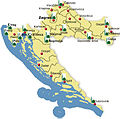 Places of worship for Muslims located in Croatia.


References
[edit]- ^ a b "Population by Ethnicity/Citizenship/Mother tongue/Religion" (xlsx). Census of Population, Households and Dwellings in 2021. Zagreb: Croatian Bureau of Statistics. 2022. Retrieved 8 April 2023.
- ^ Ethnicity/National Affiliation, Religion and Mother Tongue 2019, pp. 918–919.
- ^ "Претрага дисеминационе базе". data.stat.gov.rs. Retrieved 19 January 2025.
- ^ "Ugovor između Vlade Republike Hrvatske i Islamske zajednice u Hrvatskoj o pitanjima od zajedničkog interesa". Narodne novine – Službeni list Republike Hrvatske NN196/03 (in Croatian). Narodne novine. 15 December 2003. Retrieved 16 February 2010.
- ^ Google Books The South Slav journal: Opseg 6, Dositey Obradovich Circle – 1983.
- ^ "About Us – Bosnian Islamic Centre | Bosanski Islamski Centar".
- ^ Google Books James Jupp: The Australian people: an encyclopedia of the nation, its people and their origins, 2001, Cambridge University Press, p. 250
- ^ Hrvatski islamski centar – Croatian Islamic Centre Archived 26 May 2013 at the Wayback Machine
- ^ Svjedočanstva hrvatskih i bosanskih izbjeglica u Siriji nakon Drugoga svjetskoga rata
- ^ Radushev, Evg (2003). Inventory of Ottoman Turkish documents about Waqf preserved in the Oriental Department at the St. St. Cyril and Methodius National Library. Sv. sv. Kiril i Metodiĭ. p. 236.
- ^ İsmail Hâmi Danişmend, Osmanlı Devlet Erkânı, Türkiye Yayınevi, İstanbul, 1971, p. 29. (in Turkish)
- ^ Stavrides, Théoharis (2001). The Sultan of vezirs: the life and times of the Ottoman Grand Vezir Mahmud Pasha Angelovic (1453–1474). Brill. pp. 73–74. ISBN 978-90-04-12106-5.
- ^ Fischer 2007, p. 207.
- ^ Fischer 2007, p. 208.
- ^ Ramet 2006, p. 118.
- ^ a b c Emily Greble. Sarajevo, 1941–1945: Muslims, Christians, and Jews in Hitler's Europe. Ithaca, New York, USA: Cornell University Press, 2011. pp. 125.
- ^ Butić-Jelić, Fikreta. Ustaše i Nezavisna Država Hrvatska 1941–1945. Liber, 1977
- ^ "4. Population by ethnicity and religion". Census of Population, Households and Dwellings 2011. Zagreb: Croatian Bureau of Statistics. December 2012. Retrieved 17 December 2012.
- ^ Konačni rezultati popisa stanovništva od 15 marta 1948 godine. Vol. 9. Savezni zavod za statistiku. 1954. p. XVII.
- ^ "Population by ethnic/national affiliation, religion and by sex". Agency for Statistics of Bosnia and Herzegovina.
- ^ "Islamic Centre in Rijeka inaugurated". tportal.hr. 4 May 2013. Retrieved 11 May 2013.
{{cite web}}: CS1 maint: deprecated archival service (link)
Sources
[edit]- Ramet, Sabrina P. (2006). The Three Yugoslavias: State-Building and Legitimation, 1918–2005. Bloomington: Indiana University Press. ISBN 978-0-253-34656-8.
- Fischer, Bernd J., ed. (2007). Balkan Strongmen: Dictators and Authoritarian Rulers of South-Eastern Europe. Purdue University Press. ISBN 978-1-55753-455-2.
- Dizdar, Zdravko; Grčić, Marko; Ravlić, Slaven; Stuparić, Darko (1997). Tko je tko u NDH: Hrvatska 1941–1945 (in Croatian). Zagreb: Minerva. ISBN 978-953-6377-03-9.
- Ethnicity/National Affiliation, Religion and Mother Tongue (PDF). Sarajevo: Agency for Statistics of Bosnia and Herzegovina. 2019.
Croat Muslims
View on GrokipediaIdentity and Definition
Ethnic Origins and Religious Affiliation
Croat Muslims are ethnic Croats, a South Slavic group originating from the medieval Croat principalities in the western Balkans, whose ancestors converted to Islam during the Ottoman Empire's expansion into the region from the mid-15th century onward. These conversions primarily occurred in Ottoman-controlled territories such as central Bosnia and parts of Dalmatia and Slavonia, where ethnic Croats faced incentives including exemption from the jizya poll tax on non-Muslims, opportunities for land ownership, and advancement in the Ottoman military or administration via the devşirme system, which conscripted Christian youths—many of Croat descent—for upbringing as Muslims in elite Janissary units.[3][8] Religiously, Croat Muslims adhere to Sunni Islam of the Hanafi madhhab, the juridical school promulgated by Ottoman authorities across their Balkan domains to standardize Islamic practice among converts and settlers. This affiliation emerged from the selective adoption of Islam by Croat families, often in frontier zones exposed to prolonged Ottoman influence between 1463—when the Kingdom of Bosnia fell—and the empire's retreat by 1878, rather than wholesale societal transformation seen in core Bosnian areas. Unlike the majority of Croat converts whose descendants coalesced into broader Muslim communities, those maintaining explicit Croat ethnic continuity preserved linguistic ties to the Shtokavian dialect of Croatian and adapted pre-Islamic customs, such as folk traditions, to Islamic observance.[3] This ethnic persistence differentiates Croat Muslims from Bosniaks, whose identity crystallized in the 19th-20th centuries as a distinct nation centered on Islamic ummah solidarity, detached from Croat or Serb tribal roots despite shared South Slavic ancestry and Ottoman-era conversions. Croat Muslims, comprising a minority even among regional Muslims, rejected the 1971 Yugoslav recognition of "Muslim" as a nationality, opting instead for Croat self-identification in censuses and cultural assertions, reflecting a causal retention of pre-Ottoman kin networks amid pressures for religious-based ethnogenesis.[9][8]Distinction from Bosniaks and Other Muslim Groups
Croat Muslims are primarily distinguished from Bosniaks by their ethnic self-identification as Croats, integrating Islamic religious practice with Croatian national, linguistic, and cultural affiliation. Bosniaks, in contrast, form a separate South Slavic ethnic group centered in Bosnia and Herzegovina, where adherence to Islam functions as a foundational marker separating them from Catholic Croats and Orthodox Serbs, a distinction solidified through ethnogenesis processes in the 20th century.[10] [11] This ethnic boundary persists despite shared South Slavic roots and Ottoman-era conversions, as Bosniaks emphasize a distinct national narrative tied to Bosnian territory and transnational Islamic networks.[6] Census data in Croatia highlights this divergence: in the 2011 national census, 9,647 individuals declared themselves as ethnic Croats while professing Islam, compared to 31,479 who identified as Bosniaks among the total Muslim population of 62,977 by religion.[1] [11] The Bosniak figure largely reflects diaspora communities from Bosnia, augmented by Yugoslav-era labor migrations and 1990s war displacements, who retain allegiance to the Bosniak ethnonym and often align with the Islamic Community in Bosnia and Herzegovina rather than fully assimilating into Croatian civic structures.[6] Historical patterns reinforce the split; post-World War II censuses recorded small numbers of Croat Muslims (e.g., 3,212 in 1948), with many later shifting to a generic "Muslim" ethnic category under Yugoslav policy before the 1993 adoption of "Bosniak" prompted clearer delineations.[11] Competing identity dynamics within Croatia's Muslim community further illuminate the distinction, as some Bosnian-origin families have adopted a civic Croatian orientation amid declining immigration, increased social integration, and internal debates over the Islamic Community in Croatia's alignment—favoring a multiethnic, state-focused model over Bosniak-centric transnationalism.[11] [6] These tensions, evident in 2012 mufti elections where Bosniak-aligned candidates prevailed narrowly, underscore how Croat Muslims prioritize national cohesion with Croatia, viewing Islam as compatible with rather than supplanting ethnic Croatianness. Distinctions from other Muslim groups in Croatia, such as Albanians (about 15% of the 2011 Muslim population) or smaller Turkish and Romani Muslim communities, involve deeper linguistic and ancestral divergences. Albanian Muslims speak a non-Slavic language and preserve traditions linked to Kosovo or other Albanian regions, while Turkish descendants trace to Ottoman administrative elites, lacking the Slavic ethnic substrate shared by Croat Muslims and Bosniaks.[11] These groups, comprising roughly 7,421 Albanians and others in the census, operate within separate cultural enclaves, with limited intermingling into the Croatian ethnic framework maintained by Croat Muslims.[1]Historical Development
Pre-Ottoman and Early Interactions
The Slavic Croats settled the western Balkans, including the territories of modern Croatia, in the early 7th century as pagan tribes migrating from the north, establishing principalities amid the remnants of Roman Dalmatia and Byzantine influence.[12] By the mid-9th century, under Duke Trpimir I (r. 845–864), the Croats underwent Christianization through Frankish and Byzantine missionaries, adopting Roman Catholicism as the dominant faith, which solidified their cultural and political identity in opposition to eastern Orthodox and later Islamic influences.[12] This period saw no documented conversions to Islam among ethnic Croats, as the Islamic world’s expansions were confined to the eastern Mediterranean and did not penetrate the Croatian hinterlands. Early interactions with Muslim powers were primarily indirect, mediated through Byzantine defenses and Adriatic trade routes, rather than direct conquest or settlement. Arab naval raids into the Adriatic during the 9th century, such as those by Aghlabid fleets from Sicily around 835, occasionally threatened Dalmatian coasts but resulted in no permanent Muslim footholds or cultural exchanges leading to Islamization among Croats.[13] Venetian and Ragusan (Dubrovnik) merchants facilitated limited commerce with Muslim ports like Alexandria from the 13th century, exposing coastal Dalmatia to Islamic goods and ideas, yet these contacts reinforced Christian mercantile networks without fostering religious conversion.[14] The earliest verifiable Muslim presence in Croatian lands dates to the late 12th century in Slavonia, then under Hungarian rule, where a Hungarian royal decree from 592–3/1196 references "Ismaelites" (Muslims) in Osijek, comprising immigrant communities descended from Volga Bulgars, Cumans, and Khwārazmians rather than local Croats.[15] These groups, numbering perhaps in the hundreds, faced systematic persecution from the 11th century onward by Hungarian authorities and the Catholic Church, compelling conversions to Christianity and leading to their full assimilation by the end of the 14th century, with no enduring Islamic institutions or Croat-Muslim ethnoreligious identity emerging.[15] [12] Claims of earlier Slavic-Muslim ties, such as alleged Croat guards in Umayyad Spain (791–822), lack corroboration in primary sources and appear rooted in later nationalist reinterpretations rather than empirical evidence.[16] In summary, pre-Ottoman Croatia remained a Christian bulwark with negligible Muslim demographic impact, as any transient Islamic elements were foreign, marginal, and ultimately eradicated through assimilation and coercion, setting the stage for the transformative Ottoman incursions that would later produce Croat Muslims through targeted conversions.[15]Ottoman Conquests and Conversions
The Ottoman conquest of the Bosnian Kingdom in 1463 initiated a period of sustained control over territories inhabited by ethnic Croats, particularly in Bosnia and Herzegovina, where subsequent Islamization occurred among segments of the Catholic population.[17] The fall of Herzegovina followed in 1482, extending Ottoman influence into regions with Croat settlements.[17] Further incursions into Croatian lands, including a renewed wave of conquests from 1521 to 1552, incorporated areas such as Lika and Krbina into Ottoman administration, though these frontier zones experienced more prolonged military resistance than deeper inland territories.[18] Conversion to Islam among Croats was facilitated by Ottoman policies offering economic incentives, such as exemption from the jizya tax and access to land ownership, alongside the devşirme system, which conscripted non-Muslim boys—including those of Croat origin—for conversion, education, and integration into the empire's military and administrative elite.[3] Many Croats entered this levy system, with survivors often rising to prominent positions, as exemplified by figures like Murat-beg Tardić, a Croat noble who converted and served as an Ottoman general.[3] In central Bosnia, estimates indicate that 40,000 to 50,000 Croat Catholics converted by 1627, amid pressures including persecution of Catholicism after the Ottoman consolidation of power.[17] Unlike the more peripheral Croatian borderlands, where Catholicism endured due to Habsburg military frontiers and frequent warfare, Bosnia saw wholesale conversions among the Slavic population, including Croats, leading to the emergence of a Muslim community that retained elements of Croat ethnicity while adopting Islam.[8] This process was not uniformly coercive but driven by pragmatic advantages of alignment with the ruling faith, social mobility through Ottoman service, and the erosion of Catholic institutional structures under prolonged rule.[8] Ottoman governance in these areas persisted until the late 17th century, with Croatian territories under varying degrees of control from the 1490s to the 1690s, shaping the demographic foundations of Croat Muslims primarily in Bosnian contexts.[3]Post-Ottoman Era to Yugoslav Period
Following the Austro-Hungarian occupation of Bosnia and Herzegovina in 1878, the Muslim population—estimated at around 448,000 prior to the occupation—underwent substantial reduction through mass emigration to remaining Ottoman territories, with approximately 150,000 Muslims departing between 1878 and 1918 amid resistance to foreign rule, land reforms targeting Muslim landowners, and fears of cultural erosion.[19] These reforms, implemented from the early 1880s, redistributed agrarian holdings from Muslim effendis to Christian peasants, exacerbating economic grievances and prompting further outflows, though exact figures for those of Croat ethnic descent remain elusive due to fluid identities and lack of granular ethnic tracking.[20] Habsburg authorities responded by reorganizing Islamic institutions, appointing a reis-ul-ulema in 1882 to lead the community autonomously from Istanbul and establishing sharia courts, while promoting education in Bosnian Turkish to foster loyalty.[21] Islam received formal state recognition as a religion in Cisleithania in 1912 and Transleithania in 1916, enabling the construction of mosques and maintenance of vakufs (Islamic endowments), yet policies emphasized a supranational "Bosniak" civic identity to dilute pan-Slavic ties and Ottoman nostalgia.[21] Among Slavic Muslims, particularly in western Herzegovina and regions like Mostar and Livno with historical Croat majorities, a minority asserted Croat ethnic affiliation, viewing Islam as compatible with South Slavic Catholic heritage rather than Turkish import; this stance contrasted Habsburg efforts to portray Muslims as distinct from both Serbs and Croats, though such identifications were marginal and often suppressed in official narratives.[22] Conversions to Catholicism occurred sporadically under missionary incentives, but the core Muslim community endured, numbering about 191,000 by 1910 amid overall population stabilization.[19] The dissolution of Austria-Hungary and creation of the Kingdom of Serbs, Croats, and Slovenes (renamed Yugoslavia in 1929) integrated Bosnia into a centralized state dominated by Serb interests, compelling Muslims to navigate ethnic categorization without official nationality status until later decades. In the 1921 census, over 700,000 declared as Serbo-Croatian speakers adhering to Islam, but ethnicity required alignment with Croat or Serb blocs, leading many in Croat-leaning areas to self-identify as "Croats of Islamic faith" to access political representation and resist assimilation into a unitary "Yugoslav" identity.[23] The 1930 Law on the Islamic Religious Community, enacted March 31, formalized a unified reisu-l-ulema structure across the kingdom, standardizing religious education and endowments while curbing Wahhabi influences, though funding disputes and Serb Orthodox dominance strained implementation.[24] By the 1931 census, roughly 1.1 million Muslims resided in Yugoslavia, with a notable fraction in Herzegovina and central Bosnia declaring Croat ethnicity to align with parties like the Croatian Peasant Party, which courted them as integral to Croat nationhood against Belgrade's centralism; this reflected intellectual currents, such as articles by figures like Abdulatif Dizdarević advocating "Muslim Croats" as a bridge between faith and ethnicity.[22] Economic marginalization persisted, with rural Muslims facing land scarcity and urban migration, while secular Yugoslavism pressured religious observance; nonetheless, communities maintained distinct customs, including mektebs (Islamic schools), amid rising tensions foreshadowing World War II alignments.[25]Demographics and Statistics
Population Estimates and Census Data
In the 2021 Croatian census, 10,841 individuals self-identified as ethnic Croats while declaring adherence to Islam, out of a total Muslim population of 50,981 (1.32% of Croatia's 3,871,833 inhabitants).[26] This represents an increase from the 2011 census, which recorded 9,647 Croat Muslims amid a total of 62,977 Muslims (1.47% of the then-population).[26] These figures reflect self-reported ethnicity and religion, with Croat Muslims comprising a minority within Croatia's Muslim community, the majority of whom identify as Bosniaks (approximately 24,000 in 2021).[26]| Census Year | Croat Muslims | Total Muslims | Total Population |
|---|---|---|---|
| 2021 | 10,841 | 50,981 | 3,871,833 |
| 2011 | 9,647 | 62,977 | 4,284,433 |