Hubbry Logo
Cross-cutting relationshipsCross-cutting relationshipsMain
Open search
Cross-cutting relationships
Community hub
Cross-cutting relationships
logo
8 pages, 0 posts
0 subscribers
Be the first to start a discussion here.
Cross-cutting relationships
from Wikipedia
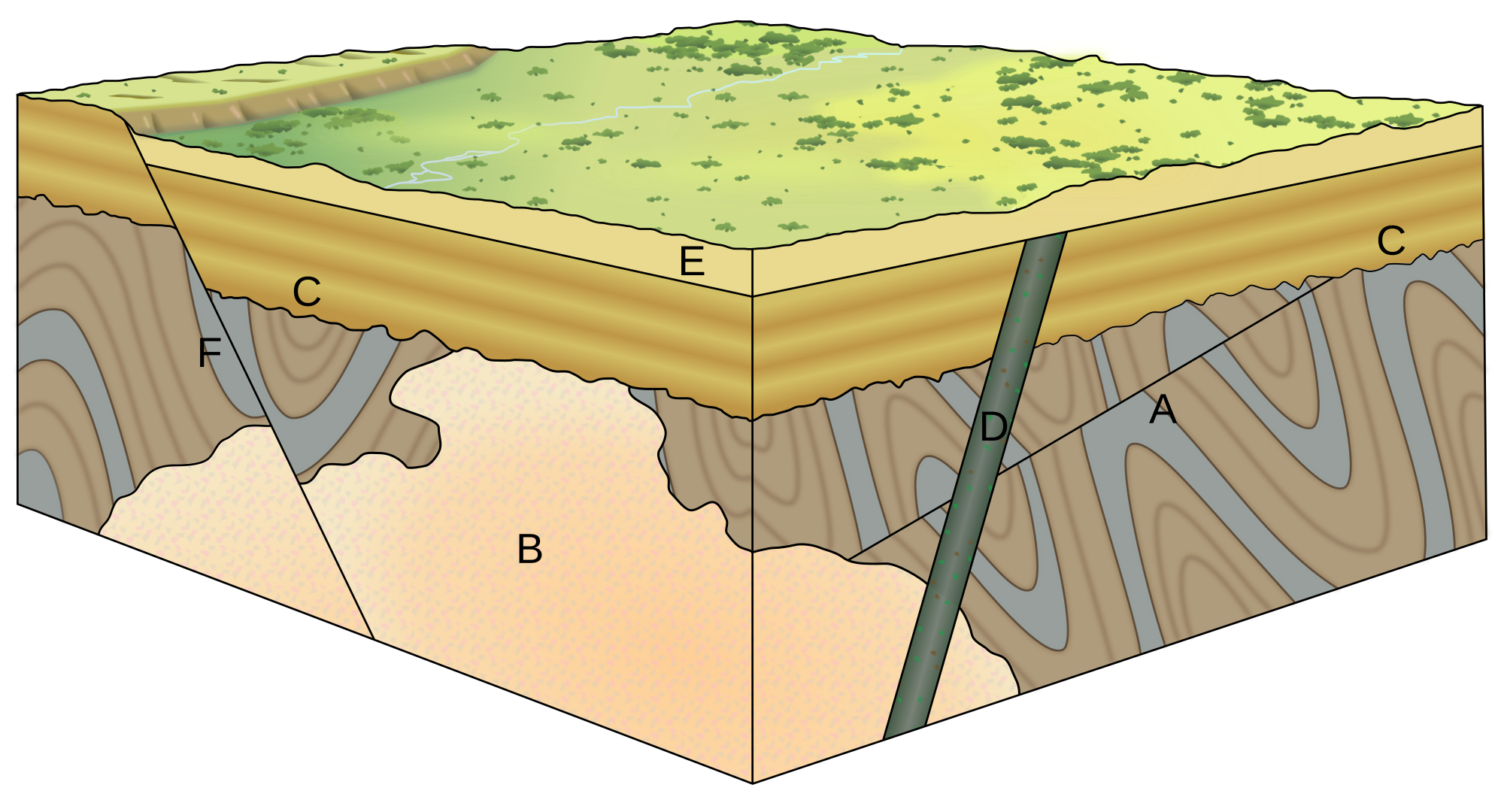
Cross-cutting relationships can be used to determine the relative ages of rock strata and other structures. Explanations: A – folded rock strata cut by a thrust fault; B – large intrusion (cutting through A); C – erosional angular unconformity (cutting off A & B) on which rock strata were deposited; D – volcanic dike (cutting through A, B & C); E – even younger rock strata (overlying C & D); F – normal fault (cutting through A, B, C & possibly E).

Cross-cutting relationships is a principle of geology that states that the geologic feature which cuts another is the younger of the two features. It is a relative dating technique in geology. It was first developed by Danish geological pioneer Nicholas Steno in Dissertationis prodromus (1669) and later formulated by James Hutton in Theory of the Earth (1795) and embellished upon by Charles Lyell in Principles of Geology (1830).

Types

[edit]

There are several basic types of cross-cutting relationships:

  • Structural relationships may be faults or fractures cutting through an older rock.
  • Intrusional relationships occur when an igneous pluton or dike is intruded into pre-existing rocks.
  • Stratigraphic relationships may be an erosional surface (or unconformity) cuts across older rock layers, geological structures, or other geological features.
  • Sedimentological relationships occur where currents have eroded or scoured older sediment in a local area to produce, for example, a channel filled with sand.
  • Paleontological relationships occur where the animal activity or plant growth produces truncation. This happens, for example, when animal burrows penetrate into pre-existing sedimentary deposits.
  • Geomorphological relationships may occur where a surficial feature, such as a river, flows through a gap in a ridge of rock. In a similar example, an impact crater excavates into a subsurface layer of rock.

Cross-cutting relationships may be compound in nature. For example, if a fault were truncated by an unconformity, and that unconformity cut by a dike. Based upon such compound cross-cutting relationships it can be seen that the fault is older than the unconformity which in turn is older than the dike. Using such rationale, the sequence of geological events can be better understood.

Scale

[edit]

Cross-cutting relationships may be seen cartographically, megascopically, and microscopically. In other words, these relationships have various scales. A cartographic crosscutting relationship might look like, for example, a large fault dissecting the landscape on a large map. Megascopic cross-cutting relationships are features like igneous dikes, as mentioned above, which would be seen on an outcrop or in a limited geographic area. Microscopic cross-cutting relationships are those that require study by magnification or other close scrutiny. For example, penetration of a fossil shell by the drilling action of a boring organism is an example of such a relationship.

Other use

[edit]

Cross-cutting relationships can also be used in conjunction with radiometric age dating to effect an age bracket for geological materials that cannot be directly dated by radiometric techniques. For example, if a layer of sediment containing a fossil of interest is bounded on the top and bottom by unconformities, where the lower unconformity truncates dike A and the upper unconformity truncates dike B (which penetrates the layer in question), this method can be used. A radiometric age date from crystals in dike A will give the maximum age date for the layer in question and likewise, crystals from dike B will give us the minimum age date. This provides an age bracket, or range of possible ages, for the layer in question.

[edit]

See also

[edit]

References

[edit]
Revisions and contributorsEdit on WikipediaRead on Wikipedia
from Grokipedia
The principle of cross-cutting relationships is a foundational concept in for determining the relative ages of rock formations and geological features without relying on numerical methods. It posits that any intrusive structure, such as an igneous dike or sill, a fault, or an erosional surface, which intersects or disrupts an existing rock body must be younger than the rock it cuts through, as the cutting event occurs after the formation of the disrupted feature. The principle was first proposed by Danish scientist Nicholas Steno in 1669 and later developed by Scottish geologist in the late 18th century, building on his theory of , which assumes that geological processes observed today have operated similarly throughout Earth's history. Hutton illustrated the concept through his examination of a intrusion at Salisbury Crag in , where the clearly cut across older sedimentary layers, demonstrating the intrusion's younger age. In practice, cross-cutting relationships are essential for reconstructing the sequence of geological events in a , often applied alongside other stratigraphic principles like superposition and original horizontality. For instance, in , the Moab Fault splay offsets layers of , indicating the fault is younger than the sandstone but older than overlying deposits. Similarly, diabase dikes in intrude through ancient sedimentary strata, confirming their post-depositional origin. These applications highlight the principle's role in interpreting complex rock sequences and unconformities, aiding broader understandings of tectonic history and landscape evolution.

Definition and Principles

Core Principle

The principle of cross-cutting relationships states that a geological feature which cuts across or disrupts another feature must be younger than the feature it intersects. This fundamental rule allows geologists to determine the relative ages of rock bodies and structures without relying on methods. It was first articulated by Nicolaus Steno in his 1669 work De solido intra solidum naturaliter contento dissertationis prodromus. The logical basis for this principle is the observation that a geological feature must form after the one it physically disrupts or cuts across. Under this reasoning, intrusive or deformational events—such as the injection of or the shearing of rock—can only occur after the host material has fully formed and solidified, ensuring that the cutting feature postdates the cut one. This provides a reliable criterion for sequencing geological events, as the physical disruption itself serves as of temporal order. Basic examples illustrate this clearly: an igneous dike penetrating sedimentary layers demonstrates that the dike's emplacement followed the of those layers, since molten material could not otherwise traverse solid rock. Likewise, a fault plane that offsets adjacent strata indicates the faulting occurred after the strata's deposition, with the displacement revealing the relative timing. In both cases, the cutting feature's youth is evident from its interruption of the pre-existing structure. At its core, the principle encompasses any intrusive, deformational, or erosional process that physically intersects earlier-formed rocks, serving as a cornerstone for interpreting the sequence of geological history across diverse settings.

Historical Development

The principle of cross-cutting relationships, which posits that a geological feature cutting across another must be younger than the feature it intersects, was first articulated by Nicolaus Steno in his 1669 work Dissertationis Prodromus. Steno, a Danish anatomist and pioneer in , described this concept while examining rock layers in , noting that veins or dikes intruding into stratified rocks must form after the host strata were deposited, thereby establishing a foundational rule for interpreting relative ages in . While often attributed to Steno, some sources credit with its modern formulation. James Hutton further refined and expanded this idea in his 1795 publication Theory of the Earth, integrating it with his doctrine of uniformitarianism—the notion that geological processes observed today have operated similarly throughout Earth's history. Hutton's observations of igneous intrusions, such as those at Salisbury Crag in Scotland, illustrated how cross-cutting features like dikes and sills provide evidence of subsequent geological events, reinforcing the principle as a key tool for reconstructing Earth's dynamic history without invoking catastrophic explanations. Charles Lyell formalized the principle in his influential 1830 book , embedding it within a comprehensive framework of uniformitarian that emphasized gradual change over vast periods. Lyell's detailed discussions and illustrations of cross-cutting relationships, including faults and intrusions intersecting strata, elevated the concept to a of , influencing generations of geologists and providing a logical basis for sequencing rock formations across regions. In the 19th and 20th centuries, cross-cutting relationships were integrated into modern to construct detailed relative chronologies worldwide. This approach proved essential in establishing the geological time scale through correlations of rock sequences before the advent of in the early .

Types of Cross-Cutting Features

Igneous Intrusions

Igneous intrusions form when from the or lower crust ascends and injects into pre-existing rocks within the crust, cooling and solidifying below the surface to create various structures. These include dikes, which are vertical or near-vertical sheet-like bodies that propagate through fractures; sills, which are horizontal or concordant layers that intrude parallel to planes; and batholiths, which are large, irregular masses often composed of that can span hundreds of kilometers. The process begins with of source rocks, followed by the buoyant rise of through zones of weakness, where it crystallizes over timescales ranging from thousands to millions of years, depending on depth and composition. In cross-cutting relationships, these intrusions exploit existing fractures, joints, or planes in the host rocks, resulting in clear offsets or penetrations of the surrounding strata without the intrusions themselves showing deformation from prior tectonic events. This discordance is evident when a dike slices across multiple layers of sedimentary or , or when a sill wedges between beds, displacing them without parallel alignment. The mechanics rely on the high temperature and low viscosity of the , allowing it to force apart or fill voids in cooler, brittle host materials, often accompanied by thermal that alters the adjacent rocks into aureoles of contact metamorphism. Such relationships demonstrate that the intrusion postdates the formation and any early deformation of the host rocks, providing a key temporal marker in geological interpretations. The interpretive value of igneous intrusions lies in their ability to establish relative ages: an intrusion is always younger than the rocks it cuts, as the host must exist and lithify before can invade. For instance, a pluton intruding into metamorphic rocks indicates the pluton's emplacement occurred after the , often during later orogenic events. This principle aids in reconstructing tectonic histories, such as distinguishing between pre- and post-intrusion folding. A classic example is the in , a intrusion approximately 300 meters thick that cross-cuts sedimentary rocks of the Newark Basin, confirming the sill's formation after basin sedimentation and early faulting around 200 million years ago. Similarly, kimberlite pipes, which are carrot-shaped intrusions carrying diamonds from the mantle, cross-cut ancient cratonic rocks in regions like South Africa's , with ages ranging from 2.5 billion to 90 million years old, highlighting episodic mantle-derived magmatism.

Tectonic Structures

Tectonic structures primarily encompass faults and fractures that arise from brittle deformation of the Earth's crust under differential stress, creating planar discontinuities that offset or disrupt older rock units. These features form when rocks fail along zones of weakness, such as pre-existing joints or bedding planes, due to compressional, extensional, or shear forces during tectonic events like rifting or mountain building. In cross-cutting relationships, a fault or fracture is interpreted as younger than the rock layers it displaces, as the deformation event must postdate the formation, deposition, and lithification of those layers. This is observed when a fault plane slices through and offsets multiple stratigraphic units, with the amount of displacement (throw or heave) indicating the scale of movement, while the lack of offset in the faulted material itself confirms its relative youth. The mechanics involve stress accumulation beyond the rock's strength, leading to sudden slip along the fault plane, often accompanied by seismic activity, and potentially reactivating older structures. Unlike ductile features like folds, which deform rocks without clear cuts, faults provide unambiguous cross-cutting evidence for timing deformation relative to sedimentation or intrusion. Key types include normal faults, which dip at angles greater than 45° and result from extensional stress, producing hanging wall down-movement; reverse (thrust) faults, with dips less than 45° under compression, where the hanging wall moves up; and strike-slip faults, which exhibit horizontal motion along near-vertical planes. Interpretively, these structures help sequence tectonic events: a fault cutting an dates the faulting after intrusion, aiding in orogenic reconstructions. For example, the Moab Fault in , , a normal fault splay, offsets Entrada layers by up to 300 meters, demonstrating that faulting occurred after sandstone deposition around 180 million years ago but before overlying sediments, linking it to influences. Another instance is the Bright Angel Fault in , which cross-cuts to Permian strata, indicating post-Paleozoic tectonic activity during the Basin and Range extension.

Erosional and Depositional Features

Erosional and depositional features represent surfaces where has truncated older rock layers, followed by the deposition of younger sediments that overlie the irregular erosion boundary, thereby the underlying strata and marking a significant temporal hiatus. These features, primarily unconformities, form when depositional processes cease due to uplift, sea-level fall, or exposure, allowing or to sculpt the before or transgression enables renewed . Key types include angular unconformities and disconformities. An angular unconformity occurs where relatively flat-lying younger sedimentary rocks rest upon older, tilted or folded strata that have been eroded, with the contact showing a clear angular discordance between the planes. In contrast, a disconformity features parallel above and below an erosional surface, often irregular and marked by subtle features such as channels incised into the underlying layers or paleosols indicating prolonged soil development during exposure. These erosional contacts demonstrate cross-cutting by truncating pre-existing layers, while the overlying deposits conform to the new surface geometry, establishing the relative younger age of the upper unit. The mechanics of these features involve initial that bevels and removes portions of older rocks, creating a planar or undulating surface, followed by deposition that buries the boundary and preserves evidence of the hiatus. This process highlights periods of landscape instability, with rates potentially removing kilometers of rock over millions of years before resumes. Interpretively, such features signal substantial time gaps—ranging from millions to billions of years—and environmental shifts like eustatic sea-level changes or tectonic adjustments, as the bounds sequences of deposition and . For instance, an angular indicates prior deformation and prolonged prior to renewed flat-lying , aiding in reconstructing basin history. A prominent example is the exposed in the Grand Canyon, where Tapeats Sandstone and overlying strata rest directly on eroded Precambrian Vishnu Schist and Granite Gorge Metamorphic Suite, representing a hiatus of approximately 1.2 billion years during which vast thicknesses of rock were eroded away. This nonconformable contact, transitional to an angular style in places due to underlying folding, illustrates how deposited flat-lying sands over a deeply incised, ancient surface following prolonged exposure and . The feature underscores global-scale erosional events tied to sea-level fluctuations and tectonic quiescence.

Applications in Geology

Relative Dating in Stratigraphy

Cross-cutting relationships serve as a cornerstone for in , enabling geologists to sequence geological events within sedimentary basins by analyzing intersections between rock layers and intrusive or deformational features. In a , layers deformed by folding or faulting can obscure the original order of deposition, but the identification of cross-cutting elements—such as dikes that penetrate multiple strata or faults that offset layers—restores the timeline by establishing that the cutting feature formed after the cut material. This process relies on the principle that any feature modifying an existing rock body must postdate it, providing a framework to reconstruct the history of interrupted by later igneous or tectonic activity. Key techniques in this application include correlating dikes across a basin to align stratigraphic sequences, as matching intrusive features that cut equivalent layers in distant outcrops confirms their relative ages and aids in mapping basin-wide events. Similarly, faults are used to bracket deposition ages by observing which strata are displaced: a fault cutting older layers but not younger ones indicates the deposition of the uncut layers post-dated faulting. These approaches complement the principle of superposition, which assumes undeformed layers are younger upward, by resolving complexities from tectonic disruptions like tilting or thrusting. The interpretive outcomes of applying cross-cutting relationships yield detailed timelines for , intrusion, and deformation in stratigraphic records; for instance, observing a fault that offsets folded layers but is itself undeformed demonstrates that folding preceded faulting, clarifying the sequence of basin .

Structural Analysis

In , cross-cutting relationships are applied to map and sequence deformational phases within folded or faulted terranes by identifying intersections where later structures truncate earlier ones, allowing geologists to reconstruct the relative timing of events such as multiple folding episodes or fault reactivation. This process relies on the principle that younger features cut across older ones, providing a framework for ordering complex tectonic histories without absolute ages. Key techniques involve detailed field mapping and analysis of planar and linear fabrics, including cleavage, , and systems, to determine their mutual cross-cutting patterns and thereby delineate orogenic phases. For instance, early (S1) developed during initial deformation (D1) may be folded or sheared by later cleavage (S2) associated with D2, while quartz veins filling fractures can cross-cut both to indicate post-D2 fluid migration. These observations, often supplemented by microstructural analysis, help define progressive strain accumulation in metamorphic rocks. The interpretive outcomes of such analyses enable reconstruction of tectonic evolution, particularly in distinguishing successive deformation phases like D1 folds truncated by D2 faults in metamorphic belts, which reveal shifts in stress regimes during orogenesis.

Scale of Observation

Microscale Examples

Cross-cutting relationships at the microscale are commonly observed using petrographic microscopes, which allow geologists to examine thin sections of rock samples under plane-polarized and cross-polarized light to reveal fine details such as veinlets that intersect crystals or fractures within individual minerals. These instruments highlight textural relationships by exploiting the and of minerals, enabling the identification of later-formed features that truncate earlier ones, such as fluid-induced alterations or deformation structures at scales of micrometers to millimeters. A prominent example involves veins that cross-cut the in , signaling post-metamorphic fluid infiltration after the development of the metamorphic fabric. In thin sections from exhuming complexes, these veins appear as clear, euhedral crystals transecting the aligned mineral bands of and , with fluid inclusions preserving evidence of hydrothermal conditions at temperatures around 300–400°C. Such relationships indicate that the veins formed during a late-stage retrograde phase, potentially linked to tectonic uplift and cooling, as the shows minimal deformation compared to the host . Another key illustration is microfaults that offset detrital grains in sandstone, demonstrating brittle deformation events superimposed on sedimentary fabrics. Under the microscope, these microfaults manifest as narrow shear zones, often 10–50 μm wide, that displace quartz or feldspar grains by tens of micrometers, with cataclastic textures like grain crushing along the fault plane. This cross-cutting is particularly evident in tight sandstones where the faults cut through early diagenetic cements, helping to sequence deformation relative to burial and compaction history. These microscale features provide critical interpretive value for dating diagenetic or low-grade metamorphic events, as seen in stylolites within limestone disrupted by later calcite-filled fractures. Stylolites, which are irregular dissolution seams formed during pressure-solution compaction, are often observed in thin sections as dark, clay-rich bands parallel to bedding; subsequent fractures, filled with blocky calcite spar, truncate these seams, indicating fracturing post-dating the stylolite formation under increasing burial loads. For instance, in micritic limestones, the fractures may show syntaxial overgrowths on host grains, confirming precipitation from fluids circulated after peak diagenesis, thus bracketing the timing of fluid flow to mesodiagenetic stages at depths of 1–2 km. A specific case from thin-section analysis of rocks highlights late-stage serpentinization veins that cross-cut earlier metamorphic assemblages in ultramafic protoliths. In samples from greenstone belts, such as those in the Isua Supracrustal Belt, serpentine veins (composed of lizardite or chrysotile) appear as fine, fibrous networks (5–20 μm thick) that intersect relict olivine pseudomorphs and amphibole, with magnetite grains along vein margins indicating oxidizing conditions during hydration at greenschist facies. These relationships demonstrate serpentinization occurred after initial high-temperature , likely driven by infiltration during exhumation around 3.7 Ga, and provide evidence for fluid-rock interactions.

Macroscale Examples

Cross-cutting relationships at the macroscale encompass features observable from to continental extents, providing insights into regional and global tectonic through that intrusive or deformational structures postdate the rocks they intersect. These relationships are identified using field mapping to document contacts and offsets in exposed terrains, for delineating linear fault traces and basin geometries over hundreds of kilometers, and geophysical surveys such as seismic reflection and gravity modeling to image subsurface intrusions and fault planes without direct exposure. Such methods enable the mapping of basin-wide plutonic bodies or plate-scale shear zones, establishing relative chronologies for events spanning millions of years. A prominent example of macroscale igneous intrusion is the in , where granitic plutons cross-cut Paleozoic and early sedimentary and metavolcanic host rocks. Field mapping and geochemical analysis reveal that plutons such as the Tungsten Hills quartz monzonite intrude and deform metavolcanic sequences, bending beds into S-shaped structures and truncating pre-existing folds and faults in the western metamorphic belt. This cross-cutting establishes the batholith's emplacement during the to as part of a subduction-related magmatic arc, with sharp contacts and indicating forceful intrusion into older terranes. further highlights the batholith's extent, spanning over 400 km, underscoring its role in Cordilleran orogenesis. Tectonic structures at this scale, such as faults in the system, demonstrate cross-cutting where Cenozoic normal faults offset basement rocks. In the western branch, border faults bounding the Moba and Marungu basins cut unmetamorphosed gneisses and units without aligning to pre-existing foliations, as mapped via geophysical profiles and field observations. These relationships indicate rift initiation around 12 Ma, postdating assembly, with seismic surveys revealing fault throws exceeding 5 km and basin subsidence driven by . Similarly, the Lewis Overthrust in exemplifies faulting, where Belt Supergroup rocks (e.g., Altyn and Greyson Formations) are emplaced over Cretaceous Kootenai and Blackleaf Formations, with the low-angle fault (dipping 15°–25° NW) truncating younger strata along a 450 km trace. Cross-cutting of pre-thrust folds and imbricates by the main , observed in field traverses, dates motion to the late Paleocene–early Eocene, reflecting Laramide compression. Ophiolites provide another interpretive lens for macroscale thrusting, as seen in the Oman-UAE , where oceanic crust and mantle are thrust as an ~11 km thick sheet over the Arabian continental margin's Permian– passive margin sediments. Geophysical modeling and structural mapping show the ophiolite overriding Hawasina and Sumeini thrust sheets, with near-horizontal contacts marking obduction during Late subduction, cross-cutting older Tethyan basin . These relationships, integrated with regional seismic data, reveal short-lived (~1 Ma) suprasubduction zone magmatism and emplacement without subsequent continent–continent collision. Collectively, such macroscale examples illuminate global histories, from arc construction and rifting to obduction, informing plate reconstructions over supercontinental cycles.

Limitations and Modern Interpretations

Assumptions and Exceptions

The principle of cross-cutting relationships rests on several foundational assumptions to establish reliable relative ages between geological features. Primarily, it assumes that the rock or structure being cut is already solid and lithified at the time of intrusion or deformation, allowing for a clear without intermixing of materials. Additionally, the principle presumes no significant post-emplacement alteration that could obscure or reverse the original relationships, such as extensive recrystallization or fluid-mediated changes. Underpinning these is the uniformitarian assumption that geological processes, including intrusion and faulting, have operated consistently over time without fundamental changes in mechanics. Despite these assumptions, several exceptions and complications can arise, particularly in complex tectonic settings, leading to ambiguous or inverted interpretations. Fault reactivation, where older structures are reused during later deformation events, can create apparent cross-cutting patterns that do not reflect a simple younger-over-older sequence, as inherited weaknesses guide subsequent motion. In ductile deformation regimes, high-temperature flow can erase or overprint original cross-cutting contacts through pervasive recrystallization and fabric development, making it challenging to discern primary relationships. Polyphase further complicates matters by potentially inverting rheological contrasts, where initially competent layers become weaker during later events, altering truncation patterns and requiring careful analysis of metamorphic fabrics. To mitigate these issues, geologists cross-verify evidence with complementary principles, such as superposition for layering sequences or inclusions to confirm enclosure timing, ensuring a robust relative . A specific case involves pseudotachylytes, frictional melt veins formed during seismic slip on faults; these can fill and solidify within older fractures, creating pseudomorphs that appear to predate subsequent cuts due to the and reintrusion process, thus misleading straightforward application of the principle unless microstructural evidence of is identified. In such ambiguous scenarios, brief integration with may help resolve timings.

Integration with Absolute Dating

Cross-cutting relationships play a complementary role to methods by establishing a relative chronological sequence that guides the selection of targeted samples for radiometric analysis, such as U-Pb, ⁴⁰Ar/³⁹Ar, or Rb-Sr techniques applied to cross-cutting features like igneous intrusions or faults. This integration leverages that the cutting feature is younger than the host rock, allowing geologists to focus dating efforts on minerals like in dikes or fault gouges to constrain event timings without dating every unit exhaustively. By combining these approaches, relative frameworks reduce uncertainty in sample choice and enhance the reliability of absolute ages in complex geological settings. The methodological workflow typically begins with field mapping to identify features and their relationships to host rocks, followed by petrographic analysis to select datable minerals. For instance, crystals from an intrusive dike that cuts older layers are analyzed via U-Pb to determine the dike's emplacement age, providing a maximum age limit for subsequent events and a minimum age for the host rock; the host may then be bracketed using biostratigraphy-calibrated layers or additional dating if feasible. This bracketing yields absolute age constraints, such as establishing that deformation in the host predates the intrusion by millions of years, assuming the host was solid at the time of intrusion. Advances in high-resolution dating, including ICP-MS and , have refined this integration to resolve events on million-year timescales, particularly in terranes where relationships delineate protracted deformation histories. These techniques allow precise sampling of zoned minerals within dikes, minimizing inheritance issues and enabling correlation of relative sequences with global . Recent developments as of 2024 include automated approaches using knowledge graphs and to interpret relationships for relative fault activity dating, enhancing efficiency in large-scale . A key example is the , where U-Pb dating of syn- to post-orogenic intrusions cutting older gneisses has constrained the event to 1.3–1.0 Ga, with specific plutons like the Havre-Saint-Pierre Anorthosite yielding ages of 1062 ± 4 Ma, marking peak metamorphism and crustal assembly in the Laurentian margin. This approach has clarified the multi-phase nature of the orogeny, integrating relative intrusion sequences with absolute timelines to reconstruct formation.

Applications Beyond Geology

In Archaeology

In archaeology, the principle of cross-cutting relationships, adapted from its geological origins, posits that any feature—such as a ditch, wall, posthole, or burial—that intersects and disrupts an earlier deposit or structure must postdate it, thereby establishing a relative sequence of site formation processes. This adaptation accounts for anthropogenic modifications, distinguishing human interventions like construction or refuse disposal from natural sedimentation, and forms a core component of stratigraphic analysis during excavations. The application involves meticulously recording interfaces where features truncate prior layers to reconstruct the chronological order of events, such as building, occupation, or disturbance. For instance, excavators section cuts to observe how a later feature, like a Roman road, intersects and removes segments of earlier field ditches, confirming the road's construction occurred afterward and aiding in sequencing landscape use. This process relies on the Harris Matrix, a diagrammatic tool that visualizes these relationships by linking units based on superposition and , ensuring precise without absolute methods. Interpretively, cross-cutting relationships help disentangle complex, mixed deposits resulting from , bioturbation, or repeated human activities, such as overlapping phases or accumulation, by clarifying which elements are primary or secondary. This clarity enhances the integration with artifact typology, where stratigraphically later cuts containing diagnostic or tools corroborate cultural sequences derived from object styles. For example, a posthole cluster cutting an earlier layer might contain later-period ceramics, reinforcing the temporal shift inferred from the intersection alone. At the Neolithic site of in , cross-cutting is evident in practices, where later interments truncate earlier house platforms and floors; for instance, in Building 60, multiple grave cuts (e.g., F.13101 and F.12998) intersect the upper white plaster layer (F.2225) of a north platform, indicating sequential inhumations postdating initial construction, with at least four events in one pit (F.2232) disturbing prior remains. Similarly, in Space 309, a juvenile (F.14150) cuts through an earlier neonatal interment (F.14162) beneath a platform, resolving the order of mortuary reuse in densely occupied structures. In urban contexts like , medieval refuse pits often cut Saxon-era layers, as seen in excavations where postholes and ditches from later periods truncate earlier organic deposits, illuminating shifts from rural to urban land use.

In Other Fields

In , the principle of cross-cutting relationships is applied to identify disruptions in sequences caused by tectonic events, such as faults that offset or fault -bearing beds after their deposition, thereby tracing interruptions in evolutionary records and establishing the timing of post-depositional geological activity. For instance, when a fault displaces layers containing distinct assemblages, the cross-cutting fault must be younger than the strata, indicating that the tectonic disruption occurred after the organisms were preserved, which helps reconstruct the paleoenvironmental history and assess the integrity of stratigraphic correlations. In , cross-cutting relationships aid in analyzing soil profiles to determine the relative of depositional layers and subsequent disturbances, including those from buried or penetration, which is essential for foundation design, site stability assessment, and evaluating impacts on subsurface . These anthropogenic or biogenic features, when observed cutting through older soil horizons, provide evidence of the timing of relative to later intrusions, allowing engineers to infer deposition rates and potential hazards like differential settlement without relying solely on methods. The principle extends to , where it is used to interpret data from missions like Mars rovers to establish relative ages of surface features; for example, grabens that cross-cut lava flows from on Mars indicate that the tectonic event postdated the volcanic activity, helping to sequence the planet's geological history and constrain timelines for water-related processes. Similarly, in lunar studies, cross-cutting relationships in layers reveal the sequence of impact events, such as craters that intersect and deform blankets from older basins, enabling the construction of a relative chronology of the Moon's bombardment history through of superposition and disruption patterns observed in orbital imagery. In , cross-cutting relationships within highlight deformational and climatic events, such as melt layers that intrude and disrupt annual varves formed by seasonal accumulation, providing records of past warming episodes and ice flow dynamics that alter layer continuity. These intrusions, identified through of core samples, demonstrate how refreezing can postdate initial layer deposition, offering insights into short-term variability and the mechanical behavior of sheets over centuries.

References

Add your contribution
Related Hubs
User Avatar
No comments yet.