



Community hub
Recent from talks
Contribute something
Nothing was collected or created yet.
Sound pressure
View on Wikipedia| Sound measurements | |
|---|---|
Characteristic | Symbols |
| Sound pressure | p, SPL, LPA |
| Particle velocity | v, SVL |
| Particle displacement | δ |
| Sound intensity | I, SIL |
| Sound power | P, SWL, LWA |
| Sound energy | W |
| Sound energy density | w |
| Sound exposure | E, SEL |
| Acoustic impedance | Z |
| Audio frequency | AF |
| Transmission loss | TL |
Sound pressure or acoustic pressure is the local pressure deviation from the ambient (average or equilibrium) atmospheric pressure, caused by a sound wave. In air, sound pressure can be measured using a microphone, and in water with a hydrophone. The SI unit of sound pressure is the pascal (Pa).[1]
Mathematical definition
[edit]
- Silence
- Audible sound
- Atmospheric pressure
- Sound pressure
A sound wave in a transmission medium causes a deviation (sound pressure, a dynamic pressure) in the local ambient pressure, a static pressure.
Sound pressure, denoted p, is defined by where

- ptotal is the total pressure,
- pstat is the static pressure.
Sound measurements
[edit]Sound intensity
[edit]In a sound wave, the complementary variable to sound pressure is the particle velocity. Together, they determine the sound intensity of the wave.
Sound intensity, denoted I and measured in W·m−2 in SI units, is defined by where

- p is the sound pressure,
- v is the particle velocity.
Acoustic impedance
[edit]Acoustic impedance, denoted Z and measured in Pa·m−3·s in SI units, is defined by[2] where
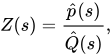
- is the Laplace transform of sound pressure,[citation needed]
- is the Laplace transform of sound volume flow rate.


Specific acoustic impedance, denoted z and measured in Pa·m−1·s in SI units, is defined by[2] where
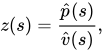
- is the Laplace transform of sound pressure,
- is the Laplace transform of particle velocity.

Particle displacement
[edit]The particle displacement of a progressive sine wave is given by where

- is the amplitude of the particle displacement,
- is the phase shift of the particle displacement,
- k is the angular wavevector,
- ω is the angular frequency.


It follows that the particle velocity and the sound pressure along the direction of propagation of the sound wave x are given by where


- vm is the amplitude of the particle velocity,
- is the phase shift of the particle velocity,
- pm is the amplitude of the acoustic pressure,
- is the phase shift of the acoustic pressure.


Taking the Laplace transforms of v and p with respect to time yields


Since , the amplitude of the specific acoustic impedance is given by


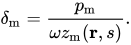
Consequently, the amplitude of the particle displacement is related to that of the acoustic velocity and the sound pressure by

Inverse-proportional law
[edit]When measuring the sound pressure created by a sound source, it is important to measure the distance from the object as well, since the sound pressure of a spherical sound wave decreases as 1/r from the centre of the sphere (and not as 1/r2, like the sound intensity):[3]

This relationship is an inverse-proportional law.
If the sound pressure p1 is measured at a distance r1 from the centre of the sphere, the sound pressure p2 at another position r2 can be calculated:

The inverse-proportional law for sound pressure comes from the inverse-square law for sound intensity: Indeed, where

\propto p^{2}(r),}](https://wikimedia.org/api/rest_v1/media/math/render/svg/bf101a3713c0641e63e2093d8d2c8f2bb424264d)
- is the particle velocity,
- is the convolution operator,
- z−1 is the convolution inverse of the specific acoustic impedance,


hence the inverse-proportional law:
Sound pressure level
[edit]Sound pressure level (SPL) or acoustic pressure level (APL) is a logarithmic measure of the effective pressure of a sound relative to a reference value.
Sound pressure level, denoted Lp and measured in dB,[4] is defined by:[5] where

- p is the root mean square sound pressure,[6]
- p0 is a reference sound pressure,
- 1 Np is the neper,
- 1 B = (1/2 ln 10) Np is the bel,
- 1 dB = (1/20 ln 10) Np is the decibel.
The commonly used reference sound pressure in air is[7]
which is often considered as the threshold of human hearing (roughly the sound of a mosquito flying 3 m away). The proper notations for sound pressure level using this reference are Lp/(20 μPa) or Lp (re 20 μPa), but the suffix notations dB SPL, dB(SPL), dBSPL, and dBSPL are very common, even if they are not accepted by the SI.[8]
Most sound-level measurements will be made relative to this reference, meaning 1 Pa will equal an SPL of . In other media, such as underwater, a reference level of 1 μPa is used.[9] These references are defined in ANSI S1.1-2013.[10]

The main instrument for measuring sound levels in the environment is the sound level meter. Most sound level meters provide readings in A, C, and Z-weighted decibels and must meet international standards such as IEC 61672-2013.
Examples
[edit]The lower limit of audibility is defined as SPL of 0 dB, but the upper limit is not as clearly defined. While 1 atm (194 dB peak or 191 dB SPL)[11][12] is the largest pressure variation an undistorted sound wave can have in Earth's atmosphere (i. e., if the thermodynamic properties of the air are disregarded; in reality, the sound waves become progressively non-linear starting over 150 dB), larger sound waves can be present in other atmospheres or other media, such as underwater or through the Earth.[13]

Ears detect changes in sound pressure. Human hearing does not have a flat spectral sensitivity (frequency response) relative to frequency versus amplitude. Humans do not perceive low- and high-frequency sounds as well as they perceive sounds between 3,000 and 4,000 Hz, as shown in the equal-loudness contour. Because the frequency response of human hearing changes with amplitude, three weightings have been established for measuring sound pressure: A, B and C.
In order to distinguish the different sound measures, a suffix is used: A-weighted sound pressure level is written either as dBA or LA, B-weighted sound pressure level is written either as dBB or LB, and C-weighted sound pressure level is written either as dBC or LC. Unweighted sound pressure level is called "linear sound pressure level" and is often written as dBL or just L. Some sound measuring instruments use the letter "Z" as an indication of linear SPL.[13]
Distance
[edit]The distance of the measuring microphone from a sound source is often omitted when SPL measurements are quoted, making the data useless, due to the inherent effect of the inverse proportional law. In the case of ambient environmental measurements of "background" noise, distance need not be quoted, as no single source is present, but when measuring the noise level of a specific piece of equipment, the distance should always be stated. A distance of one metre (1 m) from the source is a frequently used standard distance. Because of the effects of reflected noise within a closed room, the use of an anechoic chamber allows sound to be comparable to measurements made in a free field environment.[13]
According to the inverse proportional law, when sound level Lp1 is measured at a distance r1, the sound level Lp2 at the distance r2 is

Multiple sources
[edit]The formula for the sum of the sound pressure levels of n incoherent radiating sources is
![{\displaystyle L_{\Sigma }=10\log _{10}\left({\frac {p_{1}^{2}+p_{2}^{2}+\dots +p_{n}^{2}}{p_{0}^{2}}}\right)~{\text{dB}}=10\log _{10}\left[\left({\frac {p_{1}}{p_{0}}}\right)^{2}+\left({\frac {p_{2}}{p_{0}}}\right)^{2}+\dots +\left({\frac {p_{n}}{p_{0}}}\right)^{2}\right]~{\text{dB}}.}](https://wikimedia.org/api/rest_v1/media/math/render/svg/2c430352c5808ad08cb5bb81221d3058efd94d2d)
Inserting the formulas in the formula for the sum of the sound pressure levels yields


Examples of sound pressure
[edit]| Source of sound | Distance | Sound pressure level[a] | |
|---|---|---|---|
| (Pa) | (dBSPL) | ||
| Shock wave (distorted sound waves > 1 atm; waveform valleys are clipped at zero pressure)[11][12] | >1.01×10⁵ | >191 | |
| Simple open-ended thermoacoustic device[14] | [clarification needed] | 1.26×10⁴ | 176 |
| 1883 eruption of Krakatoa[15][16] | 165 km | 172 | |
| .30-06 rifle being fired | 1 m to shooter's side |
7.09×10³ | 171 |
| Firecracker[17] | 0.5 m | 7.09×10³ | 171 |
| Stun grenade[18] | Ambient | 1.60×10³ ...8.00×103 |
158–172 |
| 9-inch (23 cm) party balloon inflated to rupture[19] | At ear | 4.92×10³ | 168 |
| 9-inch (23 cm) diameter balloon crushed to rupture[19] | At ear | 1.79×10³ | 159 |
| 9-inch (23 cm) party balloon inflated to rupture[19] | 0.5 m | 1.42×10³ | 157 |
| 9-inch (23 cm) diameter balloon popped with a pin[19] | At ear | 1.13×10³ | 155 |
| LRAD 1000Xi Long Range Acoustic Device[20] | 1 m | 8.93×10² | 153 |
| 9-inch (23 cm) party balloon inflated to rupture[19] | 1 m | 731 | 151 |
| Jet engine[13] | 1 m | 632 | 150 |
| 9-inch (23 cm) diameter balloon crushed to rupture[19] | 0.95 m | 448 | 147 |
| 9-inch (23 cm) diameter balloon popped with a pin[19] | 1 m | 282.5 | 143 |
| Loudest human voice[21] | 1 inch | 110 | 135 |
| Trumpet[22] | 0.5 m | 63.2 | 130 |
| Vuvuzela horn[23] | 1 m | 20.0 | 120 |
| Threshold of pain[24][25][21] | At ear | 20–100 | 120–134 |
| Risk of instantaneous noise-induced hearing loss | At ear | 20.0 | 120 |
| Jet engine | 100–30 m | 6.32–200 | 110–140 |
| Two-stroke chainsaw[26] | 1 m | 6.32 | 110 |
| Jackhammer | 1 m | 2.00 | 100 |
| Hearing damage (over long-term exposure, need not be continuous)[27] | At ear | 0.36 | 85 |
| EPA-identified maximum to protect against hearing loss and other disruptive effects from noise, such as sleep disturbance, stress, learning detriment, etc.[28] | Ambient | 0.06 | 70 |
| Passenger car at 30 kph (electric and combustion engines)[29] | 10 m | 0.045–0.063 | 67-70 |
| TV (set at home level) | 1 m | 0.02 | 60 |
| Normal conversation | 1 m | 2×10⁻³–0.02 | 40–60 |
| Passenger car at 10 kph (combustion)[29] | 10 m | 12.6×10⁻³ | 56 |
| Passenger car at 10 kph (electric)[29] | 10 m | 6.32×10⁻³ | 50 |
| Very calm room | Ambient | 2.00×10⁻⁴ ...6.32×10−4 |
20–30 |
| Light leaf rustling, calm breathing[13] | Ambient | 6.32×10⁻⁵ | 10 |
| Auditory threshold at 1 kHz[27] | At ear | 2.00×10⁻⁵ | 0 |
| Anechoic chamber, Orfield Labs, A-weighted[30][31] | Ambient | 6.80×10⁻⁶ | −9.4 |
| Anechoic chamber, University of Salford, A-weighted[32] | Ambient | 4.80×10⁻⁶ | −12.4 |
| Anechoic chamber, Microsoft, A-weighted[33][34] | Ambient | 1.90×10⁻⁶ | −20.35 |
- ^ All values listed are the effective sound pressure unless otherwise stated.
See also
[edit]- Acoustics – Branch of physics involving mechanical waves
- Phon – Logarithmic unit of loudness level
- Loudness – Subjective perception of sound pressure
- Sone – Unit of perceived loudness
- Sound level meter – Device for acoustic measurements
- Stevens's power law – Empirical relationship between actual and perceived changed intensity of stimulus
- Weber–Fechner law – Related laws in the field of psychophysics
References
[edit]- ^ "Sound Pressure Is the Force of Sound on a Surface Area Perpendicular to the Direction of the Sound". Retrieved 22 April 2015.
- ^ a b Wolfe, J. "What is acoustic impedance and why is it important?". University of New South Wales, Dept. of Physics, Music Acoustics. Retrieved 1 January 2014.
- ^ Longhurst, R. S. (1967). Geometrical and Physical Optics. Norwich: Longmans.
- ^ "Letter symbols to be used in electrical technology – Part 3: Logarithmic and related quantities, and their units", IEC 60027-3 Ed. 3.0, International Electrotechnical Commission, 19 July 2002.
- ^ Attenborough K, Postema M (2008). A Pocket-Sized Introduction to Acoustics. Kingston upon Hull: The University of Hull. doi:10.5281/zenodo.7504060. ISBN 978-90-812588-2-1.
- ^ Bies, David A.; Hansen, Colin (2003). Engineering Noise Control.
- ^ Ross Roeser, Michael Valente, Audiology: Diagnosis (Thieme 2007), p. 240.
- ^ Thompson, A. and Taylor, B. N. Sec. 8.7: "Logarithmic quantities and units: level, neper, bel", Guide for the Use of the International System of Units (SI) 2008 Edition, NIST Special Publication 811, 2nd printing (November 2008), SP811 PDF.
- ^ Morfey, Christopher L. (2001). Dictionary of Acoustics. San Diego: Academic Press. ISBN 978-0125069403.
- ^ "Noise Terms Glossary". Retrieved 2012-10-14.
- ^ a b Self, Douglas (2020-04-17). Small Signal Audio Design. CRC Press. ISBN 978-1-000-05044-8.
this limit is reached when the rarefaction creates a vacuum, because you can't have a lower pressure than that. This corresponds to about +194 dB SPL.
- ^ a b Guignard, J. C.; King, P.F.; North Atlantic Treaty Organization Advisory Group for Aerospace Research and Development Aerospace Medical Panel (1972). Aeromedical Aspects of Vibration and Noise. North Atlantic Treaty Organization, Advisory Group for Aerospace Research and Development.
In air at an assumed atmospheric pressure of 1 bar (100,000 N/m2) this occurs theoretically at approximately 191 dB SPL (working with rms values
- ^ a b c d e Winer, Ethan (2013). "1". The Audio Expert. New York and London: Focal Press. ISBN 978-0-240-82100-9.
- ^ HATAZAWA, Masayasu; SUGITA, Hiroshi; OGAWA, Takahiro; SEO, Yoshitoki (2004-01-01). "Performance of a Thermoacoustic Sound Wave Generator driven with Waste Heat of Automobile Gasoline Engine". Transactions of the Japan Society of Mechanical Engineers B. 70 (689): 292–299. doi:10.1299/kikaib.70.292. ISSN 0387-5016.
- ^ "Krakatoa Eruption – The Loudest Sound". Brüel & Kjær. Retrieved 2021-03-24.
160 km (99 miles) away from the source, registered a sound pressure level spike of more than 2½ inches of mercury (8.5 kPa), equivalent to 172 decibels.
- ^ Winchester, Simon (2003). Krakatoa: The Day the World Exploded, August 27, 1883. Penguin/Viking. p. 218. ISBN 978-0-670-91430-2.
- ^ Flamme, Gregory A.; Liebe, Kevin; Wong, Adam (2009). "Estimates of the auditory risk from outdoor impulse noise I: Firecrackers". Noise and Health. 11 (45): 223–230. doi:10.4103/1463-1741.56216. ISSN 1463-1741. PMID 19805932.
- ^ Brueck, Scott E.; Kardous, Chuck A.; Oza, Aalok; Murphy, William J. (2014). "NIOSH HHE Report No. 2013-0124-3208. Health hazard evaluation report: measurement of exposure to impulsive noise at indoor and outdoor firing ranges during tactical training exercises" (PDF). Cincinnati, OH: U.S. Department of Health and Human Services, Centers for Disease Control and Prevention, National Institute for Occupational Safety and Health.
- ^ a b c d e f g "Did You Know How Loud Balloons Can Be?". Canadian Audiologist. 3 (6). 9 January 2014. Retrieved 8 June 2018.
- ^ "LRAD Corporation Product Overview for LRAD 1000Xi". Archived from the original on 16 March 2014. Retrieved 29 May 2014.
- ^ a b Realistic Maximum Sound Pressure Levels for Dynamic Microphones – Shure.
- ^ Recording Brass & Reeds.
- ^ Swanepoel, De Wet; Hall III, James W.; Koekemoer, Dirk (February 2010). "Vuvuzela – good for your team, bad for your ears" (PDF). South African Medical Journal. 100 (4): 99–100. doi:10.7196/samj.3697 (inactive 12 July 2025). hdl:2263/13136. PMID 20459912.
{{cite journal}}: CS1 maint: DOI inactive as of July 2025 (link) - ^ Nave, Carl R. (2006). "Threshold of Pain". HyperPhysics. SciLinks. Retrieved 2009-06-16.
- ^ Franks, John R.; Stephenson, Mark R.; Merry, Carol J., eds. (June 1996). Preventing Occupational Hearing Loss – A Practical Guide (PDF). National Institute for Occupational Safety and Health. p. 88. Retrieved 2009-07-15.
- ^ "Decibel Table – SPL – Loudness Comparison Chart". sengpielaudio. Retrieved 5 Mar 2012.
- ^ a b Hamby, William. "Ultimate Sound Pressure Level Decibel Table". Archived from the original on 2005-10-19.
- ^ "EPA Identifies Noise Levels Affecting Health and Welfare" (Press release). Environmental Protection Agency. April 2, 1974. Retrieved March 27, 2017.
- ^ a b c Misdariis, Nicolas; Pardo, Louis-Ferdinand (August 2017). "The sound of silence of electric vehicles – Issues and answers". Inter.noise (International Congress & Exposition on Noise Control Engineering). Hong-Kong, China.
Figure 1 shows the noise level generated when three vehicles go by, according to their speed. At low speed, the difference between a vehicle with an engine and an electric vehicle can be significant (over 10 dB(A)). Above 20 to 30 km/h, the noise made by the tyres on the road surface becomes dominant and the differences become less pronounced.
- ^ "'The Quietest Place on Earth' – Guinness World Records Certificate, 2005" (PDF). Orfield Labs.
- ^ Middlemiss, Neil (December 18, 2007). "The Quietest Place on Earth – Orfield Labs". Audio Junkies. Archived from the original on 2010-11-21.
- ^ Eustace, Dave. "Anechoic Chamber". University of Salford. Archived from the original on 2019-03-04.
- ^ "Microsoft Lab Sets New Record for the World's Quietest Place". 2015-10-02. Retrieved 2016-09-20.
The computer company has built an anechoic chamber in which highly sensitive tests reported an average background noise reading of an unimaginably quiet −20.35 dBA (decibels A-weighted).
- ^ "Check Out the World's Quietest Room". Microsoft: Inside B87. Retrieved 2016-09-20.
- General
- Beranek, Leo L., Acoustics (1993), Acoustical Society of America, ISBN 0-88318-494-X.
- Daniel R. Raichel, The Science and Applications of Acoustics (2006), Springer New York, ISBN 1441920803.
External links
[edit] Media related to Sound pressure at Wikimedia Commons
- Sound Pressure and Sound Power, Two Commonly Confused Characteristics of Sound
- Decibel (Loudness) Comparison Chart


| International | |
|---|---|
| National | |
| Other | |

Sound pressure
View on GrokipediaFundamentals
Definition
Sound pressure is defined as the difference between the instantaneous total pressure and the static pressure at a given point in a sound field.[8] This local deviation arises from the passage of a sound wave, distinguishing it from static pressure, which represents the uniform ambient atmospheric pressure in the absence of sound, and total pressure, which is the sum of the static pressure and the sound pressure deviation.[8] In the International System of Units (SI), sound pressure is measured in pascals (Pa), where 1 Pa equals 1 newton per square meter (N/m²). Historically, acoustics literature has employed the microbar (μbar) as a unit, with 1 μbar equivalent to 0.1 Pa, particularly in older meteorological and geophysical contexts.[9] Sound pressure plays a central role in describing longitudinal pressure waves, which are the primary mechanism for sound propagation in fluids such as air and water, where particle motion occurs parallel to the direction of wave travel, resulting in alternating compressions and rarefactions.[10] These waves transmit acoustic energy through variations in pressure without net displacement of the medium.[11] Sound pressure level, a related logarithmic measure, quantifies these variations relative to a standard reference pressure of 20 μPa.[3]Physical Nature
Sound waves manifest as longitudinal mechanical disturbances that propagate through an elastic medium, characterized by alternating regions of compression and rarefaction. In compressions, molecules are pushed closer together, resulting in elevated local pressure, while rarefactions involve molecules spreading apart, creating zones of reduced pressure relative to the surrounding equilibrium.[12] These pressure fluctuations arise from the vibration of a sound source, which disturbs nearby particles and initiates the wave.[13] Propagation occurs in elastic media—such as gases, liquids, and solids—through successive interactions among the medium's molecules or atoms. When a particle vibrates, it collides with adjacent particles, transferring momentum and causing them to oscillate in turn; this chain reaction sustains the wave without net displacement of the medium itself.[12] The medium's elasticity, which enables it to resist and recover from deformation, is essential for this transmission, as sound cannot propagate in a vacuum lacking such interactions.[13] These pressure variations represent deviations from the ambient pressure: positive deviations during compressions and negative ones during rarefactions. The magnitude of the peak pressure deviation corresponds to the amplitude of the wave, which governs the wave's overall intensity and the perceptual loudness of the sound.[12] Sound pressure is intrinsically linked to the acoustic energy density within the medium, encompassing both potential energy from the compression and expansion of the material, and kinetic energy from the oscillatory motion of its particles. In a traveling plane wave, the time-averaged potential and kinetic energy densities are equal, reflecting the balanced conversion between these forms as the wave progresses.[14] This energy relation underscores how greater pressure amplitudes correspond to higher total acoustic energy carried by the wave.[15]Mathematical Description
Instantaneous Pressure
The instantaneous sound pressure represents the time-dependent local deviation from the equilibrium atmospheric pressure caused by a propagating sound wave. In the sinusoidal model, which approximates many harmonic sound sources, the pressure at a fixed point in space is expressed as where is the pressure amplitude (peak deviation), is the angular frequency with the frequency in hertz, is time, and is the phase angle.[16] This form arises from the one-dimensional plane wave assumption, where the sound propagates linearly through a fluid medium without boundaries or attenuation. Starting from the linearized acoustic wave equation derived from Newton's second law, continuity, and the equation of state for small perturbations, with as the speed of sound, a general solution for a monochromatic wave traveling in the positive -direction is , where is the wavenumber. This satisfies the wave equation by direct substitution, confirming the sinusoidal variation in both time and space under the plane wave approximation.[17] For analytical convenience, especially in handling phase shifts and superpositions, complex exponential notation is commonly employed: where is the complex amplitude incorporating magnitude and phase. Only the real part is physically meaningful, and this representation aligns with the phasor method in linear acoustics. Sound pressure, being a scalar, does not have directional properties like velocity but exhibits spatial variation in the plane wave: at a fixed time, forms a standing sinusoidal profile along the propagation axis, with compressions where and rarefactions where . This positional dependence underscores the wave's progressive nature in one dimension.[17]Root-Mean-Square Pressure
The root-mean-square (RMS) sound pressure represents the effective value of the time-varying sound pressure, obtained as the square root of the mean of the squared instantaneous pressures.[18] This measure quantifies the magnitude of sound waves in a way that corresponds to their energy content, making it essential for acoustic analyses.[19] For a sinusoidal sound wave, where the instantaneous pressure is and is the peak pressure amplitude, the RMS pressure simplifies to .[20] In general, for any periodic waveform, the RMS pressure is calculated using the formula where is the period of the wave and the integral averages the squared pressure over one cycle.[19] For non-sinusoidal waves, such as those produced by speech or environmental noise, which consist of complex, irregular pressure fluctuations, the RMS pressure serves as a statistical average over a time interval much longer than the dominant periods, capturing the overall effective pressure level.[21] This approach ensures that the measure remains meaningful for real-world sounds that deviate from simple harmonic forms. The RMS sound pressure is particularly important in relating sound to physical power, as the acoustic intensity of a plane wave is given by , where is the medium's density and is the speed of sound.[22] This connection underscores its role in quantifying energy transfer without requiring instantaneous details. The RMS value also forms the basis for sound pressure level calculations in decibels.[20]Acoustic Measurements
Sound Intensity
Sound intensity, in acoustics, refers to the time-averaged power carried by a sound wave through a unit area perpendicular to the direction of propagation, with units of watts per square meter (W/m²).[23] This measure quantifies the energy flux of the sound field, distinguishing it from sound pressure, which describes only the local magnitude of pressure variations without directional information.[24] The reference sound intensity W/m² corresponds to the approximate threshold of human hearing for a 1 kHz tone in air.[23] As a vector quantity, sound intensity has both magnitude and direction, representing the directional flow of acoustic energy, whereas sound pressure is a scalar.[24] This vector nature arises because intensity depends on the orientation of the surface through which energy passes; for instance, maximum intensity occurs when the surface is perpendicular to the propagation direction.[24] In practical measurements, the magnitude is often considered for plane or spherical waves, but the full vector form is essential for complex fields like those in reverberant spaces.[24] For a plane progressive wave in a fluid medium, the magnitude of the sound intensity relates directly to the root-mean-square sound pressure and the characteristic acoustic impedance of the medium via the formula where and is the medium's density while is the speed of sound.[25] This equation stems from the conservation of energy in the wave, linking pressure to the power flux.[25] Equivalently, for plane waves, , where is the root-mean-square particle velocity, as .[25] These relations hold specifically for progressive plane waves, providing a foundational connection between pressure and the energetic aspects of sound propagation.[25]Particle Displacement and Velocity
Sound pressure induces oscillatory motion in the particles of the propagating medium, characterized by their displacement and velocity . The particle velocity is the time derivative of the displacement, expressed as . This kinematic relationship describes how the local compression and rarefaction associated with sound waves cause particles to oscillate about their equilibrium positions without net transport of matter. The connection between sound pressure and particle motion arises from the linearized Euler equation of fluid dynamics, which in vector form states , where is the equilibrium density of the medium. This equation indicates that spatial variations in pressure accelerate the fluid particles, linking the pressure gradient directly to the rate of change of particle velocity. For one-dimensional propagation along the x-axis, it simplifies to . In plane progressive sound waves, the root-mean-square particle velocity relates to the root-mean-square pressure by , where is the specific acoustic impedance of the medium, given by with as the speed of sound. For harmonic waves, the maximum particle displacement amplitude is , where is the pressure amplitude and is the angular frequency. Particle displacement has units of meters (m), while velocity is in meters per second (m/s). In the audible frequency range (20 Hz to 20 kHz), particle amplitudes remain exceedingly small, typically on the order of 10^{-11} m to 10^{-6} m for sound pressure levels from threshold to loud speech, underscoring the minute motions involved in typical acoustic signals.[26][27]Acoustic Impedance
Acoustic impedance quantifies the relationship between sound pressure and the motion of particles in a medium, serving as a measure of opposition to acoustic wave propagation. Specific acoustic impedance, denoted as , is defined as the ratio of the sound pressure to the particle velocity at a point in the medium:This quantity depends on both the medium properties and the wave characteristics. For plane progressive waves, it simplifies to the characteristic impedance , which is the product of the medium's density and the speed of sound :
In air at 20°C, the characteristic impedance is approximately 415 Pa·s/m.[28][29] The SI unit of acoustic impedance is the pascal-second per meter (Pa·s/m), equivalent to kg/(m²·s) or rayls (named after Lord Rayleigh). This unit reflects the impedance's role in relating pressure (in pascals) to velocity (in m/s). In plane waves, the specific acoustic impedance equals the characteristic impedance, enabling straightforward calculations of wave behavior in unbounded media. For instance, acoustic intensity can be expressed as the product of pressure and particle velocity, , which relates inversely to impedance for a given pressure.[28][30] At boundaries between media with differing acoustic impedances, such as air and a solid surface, the mismatch governs the fractions of incident wave energy that are reflected and transmitted. The reflection coefficient is given by , where and are the impedances of the incident and transmitting media, respectively; a large mismatch (e.g., air to steel) results in near-total reflection, while close matching promotes transmission. This principle underlies applications in sound barriers and acoustic design.[31][30] In near fields close to sources, acoustic impedance becomes complex to account for reactive components, expressed as , where is the resistive (real) part associated with energy dissipation and is the reactance (imaginary part) linked to energy storage without net propagation. The reactive term dominates in evanescent or standing wave regions, influencing phase differences between pressure and velocity.[32][31]
Propagation Effects
Inverse Square Law
The inverse square law describes how sound pressure from a monopolar point source decreases with distance in free space, where the instantaneous sound pressure is proportional to , with being the radial distance from the source.[33][34] This behavior arises for spherical waves propagating outward uniformly in all directions from an idealized omnidirectional source.[33] The derivation stems from the conservation of acoustic power. The total sound power emitted by the source remains constant and spreads over the surface of an expanding sphere of radius , whose area is . The sound intensity , defined as power per unit area, thus follows , making .[33][34] For acoustic waves, the root-mean-square sound pressure relates to intensity via , where is the medium density and is the speed of sound; therefore, .[33][34] This law holds under specific assumptions, including no absorption or dissipation in the medium, a free-field environment without reflections or boundaries, and the far-field approximation where the distance is much larger than the source dimensions and the wavelength (typically , ensuring plane-wave-like behavior locally).[33][34] In practice, deviations occur near the source or in non-ideal conditions, but the inverse square law provides the foundational geometric spreading model for sound propagation.[33]Attenuation with Distance
In real-world sound propagation, sound pressure experiences additional attenuation beyond geometric spreading due to dissipative processes in the atmosphere, primarily absorption, which converts acoustic energy into heat. This absorption is quantified by the absorption coefficient α, defined such that the sound pressure level decreases with distance r as dB, where α is in decibels per meter (dB/m).[35] Equivalently, the pressure attenuates as .[35] The absorption coefficient α is strongly frequency-dependent, with higher frequencies experiencing greater attenuation in air. This arises primarily from molecular relaxation processes involving oxygen and nitrogen molecules, where vibrational energy exchange with surrounding air molecules lags behind the rapid pressure oscillations at high frequencies, leading to energy dissipation. For example, at 1 kHz and standard conditions (20°C, 70% relative humidity), α is approximately 1.5 × 10^{-3} dB/m, but it rises sharply to over 0.1 dB/m at 10 kHz.[35] Classical mechanisms, such as viscosity and thermal conduction, contribute a smaller, frequency-squared dependence at lower frequencies.[36] Beyond absorption, sound pressure attenuation is influenced by scattering from atmospheric turbulence, which randomizes wave directions and increases path lengths; refraction due to spatial variations in sound speed from temperature gradients or wind shear, bending wavefronts and potentially shadowing receivers; and ground effects, where interaction with terrain surfaces causes phase interference and energy loss upon reflection. These effects are modulated by atmospheric conditions: higher humidity reduces relaxation absorption for frequencies above 2 kHz by altering molecular collision rates, while temperature increases generally elevate α through enhanced molecular activity, though the net impact varies with frequency.[36][37] To account for both geometric spreading and absorption in practical calculations, the sound pressure level at distance r is given by the combined expression dB, where the subscript "ref" denotes a reference distance and pressure level, extending the ideal inverse square law with the linear absorption term. This formulation, standardized for outdoor propagation, enables accurate prediction of pressure levels over extended distances under varying environmental conditions.[36]Sound Pressure Level
Definition and Calculation
Sound pressure level (SPL) is a logarithmic measure of the root-mean-square sound pressure relative to a reference pressure, expressed in decibels (dB). It quantifies the magnitude of acoustic pressure variations in a way that aligns with the wide dynamic range of human hearing, spanning over 120 dB from the faintest detectable sound to painful levels.[38] The SPL is calculated using the formula in decibels, where is the root-mean-square sound pressure and is the reference pressure corresponding to the threshold of human hearing at 1 kHz.[39] This reference value ensures that SPL values are standardized for comparison across measurements and environments. The factor of 20 in the formula arises because sound intensity, which is proportional to the square of pressure, uses a factor of 10 in its logarithmic expression.[40] The logarithmic scale is employed because the human ear responds to increases in sound pressure in a roughly logarithmic fashion, perceiving equal ratios of pressure as equally spaced increments in loudness rather than linear differences.[38] This approach compresses the vast range of pressures encountered in acoustics—from about Pa to over 20 Pa—into a manageable numerical scale. Furthermore, SPL relates directly to sound intensity level , where is intensity and W/m²; in air at standard conditions, because intensity scales with the square of pressure.[40] To better approximate perceived loudness, which varies with frequency due to the ear's unequal sensitivity across the audible spectrum (greater at mid-frequencies around 1–4 kHz), frequency weighting such as A-weighting is applied to the SPL measurement.[41] A-weighting attenuates low and high frequencies according to standardized curves, yielding A-weighted SPL (dBA) that correlates more closely with subjective annoyance or hazard assessment at typical environmental levels.[42] For broadband noise containing a wide range of frequencies, the SPL is determined from the overall RMS pressure, computed as the square root of the time-averaged squared pressure integrated across the spectrum, before applying the logarithmic scale.[43] This method captures the total acoustic energy without isolating specific frequency bands, providing a holistic measure suitable for general noise evaluation.Examples of Levels
Sound pressure levels vary widely across everyday and industrial scenarios, illustrating the broad dynamic range of human hearing from the faintest detectable sounds to those causing discomfort or pain. The threshold of hearing is established at 0 dB SPL, equivalent to an RMS sound pressure of 20 μPa (0.00002 Pa), representing the quietest sound perceivable by a healthy human ear under ideal conditions.[43] Quiet sounds, such as a whisper at 1 meter, typically produce around 30 dB SPL, corresponding to an RMS pressure of approximately 0.00063 Pa. In contrast, normal conversation at 1 meter generates about 60 dB SPL, or 0.02 Pa RMS, providing a baseline for comfortable auditory communication.[43][44] Louder environments highlight the potential for auditory stress; for example, a rock concert often reaches 120 dB SPL, equating to roughly 20 Pa RMS, where prolonged exposure risks hearing damage. The pain threshold for sound lies between 120 and 140 dB SPL, with pressures from 20 Pa to 200 Pa, beyond which physical discomfort in the ear occurs.[45][46] Extreme examples include a jet engine at 30 meters (100 feet), which can produce 140 dB SPL or about 200 Pa RMS, illustrating industrial noise hazards. In calibration contexts, a standard reference of 94 dB SPL precisely matches 1 Pa RMS, used to verify measurement equipment accuracy.[47][48] The table below presents selected examples of sound pressure levels and corresponding RMS pressures for common sources, emphasizing the logarithmic scale's role in compressing this vast range into a practical measure.| Sound Source | Approximate SPL (dB) | RMS Sound Pressure (Pa) |
|---|---|---|
| Threshold of hearing | 0 | 0.00002 |
| Whisper (1 m) | 30 | 0.00063 |
| Normal conversation (1 m) | 60 | 0.02 |
| Rock concert | 120 | 20 |
| Jet engine (30 m) | 140 | 200 |
| Calibration reference | 94 | 1 |