Recent from talks
Nothing was collected or created yet.
Internal combustion engine
View on Wikipedia

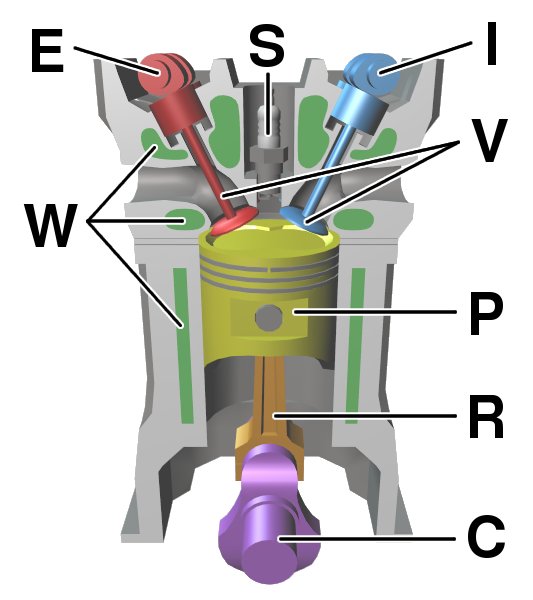
- C – crankshaft
- E – exhaust camshaft
- I – inlet camshaft
- P – piston
- R – connecting rod
- S – spark plug
- V – valves. red: exhaust, blue: intake.
- W – cooling water jacket
- gray structure – engine block
An internal combustion engine (ICE or IC engine) is a heat engine in which the combustion of a fuel occurs with an oxidizer (usually air) in a combustion chamber that is an integral part of the working fluid flow circuit. In an internal combustion engine, the expansion of the high-temperature and high-pressure gases produced by combustion applies direct force to components of the engine. The force is typically applied to pistons (piston engine), turbine blades (gas turbine), a rotor (Wankel engine), or a nozzle (jet engine). This force moves the component over a distance. This process transforms chemical energy into kinetic energy which is used to propel, move or power whatever the engine is attached to.
The first commercially successful internal combustion engines were invented in the mid-19th century. The first modern internal combustion engine, the Otto engine, was designed in 1876 by the German engineer Nicolaus Otto.[1] The term internal combustion engine usually refers to an engine in which combustion is intermittent, such as the more familiar two-stroke and four-stroke piston engines, along with variants, such as the six-stroke piston engine and the Wankel rotary engine. A second class of internal combustion engines use continuous combustion: gas turbines, jet engines and most rocket engines, each of which are internal combustion engines on the same principle as previously described.[1][2] In contrast, in external combustion engines, such as steam or Stirling engines, energy is delivered to a working fluid not consisting of, mixed with, or contaminated by combustion products. Working fluids for external combustion engines include air, hot water, pressurized water or even boiler-heated liquid sodium.
While there are many stationary applications, most ICEs are used in mobile applications and are the primary power supply for vehicles such as cars, aircraft and boats. ICEs are typically powered by hydrocarbon-based fuels like natural gas, gasoline, diesel fuel, or ethanol. Renewable fuels like biodiesel are used in compression ignition (CI) engines and bioethanol or ETBE (ethyl tert-butyl ether) produced from bioethanol in spark ignition (SI) engines. As early as 1900 the inventor of the diesel engine, Rudolf Diesel, was using peanut oil to run his engines.[3] Renewable fuels are commonly blended with fossil fuels. Hydrogen, which is rarely used, can be obtained from either fossil fuels or renewable energy.
History
[edit]
Various scientists and engineers contributed to the development of internal combustion engines. In 1791, John Barber developed the gas turbine. In 1794 Thomas Mead patented a gas engine. Also in 1794, Robert Street patented an internal combustion engine, which was also the first to use liquid fuel, and built an engine around that time. In 1798, John Stevens built the first American internal combustion engine. In 1807, French engineers Nicéphore Niépce (who went on to invent photography) and Claude Niépce ran a prototype internal combustion engine, using controlled dust explosions, the Pyréolophore, which was granted a patent by Napoleon Bonaparte. This engine powered a boat on the Saône river in France.[4][5] In the same year, Swiss engineer François Isaac de Rivaz invented a hydrogen-based internal combustion engine and powered the engine by electric spark. In 1808, De Rivaz fitted his invention to a primitive working vehicle – "the world's first internal combustion powered automobile".[6] In 1823, Samuel Brown patented the first internal combustion engine to be applied industrially.
In 1854, in the UK, the Italian inventors Eugenio Barsanti and Felice Matteucci obtained the certification: "Obtaining Motive Power by the Explosion of Gases". In 1857 the Great Seal Patent Office conceded them patent No.1655 for the invention of an "Improved Apparatus for Obtaining Motive Power from Gases".[7][8][9][10] Barsanti and Matteucci obtained other patents for the same invention in France, Belgium and Piedmont between 1857 and 1859.[11][12] In 1860, Belgian engineer Jean Joseph Etienne Lenoir produced a gas-fired internal combustion engine.[13] In 1864, Nicolaus Otto patented the first atmospheric gas engine. In 1872, American George Brayton invented the first commercial liquid-fueled internal combustion engine. In 1876, Nicolaus Otto began working with Gottlieb Daimler and Wilhelm Maybach, patented the compressed charge, four-cycle engine. In 1879, Karl Benz patented a reliable two-stroke gasoline engine. Later, in 1886, Benz began the first commercial production of motor vehicles with an internal combustion engine, in which a three-wheeled, four-cycle engine and chassis formed a single unit.[14] In 1892, Rudolf Diesel developed the first compressed charge, compression ignition engine. In 1926, Robert Goddard launched the first liquid-fueled rocket. In 1939, the Heinkel He 178 became the world's first jet aircraft.[15]
Etymology
[edit]In the past, the word engine (via Old French, from Latin ingenium, "ability") meant any piece of machinery—a sense that persists in expressions such as siege engine. A "motor" (from Latin motor, "mover") is any machine that produces mechanical power. Traditionally, electric motors are not referred to as "engines"; however, combustion engines are often referred to as "motors". (An electric engine refers to a locomotive operated by electricity.)
In boating, an internal combustion engine that is installed in the hull is referred to as an engine, but the engines that sit on the transom are referred to as motors.[16]
Applications
[edit]
Reciprocating piston engines are by far the most common power source for land and water vehicles, including automobiles, motorcycles, ships and to a lesser extent, locomotives (some are electrical but most use diesel engines[17][18]). Rotary engines of the Wankel design are used in some automobiles, aircraft and motorcycles. These are collectively known as internal-combustion-engine vehicles (ICEV).[19]
Where high power-to-weight ratios are required, internal combustion engines appear in the form of combustion turbines, or sometimes Wankel engines. Powered aircraft typically use an ICE which may be a reciprocating engine. Airplanes can instead use jet engines and helicopters can instead employ turboshafts; both of which are types of turbines. In addition to providing propulsion, aircraft may employ a separate ICE as an auxiliary power unit. Wankel engines are fitted to many unmanned aerial vehicles.
ICEs drive large electric generators that power electrical grids. They are found in the form of combustion turbines with a typical electrical output in the range of some 100 MW. Combined cycle power plants use the high temperature exhaust to boil and superheat water steam to run a steam turbine. Thus, the efficiency is higher because more energy is extracted from the fuel than what could be extracted by the combustion engine alone. Combined cycle power plants achieve efficiencies in the range of 50–60%. In a smaller scale, stationary engines like gas engines or diesel generators are used for backup or for providing electrical power to areas not connected to an electric grid.
Small engines (usually 2‐stroke single cylinder gasoline/petrol engines) are a common power source for lawnmowers, string trimmers, chainsaws, leaf blowers, pressure washers, radio-controlled cars, snowmobiles, jet skis, outboard motors, mopeds, and motorcycles.
Classification
[edit]There are several possible ways to classify internal combustion engines.
Reciprocating
[edit]By number of strokes:
- Two-stroke engine
- Clerk cycle[20]
- Day cycle
- Four-stroke engine (Otto cycle)
- Six-stroke engine
By type of ignition:
- Compression-ignition engine
- Spark-ignition engine (commonly found as gasoline engines)
By mechanical/thermodynamic cycle (these cycles are infrequently used but are commonly found in hybrid vehicles, along with other vehicles manufactured for fuel efficiency[21]):
Rotary
[edit]Continuous combustion
[edit]- Gas turbine engine
- Turbojet, through a propelling nozzle
- Turbofan, through a duct-fan
- Turboprop, through an unducted propeller, usually with variable pitch
- Turboshaft, a gas turbine optimized for producing mechanical torque instead of thrust
- Ramjet,[22] similar to a turbojet but uses vehicle speed to compress (ram) the air instead of a compressor.
- Scramjet, a variant of the ramjet that uses supersonic combustion.
- Rocket engine
Reciprocating engines
[edit]Structure
[edit]

The base of a reciprocating internal combustion engine is the engine block, which is typically made of cast iron (due to its good wear resistance and low cost)[23] or aluminum. In the latter case, the cylinder liners are made of cast iron or steel,[24] or a coating such as nikasil or alusil. The engine block contains the cylinders. In engines with more than one cylinder they are usually arranged either in 1 row (straight engine) or 2 rows (boxer engine or V engine); 3 or 4 rows are occasionally used (W engine) in contemporary engines, and other engine configurations are possible and have been used. Single-cylinder engines (or thumpers) are common for motorcycles and other small engines found in light machinery. On the outer side of the cylinder, passages that contain cooling fluid are cast into the engine block whereas, in some heavy duty engines, the passages are the types of removable cylinder sleeves which can be replaceable.[23] Water-cooled engines contain passages in the engine block where cooling fluid circulates (the water jacket). Some small engines are air-cooled, and instead of having a water jacket the cylinder block has fins protruding away from it to cool the engine by directly transferring heat to the air. The cylinder walls are usually finished by honing to obtain a cross hatch, which is able to retain more oil. A too rough surface would quickly harm the engine by excessive wear on the piston.
The pistons are short cylindrical parts which seal one end of the cylinder from the high pressure of the compressed air and combustion products and slide continuously within it while the engine is in operation. In smaller engines, the pistons are made of aluminum; while in larger applications, they are typically made of cast iron.[23] In performance applications, pistons can also be titanium or forged steel for greater strength. The top surface of the piston is called its crown and is typically flat or concave. Some two-stroke engines use pistons with a deflector head. Pistons are open at the bottom and hollow except for an integral reinforcement structure (the piston web). When an engine is working, the gas pressure in the combustion chamber exerts a force on the piston crown which is transferred through its web to a gudgeon pin. Each piston has rings fitted around its circumference that mostly prevent the gases from leaking into the crankcase or the oil into the combustion chamber.[25] A ventilation system drives the small amount of gas that escapes past the pistons during normal operation (the blow-by gases) out of the crankcase so that it does not accumulate contaminating the oil and creating corrosion.[23] In two-stroke gasoline engines the crankcase is part of the air–fuel path and due to the continuous flow of it, two-stroke engines do not need a separate crankcase ventilation system.
The cylinder head is attached to the engine block by numerous bolts or studs. It has several functions. The cylinder head seals the cylinders on the side opposite to the pistons; it contains short ducts (the ports) for intake and exhaust and the associated intake valves that open to let the cylinder be filled with fresh air and exhaust valves that open to allow the combustion gases to escape. The valves are often poppet valves[26][27] but they can also be rotary valves[28] or sleeve valves.[29] However, 2-stroke crankcase scavenged engines connect the gas ports directly to the cylinder wall without poppet valves; the piston controls their opening and occlusion instead. The cylinder head also holds the spark plug in the case of spark ignition engines and the injector for engines that use direct injection. All CI (compression ignition) engines use fuel injection, usually direct injection but some engines instead use indirect injection. SI (spark ignition) engines can use a carburetor or fuel injection as port injection or direct injection. Most SI engines have a single spark plug per cylinder but some have 2. A head gasket prevents the gas from leaking between the cylinder head and the engine block. The opening and closing of the valves is controlled by one or several camshafts and springs—or in some engines—a desmodromic mechanism that uses no springs. The camshaft may press directly the stem of the valve or may act upon a rocker arm, again, either directly or through a pushrod.

The crankcase is sealed at the bottom with a sump that collects the falling oil during normal operation to be cycled again. The cavity created between the cylinder block and the sump houses a crankshaft that converts the reciprocating motion of the pistons to rotational motion. The crankshaft is held in place relative to the engine block by main bearings, which allow it to rotate. Bulkheads in the crankcase form a half of every main bearing; the other half is a detachable cap. In some cases a single main bearing deck is used rather than several smaller caps. A connecting rod is connected to offset sections of the crankshaft (the crankpins) in one end and to the piston in the other end through the gudgeon pin and thus transfers the force and translates the reciprocating motion of the pistons to the circular motion of the crankshaft. The end of the connecting rod attached to the gudgeon pin is called its small end, and the other end, where it is connected to the crankshaft, the big end. The big end has a detachable half to allow assembly around the crankshaft. It is kept together to the connecting rod by removable bolts.
The cylinder head has an intake manifold and an exhaust manifold attached to the corresponding ports. The intake manifold connects to the air filter directly, or to a carburetor when one is present, which is then connected to the air filter. It distributes the air incoming from these devices to the individual cylinders. The exhaust manifold is the first component in the exhaust system. It collects the exhaust gases from the cylinders and drives it to the following component in the path. The exhaust system of an ICE may also include a catalytic converter and muffler. The final section in the path of the exhaust gases is the tailpipe.
Four-stroke engines
[edit]
1 ‐ Induction
2 ‐ Compression
3 ‐ Power
4 ‐ Exhaust
The top dead center (TDC) of a piston is the position where it is nearest to the valves; bottom dead center (BDC) is the opposite position where it is furthest from them. A stroke is the movement of a piston from TDC to BDC or vice versa, together with the associated process. While an engine is in operation, the crankshaft rotates continuously at a nearly constant speed. In a 4-stroke ICE, each piston experiences 2 strokes per crankshaft revolution in the following order. Starting the description at TDC, these are:[30][31]
- Intake, induction or suction: The intake valves are open as a result of the cam lobe pressing down on the valve stem. The piston moves downward increasing the volume of the combustion chamber and allowing air to enter in the case of a CI engine or an air-fuel mix in the case of SI engines that do not use direct injection. The air or air-fuel mixture is called the charge in any case.
- Compression: In this stroke, both valves are closed and the piston moves upward reducing the combustion chamber volume which reaches its minimum when the piston is at TDC. The piston performs work on the charge as it is being compressed; as a result, its pressure, temperature and density increase; an approximation to this behavior is provided by the ideal gas law. Just before the piston reaches TDC, ignition begins. In the case of a SI engine, the spark plug receives a high voltage pulse that generates the spark which gives it its name and ignites the charge. In the case of a CI engine, the fuel injector quickly injects fuel into the combustion chamber as a spray; the fuel ignites due to the high temperature.
- Power or working stroke: The pressure of the combustion gases pushes the piston downward, generating more kinetic energy than is required to compress the charge. Complementary to the compression stroke, the combustion gases expand and as a result their temperature, pressure and density decreases. When the piston is near to BDC the exhaust valve opens. In the blowdown, the combustion gases expand irreversibly due to the leftover pressure—in excess of back pressure, the gauge pressure on the exhaust port.
- Exhaust: The exhaust valve remains open while the piston moves upward expelling the combustion gases. For naturally aspirated engines a small part of the combustion gases may remain in the cylinder during normal operation because the piston does not close the combustion chamber completely; these gases dissolve in the next charge. At the end of this stroke, the exhaust valve closes, the intake valve opens, and the sequence repeats in the next cycle. The intake valve may open before the exhaust valve closes to allow better scavenging.
Two-stroke engines
[edit]The defining characteristic of this kind of engine is that each piston completes a cycle every crankshaft revolution. The 4 processes of intake, compression, power and exhaust take place in only 2 strokes so that it is not possible to dedicate a stroke exclusively for each of them. Starting at TDC the cycle consists of:
- Power: While the piston is descending the combustion gases perform work on it, as in a 4-stroke engine. The same thermodynamics for the expansion apply.
- Scavenging: Around 75° of crankshaft rotation before BDC the exhaust valve or port opens, and blowdown occurs. Shortly thereafter the intake valve or transfer port opens. The incoming charge displaces the remaining combustion gases to the exhaust system and a part of the charge may enter the exhaust system as well. The piston reaches BDC and reverses direction. After the piston has traveled a short distance upwards into the cylinder the exhaust valve or port closes; shortly the intake valve or transfer port closes as well.
- Compression: With both intake and exhaust closed the piston continues moving upwards compressing the charge and performing work on it. As in the case of a 4-stroke engine, ignition starts just before the piston reaches TDC and the same consideration on the thermodynamics of the compression on the charge apply.
While a 4-stroke engine uses the piston as a positive displacement pump to accomplish scavenging taking 2 of the 4 strokes, a 2-stroke engine uses the last part of the power stroke and the first part of the compression stroke for combined intake and exhaust. The work required to displace the charge and exhaust gases comes from either the crankcase or a separate blower. For scavenging, expulsion of burned gas and entry of fresh mix, two main approaches are described: Loop scavenging, and Uniflow scavenging. SAE news published in the 2010s that 'Loop Scavenging' is better under any circumstance than Uniflow Scavenging.[20]
Crankcase scavenged
[edit]
Some SI engines are crankcase scavenged and do not use poppet valves. Instead, the crankcase and the part of the cylinder below the piston is used as a pump. The intake port is connected to the crankcase through a reed valve or a rotary disk valve driven by the engine. For each cylinder, a transfer port connects in one end to the crankcase and in the other end to the cylinder wall. The exhaust port is connected directly to the cylinder wall. The transfer and exhaust port are opened and closed by the piston. The reed valve opens when the crankcase pressure is slightly below intake pressure, to let it be filled with a new charge; this happens when the piston is moving upwards. When the piston is moving downwards the pressure in the crankcase increases and the reed valve closes promptly, then the charge in the crankcase is compressed. When the piston is moving downwards, it also uncovers the exhaust port and the transfer port and the higher pressure of the charge in the crankcase makes it enter the cylinder through the transfer port, blowing the exhaust gases. Lubrication is accomplished by adding two-stroke oil to the fuel in small ratios. Petroil refers to the mix of gasoline with the aforesaid oil. This kind of 2-stroke engine has a lower efficiency than comparable 4-strokes engines and releases more polluting exhaust gases for the following conditions:
- They use a total-loss oiling system: all the lubricating oil is eventually burned along with the fuel.
- There are conflicting requirements for scavenging: On one side, enough fresh charge needs to be introduced in each cycle to displace almost all the combustion gases but introducing too much of it means that a part of it gets in the exhaust.
- They must use the transfer port(s) as a carefully designed and placed nozzle so that a gas current is created in a way that it sweeps the whole cylinder before reaching the exhaust port so as to expel the combustion gases, but minimize the amount of charge exhausted. 4-stroke engines have the benefit of forcibly expelling almost all of the combustion gases because during exhaust the combustion chamber is reduced to its minimum volume. In crankcase scavenged 2-stroke engines, exhaust and intake are performed mostly simultaneously and with the combustion chamber at its maximum volume.
The main advantage of 2-stroke engines of this type is mechanical simplicity and a higher power-to-weight ratio than their 4-stroke counterparts. Despite having twice as many power strokes per cycle, less than twice the power of a comparable 4-stroke engine is attainable in practice.
In the US, 2-stroke engines were banned for road vehicles due to the pollution. Off-road only motorcycles are still often 2-stroke but are rarely road legal. However, many thousands of 2-stroke lawn maintenance engines are in use.[citation needed]
Blower scavenged
[edit]
Using a separate blower avoids many of the shortcomings of crankcase scavenging, at the expense of increased complexity which means a higher cost and an increase in maintenance requirement. An engine of this type uses ports or valves for intake and valves for exhaust, except opposed piston engines, which may also use ports for exhaust. The blower is usually of the Roots-type but other types have been used too. This design is commonplace in CI engines, and has been occasionally used in SI engines.
CI engines that use a blower typically use uniflow scavenging. In this design the cylinder wall contains several intake ports placed uniformly spaced along the circumference just above the position that the piston crown reaches when at BDC. An exhaust valve or several like that of 4-stroke engines is used. The final part of the intake manifold is an air sleeve that feeds the intake ports. The intake ports are placed at a horizontal angle to the cylinder wall (I.e: they are in plane of the piston crown) to give a swirl to the incoming charge to improve combustion. The largest reciprocating IC are low speed CI engines of this type; they are used for marine propulsion (see marine diesel engine) or electric power generation and achieve the highest thermal efficiencies among internal combustion engines of any kind. Some diesel–electric locomotive engines operate on the 2-stroke cycle. The most powerful of them have a brake power of around 4.5 MW or 6,000 HP. The EMD SD90MAC class of locomotives are an example of such. The comparable class GE AC6000CW, whose prime mover has almost the same brake power, uses a 4-stroke engine.
An example of this type of engine is the Wärtsilä-Sulzer RTA96-C turbocharged 2-stroke diesel, used in large container ships. It is the most efficient and powerful reciprocating internal combustion engine in the world with a thermal efficiency over 50%.[32][33][34] For comparison, the most efficient small four-stroke engines are around 43% thermally-efficient (SAE 900648);[citation needed] size is an advantage for efficiency due to the increase in the ratio of volume to surface area.
See the external links for an in-cylinder combustion video in a 2-stroke, optically accessible motorcycle engine.
Historical design
[edit]Dugald Clerk developed the first two-cycle engine in 1879. It used a separate cylinder which functioned as a pump in order to transfer the fuel mixture to the cylinder.[20]
In 1899 John Day simplified Clerk's design into the type of 2 cycle engine that is very widely used today.[35] Day cycle engines are crankcase scavenged and port timed. The crankcase and the part of the cylinder below the exhaust port is used as a pump. The operation of the Day cycle engine begins when the crankshaft is turned so that the piston moves from BDC upward (toward the head) creating a vacuum in the crankcase/cylinder area. The carburetor then feeds the fuel mixture into the crankcase through a reed valve or a rotary disk valve (driven by the engine). There are cast in ducts from the crankcase to the port in the cylinder to provide for intake and another from the exhaust port to the exhaust pipe. The height of the port in relationship to the length of the cylinder is called the "port timing".
On the first upstroke of the engine there would be no fuel inducted into the cylinder as the crankcase was empty. On the downstroke, the piston now compresses the fuel mix, which has lubricated the piston in the cylinder and the bearings due to the fuel mix having oil added to it. As the piston moves downward it first uncovers the exhaust, but on the first stroke there is no burnt fuel to exhaust. As the piston moves downward further, it uncovers the intake port which has a duct that runs to the crankcase. Since the fuel mix in the crankcase is under pressure, the mix moves through the duct and into the cylinder.
Because there is no obstruction in the cylinder of the fuel to move directly out of the exhaust port prior to the piston rising far enough to close the port, early engines used a high domed piston to slow down the flow of fuel. Later the fuel was "resonated" back into the cylinder using an expansion chamber design. When the piston rose close to TDC, a spark ignited the fuel. As the piston is driven downward with power, it first uncovers the exhaust port where the burned fuel is expelled under high pressure and then the intake port where the process has been completed and will keep repeating.
Later engines used a type of porting devised by the Deutz company to improve performance. It was called the Schnurle Reverse Flow system. DKW licensed this design for all their motorcycles. Their DKW RT 125 was one of the first motor vehicles to achieve over 100 mpg as a result.[36]
Ignition
[edit]Internal combustion engines require ignition of the mixture, either by spark ignition (SI) or compression ignition (CI). Before the invention of reliable electrical methods, hot tube and flame methods were used. Experimental engines with laser ignition have been built.[37]
Spark ignition process
[edit]
The spark-ignition engine was a refinement of the early engines which used Hot Tube ignition. When Bosch developed the magneto it became the primary system for producing electricity to energize a spark plug.[38] Many small engines still use magneto ignition. Small engines are started by hand cranking using a recoil starter or hand crank. Prior to Charles F. Kettering of Delco's development of the automotive starter all gasoline engined automobiles used a hand crank.[39]
Larger engines typically power their starting motors and ignition systems using the electrical energy stored in a lead–acid battery. The battery's charged state is maintained by an automotive alternator or (previously) a generator which uses engine power to create electrical energy storage.
The battery supplies electrical power for starting when the engine has a starting motor system, and supplies electrical power when the engine is off. The battery also supplies electrical power during rare run conditions where the alternator cannot maintain more than 13.8 volts (for a common 12 V automotive electrical system). As alternator voltage falls below 13.8 volts, the lead-acid storage battery increasingly picks up electrical load. During virtually all running conditions, including normal idle conditions, the alternator supplies primary electrical power.
Some systems disable alternator field (rotor) power during wide-open throttle conditions. Disabling the field reduces alternator pulley mechanical loading to nearly zero, maximizing crankshaft power. In this case, the battery supplies all primary electrical power.
Gasoline engines take in a mixture of air and gasoline and compress it by the movement of the piston from bottom dead center to top dead center when the fuel is at maximum compression. The reduction in the size of the swept area of the cylinder and taking into account the volume of the combustion chamber is described by a ratio. Early engines had compression ratios of 6 to 1. As compression ratios were increased, the efficiency of the engine increased as well.
With early induction and ignition systems the compression ratios had to be kept low. With advances in fuel technology and combustion management, high-performance engines can run reliably at 12:1 ratio. With low octane fuel, a problem would occur as the compression ratio increased as the fuel was igniting due to the rise in temperature that resulted. Charles Kettering developed a lead additive which allowed higher compression ratios, which was progressively abandoned for automotive use from the 1970s onward, partly due to lead poisoning concerns.
The fuel mixture is ignited at different progressions of the piston in the cylinder. At low rpm, the spark is timed to occur close to the piston achieving top dead center. In order to produce more power, as rpm rises the spark is advanced sooner during piston movement. The spark occurs while the fuel is still being compressed progressively more as rpm rises.[40]
The necessary high voltage, typically 10,000 volts, is supplied by an induction coil or transformer. The induction coil is a fly-back system, using interruption of electrical primary system current through some type of synchronized interrupter. The interrupter can be either contact points or a power transistor. The problem with this type of ignition is that as RPM increases the availability of electrical energy decreases. This is especially a problem, since the amount of energy needed to ignite a more dense fuel mixture is higher. The result was often a high RPM misfire.
Capacitor discharge ignition was developed. It produces a rising voltage that is sent to the spark plug. CD system voltages can reach 60,000 volts.[41] CD ignitions use step-up transformers. The step-up transformer uses energy stored in a capacitance to generate electric spark. With either system, a mechanical or electrical control system provides a carefully timed high-voltage to the proper cylinder. This spark, via the spark plug, ignites the air-fuel mixture in the engine's cylinders.
While gasoline internal combustion engines are much easier to start in cold weather than diesel engines, they can still have cold weather starting problems under extreme conditions. For years, the solution was to park the car in heated areas. In some parts of the world, the oil was actually drained and heated overnight and returned to the engine for cold starts. In the early 1950s, the gasoline Gasifier unit was developed, where, on cold weather starts, raw gasoline was diverted to the unit where part of the fuel was burned causing the other part to become a hot vapor sent directly to the intake valve manifold. This unit was quite popular until electric engine block heaters became standard on gasoline engines sold in cold climates.[42]
Compression ignition process
[edit]For ignition, diesel, PPC and HCCI engines rely solely on the high temperature and pressure created by the engine in its compression process. The compression level that occurs is usually twice or more than a gasoline engine. Diesel engines take in air only, and shortly before peak compression, spray a small quantity of diesel fuel into the cylinder via a fuel injector that allows the fuel to instantly ignite. HCCI type engines take in both air and fuel, but continue to rely on an unaided auto-combustion process, due to higher pressures and temperature. This is also why diesel and HCCI engines are more susceptible to cold-starting issues, although they run just as well in cold weather once started. Light duty diesel engines with indirect injection in automobiles and light trucks employ glowplugs (or other pre-heating: see Cummins ISB#6BT) that pre-heat the combustion chamber just before starting to reduce no-start conditions in cold weather. Most diesels also have a battery and charging system; nevertheless, this system is secondary and is added by manufacturers as a luxury for the ease of starting, turning fuel on and off (which can also be done via a switch or mechanical apparatus), and for running auxiliary electrical components and accessories. Most new engines rely on electrical and electronic engine control units (ECU) that also adjust the combustion process to increase efficiency and reduce emissions.
Lubrication
[edit]
Surfaces in contact and relative motion to other surfaces require lubrication to reduce wear, noise and increase efficiency by reducing the power wasting in overcoming friction, or to make the mechanism work at all. Also, the lubricant used can reduce excess heat and provide additional cooling to components. At the very least, an engine requires lubrication in the following parts:
- Between pistons and cylinders
- Small bearings
- Big end bearings
- Main bearings
- Valve gear (The following elements may not be present):
- Tappets
- Rocker arms
- Pushrods
- Timing chain or gears. Toothed belts do not require lubrication.
In 2-stroke crankcase scavenged engines, the interior of the crankcase, and therefore the crankshaft, connecting rod and bottom of the pistons are sprayed by the two-stroke oil in the air-fuel-oil mixture which is then burned along with the fuel. The valve train may be contained in a compartment flooded with lubricant so that no oil pump is required.
In a splash lubrication system no oil pump is used. Instead the crankshaft dips into the oil in the sump and due to its high speed, it splashes the crankshaft, connecting rods and bottom of the pistons. The connecting rod big end caps may have an attached scoop to enhance this effect. The valve train may also be sealed in a flooded compartment, or open to the crankshaft in a way that it receives splashed oil and allows it to drain back to the sump. Splash lubrication is common for small 4-stroke engines.
In a forced (also called pressurized) lubrication system, lubrication is accomplished in a closed-loop which carries motor oil to the surfaces serviced by the system and then returns the oil to a reservoir. The auxiliary equipment of an engine is typically not serviced by this loop; for instance, an alternator may use ball bearings sealed with their own lubricant. The reservoir for the oil is usually the sump, and when this is the case, it is called a wet sump system. When there is a different oil reservoir the crankcase still catches it, but it is continuously drained by a dedicated pump; this is called a dry sump system.
On its bottom, the sump contains an oil intake covered by a mesh filter which is connected to an oil pump then to an oil filter outside the crankcase. From there it is diverted to the crankshaft main bearings and valve train. The crankcase contains at least one oil gallery (a conduit inside a crankcase wall) to which oil is introduced from the oil filter. The main bearings contain a groove through all or half its circumference; the oil enters these grooves from channels connected to the oil gallery. The crankshaft has drillings that take oil from these grooves and deliver it to the big end bearings. All big end bearings are lubricated this way. A single main bearing may provide oil for 0, 1 or 2 big end bearings. A similar system may be used to lubricate the piston, its gudgeon pin and the small end of its connecting rod; in this system, the connecting rod big end has a groove around the crankshaft and a drilling connected to the groove which distributes oil from there to the bottom of the piston and from then to the cylinder.
Other systems are also used to lubricate the cylinder and piston. The connecting rod may have a nozzle to throw an oil jet to the cylinder and bottom of the piston. That nozzle is in movement relative to the cylinder it lubricates, but always pointed towards it or the corresponding piston.
Typically forced lubrication systems have a lubricant flow higher than what is required to lubricate satisfactorily, in order to assist with cooling. Specifically, the lubricant system helps to move heat from the hot engine parts to the cooling liquid (in water-cooled engines) or fins (in air-cooled engines) which then transfer it to the environment. The lubricant must be designed to be chemically stable and maintain suitable viscosities within the temperature range it encounters in the engine.
Cylinder configuration
[edit]Common cylinder configurations include the straight or inline configuration, the more compact V configuration, and the wider but smoother flat or boxer configuration. Aircraft engines can also adopt a radial configuration, which allows more effective cooling. More unusual configurations such as the H, U, X, and W have also been used.

a – straight
b – V
c – opposed
d – W
Multiple cylinder engines have their valve train and crankshaft configured so that pistons are at different parts of their cycle. It is desirable to have the pistons' cycles uniformly spaced (this is called even firing) especially in forced induction engines; this reduces torque pulsations[43] and makes inline engines with more than 3 cylinders statically balanced in its primary forces. However, some engine configurations require odd firing to achieve better balance than what is possible with even firing. For instance, a 4-stroke I2 engine has better balance when the angle between the crankpins is 180° because the pistons move in opposite directions and inertial forces partially cancel, but this gives an odd firing pattern where one cylinder fires 180° of crankshaft rotation after the other, then no cylinder fires for 540°. With an even firing pattern, the pistons would move in unison and the associated forces would add.
Multiple crankshaft configurations do not necessarily need a cylinder head at all because they can instead have a piston at each end of the cylinder called an opposed piston design. Because fuel inlets and outlets are positioned at opposed ends of the cylinder, one can achieve uniflow scavenging, which, as in the four-stroke engine is efficient over a wide range of engine speeds. Thermal efficiency is improved because of a lack of cylinder heads. This design was used in the Junkers Jumo 205 diesel aircraft engine, using two crankshafts at either end of a single bank of cylinders, and most remarkably in the Napier Deltic diesel engines. These used three crankshafts to serve three banks of double-ended cylinders arranged in an equilateral triangle with the crankshafts at the corners. It was also used in single-bank locomotive engines, and is still used in marine propulsion engines and marine auxiliary generators.
Diesel cycle
[edit]
Most truck and automotive diesel engines use a cycle reminiscent of a four-stroke cycle, but with temperature increase by compression causing ignition, rather than needing a separate ignition system. This variation is called the diesel cycle. In the diesel cycle, diesel fuel is injected directly into the cylinder so that combustion occurs at constant pressure, as the piston moves.
Otto cycle
[edit]The Otto cycle is the most common cycle for most cars' internal combustion engines that use gasoline as a fuel. It consists of the same major steps as described for the four-stroke engine: Intake, compression, ignition, expansion and exhaust.
Five-stroke engine
[edit]In 1879, Nicolaus Otto manufactured and sold a double expansion engine (the double and triple expansion principles had ample usage in steam engines), with two small cylinders at both sides of a low-pressure larger cylinder, where a second expansion of exhaust stroke gas took place; the owner returned it, alleging poor performance. In 1906, the concept was incorporated in a car built by EHV (Eisenhuth Horseless Vehicle Company);[44] and in the 21st century Ilmor designed and successfully tested a 5-stroke double expansion internal combustion engine, with high power output and low SFC (Specific Fuel Consumption).[45]
Six-stroke engine
[edit]The six-stroke engine was invented in 1883. Four kinds of six-stroke engines use a regular piston in a regular cylinder (Griffin six-stroke, Bajulaz six-stroke, Velozeta six-stroke and Crower six-stroke), firing every three crankshaft revolutions. These systems capture the waste heat of the four-stroke Otto cycle with an injection of air or water.
The Beare Head and "piston charger" engines operate as opposed-piston engines, two pistons in a single cylinder, firing every two revolutions rather than every four like a four-stroke engine.
Other cycles
[edit]The first internal combustion engines did not compress the mixture. The first part of the piston downstroke drew in a fuel-air mixture, then the inlet valve closed and, in the remainder of the down-stroke, the fuel-air mixture fired. The exhaust valve opened for the piston upstroke. These attempts at imitating the principle of a steam engine were very inefficient. There are a number of variations of these cycles, most notably the Atkinson and Miller cycles.
Split-cycle engines separate the four strokes of intake, compression, combustion and exhaust into two separate but paired cylinders. The first cylinder is used for intake and compression. The compressed air is then transferred through a crossover passage from the compression cylinder into the second cylinder, where combustion and exhaust occur. A split-cycle engine is really an air compressor on one side with a combustion chamber on the other.
Previous split-cycle engines have had two major problems—poor breathing (volumetric efficiency) and low thermal efficiency. However, new designs are being introduced that seek to address these problems. The Scuderi Engine addresses the breathing problem by reducing the clearance between the piston and the cylinder head through various turbocharging techniques. The Scuderi design requires the use of outwardly opening valves that enable the piston to move very close to the cylinder head without the interference of the valves. Scuderi addresses the low thermal efficiency via firing after top dead center (ATDC).
Firing ATDC can be accomplished by using high-pressure air in the transfer passage to create sonic flow and high turbulence in the power cylinder.
Combustion turbines
[edit]Jet engine
[edit]
Jet engines use a number of rows of fan blades to compress air which then enters a combustor where it is mixed with fuel (typically JP fuel) and then ignited. The burning of the fuel raises the temperature of the air which is then exhausted out of the engine creating thrust. A modern turbofan engine can operate at as high as 48% efficiency.[46]
There are six sections to a turbofan engine:
- Fan
- Compressor
- Combustor
- Turbine
- Mixer
- Nozzle[47]
Gas turbines
[edit]A gas turbine compresses air and uses it to turn a turbine. It is essentially a jet engine which directs its output to a shaft. There are three stages to a turbine: 1) air is drawn through a compressor where the temperature rises due to compression, 2) fuel is added in the combustor, and 3) hot air is exhausted through turbine blades which rotate a shaft connected to the compressor.
A gas turbine is a rotary machine similar in principle to a steam turbine and it consists of three main components: a compressor, a combustion chamber, and a turbine. The temperature of the air, after being compressed in the compressor, is increased by burning fuel in it. The heated air and the products of combustion expand in a turbine, producing work output. About 2⁄3 of the work drives the compressor: the rest (about 1⁄3) is available as useful work output.[48]
Gas turbines are among the most efficient internal combustion engines. The General Electric 7HA and 9HA turbine combined cycle electrical plants are rated at over 61% efficiency.[49]
Brayton cycle
[edit]
A gas turbine is a rotary machine somewhat similar in principle to a steam turbine. It consists of three main components: compressor, combustion chamber, and turbine. The air is compressed by the compressor where a temperature rise occurs. The temperature of the compressed air is further increased by combustion of injected fuel in the combustion chamber which expands the air. This energy rotates the turbine which powers the compressor via a mechanical coupling. The hot gases are then exhausted to provide thrust.
Gas turbine cycle engines employ a continuous combustion system where compression, combustion, and expansion occur simultaneously at different places in the engine—giving continuous power. Notably, the combustion takes place at constant pressure, rather than with the Otto cycle, constant volume.
Wankel engines
[edit]
The Wankel engine (rotary engine) does not have piston strokes. It operates with the same separation of phases as the four-stroke engine with the phases taking place in separate locations in the engine. In thermodynamic terms it follows the Otto engine cycle, so may be thought of as a "four-phase" engine. While it is true that three power strokes typically occur per rotor revolution, due to the 3:1 revolution ratio of the rotor to the eccentric shaft, only one power stroke per shaft revolution actually occurs. The drive (eccentric) shaft rotates once during every power stroke instead of twice (crankshaft), as in the Otto cycle, giving it a greater power-to-weight ratio than piston engines. This type of engine was most notably used in the Mazda RX-8, the earlier RX-7, and other vehicle models. The engine is also used in unmanned aerial vehicles, where the small size and weight and the high power-to-weight ratio are advantageous.
Forced induction
[edit]Forced induction is the process of delivering compressed air to the intake of an internal combustion engine. A forced induction engine uses a gas compressor to increase the pressure, temperature and density of the air. An engine without forced induction is considered a naturally aspirated engine.
Forced induction is used in the automotive and aviation industry to increase engine power and efficiency. It particularly helps aviation engines, as they need to operate at high altitude.
Forced induction is achieved by a supercharger, where the compressor is directly powered from the engine shaft or, in the turbocharger, from a turbine powered by the engine exhaust.
Fuels and oxidizers
[edit]All internal combustion engines depend on combustion of a chemical fuel, typically with oxygen from the air (though it is possible to inject nitrous oxide to do more of the same thing and gain a power boost). The combustion process typically results in the production of a great quantity of thermal energy, as well as the production of steam and carbon dioxide and other chemicals at very high temperature; the temperature reached is determined by the chemical make up of the fuel and oxidizers (see stoichiometry), as well as by the compression and other factors.
Fuels
[edit]The most common modern fuels are made up of hydrocarbons and are derived mostly from fossil fuels (petroleum). Fossil fuels include diesel fuel, gasoline and petroleum gas, and the rarer use of propane. Except for the fuel delivery components, most internal combustion engines that are designed for gasoline use can run on natural gas or liquefied petroleum gases without major modifications. Large diesels can run with air mixed with gases and a pilot diesel fuel ignition injection. Liquid and gaseous biofuels, such as ethanol and biodiesel (a form of diesel fuel that is produced from crops that yield triglycerides such as soybean oil), can also be used. Engines with appropriate modifications can also run on hydrogen gas, wood gas, or charcoal gas, as well as from so-called producer gas made from other convenient biomass. Experiments have also been conducted using powdered solid fuels, such as the magnesium injection cycle.
Presently, fuels used include:
- Petroleum:
- Petroleum spirit (North American term: gasoline, British term: petrol)
- Diesel fuel.
- Autogas (liquified petroleum gas).
- Propane.
- Compressed natural gas.
- Jet fuel (aviation fuel)
- Residual fuel
- Coal:
- Gasoline can be made from carbon (coal) using the Fischer–Tropsch process
- Diesel fuel can be made from carbon using the Fischer–Tropsch process
- Biofuels and vegetable oils:
- Peanut oil and other vegetable oils.
- Woodgas, from an onboard wood gasifier using solid wood as a fuel
- Biofuels:
- Biobutanol (replaces gasoline).
- Biodiesel (replaces petrodiesel).
- Dimethyl Ether (replaces petrodiesel).
- Bioethanol and biomethanol (wood alcohol) and other biofuels (see Flexible-fuel vehicle).
- Biogas
- Hydrogen (mainly spacecraft rocket engines)
Even fluidized metal powders and explosives have seen some use. Engines that use gases for fuel are called gas engines and those that use liquid hydrocarbons are called oil engines; however, gasoline engines are also often colloquially referred to as "gas engines" ("petrol engines" outside North America).
The main limitations on fuels are that it must be easily transportable through the fuel system to the combustion chamber, and that the fuel releases sufficient energy in the form of heat upon combustion to make practical use of the engine.
Diesel engines are generally heavier, noisier, and more powerful at lower speeds than gasoline engines. They are also more fuel-efficient in most circumstances and are used in heavy road vehicles, some automobiles (increasingly so for their increased fuel efficiency over gasoline engines), ships, railway locomotives, and light aircraft. Gasoline engines are used in most other road vehicles including most cars, motorcycles, and mopeds. In Europe, sophisticated diesel-engined cars have taken over about 45% of the market since the 1990s. There are also engines that run on hydrogen, methanol, ethanol, liquefied petroleum gas (LPG), biodiesel, paraffin and tractor vaporizing oil (TVO).
Hydrogen
[edit]Hydrogen could eventually replace conventional fossil fuels in traditional internal combustion engines. Alternatively fuel cell technology may come to deliver its promise and the use of the internal combustion engines could even be phased out.
Although there are multiple ways of producing free hydrogen, those methods require converting combustible molecules into hydrogen or consuming electric energy. Unless that electricity is produced from a renewable source—and is not required for other purposes—hydrogen does not solve any energy crisis. In many situations the disadvantage of hydrogen, relative to carbon fuels, is its storage. Liquid hydrogen has extremely low density (14 times lower than water) and requires extensive insulation—whilst gaseous hydrogen requires heavy tankage. Even when liquefied, hydrogen has a higher specific energy but the volumetric energetic storage is still roughly five times lower than gasoline. However, the energy density of hydrogen is considerably higher than that of electric batteries, making it a serious contender as an energy carrier to replace fossil fuels. The 'Hydrogen on Demand' process (see direct borohydride fuel cell) creates hydrogen as needed, but has other issues, such as the high price of the sodium borohydride that is the raw material.
Oxidizers
[edit]
Since air is plentiful at the surface of the earth, the oxidizer is typically atmospheric oxygen, which has the advantage of not being stored within the vehicle. This increases the power-to-weight and power-to-volume ratios. Other materials are used for special purposes, often to increase power output or to allow operation under water or in space.
- Compressed air has been commonly used in torpedoes.[50]
- Compressed oxygen, as well as some compressed air, was used in the Japanese Type 93 torpedo. Some submarines carry pure oxygen. Rockets very often use liquid oxygen.[51]
- Nitromethane is added to some racing and model fuels to increase power and control combustion.
- Nitrous oxide has been used—with extra gasoline—in tactical aircraft, and in specially equipped cars to allow short bursts of added power from engines that otherwise run on gasoline and air. It is also used in the Burt Rutan rocket spacecraft.
- Hydrogen peroxide power was under development for German World War II submarines. It may have been used in some non-nuclear submarines, and was used on some rocket engines (notably the Black Arrow and the Messerschmitt Me 163 rocket fighter).
- Other chemicals such as chlorine or fluorine have been used experimentally, but have not been found practical.
Cooling
[edit]Cooling is required to remove excessive heat—high temperature can cause engine failure, usually from wear (due to high-temperature-induced failure of lubrication), cracking or warping. Two most common forms of engine cooling are air-cooled and water-cooled. Most modern automotive engines are both water and air-cooled, as the water/liquid-coolant is carried to air-cooled fins and/or fans, whereas larger engines may be singularly water-cooled as they are stationary and have a constant supply of water through water-mains or fresh-water, while most power tool engines and other small engines are air-cooled. Some engines (air or water-cooled) also have an oil cooler. In some engines, especially for turbine engine blade cooling and liquid rocket engine cooling, fuel is used as a coolant, as it is simultaneously preheated before injecting it into a combustion chamber.
Starting
[edit]Internal combustion engines must have their cycles started. In reciprocating engines this is accomplished by turning the crankshaft (Wankel Rotor Shaft) which induces the cycles of intake, compression, combustion, and exhaust. The first engines were started with a turn of their flywheels, while the first vehicle (the Daimler Reitwagen) was started with a hand crank. All ICE engined automobiles were started with hand cranks until Charles Kettering developed the electric starter for automobiles.[52] This method is now the most widely used, even among non-automobiles.
As diesel engines have become larger and their mechanisms heavier, air starters have come into use.[53] This is due to the lack of torque in electric starters. Air starters work by pumping compressed air into the cylinders of an engine to start it turning.
Two-wheeled vehicles may have their engines started in one of four ways:
- By pedaling, as on a bicycle
- By pushing the vehicle and then engaging the clutch, known as "run-and-bump starting"
- By kicking downward on a single pedal, known as "kick starting"
- By an electric starter, as in cars
There are also starters where a spring is compressed by a crank motion and then used to start an engine.
Some small engines use a pull-rope mechanism called "recoil starting", as the rope rewinds itself after it has been pulled out to start the engine. This method is commonly used in pushed lawn mowers and other settings where only a small amount of torque is needed to turn an engine over.
Turbine engines are frequently started by an electric motor or by compressed air.
Measures of engine performance
[edit]Engine types vary greatly in a number of different ways:
- energy efficiency
- fuel/propellant consumption (brake specific fuel consumption for shaft engines, thrust specific fuel consumption for jet engines)
- power-to-weight ratio
- thrust to weight ratio
- torque curves (for shaft engines), thrust lapse (jet engines)
- compression ratio for piston engines, overall pressure ratio for jet engines and gas turbines
Energy efficiency
[edit]Once ignited and burnt, the combustion products—hot gases—have more available thermal energy than the original compressed fuel-air mixture (which had higher chemical energy). This available energy is manifested as a higher temperature and pressure that can be converted into kinetic energy by the engine. In a reciprocating engine, the high-pressure gases inside the cylinders drive the engine's pistons.
Once the available energy has been removed, the remaining hot gases are vented (often by opening a valve or exposing the exhaust outlet) and this allows the piston to return to its previous position (top dead center, or TDC). The piston can then proceed to the next phase of its cycle, which varies between engines. Any thermal energy that is not translated into work is normally considered a waste product and is removed from the engine either by an air or liquid cooling system.
Internal combustion engines are considered heat engines (since the release of chemical energy in combustion has the same effect as heat transfer into the engine) and as such their theoretical efficiency can be approximated by idealized thermodynamic cycles. The thermal efficiency of a theoretical cycle cannot exceed that of the Carnot cycle, whose efficiency is determined by the difference between the lower and upper operating temperatures of the engine. The upper operating temperature of an engine is limited by two main factors; the thermal operating limits of the materials, and the auto-ignition resistance of the fuel. All metals and alloys have a thermal operating limit, and there is significant research into ceramic materials that can be made with greater thermal stability and desirable structural properties. Higher thermal stability allows for a greater temperature difference between the lower (ambient) and upper operating temperatures, hence greater thermodynamic efficiency. Also, as the cylinder temperature rises, the fuel becomes more prone to auto-ignition. This is caused when the cylinder temperature nears the flash point of the charge. At this point, ignition can spontaneously occur before the spark plug fires, causing excessive cylinder pressures. Auto-ignition can be mitigated by using fuels with high auto-ignition resistance (octane rating), however it still puts an upper bound on the allowable peak cylinder temperature.
The thermodynamic limits assume that the engine is operating under ideal conditions: a frictionless world, ideal gases, perfect insulators, and operation for infinite time. Real world applications introduce complexities that reduce efficiency. For example, a real engine runs best at a specific load, termed its power band. The engine in a car cruising on a highway is usually operating significantly below its ideal load, because it is designed for the higher loads required for rapid acceleration.[citation needed] In addition, factors such as wind resistance reduce overall system efficiency. Vehicle fuel economy is measured in miles per gallon or in liters per 100 kilometers. The volume of hydrocarbon assumes a standard energy content.
Even when aided with turbochargers and stock efficiency aids, most engines retain an average efficiency of about 18–20%.[54] However, the latest technologies in Formula One engines have seen a boost in thermal efficiency past 50%.[55] There are many inventions aimed at increasing the efficiency of IC engines. In general, practical engines are always compromised by trade-offs between different properties such as efficiency, weight, power, heat, response, exhaust emissions, or noise. Sometimes economy also plays a role in the cost to manufacture an engine, and to manufacture and distribute the fuel. Increasing engine efficiency brings better fuel economy, but only if the fuel cost per energy content is the same.
Measures of fuel efficiency and propellant efficiency
[edit]For stationary and shaft engines including propeller engines, fuel consumption is measured by calculating the brake specific fuel consumption, which measures the mass flow rate of fuel consumption divided by the power produced.
For internal combustion engines in the form of jet engines, the power output varies drastically with airspeed and a less variable measure is used: thrust specific fuel consumption (TSFC), which is the mass of propellant needed to generate impulses that is measured in either pound force-hour or the grams of propellant needed to generate an impulse that measures one kilonewton-second.
For rockets, TSFC can be used, but typically other equivalent measures are traditionally used, such as specific impulse and effective exhaust velocity.
Air and noise pollution
[edit]| Part of a series on |
| Pollution |
|---|
Air pollution
[edit]Internal combustion engines such as reciprocating internal combustion engines produce air pollution emissions, due to incomplete combustion of carbonaceous fuel. The main derivatives of the process are carbon dioxide CO
2, water and some soot—also called particulate matter (PM).[56] The effects of inhaling particulate matter have been studied in humans and animals and include asthma, lung cancer, cardiovascular issues, and premature death.[57] There are, however, some additional products of the combustion process that include nitrogen oxides and sulfur and some uncombusted hydrocarbons, depending on the operating conditions and the fuel-air ratio.
Carbon dioxide emissions from internal combustion engines (particularly ones using fossil fuels such as gasoline and diesel) contribute to human-induced climate change. Increasing the engine's fuel efficiency can reduce, but not eliminate, the amount of CO
2 emissions as carbon-based fuel combustion produces CO
2. Since removing CO
2 from engine exhaust is impractical, there is increasing interest in alternatives. Sustainable fuels such as biofuels, synfuels, and electric motors powered by batteries are examples.
Not all of the fuel is completely consumed by the combustion process. A small amount of fuel is present after combustion, and some of it reacts to form oxygenates, such as formaldehyde or acetaldehyde, or hydrocarbons not originally present in the input fuel mixture. Incomplete combustion usually results from insufficient oxygen to achieve the perfect stoichiometric ratio. The flame is "quenched" by the relatively cool cylinder walls, leaving behind unreacted fuel that is expelled with the exhaust. When running at lower speeds, quenching is commonly observed in diesel (compression ignition) engines that run on natural gas. Quenching reduces efficiency and increases knocking, sometimes causing the engine to stall. Incomplete combustion also leads to the production of carbon monoxide (CO). Further chemicals released are benzene and 1,3-butadiene that are also hazardous air pollutants.
Increasing the amount of air in the engine reduces emissions of incomplete combustion products, but also promotes reaction between oxygen and nitrogen in the air to produce nitrogen oxides (NOx). NOx is hazardous to both plant and animal health, and leads to the production of ozone (O
3). Ozone is not emitted directly; rather, it is a secondary air pollutant, produced in the atmosphere by the reaction of NOx and volatile organic compounds in the presence of sunlight. Ground-level ozone is harmful to human health and the environment. Though the same chemical substance, ground-level ozone should not be confused with stratospheric ozone, or the ozone layer, which protects the earth from harmful ultraviolet rays.
Carbon fuels containing sulfur produce sulfur monoxides (SO) and sulfur dioxide (SO
2) contributing to acid rain.
In the United States, nitrogen oxides, PM, carbon monoxide, sulfur dioxide, and ozone, are regulated as criteria air pollutants under the Clean Air Act to levels where human health and welfare are protected. Other pollutants, such as benzene and 1,3-butadiene, are regulated as hazardous air pollutants whose emissions must be lowered as much as possible depending on technological and practical considerations.
NOx, carbon monoxide and other pollutants are frequently controlled via exhaust gas recirculation which returns some of the exhaust back into the engine intake. Catalytic converters are used to convert exhaust chemicals to CO
2 (a greenhouse gas), H
2O (water vapour, also a greenhouse gas) and N
2 (nitrogen).
Non-road engines
[edit]The emission standards used by many countries have special requirements for non-road engines which are used by equipment and vehicles that are not operated on the public roadways. The standards are separated from the road vehicles.[58]
Noise pollution
[edit]Significant contributions to noise pollution are made by internal combustion engines. Automobile and truck traffic operating on highways and street systems produce noise, as do aircraft flights due to jet noise, particularly supersonic-capable aircraft. Rocket engines create the most intense noise.
Idling
[edit]Internal combustion engines continue to consume fuel and emit pollutants while idling. Idling is reduced by stop-start systems.
Carbon dioxide formation
[edit]A good way to estimate the mass of carbon dioxide that is released when one litre of diesel fuel (or gasoline) is combusted can be found as follows:[59]
As a good approximation the chemical formula of diesel is C
nH
2n. In reality diesel is a mixture of different molecules. As carbon has a molar mass of 12 g/mol and hydrogen (atomic) has a molar mass of about 1 g/mol, the fraction by weight of carbon in diesel is roughly 12⁄14.
The reaction of diesel combustion is given by:
2C
nH
2n + 3nO
2 ⇌ 2nCO
2 + 2nH
2O
Carbon dioxide has a molar mass of 44 g/mol as it consists of 2 atoms of oxygen (16 g/mol) and 1 atom of carbon (12 g/mol). So 12 g of carbon yields 44 g of carbon dioxide.
Diesel has a density of 0.838 kg per litre.
Putting everything together the mass of carbon dioxide that is produced by burning 1 litre of diesel can be calculated as:
The figure obtained with this estimation is close to the values found in the literature.
For gasoline, with a density of 0.75 kg/L and a ratio of carbon to hydrogen atoms of about 6 to 14, the estimated value of carbon dioxide emission from burning 1 litre of gasoline is:
Parasitic loss
[edit]The term parasitic loss is often applied to devices that take energy from the engine in order to enhance the engine's ability to create more energy or convert energy to motion. In the internal combustion engine, almost every mechanical component, including the drivetrain, causes parasitic loss and could thus be characterized as a parasitic load.
Examples
[edit]Bearings, oil pumps, piston rings, valve springs, flywheels, transmissions, driveshafts, and differentials all act as parasitic loads that rob the system of power. These parasitic loads can be divided into two categories: those inherent to the working of the engine and those drivetrain losses incurred in the systems that transfer power from the engine to the road (such as the transmission, driveshaft, differentials and axles).
For example, the former category (engine parasitic loads) includes the oil pump used to lubricate the engine, which is a necessary parasite that consumes power from the engine (its host). Another example of an engine parasitic load is a supercharger, which derives its power from the engine and creates more power for the engine. The power that the supercharger consumes is parasitic loss and is usually expressed in kilowatt or horsepower. While the power that the supercharger consumes in comparison to what it generates is small, it is still measurable or calculable. One of the desirable features of a turbocharger over a supercharger is the lower parasitic loss of the former.[60]
Drivetrain parasitic losses include both steady state and dynamic loads. Steady state loads occur at constant speeds and may originate in discrete components such as the torque converter, the transmission oil pump, and/or clutch drag, and in seal/bearing drag, churning of lubricant and gear windage/friction found throughout the system. Dynamic loads occur under acceleration and are caused by inertia of rotating components and/or increased friction.[61]
Measurement
[edit]While rules of thumb such as a 15% power loss from drivetrain parasitic loads have been commonly repeated, the actual loss of energy due to parasitic loads varies between systems. It can be influenced by powertrain design, lubricant type and temperature and many other factors.[61][62] In automobiles, drivetrain loss can be quantified by measuring the difference between power measured by an engine dynamometer and a chassis dynamometer. However, this method is primarily useful for measuring steady state loads and may not accurately reflect losses due to dynamic loads.[61] More advanced methods can be used in a laboratory setting, such as measuring in-cylinder pressure measurements, flow rate and temperature at certain points, and testing of individual parts or sub-assemblies to determine friction and pumping losses.[63]
For example, in a dynamometer test by Hot Rod magazine, a Ford Mustang equipped with a modified 357ci small-block Ford V8 engine and an automatic transmission had a measured drivetrain power loss averaging 33%. In the same test, a Buick equipped with a modified 455ci V8 engine and a 4-speed manual transmission was measured to have an average drivetrain power loss of 21%.[64]
Laboratory testing of a heavy-duty diesel engine determined that 1.3% of the fuel energy input was lost to parasitic loads of engine accessories such as water and oil pumps.[63]
Reduction
[edit]Automotive engineers and tuners commonly make design choices that reduce parasitic loads in order to improve efficiency and power output. These may involve the choice of major engine components or systems, such as the use of dry sump lubrication system over a wet sump system. Alternately, this can be effected through substitution of minor components available as aftermarket modifications, such as exchanging a directly engine-driven fan for one equipped with a fan clutch or an electric fan.[64] Another modification to reduce parasitic loss, usually seen in track-only cars, is the replacement of an engine-driven water pump for an electrical water pump.[65] The reduction in parasitic loss from these changes may be due to reduced friction or many other variables that cause the design to be more efficient.[citation needed]
See also
[edit]- Adiabatic flame temperature
- Aluminum internal combustion engine
- Air-fuel ratio
- Bore
- Centrifugal pendulum absorber
- Component parts of internal combustion engines
- Crude oil engine – a two-stroke engine
- Deglazing (engine mechanics)
- Diesel engine
- Dieselisation
- Direct injection
- Dynamometer
- Electric vehicle
- Engine test stand – information about how to check an internal combustion engine
- External combustion engine (EC engine)
- Fossil fuels
- Gasoline direct injection
- Gas turbine
- Heat pump
- Homogeneous charge compression ignition (HCCI)
- Hybrid vehicle
- Indirect injection
- Jet engine
- Magnesium injection cycle
- Model engine
- Multi-valve
- Petrofuel
- Piston engine
- Pistonless rotary engine
- Reciprocating engine
- Stroke
- Turbocharger
- Variable displacement / Variable compression ratio
References
[edit]- ^ a b "History of Technology: Internal Combustion engines". Encyclopædia Britannica. Britannica.com. Retrieved 20 March 2012.
- ^ Pulkrabek, Willard W. (1997). Engineering Fundamentals of the Internal Combustion Engine. Prentice Hall. p. 2. ISBN 978-0-13-570854-5.
- ^ Shay, E.Griffin (January 1993). "Diesel fuel from vegetable oils: Status and opportunities". Biomass and Bioenergy. 4 (4): 227–242. Bibcode:1993BmBe....4..227S. doi:10.1016/0961-9534(93)90080-N.
- ^ "The Pyréolophore: a new engine principle". Nicéphore Niépce's House Museum. 17 February 2021. Retrieved 3 April 2021.
- ^ "The Pyreolophore engine". Paléo-Energétique. 9 September 2019. Retrieved 3 April 2021.
- ^ Eckermann, Erik (2001). The World History of the Automobile. Germany: Society of Automotive Engineers. p. 371. ISBN 978-0-7680-0800-5. Retrieved 21 September 2020.
- ^ Day, Lance; McNeil, Ian (2002). Biographical Dictionary of the History of Technology. Routledge. ISBN 978-1-134-65020-0.
- ^ Alfred Ewing, J. (2013). The Steam-Engine and Other Heat-Engines. Cambridge University Press. ISBN 978-1-107-61563-2.
- ^ Jaffe, Robert L.; Taylor, Washington (2018). Physics of Energy. Cambridge University Press. ISBN 978-1-107-01665-1.
- ^ GB 185401072, Barsanti, Eugenio & Matteucci, Felice, "Obtaining motive power by the explosion of gases"
- ^ "The invention of the internal combustion engine. A spark of italian creativity" (PDF). Archived from the original (PDF) on 20 June 2019. Retrieved 20 June 2019.
- ^ "The patents". Archived from the original on 14 June 2020. Retrieved 20 June 2019.
- ^ "Étienne Lenoir". Encyclopedia Britannica. Retrieved 3 April 2021.
- ^ "Who invented the automobile?". The Library of Congress. Archived from the original on 1 February 2021. Retrieved 3 April 2021.
- ^ Constable, George; Somerville, Bob (2003). A Century of Innovation: Twenty Engineering Achievements that Transformed our Lives. Joseph Henry Press. p. 35. ISBN 9780309089081.
- ^ "World Wide Words: Engine and Motor". World Wide Words. 27 December 1998. Retrieved 31 August 2016.
- ^ James, Fales. Technology Today and Tomorrow. p. 344.
- ^ Armentrout, Patricia. Extreme Machines on Land. p. 8.
- ^ M. A. DeLuchi (1991). Emissions of Greenhouse Gases from the Use of Transportation Fuels and Electricity: Main text. Center for Transportation Research, Argonne National Laboratory. pp. 100–.
- ^ a b c "Two Stroke Cycle Diesel Engine". First Hand Info. Archived from the original on 23 August 2016. Retrieved 1 September 2016.
- ^ Haseli, Yousef (2020). Entropy Analysis in Thermal Engineering Systems. doi:10.1016/C2018-0-04777-5. ISBN 978-0-12-819168-2.[page needed]
- ^ Hall, Nancy. "Editor". NASA. Retrieved 26 June 2020.
- ^ a b c d Heywood 2018, p. 11
- ^ Denton 2011, p. 109
- ^ Yamagata 2005, p. 6
- ^ Stone, Richard (16 September 2017). Introduction to Internal Combustion Engines. Bloomsbury. ISBN 978-1-137-02829-7.
- ^ Kirkpatrick, Allan T. (23 November 2020). Internal Combustion Engines: Applied Thermosciences. John Wiley & Sons. ISBN 978-1-119-45450-2.
- ^ "WEIRD STUFF! COATES SPHERICAL ROTARY VALVE ENGINE: There Are No Valves, Just a Series of Spheres on a Rod: Sort of a Shish-Kabob". 27 October 2009.
- ^ Stone, Richard (16 September 2017). Introduction to Internal Combustion Engines. Bloomsbury. ISBN 978-1-137-02829-7.
- ^ Stone 1992, pp. 1–2.
- ^ Nunney 2007, p. 5.
- ^ "CFX aids design of world's most efficient steam turbine" (PDF). Archived from the original (PDF) on 16 November 2010. Retrieved 28 August 2010.
- ^ "New Benchmarks for Steam Turbine Efficiency – Power Engineering". Pepei.pennnet.com. 24 August 2010. Archived from the original on 18 September 2009. Retrieved 28 August 2010.
- ^ Takaishi, Tatsuo; Numata, Akira; Nakano, Ryouji; Sakaguchi, Katsuhiko (March 2008). "Approach to High Efficiency Diesel and Gas Engines" (PDF). Mitsubishi Heavy Industries Technical Review. 45 (1). Retrieved 4 February 2011.
- ^ "Two Stroke Spark Ignition (S.I) Engine". First Hand Info. Archived from the original on 9 August 2016. Retrieved 1 September 2016.
- ^ "DKW RT 125/2H, 1954 > Models > History > AUDI AG". Audi. Retrieved 1 September 2016.
- ^ "Laser sparks revolution in internal combustion engines". Physorg.com. 20 April 2011. Retrieved 26 December 2013.
- ^ "The Early History of the Bosch Magneto Company in America". The Old Motor. 19 December 2014. Retrieved 1 September 2016.
- ^ "Hand Cranking the Engine". Automobile in American Life and Society. University of Michigan-Dearborn. Retrieved 1 September 2016.
- ^ "Spark Timing Myths Debunked – Spark Timing Myths Explained: Application Notes". Innovate Motorsports. Retrieved 1 September 2006.
- ^ "Electronic Ignition Overview". Jetav8r. Retrieved 2 September 2016.
- ^ "Gasifier Aids Motor Starting Under Arctic Conditions". Popular Mechanics. Hearst Magazines. January 1953. p. 149.
- ^ Nunney 2007, p. 15.
- ^ Suzuki, Takashi (1997). The Romance of Engines. SAE. pp. 87–94.
- ^ "5-Stroke Concept Engine Design and Development". Ilmor Engineering. Archived from the original on 13 March 2017. Retrieved 18 December 2015.
- ^ "Aviation and the Global Atmosphere". Intergovernment Panel on Climate Change. Retrieved 14 July 2016.
- ^ "Engines". US: NASA Glenn Research Center. 12 June 2014. Retrieved 31 August 2016.
- ^ "How a Gas Turbine Works". General Electric Power Generation. Archived from the original on 13 August 2016. Retrieved 14 July 2016.
- ^ "Air-cooled 7HA and 9HA designs rated at over 61% CC efficiency". Gas Turbine World. Archived from the original on 20 July 2016. Retrieved 14 July 2016.
- ^ The Whitehead Torpedo, notes on handling etc. US: Bureau of Ordnance. 1890. Retrieved 15 May 2017 – via San Francisco Maritime National Park Association.
After assembling, the air-flask shall be charged to 450 lbs. pressure
- ^ "Re-Creating History". NASA. Archived from the original on 1 December 2007.
- ^ "Cadillac's Electric Self Starter Turns 100" (Press release). US: General Motors. Retrieved 2 September 2016.
- ^ "Ingersoll Rand Engine Starting – Turbine, Vane and Gas Air Starters". Ingersoll Rand. Archived from the original on 13 September 2016. Retrieved 5 September 2016.
- ^ "Improving IC Engine Efficiency". Courses.washington.edu. Retrieved 28 August 2010.
- ^ Szymkowski, Sean (1 October 2017). "Mercedes AMG F1 engine achieves 50 percent thermal efficiency". Motor Authority. US. Retrieved 23 August 2020.
- ^ Diesel and Gasoline Engine Exhausts. IARC Working Group on the Evaluation of Carcinogenic Risks to Humans: Diesel and Gasoline Engine Exhausts and Some Nitroarenes (Technical report). Vol. 46. International Agency for Research on Cancer. 1989. pp. 41–185. PMC 7681285. PMID 2483418. Retrieved 30 July 2024.
- ^ Lomnicki, Slawo; Gullett, Brian; Stöger, Tobias; Kennedy, Ian; Diaz, Jim; Dugas, Tammy R.; Varner, Kurt; Carlin, Danielle; Dellinger, Barry; Cormier, Stephania A. (January 2014). "Combustion By-Products and their Health Effects - Combustion Engineering and Global Health in the 21st Century: Issues and Challenges". International Journal of Toxicology. 33 (1): 3–13. doi:10.1177/1091581813519686. ISSN 1091-5818. PMC 3944372. PMID 24434722.
- ^ "2013 Global Sourcing Guide" (PDF). Diesel & Gas Turbine Publications. Archived from the original (PDF) on 25 September 2013. Retrieved 26 December 2013.
- ^ Hilgers, Michael (2020). The Diesel Engine, in series: commercial vehicle technology. Berlin/Heidelberg/New York: Springer. ISBN 978-3-662-60856-2.
- ^ Witzenburg, Gary (12 December 2018). "Turbochargers vs. Superchargers: Which Is Better?". Car and Driver. Retrieved 21 April 2020.
- ^ a b c Pratte, David (9 March 2020). "Drivetrain Power Loss – The 15% 'Rule'". SuperStreetOnline. Retrieved 21 April 2020.
- ^ Ko, Yoshiyuki; Hosoi, Kenzo (1 February 1984). "Measurements of Power Losses in Automobile Drive Train". SAE Technical Paper Series. Vol. 1. doi:10.4271/840054.
- ^ a b Thiruvengadam, Arvind; Pradhan, Saroj; Thiruvengadam, Pragalath; Besch, Marc; Carder, Daniel (October 2014). "Heavy-Duty Vehicle Diesel Engine Efficiency Evaluation and Energy Audit" (PDF). Center for Alternative Fuels, Engines & Emissions – via West Virginia University.
- ^ a b Smith, Jeff (1 November 2003). "Drivetrain Power Loss". Car Craft Magazine. Retrieved 21 April 2020.
- ^ Holdener, Richard (1 November 2006). "Reduce Parasitic Drag – Pump Up The Power – Dr. Dyno". Mustang 360.
Bibliography
[edit]- Anyebe, E.A (2009). Combustion Engine and Operations, Automobile Technology Handbook. Vol. 2.
- Denton, T. (2011). Automobile Mechanical and Electrical Systems. Automobile Mechanical and Electrical Systems: Automotive Technology : Vehicle Maintenance and Repair. Taylor & Francis. ISBN 978-1-136-27038-3.
- Heywood, J. (2018). Internal Combustion Engine Fundamentals 2E. McGraw-Hill Education. ISBN 978-1-260-11611-3.
- Nunney, Malcolm J. (2007). Light and Heavy Vehicle Technology (4th ed.). Elsevier Butterworth-Heinemann. ISBN 978-0-7506-8037-0.
- Ricardo, Harry (1931). The High-Speed Internal Combustion Engine.
- Singal, R.K. Internal Combustion Engines. New Delhi, India: Kataria Books. ISBN 978-93-5014-214-1.
- Stone, Richard (1992). Introduction to Internal Combustion Engines (2nd ed.). Macmillan. ISBN 978-0-333-55083-0.
- Yamagata, H. (2005). The Science and Technology of Materials in Automotive Engines. Woodhead Publishing in materials The science and technology of materials in automotive engines. Elsevier Science. ISBN 978-1-84569-085-4.
- Patents:
- ES 433850, Ubierna Laciana, "Perfeccionamientos en Motores de Explosion, con Cinco Tiem-Pos y Doble Expansion", published 1 November 1976
- ES 230551, Ortuno Garcia Jose, "Un Nuevo Motor de Explosion", published 1 March 1957
- ES 249247, Ortuno Garcia Jose, "Motor de Carreras Distintas", published 1 September 1959
Further reading
[edit]- Singer, Charles Joseph; Raper, Richard (1978). Charles, Singer; et al. (eds.). A History of Technology: The Internal Combustion Engine. Clarendon Press. pp. 157–176. ISBN 978-0-19-858155-0.
- Setright, LJK (1975). Some unusual engines. London: The Institution of Mechanical Engineers. ISBN 978-0-85298-208-2.
- Suzuki, Takashi (1997). The Romance of Engines. US: Society of Automotive Engineers. ISBN 978-1-56091-911-7.
- Hardenberg, Horst O. (1999). The Middle Ages of the Internal Combustion Engine. US: Society of Automotive Engineers.
- Gunston, Bill (1999). Development of Piston Aero Engines. PSL. ISBN 978-1-85260-619-0.
External links
[edit]- Combustion video – in-cylinder combustion in an optically accessible, 2-stroke engine
- Animated Engines – explains a variety of types
- Intro to Car Engines – Cut-away images and a good overview of the internal combustion engine
- Walter E. Lay Auto Lab – Research at The University of Michigan
- YouTube – Animation of the components and built-up of a 4-cylinder engine
- YouTube – Animation of the internal moving parts of a 4-cylinder engine
- Next generation engine technologies retrieved May 9, 2009
- How Car Engines Work
- Unusual Internal-Combustion Engines
- Aircraft Engine Historical Society (AEHS) – AEHS Home
Internal combustion engine
View on GrokipediaBasic Concepts for Beginners
-
What is an IC engine?
An IC engine converts chemical energy from fuel into mechanical energy through combustion inside the engine cylinder.[1] -
What is the difference between a two-stroke and a four-stroke engine?
A two-stroke engine completes its cycle in two piston strokes (one crankshaft revolution), while a four-stroke engine requires four strokes (two crankshaft revolutions). Four-stroke engines are more efficient and common in vehicles.[2] -
What are the main types of IC engines?
Spark Ignition (SI) engines (e.g., petrol) use a spark plug, and Compression Ignition (CI) engines (e.g., diesel) ignite fuel via high compression.[1] -
What is the compression ratio?
It is the ratio of the cylinder volume at bottom dead center to top dead center. Higher ratios improve efficiency but risk knocking in SI engines.[1] -
What is the role of the carburetor?
It mixes air and fuel in the correct ratio for combustion in SI engines.[2] -
Why is lubrication important in an IC engine?
It reduces friction and wear, cools parts, cleans contaminants, and seals the combustion chamber.[1] -
What is the purpose of the cooling system?
It prevents overheating by dissipating excess heat, protecting components like pistons and lubricant.[1] -
What is engine knocking?
Premature ignition of the air-fuel mixture, often due to high compression or poor fuel quality, which can damage the engine.[1] -
What is the difference between octane and cetane numbers?
Octane number measures resistance to knocking in SI engines; cetane number measures ignition quality in CI engines.[1] -
What is a crankshaft?
It converts the piston's reciprocating motion into rotary motion to drive the vehicle.[2]
Principles of Operation
Thermodynamic Fundamentals
The internal combustion engine (ICE) functions as an open thermodynamic cycle heat engine, wherein fuel combustion releases chemical energy as heat within the working fluid—typically an air-fuel mixture—which expands to produce mechanical work, with exhaust gases discarded after each cycle rather than recirculated.[8] This contrasts with closed cycles like the Rankine steam engine, where the fluid is reused; the open nature of ICEs introduces irreversibilities such as incomplete combustion and heat losses, limiting real-world thermal efficiencies to 20-40% despite higher theoretical potentials.[9] Fundamentally, ICE efficiency is bounded by the second law of thermodynamics, with the Carnot efficiency η_C = 1 - T_L / T_H providing an absolute upper limit for any heat engine operating between hot reservoir temperature T_H (combustion gases, often 2000-2500 K) and cold reservoir T_L (ambient or coolant, ~300-600 K), yielding η_C > 80% under ideal conditions; however, practical cycles achieve far less due to non-quasistatic processes and entropy generation.[10] For spark-ignition gasoline engines, the idealized Otto cycle approximates the process: isentropic compression of the air-fuel mixture (process 1-2), constant-volume heat addition via spark-induced combustion (2-3), isentropic expansion (3-4), and constant-volume heat rejection (4-1).[11] The thermal efficiency of the air-standard Otto cycle derives as η_Otto = 1 - (1 / r)^{γ-1}, where r is the compression ratio (typically 8-12 for gasoline engines to avoid auto-ignition) and γ ≈ 1.4 is the specific heat ratio of the working fluid; for r = 10, this yields η_Otto ≈ 60%, though real engines realize ~25-35% owing to pumping losses, friction, and variable γ during combustion.[12] This formula emerges from isentropic relations T_2 / T_1 = r^{γ-1} and T_4 / T_3 = r^{γ-1}, with heat input Q_in = C_v (T_3 - T_2) and rejection |Q_out| = C_v (T_4 - T_1), so η = 1 - |Q_out| / Q_in = 1 - T_1 / T_2.[13] In compression-ignition diesel engines, the Diesel cycle modifies the Otto by replacing constant-volume heat addition with constant-pressure combustion (process 2-3), allowing higher compression ratios (14-25) without knocking, as fuel injects post-compression.[8] Efficiency is η_Diesel = 1 - (1 / r)^{γ-1} \cdot \frac{ρ^γ - 1}{γ (ρ - 1)}, where ρ = V_3 / V_2 is the cutoff ratio (typically 1.5-3, reflecting injection duration); for r = 18 and ρ = 2, η_Diesel ≈ 65% theoretically, enabling real diesel efficiencies of 35-45%, superior to gasoline due to reduced heat rejection at lower expansion ratios but offset by slower constant-pressure burning.[14] These air-standard models assume ideal gases, reversible processes, and constant properties, ignoring real effects like dissociation, variable composition, and heat transfer, which first-principles analysis reveals as primary efficiency reducers via increased entropy production.[11]Combustion Process
In internal combustion engines, the combustion process entails the rapid exothermic oxidation of a hydrocarbon fuel by oxygen from compressed intake air within the confined combustion chamber, converting chemical energy into thermal energy that expands combustion products to drive mechanical work on the piston.[15] This reaction, ideally yielding carbon dioxide and water, occurs under high pressure and temperature conditions, with real-world processes involving finite reaction rates and incomplete mixing.[15] The process differs fundamentally between spark-ignition (SI) and compression-ignition (CI) engines, reflecting their respective thermodynamic cycles.[11] In SI engines, operating on the Otto cycle, a homogeneous air-fuel mixture at equivalence ratios near stoichiometric (approximately 14.7:1 by mass for gasoline) is compressed to ratios of 8:1 to 12:1, raising temperatures to 500-700°C, before ignition via an electric spark plug arc reaching 10,000°C.[15] Combustion initiates with kernel formation and propagates as a turbulent premixed flame at 25-50 m/s, causing pressure to peak post-top dead center at 40-60 bar and temperatures of 2000-2500 K, though heat losses and dissociation reduce effective expansion.[15] The near-constant volume heat addition in the ideal model contrasts with real finite-duration burning over 1-2 milliseconds, spanning 40-80° crank angle.[11] In CI engines, such as diesels, air alone is compressed to higher ratios of 14:1 to 25:1, achieving temperatures of 700-900°C and pressures up to 40 bar at the end of compression, enabling auto-ignition upon direct fuel injection.[16] Fuel atomizes, vaporizes during an ignition delay of 0.5-2 ms (5-15° crank angle), followed by premixed combustion—a rapid pressure spike to 100-200 bar—then diffusion-controlled mixing and burning of remaining fuel, with overall combustion extending longer than in SI engines due to heterogeneous charge.[16] Lean overall air-fuel ratios exceeding 20:1 facilitate higher thermal efficiencies but demand precise injection timing to minimize delays and NOx formation.[16] Key physical phenomena include flame quenching near walls, turbulence enhancement of mixing, and potential abnormal combustion like knock in SI (auto-ignition ahead of flame front) or excessive delay in CI leading to rough operation.[15] Fuel chemistry governs ignition: gasoline's higher octane resists premature auto-ignition, while diesel's cetane number (typically 40-55) promotes shorter delays.[15] These processes underpin engine power density and efficiency limits, with real efficiencies of 25-35% for SI and 35-45% for CI arising from incomplete combustion, heat transfer, and pumping losses beyond ideal cycle predictions.[15]Engine Classifications
Reciprocating Engines
Reciprocating engines, also known as piston engines, constitute the predominant form of internal combustion engines, utilizing one or more pistons that reciprocate within cylinders to convert the pressure from combustion into rotational mechanical work through a crankshaft.[17][18] In these engines, combustion of fuel-air mixture occurs directly inside the cylinders, driving the pistons linearly before the connecting rods transfer motion to the crankshaft.[19][20] Key components include the cylinder block housing the pistons, crankshaft for rotary output, connecting rods linking pistons to the crankshaft, valves for intake and exhaust control, and camshafts timing valve operation.[20] Spark plugs initiate combustion in spark-ignition variants, while compression-ignition types rely on high compression ratios to auto-ignite fuel.[21] Reciprocating engines are classified by ignition method and stroke cycle. Spark-ignition engines operate on the Otto cycle, featuring constant-volume heat addition via spark, suitable for gasoline fuels.[22] Compression-ignition engines follow the Diesel cycle with constant-pressure heat addition, achieving higher thermal efficiencies through elevated compression ratios typically exceeding 14:1, and are optimized for diesel fuel.[22][23] By stroke mechanism, four-stroke engines complete a power cycle over two crankshaft revolutions: intake of air-fuel mixture, compression, combustion-driven power stroke, and exhaust expulsion.[3] This design, patented by Nikolaus Otto in 1876, offers superior fuel efficiency and lower emissions but requires more components like separate valves and a dedicated lubrication system.[3] Two-stroke engines deliver a power stroke every crankshaft revolution, simplifying construction with ports instead of valves, yielding higher power-to-weight ratios ideal for applications like chainsaws and outboard motors.[24] However, two-strokes suffer from incomplete scavenging, leading to higher fuel consumption, oil mixing with fuel for lubrication, and elevated exhaust emissions compared to four-strokes.[25][26] Four-stroke engines generally exhibit better durability and torque at lower RPMs due to dedicated lubrication and reduced wear per cycle, though their complexity increases maintenance costs.[24] Two-strokes excel in high-RPM power density but accelerate component wear, necessitating frequent overhauls.[25] These engines power diverse applications from automobiles and trucks to generators and marine propulsion, with reciprocating designs dominating due to scalable efficiency and load response.[17][19]Rotary Engines
Rotary engines represent a class of internal combustion engines that achieve cyclic motion through rotation rather than reciprocating pistons, with the Wankel engine serving as the most prominent example. In the Wankel design, a triangular rotor spins within an epitrochoid-shaped housing, performing intake, compression, combustion, and exhaust phases across three faces of the rotor during each eccentric shaft revolution, yielding three power impulses per rotor rotation. This configuration eliminates crankshafts and connecting rods, reducing the number of moving parts to primarily the rotor, eccentric shaft, and seals.[27][28] Developed by German engineer Felix Wankel, initial concepts emerged from compressor research in the 1930s, with practical internal combustion prototypes realized post-World War II through collaboration with NSU Motorenwerke. NSU produced the first production Wankel-powered vehicle, the 1964 NSU Spider prototype, followed by the 1967 Mazda 110S Cosmo as the inaugural commercially successful model after Mazda licensed the technology in 1961. Applications have included automobiles like Mazda's RX-7 series (producing up to 276 horsepower in twin-rotor variants), motorcycles, snowmobiles, and auxiliary power units, though automotive use declined due to efficiency challenges.[29][30] Key advantages include a compact size and high power-to-weight ratio, enabling revs exceeding 9,000 RPM, alongside smoother torque delivery from continuous rotation. However, drawbacks are significant: apex and side seals suffer accelerated wear from sliding contact, leading to reliability issues; combustion occurs in a thin, elongated chamber, resulting in incomplete burning and elevated unburned hydrocarbon emissions (up to 10 times higher than piston engines); and fuel efficiency lags, with specific fuel consumption often 20-30% worse than comparable reciprocating engines due to sealing inefficiencies and total-loss lubrication requiring oil injection. These factors contributed to limited adoption beyond niche performance roles.[31][28][30] Distinct from Wankel types, historical "rotary" engines in early aviation, such as the 1900s Gnome Omega, featured fixed crankshafts with rotating cylinders and crankcases for cooling, but retained reciprocating pistons and thus differ fundamentally in operation from true pistonless rotaries. Experimental variants like Liquid Piston's high-efficiency rotary X-engine, introduced in the 2010s, aim to address Wankel shortcomings via improved sealing and multifuel capability, targeting diesel and range-extender uses, though commercial scaling remains nascent as of 2025.[32]Continuous Combustion Engines
Continuous combustion engines differ from intermittent types by sustaining steady-state combustion, where fuel and oxidizer flow continuously into a combustion chamber, generating a persistent stream of high-temperature gases to produce mechanical work.[33] This contrasts with reciprocating engines, which ignite fuel-air mixtures in discrete cycles. The approach enables smoother operation and higher power densities, though it demands precise control of airflow and fuel injection to maintain stability.[34] The archetypal continuous combustion engine is the gas turbine, functioning via the Brayton cycle, which comprises isentropic compression of intake air, isobaric heat addition through continuous combustion, isentropic expansion across turbine blades, and isobaric heat rejection. In operation, an axial or centrifugal compressor raises air pressure to 10-40 times atmospheric levels, elevating its temperature to 400-600 K. Fuel, typically natural gas or kerosene, mixes with this compressed air in an annular or can-type combustor, igniting to yield gases at 1200-2000 K, which then expand through one or more turbine stages. The turbine extracts energy to power the compressor (using 40-60% of output) and delivers net shaft power for propulsion or electricity generation.[35][36] Variants include turbojets and turbofans for aviation, where exhaust gases provide thrust directly or via a geared fan; industrial turbines for power plants, achieving thermal efficiencies up to 40% in simple cycles and over 60% in combined-cycle setups with steam recovery; and marine drives in ships like frigates. Ramjets and scramjets represent compressor-less continuous designs, relying on vehicle speed for air compression, suitable for supersonic applications above Mach 2 and 5, respectively. Rocket engines also employ continuous combustion in steady-state firing, injecting liquid propellants into a chamber for expansion through nozzles, powering spacecraft with specific impulses of 200-450 seconds.[35][37] Advantages encompass compact design yielding power-to-weight ratios exceeding 5 kW/kg in aero-derivatives, minimal vibration from steady flow, and rapid startup within minutes for peaking plants. Drawbacks include sensitivity to inlet air quality, with particulates eroding blades, and peak efficiencies only at full load, dropping below 20% at partial output. Material limits, such as turbine inlet temperatures capped at 1700 K by nickel superalloys, constrain performance absent advanced cooling like air film or ceramic coatings.[34]Historical Evolution
Early Concepts and Precursors
The earliest conceptual precursor to the internal combustion engine (ICE) emerged in the 17th century with experiments harnessing explosive forces within a confined space to generate mechanical work. In 1673, Dutch physicist Christiaan Huygens, collaborating with Godard van Reede, designed a prototype gunpowder engine consisting of a vertical cylinder partially filled with gunpowder; ignition created an explosion that drove a heavy piston upward against atmospheric pressure, with the piston's motion transferred via a connecting rod to a walking beam for potential pumping or other applications.[38] This device represented an initial attempt at internal combustion by containing the fuel's reaction directly within the working chamber, though it suffered from incomplete combustion, fouling from residue, and lack of a reliable return stroke, rendering it impractical for sustained operation.[39] Subsequent 17th- and 18th-century efforts built on this explosive principle but yielded limited success due to inefficiencies in fuel delivery, ignition control, and sealing. English inventor Samuel Morland patented a similar gunpowder-based piston mechanism around 1661, predating Huygens but sharing the challenges of erratic power output and material degradation from combustion byproducts.[40] Various European tinkerers, including attempts documented in the early 1700s, experimented with refined gunpowder charges in cylinders to mimic cannon propulsion on a smaller scale, yet these remained laboratory curiosities, unable to compete with emerging external combustion alternatives like Newcomen's atmospheric steam engine of 1712. By the late 18th century, precursors shifted toward gaseous or liquid fuels for cleaner operation. In 1794, English engineer Robert Street patented an ICE design using a volatile liquid fuel vaporized and mixed with air in a cylinder, ignited by a flame to drive a piston; this innovation avoided solid residues but still faced issues with weak power density and valve timing, preventing commercial viability.[41] These early endeavors highlighted fundamental causal challenges—such as achieving controlled, repeatable combustion cycles without excessive heat loss or mechanical wear—that would only be addressed in the 19th century through advances in metallurgy and thermodynamics, paving the way for practical engines.[42]19th-Century Inventions
The earliest practical internal combustion engine emerged from the work of Belgian inventor Étienne Lenoir, who constructed a single-cylinder, two-stroke device in 1859 that burned a mixture of coal gas and air.[43] This engine, patented in France in 1860 as "an air motor expanded by gas combustion," modified a double-acting steam engine by incorporating slide valves for intake of the air-fuel mixture and exhaust expulsion, with ignition via an electric spark.[44] Operating at low pressure without compression, it delivered about 0.5 horsepower at 100-200 RPM but suffered from low thermal efficiency of roughly 4%, limiting its use to stationary applications like water pumps and printing presses.[45] By 1865, approximately 300 to 500 Lenoir engines had been manufactured and sold, marking the first commercial deployment of such technology.[43] In 1872, American inventor George Brayton patented a distinct constant-pressure cycle engine, utilizing separate single-acting cylinders: one for compressing atmospheric air to about 2-3 atmospheres and another for power production where fuel was continuously injected and burned externally.[46] Known as the "Ready Motor," this two-stroke design employed petroleum or illuminating gas as fuel, ignited by a hot tube or flame, and achieved power outputs up to 3 horsepower in walking-beam configurations for stationary use.[47] The Brayton engine's external combustion chamber allowed steady operation but required bulky air reservoirs, influencing later gas turbine developments despite limited commercial success in the era due to competition from more efficient reciprocating designs.[36] A pivotal advancement occurred in 1876 when German engineer Nikolaus August Otto, building on prior atmospheric engines from 1861-1864, patented the four-stroke cycle internal combustion engine, compressing the air-fuel mixture prior to ignition for greater efficiency.[48] This Otto cycle—intake, compression, power, and exhaust strokes—operated on illuminating gas or gasoline vapor, delivering up to 3 horsepower at 150-200 RPM in early models produced by Deutz Gasmotorenfabrik, with thermal efficiencies reaching 12-15%, a marked improvement over Lenoir's design.[49] The engine's success stemmed from its closed-cycle operation and compression ignition timing, enabling scalable production; by 1878, thousands were in use for industrial power, laying the foundation for automotive applications.[48] Toward the decade's end, refinements emphasized higher speeds and portability. In 1885, Gottlieb Daimler and Wilhelm Maybach developed a compact, high-revolution Otto-derived engine with a vertical single-cylinder design, float-fed carburetion, and hot-tube ignition, capable of 600 RPM and 0.5 horsepower.[50] Patented that year, this "grandfather clock" engine powered the first motorcycle prototype and subsequent vehicles, prioritizing lightweight construction and surface carburetion for reliable operation at elevated speeds up to 1,000 RPM in later variants.[51] These innovations bridged stationary engines to mobile propulsion, though widespread vehicle commercialization awaited the 1890s.20th-Century Commercialization
The commercialization of internal combustion engines in the 20th century transformed transportation and industry by enabling mass production and widespread adoption, shifting from experimental prototypes to reliable, scalable power sources. In the automotive sector, Henry Ford's Model T, introduced on October 1, 1908, featured a 20-horsepower, four-cylinder gasoline engine and pioneered affordable mobility through innovative manufacturing. The implementation of the moving assembly line at Ford's Highland Park facility in 1913 reduced chassis assembly time from more than 12 hours to about 93 minutes, cutting costs and allowing the vehicle to be priced as low as $260 by 1925. This efficiency enabled production of over 15 million Model T units by 1927, democratizing personal automobiles and entrenching the four-stroke gasoline engine as the dominant technology for road vehicles.[52][53] Diesel engines, prized for their higher thermal efficiency and suitability for heavy-duty applications, saw parallel commercial growth. Following Rudolf Diesel's 1892 patent, early marine and stationary installations emerged around 1900, with MAN AG delivering 77 diesel cylinders for commercial use by 1901. High-speed variants suitable for vehicles appeared in the 1920s, powering trucks and buses with fuel economies up to 30% better than gasoline equivalents, which facilitated adoption in commercial trucking fleets. Mercedes-Benz's 1936 launch of the 260 D marked the first series-production diesel passenger car, producing about 85 units initially, though diesel's primary 20th-century foothold remained in industrial, marine, and heavy transport sectors due to higher torque and longevity.[54] In aviation, lightweight gasoline engines drove early powered flight and subsequent commercialization. The Wright brothers' 1903 Flyer employed a custom 12-horsepower, water-cooled inline-four engine weighing 180 pounds, achieving sustained flight and validating internal combustion for aircraft propulsion. World War I accelerated development, with engines like the French Gnome rotary producing up to 100 horsepower by 1910s production runs, equipping thousands of fighters and bombers. Post-war, these advancements supported commercial air travel, as radial and inline configurations powered passenger aircraft from the 1920s onward, with global aviation engine output scaling dramatically by mid-century.[55]Modern Developments and Adaptations
Recent advancements in internal combustion engine (ICE) technology have focused on enhancing thermal efficiency through innovations such as direct fuel injection, turbocharging, and variable valve timing, which reduce fuel consumption while maintaining performance.[56] These modifications enable engine downsizing, where smaller displacement engines deliver equivalent power via forced induction, achieving up to 10% greater efficiency gains by 2025 compared to prior regulatory baselines.[57] Commercial diesel engines have reached thermal efficiencies exceeding 53%, with research indicating potential for further increases through optimized combustion strategies.[58] Advanced combustion modes, including homogeneous charge compression ignition (HCCI), represent a significant adaptation by promoting lean-burn auto-ignition without spark plugs, yielding improvements in fuel economy of up to 13.4% alongside reduced NOx and particulate emissions.[59] HCCI integrates with turbocharging to expand operational range, though challenges in precise ignition timing control persist, limiting widespread adoption to hybrid-assisted systems.[60] Such technologies underscore causal links between mixture homogeneity and combustion efficiency, prioritizing empirical combustion dynamics over unsubstantiated regulatory assumptions.[61] Hybridization has adapted ICEs for electrified powertrains, incorporating mild-hybrid systems with electric assist for stop-start functionality and regenerative braking, which mitigate urban emissions without full battery reliance.[62] These configurations achieve net-zero carbon potential when paired with renewable fuels, positioning ICEs as scalable for sectors resistant to full electrification, such as heavy-duty transport.[63] Adaptations for alternative fuels include compatibility with e-fuels and hydrogen, leveraging ICE's fuel-agnostic design to utilize synthetic hydrocarbons produced via carbon capture, thereby reducing lifecycle emissions without engine redesign.[64] Hydrogen combustion in modified ICEs lowers carbonaceous outputs due to inherent oxygen content, though NOx management requires advanced controls.[65] These developments affirm ICE viability amid decarbonization, grounded in verifiable efficiency metrics rather than ideologically driven phase-outs.[66]Configurations and Cycles
Stroke and Valve Mechanisms
The four-stroke cycle, predominant in automotive and aviation reciprocating internal combustion engines, involves four distinct piston strokes over two crankshaft revolutions: intake, compression, power, and exhaust. During the intake stroke, the piston descends from top dead center (TDC) to bottom dead center (BDC), creating a vacuum that draws the air-fuel mixture into the cylinder through the open intake valve while the exhaust valve remains closed. The compression stroke follows, with the piston ascending to TDC, compressing the mixture to increase its temperature and pressure, both valves closed to maintain seal integrity. Ignition then occurs near TDC, initiating the power stroke where expanding combustion gases drive the piston to BDC, delivering torque to the crankshaft. Finally, the exhaust stroke sees the piston rise to TDC, expelling burned gases through the open exhaust valve.[67][68][69] Valve mechanisms in four-stroke engines regulate these flows via poppet valves—mushroom-shaped components seated in the cylinder head or block—that open and close precisely to optimize volumetric efficiency and minimize backflow. The camshaft, rotating at half crankshaft speed via timing chain, belt, or gears, features eccentric lobes that actuate valves through followers, rocker arms, or direct bucket tappets; springs return valves to closed position. Intake valves typically open 10-30 degrees before TDC on the exhaust stroke and close 40-70 degrees after BDC on intake for overlap, enhancing scavenging and cylinder filling at high speeds, while exhaust valves open near BDC on power stroke.[70] In overhead valve (OHV) designs, the camshaft resides in the block, using pushrods and rockers for remote actuation; overhead cam (OHC) configurations place it in the head for shorter, stiffer paths enabling higher RPM, with single (SOHC) or dual (DOHC) cams handling intake and exhaust independently for variable lift profiles.[70] Two-stroke engines complete the cycle in one crankshaft revolution via two strokes—upward compression/power and downward intake/exhaust—yielding higher power density but lower efficiency due to port timing and charge dilution. Piston motion uncovers intake and exhaust ports in the cylinder wall, obviating poppet valves; scavenging relies on tuned exhaust pulses or crankcase compression to direct fresh charge upward, displacing exhaust. Some designs employ reed or rotary disc valves for intake control, but poppet valves are rare owing to mechanical complexity at high frequencies. Compared to four-strokes, two-strokes fire every revolution, boosting mean effective pressure but increasing emissions from incomplete combustion and oil mixing.[71][24] Valve timing precision is critical, with deviations causing valve-piston contact; historical fixed profiles suited constant-speed operation, but modern variable valve timing (VVT) systems—emerging commercially in the 1980s—adjust phase, lift, and duration via hydraulic or electric actuators for torque across RPM ranges, improving efficiency by 5-10% in tests. Early VVT traces to 19th-century steam adaptations, but internal combustion applications prioritized reliability until electronic controls enabled it.[72][73]Primary Thermodynamic Cycles
The primary thermodynamic cycles governing reciprocating internal combustion engines are the Otto cycle for spark-ignition gasoline engines and the Diesel cycle for compression-ignition diesel engines. These air-standard models idealize engine operation by assuming a closed system with air as the working fluid, reversible processes, and no friction or heat transfer losses, providing a baseline for efficiency predictions despite real-world deviations from irreversibilities and variable composition during combustion.[74][11] The Otto cycle consists of four processes: isentropic compression from intake pressure to peak compression, constant-volume heat addition via spark ignition, isentropic expansion driving the piston, and constant-volume heat rejection during exhaust. Nikolaus August Otto patented the first practical four-stroke engine realizing this cycle in 1876, enabling compression ratios typically between 8:1 and 12:1 limited by knock from premixed fuel-air charge. The ideal thermal efficiency is η = 1 - (1/r)^{γ-1}, where r is the compression ratio and γ ≈ 1.4 for air; for r=10, this yields about 60% theoretically, though practical brake thermal efficiencies range 25-35% due to pumping losses and incomplete combustion.[55][74][75] The Diesel cycle features isentropic compression, constant-pressure heat addition from fuel injection into hot compressed air causing autoignition, isentropic expansion, and constant-volume heat rejection. Rudolf Diesel patented his engine in 1892, achieving higher compression ratios of 14:1 to 25:1 without knock risk, as fuel is introduced post-compression. Ideal efficiency is η = 1 - (1/r)^{γ-1} \cdot \frac{ρ^γ - 1}{γ(ρ - 1)}, where ρ is the cutoff ratio (volume at end of heat addition over compression volume); this generally exceeds Otto efficiency for equivalent r, with practical diesel engines attaining 40-50% brake thermal efficiency.[54][9][76]| Cycle | Ignition Type | Heat Addition Process | Typical Compression Ratio | Theoretical Efficiency Basis | Practical Efficiency Range |
|---|---|---|---|---|---|
| Otto | Spark | Constant volume | 8:1–12:1 | 1 - (1/r)^{γ-1} | 25–35% |
| Diesel | Compression | Constant pressure | 14:1–25:1 | 1 - (1/r)^{γ-1} \cdot \frac{ρ^γ - 1}{γ(ρ - 1)} | 40–50% |
Advanced and Experimental Cycles
The Atkinson cycle modifies the Otto cycle by employing a longer expansion stroke than compression stroke, typically achieved through late intake valve closing, which reduces pumping losses and enhances thermal efficiency at the expense of power output. This design, originally patented in 1882, allows for better utilization of combustion energy, with modern implementations in hybrid engines demonstrating brake thermal efficiencies up to 41% under part-load conditions.[77] The Miller cycle, patented by Ralph Miller in the mid-20th century, similarly delays intake valve closing but incorporates supercharging or turbocharging to compensate for reduced volumetric efficiency, enabling higher overall power while maintaining efficiency gains; experimental studies on turbocharged gasoline engines have shown reductions in fuel consumption by 5-10% compared to conventional Otto cycles.[78][79] Homogeneous Charge Compression Ignition (HCCI) represents an experimental low-temperature combustion strategy that combines premixed gasoline-like charge preparation with diesel-like compression ignition, autoigniting the homogeneous mixture without a spark to achieve diesel-level efficiencies (around 45-50% indicated thermal efficiency) and near-zero NOx and soot emissions. Challenges include narrow operating ranges limited by knocking at high loads and misfire at low loads, with research focusing on variable valve timing and exhaust gas recirculation to extend controllability; prototype engines have demonstrated up to 15% better fuel economy than port-fuel-injected Otto engines in steady-state tests.[80] Reactivity Controlled Compression Ignition (RCCI), a dual-fuel variant using high-reactivity diesel for direct injection and low-reactivity gasoline for port injection, stratifies reactivity gradients to precisely control ignition timing and heat release, yielding NOx and soot reductions over 90% relative to conventional diesel while targeting 55-60% thermal efficiency in heavy-duty engines.[81] Drive-cycle simulations indicate 7% fuel economy improvements over diesel with aftertreatment, though real-world implementation requires advanced controls for cycle-to-cycle variability.[82] Novel experimental configurations include six-stroke cycles, which extend the four-stroke process with additional strokes for secondary combustion or water injection to recover exhaust heat, potentially reducing fuel consumption by 30-40% and emissions through cooler operation; recent patents, such as Porsche's 2024 design incorporating planetary gear mechanisms for extra compression and power phases, aim to integrate these into production hybrids.[83][84] Free-piston engines eliminate the crankshaft, allowing linear piston motion driven by combustion and returned by gas springs or linear alternators, simplifying mechanics and enabling variable compression ratios for efficiencies potentially exceeding 50% in generator applications. Prototypes have achieved stable operation with two-stroke cycles, though challenges persist in precise motion control and durability without traditional bearings.[85] These cycles remain largely developmental due to control complexities and integration hurdles, with empirical data underscoring their potential for efficiency gains amid regulatory pressures on emissions.[86]Ancillary Systems
Ignition and Starting Mechanisms
Ignition mechanisms in internal combustion engines initiate combustion of the air-fuel mixture through either spark ignition or compression ignition. Spark ignition engines, typically gasoline-powered, premix fuel and air in the intake manifold or cylinder, then generate an electric spark across a spark plug gap to ignite the mixture near the end of the compression stroke.[1] Compression ignition engines, such as diesels, compress only air to high temperatures (around 500-700°C), then inject fuel directly into the hot compressed air, causing auto-ignition without a spark.[1] [87] Early spark ignition systems relied on magneto generators, which produce high-voltage pulses mechanically driven by the engine crankshaft, eliminating the need for batteries.[88] Magnetos, common in pre-1920s engines and aviation, use permanent magnets rotating near coils to induce current, stepped up via interrupters or transformers for spark timing.[89] By the 1910s, battery-coil systems emerged, with Charles Kettering's 1910 Delco ignition using a low-tension magneto for initial spark and battery for consistent operation.[90] Breaker-point distributors, introduced in the early 1900s, mechanically timed sparks via cam-driven contacts opening to collapse magnetic fields in ignition coils, producing 20,000-40,000 volts.[91] Electronic ignition systems, popularized from the 1970s, replaced mechanical points with solid-state switches or Hall effect sensors for precise timing, reducing wear and enabling higher RPM operation.[91] Distributorless systems, introduced in the 1980s, use crankshaft position sensors and engine control units to fire multiple coil-on-plug units directly, improving efficiency and emissions control.[91] Compression ignition avoids dedicated ignition hardware, relying on precise fuel injection timing and glow plugs for cold starts to aid vaporization and initial combustion.[87] Starting mechanisms cranks the engine to achieve initial rotation for self-sustaining combustion. Prior to electric starters, hand-cranking via a protruding crankshaft handle was standard from the late 1800s, risking injury from kickback if timing misfired.[92] Charles Kettering developed the first practical electric starter in 1911, featuring a small DC motor with reduction gears to torque-multiply battery power for cranking, debuting on the 1912 Cadillac.[93] [92] This solenoid-engaged system, refined with Bendix's 1910 pre-engaged pinion drive to mesh gears before full motor torque, became ubiquitous by the 1920s, enabling reliable starts regardless of weather or user strength.[94] Modern starters integrate with start-stop systems for frequent cycling, using higher-efficiency motors and lithium batteries, while diesels often employ glow plugs and higher cranking speeds (200-300 RPM) to build compression heat.[95] Alternative methods, like compressed air starters in heavy-duty or marine applications, inject air to spin pistons, avoiding electrical dependency in hazardous environments.[96]Forced Induction Technologies
Forced induction technologies enhance the power output of internal combustion engines by compressing the intake air, thereby increasing its density and enabling greater fuel combustion within the cylinders without enlarging the engine displacement. This process counters the limitations of naturally aspirated engines, where air intake is restricted by atmospheric pressure, typically around 1 bar at sea level, resulting in volumetric efficiencies below 100%. By boosting intake pressure to 1.5–3 bar or higher, forced induction achieves power densities up to 50% greater than comparable naturally aspirated designs, while also improving fuel efficiency in downsized engines through better thermodynamic efficiency.[97][98] Superchargers, the earliest form of forced induction, are mechanically driven compressors powered directly by the engine's crankshaft via belts, gears, or chains, imposing a parasitic load that reduces net efficiency by 10–20% at full boost. The Roots-type supercharger, patented in 1867 by Philander and Francis Roots, uses two lobed rotors to trap and displace air, achieving boost ratios up to 2:1 but with notable inefficiency due to internal leakage and heat generation. Centrifugal superchargers, akin to turbo compressor wheels, spin at 50,000–100,000 rpm to impart kinetic energy to air via impeller blades, offering higher efficiency (70–80%) and adiabatic compression but requiring higher engine speeds for peak boost. Screw-type superchargers, developed in the 1930s by companies like Lysholm, employ intermeshing helical rotors for near-isentropic compression with minimal pulsation, commonly used in high-performance applications for their compact design and boost delivery from low rpm. Early adoption occurred in aviation during World War I, with Mercedes equipping aircraft engines like the D.IIIa in 1917, yielding 20–30% power gains at altitude.[99][100] Turbochargers, exhaust-gas-driven devices, recover waste energy from the engine's turbine to drive a compressor, eliminating mechanical parasitic losses and enabling efficiencies exceeding 35% in modern units, compared to superchargers' 15–25%. Swiss engineer Alfred Büchi patented the turbocharger concept in 1905 for diesel engines, with the first operational prototype tested in 1915 on a diesel locomotive, though commercial viability emerged in the 1920s for marine applications. The first automotive use appeared in 1938 on Saurer trucks, boosting diesel efficiency by reducing specific fuel consumption by up to 20%. In gasoline engines, widespread adoption began post-World War II, with Oldsmobile's 1962 Jetfire featuring a turbo for 230 kW from a 3.5 L displacement, though early designs suffered from detonation issues requiring water-methanol injection. Turbo lag, the delay in boost buildup due to inertial spool-up (typically 0.5–2 seconds), remains a drawback, mitigated by variable-geometry turbines (VGT) introduced in the 1980s for diesels, which adjust vane angles to optimize exhaust flow across rpm ranges, improving low-end torque by 30–50%. Twin-scroll turbos, dividing exhaust pulses for reduced interference, further enhance transient response in multi-cylinder engines.[101][102][103] Hybrid systems like twincharging combine superchargers for instant low-rpm boost with turbos for high-rpm efficiency, as in Volvo's 2007 T5 engine, delivering 160 kW from 2.0 L with minimal lag. Electric-assisted turbos, emerging in the 2010s, use motors to preemptively spool compressors, reducing lag to under 0.1 seconds and enabling 48V mild-hybrid integration for overall efficiency gains of 5–10% in transient operation. Despite benefits, forced induction increases component stresses, necessitating reinforced pistons, rods, and cooling, with risks of knock in gasoline engines requiring higher-octane fuels or retarded timing, which can cut peak power by 10–15%. Diesel applications dominate due to inherent compression ratios (16:1–22:1) tolerating boost without pre-ignition, achieving brake thermal efficiencies over 40% in turbo-diesel trucks.[104][105][106]Cooling, Lubrication, and Valvetrain
Internal combustion engines generate substantial heat from combustion, necessitating effective cooling to avoid thermal damage, maintain material integrity, and optimize performance; typical operating temperatures range from 80–110°C for cylinder walls and up to 200–250°C for exhaust valves.[107][108] Two primary cooling methods exist: air cooling, which relies on fins on cylinder heads and barrels with forced airflow from fans or vehicle motion, and liquid cooling, predominant in modern automotive and high-performance applications for superior heat transfer uniformity.[109][110] Liquid systems circulate a coolant mixture—typically 50/50 water and ethylene glycol antifreeze—through water jackets in the block and heads via a centrifugal pump driven by the crankshaft, with a radiator dissipating heat via airflow and a thermostat modulating flow to achieve rapid warmup and stable temperatures.[107][108] Air cooling, used in early motorcycles, aircraft like the radial engines of World War II, and select vehicles such as the Volkswagen Beetle until 2003, offers simplicity, lighter weight, and no freeze risk but struggles with even cooling in multi-cylinder setups, limiting power density.[109][110] Lubrication systems minimize friction between moving parts, remove wear debris, and provide secondary cooling by absorbing and dissipating heat from bearings and pistons, with engine oils formulated to withstand shear forces and temperatures up to 150°C in critical areas.[111][112] Modern engines employ full-force pressure-feed lubrication, where a gear or gerotor pump draws oil from a wet sump (pan below the crankcase) or dry sump (remote reservoir for racing) and delivers it at 2–6 bar to crankshaft main and rod bearings, camshaft lobes, and cylinder walls via drilled passages, with splash lubrication aiding pistons and timing chains.[113][111] Oil filters remove contaminants, while additives like detergents and anti-wear agents (e.g., zinc dialkyldithiophosphate) enhance longevity; synthetic oils, introduced commercially in the 1970s, offer better viscosity stability across temperatures compared to mineral-based ones.[113][114] Dry sump systems, standard in high-performance engines since the 1930s, prevent oil starvation under high-g cornering by scavenging oil back to a reservoir.[113] , rocker arms, valves, keepers, and springs that return valves to seats at speeds up to 20,000 cycles per minute in high-revving engines.[115][116] Overhead valve (OHV) or pushrod systems position the camshaft in the block, using long pushrods and rockers for valve actuation, enabling compact packaging and lower production costs but incurring higher inertial losses and limited maximum RPM around 6,000–7,000.[116][117] Overhead camshaft (OHC) configurations place the cam directly above valves in the head—single (SOHC) actuating both intake and exhaust via rockers, or dual (DOHC) with separate cams for each—reducing mechanical complexity, enabling shorter valve timing durations, and supporting RPMs exceeding 8,000, as in many post-1980s automotive engines.[118][116] DOHC designs facilitate variable valve timing (VVT), introduced by Honda in 1989 with VTEC, which hydraulically adjusts cam phasing or lift to optimize low-end torque and high-end power, improving efficiency by 5–10% through better volumetric efficiency and reduced pumping losses.[117][116]Fuels and Additives
Hydrocarbon and Conventional Fuels
Hydrocarbon fuels for internal combustion engines consist primarily of petroleum-derived mixtures of alkanes, cycloalkanes, alkenes, and aromatics, which combust with oxygen to release energy through exothermic reactions producing carbon dioxide, water, and heat.[119] These conventional fuels, refined from crude oil via distillation and cracking, dominate applications due to their high energy density, portability, and compatibility with engine designs optimized for liquid injection and vaporization.[120] Gasoline and diesel account for the majority of usage, with global petroleum consumption for transportation exceeding 60% of total oil production as of 2018.[121] Gasoline, employed in spark-ignition engines, is a volatile blend of hydrocarbons typically spanning C4 to C12 chains, with a boiling range of 32–210 °C to facilitate carburetion or fuel injection.[122] Its key performance metric, the octane rating (anti-knock index or AKI), quantifies resistance to premature auto-ignition under compression; regular grade in the U.S. averages 87 AKI, while premium reaches 91–93 AKI, determined via standardized engine tests comparing to iso-octane and n-heptane blends.[123] Energy content approximates 114,000–125,000 BTU per gallon, though blending with 10% ethanol reduces this by 3–4%.[124] Diesel fuel, suited for compression-ignition engines, features heavier C9–C20 hydrocarbons, yielding superior volumetric energy density at roughly 129,000–138,000 BTU per gallon—113% higher than gasoline equivalents.[124] The cetane number, measuring ignition quality via delay time in a CFR test engine, ranges from 40 to 55 for on-road grades, with higher values from straight-chain paraffins promoting smoother combustion and reduced noise.[125] [126] Refining specifications, such as ASTM D975, limit sulfur to 15 ppm in ultra-low sulfur diesel to minimize emissions while preserving lubricity.[127] Other conventional hydrocarbon fuels include kerosene (C10–C16 blends) for certain turbine and piston aviation engines, offering a cetane index around 45 and flash point above 38 °C for safety, and liquefied petroleum gases (LPG) like propane-butane mixtures for dual-fuel or dedicated engines, with energy densities of 91,000 BTU per gallon equivalent.[120] [119] These fuels' efficacy stems from their chemical stability and tunable properties, though variations in composition affect efficiency; for instance, aromatic content in diesel inversely correlates with cetane number.[128]Alternative Fuels Including Synthetics and Hydrogen
Alternative fuels for internal combustion engines encompass a range of non-conventional options designed to reduce reliance on petroleum-derived hydrocarbons, including alcohols such as methanol and ethanol, compressed natural gas (CNG), liquefied petroleum gas (LPG), and biofuels like biodiesel, alongside synthetic hydrocarbons and hydrogen.[129] These fuels often require minimal or no engine modifications for compatibility, though performance varies; for instance, alcohols offer higher octane ratings for spark-ignition engines but lower energy density, leading to reduced range unless compensated by larger tanks.[130] Gaseous fuels like CNG provide cleaner combustion with lower particulate matter (PM) and carbon monoxide (CO) emissions compared to gasoline, achieving up to 20-30% reductions in some tests, but infrastructure limitations persist.[131] Synthetic fuels, or e-fuels, are chemically identical drop-in replacements for gasoline and diesel, produced via processes like Fischer-Tropsch synthesis from syngas (carbon monoxide and hydrogen) derived from biomass, natural gas, or captured CO2 combined with green hydrogen from electrolysis.[132] Fischer-Tropsch diesel exhibits a cetane number exceeding 70—higher than conventional diesel's 40-55—enabling superior ignition quality, reduced PM emissions by up to 50%, and lower unburned hydrocarbons (HC) without engine alterations; sulfur and aromatic content near zero further minimize SOx and soot formation.[133][134] However, lifecycle CO2 neutrality depends on renewable feedstocks; fossil-derived syngas undermines this, and overall well-to-wheel efficiency remains low at 10-20% due to electrolysis and synthesis losses, compared to 70-90% for battery electric vehicles.[135] NOx emissions mirror those of fossil fuels, as combustion temperatures and oxygen content are similar, limiting air quality benefits.[136] Production costs exceed 3-4 euros per liter as of 2030 projections, constraining scalability despite compatibility with existing infrastructure.[137] Hydrogen combustion in internal combustion engines involves direct burning of H2 in modified spark-ignition or compression-ignition setups, yielding near-zero CO2 emissions—limited to trace amounts from lubricating oil—but generating elevated NOx due to flame temperatures reaching 2500 K, potentially 2-6 times higher than hydrocarbon fuels without advanced controls like lean-burn or exhaust gas recirculation.[138][139] Engine modifications include reinforced pistons for preignition resistance, cryogenic storage or high-pressure tanks, and optimized injection to manage backfiring; port fuel injection yields smoother operation and lower NOx than direct injection but at the cost of power density.[140] Brake thermal efficiency can reach 35-40% in prototypes, surpassing gasoline engines' 25-30%, with blending ratios up to 20% H2 in gasoline reducing CO and HC by 20-50% while slightly boosting torque.[141] Drawbacks include reduced volumetric power output—up to 20% lower without turbocharging—and NOx mitigation challenges, as catalytic converters are less effective than in fuel cells, which achieve 50-60% efficiency without combustion byproducts.[142] Demonstration engines, such as Cummins' 6.7L prototypes, validate feasibility for heavy-duty applications but highlight NOx as the primary pollutant, requiring aftertreatment like selective catalytic reduction.[138]Oxidizers and Combustion Enhancers
In conventional internal combustion engines, atmospheric air serves as the primary oxidizer, supplying oxygen at approximately 21% concentration by volume to facilitate the exothermic oxidation of fuel hydrocarbons during combustion.[143] This oxygen reacts with fuel molecules to produce carbon dioxide, water, and heat, with nitrogen from air acting primarily as a diluent to moderate flame temperatures and prevent excessive thermal stress on engine components.[143] Nitrous oxide (N₂O), when injected into the intake manifold, functions as a chemical oxidizer and combustion enhancer, decomposing endothermically above 300°C (572°F) into nitrogen gas and nascent oxygen, thereby increasing the oxygen available for fuel oxidation beyond that provided by ambient air.[144] This augmentation allows for a richer fuel-air mixture, typically yielding 50-100% instantaneous power increases in spark-ignition engines, as demonstrated in motorsport applications where systems deliver 100-500 horsepower equivalents for bursts of 10-15 seconds.[145] However, prolonged use risks detonation, component fatigue, and elevated cylinder pressures exceeding 200 bar, necessitating engine reinforcements and precise fuel enrichment to maintain air-fuel ratios near stoichiometric levels (around 14.7:1 for gasoline).[145] Nitrous oxide systems, popularized since the 1940s in aviation and later in drag racing, are not viable for continuous operation due to storage limitations—N₂O is liquefied at -88°C or 50 bar—and its contribution to nitrous oxide emissions, a greenhouse gas with 298 times the global warming potential of CO₂ over 100 years.[144][146] Oxygen-enriched combustion, involving intake air augmented to 23-30% oxygen via separation technologies like pressure swing adsorption or membrane permeation, has been experimentally applied to enhance thermal efficiency by 5-10% and reduce unburned hydrocarbons and particulates in both gasoline and diesel engines.[147] Studies on single-cylinder engines show peak torque improvements of up to 15% at oxygen levels of 25%, attributed to faster flame propagation and complete fuel oxidation, though adiabatic flame temperatures rise by 200-300°C, amplifying nitrogen oxide (NOx) formation by factors of 2-4 via the Zeldovich mechanism.[148][147] Practical implementation remains limited to stationary or industrial ICEs, such as diesel generators, due to the energy-intensive oxygen production (requiring 0.2-0.3 kWh per kg O₂) and risks of pre-ignition or material oxidation; automotive adoption is constrained by system complexity and NOx aftertreatment demands.[149][150] Chemical combustion enhancers, including alkyl nitrates (e.g., 2-ethylhexyl nitrate) and metal-based catalysts like cerium oxide nanoparticles, promote oxidation kinetics by lowering ignition delays and stabilizing flame fronts in diesel fuels, enabling 1-3% reductions in soot emissions and improved cold-start performance.[151] In methanol-fueled compression-ignition engines, such additives facilitate dual-fuel operation by accelerating autoignition, with cetane numbers boosted from near-zero to 40-50, though they introduce trace aldehyde byproducts requiring catalytic converters.[151] Niche applications, such as ozone injection at 1-5% by volume, have demonstrated 20-30% soot reductions in biodiesel engines by enhancing OH radical formation for faster carbon oxidation, but scalability is hindered by generator costs and byproduct peroxides.[152] Overall, these enhancers prioritize performance or emissions trade-offs over primary oxidizer replacement, with efficacy verified through dynamometer testing rather than universal deployment.[153]Performance Evaluation
Efficiency and Power Metrics
Brake thermal efficiency (BTE) measures the fraction of fuel's chemical energy converted into useful brake power output, calculated as BTE = (brake power) / (fuel mass flow rate × fuel lower heating value).[154] This metric accounts for real-world losses including incomplete combustion, heat transfer to coolant and exhaust, pumping losses during gas exchange, and mechanical friction.[9] Typical BTE for spark-ignition gasoline engines ranges from 25% to 35% under optimal conditions, limited by lower compression ratios (around 10:1 to 12:1) to avoid knock; however, the overall tank-to-wheel efficiency for converting fuel energy to wheel energy in gasoline vehicles is typically 20–30%, with the remainder lost primarily as waste heat, friction, and drivetrain losses.[155][156] Compression-ignition diesel engines achieve higher BTE of 35% to 45%, benefiting from higher compression ratios (14:1 to 25:1) that enable leaner burns and reduced heat rejection during expansion.[157] Advanced diesel engines have pushed BTE boundaries; Weichai Power's 2024 prototype attained 53.09% intrinsic thermal efficiency through optimized piston bowl design, low-friction materials, and precise fuel injection timing to minimize heat losses and maximize combustion completeness.[158] Similarly, Mercedes-AMG's 1.6-liter turbocharged Formula 1 engine reached over 50% BTE in 2017 via high compression, variable valve timing, and anti-lag turbo systems that recover exhaust energy.[159] Gasoline engines lag behind but have improved; Nissan's e-POWER series engine hit 50% BTE in 2019 by integrating Miller cycle thermodynamics with electric supercharging to enhance expansion ratios while controlling peak pressures.[160] These peaks contrast with average production values, where diesels offer 20-35% better fuel economy than gasoline counterparts due to inherent cycle advantages and higher energy density of diesel fuel.[157] Power metrics quantify output per engine attribute, independent of size. Brake mean effective pressure (BMEP) represents the average cylinder pressure required to produce measured torque, derived as BMEP = (brake torque × 4π) / displacement for four-stroke engines, serving as a design efficiency yardstick.[161] High-performance naturally aspirated engines achieve BMEP around 10-12 bar, while turbocharged diesels exceed 20 bar through forced induction and intercooling that boost charge density without excessive stress.[162] Specific power, output per unit displacement (kW/L), highlights volumetric efficiency; modern turbo gasoline engines reach 100-150 kW/L via direct injection and variable geometry turbos, surpassing diesels' 50-80 kW/L due to diesels' emphasis on torque over peak power.[161]| Engine Type | Typical BTE (%) | Peak BMEP (bar) | Specific Power (kW/L) |
|---|---|---|---|
| Gasoline (SI) | 25-35 | 10-15 | 80-150 |
| Diesel (CI) | 35-45 | 15-25 | 50-80 |
| Advanced/Record | >50 | >20 | >100 |
Fuel Consumption Measures
Brake specific fuel consumption (BSFC) serves as the primary metric for evaluating fuel efficiency in internal combustion engines, defined as the mass of fuel consumed per unit of brake power output produced over a given time period.[163] It is calculated as BSFC = (fuel consumption rate in g/h) / (brake power in kW), yielding units of grams per kilowatt-hour (g/kWh), where lower values indicate superior efficiency.[163] This measure isolates engine performance by focusing on shaft output, excluding downstream losses in vehicle applications.[164] Typical BSFC values for spark-ignition gasoline engines range from 240 to 300 g/kWh under optimal load and speed conditions, reflecting their lower compression ratios and reliance on spark timing for combustion control.[163] In contrast, compression-ignition diesel engines achieve 190 to 220 g/kWh, benefiting from higher thermal efficiencies due to elevated compression ratios exceeding 14:1 and leaner air-fuel mixtures.[163] [9] Modern turbocharged diesels can approach 170 g/kWh at peak torque, though real-world operation often exceeds these minima due to transient loads and part-throttle inefficiencies.[9] For vehicular applications, fuel consumption is alternatively expressed in distance-specific units such as miles per gallon (MPG) for imperial systems or liters per 100 kilometers (L/100 km) for metric, integrating engine output with transmission, aerodynamics, and rolling resistance. These metrics are derived from standardized dynamometer or chassis tests, such as the U.S. EPA's Federal Test Procedure (FTP-75) for city driving or the Highway Fuel Economy Test (HWFET), which simulate real-world cycles but yield combined ratings like 25-35 MPG for efficient gasoline sedans and 40-50 MPG for diesels. The Worldwide Harmonized Light Vehicles Test Procedure (WLTP), adopted globally since 2017, provides more representative values by incorporating higher speeds and accelerations, often resulting in 10-20% lower MPG estimates than older NEDC protocols. BSFC contours, plotted against engine speed and torque, reveal efficiency islands where minimum consumption occurs, typically near 75-100% load for diesels and mid-range RPM for both types, guiding control strategies like variable valve timing to sustain these regimes.[163] Indicated specific fuel consumption (ISFC), measured at the cylinder before mechanical losses, is higher than BSFC by 10-20% in gasoline engines, highlighting frictional and pumping inefficiencies.[164] These measures enable cross-engine comparisons, with diesel designs consistently outperforming gasoline by 20-30% in BSFC due to thermodynamic advantages, though hybridization and turbocharging narrow gaps in modern spark-ignition variants.[9]Losses and Optimization Strategies
The primary energy losses in internal combustion engines (ICEs) arise from incomplete combustion, heat transfer to coolant and exhaust, mechanical friction, and gas pumping work, collectively accounting for 60-80% of the fuel's chemical energy being dissipated without producing useful mechanical work.[9] In a typical gasoline engine, exhaust gas carries away 30-40% of the energy as thermal losses, while 25-35% is rejected via the cooling system due to heat transfer from combustion gases to cylinder walls and components.[165] Mechanical friction losses, including piston ring-cylinder wall interactions and bearing friction, consume 5-10% of indicated power, with higher shares (up to 20-30% of mechanical losses) from ancillary components like oil and fuel pumps.[166] Pumping losses, resulting from intake throttling and exhaust backpressure in throttled spark-ignition engines, can represent 5-15% of total losses, exacerbating inefficiency at part-load conditions common in vehicular operation.[167]| Loss Type | Typical Percentage of Fuel Energy | Primary Causes |
|---|---|---|
| Exhaust Thermal | 30-40% | High-temperature gas expulsion before full expansion[168] |
| Cooling/Heat Transfer | 25-35% | Conduction from combustion chamber to walls and fluids[165] |
| Mechanical Friction | 5-10% | Piston, rings, valves, and bearings[166] |
| Pumping | 5-15% | Throttling and valve timing mismatches[167] |
| Incomplete Combustion/Chemical | 2-5% | Unburned hydrocarbons and dissociation[9] |
Applications and Implementations
Automotive and Light Vehicle Uses
The internal combustion engine (ICE) powers the majority of automobiles and light vehicles, providing on-demand propulsion through controlled combustion of hydrocarbon fuels. The first practical application in a self-propelled road vehicle occurred in 1885, when Karl Benz fitted a single-cylinder, four-stroke gasoline engine producing 0.75 horsepower to a three-wheeled chassis, achieving speeds up to 10 mph.[171] This design demonstrated the feasibility of liquid-fueled mobility, offering higher energy density than batteries or steam systems of the era, with refueling via simple fuel transfer rather than lengthy boiling or charging processes. By the early 20th century, mass production by Henry Ford's Model T from 1908 onward standardized the four-stroke gasoline ICE, enabling widespread adoption for personal transport due to its reliability and scalability.[172] In contemporary passenger cars, sport utility vehicles (SUVs), and light trucks, spark-ignited gasoline engines operating on the Otto cycle remain dominant, typically featuring multi-cylinder configurations such as inline-four or V-six arrangements with displacements from 1.0 to 6.0 liters.[173] These deliver power outputs ranging from 80 horsepower in compact economy models to over 700 horsepower in high-performance variants, with thermal efficiencies improved to 30-35% through technologies like variable valve timing, direct fuel injection, and turbocharging. Compression-ignition diesel engines, prevalent in Europe until the 2010s, provide superior torque and fuel economy—up to 40% thermal efficiency—for diesel light-duty applications, though their new sales share fell below 10% in the EU by 2023 amid stringent nitrogen oxide regulations following emissions test discrepancies revealed in 2015.[174] Globally, ICE-equipped vehicles, encompassing conventional, hybrid, and plug-in hybrid variants, comprised 78% of new light-duty vehicle sales in 2024, far outpacing battery-electric models at 22%, as liquid fuels sustain longer ranges of 300-500 miles per tank versus 200-300 miles for most electrics.[175] Hybrid powertrains integrate downsized ICEs with electric motors to enhance overall efficiency, allowing the engine to operate at optimal loads during acceleration and highway cruising while relying on batteries for low-speed urban driving; the Toyota Prius, introduced in 1997, pioneered this approach, achieving combined fuel economies exceeding 50 mpg in later models. Refueling advantages persist, with ICE vehicles replenishing in 3-5 minutes at ubiquitous stations, enabling seamless long-haul travel without the range anxiety or extended charging times—often 30 minutes or more for 80% capacity—that constrain electric alternatives, particularly in rural or cold climates where battery performance degrades.[176] U.S. light-duty fleet average fuel economy advanced from 24 mpg in 2000 to 28 mpg by 2024, driven by regulatory standards and engineering refinements reducing parasitic losses and improving combustion control.[177] In motorcycles and smaller light vehicles, compact two-stroke or four-stroke ICEs predominate for their high power-to-weight ratios, with displacements under 1.0 liter suiting urban commuting and off-road use, though two-strokes face phase-outs in some markets due to higher emissions per unit of power. ICE reliability in automotive contexts stems from decades of iterative design, yielding mean time between failures exceeding 200,000 miles in modern units, supported by standardized fuels and service networks that outstrip emerging electric infrastructure in coverage and speed.[178]Heavy-Duty, Marine, and Aviation Applications
Heavy-duty internal combustion engines, predominantly diesel variants, power trucks, buses, and construction equipment due to their superior torque output and fuel efficiency compared to gasoline counterparts. These engines typically range from 400 to 600 horsepower with peak torque between 1,650 and 2,050 pound-feet, enabling effective hauling of heavy loads.[179] For instance, Cummins' 15-liter and 12-liter advanced diesel engines are widely used in demanding applications like long-haul trucking, offering reliability under high loads.[180] In construction, models such as Detroit Diesel's 60 Series drive equipment like excavators and generators, with power outputs suited for continuous operation.[181] Marine applications favor large low-speed two-stroke diesel engines for their high power density and efficiency in propelling ships. The Wärtsilä-Sulzer RTA96-C, a 14-cylinder two-stroke engine introduced in 2006, represents the largest reciprocating type, delivering 80.08 megawatts (approximately 107,390 horsepower) at 102 rpm while weighing over 2,300 tons.[182] These engines achieve thermal efficiencies up to 50% when burning heavy fuel oil, powering container ships like the Emma Mærsk.[182] Four-stroke diesels serve smaller vessels, often with turbocharging to boost output without added fuel costs, while two-strokes dominate deep-sea operations for their compact power delivery.[183] Category 1 and 2 marine diesels range from 500 to 8,000 kilowatts (700 to 11,000 horsepower), providing auxiliary propulsion.[184] In aviation, reciprocating piston engines—primarily horizontally opposed configurations—remain the standard for general aviation aircraft, converting fuel's chemical energy into mechanical power via piston reciprocation to drive propellers.[185] These engines operate on four-stroke cycles, with cylinders arranged for balance and reduced vibration in small planes, unlike radial types in older designs.[186] They suit low-speed flight below 20,000 feet, prioritizing reliability over the higher thrust of turbines used in commercial jets.[187]Stationary and Industrial Power Generation
![Montreal power backup generator installation][float-right]Reciprocating internal combustion engines serve as a primary technology for stationary power generation in industrial and commercial settings, providing reliable electricity for prime power, peaking, and backup applications. These engines, operating on the Otto or Diesel cycles, convert chemical energy from fuels such as diesel, natural gas, or biogas into mechanical power that drives generators. In combined heat and power (CHP) systems, they achieve overall efficiencies exceeding 70% by recovering waste heat for thermal uses like steam production or space heating.[19][188] Historically, stationary internal combustion engines emerged in the late 19th century, with Nikolaus Otto's four-stroke gas engine patented in 1876 enabling initial industrial applications, though early units produced limited power and competed with steam engines. Rudolf Diesel's compression-ignition engine, introduced in 1897, gained prominence for stationary use by the 1920s due to its higher efficiency and ability to handle heavy loads, supplanting lower-pressure hot-bulb engines in high-power scenarios. By the mid-20th century, diesel and gas reciprocating engines powered factories, mines, and remote installations, with modern units scaling to capacities over 5 MW per engine. In the United States, over 2,000 reciprocating engine CHP installations provide nearly 2.3 gigawatts of capacity as of recent assessments.[19][188] In industrial contexts, these engines support continuous operations in sectors like manufacturing, oil and gas, and wastewater treatment, often fueled by digester gas or natural gas for on-site generation. Diesel generator sets, for instance, range from 6 kW to over 7,000 kVA, offering fuel efficiencies around 40% at 70-80% load, with consumption rates such as approximately 50 gallons per hour for a 500 kW unit at full load. Backup systems, critical for data centers, hospitals, and utilities, leverage the engines' rapid startup—reaching full load in seconds to minutes—and black-start capability without external power. Natural gas variants provide flexibility for baseload CHP, complementing intermittent renewables by delivering dispatchable power with low emissions when equipped with aftertreatment.[189][190][191][192][193][194] Advantages include modular scalability, allowing multiple units for redundancy, and proven durability in harsh environments, with maintenance intervals supporting high uptime. In cogeneration, reciprocating engines outperform turbines in part-load efficiency and multi-fuel adaptability, making them suitable for variable industrial demands. Despite regulatory pressures on emissions, advancements in turbocharging and selective catalytic reduction maintain their viability for reliable, on-demand power where grid stability is paramount.[195][196][193]
Environmental and Health Impacts
Emissions Profiles and Technological Reductions
Internal combustion engines (ICEs) primarily emit carbon dioxide (CO₂), nitrogen oxides (NOₓ), carbon monoxide (CO), unburned hydrocarbons (HC), and particulate matter (PM) from incomplete combustion and high-temperature reactions. CO₂ arises from complete fuel oxidation, typically comprising 10-15% of exhaust volume, with modern gasoline passenger vehicles emitting around 120-150 g/km under standardized cycles like WLTP, while diesels emit slightly less (e.g., 109-139 g/km) due to higher thermal efficiency.[197][198] NOₓ forms from nitrogen and oxygen at elevated temperatures (>1500°C), with diesels producing higher levels (often >50% of total pollutants, up to 8 g/kWh in unregulated heavy-duty cases) than gasoline engines due to lean-burn operation.[199][200] CO and HC result from incomplete combustion, more prevalent in gasoline engines (e.g., CO up to 35 g/kg fuel in some diesels but generally higher in rich gasoline mixtures), while PM—solid carbon soot and sulfates—is dominant in diesels, contributing to respiratory health risks.[201][7] Gasoline engines exhibit higher CO and HC emissions but lower NOₓ and PM compared to diesels, reflecting stoichiometric combustion versus lean diesel operation; for instance, spark-ignited engines account for most HC and CO from mobile sources, while diesels dominate NOₓ and PM contributions.[7] Unregulated emissions have declined dramatically due to regulatory standards: U.S. vehicles achieved 20-60-fold reductions in CO (to ~5 g/mile), NOₓ (~0.2 g/mile), and HC (~0.3 g/mile) over 50 years through technology, with new 2023 models emitting less than half the CO₂ per mile of 1975 counterparts and a 31% tailpipe drop since 2004.[202][203] These profiles vary by load, fuel quality, and maintenance, with cold starts elevating HC and CO by factors of 10-100.[204] Technological reductions target combustion control and aftertreatment. Exhaust gas recirculation (EGR) lowers NOₓ by 20-50% in diesels via cooled exhaust dilution, reducing peak flame temperatures without lean NOx traps.[205][206] Three-way catalytic converters, mandated since the 1970s U.S. Clean Air Act, convert >90% of CO, HC, and NOₓ in gasoline engines under stoichiometric conditions using platinum, palladium, and rhodium.[207] Diesel particulate filters (DPF) capture >90-99% PM via wall-flow ceramics with periodic regeneration, while selective catalytic reduction (SCR) injects urea (AdBlue) to achieve >90% NOₓ reduction via ammonia reactions over vanadium or zeolite catalysts.[208][209] Advanced engine designs further mitigate emissions: direct injection and turbocharging improve efficiency (reducing CO₂ by 10-20%), stratified charge enables lean-burn with lower HC/CO, and low-sulfur fuels (<15 ppm since 2006 EPA rules) enhance catalyst durability.[210] Combined systems like EGR+SCR yield synergistic NOₓ cuts (e.g., 24-56% in transient cycles), enabling compliance with Euro 6/VI standards that slashed NOₓ by 35-56% from prior eras.[211][212] These interventions, driven by mandates like the 1970 Clean Air Act's 90% reduction goal by 1975, demonstrate causal efficacy in curbing per-vehicle emissions despite rising vehicle miles traveled.[207]| Emission Type | Key Reduction Technology | Typical Effectiveness |
|---|---|---|
| NOₓ | EGR, SCR | 20-90%+ |
| PM | DPF | 90-99% |
| CO/HC | Catalytic converters | >90% |
| CO₂ | Efficiency improvements (e.g., turbo, injection) | 10-25% per tech iteration |
Noise, Vibration, and Localized Pollution
Internal combustion engines generate significant noise primarily from combustion events, exhaust gas flow, mechanical impacts of pistons and valves, and airflow over components, with overall sound power levels historically reaching around 100 dB(A) for early 20th-century industrial engines and modern automotive examples typically measuring 80 to 110 dB(A) at 1 meter from the engine surface.[214][215] These levels contribute to noise, vibration, and harshness (NVH) characteristics that affect occupant comfort and exterior sound pollution, prompting regulatory limits such as the European Union's phased reductions of 3 to 4 dB in vehicle noise standards between 2016 and 2026, equivalent to halving perceived loudness.[216] Vibration in internal combustion engines arises from reciprocating masses like pistons and connecting rods, cyclic combustion pressure fluctuations, and rotational imbalances, transmitting forces that can degrade component durability, limit power output, and propagate through vehicle structures to cause harshness felt by occupants.[217][218] Mitigation strategies include dynamic balancing of crankshafts, flexible engine mounts to isolate vibrations at the chassis interface, and viscous dampers on accessories, which reduce transmission by absorbing torsional and linear oscillations without fully eliminating root causes tied to the engine's thermodynamic cycle.[218][219] Localized pollution from internal combustion engine exhaust encompasses high concentrations of ultrafine particles (UFPs, <0.1 micrometers), nitrogen oxides (NOx), carbon monoxide (CO), and unburned hydrocarbons immediately downwind of the source, with UFPs comprising 80 to 95% of diesel soot mass and capable of deep lung penetration due to their small size and high surface area for adsorbing toxins.[220][221] These near-field emissions differ spatially from broader pollutants like CO2, forming elevated gradients near roadways—e.g., UFPs and NOx hotspots within tens of meters—that correlate with elevated cardiovascular and respiratory risks in proximate populations, as evidenced by studies linking ambient UFP exposure to systemic inflammation independent of larger particulate matter.[222][223] Engine design factors, such as fuel injection timing and aftertreatment like particulate filters, influence UFP nucleation in cooling exhaust, but combustion inherently produces these nanoparticles, with diesel engines yielding higher yields than gasoline due to richer mixtures and soot formation pathways.[224][221]Full Lifecycle Assessments vs. Alternatives
Manufacturing of battery electric vehicles (BEVs) generates higher upfront greenhouse gas (GHG) emissions than internal combustion engine (ICE) vehicles, primarily due to energy-intensive battery production involving mining and refining of lithium, cobalt, nickel, and other materials; estimates indicate BEV production emissions are about 40% greater than those for comparable ICE vehicles, with batteries contributing 5-14 tons of CO₂-equivalent (tCO₂e) per vehicle depending on battery size.[225] [226] Operationally, BEVs produce zero tailpipe emissions, but their well-to-wheel (WTW) emissions depend heavily on electricity grid carbon intensity; in the average U.S. grid mix as of 2021-2023, BEV use-phase emissions range from 0.14-0.28 kg CO₂e per mile, often lower than ICE vehicles' combined WTW emissions of 0.30-0.40 kg CO₂e per mile for gasoline models.[225] [226] End-of-life recycling can offset some emissions for both, but battery recycling rates remain low (under 5% globally as of 2023), limiting credits to 1-2 tCO₂e savings.[225] Cradle-to-grave LCAs, using models like Argonne National Laboratory's GREET, show BEVs achieving 46-52% lower total GHG emissions than ICE vehicles over a 200,000-mile lifetime in the U.S., assuming a 2023-2024 grid mix and medium-sized sedans; for example, a BEV might emit 39 tCO₂e total versus 56 tCO₂e for an ICE vehicle.[227] [225]| Vehicle Type | Total Lifecycle GHG (tCO₂e, 240,000 km) | Production (tCO₂e) | Use Phase (tCO₂e) | Key Assumption |
|---|---|---|---|---|
| BEV | 39 | 14 | 26 (electricity-dependent) | U.S./EU grid mix, 2021 data |
| Hybrid (HEV) | 47 | 10 | 36 | Blended gasoline-electric |
| ICE | 56 | 10 | 45 | Gasoline, average efficiency |
Societal, Economic, and Policy Dimensions
Innovations Driving Economic Growth
The development of practical internal combustion engines (ICEs) in the late 19th century, building on Nikolaus Otto's four-stroke cycle patented in 1876, enabled portable, high-power density prime movers that surpassed steam engines in efficiency and flexibility for mobile applications, catalyzing industrialization by powering mechanized agriculture, early tractors, and stationary equipment that boosted crop yields and farm productivity by up to 50% in adopting regions during the early 20th century.[230][231] This shift from animal and steam power reduced labor intensity in farming and manufacturing, contributing to a surge in global output; for instance, U.S. agricultural productivity grew at an average annual rate of 1.5% from 1900 to 1940, partly attributable to ICE-driven tractors that displaced draft animals and enabled larger-scale operations.[231] The advent of reliable, affordable gasoline engines culminated in Henry Ford's Model T, introduced in 1908, which leveraged standardized ICE components and assembly-line production to drop the vehicle's price from $850 to $260 by 1925, making personal automobiles accessible to the middle class and rural farmers, thereby expanding markets and stimulating ancillary industries like steel, rubber, and petroleum refining.[52][232] This mass automobility spurred infrastructure investments, including over 3 million miles of U.S. roads built by 1930, and created multiplier effects: the automotive sector generated jobs in supply chains, with Ford alone employing 300,000 workers at peak, while fostering consumer spending and suburban development that amplified GDP growth by facilitating goods transport and labor mobility.[233][234] Rudolf Diesel's compression-ignition engine, commercialized in 1897, further propelled heavy industry by offering 30-50% higher thermal efficiency than gasoline counterparts, powering ships, locomotives, and factories that reduced transport costs and enabled global trade expansion; for example, diesel marine engines cut shipping fuel expenses by half compared to steam by the 1920s, supporting a tripling of world merchandise trade volume from 1900 to 1950.[235] In the U.S., the automotive industry's reliance on ICE innovations has historically contributed about 3% to GDP, with direct and indirect economic output exceeding $1.5 trillion annually as of 2024 through manufacturing, sales, and servicing that employ millions and drive innovation in related sectors.[236][237] Subsequent refinements, such as electronic fuel injection introduced in passenger cars by the 1980s and turbocharging widespread by the 1990s, enhanced fuel economy by 20-30% and power output, sustaining ICE dominance in light-duty vehicles and averting supply constraints that could have hampered post-war economic booms; these advancements supported the sector's role in generating one-third of U.S. GDP growth during recovery periods like the 1990s.[238][239] Overall, ICE innovations have underpinned a causal chain from localized power generation to networked economies, with empirical data showing correlations between vehicle ownership rates and per capita income growth rates exceeding 2% annually in industrializing nations from 1920 onward.[240]Reliability and Practical Superiorities
Internal combustion engines demonstrate exceptional long-term durability, with well-maintained gasoline engines routinely achieving 200,000 to 300,000 miles (320,000 to 480,000 km) of service life before major overhaul, and some exceeding 1 million km (620,000 miles) in fleet applications such as taxis and commercial vehicles.[241][242] This reliability stems from mature manufacturing processes, widespread availability of replacement parts, and mechanical simplicity that allows for cost-effective repairs by technicians globally, contrasting with the specialized expertise required for electric vehicle battery systems. In heavy-duty sectors like marine propulsion and industrial generators, ICE units have powered equipment for decades under continuous operation, with documented cases of diesel engines surpassing 1 million hours of runtime through routine servicing.[243][244] A key practical superiority lies in the superior energy density of hydrocarbon fuels, enabling ICE vehicles to store far more energy per unit mass and volume than lithium-ion batteries; gasoline provides approximately 12.7 kWh/kg, over 50 times the gravimetric density of typical EV batteries at 0.25 kWh/kg.[245] This allows for ranges exceeding 500 miles (800 km) on a single tank without the weight penalties that reduce EV efficiency and payload capacity, particularly advantageous for long-haul trucking and aviation where battery mass would compromise performance. Refueling times further enhance practicality, typically requiring 2 to 5 minutes at standard pumps to achieve full capacity, compared to 20 to 30 minutes for EVs to reach 80% charge via DC fast chargers, enabling seamless integration into high-mobility workflows without extended downtime.[246]| Fuel/Battery Type | Gravimetric Energy Density (Wh/kg) | Volumetric Energy Density (Wh/L) |
|---|---|---|
| Gasoline | 12,700 | ~9,700 |
| Lithium-ion Battery | ~250 | ~750 |
