Hubbry Logo
TransfăgărășanTransfăgărășanMain
Open search
Transfăgărășan
Community hub
Transfăgărășan
logo
8 pages, 0 posts
0 subscribers
Be the first to start a discussion here.
Transfăgărășan
Transfăgărășan
from Wikipedia
National Road 7C shield}}
National Road 7C
Drumul Național 7C
Transfăgărășan
Transzfogarasi út
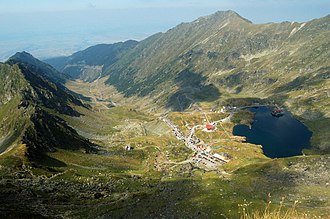
RO B Transfagarasan view towards the north from Balea Lake 2.jpg
Route information
Maintained by Compania Națională de Autostrăzi și Drumuri Naționale din România
Length151 km (94 mi)
Existed1974[1]–present
Major junctions
FromPitești
ToArpașu de Jos
Location
CountryRomania
Major citiesCăpățâneni, Bâlea Lake, Arpașu de Jos, Arefu, Pitești, Curtea de Argeș
Highway system

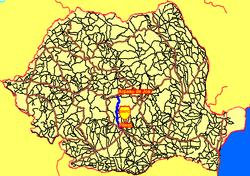
The Transfăgărășan (trans + Făgăraș; Hungarian: Transzfogarasi út) or DN7C is a paved mountain road crossing the southern section of the Carpathian Mountains of Romania. It has national-road ranking and is the second-highest paved road in the country after the Transalpina. It starts near the village of Bascov, near Pitești, and stretches 90 kilometres (56 mi) to the crossroad between the DN1 and Sibiu, between the highest peaks in the country, Moldoveanu and Negoiu. The road, built in the early 1970s as a strategic military route, connects the historic regions of Transylvania and Wallachia.[1]

History

[edit]

The Transfăgărășan was constructed between 1970 and 1974 during the rule of Nicolae Ceaușescu as a response to the 1968 invasion of Czechoslovakia by the Soviet Union.[2] Ceaușescu wanted to ensure quick military access across the mountains in case of a Soviet invasion. At the time, Romania already had several strategic mountain passes through the Southern Carpathians, whether inherited from the pre-communist era (the DN1 and the high-pass DN67C) or built during the initial years of the Communist regime (the DN66). These passes, however, were mainly through river valleys, and would be easy for the Soviets to block and attack. Ceaușescu therefore ordered the construction of a road across the Făgăraș Mountains, which divide northwestern and southern Romania.[1][2]

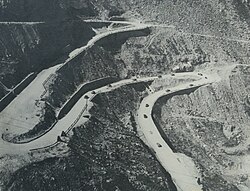
Lower section of the road

Built mainly by military forces, the road had a high financial and human cost. Work was carried out in an alpine climate, at an elevation of 2,000 metres (6,600 ft), using roughly six million kilograms (5,900 long tons; 6,600 short tons) of dynamite, and employing junior military personnel who were untrained in blasting techniques. Many workers died; official records state that only 40 soldiers lost their lives, but unofficial estimates by workers put the number in the hundreds.[2]

The road was officially opened on 20 September 1974, although work, particularly paving of the roadbed, continued until 1980.[1]

Route

[edit]

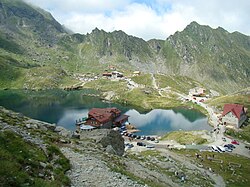
The road climbs to an altitude of 2,042 metres (6,699 ft), making it the second highest mountain pass in Romania after the Transalpina. It is a winding road, dotted with steep hairpin turns, long S-curves, and sharp descents. It is both an attraction and a challenge for hikers, cyclists, drivers and motorcycle enthusiasts.[3] Due to the topography, the average speed is around 40 km/h (25 mph). The road also provides access to Bâlea Lake and Bâlea Waterfall.

The road is usually closed from late October until late June because of snow. Depending on the weather, it may remain open until as late as November, or may close even in the summer; signs at the town of Curtea de Argeș and the village of Cârțișoara provide information.

The Transfăgărășan has more tunnels (a total of 5)[4] and viaducts than any other road in Romania. Near the highest point, at Bâlea Lake, the road passes through Bâlea Tunnel, the longest road tunnel in Romania at 884 m (2,900 ft).

Along the southern section of the road, near the village of Arefu, is Poenari Castle. The castle was the residence of Vlad Tepes, also known as Vlad the Impaler, who is said to have been the inspiration for Bram Stoker's Count Dracula. However, Bram Stoker never stated that Tepes was the inspiration for Dracula and Stoker himself never visited Romania. The castle that Stoker used in his novel for illustration was Castelul Bran, the only castle in the region that remains intact.

The northern section is used for annual cycling competitions, including the Tour of Romania, and the 22 km (14 mi) section to Bâlea Lake has been used since 2011 for the Sibiu Cycling Tour. These sections are considered to be similar in difficulty to hors catégorie climbs in the Tour de France.

Appearance in Top Gear

[edit]

The Transfăgărășan was featured in a segment of the British TV show Top Gear, in the first episode of Series 14 (November 2009). Host Jeremy Clarkson proclaimed that the Transfăgărășan was "the best road in the world,"[2] a title the presenters had previously given to the Stelvio Pass in Italy. The road has also been dubbed "Ceaușescu's Folly".[3]

[edit]

See also

[edit]

References

[edit]
[edit]
Revisions and contributorsEdit on WikipediaRead on Wikipedia
from Grokipedia
The Transfăgărășan, designated as national road DN7C, is a 90-kilometer serpentine highway traversing the in Romania's , connecting in the south to in the north. Constructed between 1970 and 1974 under the directive of communist leader as a strategic artery, the road was engineered to enable swift access across the formidable mountain ridge following the 1968 , amid fears of potential Soviet aggression against Romania. Rising to an elevation of 2,042 meters at Bâlea Pass adjacent to , it incorporates 27 viaducts, over 830 bridges, and five tunnels—including the 887-meter Capra Tunnel, Romania's longest road tunnel—achieved through the use of 6,500 tons of dynamite to carve through the terrain. The project's demanding conditions, involving army engineers and forced labor, yielded an official toll of approximately 40 fatalities, though unverified accounts suggest hundreds died from accidents, exhaustion, and . Renowned for its hairpin turns, precipitous drops, and panoramic alpine vistas, the Transfăgărășan exemplifies audacious amid Romania's communist era constraints, yet its seasonal closure from late autumn to early summer underscores the harsh geophysical realities of high-altitude passes.

Historical Context and Construction

Origins and Planning

The Transfăgărășan road originated from heightened national security concerns in following the Warsaw Pact's invasion of Czechoslovakia in August 1968, which suppressed the Prague Spring reforms and underscored Soviet willingness to intervene in socialist states. , 's communist leader, viewed the event as a direct threat to Romanian sovereignty, given the USSR's encirclement of 's northern borders and Ceaușescu's prior defiance of Moscow through 's independent foreign policy. In 1969, Ceaușescu issued a directive for a new strategic highway to enable swift military mobilization across the Carpathians, connecting in the south to in the north and circumventing slower existing passes vulnerable to blockade or delay in wartime. Planning emphasized military imperatives under Ceaușescu's centralized command economy, where infrastructure decisions bypassed typical civilian or economic assessments in favor of rapid defense enhancements. The route was selected through the remote, high-altitude —spanning elevations up to 2,142 meters at Bâlea Pass—for its potential to provide unobstructed connectivity via uninhabited terrain, minimizing exposure to populated areas that could complicate troop movements. Initial geological and topographic surveys, conducted by military engineers starting immediately after the 1969 order, confirmed the feasibility despite the harsh, geologically unstable conditions, reflecting the regime's prioritization of geopolitical deterrence over domestic welfare or infrastructural precedents. This initiative exemplified communist Romania's doctrine of militarized development, with state resources reallocated to forge a defensive capable of supporting armored divisions and in under hours, rather than days via alternative routes. Ceaușescu's personal oversight ensured the project's elevation as a national priority, underscoring the dictatorial nature of planning where strategic imperatives trumped cost-benefit analysis or public input.

Construction Process and Challenges

The construction of the Transfăgărășan highway, initiated in 1970 under Nicolae Ceaușescu's regime, relied heavily on explosive blasting to carve through the rugged Făgăraș Mountains, utilizing approximately 6,000 tons of to fracture solid rock formations and facilitate the creation of 28 viaducts and numerous short tunnels, including the primary 887-meter Capra tunnel. This method was chosen to accelerate progress across steep gradients and narrow passes, reflecting the urgency driven by strategic military imperatives following the 1968 Soviet invasion of Czechoslovakia, though it amplified risks in an area prone to geological instability. The workforce primarily consisted of military conscripts, many lacking specialized training in handling explosives, augmented by a smaller cadre of engineers to oversee operations amid the regime's push for rapid completion by 1974. Work proceeded year-round, contending with severe alpine weather including heavy snowfall and subzero temperatures that persisted into late spring, complicating machinery operation and material transport in a logistically isolated highland environment. Key obstacles included unstable rock slopes susceptible to frequent landslides—locally termed "ebulments"—which threatened ongoing excavations and required constant reinforcement, as well as risks inherent to the range's steep, snow-laden terrain. Logistical challenges were exacerbated by the remote location, with supply lines strained by narrow access routes and the need to haul heavy equipment and explosives over rudimentary paths, often under adverse conditions that halted progress for days at a time.

Completion and Inauguration

The Transfăgărășan highway reached substantial completion after four years of construction, initiated in 1970 under direct orders from , and was officially inaugurated on September 20, 1974. personally attended the near the summit, where portrayed the project as a pinnacle of Romanian socialist engineering prowess and national unity. Despite the fanfare, the road's asphalt surfacing remained unfinished at , with paving efforts extending until 1980, which restricted early vehicular traffic primarily to and use. The highway's incorporated overbuilt elements, including 27 tunnels and multiple viaducts, far exceeding civilian transportation norms but fulfilling its core intent as a rapid conduit across the to counter potential invasions. Seasonal closures due to heavy snowfall further limited accessibility in the initial years, confining operations to summer months.

Route and Geography

Overall Path

The Transfăgărășan, officially National Road DN 7C, spans approximately 90 kilometers across the in the , connecting the Wallachian region to . It commences at the intersection with DN 7 near the Vidraru Reservoir in , beginning the ascent from elevations around 800 meters, and terminates near Cârtișoara in , linking to regional highways toward DN 1 and . Constructed primarily as a strategic route to enable rapid troop mobilization between southern and northern in response to potential invasions, the road prioritizes direct traversal over navigational simplicity. The trajectory features a southern ascent involving substantial gain to 2,042 meters at Bâlea Pass, characterized by hairpin turns and varying gradients averaging around 5 percent with steeper sections exceeding 10 percent. A short plateau at the summit transitions into the northern descent, which includes long S-curves and reaches lower elevations near 1,200 meters, offering a less uniform gradient profile. This end-to-end path demands careful handling due to its winding nature, encompassing numerous sharp bends that total over 600 in some accounts, reflecting the engineering compromises made for expedited cross-mountain access.

Key Landmarks and Features

Bâlea Lake represents a primary natural landmark along the Transfăgărășan, a glacial lake formed in a cirque at 2,034 meters elevation within the Făgăraș Mountains, illustrating the route's integration with Pleistocene-era glacial topography. The lake covers 4.6 hectares and receives inflow from the Bâlea Waterfall, which cascades from adjacent higher terrain, enhancing the scenic alpine character near the road's highest accessible point. This feature underscores the highway's path through cirque basins and valley heads shaped by ancient ice action. Adjacent to Bâlea, Capra Lake provides another glacial vantage, situated above 2,000 meters with a surface area of 1.8 hectares and depth reaching 11 meters, offering hikers elevated views of the surrounding ridges that complement the route's northward descent. The lake's crystalline waters and proximity facilitate observation of subtle glaciation remnants, such as polished and minor deposits, integrating natural geomorphic elements with the roadway's alignment through high passes. The Făgăraș Mountains' alpine zones along the Transfăgărășan exhibit sparse vegetation dominated by grasslands and cushion plants adapted to rocky, windswept conditions above the treeline, covering about 25% of the range in non-forested habitats. Wildlife includes frequenting steep, rocky slopes for foraging and refuge, alongside brown bears occasionally traversing roadside areas in search of food sources. These elements highlight the route's passage through a preserving Carpathian endemics amid rugged terrain.

Engineering and Design

Structural Elements

The Transfăgărășan road includes five tunnels bored through the mountainside, with the longest being the Bâlea Tunnel at 887 meters, enabling passage near the summit at . These tunnels vary in length, accommodating the need to traverse solid rock while minimizing surface disruption in the steep range. The linings provide structural integrity against and , contributing to long-term durability in a high-altitude environment prone to freeze-thaw cycles. Complementing the tunnels are 27 viaducts spanning a combined length of approximately 830 , featuring arched designs that bridge deep valleys and streams. These elevated structures, constructed primarily of , support the roadway over challenging topography, with spans engineered to distribute loads effectively and resist lateral forces from wind and potential debris flows. The viaducts' robust footings and piers enhance stability on unstable slopes, demonstrating foresight in design for enduring alpine stresses. Extensive rock cuts, formed through controlled blasting with over 6,520 tons of dynamite, define much of the route's path, exposing sheer faces that required immediate stabilization. Retaining walls, built from concrete and stone, line these cuts to counteract erosion and gravitational forces, preventing soil and rock displacement during heavy rains or snowmelt. Slope consolidation measures, including netting and drainage systems integrated into the walls, further bolster resistance to mass wasting, ensuring the cuts' longevity despite the erosive forces prevalent in the Carpathians. Given the seismic activity associated with the , the structural elements incorporate generalized reinforcements such as flexible joints in viaducts and deep anchoring in tunnels and walls, though specific adaptations reflect 1970s standards prioritizing overbuilt mass rather than advanced . This approach has proven resilient, with components maintaining functionality amid regional tremors without documented catastrophic failures attributable to earthquakes.

Technical Specifications and Innovations

The Transfăgărășan, designated as DN7C, spans approximately 90 kilometers through the Făgăraș Mountains, featuring a minimum width of 6 meters to support two lanes of traffic. It ascends to a maximum of 2,042 meters at Bâlea Pass, the second-highest paved pass in . The entire route is surfaced with asphalt, which has been periodically resurfaced to maintain drivability, including recent improvements enhancing smoothness for vehicular passage. Engineering innovations stem from its origins as a strategic route, prioritizing for heavy vehicles through constrained gradients achieved via extensive bends rather than direct steep ascents. This approach, while efficient for troop and equipment movement, incorporates specifications exceeding standard civilian requirements in terms of load-bearing capacity but initially featured sparse guardrails and signage, reflecting secondary emphasis on non-military . Elevation-specific adaptations include avalanche mitigation via concrete galleries and shelters in prone areas, diverting debris to protect the alignment during winter hazards. Such elements underscore a design optimized for rapid wartime utility over comprehensive civilian safeguards.

Human and Economic Costs

Labor Force and Casualties

The Transfăgărășan was constructed primarily using labor under the direction of the Romanian People's Army, involving approximately 3,000 soldiers of all ranks deployed between 1970 and 1974 to handle tasks such as blasting, earthworks, and structural assembly. Many of these workers were conscripts lacking specialized training in high-risk activities like handling, which was employed in quantities exceeding six million kilograms to carve through the . This reliance on rotated personnel reflected Nicolae Ceaușescu's policy of mobilizing the armed forces for prestige infrastructure projects, prioritizing accelerated timelines amid geopolitical tensions over professional civilian expertise or phased civilian contracting. Casualties were driven by the absence of modern safety protocols, including inadequate protective gear, insufficient medical support, and disregard for weather-related risks in the alpine terrain at elevations up to 2,150 meters. Deaths occurred mainly from rockfalls during uncontrolled blasting, explosive misfires, structural collapses, and exhaustion-induced accidents, exacerbated by year-round operations in extreme conditions without rotation limits or rest mandates. Official communist-era records, likely minimized to maintain on project efficiency, report 40 fatalities among soldiers and non-commissioned officers. However, post-regime testimonies from survivors and independent estimates indicate a far higher toll, ranging from 100 to several hundred, with discrepancies attributed to underreporting and exclusion of non-fatal injuries or indirect deaths in state documentation. The disproportionate casualty rate stemmed from centralized command structures that subordinated rigor to political imperatives, deploying untrained troops en masse rather than leveraging specialized firms—a contrast to contemporaneous Western mountain road projects, such as Italy's expansions, where union-mandated standards and contractor yielded fatality rates under 1% of despite similar geological challenges. This approach amplified human costs, as oversight suppressed on-site assessments and corrective measures in favor of quota-driven progress.

Financial Burden and Strategic Utility

The construction of the Transfăgărășan imposed a substantial financial burden on Romania's centrally planned economy, requiring the mobilization of military engineering units and vast material inputs, including approximately 6,000 tons of dynamite to blast through 3.8 million cubic meters of rock in harsh alpine conditions. This approach, directed by state fiat under Nicolae Ceaușescu, circumvented market pricing for labor and equipment, fostering inefficiencies inherent to command allocation where costs were not subject to competitive scrutiny or opportunity-based trade-offs. Strategically, the road was conceived in as a response to the Warsaw Pact invasion of Czechoslovakia, aiming to enable swift north-south troop movements across the dividing from , thereby bolstering defenses against potential Soviet incursions. However, its serpentine design through a narrow 2,142-meter pass exposed it to easy disruption via aerial strikes, undermining its viability in air-dominant warfare scenarios prevalent by the ; subsequent events confirmed its negligible , with no invasions materializing after completion in 1974. In the broader economic context of Romania's industrialization drive, which achieved rapid GDP growth but prioritized over consumer needs, the project's resource demands exemplified misallocation under dictatorial priorities, diverting steel, fuel, and explosives from sectors like and amid emerging shortages that intensified in the following decade. This reflected causal realities of centralized systems, where prestige-driven often trumped productivity-enhancing investments, contributing to long-term drags on welfare despite short-term output gains.

Cultural and Touristic Impact

Media Exposure and Recognition

The Transfăgărășan received limited international attention prior to 2009, primarily among European motorcycling and driving enthusiasts familiar with its challenging twists and alpine scenery through niche publications and forums. Its profile surged globally following a feature in the second episode of BBC's Top Gear series 14, aired on July 23, 2009, where hosts Jeremy Clarkson, Richard Hammond, and James May drove Aston Martin DBS Volante, Ferrari 430 Spider, and Lamborghini Gallardo Spyder convertibles along the route during a Romanian road trip special. Clarkson proclaimed it "the best road in the world" for its combination of elevation changes, hairpins, and vistas, a subjective assessment that emphasized dramatic driving over objective metrics like pavement quality or comparative engineering. This episode, viewed by millions, catalyzed Western media portrayals that often overlooked the road's origins under Nicolae Ceaușescu's regime, framing it instead as an undiscovered gem rediscovered by British presenters. Subsequent documentaries and films amplified this exposure, frequently highlighting the route's engineering amid the Făgăraș Mountains. Productions such as the travel series Wild Carpathia (2013–2015) showcased its viaducts and tunnels as natural wonders integrated with human ingenuity, while action films like Ghost Rider: Spirit of Vengeance (2011) incorporated chase scenes on its serpentine sections for visual spectacle. Engineering-focused content, including segments in BBC's The Misadventures of Romesh Ranganathan: Romania (2022), explored its post-construction legacy, though rarely delving into the 1970–1974 build's human costs or Ceaușescu-era context. Romanian state media during the communist period had earlier utilized construction footage to propagandize the regime's infrastructural prowess, presenting the road—commissioned for strategic defense—as a symbol of national triumph, though such clips remained obscure outside archival collections until post-1989 digitization. While Top Gear's endorsement endures in popular discourse, the road's superlative status invites scrutiny as media-driven hype rather than empirical superiority. Objectively, its 90-kilometer length includes about 27 hairpin turns and reaches 2,134 meters, but comparable European passes like Italy's Stelvio (2,757 meters, 48 hairpins) offer steeper gradients and tighter radii with superior , rendering Transfăgărășan's acclaim more attributable to televisual flair than unparalleled thrill or scenery. User accounts from experienced drivers frequently note degraded asphalt, potholes, and seasonal closures that diminish the experience relative to hyped expectations, underscoring how Western outlets prioritized entertainment value over balanced comparisons with longstanding Alpine alternatives.

Tourism Effects and Economic Contributions

The Transfăgărășan road draws substantial international and domestic tourism during its seasonal opening from late June to early November, primarily appealing to motorcyclists, drivers, and scenic route enthusiasts, with visitor numbers reaching tens of thousands annually despite its limited accessibility. This influx generates revenue for local businesses, particularly around , where facilities such as the Bâlea Lake Mountain Chalet and the seasonal Hotel of Ice provide lodging options that capitalize on the road's endpoint popularity. Additional income stems from ancillary services like cable car operations to the lake, parking fees, and roadside vendors selling food and souvenirs, contributing to direct economic activity in otherwise remote Făgăraș Mountain communities. Tourism spillover extends to surrounding rural areas in Argeș and counties, where increased visitor traffic stimulates demand for accommodations, guided tours, and agricultural products, fostering secondary employment in and hospitality. However, the concentrated summer crowds—peaking in July and August—impose infrastructural strains, including severe around and waterfall viewpoints, often resulting in hours-long delays on weekends. Litter accumulation from high-volume day-trippers exacerbates environmental pressures, overwhelming in isolated sections and highlighting the need for enhanced site stewardship to sustain long-term viability. Post-communist economic repurposing has elevated the road from a costly prestige project to a viable regional asset, with offsetting maintenance burdens through user-generated funds and broader promotional value for Romanian rural destinations, though quantifiable net returns remain modest relative to national aggregates. Proposals for formalized access fees, as discussed in 2025, aim to channel visitor contributions directly into upkeep, potentially amplifying local fiscal benefits while addressing overuse.

Current Status and Maintenance

Seasonal Operations and Accessibility

The Transfăgărășan operates seasonally, typically opening in mid-June after clearance and closing in late or early due to accumulating snowfall and hazardous weather conditions. In 2024, the road opened on June 7, while in 2025, it reopened on June 6 at 7:00 a.m., with full access to the alpine section between Bâlea Cascadă and Piscu Negru potentially delayed until early July depending on conditions. These dates are determined by Romania's National Road Administration (CNAIR) based on meteorological assessments and road inspections to mitigate risks from ice, fog, and avalanches. Vehicle restrictions prohibit heavy trucks over 3.5 tons and certain motorcycles from traversing the route to prevent accidents on its narrow, serpentine sections with steep gradients. A recommended maximum speed of 40 km/h applies throughout, enforced through and periodic patrols to account for bends, limited , and high volumes during peak tourist periods. Checkpoints at key points like Bâlea Cascadă serve to regulate entry, inspect vehicles for compliance, and direct toward parking areas or the cable car to when upper sections face delays. Accessibility challenges stem from the road's , peaking at 2,134 meters, where subfreezing temperatures can persist even in summer, alongside requiring drivers to equip vehicles with appropriate tires and maintain brakes to avoid overheating during descents.

Recent Developments and Safety Concerns

The Transfăgărășan experienced early seasonal snowfall in late 2025, with accumulations reported above 1,700 meters, prompting warnings for icy conditions and reduced visibility. This followed an unseasonably cold snap, exacerbating hazards on the unpaved and winding alpine sections. The road's high-altitude segments, prone to rapid weather shifts, led to its full closure on October 20, 2025, between Bâlea Cascadă and Piscul Negru due to accumulating and adverse conditions. In August 2025, traffic was temporarily halted on August 29 for three hours (8:00-11:00) to facilitate an organized event, underscoring ongoing logistical challenges for public access during peak season. Minor repair works continued into 2025, building on 2024 efforts to address pavement degradation and structural wear from heavy tourist traffic, though comprehensive upgrades remain limited by funding constraints. Safety risks persist due to the road's 90 turns, steep 10-25% gradients, and unguarded drops, which contribute to accidents primarily from speeding, driver fatigue, and inexperience among international visitors. encounters pose additional threats, as evidenced by the fatal on Italian motorcyclist Omar Farang Zin in July 2025 near the roadside. -prone zones in the Bâlea glacial area heighten winter and early-season dangers, with historical data indicating frequent events impacting the route despite monitoring efforts. Recent initiatives include enhanced and seasonal risk assessments, but critiques highlight insufficient investment in barriers, , and real-time monitoring systems relative to traffic volume.

References

Add your contribution
Related Hubs
User Avatar
No comments yet.