


Community hub
Recent from talks
Contribute something
Nothing was collected or created yet.
Dual-purpose improved conventional munition
View on Wikipedia
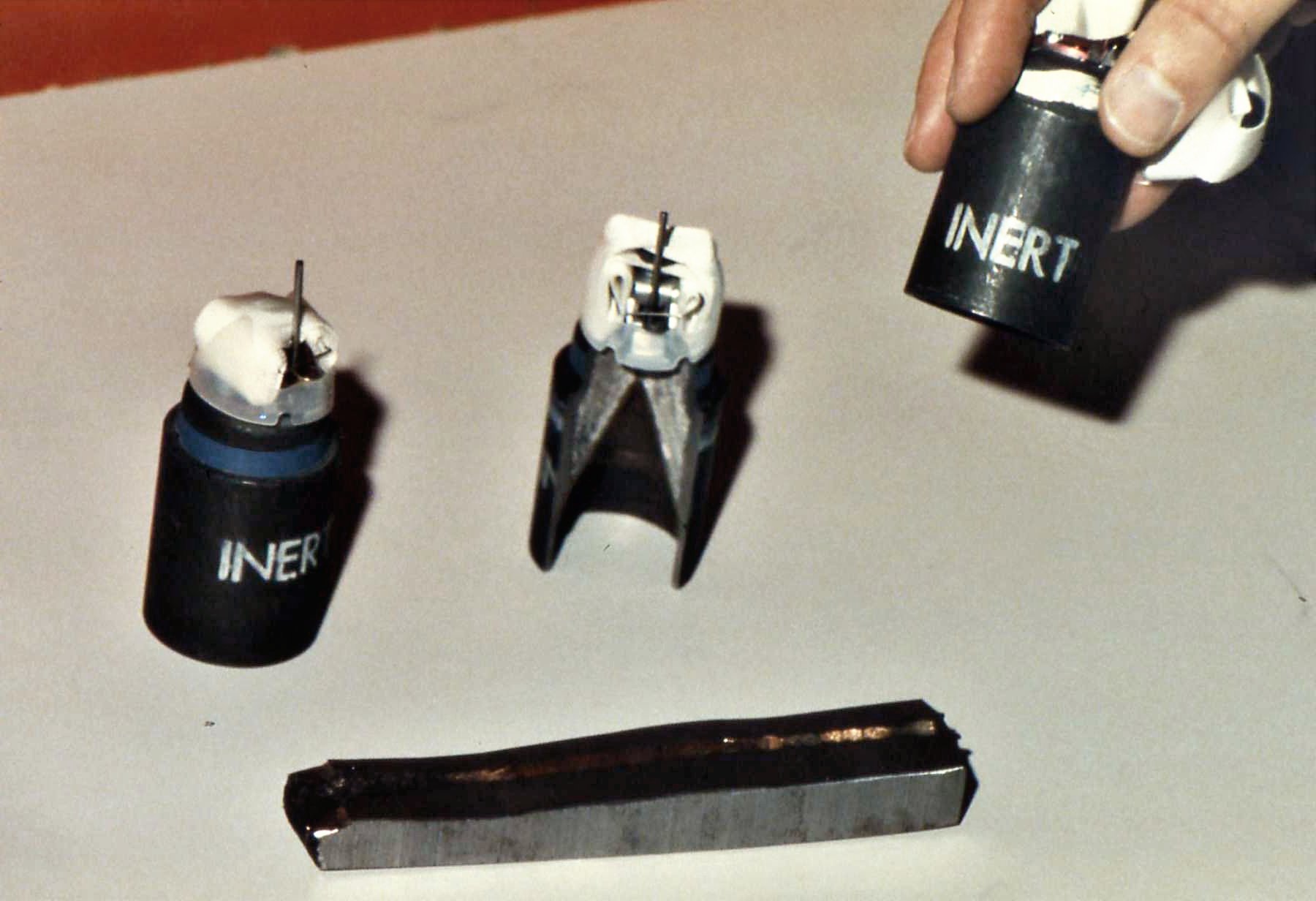
A dual-purpose improved conventional munition (DPICM) is an artillery or surface-to-surface missile warhead designed to burst into submunitions at an optimum altitude and distance from the desired target for dense area coverage. The submunitions use both shaped charges for the anti-armor role, and fragmentation for the antipersonnel role, hence the nomenclature "dual-purpose". Some submunitions may be designed for delayed reaction or mobility denial (mines). The air-to-surface variety of this kind of munition is better known as a cluster bomb. They are banned by more than 100 countries under the Convention on Cluster Munitions.
United States DPICM projectiles
[edit]| Conventional | 105 mm | 155 mm | 203 mm |
|---|---|---|---|
| Rounds expended | 7079 | 3465 | 149 |
| Rounds / kill | 31.6 | 13.6 | 16.6 |
| ICM | 105 mm | 155 mm | 203 mm |
| Rounds expended | 1121 | 772 | 153 |
| Rounds / kill | 2 | 1.7 | 0.8 |
Development work for DPICM projectiles began in the late 1950s. The first projectile, the 105 mm M444, entered service in 1961. Its submunitions were simple bounding anti-personnel grenades (ICM). Production of the M444 ended in the early 1990s.
The first true DPICM was the 155 mm M483, produced in the 1970s. By 1975, an improved version, the M483A1, was being used. The projectile carried 88 M42/M46 grenade-like dual purpose submunitions. The grenades are very similar, but M42 side wall is optimized for fragmentation characteristics while M46s have thicker walls strengthened to withstand additional setback loads in the last three aft layers of the projectile, where they are placed.[2]
The 155 mm M864 projectile entered production in 1987, and featured a base bleed that enhances the range of the projectile, although it still carries the same M42/M46 grenades. The base bleed mechanism reduces the submunition count to 72. Work was budgeted in 2003 to retrofit the M42/M46 grenades with self-destruct fuses to reduce the problem of "dud" submunitions that do not initially explode, but may explode later upon handling.
Work on 105 mm projectiles started in the late 1990s based around the M80 submunition. The eventual results were two shells, the M915 intended for use with the M119A1 light towed howitzer, and the M916 developed for the M101/M102 howitzers.

| Projectile | M509A1 | M483A1 | M864 | M915 | M916 | M444 |
|---|---|---|---|---|---|---|
| Caliber mm | 203 | 155 | 155 | 105 | 105 | 105 |
| Service date | ? | 1975 | 1987 | 1998 (?) | 1998 | 1961 (production ended early 1990s) |
| Range km | 5.4–23.4 | ?–17 | ?–30 | 10–14 | 3–11 | ?–11.5 |
| Load | 180 × M42 | 64 × M42 24 × M46 |
48 × M42 24 × M46 |
42 × M80 | 42 × M80 | 18 × M39 (M444E1 used M36) |
| Weight projectile (fuzed) kg |
94 (approx) | 46.5 | 47 (approx) | ? | ? | 14.97 |
| Length (fuzed) mm | 1115 | 937 | 899 | ? | ? | 371.9 |
Uses
[edit]DPICMs were developed for several reasons:
- They can give a heavy, indirect-fire cannon the ability to engage area targets, with the spread compensating for their inherent inaccuracy;
- DPICM has a potential destructive effect on armored vehicles due to the shaped charge bomblet, but it may require a very large number of shells to have an effect against targets like tank formations to the point of futility;[3][dubious – discuss]
Future
[edit]Large quantities of munitions bought during the Cold War were put into war reserve stockpiles. By the mid-2010s, many were reaching the end of their useful life and required disposal, an expensive process. The submunitions, which became old and less reliable, had to be extracted. After a careful "soft touch" disassembly fully intact[4] D563 shell casings from M483-series 155-mm projectiles[5] were being refilled with explosives, recycling them for use as inexpensive training ammunition.[6] One such round is the M1122, built from recycled D563s mostly filled with concrete topped with some explosive filling. As a training round, the M1122 has one-seventh the explosive impact at one-third the cost of a standard M795 high-explosive shell.[7]
The U.S. Army is seeking a replacement of DPICMs from the Alternative Warhead Program (AWP). The AWP warheads have an equal or greater effect against materiel and personnel targets, while leaving no unexploded ordnance behind. The program is being developed by Lockheed Martin and Alliant Techsystems.[8] The first AW rockets were ordered in September 2015.[9]
Russian invasion of Ukraine
[edit]On July 7, 2023, the US announced that it would supply DPICM munitions to Ukraine.[10] The weapon system could be used in both HIMARS and 155 mm shell projectiles.[11][12]
President Biden justified the move by saying "the Ukrainians are running out of ammunition”. Colin H. Kahl, Under Secretary of Defense for Policy, told reporters that DPICMs were needed by Ukraine. Russian defences are making Ukraine’s offensive “hard sledding, because the Russians had six months to dig in.” Their usage also takes pressure off of US stockpiles of unitary high explosive rounds, such as those by HIMARS and the M982 Excalibur, allowing domestic production of these rounds to catch up to demand. Kahl also claimed that DPICMs can “scatter over a wide[r] area” than standard rounds, including Russian defences such as trenches. An unnamed Pentagon official put the figure of these rounds at “hundreds of thousands”. The expected fail rate is less than 2.35%. Kahl claimed that Russian cluster munitions have a fail rate of 30-40%. Ukraine has had to enter into guarantees not to use them in civilian areas and to mark areas where they have been used.[13][14]
On 10 July, Royal United Services Institute (RUSI) published an article supporting the supply of cluster munitions to Ukraine, arguing that a United States Army study of the Vietnam War had found that while it took approximately 13.6 high explosive shells for each enemy soldier killed.[15] A shell firing DPICMs relied on average only 1.7 shells to kill an enemy soldier making it eight times as effective in producing casualties as standard high explosive projectiles. RUSI used an example of a trench, a direct hit by a high explosive round will spread shrapnel "within line of sight of the point of detonation". This also reduces the wear and tear on the barrels of 155 mm artillery weapons systems.[16]
On 12 July, Ukrainian Army Brigadier General Oleksandr Tarnavskyi, the commander of the Ukrainian Tavriia military sector deployed in the southern front, told CNN that they had received the cluster munitions pledged by the United States in 7 July.[17]
During the course of the Russo-Ukrainian War, objections have been raised by some NATO members which had signed the 2008 Convention on Cluster Munitions, including Germany, France and the United Kingdom. However neither Ukraine nor the United States have signed the agreement. Several other NATO member states, including Estonia, Finland, Greece, Latvia, Poland, Romania, and Turkey, are also not signatories of this agreement, nor is Russia. Human Rights Watch has reported that at least 10 types of cluster munitions are already being used on the battlefield, including munitions which were left over from USSR weapons stockpiles, and including the use of cluster munitions by Russia since 2014.[18] It is reported,[19] though officially denied, that Turkey has provided other types of cluster munitions to Ukraine in the past.[20][21]
On 14 August, Ukrainian forces released drone footage from Urozhaine, in Donetsk Oblast. The two videos appear to show the remaining Russian forces in the town retreating under fire, as the Ukrainians deploy DPICMs in their path. Forbes writer David Axe has described the resulting scene as "murder" and a "bloodbath", given that Ukrainian artillery spotters were afforded an unobstructed view of the Russian retreat in the clear light of day, and the retreating Russian infantrymen were completely unsupported by tanks or other vehicles.[22]
References
[edit]- ^ The Evolution of Artillery for Increased Effectiveness (PDF), Picatinny Arsenal, RDECOM, June 2008
- ^ "MOTIS Ordnance Category". uxoinfo.com. Retrieved 2024-10-31.
- ^ Dullum, Ove (2008). Cluster weapons – military utility and alternatives. Norwegian Defence Research Establishment. pp. 35–36. ISBN 978-82-464-1318-1.
- ^ Evans, Dr Gareth (2015-06-01). "Recycling ammunition - modern militaries do their bit to reuse and reclaim". Army Technology. Retrieved 2024-10-31.
- ^ "155-Millimeter Cartridges cont'd". armymunitions.tpub.com. Retrieved 2024-10-31.
- ^ "Recycling Cold War Super Shells". Strategypage.com. January 25, 2013.
- ^ Groundbreaking round: New artillery round brings promise of more bang, less buck - Marines.mil, 30 November 2015
- ^ "US Army searches for cluster munitions alternatives". Dmilt.com. 6 June 2013.
- ^ "Lockheed Martin GMLRS Alternative Warhead Gets First Order". Marketwatch.com. 15 September 2015.
- ^ "US to send cluster munitions because Ukrainian counteroffensive 'going slower than hoped'". The Guardian. 7 July 2023. Retrieved 7 July 2023.
- ^ Bertrand, Natasha (29 June 2023). "Biden administration could soon approve sending controversial cluster munitions to Ukraine". CNN.
- ^ WARD, ALEXANDER (29 June 2023). "U.S. actively considering giving cluster munitions to Ukraine". politico.
- ^ ALTMAN, HOWARD (7 July 2023). "Ukraine Situation Report: U.S. Sending 'Hundreds Of Thousands' Of Cluster Munitions". the drive.
- ^ Smith, David (8 July 2023). "End justifies means for Biden in sending cluster bombs to Ukraine". The Guardian.
- ^ "Giving Ukraine Cluster Munitions is Necessary, Legal and Morally Justified". rusi.orghttps. Retrieved 2024-09-04.
- ^ Dr Jack Watling; Professor Justin Bronk (10 July 2023). "Giving Ukraine Cluster Munitions is Necessary, Legal and Morally Justified". Royal United Services Institute.
- ^ "Commander: Ukraine receives cluster munitions from US". The Kyiv Independent. 13 July 2023. Retrieved 13 July 2023.
- ^ "Cluster Munition Use in Russia-Ukraine War". 29 May 2023.
- ^ Rogin, Josh (2023-03-02). "Opinion | Ukrainians are begging for cluster munitions to stop the Russians". Washington Post. ISSN 0190-8286. Retrieved 2023-07-17.
- ^ "What are the cluster munitions the US is expected to supply Ukraine and why are they so controversial?". CNN. 7 July 2023.
- ^ ARMY AMMUNITION DATA SHEETS ARTILLERY AMMUNITION FOR GUNS, HOWITZERS, MORTARS, RECOILLESS RIFLES, AND 40MM GRENADE LAUNCHERS (FEDERAL SUPPLY CLASS 1310, 1315, 1320, 1390) (PDF) (Technical Manual). United States Army Publishing Directorate. 28 April 1994.
- ^ "Ukrainian Cluster Shells Massacred Russian Troops Fleeing Urozhaine". Forbes. 14 August 2023. Retrieved 13 July 2023.
Dual-purpose improved conventional munition
View on GrokipediaOverview
Definition and Purpose
A dual-purpose improved conventional munition (DPICM) is an artillery shell or surface-to-surface missile warhead containing multiple submunitions designed to disperse over a target area upon detonation. Each submunition functions dually: a shaped charge penetrates light armor while fragmentation effects target personnel.[4] This design enhances lethality against mixed threats compared to unitary conventional munitions by covering larger areas with fewer projectiles.[5] The "improved" designation reflects refinements over earlier cluster types, such as the M80 variant incorporating an enhanced fragmentation case for better anti-personnel performance alongside anti-armor capability.[4] The primary purpose of DPICM is to provide area suppression and defeat of both armored vehicles and infantry concentrations in military operations. By scattering dozens of submunitions—typically 88 in 155mm shells like the M483A1—it achieves wide dispersion patterns effective for suppressing troop movements, destroying parked aircraft, or engaging vehicle formations in open terrain.[1] This capability allows artillery units to saturate targets rapidly, conserving ammunition relative to high-explosive rounds while maximizing coverage against dispersed or poorly located threats.[6] In practice, DPICM supports offensive maneuvers by denying enemy assembly areas and disrupting logistics, as demonstrated in U.S. Army applications from the 1970s onward.[1]Basic Design Principles
Dual-purpose improved conventional munitions (DPICM) are warheads designed for artillery shells, rockets, or missiles that disperse multiple submunitions over a designated area to engage both armored vehicles and personnel simultaneously. Each submunition incorporates a shaped charge explosive for penetrating vehicle armor, typically achieving up to 100-150 mm of rolled homogeneous armor equivalent penetration, alongside a fragmentation body that generates lethal shrapnel for anti-personnel effects within a 10-15 meter radius.[4][7] The core design principle emphasizes wide-area saturation to overwhelm dispersed or concealed targets, with submunitions numbering 88 in 155mm artillery projectiles like the M483A1 or 644 in MLRS rockets, ensuring probabilistic hits across footprints spanning hundreds of square meters depending on altitude and velocity at release. Dispersion relies on centrifugal force from the carrier's rotation or pyrotechnic ejection for non-spinning variants, arming submunitions via impact, tilt, or proximity sensors to detonate upon target contact.[5][8] Improvements in DPICM focus on mitigating unexploded ordnance hazards through electronic fuzes with self-destruct timers, often set to activate 4-15 minutes post-dispersion if the primary impact fuze fails, reducing dud rates to under 2.35% as targeted in U.S. programs. Additional features include anti-disturbance sensors that trigger detonation if the submunition is handled post-failure, and random delays to prevent patterned failures exploitable by adversaries. These enhancements stem from post-Gulf War analyses revealing higher reliability needs, prioritizing operational effectiveness without long-term battlefield denial.[4][9]Historical Development
Origins and Early US Adoption
Development of dual-purpose improved conventional munitions (DPICM) originated in the late 1950s as part of U.S. efforts to enhance artillery effectiveness through submunition-dispensing projectiles, building on earlier cluster bomb concepts from World War II but tailored for ground-based cannon systems.[10] The initial focus was on anti-personnel effects, with the 105 mm M444 projectile—the first such system—entering U.S. Army service in 1961, containing 18 M40 submunitions primarily for fragmentation damage against infantry, though these lacked significant anti-armor capability.[10] This early design addressed limitations in conventional high-explosive rounds for area targets but highlighted needs for versatility against mechanized forces, prompting evolution toward dual-purpose submunitions combining blast/fragmentation with shaped-charge penetration.[11] By the early 1970s, amid Cold War tensions and lessons from Vietnam-era cluster use, the U.S. Army prioritized "improved conventional munitions" (ICM) to counter massed Soviet armor and troop formations, leading to true DPICM configurations with submunitions like the M77, which integrated a copper liner for armor defeat alongside anti-personnel effects.[1] The seminal 155 mm M483 projectile, loading 88 such dual-purpose bomblets (64 M42 and 24 M46 variants), emerged from this program, with development accelerating to field systems capable of suppressing both personnel and light vehicles over wide areas.[2] Production contracts for ICM components, including plasticized explosives machined for reliability, were issued as early as the late 1960s, but scaled significantly in the mid-1970s.[12] Early U.S. adoption emphasized integration into standard artillery inventories, with the M483A1—an upgraded M483 variant—entering service in the late 1970s to early 1980s, produced in large quantities alongside compatible 105 mm and 203 mm rounds until the mid-1990s.[1] [11] This fielding aligned with doctrinal shifts toward suppressing enemy counterbattery and armored advances, as DPICM offered superior area coverage compared to unitary warheads, with each 155 mm round dispersing submunitions over 20,000 square meters.[1] The Army's Joint Munitions Command oversaw ramped-up output to stockpile millions of rounds, viewing DPICM as a cost-effective multiplier for howitzer batteries against numerically superior foes, though initial designs retained higher dud rates that later improvements targeted.[13] Combat debut occurred in the 1991 Gulf War, where coalition forces, including U.S. units, expended tens of thousands of DPICM rounds for rapid area neutralization.[14]Key Variants and Technological Iterations
The initial implementation of dual-purpose improved conventional munitions (DPICM) occurred with the U.S. Army's 155 mm M483 projectile in the 1970s, which expelled submunitions engineered for both anti-armor penetration via shaped charge and anti-personnel fragmentation effects.[4] This design marked a shift from single-purpose cluster submunitions by integrating a copper shaped-charge liner within a notched steel body to enhance dual lethality against personnel and light vehicles.[4] An upgraded variant, the M483A1, entered service around 1975 and carried 88 DPICM submunitions—primarily M77 grenades—offering improved dispersion and reliability over the original M483's mixed M42 anti-personnel and M46 anti-material pellets.[4] The M77 submunition featured a mechanical fuze with spinner-based arming, impact detonation, and a 4.5-minute self-destruct timer to mitigate unexploded ordnance, though field tests later revealed dud rates exceeding 2% under certain conditions.[15] The M864 projectile, introduced in the 1980s as an extended-range iteration, dispensed 72 M77 submunitions while incorporating base-bleed technology to achieve a 28 km firing range compared to the M483A1's 24 km, prioritizing area coverage in artillery barrages.[16] Rocket-delivered variants, such as the M26 for the M270 MLRS, scaled up delivery by carrying 644 M77 submunitions per rocket, enabling saturation of larger targets from standoff distances up to 36 km.[4] Technological iterations in the 1990s and 2000s focused on fuze enhancements to meet U.S. Department of Defense goals of less than 1% dud rates, including electronic time fuzes with backup self-deactivation for submunitions like the Israeli-developed M85, which influenced U.S. reliability studies despite not being adopted as standard.[15] These advancements added multi-mode options—impact, airburst, and delayed self-destruct—to optimize terminal effects while addressing empirical failure data from conflicts showing higher UXO persistence in legacy designs.[1] Smaller-caliber variants, such as the 105 mm M913 with M80 DPICM submunitions, extended the concept to lighter artillery for divisional fire support.[17] Ongoing programs, including the U.S. Army's DPICM Replacement initiative launched in the 2010s, aim to iterate beyond traditional cluster designs toward precision-guided alternatives or low-UXO dispersions for engaging area targets prior to close combat, reflecting causal assessments of legacy munitions' trade-offs in effectiveness versus post-conflict hazards.[18] Variants like the M999, tested for compatibility with 155 mm systems, incorporate tailored submunitions meeting stringent UXO thresholds under updated military policies.[1]Technical Specifications
Submunition Composition and Mechanisms
Dual-purpose improved conventional munition (DPICM) submunitions, such as the U.S. M77, feature a cylindrical steel body approximately 42 mm in diameter designed for both anti-armor and anti-personnel effects.[19] The body houses a shaped charge warhead with a copper or metal liner that forms an explosively formed penetrator (EFP) or high-explosive anti-tank (HEAT) jet upon detonation, enabling penetration of armored vehicles up to several hundred millimeters of rolled homogeneous armor equivalent.[7] Surrounding the explosive fill, typically Composition B for the M77 or Composition A-5 for M46-type submunitions, or similar high-explosive mixtures, is a fragmentation jacket or embedded steel fragments to enhance lethal radius against personnel through blast and shrapnel.[4][20] Arming and fuzing mechanisms rely on aerodynamic stabilization post-dispersion from the carrier projectile, such as the M483A1 155 mm round containing 88 M77 submunitions.[4] A ribbon or small parachute deploys to orient the submunition base-first toward the ground, ensuring the shaped charge impacts at an optimal angle for armor defeat.[19] Upon ground or target impact, a mechanical or piezoelectric impact sensor initiates the fuze train, detonating the main charge; this produces the armor-piercing jet while dispersing fragments outward in a 360-degree pattern for area denial against infantry.[7] To mitigate unexploded ordnance risks, improved variants incorporate secondary fuzing systems, including electronic self-destruct timers activated after arming if no impact occurs, targeting dud rates below 1% in testing, though field data from conflicts like the 1991 Gulf War indicate rates up to 5-20% depending on terrain and impact conditions.[21][4] For instance, efforts in the early 2000s budgeted retrofits for M77-like grenades with self-destruct fuzes to address hazardous duds that remain armed but unfuzed.[4] These mechanisms prioritize reliability through redundant electronic components, such as micro-electro-mechanical systems (MEMS) in advanced designs, enhancing safety margins over legacy impact-only fuzing.[21]Delivery Platforms and Dispersion Patterns
Dual-purpose improved conventional munitions (DPICM) are predominantly delivered through ground-launched artillery systems, with the 155 mm M864 projectile serving as a primary example. This base-bleed equipped shell, compatible with standard howitzer platforms such as the M109 Paladin or M777, carries 72 submunitions—comprising 48 M42 and 24 M46 dual-purpose grenades—and achieves ranges up to 30 kilometers.[22][23] Other artillery calibers, including 105 mm and 203 mm, have also incorporated DPICM warheads for similar delivery.[24] Surface-to-surface rocket systems provide an alternative delivery method, notably the M26 227 mm rocket for the M270 Multiple Launch Rocket System (MLRS), which disperses 644 M77 DPICM submunitions.[6] These platforms enable rapid saturation of larger areas compared to single artillery rounds, though they require specialized launchers. While air-dropped cluster bombs have employed similar submunitions historically, DPICM variants are optimized for cannon and rocket artillery, emphasizing precision fire support in conventional warfare.[5] Dispersion occurs upon fuze activation, typically at 300 to 1,000 meters altitude, where the carrier bursts to eject submunitions rearward and outward along the trajectory. Artillery-delivered DPICM, influenced by projectile spin, forms an elliptical footprint elongated in the direction of flight, with the submunitions stabilizing via internal ribbons or rotation to ensure broad coverage.[25] Effective patterns span several thousand square meters—approximately 4,600 m² for a standard 155 mm round—varying with ejection height, velocity, and environmental factors like wind.[24] Rocket systems like the M26 yield more circular dispersions due to lower spin rates, potentially covering up to 30,000 m² depending on deployment parameters.[2] Submunitions descend ballistically or with minimal stabilization, detonating on impact to maximize area denial against personnel and light armor.[26]Military Effectiveness
Area Coverage and Target Engagement Capabilities
Dual-purpose improved conventional munitions (DPICM) deliver area coverage through the aerial dispersion of submunitions from a carrier projectile or warhead, which bursts at an optimal altitude to maximize the footprint. For standard 155 mm artillery rounds such as the M483A1, this disperses 88 submunitions over an area approximately 200 meters in diameter, providing saturation effects across roughly 30,000 square meters.[4] The dispersion pattern is typically elliptical, shaped by factors including release height, forward velocity, spin stabilization, and environmental conditions like wind, ensuring broad distribution for engaging clustered or moving targets. Each DPICM submunition functions via dual mechanisms: a shaped charge warhead for anti-armor penetration, capable of defeating lightly armored vehicles by striking top armor at near-vertical angles to enhance effectiveness, and a fragmentation casing for anti-personnel lethality extending to a radius of several meters per submunition.[4] This combination allows simultaneous engagement of both hard and soft targets within the covered area, such as infantry in the open, unarmored logistics elements, or dispersed armored formations. The submunitions' impact fuze initiates upon ground contact, with backup self-destruct features in improved variants to limit unexploded ordnance, though primary engagement relies on direct hits or proximity effects.[2] In military applications, DPICM demonstrate superior target engagement efficiency against area threats compared to unitary high-explosive munitions, with operational analyses indicating that one DPICM round can achieve effects equivalent to multiple conventional shells by hitting numerous discrete targets.[27] Empirical data from field tests show improved conventional munitions requiring approximately 1.7 rounds per kill versus 13.6 for standard 155 mm rounds, underscoring their value in suppressing troop concentrations, disrupting convoys, or denying terrain to enemy forces.[28] This capability stems from the high density of lethal points created by submunition scatter, enabling probabilistic hits on evasive or concealed adversaries in scenarios where precision-guided unitary weapons may underperform due to target dispersion or volume requirements.[5]Comparative Performance Against Conventional Munitions
Dual-purpose improved conventional munitions (DPICM) demonstrate significantly higher lethality against dispersed or area targets compared to unitary high-explosive (HE) rounds, primarily due to their dispersion of multiple submunitions over a wider footprint.[5] In peacetime testing against vehicle targets, cluster munitions including DPICM variants have proven approximately 60 times more effective than equivalent unitary warheads, as the submunitions enable simultaneous engagement of multiple assets within the burst radius.[5] Historical operational data from conflicts like the Vietnam War further indicate that cluster munitions generate eight times more casualties per round than standard HE bombs against personnel in open terrain.[5] In terms of ammunition efficiency, a single DPICM artillery round, such as the M483A1 155mm projectile containing 88 dual-purpose submunitions, can achieve effects equivalent to or exceeding five or more unitary guided multiple launch rocket system (GMLRS) rounds with single warheads, particularly against infantry concentrations or lightly armored formations.[6] Military analyses estimate DPICM lethality at 5 to 15 times that of comparable HE rounds, varying by terrain, weather, and target density; for instance, against vehicle convoys or troop assemblies, the probability of multiple hits per delivery rises substantially due to the submunitions' shaped-charge and fragmentation effects.[27] This efficiency reduces logistical demands, with reports indicating that fewer DPICM rounds are required to suppress or neutralize area threats compared to the volume of unitary munitions needed for equivalent coverage.[29][30] However, unitary munitions retain advantages in precision strikes on hardened or singular high-value targets, where concentrated blast and penetration outperform dispersed submunitions, which may dilute energy across a broader pattern.[31] DPICM's dual-purpose design—combining anti-armor penetration with anti-personnel fragmentation—enhances versatility against mixed threats, but empirical dud rates of 2.35% or lower in U.S. DPICM stocks introduce post-engagement hazards absent in near-zero-failure unitary rounds, potentially offsetting short-term gains in sustained operations.[3] Overall, DPICM excel in high-intensity scenarios involving massed adversaries, conserving munitions while maximizing area denial, though their performance degrades against concealed or mobile point targets better suited to unitary alternatives.[5][31]Controversies
Unexploded Ordnance Risks and Empirical Data on Failure Rates
Unexploded ordnance (UXO) from dual-purpose improved conventional munitions (DPICM) poses significant post-conflict hazards, functioning as persistent anti-personnel and anti-vehicle threats akin to landmines. These submunitions, if they fail to detonate on impact, remain armed and sensitive to disturbance, leading to civilian casualties during reconstruction, farming, or incidental encounters. In areas of use, UXO contaminates terrain, delaying demining efforts and restricting civilian access, with empirical evidence from past conflicts indicating disproportionate impacts on non-combatants long after hostilities cease.[32] DPICM variants incorporate self-destruct and self-deactivation mechanisms to mitigate failure rates, with U.S. Department of Defense policy since 2001 requiring new submunitions to achieve less than 1% unreliability in testing. However, stockpiled older DPICM rounds, such as those transferred to Ukraine, exceed this threshold, prompting presidential waivers for use. Official U.S. claims assert dud rates below 2.35% for M42 and M46 submunitions in M864 artillery projectiles, though underlying test data remains classified, limiting independent verification.[33] Empirical data from operational environments reveal higher failure rates than controlled tests suggest, influenced by factors like impact angle, soil conditions, and submunition orientation. U.S. Government Accountability Office analysis of M77 submunitions from the 1991 Gulf War found failure rates of 16-23%, attributing many duds to arming mechanism issues rather than inherent defects. British military testing of M77 reported up to 23% unreliability, while initial U.S. assessments ranged from 5-23%. For M42/M46 DPICM submunitions, field-derived estimates indicate at least 14% failure, contrasting manufacturer claims of 2-3% and highlighting discrepancies between laboratory performance and combat realities.[34][35][36] These elevated dud rates amplify UXO risks in protracted conflicts, as evidenced by clearance operations in Iraq and Afghanistan where U.S. DPICM remnants necessitated extensive remediation, incurring high costs and casualties among deminers. Non-governmental assessments, while potentially influenced by advocacy agendas, align with military post-conflict surveys showing persistent contamination, underscoring the causal link between submunition unreliability and humanitarian legacies. Proponents argue modern iterations reduce risks relative to legacy systems with 30-40% failures, yet absence of transparent, peer-reviewed combat data impedes definitive reliability claims.[37][4]Humanitarian Criticisms and International Responses
Humanitarian organizations, including Human Rights Watch and Amnesty International, have condemned dual-purpose improved conventional munitions (DPICM) for their potential to disperse submunitions that fail to detonate, functioning as persistent explosive remnants of war that indiscriminately endanger civilians long after hostilities cease.[38][39] These groups cite empirical data from conflicts where cluster munitions caused up to 40% failure rates in older variants, leading to thousands of civilian casualties; even for "improved" types like DPICM, they argue that failure rates of 2-3% still yield dozens of hazardous duds per artillery projectile across wide areas, with children comprising 71% of recorded remnant casualties in 2022 per the Cluster Munition Monitor.[32][40] Critics maintain that such remnants contaminate farmland and urban zones, exacerbating post-conflict humanitarian crises, as evidenced by over 1,200 cluster-related civilian casualties in Ukraine from Russian strikes since February 2022, including at least eight deaths from a single July 2023 incident.[41][42] The U.S. transfer of DPICM to Ukraine, announced on July 7, 2023, and involving variants with submunition failure rates under 2.35%, intensified these concerns, with opponents highlighting that real-world performance often exceeds laboratory-tested rates due to factors like terrain and storage degradation.[43][44] Advocacy coalitions such as the U.S. Cluster Munition Coalition labeled the move a violation of emerging global norms, predicting heightened risks to Ukrainian civilians and deminers, particularly as submunitions like the M42 and M46—small enough to resemble batteries—evade detection and attract children.[45] By April 2024, this marked the fifth such U.S. shipment, drawing rebukes for prioritizing short-term military gains over enduring civilian safety.[45] Internationally, the 2008 Convention on Cluster Munitions (CCM), ratified by 112 states as of 2023, explicitly bans cluster munitions lacking fail-safe mechanisms, framing them as inherently indiscriminate due to wide-area effects and dud persistence; however, non-signatories including the United States, Russia, Ukraine, and China have continued production and use, with the U.S. waiving its domestic policy against transferring munitions exceeding 1% failure rates to enable Ukraine aid.[5][46] The CCM's intersessional meetings and annual reviews have seen states parties like Spain condemn U.S. transfers, while NGOs decry the action as eroding the treaty's stigma against such weapons, though enforcement remains absent without universal adherence.[3] In response to perceived threats from Russian cluster use, Lithuania announced its CCM withdrawal effective March 6, 2025—the first such exit—citing security imperatives amid the Ukraine conflict, signaling fractures in the ban regime among NATO allies.[47] Despite these developments, CCM advocates persist in universalization efforts, reporting no stockpile destruction by non-states parties and ongoing transfers as setbacks to humanitarian disarmament.[40]Military Necessity and Reliability Improvements in Modern Variants
Dual-purpose improved conventional munitions (DPICM) fulfill a critical military role in high-intensity conflicts by delivering wide-area effects against dispersed or massed targets, such as infantry assaults, light armored vehicles, and artillery positions, where unitary high-explosive rounds prove insufficient in coverage and lethality per projectile.[48] In scenarios involving numerically superior adversaries, DPICM enable forces to suppress or neutralize threats over larger footprints with fewer munitions, conserving limited artillery resources and enhancing defensive postures against breakthroughs.[27] This capability stems from the submunitions' dual anti-personnel and anti-armor design, which fragments to penetrate light armor while scattering to cover areas up to several football fields, outperforming conventional shells in casualty infliction—requiring on average 1.7 DPICM shells per enemy soldier killed compared to higher numbers for standard rounds.[30] During the Russian invasion of Ukraine, DPICM have demonstrated necessity by countering entrenched Russian infantry and compensating for Ukrainian artillery ammunition shortages, allowing sustained fire support without proportional increases in barrel wear or logistics demands.[6] Ukrainian forces reported marked increases in effectiveness against dug-in positions following DPICM deliveries in mid-2023, disrupting advances and reducing the need for riskier close assaults, as the munitions' dispersion patterns engage multiple targets simultaneously in trench networks or assembly areas.[49] Military analyses emphasize that without such area-denial tools, defenders face amplified attrition from enemy volume-of-fire advantages, underscoring DPICM's role in balancing quantitative disparities through qualitative overmatch.[2] Historical DPICM variants suffered dud rates of 5% to 40% in field conditions, attributable to mechanical fuze sensitivities and manufacturing variances, prompting U.S. Department of Defense (DoD) policy shifts toward reliability enhancements.[6] In 2008, DoD mandated phasing out non-compliant cluster munitions, targeting a uniform <1% unexploded ordnance (UXO) rate by January 1, 2019, through integration of electronic time fuzes with self-destruct mechanisms that activate after impact failure, converting potential duds into inert fragments.[26] Subsequent 2017 directives under DoD Directive 3000.09 reaffirmed this standard, prioritizing variants with redundant arming sequences to mitigate environmental and deployment variables.[50] Modern DPICM iterations, such as upgraded M864 projectiles from post-2000 production lots, incorporate these features, with DoD assessments claiming dud rates below 2.35% based on controlled testing, though full data remains classified to protect technical details.[51] Programs like High Reliability DPICM Replacement (HRDR) further refine submunition designs with improved aerodynamic stability and electronic backups, aiming to reduce hazardous remnants to <1% while preserving lethal radius.[1] Field evaluations in Ukraine indicate these variants achieve higher detonation reliability than legacy stocks, though empirical dud persistence varies with terrain and handling, informing ongoing DoD refinements for operational theaters.[52][6]Combat Deployments
Historical Uses in Major Conflicts
Dual-purpose improved conventional munitions (DPICM) saw their first major combat deployment during Operation Desert Storm in the 1991 Persian Gulf War, primarily delivered via 155mm M864 artillery projectiles fired by U.S. forces. These munitions, each containing 72 submunitions designed for both anti-armor and anti-personnel effects, were used to target Iraqi armored divisions, troop concentrations, and supply lines in Kuwait and southern Iraq, contributing to the rapid degradation of Republican Guard units during the ground campaign from February 24 to 28, 1991. U.S. Army artillery units, including those equipped with M109 howitzers and M198 towed guns, expended thousands of DPICM rounds in fire missions that saturated areas with submunitions, enhancing area denial and suppression capabilities against mechanized forces.[53][54] In the Iraq War of 2003, U.S. forces, including Marine Corps artillery, again employed DPICM, such as M864 projectiles, during the invasion phase starting March 20, 2003, to engage Iraqi regular army positions and Fedayeen paramilitary units. Notable uses included fire support for advancing coalition units near Baghdad, where DPICM barrages disrupted enemy defenses and vehicle convoys, as seen in operations around al-Hilla on March 31, 2003, targeting suspected military sites. The munitions proved effective in high-intensity maneuvers against dispersed and fortified targets, though their deployment diminished in later counterinsurgency phases post-May 2003.[55] DPICM variants were also utilized by U.S. allies in regional conflicts, with reports of their incorporation alongside indigenous systems during Israel's 2006 Lebanon War against Hezbollah positions in southern Lebanon, where older DPICM submunitions complemented air-dropped clusters for area suppression. However, primary historical applications by major powers centered on U.S.-led coalitions in the Gulf region, reflecting their role in conventional warfare against armored threats prior to shifts toward precision-guided alternatives.[56]Application in the Russian Invasion of Ukraine
Russian forces have employed cluster munitions extensively since the full-scale invasion of Ukraine began on February 24, 2022, including in attacks on populated areas that resulted in civilian casualties.[57] For instance, a Russian cluster munition strike on Odesa in May 2024 killed seven civilians and injured dozens more.[58] These munitions, often delivered via systems like Smerch and Uragan multiple-launch rocket systems, feature higher failure rates compared to modern variants, contributing to unexploded ordnance risks.[59] By September 2025, cluster munitions had caused over 1,200 civilian casualties in the conflict, with Russian use predominating in documented incidents.[60] Ukraine initially relied on Soviet-era cluster munitions from existing stockpiles, deploying them in counter-battery fire and against Russian troop concentrations, such as in attacks around Donetsk in early 2023.[61] On July 7, 2023, the United States announced the transfer of dual-purpose improved conventional munitions (DPICM) as part of an $800 million security assistance package, including 155mm artillery rounds designed for compatibility with Ukrainian howitzers and M777 systems.[62][63] These DPICM rounds, containing submunitions with tungsten-obturator rings for enhanced anti-armor and anti-personnel effects, have dud rates below 2.35%, significantly lower than legacy Soviet designs.[59] Ukrainian forces began employing US-supplied 155mm DPICM projectiles within weeks of the July 2023 announcement, with the first documented use occurring by July 21, 2023, against Russian positions via night-vision footage showing dispersion patterns.[64][65] DPICM has proven effective in high-intensity scenarios, providing wide-area coverage against infantry assaults, entrenched positions, and artillery batteries, thereby conserving precision-guided unitary munitions amid artillery shell shortages.[5][30] In counteroffensives, such as those in fall 2023 and 2024, DPICM enabled rapid suppression of Russian human-wave tactics and vehicle convoys, altering local battlefield dynamics by increasing the lethality of Ukrainian artillery fire.[66] Continued transfers from US stockpiles in Europe have sustained this capability into 2025.[50]