Hubbry Logo
Dargin languagesDargin languagesMain
Open search
Dargin languages
Community hub
Dargin languages
logo
8 pages, 0 posts
0 subscribers
Be the first to start a discussion here.
Contribute something
Dargin languages
Dargin languages
from Wikipedia
Dargin
Dargwa
Geographic
distribution
Southcentral Dagestan[citation needed]
Native speakers
590,000 (2020 census)[1]
Linguistic classificationNortheast Caucasian
  • Dargin
Proto-languageProto-Dargwa
Subdivisions
Language codes
ISO 639-2 / 5dar
ISO 639-3dar
Glottologdarg1242
  Dargin

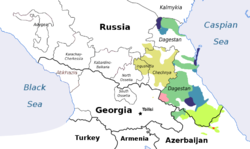
Map of individual Dargin languages according to Koryakov 2021.[2]
Classification of Dargin languages according to Koryakov 2021.[2]

The Dargin languages consist of a dialect continuum of over 60[3] Northeast Caucasian languages or dialects spoken by the Dargin people in southcentral Dagestan. Kajtak, Kubachi, Itsari, Mehweb and Chirag are often considered dialects of the same Dargin/Dargwa language. Ethnologue lists these under a common Dargin language, but also states that these may be separate languages from Dargwa proper.[citation needed] Reasons for classifying the southern group of dialects from the northern group is that speakers of the southern dialects have been reported as treating the literary Aqusha dialect as a foreign language.[4] Due to the linguistic fragmentation of the Dargin languages, speakers use Russian as a lingua franca.[5]

Classification

[edit]

The Dargin languages are classified as follows by Koryakov 2021:[2]

Dargin

Mutalov 2021 proposes a different classification:[6]

Dargin languages

Glottolog uses a different classification, based on Koryakov 2012.[7][8]

Dargwic

    • Chirag
    • Kubachi
    • North-Central Dargwa
      • Megeb
      • North Dargwa
        • Cudaxar
        • Gapshin-Butrin
        • Kadarskij
        • Muirin
          • Dejbuk
          • Xarbuk
        • Nuclear North Dargwa
          • Aqusha-Uraxi
          • Mugin
          • Murego-Gubden
          • Upper Mulebki
    • South Dargwa
      • Kajtak
      • Southwestern Dargwa
        • Amuzgu-Shiri
        • Sanzhi-Icari
        • Sirhwa-Tanty
        • Upper-Vurqri
          • Amux
          • Khuduts
          • Qunqi

Phonology

[edit]

The following chart is a collective phoneme inventory of all Dargin languages.

Labial Dental Postalveolar Palatal Velar Uvular Pharyngeal
Epiglottal
Glottal
plain sib.
Nasal m n
Plosive/
Affricate
voiced b d d͡z1 d͡ʒ1 ɡ ɢ1 ʡ1
voiceless p t t͡s t͡ʃ k q ʔ
long 2 2 t͡sː2 t͡ʃː2 2 2
ejective t͡sʼ t͡ʃʼ ʡʼ2
Fricative voiced v1 z ʒ ɣ1 ʁ ʢ ɦ
voiceless f1 s ʃ ç1 x χ ʜ
long 2 ʃː2 2 χː2
Trill r
Approximant w l j
  1. Present in the literary standard of Dargwa, but not some other dialects.
  2. Present in some dialects, but not the literary standard.

The source is rather ambiguous in its using the term "laryngeal" for a presumed column of consonants that includes both a "voiced" and a "glottalized" plosive. A voiced glottal plosive cannot be made, because the glottis needs to be closed, and an ejective consonant requires an additional closure further up the vocal tract. Pending clarification, this row has been transcribed here as an epiglottal column and a glottal stop, both found in many other East Caucasian languages.

References

[edit]
Revisions and contributorsEdit on WikipediaRead on Wikipedia
from Grokipedia
The Dargin languages, also known as Dargwa or Dargic, constitute a branch of the Northeast Caucasian (Nakh-Dagestanian) language family, forming a dialect continuum spoken primarily by the Dargin people in the central and southern regions of Dagestan, Russia, as well as in smaller communities in Azerbaijan and Central Asia. This macrolanguage encompasses over 60 varieties, classified by linguists as comprising 17 distinct languages due to low mutual intelligibility (ranging from 15.4% to 67.7% between some forms), with prominent subgroups including Aqusha (the basis for the literary standard), Tsudaqar, Muira, Kubachi, Kaitag, Chirag, and Megeb. Approximately 626,601 Dargins live in Russia according to the 2021 census, with approximately 528,000 in Dagestan, making Dargin one of the larger language groups in the family, though exact speaker numbers for individual varieties vary widely. Linguistically, the Dargin languages are characterized by agglutinative morphology and an ergative alignment, featuring complex nominal systems with numerous grammatical and locative cases (often exceeding 20 in some varieties) that encode spatial relations and other semantic roles. Verbal structures typically include rudimentary person-agreement markers, and some dialects, such as Chirag Dargwa, exhibit a rich vowel system with length distinctions (e.g., pairs like /aː/ vs. /a/ and /iː/ vs. /i/) and potential tonal features. Historically, the languages gained literary status during the Soviet era through standardization efforts, with Literary Dargwa serving as the high variety in a diglossic context alongside local spoken forms; post-Soviet, publishing and media use have declined despite ongoing instruction in schools. The are assessed as vigorous (EGIDS level 6a), with strong use in rural homes and communities but signs of shift toward Russian in some varieties, driven by high bilingualism (over 90% of in speak Russian fluently) and limited institutional support beyond basic education. Efforts to document and preserve the diversity include sociolinguistic surveys highlighting the need for expanded media and orthographic development in non-standard varieties, as mutual unintelligibility poses challenges for unified revitalization.

Overview

Definition and scope

The Dargin languages, also referred to as the Dargwa or Dargic languages, form a group of over 60 closely related varieties classified as languages or dialects within the . These varieties are primarily associated with the Dargin people and exhibit features typical of the family's complex morphological and phonological systems. The group constitutes a , where adjacent varieties show higher than distant ones, though overall comprehension can be low across the spectrum, leading some linguists to recognize up to 12 distinct languages within it. The term "Dargin languages" encompasses this entire continuum, while "Dargwa" specifically designates the literary , which is based on the Aqusha variety and used in , media, and official contexts. Native endonyms include variants such as Dargwa, Darkkwa, Darga, Dargo, or Dargan mez. The ISO 639-3 code for the macrolanguage is "dar". Within the Nakh-Daghestanian (Northeast Caucasian) family, the Dargin languages belong to the Dargwic branch, one of seven primary branches that also include Nakh, Avar-Andic, Tsezic, Lezgic, Lak, and . This positioning highlights their role as a key component of the family's Dagestanian subgroup, contributing to the region's linguistic diversity.

Speakers and geographic distribution

The Dargin languages, collectively spoken by approximately 625,000 people as of the , are primarily used by the ethnic Dargin population. This figure encompasses speakers across various dialects within the Dargin linguistic group, reflecting a but regionally concentrated user base. The primary geographic area of usage is south-central in the Russian Federation, with the highest concentrations in the Akushinsky, Dakhadayevsky, Kaytagsky, Levashinsky, and Sergokalinsky districts. These languages are spoken inland from the , in both mountainous rural villages and lowland settlements, forming a core habitat for approximately 521,000 speakers within alone as of the 2021 census. There is a minor presence in adjacent regions, including small communities in and , as well as scattered speakers in other parts of such as . Due to ongoing within , small Dargin-speaking communities have formed in urban centers like —the capital of —and , where speakers relocate for economic opportunities. Russian serves as the dominant among Dargin speakers, with proficiency rates exceeding 90% in , largely owing to the dialectal fragmentation that hinders across varieties.

Classification and history

Genetic affiliation

The Dargin languages, also known as Dargwa, form a distinct branch within the Northeast Caucasian language family, commonly referred to as Nakh-Daghestanian. This family encompasses approximately 30-35 languages spoken primarily in the North Caucasus region of Russia, with Dargin positioned alongside other major branches such as Nakh, Avar-Andic, Tsezic, Lezgic, and Lak. The Dargic (or Dargwic) branch is characterized by a dialect continuum comprising multiple closely related varieties, often debated in terms of their status as separate languages or dialects based on lexicostatistical criteria. In terms of relations to neighboring languages, the Dargin languages exhibit the closest affinities to Lak, a single-language branch within the same family, leading some scholars to propose a based on shared morphological and lexical features. However, this grouping remains controversial, as no exclusive shared innovations have been definitively identified, and most contemporary classifications maintain Lak and Dargic as separate branches. In contrast, Dargin shows clear distinctions from the Lezgic branch (e.g., Lezgi, Tabasaran) to the east and the Avar-Andic branch (e.g., Avar, Andi) to the north, reflecting deeper divergence within the Northeast Caucasian family tree. Scholarly classifications vary in their treatment of internal structure. Yuri Koryakov (2021) recognizes the Dargin group as a cohesive unit comprising 15 distinct languages or lects, emphasizing its unity through comparative methods while noting ongoing refinements in subgrouping. , in its 5.2 edition, adopts a more subdivided approach under the Dargwic family, delineating internal subgroups such as North-Central Dargwa, Southwestern Dargwa (including Chirag and Kubachi), and North Dargwa, based on phonological and lexical divergences. These frameworks highlight the branch's internal diversity without altering its position relative to other Northeast Caucasian branches. Beyond the Northeast Caucasian family, no established genetic links have been confirmed for the Dargin languages, despite proposals for broader macro-families such as a North Caucasian super-family incorporating (e.g., Abkhaz-Adyghe). Such hypotheses, often rooted in typological similarities like complex consonant systems, remain unproven due to insufficient regular sound correspondences and shared vocabulary.

Historical development

The Dargic languages, a branch of the Northeast Caucasian family, are thought to descend from a hypothesized Proto-Dargwa ancestor, with linguistic reconstructions indicating a shared morphological system featuring a tripartite perfective past tense structure: a synthetic simple past (Aorist), a participial past (Perfect), and a resultative form. This proto-system, reconstructed through comparative analysis of modern varieties, shows signs of instability, with the resultative encroaching on the perfect and the perfect on the aorist, leading to innovations in daughter languages. The divergence into northern (e.g., Akusha, Sanzhi) and southern (e.g., Shiri, Kaitag) branches likely occurred through gradual dialectal differentiation, driven by geographic isolation in the mountainous terrain of Dagestan. Historical contacts have profoundly shaped Dargic languages, beginning with the Islamization of from the CE, which introduced significant lexical and cultural influences, particularly in religious and administrative domains; served as the primary written medium until the early , while oral use of Dargwa remained dominant. Persian literary traditions permeated the region via trade and scholarship, contributing loanwords and poetic forms, often mediated through texts. During the medieval period, , especially Kumyk, functioned as regional lingua francas in khanates like Kaitag Utsmiystvo (established around the ), resulting in Turkic borrowings in everyday vocabulary and toponyms. These multilayered contacts fostered a triglossic pattern: Dargwa for local oral communication, for , and Turkic or Persian for inter-ethnic exchange. The 19th-century Russian conquest of Dagestan, culminating in the Caucasian War (1817–1864) and the abolition of local entities like the Kaitag Utsmiystvo in 1820, initiated administrative pressures that indirectly spurred early standardization efforts, including the creation of the first Dargwa alphabet by Peter Uslar in the 1870s for the Urakhi dialect. However, full literacy development awaited the Soviet era, marked by Russification policies from the 1930s onward, which promoted Russian as the language of education and governance while establishing Literary Dargwa (based on the Akusha variety) in 1930 with a Latin script, switched to Cyrillic in 1938. Dargic languages preserved rich oral traditions—encompassing epics, folklore, and genealogies—without ancient written records, relying on communal recitation until 20th-century initiatives introduced widespread schooling and publishing, though Russian dominance later eroded vernacular use in urban settings.

Dialects and varieties

Major dialect groups

The Dargin languages, collectively known as Dargwa, constitute a comprising over 60 varieties spoken mainly in the mountainous regions of , . These varieties are broadly categorized into major dialect groups based on geographic distribution and shared linguistic traits, with the primary divisions being North-Central and Dargwa (often referred to as Northern and Southern in some classifications). North-Central Dargwa (Northern) encompasses dialects such as Akusha and Urakhi, primarily centered in central , including areas like the Akushinsky and Levashinsky districts. The Akusha dialect, in particular, forms the foundation of the literary standard Dargwa language. South Dargwa (Southern) includes varieties like Sanzhi, Chirag, Kubachi, and Mehweb, spoken in the southern mountainous zones of , such as the Kuraksky and Magaramkentsky districts. These dialects reflect adaptations to more isolated highland communities. Other groups, such as Kajtak and Itsari, serve as transitional or distinct dialects bridging the north-central and southern continuum, often exhibiting hybrid features due to historical population movements. Notably, dialects like Kubachi display substrate influences from unrelated local languages, resulting from ancient migrations that integrated pre-existing linguistic elements into the Dargwa framework.

Mutual intelligibility and standardization

The Dargwa dialects exhibit low , particularly between north-central and southern varieties, with comprehension scores in recorded text tests ranging from 15.4% to 67.7% across core lects such as Aqusha (north-central), Tsudaqar, Kubachi, Kaitag, and Muira (southern). For instance, Aqusha speakers, the basis for the literary standard, often perceive southern variants like those of Kaitag or Kubachi as foreign languages due to these low scores, which fall below the 70% threshold typically indicating distinct languages. Southern varieties such as Sanzhi Dargwa show even greater divergence from north-central ones, with differences exceeding those between related Andic languages and rendering Standard Dargwa incomprehensible to Sanzhi speakers. Standardization of Dargwa occurred during Soviet reforms in the 1930s, when the Akusha dialect was selected as the foundation for Literary Dargwa at the 1930 Dagestanian orthography conference due to its large speaker base and historical prominence as a north-central variety. This standard, initially using Arabic script before transitioning to Latin in 1928 and Cyrillic by 1938, has been employed in education, administration, and media, though its use was limited to early primary grades by the 1970s and remains confined primarily to north-central speakers. Recent linguistic efforts, such as those by Rasul Mutalov in 2021, advocate recognizing multiple distinct standards by classifying Dargwa into six separate languages—Northern Darginian, Megebian, Tsudakharian-Sirkhin, Kaitag, Kubachinsky, and Chiragsky—to better reflect the continuum's fragmentation and support targeted documentation. Russian functions as a bridging these gaps, with over 90% proficiency among Dargwa speakers facilitating inter-variety communication. However, this dialectal fragmentation challenges the development of a unified ethnic identity, exacerbated by the absence of written forms for peripheral varieties like Chirag, which lacks a codified standard despite ongoing documentation projects.

Phonology

Consonants

The Dargin languages, part of the branch of , feature a rich inventory typically exceeding 40 phonemes, reflecting the typological complexity of the family with extensive contrasts in manner and . Common across varieties are series of stops, fricatives, affricates, nasals, and approximants, including ejective and pharyngeal that contribute to the languages' phonological density. Places of articulation span from bilabial to epiglottal, with uvular particularly prominent, such as the voiceless uvular stop /q/, voiced /ɢ/, ejective /q'/, voiceless /χ/, and voiced /ʁ/. Pharyngeal like the voiceless /ħ/ and the pharyngeal stop /ʡ/ (often realized as a voiced [ʕ] in some contexts) are typical, alongside a non-phonemic /ʔ/ that appears allophonically before word-initial vowels. The inventory also includes labialized variants of velar and uvular (e.g., /kʷ/, /qʷ/, /k'ʷ/, /q'ʷ/) in certain dialects, though these are absent in the literary standard. The following table presents a representative consonant chart based on Sanzhi Dargwa, a southern Dargin variety, illustrating the core phonemes shared across the group (orthographic representations in parentheses where standard; geminates like /pː/ and /sː/ occur but are not shown separately).
BilabialAlveolarPostalveolarPalatalVelarUvularPharyngealGlottal
Stops (voiceless plain)p (п)t (т)k (к)q (къ)
Stops (voiced)b (б)d (д)g (г)ɢ (гъ)ʡ
Stops (ejective)p' (п')t' (т')k' (к')q' (къ')ʔ (allophonic)
Fricatives (voiceless)f (ф)s (с)ʃ (ш)x (х)χ (хъ)ħ (хь)h (гь)
Fricatives (voiced)v (в)z (з)ʒ (ж)ɣ (ғ)ʁ (ғъ)
Affricates (voiceless)ts (ц)tʃ (ч)
Affricates (ejective)ts' (ц')tʃ' (ч')
Nasalsm (м)n (н)
j (й)w (у)
Dialectal variations affect the inventory; for instance, northern varieties like those in the Kubachi group exhibit additional ejectives or geminates not always present in southern forms like Sanzhi, while is more robust in peripheral dialects but simplified among younger speakers in the standard. Allophonic processes include post-aspiration of word-final voiceless stops (e.g., /t/ → [tʰ]) and lack of voicing contrasts for fricatives in geminated positions, where they surface as voiceless. Velar consonants palatalize before front vowels (e.g., /k/ → [tʃ], /x/ → [ʃ]), contributing to surface alternations without altering the underlying phonemic contrasts.

Vowels and prosody

The vowel systems of the Dargin languages are relatively modest, typically comprising 5 to 7 distinct vowels that contrast primarily in terms of height and front-back position. Common vowels include /a/, /e/, /i/, /o/, and /u/, with /ə/ appearing as a central mid vowel in certain dialects, often as a result of reduction processes. For instance, in Sanzhi Dargwa, the inventory consists of four plain vowels (/i/, /e/, /a/, /u/) and three pharyngealized counterparts (/aˁ/, /uˁ/, /iˁ/, the latter being rare), yielding a total of seven phonemes, while Icari Dargwa features pharyngealized /aˁ/ and /uˁ/ alongside plain vowels. Pharyngealization, a secondary articulation involving a lowered pharynx, creates phonemic distinctions, as in Sanzhi Dargwa pairs like šaˁm 'candle' versus šam 'ram'. Long vowels, such as /aː/ and /aˁː/, occur non-phonemically through gemination or morphological processes but are more systematic in dialects like Kubachi. Prosody in Dargin languages lacks lexical tone but relies on stress and intonation for rhythmic and pragmatic functions. Stress is generally dynamic and lexicalized, with placement varying by dialect—often on the first syllable in many forms or the penultimate in others—though the literary standard tends toward fixed placement on the final syllable. In compounds or prefixed words, multiple stresses may occur, as in qar-ši'nh 'grass and water', and stress can shift for grammatical differentiation, such as in verbal forms. Intonation contours are primarily used for sentence types, with rising patterns marking questions, as in interrogative lebu? 'is there?', while the overall stress is described as weak and non-contrastive in isolation. Consonant clusters from adjacent morphemes can influence prosodic rhythm but do not alter core vowel qualities. Vowel harmony is absent across Dargin varieties, allowing free combination of vowels within words. However, reduction to [ə] (schwa) in unstressed positions is prevalent, especially in northern dialects like Sanzhi, where non-high vowels shorten and centralize, as seen in plural forms like šuša > šuš-ne 'children'. This reduction contributes to schwa-zero alternations in rapid speech or enclitics. Southern varieties, such as Kubachi, exhibit a higher incidence of diphthongs like /ai/ and /au/, often arising at morpheme boundaries or in loanwords, adding melodic complexity to the prosody; for example, sequences like a + i may yield [ai] in contexts without syncope.

Grammar

Nominal system

The nominal system in Dargin languages, also known as Dargwa, is characterized by a rich morphology that includes , case, and number marking, with serving as the head of noun phrases where modifiers agree in gender and number. Nouns are inflected for these categories, and the system exhibits ergative-absolutive alignment, particularly in case marking and agreement patterns. This structure reflects the language's Northeast Caucasian heritage, with variations across dialects such as Sanzhi and Mehweb. Dargin languages typically feature three genders in the singular: masculine, feminine, and neuter, distinguished semantically with masculine for human males, feminine for human females, and neuter for non-human entities such as animals, objects, and abstracts. In the plural, the system often expands to four categories, incorporating a human plural distinct from non-human plural, alongside first- and second-person plural forms that align with human plural agreement. Gender is realized through agreement prefixes on adjectives, verbs, and other modifiers, primarily controlled by the absolutive argument in the clause; for example, masculine agreement uses w- or zero, feminine r-, and neuter b-. Some dialects, like Sanzhi, show consistent three-gender marking, while others may exhibit vestigial neuter traces in restricted contexts, though the neuter remains productive for non-humans across varieties. Noun classes are largely based on a human/non-human distinction, with human nouns triggering masculine or feminine agreement in the singular and human plural in the plural, whereas non-humans default to neuter. The case system employs 8 to 19 cases depending on the dialect, blending grammatical and spatial functions with ergative-absolutive alignment for core arguments. Core grammatical cases include the absolutive (unmarked, ∅, for intransitive subjects and transitive objects), ergative (-li, for transitive subjects), genitive (-la, for possession), and dative (-j or -ib, for indirect objects and experiencers). Spatial cases extend this with locative (-le), lative (-šːu), ablative, and others like essive and comitative, often combining localization (e.g., in-, ad-) and orientation (e.g., essive, elative) prefixes or suffixes; for instance, Mehweb Dargwa has six functional cases and up to 11 distinct spatial forms. This alignment means the absolutive case patterns together for S (intransitive subject) and P (transitive object), while the ergative marks A (transitive subject), influencing gender agreement as well. Number marking distinguishes singular from , with no dual category; forms are created via suffixes that vary by stem and , such as -e, -be, -me, -ne, or -re in Sanzhi, and up to ten variants like -t, -he, or -qale in Mehweb. Some s exhibit suppletive plurals, where the form changes irregularly, as in Mehweb xunul '' becoming xu-he 'women'. agreement on verbs and adjectives reflects the human/non-human split, with human plurals often using d- or le-b- prefixes. Diminutives are productively formed with the suffix -li, which also doubles as the ergative marker, adding a sense of smallness or affection to the ; examples include durħu-li 'little boy' from durħu 'boy' in Sanzhi, or muħammad-li in Mehweb oblique contexts. This suffix integrates seamlessly into the case system, as seen in forms like durħu-li-j 'to the ' (ergative-dative).

Verbal system

The verbal system in Dargin languages, exemplified by varieties such as Standard Dargwa and Sanzhi Dargwa, is characterized by a rich morphology that encodes tense, aspect, and agreement through a combination of stem alternations, prefixes, suffixes, and analytic constructions. Verbs typically distinguish present, past (including simple preterite and perfect forms), and future tenses, with aspectual oppositions between perfective and imperfective realized via paired stems—for instance, in Sanzhi Dargwa, the perfective stem buy- contrasts with the imperfective buy- in forms like b-uy-ib (perfective preterite 'he took') and b-uy-ul (imperfective converb 'taking'). The present tense often employs the imperfective stem plus person suffixes or a copula, as in r-ik’-ul=da ('I am laughing' in Sanzhi), while the past simple uses perfective suffixes like -ib or -ub (e.g., kax-ub 'he killed'), and perfect forms combine participles with auxiliaries for resultative or experiential nuances. Future tense is synthetic in many varieties, marked by suffixes like -an (e.g., d-ax-an 'we will go' in Sanzhi), but is restricted or irregular in Standard Dargwa, applying mainly to motion verbs like 'give' or 'come.' Agreement in Dargin verbs primarily targets the absolutive argument (intransitive subject or transitive object), marking and number via prefixes that align with the nominal of four classes (masculine, feminine, neuter singular; ). Common prefixes include w- (masculine singular), r- (feminine singular), b- (neuter singular), and d- (), as seen in Standard Dargwa forms like w-ic’-ib ('he (masc.) went') versus r-ic’-ib ('she (fem.) went'). Person agreement follows a prioritizing speech-act participants, using suffixes or enclitics such as -da (1st person) or -tːe (2nd singular), often yielding paradigms with six forms per tense-aspect combination. Some dialects, including Sanzhi, exhibit evidential markers, such as the indirect evidential auxiliary b-ug- ('be' for ) or the hearsay form b-ik’ʷ-ar ('they say'), integrated into past and future constructions to indicate non-direct . Conjugation paradigms are highly complex, with over 20 finite forms per stem arising from intersections of tense, aspect, , and , plus non-finite categories like converbs and ; for example, Sanzhi verbs combine up to five prefixes (spatial, gender, causative) with suffixes for a single form. Causatives are derived productively via the prefix a-, which increases valency and attaches to the stem before agreement, as in Sanzhi a-b-alχ-i ('make him/her sit') from b-alχ-ib ('sit'). Dialectal variation is prominent, particularly in the : northern Dargwa varieties favor analytic constructions with auxiliaries or (e.g., imperfective + copula-person marker), contrasting with the more synthetic forms in southern dialects like Sanzhi.

Syntax and word order

Dargin languages, part of the Nakh-Daghestanian family, predominantly exhibit a subject-object-verb (SOV) in main clauses, though this order is flexible due to rich case marking on nouns that allows constituents to be displaced for pragmatic purposes such as or focus. This flexibility is characteristic of dependent-marking languages like Dargwa, where semantic roles are clearly indicated by morphological markers, enabling variations like OSV or SVO without ambiguity. In some dialects, such as Icari Dargwa, the neutral shifts to SVO, highlighting dialectal diversity within the group. Clause types in Dargin languages include relative clauses formed using participles, which are head-final and precede the head , allowing relativization of subjects, objects, and other roles through non-finite forms derived from past or imperfective stems. Coordination of clauses or phrases employs conjunctions such as da for 'and', often in conjunctive or adversative constructions, though clause coordination is relatively rare compared to the use of non-finite forms for subordination. Ergative alignment is prominent, particularly in past tenses, where transitive subjects take the while intransitive subjects and objects share the absolutive, contrasting with nominative-accusative patterns in non-past tenses. Postpositions govern locative expressions, combining with spatial cases or adverbs to encode directions and positions, as in forms like diriχ=sa-b ('in the house'). Dialectal variations influence syntactic patterns, with southern varieties like Sanzhi showing stricter SOV preferences in declaratives but permitting more fluidity in questions, though fixed VSO orders are not widely attested across the group. These features align with broader Nakh-Daghestanian traits, where relies heavily on morphological cues rather than rigid positioning.

Writing and

Writing systems

The Dargin languages, collectively referred to as Dargwa in their standardized form, have undergone several shifts in writing systems throughout the . Prior to the Soviet era, was used sporadically for religious and literary purposes, dating back at least to the late for Islamic scholarship but with limited standardization and primarily confined to traditions. In the , as part of broader Soviet latinization efforts for minority languages, a Latin-based alphabet was introduced for Dargwa varieties starting in 1928, facilitating the publication of the first newspapers and basic educational materials. At the first Dagestanian conference on in 1930, the Aqusha dialect was selected as the basis for Literary Dargwa due to its prestige and central position among varieties. Since 1938, an adapted Cyrillic alphabet has been the standard script for Literary Dargwa, reflecting a policy shift to align non-Slavic languages more closely with Russian orthographic norms. This alphabet extends the Russian Cyrillic base with over 40 letters to accommodate the phonemic inventory of Dargwa, including dedicated characters for ejective and pharyngeal sounds such as ХӀ (хӀ) for the ejective uvular fricative /χʼ/. The 1938 Cyrillic orthography was adapted from the 1930 Latin standard. Digital resources for historical Dargwa materials remain limited, as the 1920s Latin alphabet lacks full Unicode support. Literacy in Literary Dargwa is supported through limited instruction in the Russian educational system (1-3 hours per week in primary levels), though Russian remains dominant and student interest is low, promoting bilingual proficiency primarily in Russian.

Lexical features

The core lexicon of Dargwa languages, a of the Northeast Caucasian family, draws heavily from native Proto-Dargwa that encode essential aspects of daily life, relations, and natural surroundings in the speakers' mountainous . Terms for family members, such as those distinguishing maternal and paternal lineages, and basic environmental concepts like sources or reflect this indigenous foundation, as evidenced in comparative lexical databases covering traditional domains. Agglutinative derivations expand these through suffixation, while compound formations create nuanced expressions for tools and activities; for instance, in Sanzhi Dargwa, the compound er b-iχʷ-ij combines a root for "life" with a for "be" to denote "live" or "reside." Borrowings form a substantial part of the Dargwa lexicon due to historical multilingualism in Dagestan, with influences from Arabic, Persian, Russian, and Turkic languages adapting to the host structure. Arabic loans predominate in religious and scholarly domains, such as sːalam for "greeting" or qibla for the "direction of prayer," introduced via Islamic scholarship. Persian contributions appear in agricultural vocabulary, Turkic terms relate to pastoral practices from pre-Soviet interactions with Kumyk speakers, and Russian imports cover modern technology and administration, often phonologically nativized. Loanwords integrate grammatically by acquiring gender agreement and case endings, as seen in verbal complexes like sːalam b-ičː-ij ("to greet"). Dargwa languages exhibit a rich array of onomatopoeic expressions, particularly for animal sounds and natural actions, aligning with broader Northeast Caucasian patterns of ideophonic vocabulary. Examples include forms mimicking sounds like blowing (uf) or cutting (qaˁš), which embed in verb constructions such as uf b-ik’ʷ-ij ("to blow"). Color terminology adheres to the basic 11-term system outlined in cross-linguistic studies, encompassing primaries like black, white, red, green, yellow, blue, brown, purple, pink, orange, and gray, though dialects show synonyms for secondary hues influenced by local flora and terrain. Semantic fields in the Dargwa emphasize the rugged of , with specialized native terms for mountainous features such as slopes (čːarg), rocks (barz), cliffs (d̦ːa), and elevations, alongside compounds describing terrain interactions like paths. This focus underscores the adaptive vocabulary for and subsistence in highland environments, as captured in ethnographic texts and dictionaries.

Sociolinguistics

Language status and endangerment

The Dargin languages, collectively known as Dargwa, hold official status in the Republic of , where they are recognized as a literary macrolanguage and incorporated into the regional education system. However, instruction in Dargwa is limited to 1-3 hours per week in primary schools and serves a secondary role to Russian, the dominant language of instruction and administration. This bilingual framework fosters widespread between Dargwa and Russian in daily interactions, particularly in urban and professional settings, where Russian is perceived as more prestigious. With 626,601 speakers in as of the 2021 census—521,381 of whom reside in —the Dargwa languages maintain overall stability, classified as threatened (EGIDS level 7) but with vigorous use in rural communities. Media presence supports vitality through broadcasts on Dagestani television and radio in literary Dargwa, though coverage remains limited compared to Russian-language content. Certain peripheral dialects, such as Chirag Dargwa spoken by 2,100-2,400 individuals in the Chirag village area and urban , are vulnerable on the endangerment scale due to depopulation and intergenerational transmission gaps. Demographic trends indicate a gradual shift among younger generations toward Russian, driven by urbanization rates of 45.2% as of 2021 and migration to lowland cities, yet strong ethnic identity continues to sustain home and community use of Dargwa varieties. Dialect fragmentation across more than 60 varieties exacerbates these pressures by complicating standardization efforts in education and media.

Revitalization and cultural role

Efforts to revitalize Dargin languages, also known as Dargwa, have gained momentum through academic and community initiatives in post-Soviet . Scholars such as Rasul Mutalov have contributed comprehensive grammatical descriptions, including classifications of Dargwa dialects and analyses of morphological features, aiding in the standardization and teaching of literary Dargwa. Collaborations between linguists and local communities, such as the multimodal projects for endangered varieties like Shiri, Sanzhi, and Chirag, have focused on recording oral and everyday speech to preserve dialectal diversity. These efforts align with Russia's national program for language preservation, proposed by the Institute of Linguistics of the , which emphasizes and educational support for minority languages amid accelerating rates in the post-Soviet era. Digital tools have emerged since the to support learning and transmission, particularly in rural areas where Dargwa remains vigorous. Apps like Avdan offer interactive flashcards with native speaker audio for children learning Dargwa variants such as Kaitag, fostering intergenerational use through gamified content, with updates continuing as of 2025. Grassroots activism in leverages and online platforms to promote oral expression in Dargwa, countering urban , though funding shortages limit widespread adoption and development of such resources. programs, including classes and curricula allocating 1-3 hours weekly to literary Dargwa, reflect desires for expanded , but low parental interest and institutional support pose ongoing challenges. Dargin languages play a central role in cultural identity, embedded in oral traditions that sustain ethnic heritage during festivals and social gatherings. Lyrical ballads, proverbs, and ritual songs—such as those for weddings and funerals—dominate Dargwa folklore, emphasizing communal values and historical narratives rather than extensive heroic epics. These elements are performed at cultural events like concerts and calendar festivals, reinforcing intergenerational bonds and ethnic unity in Dagestan's multilingual context. In music and literature, Dargwa influences Dagestani traditions, with family-household songs and poetic expressions highlighting visual and thematic diversity, though urbanization threatens their vitality outside rural settings. Despite funding constraints, these practices succeed in maintaining Dargwa's cultural prominence in villages, where they underpin identity amid post-Soviet ethnic autonomy frameworks.

References

Add your contribution
Related Hubs
Contribute something
User Avatar
No comments yet.