


Community hub
Recent from talks
Contribute something
Nothing was collected or created yet.
David Prowse
View on Wikipedia
David Charles Prowse (1 July 1935 – 28 November 2020) was an English actor, bodybuilder, strongman and weightlifter.[1] He portrayed Darth Vader in the original Star Wars trilogy and a manservant in Stanley Kubrick's 1971 film A Clockwork Orange. In 2015, he starred in two documentaries concerning his Darth Vader role, one titled The Force's Mouth, which included Prowse voicing Darth Vader's lines with studio effects applied for the first time, and the other titled I Am Your Father, covering the subject of the fallout between Prowse and Lucasfilm.
Key Information


Prior to his role as Vader, Prowse had established himself as a super-hero figure in the United Kingdom as the Green Cross Man in Green Cross Code media aimed at teaching children and young people road safety.[2][3][4]
Early life
[edit]David Charles Prowse was born on 1 July 1935 in Bristol, England. He was the son of Gladys (née Burt) and Charles Prowse.[5] He was brought up on the Southmead housing estate in Bristol, gaining a scholarship to Bristol Grammar School.[6] Prowse was tall, standing 6 ft 6 in (1.98 m), and developed an interest in bodybuilding. His early jobs included a bouncer at a dance hall, where he met his future wife, at Henleaze Swimming Pool. Following his successes from 1961 in the British heavyweight weightlifting championship, he left Bristol in 1963 to work for a London weightlifting company.[7]
Career
[edit]Weightlifting and training
[edit]Prowse won the British heavyweight weightlifting championship in 1962. The following two years[7] he represented England in the weightlifting event at the 1962 British Empire and Commonwealth Games in Perth, Western Australia.[8] During his bodybuilding course, Prowse became friends with Arnold Schwarzenegger and Lou Ferrigno.[9]
Prowse could deadlift as much as 785 lb (356 kg) and in 1963, became the first man to lift the Dinnie Stones after Dinnie father and son duo.[10][11] During his prime, Prowse weighed around 283 pounds (128 kg).
During the 1970s, Prowse developed a minor interest with wrestling and trained many British wrestlers of the time.[12]
Prowse helped to train Christopher Reeve for the lead role in Superman (1978) after lobbying for the part himself.[13][14] In a television interview, he related how his response to being told "we've found our Superman" was "Thank you very much." Only then was he told that Reeve had been chosen for the role and he was to only be a trainer.[15] He trained Cary Elwes for his role as Westley in The Princess Bride (1987).[16]
Prowse also became fitness consultant to Harrods,[13] ripped up phone books under the stage name 'Jack the Ripper', and opened a series of gyms, including The Dave Prowse Fitness Centre in Southwark, London.[17] Notably, Arnold Schwarzenegger sometimes trained at Prowse's gym and the British bodybuilder was also a judge at the last Mr. Universe contest Schwarzenegger won.
After making his last professional film appearance as Vader in 1983, he returned his major focus to weightlifting and continued to appear on some strength demonstrations in the United Kingdom until the late 1990s.
Acting
[edit]
His first appearance is a brief cameo in a gym as a weightlifter in the 1968 TV show The Champions: the opening sequence of episode 2 "The Invisible Man".[18] Also in 1968, he was cast as kilt wearing and bagpipe playing Emlyn MacGregor in The Beverly Hillbillies episode "Coming Through the Rye" (season 7 episode 4). He made an appearance as henchman Tony in the 1969 TV show The Saint (series 6 episode 20) starring Roger Moore.
In the United Kingdom, Prowse was well known as the Green Cross Man, a superhero invented to promote a road safety campaign for children in 1975. As a result of his association with the campaign, which ran between 1971 and 1990, he received the MBE in 2000.[19]
He had a role as Frank Alexander's manservant, Julian, in the film A Clockwork Orange (1971), in which he was noticed by the future Star Wars director George Lucas.[7] He played a circus strongman in Vampire Circus (1972), a Minotaur in the Doctor Who serial The Time Monster (also 1972), and an android named Coppin in The Tomorrow People in 1973. He appeared in an episode of Space: 1999, "The Beta Cloud" (1976), right before he was cast as Darth Vader. Around that time, he appeared as the Black Knight in the Terry Gilliam film Jabberwocky (1977) and was supposed to play Minoton in Sinbad and the Eye of the Tiger (1977), but the part went to Peter Mayhew instead, who later played Chewbacca in Star Wars.[20]
Prowse claimed that he nearly got the role of Jaws in James Bond (which ultimately went to Richard Kiel) and was offered the part of Conan the Barbarian before Arnold Schwarzenegger.[21]
Prowse had a small role as Hotblack Desiato's bodyguard in the 1981 BBC TV adaptation of The Hitchhiker's Guide to the Galaxy. He appeared in the first series of Ace of Wands on LWT and as a bodyguard in Callan (1974), a feature film version of the TV series, as well as the character Wellington in one episode of the TV series. He played Charles, the duke's wrestler, in the BBC Television Shakespeare production of As You Like It in 1978.[22]

Prowse played Frankenstein's monster in three films, Casino Royale and the Hammer horrors The Horror of Frankenstein and Frankenstein and the Monster from Hell.[13][23][24] Prowse made two uncredited appearances on The Benny Hill Show. On Hill's first show for Thames Television in 1969, he played a briefs-clad muscleman in the "Ye Olde Wishing Well" quickie,[25] and in 1984 "Scuttlevision" he showed off his muscles in a sketch set to the song "Stupid Cupid".[26] The earlier routine was also featured in the 1974 film The Best of Benny Hill, in which he was credited.[27]
Among his many non-speaking roles, Prowse played a major role in "Portrait of Brenda", the penultimate episode of The Saint broadcast in 1969.[28]
In May 2010, he played Frank Bryan in The Kindness of Strangers, an independent British film produced by Queen Bee Films. The film screened at the 2010 Cannes Film Festival.[29]
Star Wars
[edit]Prowse played the physical form of Darth Vader in the original Star Wars trilogy.[30] Prowse spoke the dialogue during filming, but George Lucas wanted a "darker voice" than Prowse's relatively jovial West Country accent, and had James Earl Jones provide a more sinister, malevolent voice for the character. Prowse stated he was originally told he would be seen and heard at the end of Return of the Jedi when Vader's mask was removed. Instead, actor Sebastian Shaw was used.[31] Upon Prowse's death, Lucas stated that:
David brought a physicality to Darth Vader that was essential for the character. He made Vader leap off the page and on to the big screen, with an imposing stature and movement performance to match the intensity and undercurrent of Vader's presence. David was up for anything and contributed to the success of what would become a memorable, tragic figure.[32]
In the 2004 documentary Empire of Dreams, actress Carrie Fisher, who played Princess Leia in the original trilogy films, quipped that they nicknamed Prowse "Darth Farmer" (a jibe regarding his West Country accent). In the lightsaber fight scenes between Vader and Luke Skywalker (Mark Hamill), Prowse, who was not a very skilled swordsman and kept breaking the staffs used as the lightsabers, was replaced by the scene's fight choreographer, the stuntman and fencing coach Bob Anderson. Prowse felt sidelined by Anderson during the making of Return of the Jedi in particular, and said he was only able to persuade director Richard Marquand that he should be the one to throw Emperor Palpatine (Ian McDiarmid) down the shaft after Marquand had tried and failed for a week to film the scene successfully without him.[33]
Prowse reprised his role of Darth Vader for the video games Star Wars: The Interactive Video Board Game (1996) and Monopoly Star Wars (1997).[34] In 1977, Prowse appeared as a contestant on the syndicated version of the game show To Tell The Truth, hosted by Joe Garagiola.[35]
After the original trilogy, future actors to succeed Prowse in his physical portrayal of Darth Vader include Spencer Wilding and Daniel Naprous (Rogue One), Hayden Christensen (Revenge of the Sith, Obi-Wan Kenobi), Dmitrious Bistrevsky and Tom O'Connell (Obi-Wan Kenobi). Nevertheless, they were criticized by some fans of not having the same "body width" and intimidating movements as Prowse.
In 2002, Prowse became an honorary member and honorary leader of the 501st Legion, a fan group dedicated to Star Wars costuming.[36]
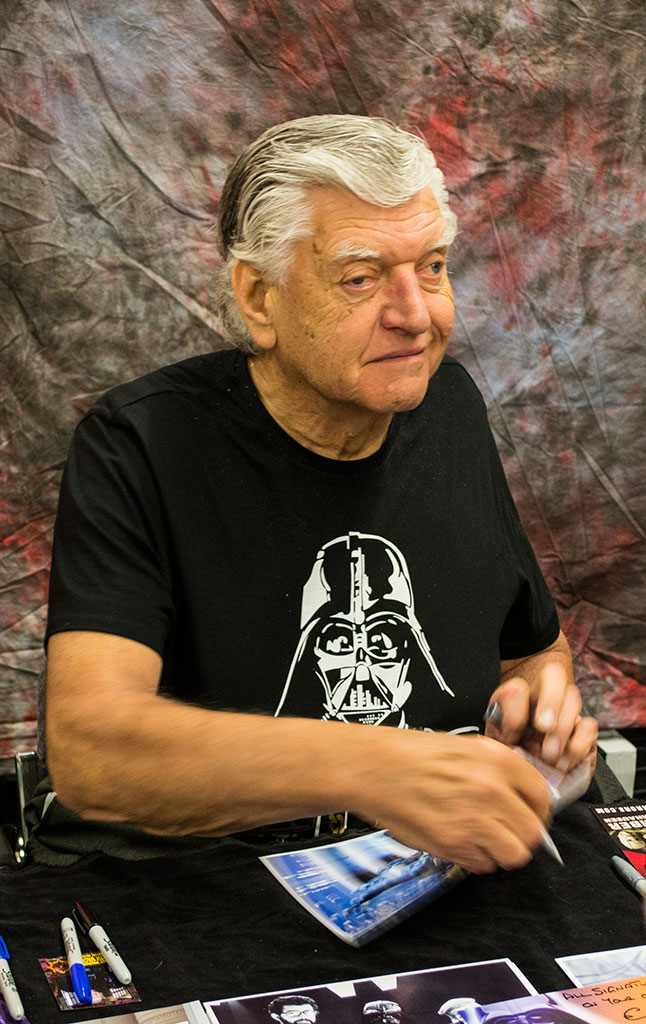
Prowse continued to associate himself with his role in the Star Wars films and was involved in the convention circuit. Despite this, he was not included in some reunions of the original cast, such as those for the Empire of Dreams documentary and the 2005 Vanity Fair cover. While being interviewed by Kevin Moore of The Moore Show Prime Time, he admitted his dislike of the prequel trilogy and said the new films were "out of context" in terms of special effects in comparison to the original trilogy.[37]
In July 2007, Prowse joined many others from the Star Wars films for the first ever Star Wars Celebration event held outside the United States. It was run by Lucasfilm Ltd. and the Cards Inc. Group, at the ExCeL Exhibition Centre in London.[38][39] The occasion was to mark the 30th anniversary of Star Wars.[40]
Prowse played a cameo role in the Star Wars fan films "Order of the Sith: Vengeance" and its sequel "Downfall" – Order of the Sith, alongside Jeremy Bulloch and Michael Sheard. These fan films were made in Britain in support of the charity Save the Children.[41]
In 2008, he was one of the cast members featured on Justin Lee Collins's Bring Back...Star Wars. In the episode, Prowse commented that he had a dispute with Lucas after he allegedly leaked reports of Darth Vader's death to the press. Prowse had previously suggested that Darth Vader could be Luke Skywalker's father in a speech he gave to University of California, Berkeley, in 1978.[42] However, this was shortly after the release of Star Wars and nearly two years before The Empire Strikes Back[43] was released,[44][45] and the script had not even been written at the time. Gary Kurtz, the producer of The Empire Strikes Back, said in the 2015 documentary I Am Your Father that Prowse's apparent plot spoiler was simply "a good guess."[46]
Prowse stated his contract for Return of the Jedi included a share of profits on the film, and although it grossed $475 million on a $32 million budget, Prowse explained in an interview in 2009 that he never received residuals for his performance.[47] Due to "Hollywood accounting", the actual profits are sent as "distribution fees" to the studio, leaving nothing to distribute to others.[48]
In July 2010, Prowse was banned by Lucas from attending official Star Wars fan conventions.[49][50] Lucas had given Prowse no reason, other than stating that Prowse "burnt too many bridges" between Lucasfilm and himself.[51]
In 2011, Prowse wrote and released his autobiography Straight from the Force's Mouth.[52]
A 2015 Spanish documentary by filmmaker Marcos Cabotá, entitled I Am Your Father, detailed Prowse's then life and his blackballing by Lucasfilm, which the documentary suggested was unjustified. The leaks featured in the documentary originated from a technician working on the films.[53][54]
Partnership with Jayce Lewis
[edit]

Prowse became friends with Welsh musician Jayce Lewis when the latter was a teenager, after they met at a science fiction convention.[55] At the convention, Lewis recalled learning that Prowse's son, whom he later met after a performance, was also a drummer.[56][57] On their shared musical interest, Prowse identified himself as "a music fan for years, going from big band jazz, trad jazz, modern and progressive."[58]
The two became business partners[59] with Prowse taking on a management and public relations role. He was also featured in the music video for "Shields" on the album Orderart.[60] On 1 October 2015, Lewis created a mini-documentary entitled The Force's Mouth, which gave Prowse the opportunity to hear himself voicing Darth Vader's lines with studio effects applied for the first time.[55][61]
Personal life
[edit]Prowse married Norma Scammell in 1963 and was the father of three children.[62] He was a supporter of Bristol Rugby Club. He lived in Addiscombe, Croydon, in Surrey from 1963.[63]
Prowse publicly declared his support for the United Kingdom Independence Party in the 2009 European Parliament election: "I've looked right and left and right again and the only party I can safely vote for is UKIP."[64]
Health problems
[edit]
Prowse suffered from arthritis for much of his life. This led to replacements of both hips, and to his ankle being fused, as well as several revisionary surgeries on his hip replacements.[65] His arthritic symptoms first appeared when he was 13. Though they seemingly disappeared after he took up competitive weightlifting, they reappeared in 1990.[65]
Prowse worked with multiple arthritis organisations in Britain and was vice-president of the Physically Handicapped and Able-bodied Association.[66]
In March 2009, Prowse revealed that he was suffering from prostate cancer. He underwent radiation therapy at the Royal Marsden Hospital in South London.[67] Later that year he was said to be in remission.[68]
In November 2014, the Daily Mirror reported that he had dementia.[69] Prowse denied this, but admitted that he had problems with his memory, which he put down to age.[70]
Retirement
[edit]In late 2017, Prowse retired from all public appearances and events, due to ill health and the wishes of his family.[71][72] His final onscreen appearance[73] was filmed with his long-time friend the Welsh musician Jayce Lewis in a sci-fi music video titled Shields.[74][75] Upon completing production Prowse was quoted as saying; Well, that's that and Jayce as responding; Job done, Legacy made![76]
Death
[edit]Prowse died at a hospital in London, England, on 28 November 2020, aged 85.[77][78][79]
Honours and awards
[edit]Prowse was appointed Member of the Order of the British Empire (MBE) for services to charity and road safety at the New Year Honours in 2000.[80]
Filmography
[edit]| Year | Title | Role | Notes | Ref. |
|---|---|---|---|---|
| 1967 | Casino Royale | Frankenstein's Creature | Uncredited | [13] |
| 1968 | Hammerhead | George | [81] | |
| The Saint (TV series) | Tony | Episode: "Portrait of Brenda" | ||
| 1970 | The Horror of Frankenstein | The Creation | [24] | |
| 1971 | Up Pompeii | Muscular Man | Uncredited | [82] |
| Up the Chastity Belt | Sir Grumbel | [83] | ||
| Carry On Henry | Bearded torturer | [84] | ||
| A Clockwork Orange | Julian | [85] | ||
| 1972 | Vampire Circus | Strong man | [86] | |
| Doctor Who | Minotaur | Episode: "The Time Monster" | [87] | |
| 1973 | Black Snake | Jonathan Walker | [88] | |
| White Cargo | Harry | [89] | ||
| The Tomorrow People | Android | Series 1 Story 2: "The Medusa Strain" | ||
| 1974 | Frankenstein and the Monster from Hell | Creation | [23] | |
| Callan | Arthur | [90] | ||
| 1976 | Space: 1999 | The Beta Cloud Creature | Episode: "The Beta Cloud" | [91] |
| 1977 | Star Wars | Darth Vader | Voiced by James Earl Jones | [92] |
| Jabberwocky | Red Herring and Black Knights | [93] | ||
| The People That Time Forgot | Executioner | [94] | ||
| 1978 | A Horseman Riding By | Jem Pollock | Part 7: "1914: The Last Hot Summer" | [95] |
| As You Like It (BBC Television Shakespeare) | Charles | Credited as Dave Prowse | [96] | |
| 1980 | The Empire Strikes Back | Darth Vader | Voiced by James Earl Jones | [97] |
| 1983 | Return of the Jedi | [98] | ||
| 2004 | Saving Star Wars | Dave Prowse | [99] | |
| 2006 | Perfect Woman | Dr Maurice Hawkins | [100] | |
| 2010 | The Kindness of Strangers | Frank Bryan | [101] | |
| 2015 | Elstree 1976 | Himself | [102] | |
| 2015 | I Am Your Father | [14] | ||
| 2015 | The Force's Mouth | Documentary | [103] | |
| 2017 | Jayce Lewis – "Shields" | Music video | [104] |
References
[edit]- ^ ""Return of the Jedi" not Profitable?". The Times. 2002. Archived from the original on 15 June 2011. Retrieved 25 July 2010.
- ^ "Green Cross Code Man back on screen". BBC. 24 March 2017. Archived from the original on 11 April 2018. Retrieved 22 June 2018.
- ^ "The National Archives". The National Archives. Archived from the original on 3 February 2011. Retrieved 30 December 2010.
- ^ "Jonathan.thompson.co.uk". Jonathan.thompson.co.uk. Archived from the original on 22 October 2011. Retrieved 30 December 2010.
- ^ "Dave Prowse: Road safety hero who crossed over to the Dark Side | the Independent". Independent.co.uk. Archived from the original on 29 November 2020. Retrieved 6 December 2020.
- ^ "Where did these 11 Bristol celebrities go to school? Archived 20 May 2017 at the Wayback Machine",Bristol Post, 2 April 2017 (Accessed 4 April 2017)
- ^ a b c "Darth Vader returns to Bristol home where he grew up". Bristol Evening Post. 16 November 2009. Archived from the original on 25 September 2012. Retrieved 18 September 2011.
- ^ Lawless, Jill (29 November 2020). "Dave Prowse, actor who played Darth Vader, dies at 85". Associated Press. Archived from the original on 29 November 2020. Retrieved 29 November 2020.
- ^ "R.I.P. David Prowse: How The British Bodybuilder Got To Play Darth Vader". Boldentrance. Daniel Rennie. 28 November 2020. Archived from the original on 4 February 2023. Retrieved 4 February 2023.
- ^ "STRENGTH RECORD, Landmark Feats and others Records". www.strengthrecord.com. Retrieved 16 April 2025.
- ^ "DARTH VADER'S SOURCE OF STRENGTH!". Neckberg. MrBerg. Archived from the original on 27 September 2020. Retrieved 4 February 2023.
- ^ "Dave Prowse: 'My first recollection of him was he was enormous'". BBC. 29 November 2020. Archived from the original on 29 November 2020. Retrieved 19 April 2023.
- ^ a b c d "Darth Vader actor Dave Prowse dies aged 85". The Guardian. 29 November 2020. Archived from the original on 29 November 2020. Retrieved 29 November 2020.
- ^ a b Barnes, Mike (28 November 2020). "David Prowse, Man Behind the Darth Vader Mask, Dies at 85". The Hollywood Reporter. Archived from the original on 29 November 2020. Retrieved 29 November 2020.
- ^ "Movie Reviews (Christopher Reeve Homepage)". Archived from the original on 22 September 2018. Retrieved 24 November 2014.
- ^ Elwes, Cary (29 November 2020). "Tribute". Twitter. Archived from the original on 29 November 2020. Retrieved 30 November 2020.
- ^ "Darth Vader's actual 'The Empire Strikes Back' helmet sold for $900k at auction". Man of Many. 30 September 2019. Archived from the original on 23 October 2020. Retrieved 30 November 2020.
- ^ The Champions 1968: The Invisible Man
- ^ "The Green force". BBC News Magazine. Archived from the original on 12 May 2009. Retrieved 24 November 2014.
- ^ Hirsch, David (June 1979). Zimmerman, Howard (ed.). "Starlog Interview: David Prowse". Starlog. No. 23. New York: Norman Jacobs and Kerry O'Quinn. p. 55.
- ^ "From the archive: Dave Prowse 'could have been Darth Vader, Conan and Jaws'". Big Issue. 29 November 2020. Archived from the original on 29 November 2020. Retrieved 1 December 2020.
- ^ "Note to As You Like It 1.1.129". Shakespeare Navigators. Archived from the original on 2 September 2018. Retrieved 30 November 2020.
- ^ a b "Frankenstein and the Monster from Hell (1974)". British Film Institute. Archived from the original on 21 October 2020. Retrieved 29 November 2020.
- ^ a b "The Horror of Frankenstein (1970)". British Film Institute. Archived from the original on 5 December 2020. Retrieved 29 November 2020.
- ^ G. Barnés, Héctor (27 January 2017). "La historia oculta de Benny Hill". El Confidencial (in Spanish). Archived from the original on 15 September 2019. Retrieved 30 November 2020.
- ^ "The Benny Hill Show: Show 46". TV.com. Archived from the original on 8 January 2020. Retrieved 30 November 2020.
- ^ "The Best of Benny Hill (1974)". BFI. Archived from the original on 22 September 2020. Retrieved 30 November 2020.
- ^ "The Saint: Portrait of Brenda. Cast and Crew". TV.com. Archived from the original on 1 November 2019. Retrieved 30 November 2020.
- ^ Pryor, Fiona (18 May 2010). "Debut director lives Cannes dream". BBC News. Archived from the original on 13 July 2014. Retrieved 24 November 2014.
- ^ "New York Times". Archived from the original on 5 December 2020. Retrieved 24 November 2014.
- ^ Pirani, Adam. "Sebastian Shaw: The Return of Anakin Skywalker", Starlog, July 1987, Vol. 11, Iss. 120, p. 56–57, 96.
- ^ Lovett, Jamie (29 November 2020). "Star Wars Creator George Lucas Releases Statement on Death of Darth Vader Actor David Prowse". ComicBook.com. Archived from the original on 30 November 2020. Retrieved 30 November 2020.
- ^ Cabota, Marcos; Bestard, Toni (directors) (20 November 2015). I Am Your Father (Documentary).
- ^ "David Prowse". Buckingham Covers. Archived from the original on 5 December 2020. Retrieved 30 November 2020.
- ^ "To Tell the Truth (Garagiola): Special Star Wars edition from 1977". YouTube. 20 December 2019. Archived from the original on 10 September 2024. Retrieved 9 September 2023.
- ^ "Honorary Members and Friends". 501st Legion. Archived from the original on 19 November 2018. Retrieved 18 February 2015.
- ^ Kevin Moore, David Prowse (26 November 2011). Dave Prowse aka Darth Vader from the original 'Star Wars' Trilogy. Archived from the original on 10 September 2024. Retrieved 30 November 2020.
- ^ "Star Wars Celebration Europe!". Southport Reporter. 16 July 2007. Archived from the original on 16 July 2011. Retrieved 7 August 2012.
- ^ "Star Wars Celebration Europe Tickets". Seatwave. 2007. Archived from the original on 5 February 2012. Retrieved 7 August 2012.
- ^ "UK to host huge Star Wars event". BBC. 24 January 2007. Archived from the original on 19 March 2014. Retrieved 30 November 2020.
- ^ "'Order of the Sith', website". Orderofthesith.net. Archived from the original on 19 March 2008. Retrieved 30 December 2010.
- ^ Wilstein, Matt (12 December 2015). "Does Darth Vader Actor David Prowse Still Hate 'Star Wars'?". The Daily Beast. Archived from the original on 3 January 2017. Retrieved 2 January 2017.
- ^ "Darth Vader has passed away". 30 November 2020. Archived from the original on 18 April 2021. Retrieved 18 April 2021.
- ^ "Darth Vader (Anakin Skywalker)". Chasing the Frog. Archived from the original on 26 November 2015. Retrieved 19 November 2015.
- ^ "The Man Behind Darth Vader". Rockcellar Magazine. Archived from the original on 14 December 2016. Retrieved 19 November 2015.
- ^ Rosenfield, Kat; Harbet, Xandra (27 December 2016). "The untold truth of Darth Vader". Looper. Archived from the original on 23 October 2020. Retrieved 30 November 2020.
- ^ "Times Online". Times. Archived from the original on 15 June 2011. Retrieved 12 September 2012.
- ^ "How Hollywood Accounting Can Make a $450 Million Movie "Unprofitable"". The Atlantic. Archived from the original on 15 September 2012. Retrieved 12 September 2012.
- ^ "The Force". The Force. Archived from the original on 2 October 2010. Retrieved 30 December 2010.
- ^ Lefort, Rebecca (17 July 2010). "Darth Vader actor David Prowse banned for annoying director George Lucas". Daily Telegraph. London. Archived from the original on 26 December 2010. Retrieved 30 December 2010.
- ^ Welch, Michelle (19 July 2010). "David Prowse banned from all Lucasfilm-related Star Wars events". The A.V. Club. Archived from the original on 29 November 2020. Retrieved 29 November 2020.
- ^ "Details of Publication – Apex Publishing Ltd". www.apexpublishing.co.uk. Archived from the original on 20 October 2020. Retrieved 29 November 2020.
- ^ Sancha Rojo, María De (7 October 2016). "'I Am Your Father', el documental español que homenajea al ignorado actor de Darth Vader". El Huffington Post (in Spanish). Archived from the original on 18 November 2016. Retrieved 18 November 2016.
- ^ "Documentary on Darth Vader actor's documentary at Iffi 2016 – Times of India". The Times of India. 16 November 2016. Archived from the original on 1 January 2017. Retrieved 18 November 2016.
- ^ a b Owens, David. "How Dave Prowse would have sounded as Star Wars' Darth Vader". Archived from the original on 3 October 2015. Retrieved 3 October 2015.
- ^ "Musician's surprise at Asia hit". BBC. 17 September 2009. Archived from the original on 5 December 2020. Retrieved 3 October 2015.
- ^ "You could have dinner with Darth Vader". Wales Online. 29 March 2013. Archived from the original on 5 December 2020. Retrieved 30 November 2020.
- ^ "Darth Vader Manages Rock Band! | Dolphin Music". Dolphinmusic.co.uk. Archived from the original on 4 October 2015. Retrieved 3 October 2015.
- ^ "My Friend 'Darth Vader'". PressReader. South Wales Echo. 30 November 2020. Archived from the original on 5 December 2020. Retrieved 2 December 2020.
- ^ Bolter, Abby (31 January 2017). "Star Wars' Dave Prowse on his 'father-son' friendship with a Welsh musician". Archived from the original on 4 February 2018. Retrieved 3 February 2018.
- ^ "The Force's Mouth (Featuring – Dave Prowse & Jayce Lewis)" on YouTube
- ^ Briggs, Helen (22 June 2009). "Darth Vader star on cancer". BBC News. Archived from the original on 5 December 2020. Retrieved 22 June 2009.
- ^ Quinn, Angie (29 November 2020). "Legendary Croydon actor David Prowse who was Darth Vader dies". My London. Archived from the original on 29 November 2020. Retrieved 30 November 2020.
- ^ "Comedian Frank Carson backs UKIP". BBC. 15 May 2009. Archived from the original on 7 March 2012. Retrieved 30 November 2020.
- ^ a b "USATODAY.com – Darth Vader battles 'dark side' of arthritis". USA Today. Archived from the original on 20 March 2012. Retrieved 24 November 2014.
- ^ Ward, Marshall (1 October 2012). "The Man Behind Darth Vader (Interview with Dave Prowse)". Rock Cellar. Archived from the original on 29 November 2020. Retrieved 29 November 2020.
- ^ "Darth Vader actor battles prostate cancer". Archived from the original on 5 December 2020. Retrieved 24 November 2014.
- ^ "Darth Vader star David Prowse Clear of Cancer". Daily Mirror. 2 February 2010. Archived from the original on 15 February 2011. Retrieved 30 December 2010.
- ^ McPhee, Rod. "Star Wars' Darth Vader: I'd have loved a part in the new film but I'd forget my lines". Daily Mirror. Archived from the original on 29 November 2014. Retrieved 29 November 2014.
- ^ Prowse, Dave. "LATEST NEWS". The Official Dave Prowse Website. Archived from the original on 6 February 2015. Retrieved 3 January 2015.
- ^ "David Prowse makes his final on-screen appearance in music video for Jayce Lewis". Team Rock. Future Publishing Limited. 15 September 2017. Archived from the original on 16 September 2017. Retrieved 4 January 2019.
- ^ Robinson, Dan (23 September 2017). "Darth Vader star makes last on-screen appearance in Notts firm's warehouse". Nottingham Post. Local World. Archived from the original on 12 June 2018. Retrieved 4 January 2019.
- ^ "My Interview With Darth Vader Actor And His Apprentice: Their Music Video & Star Wars". HuffPost. 14 September 2017. Archived from the original on 10 September 2024. Retrieved 8 January 2021.
- ^ Owens, David (15 September 2017). "Darth Vader star's final appearance in Welsh music video". Wales Online. Media Wales Ltd. Archived from the original on 11 April 2019. Retrieved 4 January 2019.
- ^ Woodhouse, Alex (18 September 2017). "Jayce Lewis releases new album details and video featuring final screen appearance of David Prowse (Darth Vader)". Midlands Metalheads. Archived from the original on 12 June 2018. Retrieved 4 January 2019.
- ^ "My Interview with Darth Vader Actor and His Apprentice: Their Music Video & Star Wars". 14 September 2017. Archived from the original on 30 November 2020. Retrieved 8 January 2021.
- ^ Dewan, Angela; Beech, Samantha (29 November 2020). "David Prowse, the original Darth Vader, dies aged 85". CNN. Archived from the original on 29 November 2020. Retrieved 30 November 2020.
- ^ Bell, Chris (29 November 2020). "Dave Prowse: 'My first recollection of him was he was enormous'". BBC News. Archived from the original on 29 November 2020. Retrieved 30 November 2020.
- ^ Ramachandran, Naman (29 November 2020). "Darth Vader Actor David Prowse Dies at 85". Variety. Archived from the original on 29 November 2020. Retrieved 29 November 2020.
- ^ "No. 55710". The London Gazette (Supplement). 31 December 1999. p. 30.
- ^ "Hammerhead (1968)". British Film Institute. Archived from the original on 26 October 2020. Retrieved 29 November 2020.
- ^ "Up Pompeii (1971)". British Film Institute. Archived from the original on 8 November 2020. Retrieved 29 November 2020.
- ^ "Up the Chastity Belt (1971)". British Film Institute. Archived from the original on 30 October 2020. Retrieved 29 November 2020.
- ^ "Carry On Henry (1971)". British Film Institute. Archived from the original on 26 October 2020. Retrieved 29 November 2020.
- ^ "A Clockwork Orange (1971)". British Film Institute. Archived from the original on 28 October 2020. Retrieved 29 November 2020.
- ^ "Vampire Circus (1972)". British Film Institute. Archived from the original on 28 October 2020. Retrieved 29 November 2020.
- ^ Muir, John Kenneth (15 September 2015). A Critical History of Doctor Who on Television. McFarland. p. 202. ISBN 978-1-4766-0454-1. Archived from the original on 5 December 2020. Retrieved 29 November 2020.
- ^ "Blacksnake! (1973)". British Film Institute. Archived from the original on 5 May 2019. Retrieved 29 November 2020.
- ^ "White Cargo (1973)". British Film Institute. Archived from the original on 20 May 2019. Retrieved 29 November 2020.
- ^ "Callan (1974)". British Film Institute. Archived from the original on 25 October 2020. Retrieved 29 November 2020.
- ^ Muir, John Kenneth (15 September 2015). Exploring Space: 1999: An Episode Guide and Complete History of the Mid-1970s Science Fiction Television Series. McFarland. p. 132. ISBN 978-0-7864-5527-0. Archived from the original on 5 December 2020. Retrieved 29 November 2020.
- ^ "Star Wars (1977)". British Film Institute. Archived from the original on 29 October 2020. Retrieved 29 November 2020.
- ^ "Jabberwocky (1977)". British Film Institute. Archived from the original on 30 December 2018. Retrieved 29 November 2020.
- ^ "The People That Time Forgot (1977)". British Film Institute. Archived from the original on 5 May 2019. Retrieved 29 November 2020.
- ^ "A Horseman Riding by Part 8 1914: Call to Arms (1978)". British Film Institute. Archived from the original on 4 May 2019. Retrieved 4 January 2022.
- ^ "As You Like It (1978)". British Film Institute. Archived from the original on 5 December 2020. Retrieved 29 November 2020.
- ^ "Star Wars Episode V The Empire Strikes Back (1980)". British Film Institute. Archived from the original on 7 November 2020. Retrieved 29 November 2020.
- ^ "Star Wars Episode VI Return of the Jedi (1983)". British Film Institute. Archived from the original on 5 November 2020. Retrieved 29 November 2020.
- ^ Armitage, Hugh (22 May 2016). "The five Darth Vaders – Where are they now?". Digital Spy. Archived from the original on 29 November 2020. Retrieved 29 November 2020.
- ^ "Perfect Woman". British Film Institute. Archived from the original on 4 May 2019. Retrieved 29 November 2020.
- ^ "British Council Film: The Kindness of Strangers". British Council Film. Archived from the original on 5 December 2020. Retrieved 29 November 2020.
- ^ "British Film Festival Review: Elstree 1976". Glam Adelaide. 12 November 2015. Archived from the original on 29 November 2020. Retrieved 29 November 2020.
- ^ Owens, David (1 October 2015). "This is what Darth Vader would sound like if Dave Prowse actually voiced him". Mirror.co.uk. Archived from the original on 5 June 2019. Retrieved 29 November 2020.
- ^ "Ill health forces Darth Vader actor David Prowse to end public appearances". The Irish News. 7 September 2017. Archived from the original on 29 November 2020. Retrieved 29 November 2020.
External links
[edit] Media from Commons
 Quotations from Wikiquote
 Data from Wikidata


David Prowse
View on GrokipediaEarly Life
Childhood and Family Background
David Prowse was born on 1 July 1935 in Bristol, England, to a working-class family.[3][1] His father, Charles Prowse, died when David was five years old, after which he was raised primarily by his mother, Gladys (née Burt), in the Southmead area of the city.[3][6] This family environment instilled a sense of resilience amid the challenges of a single-parent household in a modest community.[7] Prowse's childhood unfolded in post-World War II Britain, characterized by widespread economic austerity, rationing until 1954, and rebuilding efforts that disproportionately affected working-class families like his own in industrial Bristol.[3] He secured a scholarship to the selective Bristol Grammar School, reflecting academic potential despite limited resources at home, though his formal education emphasized practical discipline over extended higher studies.[8][3] These early years in a constrained socioeconomic setting fostered the determination evident in his later endeavors, with nascent interests in physical pursuits emerging within the context of local working-class youth culture.[7]Overcoming Health Challenges and Entry into Weight Training
At around age 13, Prowse developed weak legs that severely restricted his mobility, prompting physicians to diagnose a debilitating condition and counsel him against engaging in any sports or physical activities, forewarning permanent incapacity.[4] Undeterred by this outlook, Prowse embarked on self-directed strength training in the early 1950s, beginning at age 17 in 1952 with a Charles Atlas dynamic tension program aimed at fortifying his knees; he practiced in the family garden and a repurposed coal shed, improvising exercises before saving to purchase actual weights.[9][10][11] These efforts produced swift enhancements in his physical capabilities, validating his approach through direct personal evidence and allowing him to dismiss the earlier medical reservations. This foundational phase of recovery through methodical, trial-based exertion laid the groundwork for his subsequent pursuit of athletic prowess, transforming adversity into a catalyst for disciplined training.[4]Athletic Career
Bodybuilding Achievements
David Prowse, standing at 6 feet 6 inches (1.98 m) tall and competing at weights exceeding 250 pounds (113 kg), leveraged his exceptional frame and rigorous training regimen to excel in heavyweight divisions during the early 1960s.[12][13] His height provided a mechanical advantage in lifts requiring leverage, such as the clean and jerk, contributing causally to his competitive edge over shorter rivals in an era when such anthropometric factors were underexplored but empirically decisive in outcomes.[4] Prowse secured the British Heavyweight Weightlifting Championship in 1962, a title he defended successfully in 1963 and 1964, establishing him as the dominant figure in the category under the British Amateur Weight Lifters' Association.[14] These victories followed a bronze medal in the 1961 BAWLA Heavyweight Championships, marking his progression from regional contests to national supremacy through consistent performance in snatch, clean and jerk, and press events.[4] Representing England, he competed at the 1962 British Empire and Commonwealth Games in Perth, Australia, and the World Championships in Budapest, where his totals placed him among elite international lifters despite the era's limited global data on comparative strengths.[4] Transitioning toward bodybuilding aesthetics while maintaining weightlifting prowess, Prowse entered the NABBA Mr. Universe contest as a contender in 1960 at age 25, competing against professionals who emphasized muscular symmetry over pure strength metrics.[15] His participation highlighted a shift from therapeutic training—initially adopted to combat childhood respiratory issues—to competitive pursuits, where quantifiable gains in muscle mass and power output underscored the efficacy of progressive overload principles he applied empirically.[14] By the mid-1960s, disillusionment with bodybuilding's subjective judging prompted a refocus on verifiable lifting records, though his foundational achievements laid groundwork for later strongman recognition.[14]Strongman Performances and Public Demonstrations
In the early 1960s, after retiring from competitive weightlifting, Prowse formed a professional strongman act self-billed as "Britain's Strongest Man" while residing in Croydon.[11] He conducted public appearances across the UK and toured Europe, demonstrating exceptional feats of strength to captivate audiences and promote physical fitness.[16] These spectacles, often held at events and venues blending athletic display with entertainment, included heavy deadlifts surpassing 660 pounds (299 kg), highlighting his raw power derived from disciplined training.[10] Prowse's strongman routines extended to television spots and promotional demonstrations in the 1960s and 1970s, where he showcased lifting capabilities that underscored the practical limits of human strength under load.[14] Such performances not only built his public profile but also served as vehicles for fitness advocacy, encouraging viewers to adopt weight training for health benefits amid rising interest in body conditioning.[17] By integrating spectacle with instruction, Prowse translated competitive athleticism into accessible public education on strength mechanics. Complementing these feats, Prowse worked as a personal trainer for high-profile celebrities, applying his strongman expertise to customized regimens. Clients included actors Vanessa Redgrave, Daniel Day-Lewis, and Christopher Reeve, for whom he designed conditioning programs during the latter's preparation for the Superman films in the late 1970s.[13] [18] This role merged demonstration with one-on-one coaching, emphasizing progressive overload and recovery principles to enhance physical performance while mitigating overuse strains common in power-based activities.Professional Career in Entertainment
Early Acting Roles and Fitness Advocacy
Prowse entered acting in the late 1960s, capitalizing on his bodybuilding physique for physically demanding or intimidating parts. His screen debut came in the 1967 James Bond spoof Casino Royale, where he played Frankenstein's creature in a brief but memorable sequence.[8] He reprised similar monstrous roles, including the creature in the Hammer horror film Frankenstein and the Monster from Hell (1974).[19] In 1971, Prowse portrayed Julian, the hulking bodyguard to the writer Frank Alexander, in Stanley Kubrick's A Clockwork Orange, a role that showcased his ability to convey silent menace through sheer physicality.[20] Additional film appearances that decade included the executioner in The People That Time Forgot (1977) and comedic bits in Carry On Henry (1971) and Jabberwocky (1977).[3] On television, he guest-starred in episodes of series such as The Saint (1969), The Benny Hill Show (1969-1989), and The Champions (1968-1969), often cast for his strength and stature.[21] Parallel to these roles, Prowse advocated for fitness through public demonstrations, gym ownership, and media. He served as a fitness consultant to Harrods department store and performed feats like tearing phone books to promote weight training.[22] In 1979, he published Fitness Is Fun, a guide blending personal anecdotes with practical exercises emphasizing progressive resistance training for measurable strength improvements rather than short-term dietary fads.[15] From 1975 to the late 1970s, Prowse embodied the Green Cross Code Man in British public service announcements, a caped superhero promoting the seven-step road safety code to children.[19] The campaign leveraged his commanding presence—reminiscent of a dark enforcer—to deliver fear-informed warnings about traffic hazards, appearing in films and school visits. Prowse later attributed an estimated prevention of 250,000 child road injuries or deaths to the initiative's reach and messaging.[23]
Casting and Portrayal of Darth Vader
David Prowse was cast in the role of Darth Vader's physical form in March 1976 during pre-production for Star Wars, with George Lucas selecting him for his exceptional height of 6 feet 6 inches (198 cm) and robust physique developed through competitive bodybuilding and strongman competitions.[24][25] Prowse's prior screen presence in films like A Clockwork Orange (1971) had drawn Lucas's attention, positioning him as ideal to embody the character's intended imposing, armored menace without relying on visual effects.[24] Prowse handled the on-set physical performance for Darth Vader across the original trilogy—Star Wars (1977), The Empire Strikes Back (1980), and Return of the Jedi (1983)—executing movements, gestures, and the bulk of non-combat actions while clad in the full costume.[26][27] The suit, constructed from rigid fiberglass and leather components weighing approximately 40 pounds (18 kg), restricted mobility and demanded Prowse's strength training background to maintain Vader's deliberate, authoritative posture during extended shoots.[28] Visibility inside the helmet was severely limited by two narrow eye slits prone to fogging from exhaled breath, forcing Prowse to navigate sets via memorized blocking, audio cues from crew, and repeated rehearsals rather than direct sightlines.[29] Breathing was further hampered by the armor's poor ventilation and integrated respirator elements, often leading to physical exhaustion after prolonged wear, yet this real-world strain causally amplified the portrayal's authenticity by conveying Vader's labored respiration and unyielding physical dominance through Prowse's evident exertion.[29][28] The resulting gait—methodically heavy and predatory—emerged from these practical constraints and Prowse's athletic precision, establishing Vader's screen menace via tangible human capability predating any digital augmentation.[26][29]Other Film, Television, and Public Campaigns
David Prowse portrayed Frankenstein's monster in the 1970 Hammer horror film The Horror of Frankenstein, directed by Jimmy Sangster, where he played the reanimated creature assembled by Victor Frankenstein (Ralph Bates).[30] He reprised similar physically imposing roles in earlier projects, such as the monster in the 1967 James Bond spoof Casino Royale.[31] In Stanley Kubrick's 1971 dystopian film A Clockwork Orange, Prowse appeared as Julian, the muscular bodyguard to the character Frank Alexander.[19] On television, Prowse played the Minotaur in the 1972 Doctor Who serial "The Time Monster," a Third Doctor story involving ancient myths and time manipulation.[32] He made guest appearances in series such as The Benny Hill Show, leveraging his physique for comedic sketches, and Space: 1999, contributing to science fiction productions beyond the Star Wars franchise.[19] These roles highlighted his versatility in embodying large, imposing figures, often without dialogue, drawing on his bodybuilding background. Prowse served as the Green Cross Code Man in a long-running British road safety campaign launched by the Department of Transport in 1976, portraying a superhero-like figure who taught children the "Green Cross Code" rules for safe pedestrian crossing through television advertisements and school demonstrations.[33] The initiative, which emphasized thinking first, observing surroundings, and signaling intentions, reached millions and was credited with reducing child pedestrian accidents; Prowse's involvement lasted until the early 1990s, when the character was phased out.[33] In public fitness demonstrations, Prowse drew on his experience overcoming childhood nephritis through weight training to advocate physical conditioning, conducting workshops and motivational talks that emphasized discipline and resilience as keys to health recovery.[25] Post-Star Wars trilogy, he engaged fans at independent conventions worldwide, frequently donning the Darth Vader costume to perform strength feats like lifting attendees, thereby extending his physical legacy into interactive public appearances.[34]Musical Partnership with Jayce Lewis
David Prowse formed a professional partnership with Welsh rock musician Jayce Lewis in the late 2000s, initially handling public relations for Lewis starting in 2009 after a friendship that began around 2001.[35][36] This collaboration evolved into on-screen appearances in Lewis's music videos, where Prowse's physically imposing presence and association with the Darth Vader character were integrated into industrial and heavy rock aesthetics.[37] Prowse appeared in Lewis's 2015 promotional video "The Force's Mouth – Part 1," which highlighted their mentor-apprentice dynamic through dialogue and visuals evoking Prowse's strongman background.[38] His final on-screen role came in the 2017 music video for "Shields," portraying an experimental, monstrous laboratory subject amid sci-fi themed production that blended horror elements with Lewis's aggressive sound.[39] These appearances capitalized on Prowse's villainous iconography to enhance visual impact for Lewis's niche rock audience, without pursuing broader commercial success.[40] The partnership included joint promotional efforts, such as endorsements and convention-related activities tied to Lewis's releases, reinforcing Prowse's cult appeal in alternative entertainment circles.[41] While not yielding mainstream breakthroughs, the collaboration provided Prowse a platform to extend his physical performer legacy into music media, drawing on empirical draw of his established imagery for targeted fan engagement.[42]Political Views and Public Advocacy
Support for UKIP and Brexit
In May 2009, David Prowse publicly endorsed the United Kingdom Independence Party (UKIP) ahead of the European Parliament elections, marking a rare foray into overt political advocacy despite his prior reticence on such matters.[3] He explained his choice by stating, "I've looked right and left and right again and the only party I can safely vote for is UKIP," reflecting a deliberate assessment of alternatives in favor of UKIP's platform emphasizing reduced EU influence and restored national autonomy over legislation, immigration, and economic policy.[3] This alignment underscored Prowse's preference for governance structures prioritizing direct accountability to British voters over supranational bodies, consistent with UKIP's core arguments for sovereignty derived from independent decision-making rather than pooled authority. Prowse's backing extended to appreciation from UKIP leadership, with then-leader Nigel Farage later acknowledging his support as a notable contribution during Farage's tenure.[43] As UKIP positioned itself as the primary advocate for British withdrawal from the EU—culminating in the party's pivotal role in the Brexit debate—Prowse's 2009 endorsement implicitly favored policies aimed at reclaiming control from Brussels, including stricter border management and rejection of federalist integration, though he issued no recorded statements specifically on the 2016 referendum.[3] His stance drew from a working-class Bristol background, where empirical experiences of local policy impacts may have informed skepticism toward expansive welfare systems and open-border arrangements perceived as straining national resources, aligning with UKIP's critiques of unchecked EU-driven migration and regulatory overreach.[19]Fitness Promotion and Social Campaigns
Prowse established a series of gyms in London during the 1960s and 1970s to advance public access to weight training, viewing resistance exercise as essential for building strength and countering physical decline from inactivity. One such facility operated in Borough, south London, where he conducted personal training sessions, including free instruction for individuals seeking to improve their physiques.[17] Participants reported tangible benefits, such as reduced body fat and enhanced muscular development, attributing these outcomes to Prowse's structured routines emphasizing progressive overload and consistent effort.[17] He positioned these centers as practical demonstrations that disciplined training could transform baseline weakness into functional power, drawing on his own progression from childhood respiratory ailments—requiring leg braces until age 13—to heavyweight lifting championships in 1962, 1963, and 1964.[44][4] In parallel, Prowse authored instructional materials to disseminate his fitness principles, including the book Fitness Is Fun, which detailed accessible weight resistance protocols suitable for various ages and physical starting points. The guide advocated routines grounded in compound lifts like deadlifts—where Prowse personally demonstrated capacities exceeding 400 pounds—to illustrate how mechanical stress fosters adaptive strength gains, independent of innate advantages. He extended this advocacy to underserved groups, including those with disabilities, by adapting programs based on his recovery from early mobility limitations through targeted resistance work, which he credited with enabling feats like tearing phone books and lifting heavyweights publicly.[45] Verifiable accounts from trainees, such as a young individual receiving gratis sessions to address physical shortcomings, underscore the efficacy of these methods in promoting self-reliance over dependency.[46] Prowse's campaigns targeted cultural acceptance of sedentary habits by highlighting empirical contrasts: his sustained training into later decades maintained mobility despite aging and injuries, contrasting with population-level data on inactivity-linked frailty. As Harrods' fitness consultant and trainer to actors like Christopher Reeve for Superman (1978)—involving customized regimens of runs, weights, and cardio—he stressed that outcomes stemmed from volitional discipline, not victim narratives or external validations.[1][47] This approach informed his broader social efforts, such as consultancy roles that integrated strength-building into everyday wellness, rejecting excuses rooted in modern conveniences as barriers to causal health improvements.[48]Critiques of Modern Cultural Trends
Prowse critiqued political correctness as an intrusive force in film production, asserting that it supplanted merit-based decisions with representational quotas. In a 1999 interview, he claimed the studio replaced his Bristol-accented dialogue for Darth Vader with James Earl Jones's voice due to fears that the original cast's lack of black actors would prompt boycotts, describing the intervention as stemming from the "PC police" and amounting to "reverse racism."[49][50] This episode, occurring amid preparations for Star Wars: Episode I – The Phantom Menace, underscored his view that such pressures prioritized ethnic diversity over the performer's established physical and on-set contributions. Drawing from his bodybuilding background, where success demanded rigorous, individual effort rather than external accommodations, Prowse implicitly contrasted entertainment's evolving norms with the self-reliant ethos of strength sports. His advocacy for fitness campaigns, including public demonstrations of feats like lifting 280-pound barbells overhead, emphasized earned resilience over unearned concessions, positioning physical discipline as a bulwark against cultural softening.[22] In later years, amid his support for UKIP's emphasis on national sovereignty, Prowse's remarks aligned with broader reservations about progressive mandates eroding traditional meritocracy, though he refrained from extensive public commentary on subsequent media shifts like those in the Star Wars sequel trilogy.[51] His fitness promotions, such as introducing innovative training methods to Britain in the 1960s, served as practical rebuttals to sedentary modern habits, advocating proactive health to foster societal vigor.[22]Controversies and Disputes
Conflicts with Lucasfilm and Star Wars Franchise
Tensions between David Prowse and Lucasfilm arose during the production of The Empire Strikes Back in the late 1970s, stemming from strict secrecy protocols enforced by George Lucas to preserve key plot twists. Prowse, performing in the physically demanding Darth Vader suit, was not informed of the true dialogue for pivotal scenes; for instance, he delivered the scripted line "Obi-Wan killed your father" during the Bespin confrontation with Luke Skywalker, which was later dubbed by James Earl Jones to reveal "No, I am your father." This measure, intended to prevent leaks among cast and crew, led Prowse to ad-lib lines based on incomplete information, causing on-set frustrations and requiring reshoots or adjustments that Lucas attributed to Prowse's unreliability.[52][53] These issues escalated when Prowse publicly spoiled major plot points in interviews, undermining Lucasfilm's efforts to maintain narrative surprise, which was empirically vital to the franchise's cultural impact—The Empire Strikes Back grossed over $538 million worldwide upon its 1980 release, partly due to the shock value of revelations. In a 1978 interview, Prowse disclosed to an audience of about 1,000 fans that Vader was Luke's father, two years before the film's premiere, confirming details he had gleaned from production scripts. Similar indiscretions occurred ahead of Return of the Jedi in 1983, where Prowse revealed aspects of the Emperor's role and Vader's redemption arc to reporters, prompting Lucasfilm to view him as a persistent risk to intellectual property security. While Prowse maintained these were inadvertent or tricked statements, Lucasfilm prioritized causal control over storyline integrity, citing repeated breaches as justification for diminished trust.[54][53][55] The contractual separation of Prowse's physical performance from Jones's voice work, agreed upon pre-production, fueled ongoing disputes over credit and compensation, with Prowse advocating for unified recognition as Vader despite the arrangement's rationale for enhancing vocal menace. By 2010, these accumulated frictions—exacerbated by Prowse's perceived advocacy for greater actor input against Lucasfilm's top-down decisions—resulted in his formal ban from all official Star Wars events, including Celebration V, with Lucasfilm stating he had "burnt too many bridges." Prowse's indispensable contribution to Vader's imposing physicality, evidenced by his bodybuilding background enabling the character's 6-foot-5-inch stature and forceful movements, remained uncontroverted, yet Lucasfilm's exclusionary stance reflected a preference for narrative guardianship over collaborative equity, a decision that sidelined Prowse from franchise milestones despite his foundational role in a series generating billions in revenue.[56][55][57]Relations with Fans and Convention Appearances
Prowse maintained a dedicated following among Star Wars enthusiasts for his physical embodiment of Darth Vader, often drawing significant crowds at fan conventions where he appeared in costume or recounted filming experiences. Early in the franchise's convention history, he participated in events that celebrated the original trilogy, leveraging his imposing stature and distinctive voice to engage attendees. However, his interactions were not universally positive, as some fans expressed frustration over his tendency to reveal plot spoilers, such as disclosing in 1978 that Vader was Luke Skywalker's father—a twist not revealed on screen until The Empire Strikes Back in 1980.[55][58] In July 2010, Lucasfilm banned Prowse from all official Star Wars conventions, including events like Star Wars Celebration, citing ongoing tensions rather than a single incident. This decision stemmed from cumulative issues, including Prowse's history of unauthorized disclosures and his participation in projects critical of George Lucas, such as the 2010 documentary The People vs. George Lucas, which portrayed the filmmaker unfavorably. Prowse's outspoken criticism of Lucas and perceived brash demeanor clashed with the franchise's emphasis on a controlled narrative, leading to his exclusion despite his foundational role in the character's physical presence.[59][55] Post-ban, Prowse continued appearing at independent conventions unaffiliated with Lucasfilm, such as Film & Comic Con Bournemouth in August 2017 and Hamilton Comic Con in October 2016, where he interacted with fans focused on his bodybuilding background and Vader portrayal. These events underscored a core segment of supporters who valued his authentic contributions over franchise disputes, though attendance was limited compared to official gatherings. By September 2017, Prowse announced his retirement from convention appearances, attributing it to health concerns rather than fan reception.[60][61] While some fans distanced themselves due to his spoiler incidents and perceived self-promotion, others defended his legacy, arguing that his physical performance defined Vader's menace independently of voice or direction. This divide reflected broader tensions between individual contributor recognition and corporate brand management, with Prowse's isolation partly self-inflicted through repeated boundary-pushing rather than unilateral exclusion.[62][63]Lifestyle Contradictions and Public Image
Prowse cultivated a public persona centered on physical strength and health promotion, rooted in his achievements as a competitive bodybuilder who won the British Heavyweight Weightlifting Championship in 1962 and opened his own gym in Bristol in 1963, where he trained clients including celebrities.[10] This image extended to his role as the Green Cross Code Man in the 1970s and 1980s, a public service campaign character emphasizing pedestrian safety and implicitly endorsing an active, vigilant lifestyle for children across the UK.[33] However, this advocacy for fitness and resilience clashed with the biomechanical realities of his career; prolonged heavy lifting and strongman feats eroded his joints, culminating in chronic arthritis that required hip replacement surgeries following an injury in 1989 and subsequent spinal and ankle complications.[3] Such outcomes exemplify causal mechanisms in strength training, where repetitive axial loading exceeds cartilage resilience, accelerating degenerative changes irrespective of overall conditioning—empirical analyses of weightlifters indicate elevated osteoarthritis prevalence due to microtrauma accumulation, not mitigated by muscle hypertrophy alone. Prowse's trajectory underscores that elite physical pursuits, while building capacity, impose non-reversible wear on connective tissues, debunking notions of invulnerability in fitness icons and revealing how personal vocational habits propagate downstream health constraints. No external factors excused these effects; his regimen prioritized performance metrics over long-term joint preservation, aligning with data showing former powerlifters experience 2-4 times higher arthritis rates than sedentary controls. This duality—projecting unyielding vigor publicly while privately contending with mobility loss—humanized Prowse, challenging idealized role model narratives by demonstrating fallibility's tangible costs without narrative sanitization. Fans encountered the affable gym proprietor and safety advocate, yet his retirement from appearances by 2015 stemmed from these inexorable physical limits, prioritizing empirical bodily feedback over sustained image maintenance.[3]Personal Life and Later Years
Family and Relationships
Prowse married Norma Scammell in 1963, remaining wedded to her until his death in 2020, for a total of 57 years.[3] [64] The couple had three children—Steve, James, and Rachel—who pursued lives shielded from media attention despite their father's prominence in film and public campaigns.[3] [65] Following their marriage, Prowse and his family left Bristol for London in 1963, where he took up work with a weightlifting firm, establishing a household in the Croydon area that emphasized seclusion over publicity.[66] [67] This relocation aligned with his entry into fitness-related enterprises, which the family navigated quietly amid his evolving show business pursuits.[68] The endurance of Prowse's marriage stood in contrast to the transient relationships often associated with entertainment figures, reflecting a deliberate choice for domestic steadiness; Norma outlived him, continuing to represent the family's reserved stance post-2020.[3] [64]Health Decline and Retirement
In the years following his strongman career, Prowse experienced chronic mobility limitations stemming from a 1989 weightlifting accident that damaged nerves in his arm and curtailed his physical activities.[69] This injury, compounded by the cumulative strain of decades as a bodybuilder and weightlifter, contributed to progressive frailty as he entered his 80s.[22] Prowse's health further deteriorated with a prostate cancer diagnosis in March 2009, for which he underwent two months of radiation therapy at the Royal Marsden Hospital, completing treatment by May of that year.[70] In 2014, he publicly disclosed suffering from dementia, adding to the physical and cognitive challenges of advanced age.[66] These accumulating conditions prompted Prowse to retire from international fan conventions in October 2016 at age 81, followed by a full cessation of personal appearances and conventions starting January 2018 due to declining health and frailty.[71][72] By August 2018, he also ended in-home autograph signings, shifting focus away from public engagements toward private life.[73]Death and Immediate Aftermath
David Prowse died on 28 November 2020 at the age of 85 following a short illness.[74] His agent, Thomas Bowington, announced the death on 29 November, stating that Prowse had passed away the previous day and requesting privacy for the family during their time of grief.[75][3] Prowse's daughter, Rachel, later disclosed to British media that the illness involved complications from COVID-19, after he had battled the virus for two weeks and been hospitalized.[76][77] This revelation came amid the global pandemic, though initial reports respected the family's call for discretion regarding specifics.[78] Lucasfilm issued a statement expressing sadness over Prowse's passing, recognizing his "commanding presence and imposing physical performance" as Darth Vader in the original Star Wars trilogy.[79] George Lucas, the franchise's creator, separately paid tribute, crediting Prowse with bringing essential physicality to the character that made Vader "leap off the page and on to the big screen."[80][81] Immediate responses from fans and peers emphasized Prowse's distinctive embodiment of Vader's menacing stature and movement, distinct from James Earl Jones's voice work, with tributes flooding social media and Star Wars communities to honor his contributions to the character's iconic physical menace.[26][82]Legacy
Awards and Honours
Prowse was appointed Member of the Order of the British Empire (MBE) in the 2000 New Year Honours for his contributions to road safety campaigns and charity work, notably as the Green Cross Code Man in public service announcements promoting pedestrian safety from 1971 to 1990.[4][74] Prior to his acting career, Prowse achieved recognition in competitive weightlifting, winning the British Heavyweight Championship in 1962, 1963, and 1964, which qualified him to represent England at international events including the Commonwealth Games.[74][4] These titles underscored his status as a leading figure in British strength sports during the early 1960s, built on a foundation of bodybuilding training that began in his youth.[4]Cultural Impact and Recognition
Prowse's physical embodiment of Darth Vader contributed to the character's archetype as a towering, mechanically enhanced enforcer, setting precedents for villainous physicality in science fiction where stature and brute force amplify intimidation beyond dialogue. Selected for his 6-foot-5-inch height and competition-honed musculature, his movements under the suit conveyed a grounded menace that distinguished Vader from purely ethereal threats, influencing portrayals in later franchises emphasizing armored, strength-dominant antagonists.[83][68] Independent of the franchise, Prowse's pre-acting career in strength sports exerted a more direct, empirical influence on UK fitness practices, fostering gym culture amid limited infrastructure. As a three-time British Heavyweight Weightlifting Champion from 1962 to 1964, he operated an early south London gym that drew aspirants through hands-on training rooted in overcoming personal frailty via progressive overload, predating widespread commercialization of weight training.[84][4] This causal emphasis on verifiable strength gains—such as his 500-pound bench press—outlasted cinematic fame by embedding practical methodologies in nascent bodybuilding communities, unmediated by narrative embellishment.[68] Recognition of Prowse's performative legacy manifests in surging memorabilia markets, where props from his Vader scenes command premium valuations tied to their on-set authenticity. A lightsaber wielded by Prowse in The Empire Strikes Back fetched $3.65 million at a September 2025 Propstore auction in Los Angeles, surpassing prior Star Wars records and underscoring collector demand for artifacts embodying his physical contributions over voice or scripting.[85][86] Such sales highlight a cultural persistence grounded in tangible performance artifacts, rather than abstracted mythos.Filmography
David Prowse's early film roles capitalized on his bodybuilding physique, often portraying monstrous or imposing figures. In 1967, he appeared as Frankenstein's monster in the James Bond spoof Casino Royale. He reprised similar roles as the monster in Hammer Horror films The Horror of Frankenstein (1970) and Frankenstein and the Monster from Hell (1974). In 1971, Prowse played the bodyguard in Stanley Kubrick's A Clockwork Orange. His television appearances included the Minotaur in the 1972 Doctor Who serial "The Time Monster". From 1976, he portrayed the Green Cross Code Man in British road safety public service announcements, emphasizing pedestrian safety for children.[19] Prowse's breakthrough came with the role providing the physical performance for Darth Vader in the Star Wars original trilogy: Star Wars (1977), The Empire Strikes Back (1980), and Return of the Jedi (1983), with the character's voice supplied by James Earl Jones. Other films from this period include The Eagle Has Landed (1976) as a German sergeant and The People That Time Forgot (1977) as the executioner. In his later years, Prowse featured in music videos for Welsh musician Jayce Lewis, including "Pure" (2016) and "Shields" (2017), marking his final on-screen appearance.[87][39]
| Year | Title | Role |
|---|---|---|
| 1967 | Casino Royale | Frankenstein's Monster |
| 1970 | The Horror of Frankenstein | The Monster |
| 1971 | A Clockwork Orange | Bodyguard |
| 1972 | Doctor Who: "The Time Monster" | Minotaur |
| 1974 | Frankenstein and the Monster from Hell | The Monster |
| 1976–1980s | Green Cross Code advertisements | Green Cross Code Man |
| 1976 | The Eagle Has Landed | German Sergeant |
| 1977 | Star Wars | Darth Vader (physical performance) |
| 1977 | The People That Time Forgot | Executioner |
| 1980 | The Empire Strikes Back | Darth Vader (physical performance) |
| 1983 | Return of the Jedi | Darth Vader (physical performance) |
| 2016–2017 | Jayce Lewis music videos (Pure, Shields) | Various |