Hubbry Logo
Carrie FisherCarrie FisherMain
Open search
Carrie Fisher
Community hub
Carrie Fisher
logo
25 pages, 0 posts
0 subscribers
Be the first to start a discussion here.
Carrie Fisher
Carrie Fisher
from Wikipedia

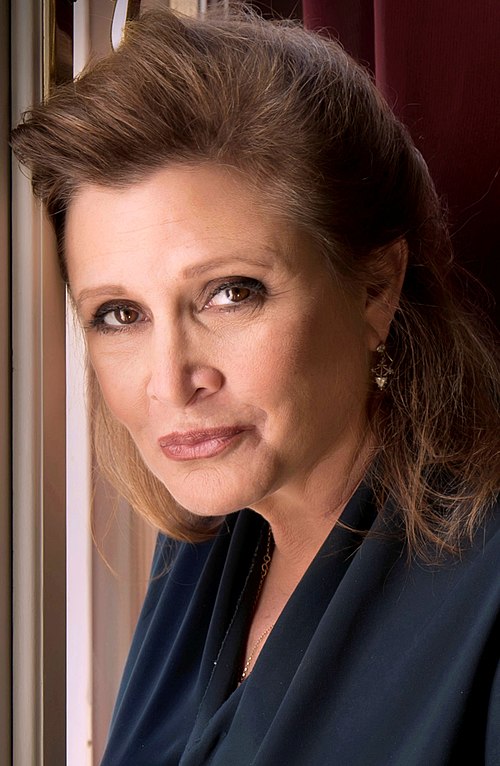
Carrie Frances Fisher (October 21, 1956 – December 27, 2016) was an American actress and writer.[1] She played Princess Leia in the original Star Wars films (1977–1983) and reprised the role in The Force Awakens (2015), The Last Jedi (2017)—a posthumous release that was dedicated to her[2][3]—and The Rise of Skywalker (2019), the latter using unreleased footage from The Force Awakens.[4][5] Her other film credits include Shampoo (1975), The Blues Brothers (1980), Hannah and Her Sisters (1986), The 'Burbs (1989), When Harry Met Sally... (1989), Soapdish (1991), and The Women (2008).[6] She was nominated twice for the Primetime Emmy Award for Outstanding Guest Actress in a Comedy Series for her performances in the NBC sitcom 30 Rock (2007) and the Channel 4 series Catastrophe (2017).

Key Information

Fisher wrote several semi-autobiographical novels, including Postcards from the Edge and an autobiographical one-woman play, and its nonfiction book, Wishful Drinking, based on the play. She wrote the screenplay for the film version of Postcards from the Edge which garnered her a nomination for the BAFTA Award for Best Adapted Screenplay, and her one-woman stage show of Wishful Drinking received a nomination for the Primetime Emmy Award for Outstanding Variety, Music or Comedy Special. She worked on other writers' screenplays as a script doctor, including tightening the scripts for Hook (1991), Sister Act (1992), The Wedding Singer (1998), and many of the films from the Star Wars franchise, among others.[7] An Entertainment Weekly article from May 1992 described Fisher as "one of the most sought-after doctors in town."[8][9]

Fisher was the daughter of singer Eddie Fisher and actress Debbie Reynolds. She and her mother appear together in Bright Lights: Starring Carrie Fisher and Debbie Reynolds, a documentary about their relationship. It premiered at the 2016 Cannes Film Festival. She earned praise for speaking publicly about her experiences with bipolar disorder and drug addiction.[10] Fisher died of a sudden cardiac arrest in December 2016, at age 60, four days after experiencing a medical emergency during a transatlantic flight from London to Los Angeles. She was posthumously made a Disney Legend in 2017,[11] and was awarded a posthumous Grammy Award for Best Spoken Word Album the following year. In 2023, she posthumously received a star on the Hollywood Walk of Fame.[12]

Early life

[edit]
Fisher with her parents and brother in a photo taken for an issue of Modern Screen, 1958

Carrie Frances Fisher[13] was born on October 21, 1956, at Providence Saint Joseph Medical Center in Burbank, California,[14] to actress Debbie Reynolds and singer Eddie Fisher.[15] Fisher's paternal grandparents were Russian-Jewish immigrants,[16][17][18][19][20] while her mother, who was raised a Nazarene, was of English and Scots-Irish descent.[21][22][23][24]

Fisher was two years old when her parents divorced in 1959 after it was revealed shortly following the death of Elizabeth Taylor's husband, Mike Todd, that Eddie Fisher had been having an affair with her.[25] Eddie Fisher and Taylor married that same year and divorced in 1964. Her father's third marriage, to actress Connie Stevens, resulted in the births of Fisher's two half-sisters, Joely Fisher and Tricia Leigh Fisher. In 1960, her mother married Harry Karl, owner of a chain of shoe stores.[26][27] Reynolds and Karl divorced in 1973 when Fisher was 17 years old.[28]

Fisher "hid in books" as a child, becoming known in her family as "the bookworm".[29] She spent her earliest years reading classic literature and writing poetry. She attended Beverly Hills High School until age 16, when she appeared as a debutante and singer in the hit Broadway revival Irene (1973), also starring her mother.[30] Her time on Broadway interfered with her education, resulting in her dropping out of high school.[31] In 1973, she enrolled at London's Central School of Speech and Drama, which she attended for 18 months.[29][32] Following her time there, she was accepted at Sarah Lawrence College, where she planned to study the arts. She later left without graduating.[33][34][35]

Career

[edit]

1970s

[edit]

She was extremely smart; a talented actress, writer and comedienne with a very colorful personality that everyone loved. In Star Wars she was our great and powerful princess—feisty, wise and full of hope in a role that was more difficult than most people might think.

—director George Lucas[36]

Fisher made her film debut in 1975 as the precociously seductive character Lorna Karpf in the Columbia Pictures comedy Shampoo, filmed in mid-1974, when she was age 17.[6] In 1977, Fisher starred as Princess Leia in George Lucas' space opera film Star Wars (later retitled Star Wars: Episode IV – A New Hope) opposite Mark Hamill and Harrison Ford.[37] Though her fellow actors were not close at the time, they bonded after the commercial success of the film.[38]

Fisher with Wim Wenders at a private party after the premiere of the movie F.I.S.T. in 1978

In April 1978, Fisher appeared as the love interest in Ringo Starr's 1978 TV special Ringo.[39] The next month, she starred alongside John Ritter (who had also appeared in Ringo) in the ABC-TV film Leave Yesterday Behind.[40] At this time, Fisher appeared with Laurence Olivier and Joanne Woodward in the anthology series Laurence Olivier Presents in a television version of the William Inge play Come Back, Little Sheba.[41] That November, she played Princess Leia in the 1978 TV production Star Wars Holiday Special, and sang in the last scene.[42]

1980s

[edit]

Fisher appeared in the film The Blues Brothers as Jake's vengeful ex-lover; she is listed in the credits as "Mystery Woman".[43] While Fisher was in Chicago filming the movie, she choked on a Brussels sprout; Dan Aykroyd performed the Heimlich maneuver which "saved my life", according to Fisher.[44] She appeared on Broadway in Censored Scenes from King Kong in 1980. The same year, she reprised her role as Princess Leia in The Empire Strikes Back, and appeared with her Star Wars co-stars on the cover of the July 12, 1980, issue of Rolling Stone to promote the film.[45] She also starred as Sister Agnes in the Broadway production of Agnes of God in 1983,[46][47] a run which overlapped with her mother's appearance in the Broadway company of Woman of the Year.[48][49]

Waxwork of Fisher as Princess Leia (and Jabba the Hutt) from Return of the Jedi, Madame Tussauds, London

In 1983, Fisher returned to the role of Princess Leia in Return of the Jedi, and posed in the character's metal bikini on the cover of the Summer 1983 issue of Rolling Stone to promote the film.[50][51] The costume later achieved a following of its own.[52] In 1986, she starred along with Barbara Hershey and Mia Farrow in Woody Allen's Hannah and Her Sisters.

In 1987, Fisher published her first novel, Postcards from the Edge. The book was semi-autobiographical in the sense that she fictionalized and satirized real-life events such as her drug addiction of the late 1970s and her relationship with her mother. It became a bestseller, and she received the Los Angeles Pen Award for Best First Novel. Also during 1987, she was in the Australian film The Time Guardian. In 1989, Fisher played a major supporting role in When Harry Met Sally..., and in the same year she appeared with Tom Hanks as his character's wife in The 'Burbs.[6]

1990s

[edit]

In 1990, Columbia Pictures released a film version of Postcards from the Edge, adapted for the screen by Fisher and starring Meryl Streep, Shirley MacLaine, and Dennis Quaid.[53] Fisher appeared in the fantasy comedy film Drop Dead Fred in 1991, and played a therapist in Austin Powers: International Man of Mystery (1997).[6] During the 1990s, Fisher also published the novels Surrender the Pink (1990) and Delusions of Grandma (1993). Fisher wrote an episode of the television sitcom Roseanne entitled "Arsenic and Old Mom", in which her mother Debbie Reynolds made a guest appearance. Fisher also did uncredited script work for movies such as Lethal Weapon 3 (where she wrote some of Rene Russo's dialogue), Outbreak (also starring Russo), The Wedding Singer,[54] and Stop! Or My Mom Will Shoot.[55]

2000s

[edit]

In the 2000 film Scream 3, Fisher played a former actress who acknowledges she looks like Fisher,[56] and in 2001 she played a nun in the Kevin Smith comedy Jay and Silent Bob Strike Back. She also co-wrote the TV comedy film These Old Broads (2001), of which she was also co-executive producer. It starred her mother Debbie Reynolds, as well as Elizabeth Taylor, Joan Collins, and Shirley MacLaine.[57] In 2003 Fisher played Mother Superior, another nun, in Charlie's Angels: Full Throttle.[58][59]

In addition to acting and writing original works, Fisher was one of the top script doctors in Hollywood, working on the screenplays of other writers.[60][61] She did uncredited polishes on movies in a 15-year stretch from 1991 to 2005. She was hired by George Lucas to polish scripts for his 1992 TV series The Young Indiana Jones Chronicles and the dialogue for the Star Wars prequel scripts.[60] Her expertise in this area was the reason she was chosen as one of the interviewers for the screenwriting documentary Dreams on Spec in 2007. In an interview in 2004, Fisher said she no longer did much script doctoring.[61]

Fisher also voiced Peter Griffin's boss, Angela, on the animated sitcom Family Guy[62] and wrote the introduction for a book of photographs titled Hollywood Moms, which was published in 2001.[63] Fisher published a sequel to Postcards, The Best Awful There Is, in 2004. In 2005, Women in Film & Video – DC recognized Fisher with the Women of Vision Award.[64]

Fisher wrote and performed in her one-woman play Wishful Drinking at the Geffen Playhouse in Los Angeles from November 2006 to January 2007.[65] Her show then played throughout 2008 at the Berkeley Repertory Theater,[66] San Jose, the Hartford Stage,[67] the Arena Stage[68] and Boston.[69] Fisher published her autobiographical book, also titled Wishful Drinking, based on her successful play in December 2008 and embarked on a media tour. In 2009, Fisher returned to the stage with her play at the Seattle Repertory Theatre.[70] Wishful Drinking then opened on Broadway in New York at Studio 54 and played an extended run from October 2009 until January 2010.[71][72] In December 2009, Fisher's audiobook recording of Wishful Drinking earned her a nomination for a 2009 Grammy Award in the Best Spoken Word Album category.[73]

Fisher joined Turner Classic Movies host Robert Osborne on Saturday evenings in 2007 for The Essentials with informative and entertaining conversation on Hollywood's best films. She guest-starred in the episode titled "Sex and Another City" from season 3 of Sex and the City with Sarah Jessica Parker. On October 25, 2007, Fisher guest-starred as Rosemary Howard on the second-season episode of 30 Rock called "Rosemary's Baby", for which she received an Emmy Award nomination.[74] On April 28, 2008, she was a guest on Deal or No Deal.[75] In 2008, she also had a cameo as a doctor in the Star Wars-related comedy Fanboys.

When asked if she was still working as a script doctor in December 2008, she said: "I haven't done it for a few years. I did it for many years, and then younger people came to do it and I started to do new things. It was a long, very lucrative episode of my life. But it's complicated to do that. Now it's all changed, actually. Now in order to get a rewrite job, you have to submit your notes for your ideas on how to fix the script. So they can get all the notes from all the different writers, keep the notes and not hire you. That's free work and that's what I always call life-wasting events."[76]

2010s

[edit]
Fisher at the film premiere of Star Wars: The Force Awakens at Leicester Square, London

In 2010, HBO aired a feature-length documentary based on a special live performance of Fisher's Wishful Drinking stage production.[77] At the time of her death, Fisher had been preparing a sequel to the one-woman play.[78]

Fisher appeared on the seventh season of Entourage in the summer of 2010.[77] She was among the featured performers at the Comedy Central Roast of Roseanne, which aired in August 2012. In her monologue, Fisher poked fun at her own mental illness,[79] and her fellow roasters' reliance on weight and menopause jokes.[80] Fisher joked that she had no idea why she was asked to roast Roseanne, until "they explained that we were actually good friends, and that apparently we have worked together."[81] Host Jane Lynch joked that Fisher was there to add perspective to Roseanne's struggles with weight and drugs. Fellow roaster Wayne Brady poked fun at Fisher's career, saying she was the only celebrity "whose action figure is worth more than you are."[82]

She was selected as a member of the main competition jury at the 2013 Venice Film Festival.[83] She filmed an appearance on the UK comedy panel show QI that was broadcast on December 25, 2014.[84] Fisher starred alongside Sharon Horgan and comedian Rob Delaney in the British comedy series Catastrophe, that was first broadcast on Channel 4 in the UK on January 19, 2015.[85][86] Her last appearance on Catastrophe, which aired in the UK on April 4, 2017, left many viewers in tears[87] and earned her a posthumous Primetime Emmy Award for Outstanding Guest Actress in a Comedy Series nomination.

Fisher with Mark Hamill and Harrison Ford at the 2015 San Diego Comic-Con promoting Star Wars: The Force Awakens

In a March 2013 interview following the announcement that a new trilogy of films would be produced, Fisher confirmed that she would reprise her role as Princess Leia in Episode VII of the Star Wars series. Fisher claimed that Leia was "Elderly. She's in an intergalactic old folks' home [laughs]. I just think she would be just like she was before, only slower and less inclined to be up for the big battle."[88] After other media outlets reported this on March 6, 2013, her representative said the same day that Fisher was joking and that nothing was announced.[89]

In a January 2014 interview, Fisher confirmed her involvement and the involvement of the original cast in the upcoming sequels by saying "as for the next Star Wars film, myself, Harrison Ford and Mark Hamill are expected to report to work in March or April. I'd like to wear my old cinnamon buns hairstyle again but with white hair. I think that would be funny."[90]

In March 2014, Fisher stated that she was moving to London for six months because that was where Star Wars Episode VII filming would take place.[91] On April 29, 2014, the cast for the new sequel was officially announced, and Fisher, along with Harrison Ford, Mark Hamill, Peter Mayhew, Anthony Daniels, and Kenny Baker, were all cast in their original roles for the film. Star Wars Episode VII, subtitled The Force Awakens, was released worldwide on December 18, 2015. Fisher was nominated for a 2016 Saturn Award for Best Supporting Actress for her portrayal.[92]

In Rogue One (2016), which is set just before the original trilogy, young versions of Leia and the Peter Cushing character Grand Moff Tarkin appear through computer animation.[93][94] Fisher had completed filming her role as Leia in Star Wars: The Last Jedi (2017) shortly before her death.[95] Director Rian Johnson has stated that many of Fisher's own ideas made it into the film, and that she supplied a few of Leia's lines.[96] Fisher appeared posthumously in Star Wars: The Rise of Skywalker (2019) via unreleased footage from The Force Awakens.[4][5][97]

Fisher's memoir, The Princess Diarist, was released in November 2016. The book is based on diaries she kept while filming the original Star Wars trilogy in the late 1970s and early 1980s.[98][99] Her audiobook recording of the memoir earned her the 2018 Grammy Award for Best Spoken Word Album, awarded 13 months after her death.[100]

Fisher and her mother appear in Bright Lights: Starring Carrie Fisher and Debbie Reynolds,[101] a 2016 documentary about their close relationship featuring interviews, photographs and home movies. The documentary premiered at the 2016 Cannes Film Festival and was broadcast on January 7, 2017.[102]

Fisher appeared as herself in the final episode of series 1 of Urban Myths (2017) but the episode was never broadcast following objections by the Jackson family to Joseph Fiennes' portrayal of Michael Jackson in the episode.

2020s

[edit]

Fisher was featured in the film Wonderwell with Rita Ora, which was filmed in mid-2016 in Italy;[103] it received a limited theatrical release on June 23, 2023, followed by a digital release.[104]

Personal life

[edit]

Marriages and relationships

[edit]

In her 2016 autobiography The Princess Diarist, Fisher wrote that she and Harrison Ford had a three-month affair during the filming of Star Wars in 1976.[105]

Fisher met musician Paul Simon through her friend actress Shelley Duvall in 1978, and the pair began dating.[106][107]

In 1980, she was briefly engaged to Canadian actor and comedian Dan Aykroyd, who proposed to her on the set of their film The Blues Brothers. She said: "We had rings, we got blood tests, the whole shot. But then I got back together with Paul Simon."[108]

Fisher was married to Simon from August 1983 to July 1984, and they dated again for a time after their divorce.[109][108] During their marriage, she appeared in Simon's music video for the song "Rene and Georgette Magritte with Their Dog after the War". Simon's song "Hearts and Bones" is about their romance,[110][111] and she is referenced in his song "Graceland", which was written after their divorce.[112] Fisher said she felt privileged to appear in Simon's songs.[112]

Fisher subsequently had a relationship with the Creative Artists Agency's principal talent agent, Bryan Lourd. Their only child, Billie Lourd, was born in 1992. Eddie Fisher stated in his autobiography (Been There Done That) that his granddaughter's name is Catherine Fisher Lourd and her nickname is "Billy". Carrie Fisher's relationship with Bryan Lourd ended when he left her for a man. In interviews, Fisher described Lourd as her second husband, but a 2004 profile revealed that she and Lourd were never legally married.[113]

Fisher had a close relationship with English singer-songwriter James Blunt. While working on his album Back to Bedlam in 2003, Blunt spent much of his time at Fisher's residence. When Vanity Fair's George Wayne asked Fisher if their relationship was sexual, she replied: "Absolutely not, but I did become his therapist. He was a soldier. This boy has seen awful stuff. Every time James hears fireworks or anything like that, his heart beats faster and he gets 'fight or flight.' You know, he comes from a long line of soldiers dating back to the 10th century. He would tell me these horrible stories. He was a captain, a reconnaissance soldier. I became James' therapist. So it would have been unethical to sleep with my patient."[37]

On February 26, 2005, R. Gregory "Greg" Stevens, a 42-year-old lobbyist, was found dead in Fisher's California home. The final autopsy report listed the cause of death as "cocaine and oxycodone use" but added chronic and apparently previously undiagnosed heart disease as contributing factors. Media coverage of an initial autopsy report used the word "overdose", but that wording is not in the final report.[114] In an interview, Fisher claimed that Stevens' ghost haunted her mansion, which unsettled her: "I was a nut for a year, and in that year I took drugs again."[37]

In her later years, Fisher had a pet French bulldog named Gary, that she brought to numerous appearances and interviews.[115] Following her death, reports indicated that Fisher's daughter Billie Lourd would take care of Gary.[116]

Advocacy

[edit]

Fisher described herself as an "enthusiastic agnostic who would be happy to be shown that there is a God."[117] She was raised Protestant,[118] but often attended Jewish services (her father's faith) with Jewish Orthodox friends.[119]

During the 1988 presidential election, Fisher was supportive of Democratic presidential nominee Michael Dukakis.[120]

In 2016, Harvard College gave Fisher its Annual Outstanding Lifetime Achievement Award in Cultural Humanism, noting that "her forthright activism and outspokenness about addiction, mental illness, and agnosticism have advanced public discourse on these issues with creativity and empathy."[10]

Fisher was a supporter and advocate for several causes, including women's advocacy,[121] animal rights,[122] and LGBT causes.[123] She was open about her experiences caring for friends who had AIDS, contributing financially to various AIDS and HIV organizations, including hosting a benefit for amfAR, The Foundation for AIDS Research.[124] She also served as an honorary board member for the International Bipolar Foundation,[125] and, in 2014, received the Golden Heart Award for her work with The Midnight Mission.[126]

She was a spokesperson for Jenny Craig weight loss television ads that aired in January 2011.[127]

Bipolar disorder and drug use

[edit]

During appearances on 20/20 and The Secret Life of the Manic Depressive with Stephen Fry, Fisher publicly discussed her diagnosis of bipolar disorder and her addictions to cocaine and prescription medication.[128] She said her drug use was a form of self-medication; she used pain medication such as Percodan to "dial down" the manic aspect of her bipolar disorder.[129] She gave nicknames to her bipolar moods: Roy ("the wild ride of a mood") and Pam ("who stands on the shore and sobs").[130] "Drugs made me feel more normal", she explained to Psychology Today in 2001. "They contained me."[129] She discussed her 2008 memoir Wishful Drinking and various topics in it with Matt Lauer on NBC's Today that same year, and also revealed that she would have turned down the role of Princess Leia had she realized it would give her the celebrity status that made her parents' lives difficult.[131] This interview was followed by a similar appearance on The Late Late Show with Craig Ferguson on December 12, 2008, where she discussed her electroconvulsive therapy (ECT) treatments.[132] At one point, she received ECT every six weeks to "blow apart the cement" in her brain.[133] In 2014, she said she was no longer receiving the treatment. Her 2011 book Shockaholic describes these treatments.[134]

In another interview, Fisher revealed that she used cocaine during the filming of The Empire Strikes Back. "Slowly, I realized I was doing a bit more drugs than other people and losing my choice in the matter", she noted.[135] In 1985, after months of sobriety, she accidentally overdosed on a combination of prescription medication and sleeping pills.[136] She was rushed to the hospital, creating the turn of events that led to much of the material in her novel and screenplay, Postcards from the Edge. Asked why she did not take on the role of her story's protagonist, named Suzanne, in the film version, Fisher remarked, "I've already played Suzanne."[137]

Death

[edit]

After finishing the European leg of her book tour (her last TV appearance was on an episode of 8 Out of 10 Cats in the United Kingdom, broadcast December 21, 2016), Fisher was on a commercial flight on December 23, 2016, from London to Los Angeles when she had a medical emergency around fifteen minutes before the aircraft landed.[138][a] A passenger seated near Fisher reported that she had stopped breathing;[141] another passenger performed CPR on Fisher until paramedics arrived at the scene. Emergency services in Los Angeles were contacted when the flight crew reported a passenger unresponsive prior to landing. Fisher was taken by ambulance to the Ronald Reagan UCLA Medical Center, where she was placed on a ventilator.[142][143]

On the morning of December 27, 2016, after being in intensive care for four days, Fisher died at the age of 60 at the UCLA Medical Center.[144] Fisher's daughter, Billie Lourd, confirmed her mother's death in a statement to the press.[142] Many of her co-stars and directors from Star Wars and other works also shared their thoughts on her death.[145]

On January 9, 2017, the Los Angeles County Department of Public Health issued a death certificate that stated "cardiac arrest/deferred" as the cause of death, with more tests to be expected.[146] In a June 16, 2017 news release, the Los Angeles County coroner's office said that the exact cause of death could not be determined, but sleep apnea and the buildup of fatty tissue on the walls of arteries were among the contributing factors.[147] A full report from June 19, 2017, stated that Fisher had cocaine in her system, as well as traces of heroin, other opiates, and MDMA. The report also stated that the investigation was unable to determine when she had taken the drugs and whether they contributed to her death.[148] Her daughter stated that Fisher "battled drug addiction and mental illness her entire life. She ultimately died of it. She was purposefully open in all of her work about the social stigmas surrounding these diseases.... I know my Mom, she'd want her death to encourage people to be open about their struggles."[149] In her 2008 work Wishful Drinking, Fisher wrote that "no matter how I go, I want it reported that I drowned in moonlight, strangled by my own bra."[150] After Fisher's death, several news sources and magazines honored her request in their obituaries,[151][152] with Bustle featuring a fantastical reimagining of Fisher's last moments as an ascent into space.[153]

On December 28, 2016, the day after Fisher's death, her mother, Debbie Reynolds, had a stroke at the home of her son, Todd, where the family was planning Fisher's burial arrangements.[154] She was taken to Cedars-Sinai Medical Center, where she died later that afternoon.[155][156] According to Todd, Reynolds had said, "I want to be with Carrie" immediately before she had the stroke.[157][158][b] On January 5, 2017, a joint private memorial was held for Fisher and Reynolds. Fisher was cremated while her mother was entombed. A portion of Fisher's ashes was placed beside Reynolds in a crypt at Forest Lawn Memorial Park in Hollywood Hills.[160] The remainder of those ashes are held in a giant novelty Prozac pill.[161]

Legacy

[edit]
Fisher's fan-made star on the Hollywood Walk of Fame

In the absence of a star for Fisher on the Hollywood Walk of Fame after her death, fans created their own memorial using a blank star. Along with flowers and candles, words put on the blank star read, "Carrie Fisher / May The Force Be With You Always / Hope".[1] Fans also gathered at the Yoda Fountain outside the Lucasfilm offices in San Francisco.[162] In June 2021, it was announced that Fisher would receive an official star on the Hollywood Walk of Fame in 2022. She received the star on May 4, 2023, which was Star Wars Day.[12][163]

Plaque honoring Fisher outside Grauman's Chinese Theatre in Hollywood.

In the video game Star Wars: The Old Republic, thousands of fans paid tribute to Fisher by gathering at House Organa on the planet Alderaan where Fisher's character in Star Wars was raised.[164][165] Lightsaber vigils and similar events in Fisher's honor were held at various Alamo Drafthouse Cinema theaters and other sites.[166][167][168] On January 6, 2017, the lights on Broadway in Manhattan were darkened for one minute in honor of Fisher and her mother.[169] Fisher and Reynolds were also both featured in the 89th Academy Awards In Memoriam segment.[170] On March 25, 2017, a public memorial for mother and daughter was held at the Hall of Liberty theater in Forest Lawn Memorial Park. The event was streamed live on Reynolds' website. On April 14, a special tribute to Fisher was held by Mark Hamill during the Star Wars Celebration in Orlando.[171] The 2017 film Star Wars: The Last Jedi was dedicated to her memory. On October 27, 2023, James Blunt released an album including a track called "Dark Thought" about the death of Fisher, who was a friend of his.[172]

Filmography

[edit]

During her almost five-decade-long career, Fisher had appearances in more than 50 films, as well as various television series, documentaries, late night talk shows, video games, and commercials. Her credits also include writing novels, screenplays, television specials and series episodes.

Works

[edit]

Novels

  • Postcards from the Edge (1987), ISBN 0-7434-6651-9
  • Surrender the Pink (1990), ISBN 0-671-66640-1
  • Delusions of Grandma (1993), ISBN 0-684-85803-7
  • The Best Awful There Is (2004), ISBN 0-7434-7857-6

Non-fiction

Screenplays

Plays

  • Wishful Drinking (2006)[175]
  • A Spy in the House of Me (2008)[176]

Audio

Awards and honors

[edit]
Award Year Category Nominated work Results Ref.
British Academy Film Awards 1990 Best Adapted Screenplay Postcards from the Edge Nominated [178]
Dorian Awards 2016 Wilde Wit of the Year Won[c] [179]
Drama Desk Awards 2010 Outstanding Solo Performance Wishful Drinking Nominated [180]
Grammy Awards 2009 Best Spoken Word Album Wishful Drinking Nominated [181]
2017 The Princess Diarist Won[c]
Hugo Awards 2017 Best Related Work Nominated [182]
Online Film & Television Association Awards 2011 Best Host or Panelist in a Non-Fiction Program Carrie Fisher: Wishful Drinking Nominated [183]
2017 Best Guest Actress in a Comedy Series Catastrophe Won[c] [184]
2019 Film Hall of Fame: Actors Inducted [185]
2021 Television Hall of Fame: Actors Inducted [186]
2023 Film Hall of Fame: Characters Princess Leia Organa Inducted [187]
Online Film Critics Society Awards 2016 Memorial Award Honored [188]
Primetime Emmy Awards 2008 Outstanding Guest Actress in a Comedy Series 30 Rock Nominated [189]
2011 Outstanding Variety, Music or Comedy Special Carrie Fisher: Wishful Drinking Nominated
2017 Outstanding Guest Actress in a Comedy Series Catastrophe Nominated
Saturn Awards 1977 Best Actress Star Wars: Episode IV – A New Hope Nominated [190]
1983 Star Wars: Episode VI – Return of the Jedi Nominated
1988 President's Award Won
2015 Best Supporting Actress Star Wars: Episode VII – The Force Awakens Nominated [191]
2017 Best Supporting Actress in a Film Star Wars: Episode VIII – The Last Jedi Nominated [192]
Teen Choice Awards 2018 Choice Movie Actress: Fantasy Won[c] [193]

References

[edit]
[edit]
Revisions and contributorsEdit on WikipediaRead on Wikipedia
from Grokipedia
Carrie Frances Fisher (October 21, 1956 – December 27, 2016) was an American actress and writer best known for portraying Princess Leia Organa in the original Star Wars film trilogy. Born in Burbank, California, to entertainer parents singer Eddie Fisher and actress Debbie Reynolds—whose high-profile marriage ended in scandal when Fisher left Reynolds for Elizabeth Taylor while Carrie was a toddler—she entered acting amid a turbulent family legacy marked by Hollywood glamour and dysfunction. Fisher's breakthrough came with her debut major film role as the resilient rebel leader Leia in Star Wars: Episode IV - A New Hope (1977), followed by reprisals in (1980) and (1983), roles that defined her career and cemented her as a of strength and defiance. Beyond acting in films like (1975) and uncredited script consulting for projects including (1992) and (1992), she authored semi-autobiographical novels such as (1987)—adapted into a film she scripted—and memoirs like Wishful Drinking (2008), candidly detailing her battles with , substance addiction, and treatments. Open about her diagnoses of in her twenties and lifelong struggles with drugs including and , Fisher became a vocal for awareness, emphasizing personal agency over stigma in speeches and writings that challenged sanitized narratives of recovery. She died at age 60 from induced by , with contributing factors including atherosclerotic heart disease and traces of multiple substances like , , , and prescription medications in her system, as determined by the Los Angeles County coroner's examination.

Early life

Childhood and family background

Carrie Frances Fisher was born on October 21, 1956, in , to actress and singer . The couple had married in 1955 amid their rising fame in Hollywood, with Reynolds starring in films like and Fisher topping music charts as a teen idol. Fisher had a younger brother, Todd, born in early 1958, completing the immediate family unit before its dissolution. The Fishers' marriage ended in divorce in 1959, when Carrie was two years old, following Eddie's public affair with after the death of Taylor's husband . Reynolds received custody of Carrie and Todd, while Eddie provided limited financial support and minimal direct involvement in their upbringing. This paternal absence fostered early feelings of abandonment in Carrie, as she later described the emotional void left by her father's prioritization of his career and subsequent relationships over family responsibilities. From infancy, Fisher was immersed in Hollywood's environment, often accompanying her mother to studio lots like , where Reynolds continued working, exposing her to the industry's glamour and relentless demands. The household buzzed with celebrity visitors and media attention, instilling an acute awareness of fame's double-edged nature amid the instability of her parents' high-profile split. Reynolds' dedication to her career meant Carrie experienced a peripatetic childhood shaped by routines, with familial discord contributing to foundational relational patterns that echoed into adulthood.

Career

Pre-Star Wars roles (1970s)

Fisher dropped out of high school in 1972 at age 15 to focus on , bypassing to participate in her mother ' stage productions. This decision facilitated her rapid entry into professional performance, leveraging family ties in an industry where such connections often expedited opportunities for relatives of established stars like Reynolds. Her Broadway debut occurred in the 1973 revival of the musical Irene, where she played a debutante in the chorus alongside Reynolds in the title role; the production opened on March 13 at the Minskoff Theatre and ran for 594 performances. This minor role, obtained through her mother's involvement rather than open audition, exposed her limited experience but highlighted the nepotistic pathways available in theater. Prior to this, from age 13, Fisher had joined Reynolds' nightclub acts, performing songs that showcased her vocal abilities in informal settings. In 1975, Fisher secured her first film role in Shampoo, directed by , portraying Lorna—a 17-year-old who seduces the older protagonist played by —marking a bold early screen appearance amid the film's satirical take on Hollywood promiscuity. The part, which involved nude scenes and reflected the era's loosening sexual norms, evidenced her willingness to pursue provocative material at age 18, potentially signaling impulsive career risks influenced by youthful ambition and industry access via connections like Beatty's circle. She continued cabaret work with Reynolds, including a 1974 engagement at the London Palladium, where she performed numbers that built her stage comfort but risked as a supporting familial act. These pre-fame efforts underscored a trajectory shaped by inherited advantages, with scant independent credits amid personal choices prioritizing immediate exposure over structured training.

Star Wars franchise and breakthrough

Carrie Fisher was cast as Princess Leia Organa in Star Wars (1977) at the age of 19, marking her second major film role after a brief appearance in Shampoo (1975). Her portrayal depicted Leia as a resilient leader combining vulnerability with resolve, earning praise from co-star Mark Hamill for embodying "effortless feminism" by presenting a woman as "formidable as any man" on screen without apology. The film grossed approximately $775 million when adjusted for inflation, propelling Fisher to international stardom and providing financial independence amid her family's entertainment industry pressures. Fisher reprised the role in (1980) and (1983), deepening Leia's character arc from captive royalty to active rebel commander. On-set during the original production, Fisher, then 19, engaged in a three-month affair with co-star , who was 33, married, and a father of two; she later detailed in her memoir (2016) her intense , describing it as obsessive while Ford viewed it more casually. The abrupt fame yielded professional breakthroughs, including lucrative residuals and typecasting as a cultural icon, but imposed severe personal strains, including invasive media scrutiny and social isolation. This pressure exacerbated Fisher's preexisting substance experimentation—having started marijuana at 13—which escalated to cocaine use during and after the films' productions; she survived an overdose on the Empire Strikes Back set and later attributed early addiction patterns to coping with the psychological toll of sudden celebrity. Her accounts, corroborated by co-star recollections, highlight how the role's success inadvertently fueled self-destructive behaviors amid unrelenting public expectations.

Post-Star Wars acting (1980s-1990s)

Following the success of Star Wars: Episode V – The Empire Strikes Back in 1980, Fisher appeared as the "mystery woman" in The Blues Brothers, portraying a jilted ex-girlfriend who attempts to assassinate one of the protagonists with an array of weapons in a comedic chase sequence. The following year, she starred as Annie Clark, a midget performer, in the comedy Under the Rainbow, a film loosely inspired by the filming of The Wizard of Oz. These roles represented early efforts to leverage her rising fame into diverse comedic parts beyond Princess Leia, though both films received mixed reviews and limited her exposure to supporting or novelty characters. During the 1983 production of Star Wars: Episode VI – Return of the Jedi, Fisher experienced significant on-set friction with director , whom she later described as yelling at her constantly while fawning over co-star , leading her to state outright that she "hated him." Marquand's verbal criticisms contributed to a tense atmosphere for Fisher, exacerbating her personal challenges amid the franchise's demands. This period coincided with her escalating struggles with , including use that began in her early 20s and an accidental overdose in 1985, which prompted entry into a rehabilitation program. Her issues, compounded by , manifested in erratic behavior that witnesses, including during The Blues Brothers shoot where she observed John Belushi's own substance descent, linked to broader professional unreliability. Into the late 1980s, Fisher took supporting roles such as the quirky Marie in When Harry Met Sally... (1989), where she advises on romantic entanglements, and a neighbor in (1989), but these failed to establish her as a leading dramatic actress despite her evident comedic timing. Typecasting as the iconic Leia persistently hindered breakthroughs, with Fisher noting in interviews the difficulty of shedding the princess image even as she pursued edgier parts reflecting her real-life frailties, such as acerbic or unstable figures. In the 1990s, she appeared as the scheming agent Delia in (1991), a role embracing her sharp-witted persona often informed by personal demons, and made an uncredited cameo as a therapist in Austin Powers: International Man of Mystery (1997), counseling the spy on his romantic woes. Fisher's addiction and battles, including electroshock therapy and ongoing substance use through the , limited her to intermittent character work rather than starring , as her unreliability deterred directors seeking dependable leads—a pattern evidenced by her own admissions of drugs "managing" internal turmoil at the expense of consistent output. Despite undeniable talent for portraying flawed, outspoken women, she could not fully escape Leia's shadow, settling into roles that mirrored her vulnerabilities without achieving the career diversification afforded to some peers.

Revival and later roles (2000s-2010s)

In the 2000s, Fisher sustained her acting career through voice work and television guest spots, often leveraging her distinctive persona amid persistent typecasting from her Star Wars role. She voiced Angela, the acerbic boss at the Pawtucket Brewery, in Family Guy beginning with the 2005 episode "PTV," contributing to 25 episodes over the next decade until her death. In 2007, she appeared as Rosemary Howard, a trailblazing 1960s female comedy writer and mentor figure to Liz Lemon, in the 30 Rock episode "Rosemary's Baby," delivering a performance that parodied her own career while highlighting industry barriers for women. Fisher supplemented her income by attending fan conventions, particularly Star Wars events, where her Princess Leia portrayal drew large crowds. She headlined appearances at Star Wars Celebration V in Orlando from August 12–15, 2010, and the Comic & Entertainment Expo (C2E2) in 2010, events that monetized her enduring franchise association but underscored limited opportunities for non-franchise leads. These engagements reflected a career pattern where confined her to cameo-level roles, with few successes outside Star Wars—her post-1983 films rarely exceeded supporting parts in mid-tier productions, as her filmography shows no major starring vehicles achieving significant commercial impact. The 2010s brought a franchise revival with Fisher's return as General Leia Organa in Star Wars: The Force Awakens, released December 18, 2015, after filming concluded in 2014; the role reignited public interest but reinforced her association with the character. Concurrently, she took a recurring role as Mia, the foul-mouthed mother of Delaney's character, in the /Amazon sitcom Catastrophe across its 2015 and 2016 seasons, showcasing her comedic timing in a more substantial TV capacity. Periods of sobriety, achieved after an overdose in 1985 and maintained with bipolar management, facilitated this output, though episodic health disruptions and industry perceptions of typecasting curtailed breakthroughs into lead dramatic roles.

Posthumous releases

Fisher's portrayal of General Leia Organa featured in Star Wars: Episode IX – The Rise of Skywalker (2019), released on December 20, 2019, incorporated about ten minutes of unused footage from her performance in The Force Awakens (2015). Director selected this method to avoid full digital recreation, employing CGI primarily for costume and environmental adjustments to fit new scenes, such as Leia's meditation and Force projection sequences. The approach stemmed from a cut plotline in The Force Awakens involving Leia's emotional response to Han Solo's death, with Fisher's daughter granting approval for its use to honor her mother's legacy without fabricating new material. In (2023), Fisher played the role of , marking her last completed on-screen performance, filmed in during the summer of 2016 mere weeks prior to her death on December 27, 2016. The film, a coming-of-age fantasy directed by Vlad Mars, faced extensive delays spanning seven years due to financing and editing challenges, culminating in a limited U.S. theatrical release on , 2023, via select AMC theaters followed by digital platforms. Critically, it earned a 29% Tomatometer score on from seven reviews and a 5.8/10 user rating on , with reviewers noting its uneven narrative and failure to capitalize on the cast including and , despite a dedication to Fisher in the credits. Box office performance was negligible, reflecting its niche release and lack of broad appeal amid the prolonged wait. Posthumous uses of Fisher's likeness prompted discussions on authenticity and in , particularly after Lucasfilm's January 2017 statement affirming no intentions to digitally recreate her as Leia in future projects, prioritizing respect for her filmed work over synthetic extensions. While The Rise of Skywalker grossed over $1 billion worldwide, it underperformed relative to prior sequel trilogy entries like The Force Awakens ($2.07 billion), partly attributed to narrative choices including the repurposed footage, which some critics and fans viewed as patchwork rather than seamless closure. These releases highlight estate decisions favoring existing assets over innovation, balancing fan demand for continuity against risks of perceived exploitation in an era of advancing deepfake technology.

Writing and creative works

Novels and screenplays

Carrie Fisher's debut novel, , was published in 1987 by . The work follows Suzanne Vale, an navigating recovery from amid Hollywood's superficiality and familial pressures, incorporating elements of Fisher's own struggles with and fame. Fisher adapted the novel into a for the 1990 directed by , starring as Vale, which highlighted themes of personal redemption and industry dysfunction through satirical vignettes. Her second novel, Surrender the Pink, appeared in 1990, chronicling protagonist Kaufman's turbulent romantic entanglements and emotional voids in a celebrity-adjacent world, projecting Fisher's observations on relational instability and self-sabotage. Critics praised its sharp dialogue and humor, with noting the character's accessibility compared to Fisher's fragmented debut style, though observed that vivid scenes often dissolved into subjective introspection without firm narrative structure. Subsequent included Delusions of Grandma in 1994, exploring aging and familial discord, and The Best Awful in 2004, a to Postcards delving deeper into addiction's long-term tolls. These novels consistently channeled therapeutic projection, using fictional lenses to dissect Hollywood's corrosive dynamics and personal frailties as a coping mechanism apart from direct . Fisher also contributed to screenwriting, co-authoring the 2001 ABC television film These Old Broads with Elaine Pope. The comedy reunites aging actresses—portrayed by , , , and —for a stage , satirizing faded stardom, ego clashes, and industry obsolescence while underscoring intergenerational tensions drawn from Fisher's family insights. This project exemplified her pattern of leveraging writing to therapeutically confront relational and professional dysfunctions inherent to entertainment circles.

Memoirs and autobiographical works

Carrie Fisher's memoirs provided unfiltered accounts of her battles with , , and the fallout from early fame, linking these to patterns of self-sabotage such as repeated relapses and impulsive relationships that exacerbated her instability. These works eschewed for sharp, self-deprecating humor, revealing how untreated issues fueled destructive cycles, including substance dependency that impaired her memory and judgment. Her first major memoir, Wishful Drinking, published in 2008 by , originated as a one-woman stage show and detailed her chaotic upbringing amid her parents' high-profile divorce, her rapid ascent via Star Wars, and ensuing addictions to drugs and alcohol intertwined with manic episodes. Fisher described how bipolar-driven compulsions led to sexual and professional derailments, framing these not as triumphs but as causal contributors to prolonged personal turmoil. The book highlighted electroconvulsive therapy's role in managing symptoms, albeit at the cost of fragmented recollections, underscoring the trade-offs in her recovery efforts. In Shockaholic (2011), Fisher delved deeper into (ECT), recounting its application as a treatment for severe bipolar depression after failed attempts with medications and sobriety lapses. She detailed ECT's efficacy in halting and manic highs but candidly addressed its side effects, including that erased recent events and strained relationships. The memoir also touched on celebrity encounters, such as with and , to illustrate how fame amplified her isolation and tendencies, rather than mitigating them. The Princess Diarist (2016) drew from journals Fisher kept at age 19 during the filming of the original Star Wars trilogy, exposing youthful insecurities and a three-month affair with co-star Harrison Ford, then 33 and married. She portrayed the liaison as an obsessive infatuation fueled by her emotional vulnerability and his detachment, contributing to long-term regrets over boundary-crossing decisions amid professional pressures. Following her December 2016 death, the book surged to the top of Amazon's bestseller list, with her earlier memoirs also seeing reprints of over 20,000 copies each as readers sought her raw dissections of fame's underbelly. These works challenged polished celebrity personas by prioritizing causal accountability—tracing self-sabotage to untreated illness and enabling environments—over redemption arcs, though some reviewers noted the diaristic elements in as overwrought and repetitive. Fisher's disclosures, including family dysfunction like her father's , invited for airing private grievances, yet empirically demonstrated how such transparency could normalize the interplay of failures and recovery attempts.

Stage performances and public speaking

Carrie Fisher adapted her 2008 memoir Wishful Drinking into a one-woman stage show, which she wrote and performed, blending sharp humor with candid personal anecdotes from her life in Hollywood, family dynamics, and career highlights including her role as Princess Leia. The production premiered at the Coronet Theatre in Los Angeles in 2006 before touring to cities such as Seattle, where it ran at the Seattle Repertory Theatre through May 3, 2009. The show achieved a Broadway engagement at Studio 54, produced by Roundabout Theatre Company, with previews beginning September 22, 2009, an official opening on October 23, 2009, and closing on January 17, 2010, after extensions due to strong audience reception. An HBO adaptation was filmed during a 2010 performance in New Jersey. Fisher continued touring with the show into 2012, including a run at the Hobby Center for the Performing Arts in Houston from May 15 to 20. Beyond the stage production, Fisher maintained an active schedule of , frequently appearing at fan conventions and panels focused on the Star Wars franchise, where she shared insights and entertained with her quick wit. Notable engagements included the "Straight Talk from a " panel at Europe in 2013, moderated by ; a session at Anaheim in 2015 discussing her experiences with directors and ; and "The Diaries" panel at in 2016. She also participated in panels at events such as Wizard World Comic Con in 2016, Tampa Bay Comic Con in 2015, and Comic Con in 2015. These live performances and convention appearances represented a shift toward direct audience interaction and nostalgia-driven events as Fisher's opportunities in feature films diminished in the later stages of her career, allowing her to leverage her enduring cultural recognition from Star Wars in a format emphasizing her storytelling prowess.

Personal relationships

Marriages and romantic partners

Fisher began a three-month affair with her Star Wars co-star in late 1976 during filming in ; at the time, she was 19 years old and Ford, aged 33, was married with two children. The relationship, described by Fisher as intense and obsessive, ended without long-term commitment, contributing to early patterns of short-lived entanglements with unavailable partners. In 1980, while filming , Fisher became briefly engaged to co-star , whom she had met in 1978 when hosting . Aykroyd proposed on set, and the couple underwent blood tests and obtained rings, but Fisher ended the engagement soon after, citing incompatibility amid her ongoing volatility in romantic pursuits. Fisher's sole marriage was to musician , whom she began dating intermittently from 1977; they wed on August 16, 1983, in a small ceremony at Simon's apartment attended by guests including and . The union dissolved after less than a year, with separation announced in July 1984 following documented conflicts including arguments and substance issues, though they reconciled briefly for further dating periods into the early 1990s. From 1991 to 1994, Fisher was in a relationship with talent agent , with whom she had daughter Billie Catherine Lourd on July 17, 1992; the couple parted ways after Lourd came out as gay, leaving Fisher to raise their child primarily as a single mother. Fisher's romantic history exhibited recurring instability, marked by attractions to emotionally distant or committed men—such as the married Ford and the on-off dynamic with Simon—which she later attributed in personal reflections to the abandonment by her father, singer , who left her family when she was two; these choices demonstrably amplified cycles of relational turmoil and abrupt endings rather than fostering stability.

Family dynamics and motherhood

Carrie Fisher gave birth to her only child, daughter , on July 17, 1992, with partner , a . Fisher's efforts to parent amid her ongoing battles with and substance were marked by relapses, as she later reflected in her writings and interviews, though she sought to shield Billie from the full extent of her struggles. Billie Lourd has publicly stated that her mother could not ultimately escape her addiction despite family interventions, highlighting the intergenerational impact of Fisher's personal challenges on their mother-daughter dynamic. Tensions in Fisher's parenting role extended to public scrutiny of her life, exemplified by Billie's and Bryan Lourd's 2019 disavowal of the unauthorized biography Carrie Fisher: A Life on the Edge by Sheila Weller, which they criticized for inaccuracies and exploitation without family input. This reflected broader pressures on Billie as the child of a celebrity parent, inheriting Hollywood's relentless exposure. Fisher's own upbringing amid her parents' fame—marked by Eddie Fisher's 1959 abandonment of for when Carrie was two—instilled early awareness of family instability, which she discussed as contributing to her relational patterns. Despite early estrangements, Fisher maintained a close bond with her mother, , reconciling in adulthood and collaborating professionally, including in the 2001 TV film and the 2016 documentary Bright Lights: Starring Carrie Fisher and Debbie Reynolds, which candidly explored their intergenerational Hollywood experiences and mutual dependencies. Reynolds' death on December 28, 2016—the day after Fisher's—underscored their inseparability, with Reynolds reportedly expressing a desire to join her daughter. Fisher's relationship with her father, , remained strained for decades due to his absence and subsequent addictions, though partial reconciliations occurred later in his life before his 2010 death; she described it as complicated but acknowledged his influence on her resilience. Posthumous family dynamics revealed further estrangements, including disputes between and Carrie's brother over estate assets valued at around $95 million, with Todd contesting Billie's inheritance from Reynolds and accusing profiting from memorabilia sales, leading to severed ties and Billie's exclusion of siblings from her 2023 Walk of Fame ceremony for Fisher. These conflicts illustrate the persistent pressures of legacy and inheritance in the Fisher-Reynolds family, perpetuating cycles of public and private discord.

Mental health and addiction struggles

Bipolar disorder

Carrie Fisher was formally diagnosed with at age 24 in 1980, though she had experienced symptoms, including mood instability, since and had been in since around age 15. She initially rejected the , delaying acceptance for approximately five years until around 1985, during which time manic episodes escalated, leading to multiple hospitalizations for acute characterized by heightened energy, , and delusional thinking. Genetic predisposition likely contributed, as her father, singer , exhibited similar bipolar traits, including severe manic behaviors such as compulsive spending and relational instability, consistent with familial patterns in where first-degree relatives face elevated risk. Despite this, Fisher's episodic relapses were exacerbated by inconsistent medication adherence; she described in her memoirs periodically discontinuing and other stabilizers due to side effects like cognitive dulling, which precipitated recurrent cycles of and depression unresponsive to prior regimens. To address , Fisher underwent (ECT) starting in the mid-1990s, undergoing sessions every six weeks for extended periods, which she credited with providing rapid symptom relief when failed, though required ongoing interventions without achieving full remission. Empirical outcomes from her self-reported timelines indicate ECT effectively interrupted severe depressive states but did not prevent future manic escalations tied to non-compliance, underscoring the chronic, partially managed nature of her condition over four decades.

Substance abuse and relapses

Fisher began using cocaine during the principal photography of The Empire Strikes Back in 1979–1980, admitting to snorting the drug on the Hoth set alongside co-stars, describing it as a casual social activity despite her lack of strong affinity for it. This period marked the escalation of her substance abuse, which included earlier experimentation with marijuana from age 13 and LSD by her late teens, contributing to an overdose incident that prompted her first formal rehab admission at age 28 in approximately 1984. Following initial sobriety around , Fisher experienced extended clean periods, including one lasting three years and another spanning eight years into the , yet these were interrupted by at least four or five documented relapses through the , underscoring the chronic, volitional pattern of her despite interventions. Her extended to prescription opioids like Percodan, which she consumed at rates of up to 30 pills daily during peak dependency, alongside later reliance on sleep aids, painkillers such as and , and other sedatives that compounded physical deterioration. These habits inflicted severe repercussions, including acute health crises like the 1984 overdose requiring hospitalization, chronic reliability issues on sets evidenced by co-star accounts of her cocaine-fueled collapses and illnesses during Empire production, and long-term physiological damage such as exacerbated sleep apnea intertwined with residual drug effects at her 2016 death, where toxicology revealed cocaine, heroin, morphine, and multiple opioids in her system. Career-wise, her addictions derailed consistent acting momentum post-Star Wars, channeling her experiences into semi-autobiographical works like Postcards from the Edge amid periods of professional instability, while relational strains manifested in failed marriages and family estrangements tied to her unreliability and financial drains from sustained drug procurement. The pattern highlights personal agency in relapse cycles, as Fisher repeatedly resumed use after sobriety milestones, rejecting exogenous justifications in favor of acknowledging self-perpetuated harm over decades.

Professional and personal impacts

Fisher's episodes of manic instability and substance dependency in the 1980s undermined her reliability for film productions, contributing to fewer leading roles outside the Star Wars franchise despite initial post-1977 momentum. She acknowledged in interviews that self-medication with drugs like Percodan to manage bipolar symptoms often led to erratic behavior, which directors and producers viewed as a risk for scheduling and performance consistency. This pattern persisted into lost opportunities, such as being passed over for parts in major projects where her history of addiction raised concerns about dependability, shifting her trajectory toward supporting roles, voice work, and eventually writing over sustained on-screen leads. Typecasting as Princess Leia was compounded by tabloid exposure of her relapses and electroconvulsive therapy, eroding the wholesome public image tied to the character and limiting diverse casting. Post-1980s, her thinned to sporadic appearances—averaging fewer than two major credits per decade until the sequel trilogy—reflecting self-imposed barriers over external alone, as she prioritized recovery and memoirs amid ongoing episodes. Financially, Star Wars residuals became a lifeline, with profit participations from the originals and later films generating ongoing revenue that supported her without full-time acting demands; her estate continued collecting these post-2016, underscoring the franchise's enduring economic offset to career intermittency. On the personal front, her volatility strained romantic partnerships, yielding short-lived marriages to (July 1980–April 1982) and (August 1983–July 1984), both dissolving amid her admitted patterns of impulsivity and substance-fueled conflicts. With partner , she welcomed daughter on July 17, 1992, but separated soon after, raising Billie primarily amid her own therapeutic regimens; Billie later cited observing her mother's cycles as a lesson in parental pitfalls to avoid. Long-term drug use exacerbated physical tolls, including documented in her medical timeline, which coroners linked to respiratory suppression and underlying heart strain from decades of abuse rather than isolated incidents. These outcomes highlight causal chains from unmanaged personal struggles, where Fisher herself attributed career and relational stalls more to internal demons than Hollywood biases.

Public advocacy

Mental health destigmatization efforts

Fisher publicly discussed her bipolar disorder and addiction in interviews throughout the 2000s to encourage open dialogue, including a December 2000 ABC News interview with Diane Sawyer where she described the condition as "a chemical imbalance that, in its most extreme state, will lead me to a mental hospital." Her 2008 memoir Wishful Drinking detailed personal experiences with electroconvulsive therapy for bipolar management and substance abuse, framing these struggles with humor to normalize them and reduce stigma. In recognition of such candor, the National Alliance on Mental Illness (NAMI) awarded her the Rona and Ken Purdy Award in 2001 for confronting mental illness in media. These efforts aimed to promote treatment-seeking by demonstrating that high-profile individuals could manage symptoms while maintaining careers, though Fisher emphasized the role of medication and therapy over unaided recovery. Reception to Fisher's advocacy was mixed, with supporters crediting her for empowering those affected by reducing isolation through relatable narratives, while critics questioned whether her revelations undermined perceptions of her professional stability. Some accounts noted her tendency to link manic episodes to creative bursts, potentially romanticizing aspects of the disorder rather than solely portraying its debilitating effects. Following her December 2016 death, the #InHonorOfCarrie trended on , generating discussions that amplified her stigma-reduction message, with analyses showing over 10,000 related tweets in the initial weeks reinforcing celebrity influence on openness. Limitations in her approach included a frequent emphasis on biological determinism and external Hollywood pressures as primary drivers, which contrasted with perspectives prioritizing individual agency and behavioral in managing relapses. While her disclosures correlated with anecdotal reports of increased help-seeking among fans, empirical data on sustained behavioral changes remained limited, and her narrative sometimes blurred personal responsibility amid relapses documented in . This framing, while candid, drew occasional accusations of tied to her status, potentially prioritizing value over rigorous self-examination.

Critiques of Hollywood culture

Carrie Fisher frequently criticized Hollywood's entrenched , arguing that women faced disproportionate scrutiny and barriers compared to men. In a 2015 interview promoting , she stated, "Everything is harder for women because we have to do it twice as well," citing biological differences like additional fat cells for fetal support alongside professional demands such as wearing makeup, heels, and performing action sequences. She highlighted the need for more robust roles for aging female characters, positioning her reprisal of Leia Organa as General as an example of overdue empowerment rather than diminishment. Fisher's response to ageist backlash following the 2015 Force Awakens trailer release exemplified her pushback against looks-based judgments. After online critics and media commentary questioned her appearance at age 58, she tweeted, "Please stop debating whether or not I aged well. It hurts all three of my feelings," and elaborated that her body served merely as "transportation for the mind." She countered the narrative by retweeting supporters who noted, "Men don't age better than women, they're just allowed to age," underscoring selective standards where male actors like continued leading roles into their 70s without equivalent disparagement. In a appearance, she dismissed body-shaming as misguided, emphasizing intellectual contributions over physical conformity. These critiques were informed by her own Hollywood upbringing, yet tempered by her beneficiary status from parental . Born to singers and , whose stardom in the 1950s provided early industry access—including her Broadway debut at age 15 and visibility that facilitated her Star Wars audition—Fisher's path contradicted blanket condemnations of systemic exclusion. While she did not overtly decry as a structural flaw, her admissions of familial fame's role in opening doors highlighted inconsistencies in portraying the industry solely as oppressively merit-blind, particularly as her career leveraged connections Reynolds maintained through decades of performing. Fisher also jabbed at fame's inherent corrosiveness, describing it in a 1983 interview as "like a ... constantly moving forward, and if you stop, it’ll eat you alive." She portrayed Hollywood as superficial and exploitative, where stars were built up for profit only to be discarded for deviations like , reflecting a culture prioritizing image over substance. Her guest role on 30 Rock in 2012 satirized these dynamics, with her character embodying the industry's dismissive treatment of older women, aligning with her view of pervasive extending beyond gender to nonconformity. Such observations, drawn from direct experience, avoided unsubstantiated claims of uniform oppression, instead grounding indictments in observable patterns like unequal aging allowances and the relentless pace of celebrity maintenance.

Death and immediate aftermath

Health events leading to death

On , 2016, Carrie Fisher, aged 60, experienced a during a flight from to following a promotional tour for her memoir The Princess Diarist. The 11-hour flight landed at around 11:20 a.m. local time, where paramedics boarded the aircraft and found her unresponsive for approximately 15 minutes before restoring a pulse; she was immediately transported to in Westwood for intensive care. Fisher's longstanding health challenges included severe , which coroner's findings later identified as a key factor exacerbated by her history of and irregular sleep patterns from management. Diagnosed with at age 24, she had undergone and relied on medications, while her early experimentation with marijuana at 13, by 21, and later and other illicit drugs contributed to cardiovascular strain over decades. Family members, including daughter , publicly acknowledged that Fisher's persistent battles with addiction and mental illness formed a causal chain of physical decline, independent of acute events. Autopsy reports from the County Department of Medical Examiner-Coroner in June 2017 documented atherosclerotic heart disease—characterized by plaque buildup in arteries—as an underlying condition linked to her cumulative lifestyle factors, including chronic use that can accelerate vascular damage and interact adversely with sleep-disordered . During hospitalization, initial stabilization efforts involved and monitoring for multi-organ effects, reflecting the interplay of her pre-existing apnea, medication regimen, and historical substance exposure rather than isolated incident.

Cause of death and family response

Carrie Fisher died on December 27, 2016, at the age of 60, four days after suffering on a flight from to . The Los Angeles County Department of Medical Examiner-Coroner determined the official cause as and other undetermined factors, with atherosclerotic heart disease—a buildup of plaque blocking arteries—listed as a significant contributing condition. Her toxicology report, released in June 2017, detected multiple substances including cocaine metabolites, , (ecstasy), methadone, opiates, alcohol, and marijuana, though levels indicated use several days prior rather than acute intoxication at the time of the cardiac event. Coroner officials emphasized that while the drugs likely exacerbated underlying health risks such as cardiovascular strain from long-term abuse, they did not constitute the direct cause, shifting focus to unmanaged and arterial blockage as empirically preventable factors amid her history of and substance use. Daughter issued immediate statements mourning Fisher as her "best friend" and emphasizing her resilience despite struggles, while later defending the findings by noting Fisher's public candor about as a means of destigmatization rather than glorification. In a on what would have been Fisher's 69th birthday, Lourd shared explaining the death to her young son as resulting from Fisher "not taking care of her body," expressing resultant anger over the avoidable nature of the outcome. Family tensions escalated post-mortem, including Lourd's 2019 disavowal of an , Carrie Fisher: A Life on the Edge, which she and father condemned for lacking family input and potentially sensationalizing private details. Estate disputes further highlighted fractures, with Lourd as sole beneficiary of Fisher's approximately $6.8 million assets clashing with uncle over inheritance shares from grandmother ' estate and allegations of profiting from media projects on Fisher's , such as documentaries, leading Lourd to exclude siblings from a 2023 Walk of Fame ceremony. The revelations fueled intense media scrutiny, amplifying debates on vulnerability to lifestyle-induced cardiac risks over narrative framing of Fisher's life as unyieldingly triumphant.

Legacy

Influence on pop culture and feminism debates


Princess Leia's depiction by Carrie Fisher pioneered a archetype of assertive female leads in blockbuster franchises, emphasizing leadership, strategic acumen, and combat proficiency that informed later characters like Ellen Ripley and Sarah Connor. This empowerment contrasted with passive princess tropes, as Leia orchestrates the Death Star plans' delivery and executes tactical maneuvers, though her initial capture in A New Hope (1977) prompted critiques of lingering damsel dynamics amid the film's rescue plot. The Star Wars saga, anchored by Leia's centrality in the original trilogy, amassed over $10 billion in worldwide box office earnings across its films by 2024, amplifying her archetype's cultural reach.
Leia's resonance stems from her embodiment of individual agency—defying imperial tyranny through personal resolve and initiative—appealing to audiences valuing over enforced , a trait echoed in conservative appreciations of her unyielding heroism against collectivist oppression. Fan-driven merchandise, including Leia-led comics topping sales charts with over 250,000 units for titles like Princess Leia #1 in 2015, underscores this dominance, outpacing many male-centric Star Wars lines in targeted demographics. Typecasting as Leia propelled female visibility in sci-fi but curtailed Fisher's versatility, confining her to regal or witty variants of the despite her advocacy for broader ; post-2016 tributes post-Fisher's intensified analyses of this constraint, noting how it boosted genre opportunities for women while her personally. Debates over idealization peaked with the Return of the Jedi (1983) slave sequence, decried by some feminists for sexualization yet defended by Fisher for Leia's retained dominance, as she lethally subverted her captivity against on June 25, 1983. This duality highlights causal tensions: Leia's strength advanced pop culture archetypes, but real-world contrasts with Fisher's career limits reveal 's mixed in feminist .

Advocacy's long-term effects and limitations

Her death on December 27, 2016, prompted an immediate surge in mental health disclosures on social media, with the hashtag #InHonorOfCarrie generating thousands of posts where users shared experiences of bipolar disorder and related conditions to honor her lifelong candor. A 2020 study of this activity highlighted how it extended her advocacy by fostering peer narratives that reduced immediate feelings of isolation, though primarily in online echo chambers rather than broader societal shifts. This momentum influenced subsequent advocates, including her daughter , who has publicly drawn on Fisher's example of resilience amid bipolar challenges to discuss generational patterns and encourage treatment-seeking in interviews and tributes. Empirically, while Fisher's visibility correlated with short-term upticks in bipolar-related searches and self-reports—evident in post-2016 trends—longer-term data reveal limited progress in core outcomes. National surveys from 2016 to 2023 document stable or only marginally declining self-stigma rates among those with , with over 50% reporting internalized shame impacting help-seeking, suggesting awareness campaigns like hers amplify visibility but fail to dismantle entrenched barriers without paired policy or therapeutic interventions. Critiques center on her emphasis on accepting chronic relapses and "imperfect" recovery as normative, which some recovery experts argue risks framing bipolar management as inherently uncontrollable rather than amenable to rigorous behavioral disciplines, adherence, and modifications shown in longitudinal studies to achieve remission in up to 60% of adherent cases. This portrayal, while destigmatizing in intent, may inadvertently normalize suboptimal outcomes over evidence-based paths prioritizing and stability, as evidenced by persistent high relapse rates (over 70% within five years) in comorbid substance use cohorts.

Career assessments and controversies

Fisher's versatility as a and received acclaim from industry peers, with her contributions to films such as (1992) and (1992) highlighting her talent for refining dialogue and structure, often uncredited but essential to their commercial success. Her novels, including (1987), drew praise for their candid portrayal of and Hollywood dysfunction, blending humor with raw self-examination that resonated beyond her acting fame. These efforts underscored a professional acumen that compensated for inconsistent on-screen roles, positioning her as a behind-the-scenes asset rather than a leading actress. Critics and collaborators noted Fisher's post-Star Wars acting trajectory was undermined by personal unreliability stemming from and , including a 1985 overdose that necessitated rehabilitation and disrupted commitments. Her use extended to sets like (1980), where it contributed to erratic behavior amid grueling schedules, exacerbating challenges and leading to a string of underperforming films such as The Man with One Red Shoe (1985). Fisher herself acknowledged in interviews that addiction fueled self-sabotaging patterns, including clashes with directors; she described intense friction with on (1983), where he repeatedly yelled at her while favoring co-stars, straining her performance. These incidents, tied to her choices rather than systemic industry bias, diminished opportunities, as evidenced by her pivot to writing after repeated professional setbacks. Controversies surrounding Fisher's career intensified in later years, including a 2015 backlash over her appearance in The Force Awakens, where critics and online commentators fixated on her weight gain and aging, prompting a New York Post review suggesting she retire to avoid scrutiny. Fisher retorted sharply on and in interviews, dismissing the discourse as "stupid" and urging detractors to "blow us" while defending her right to reprise the role without conforming to youthful ideals. A posthumous 2019 biography, Carrie Fisher: A Life on the Edge by Sheila Weller, sparked family backlash for its unauthorized depiction of her final years, with daughter and ex-husband publicly disavowing it as exploitative and inaccurate, highlighting tensions over narrative control of her legacy. Such episodes reflect how Fisher's unfiltered persona invited polarized assessments, often prioritizing hagiographic portrayals in over accountability for behavioral patterns that curtailed her potential.

Awards and recognition

Acting accolades

Fisher's acting accolades were limited in number, largely confined to honors tied to her Star Wars roles amid persistent that constrained diverse performance opportunities, with sparse wins beyond genre-specific recognitions. Her most notable award came from the Academy of Science Fiction, Fantasy and Horror Films, which presented her with the for Best Supporting Actress for portraying Organa in Star Wars: Episode V – (1980), awarded at the 8th ceremony on July 26, 1981. She received nominations for the same role in the original Star Wars (1977), (1983), and The Force Awakens (2015), totaling four career nods from the organization without additional wins. In television, Fisher earned a Primetime Emmy Award nomination for Outstanding Guest Actress in a Comedy Series for her portrayal of aging action hero Rosemary Howard in the 30 Rock episode "Rosemary's Baby," which aired on October 4, 2007, with the nomination at the in 2008. A posthumous Emmy nomination followed for her guest role in the Amazon series Catastrophe (2016), recognized in 2017 for Outstanding Guest Actress in a Comedy Series. Posthumously, Fisher was awarded a star on the —the 2,754th overall—on May 4, 2023, in the Motion Pictures category at 6751 , selected by the Hollywood Chamber of Commerce to honor her cinematic contributions. She was also inducted as a Disney Legend in 2017 for her enduring impact on the Star Wars franchise under The Walt Disney Company's ownership. These later tributes underscored retrospective appreciation, though her lifetime competitive acting wins remained few, highlighting career inconsistencies beyond the Leia archetype.
AwardYearCategory/WorkResult
Saturn Award1981Best Supporting Actress / The Empire Strikes BackWon
Primetime Emmy Award2008Outstanding Guest Actress in a Comedy Series / 30 RockNominated
Primetime Emmy Award2017 (posthumous)Outstanding Guest Actress in a Comedy Series / CatastropheNominated
Hollywood Walk of Fame2023 (posthumous)Motion PicturesStar awarded
Disney Legend2017 (posthumous)Contributions to Disney franchisesInducted

Writing honors

Fisher's debut novel Postcards from the Edge, published in 1987, earned the Los Angeles PEN Award for Best First Novel, recognizing its semi-autobiographical depiction of Hollywood excess and addiction. Her subsequent memoirs, including Wishful Drinking (2008) and Shockaholic (2010), achieved commercial milestones as New York Times bestsellers, with post-2016 demand prompting Simon & Schuster to order over 50,000 additional copies across her titles amid rapid sell-outs. In audio formats, Fisher's narrated works received Grammy recognition: a for Best Spoken Word Album for Wishful Drinking at the in 2009, and a posthumous win in the same category for The Princess Diarist at the on January 28, 2018. These honors highlighted her distinctive voice in confessional , though broader literary prizes remained sparse, underscoring the niche appeal of her introspective style amid her dominant public association with .

References

Add your contribution
Related Hubs
User Avatar
No comments yet.