Hubbry Logo
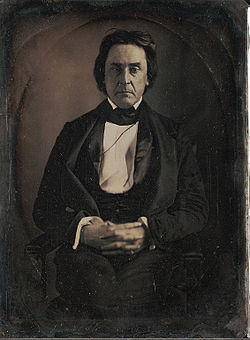
David Rice AtchisonDavid Rice AtchisonMain
Open search
David Rice Atchison
Community hub
David Rice Atchison
logo
8 pages, 0 posts
0 subscribers
Be the first to start a discussion here.
David Rice Atchison
David Rice Atchison
from Wikipedia

David Rice Atchison (August 11, 1807 – January 26, 1886) was a mid-19th-century Democratic[1] United States Senator from Missouri.[1] He served as president pro tempore of the United States Senate for six years.[2] Atchison served as a major general in the Missouri State Militia in 1838 during Missouri's Mormon War and as a Confederate brigadier general during the American Civil War under Major General Sterling Price in the Missouri Home Guard. Some of Atchison's associates claimed that for 24 hours—Sunday, March 4, 1849, through noon on Monday—he may have been acting president of the United States. This belief, however, is dismissed by most scholars.[2][3]

Key Information

Atchison, owner of many slaves and a plantation, was a prominent pro-slavery activist and border ruffian leader, deeply involved with violence against abolitionists and other free-staters during the "Bleeding Kansas" events that preceded admission of the state to the Union.[4][5][6][7]

Early life

[edit]

Atchison was born to William Atchison and his wife in Frogtown (later Kirklevington), which is now part of Lexington, Kentucky. He was educated at Transylvania University in Lexington. Classmates included five future Democratic senators (Solomon Downs of Louisiana, Jesse Bright of Indiana, George Wallace Jones of Iowa, Edward Hannegan of Indiana, and Jefferson Davis of Mississippi). Atchison completed law studies and was admitted to the Kentucky bar in 1829.[8]

Missouri lawyer and politician

[edit]

In 1830, he moved to Liberty in Clay County in western Missouri,[8] and set up practice there. He also acquired a farm or plantation, with labor provided by enslaved African Americans. Atchison's law practice flourished, and his best-known client was Joseph Smith, founder of the Latter Day Saint Movement.[9] Atchison represented Smith in land disputes with non-Mormon settlers in Caldwell County[9] and Daviess County.[9]

Alexander William Doniphan joined Atchison's law practice in Liberty in May 1833.[10] The two became fast friends and spent many leisure time hours playing cards, going to horse races, hunting, fishing, and attending social functions and political events. Atchison, already a member of the Liberty Blues, a volunteer militia in Missouri, got Doniphan to join.[11]

Atchison was elected to the Missouri House of Representatives in 1834.[12][13] He worked hard for the Platte Purchase, which required Native American tribes to cede land to the United States and extended the northwestern boundary of Missouri to the Missouri River in 1837.

When early disputes broke out into the Mormon War of 1838, Atchison was appointed a major general in the state militia.[14] He took part in suppressing violence by both sides.

Active in the Democratic Party, Atchison was re-elected to the Missouri State House of Representatives in 1838. In 1841, he was appointed a circuit court judge for the six-county area of the Platte Purchase. In 1843, he was named a county commissioner in Platte County, where he then lived.

Senate career

[edit]
Statue in front of the Clinton County Courthouse, Plattsburg, Missouri

In October 1843,[9] Atchison was appointed to the U.S. Senate to fill the vacancy left by the death of Lewis F. Linn. He was the first senator from western Missouri to serve in this position.[9] At age 36, he was the youngest senator from Missouri up to that time.[9] Atchison was re-elected to a full term on his own account in 1849.[9]

Atchison was very popular with his fellow Senate Democrats. When the Democrats took control of the US Senate in December 1845, they chose Atchison as president pro tempore,[14] placing him second in succession for the presidency.[15] He also was responsible for presiding over the Senate when the vice president was absent. At 38, he was a young man with low seniority in the Senate after two years to gain such a position.

In 1849, Atchison stepped down as president pro tempore in favor of William R. King.[14] King, in turn, yielded the office back to Atchison in December 1852, after being elected Vice President of the United States. Atchison continued as president pro tempore until December 1854.[14]

As a senator, Atchison was a fervent advocate of slavery[14] and territorial expansion. He supported the annexation of Texas and the U.S.-Mexican War. Atchison and Thomas Hart Benton, Missouri's other senator, became rivals and finally enemies, although both were Democrats. Benton declared himself to be against slavery in 1849. In 1851 Atchison allied with the Whigs to defeat incumbent Benton for re-election.

Benton, intending to challenge Atchison in 1854, began to agitate for territorial organization of the area west of Missouri (now the states of Kansas and Nebraska) so that it could be opened to settlement. To counter this, Atchison proposed that the area be organized and that the section of the Missouri Compromise banning slavery there be repealed in favor of popular sovereignty. Under this plan, settlers in each territory would vote to decide whether they would allow slavery.

At Atchison's request, Senator Stephen Douglas of Illinois introduced the Kansas–Nebraska Act, which embodied this idea, in November 1853. The act was passed and became law in May 1854, establishing the Territories of Kansas and Nebraska.

Border ruffians

[edit]

Both Douglas and Atchison had believed that Nebraska would be settled by Free-State men from Iowa and Illinois, and Kansas by pro-slavery Missourians and other Southerners, thus preserving the numerical balance between free states and slave states in the nation. In 1854 Atchison helped found the town of Atchison, Kansas, as a pro-slavery settlement. The town (and county) were named for him.[16]

While Southerners supported the idea of settling in Kansas, few migrated there. Most free-soilers preferred Kansas to Nebraska. Furthermore, anti-slavery activists throughout the North came to view Kansas as a battleground and formed societies to encourage free-soil settlers to go to Kansas, to ensure there would be enough voters in both Kansas and Nebraska to approve their entry as free states.[17]

It appeared as if the Kansas Territorial legislature to be elected in March 1855 would be controlled by free-soilers and ban slavery. Atchison and his supporters viewed this as a breach of faith. An angry Atchison called on pro-slavery Missourians to uphold slavery by force and "to kill every God-damned abolitionist in the district" if necessary.[18] He recruited an immense mob of heavily armed Missourians, the infamous "border ruffians". On election day, March 30, 1855, Atchison led 5,000 border ruffians into Kansas. They seized control of all polling places at gunpoint, cast tens of thousands of fraudulent votes for pro-slavery candidates, and elected a pro-slavery legislature.[17]

The outrage was nonetheless accepted by the Federal government. When Territorial Governor Andrew Reeder objected, President Franklin Pierce fired him.

Despite this show of force, far more free-soilers than pro-slavery settlers migrated to Kansas. There were continual raids and ambushes by both sides in "Bleeding Kansas". In spite of the best efforts of Atchison and the Ruffians, Kansas rejected slavery and finally became a free state in 1861.

Charles Sumner, in the epic "Crimes Against Kansas" speech on May 19, 1856, exposed Atchison's role in the invasion, tortures, and killings in Kansas. Speaking in the flamboyant style he and others used, lacing his prose with references to Roman history, Sumner compared Atchison to Roman Senator Catiline, who betrayed his country in a plot to overthrow the existing order. For two days, Sumner listed crime, after crime, in detail, complete with documentation by newspapers and letters of the time, showing the tortures and violence by Atchison and his men.[19]

Two days later, Atchison gave his own speech, totally unaware that he had been exposed on the Senate floor in such a fashion. Atchison's speech was to the Texas men he had just met, hired, and paid for, Atchison reveals in his speech, by "authorities in Washington". They are about to invade Lawrence, Kansas. Atchison makes the men promise to kill and "draw blood," and boasts of his flag, which was red in color for "Southern Rights" and the color of blood. They would press "to blood" the spread of slavery into Kansas. He revealed in this speech that the immediate goal of the invasion was to stop the newspaper in Lawrence from publishing anti-slavery material. Atchison's men had made it a crime to publish anti-slavery newspapers in Kansas.[20]

Atchison made it clear the men were to kill and draw blood, told the men they would be "well paid," and encouraged them to plunder from the homes that they invaded. That was after the hundreds of dozens of tortures and killings that Sumner had detailed in his Crimes Against Kansas speech. In other words, things were about to get much worse since Atchison had his hired men from Texas.[19]

Defeated for re-election

[edit]

Atchison's Senate term expired on March 3, 1855. He sought election to another term, but the Democrats in the Missouri legislature were split between him and Benton, while the Whig minority put forward their own man. No senator was elected until January 1857, when James S. Green was chosen.

Railroad proposal

[edit]

When the first transcontinental railroad was proposed in the 1850s, Atchison called for it to be built along the central route (from St. Louis through Missouri, Kansas, and Utah), rather than the southern route (from New Orleans through Texas and New Mexico). Naturally, his suggested route went through Atchison.

American Civil War

[edit]

Atchison and his law partner Doniphan fell out over politics in 1859–1861, disagreeing on how Missouri should proceed. Atchison favored secession, while Doniphan was torn and would remain, for the most part, non-committal. Privately, Doniphan favored the Union, but found it difficult to oppose his friends and associates.[11]

During the secession crisis in Missouri at the beginning of the American Civil War, Atchison sided with Missouri's pro-Confederate governor, Claiborne Jackson. He was appointed a major general in the Missouri State Guard. Atchison actively recruited State Guardsmen in northern Missouri and served with Guard commander General Sterling Price in the summer campaign of 1861. In September 1861, Atchison led 3,500 State Guard recruits across the Missouri River to reinforce Price and defeated Union troops that tried to block his force in the Battle of Liberty.

Atchison served in the State Guard through the end of 1861. In March 1862, Union forces in the Trans-Mississippi theater won a decisive victory at Pea Ridge in Arkansas and secured Union control of Missouri. Atchison then resigned from the army over reported strategy arguments with Price and moved to Texas for the duration of the war. After the war, he retired to his farm near Gower. He denied many of his pro-slavery public statements made prior to the Civil War. Then, his retirement cottage outside of Plattsburg, Missouri burned to the ground before he died in 1886. This entailed the complete loss of his library containing books, documents, and letters documenting his role in the Mormon War, Indian affairs, pro-slavery activities, Civil War activities, and other legislation covering his career as a lawyer, senator, and soldier.

Purported one-day presidency

[edit]

Inauguration Day—March 4—fell on a Sunday in 1849, and so president-elect Zachary Taylor did not take the presidential oath of office until the next day out of religious concerns. Even so, the term of the outgoing president, James K. Polk, ended at noon on March 4. On March 2, outgoing vice president George M. Dallas relinquished his position as president of the Senate. Congress had previously chosen Atchison as president pro tempore. In 1849, according to the Presidential Succession Act of 1792, the Senate president pro tempore immediately followed the vice president in the presidential line of succession. As Dallas's term also ended at noon on the 4th, and as neither Taylor nor vice president-elect Millard Fillmore had been sworn into office on that day, it was claimed by some of Atchison's friends and colleagues that from March 4 to 5, 1849, Atchison was acting president of the United States.[21][22]

Historians, constitutional scholars, and biographers dismiss the claim. They point out that Atchison's Senate term had also ended on March 4.[3] When the Senate of the new Congress convened on March 5 to allow new senators and the new vice president to take the oath of office, the secretary of the Senate called members to order, as the Senate had no president pro tempore.[21] Although an incoming president must take the oath of office before any official acts, the prevailing view is that presidential succession does not depend on the oath.[3] Even supposing that an oath was necessary, Atchison never took it, so he was no more the president than Taylor.[3]

In September 1872, Atchison, who never himself claimed that he was technically president,[3] told a reporter for the Plattsburg Lever:

It was in this way: Polk went out of office on March 3, 1849, on Saturday at 12 noon. The next day, the 4th, occurring on Sunday, Gen. Taylor was not inaugurated. He was not inaugurated till Monday, the 5th, at 12 noon. It was then canvassed among Senators whether there was an interregnum (a time during which a country lacks a government). It was plain that there was either an interregnum or I was the President of the United States being chairman of the Senate, having succeeded Judge Mangum of North Carolina. The judge waked me up at 3 o'clock in the morning and said jocularly that as I was President of the United States he wanted me to appoint him as secretary of state. I made no pretense to the office, but if I was entitled in it I had one boast to make, that not a woman or a child shed a tear on account of my removing any one from office during my incumbency of the place. A great many such questions are liable to arise under our form of government.[23]

Death

[edit]
David Rice Atchison's tombstone

Atchison died on January 26, 1886, at his home near Gower, Missouri at the age of 78. He was buried at Greenlawn Cemetery in Plattsburg, Missouri. His grave marker reads "President of the United States for One Day."

Legacy

[edit]

See also

[edit]

References

[edit]
[edit]
Revisions and contributorsEdit on WikipediaRead on Wikipedia
from Grokipedia

David Rice Atchison (August 11, 1807 – January 26, 1886) was an American lawyer and Democratic politician from Missouri who served as a United States Senator from 1843 to 1855. Born in Kentucky and educated at Transylvania University, he moved to Missouri in 1830, where he practiced law, served in the state legislature, and acted as a circuit judge before his appointment to the Senate to fill a vacancy. Elected president pro tempore of the Senate a record sixteen times between 1846 and 1854, Atchison presided over the chamber during the frequent absences of Vice President George M. Dallas. A leading advocate for the expansion of slavery into western territories, he chaired the Senate Committee on Indian Affairs and played a pivotal role in securing the passage of the Kansas-Nebraska Act of 1854, which repealed the Missouri Compromise of 1820 and introduced popular sovereignty on the issue of slavery, thereby igniting the border conflicts later termed Bleeding Kansas. Atchison organized pro-slavery incursions from Missouri into Kansas to influence territorial elections and ensure slavery's foothold, aligning with "Border Ruffians" in efforts that escalated violence between pro- and anti-slavery settlers. After leaving the Senate, he sympathized with the Confederate cause during the Civil War but did not hold military office. He is also associated with a longstanding myth claiming he acted as president for one day on March 4, 1849—due to a gap between President James K. Polk's term ending at noon and President-elect Zachary Taylor's inauguration delayed until March 5 amid a Sunday Sabbath observance—but Atchison denied ever assuming or exercising presidential powers, and constitutional scholars dismiss the notion as he was not sworn into the role and the presidency's continuity precluded any vacancy.

Early Life

Birth, Family, and Upbringing

David Rice Atchison was born on August 11, 1807, in Frogtown (later known as Kirklevington), a rural area near Lexington in . He was the son of William Atchison, a farmer of modest means who helped establish a local Presbyterian church, and Catherine . The Atchison family traced its roots to Scotch-Irish immigrants and maintained a plantation-style household typical of the region's agrarian economy, which relied on enslaved labor for cultivation. Atchison spent his early years in this environment, immersed in the customs and economy of frontier , where family landholdings and agricultural self-sufficiency shaped daily life. His upbringing emphasized practical skills and community involvement, reflecting his father's influence as a respected local figure, though the family lacked significant wealth or political prominence at the time. By his early twenties, Atchison sought opportunities beyond 's borders, migrating westward in 1830 to Clinton County, , drawn by prospects in the expanding frontier territories. This relocation marked the transition from his rural roots to active participation in 's developing political and legal landscape.

Education and Initial Career

Atchison attended in , graduating from its college in 1825. He subsequently studied , likely through the university's law department in Lexington, completing his preparation by 1829. In 1829, Atchison was admitted to the bar in Kentucky and briefly commenced practice in Carlisle. Seeking opportunities in a growing frontier region, he relocated to in , in 1830, where he gained admission to the state bar that same year. There, he established a successful practice, representing clients in local courts and building a reputation amid Missouri's expanding settlements.

Rise in Missouri Politics

Atchison studied law following his attendance at Transylvania University in , and was admitted to the Kentucky bar in 1829. In 1830, he relocated to Liberty in , where he established a law practice that quickly prospered amid the region's growing frontier economy. His firm attracted a diverse clientele, including settlers, landowners, and early commercial interests, bolstered by Atchison's reputation for competence in property disputes and local litigation. A notable partnership formed when joined Atchison's practice around 1833, creating a prominent legal team in western known for handling complex cases involving land titles and territorial claims. Among his highest-profile clients was Mormon leader , for whom Atchison provided legal assistance in 1833 during the preparation of redress petitions following the expulsion of Latter-day Saints from ; this involvement highlighted his early navigation of religious and communal tensions in the state. The success of his practice not only afforded financial stability but also positioned Atchison within influential networks that propelled his entry into politics.

State Legislature Service

Atchison was first elected to the in 1834, representing Clay County as a Democrat with support from Mormon settlers he had defended in legal disputes against local non-Mormon opposition during 1833–1834. During his initial term, which aligned with the 1834–1836 legislative session, he collaborated with Alexander W. Doniphan to advocate for the creation of Caldwell County in 1836 as a designated settlement area for members of the Church of Jesus Christ of Latter-day Saints, aiming to reduce conflicts with established residents in surrounding counties like Clay. Atchison continued his legislative involvement by contributing to efforts surrounding the , a treaty ratified in 1837 that added approximately 2,230 square miles to northwestern from Native American lands held by the Platte and other tribes, thereby extending the state's border to the . He was re-elected to the in 1838 for another term spanning roughly 1838–1840, during which he represented in ongoing land disputes involving Mormon properties in Caldwell and Daviess Counties against non-Mormon claimants. Throughout his state legislative service, Atchison aligned with Democratic interests in Missouri's frontier politics, leveraging Mormon bloc voting for electoral advantage while advocating policies that balanced settler expansion with slavery's extension into , though no formal roles such as chairmanships are recorded for him in the . His pragmatic defense of Mormon rights stemmed from shared economic stakes in regional stability rather than ideological affinity, as evidenced by his later opposition to their growing political influence amid escalating tensions by the late .

U.S. Senate Career

Election and Early Tenure

David Rice Atchison, a Democrat from , was appointed to the on October 14, 1843, to fill the vacancy caused by the death of Senator Lewis F. Linn. At age 36, he became the youngest senator from and the first to represent the western part of the state. The subsequently elected him to complete the term and for the subsequent full term beginning in 1845, reflecting his strong support among pro-slavery Democrats in the legislature. During his early Senate tenure in the 28th Congress (1843–1845), Atchison emerged as a vocal advocate for territorial expansion, particularly the annexation of , which he viewed as essential for preserving the balance of slave and free states in . This position led to a rift with Missouri's senior senator, Thomas Hart Benton, who opposed immediate annexation on grounds that it risked war with and disrupted sectional equilibrium without adequate safeguards for slavery's extension. Atchison's advocacy aligned with President John Tyler's push for a annexing , which passed in early 1845 just before the term's end, setting the stage for the Mexican-American War. As a staunch defender of , Atchison prioritized policies that would facilitate its spread into , using his influence to rally Democratic support for expansionist measures amid growing sectional tensions. His early efforts focused on work and floor debates reinforcing Missouri's interests as a slave state, though specific legislative achievements in this period were limited by the contentious partisan environment.

President pro Tempore Role

David Rice Atchison was elected of the during the 29th on December 23, 1845, at the age of 38, owing to his popularity and influence among Democratic senators. He retained the position through the 33rd , serving until December 4, 1854, and was reelected on 13 separate occasions, including a unanimous vote on August 8, 1846. This tenure made him one of the longest-serving holders of the office in the mid-19th century. The constitutional role of the , as outlined in Article I, Section 3 of the U.S. Constitution, is to preside over proceedings in the 's absence and to assume the duties of president. In practice during the and , such as and frequently delegated daily presiding responsibilities to the pro tempore due to their own absences or other obligations, leading Atchison to regularly chair sessions and appoint other senators to do so when needed. Additionally, the position placed Atchison second in the presidential line of succession after the , a contingency that underscored its significance amid the era's political transitions. Atchison's leadership in this capacity contributed to his prominence in Senate affairs, where he influenced proceedings on key issues like territorial expansion, though his presiding style emphasized procedural efficiency over partisan dominance. His multiple reelections reflected bipartisan respect, as evidenced by consistent senatorial support across Democratic majorities.

Support for Territorial Expansion and Slavery

Atchison, a slaveholder who owned a plantation in , consistently defended the institution of during his Senate service from 1843 to 1855, viewing it as essential to Southern economic interests and constitutional rights. As a border-state Democrat, he argued that should accompany territorial expansion to maintain sectional balance, aligning with other pro-slavery senators in the informal "F Street Mess" coalition that coordinated Southern legislative strategies. He advocated for the extension of into territories north of the 36°30' parallel established by the of 1820, including the region, despite its prohibition there; in the 1840s, Atchison proposed measures to introduce regardless of those restrictions, reflecting his early rejection of geographic limits on the practice. This stance stemmed from Missouri's reliance on slave labor for production and Atchison's fear that free territories would encroach on slave-state influence along the western border. Atchison's support for territorial expansion intertwined with his pro-slavery views, as he saw new lands as opportunities to strengthen the . He backed the of via joint congressional resolution on March 1, 1845, which admitted it as a slave state and expanded U.S. territory by over 389,000 square miles, countering his rival Senator Thomas Hart Benton's more cautious approach. Similarly, he endorsed the Mexican-American War declared on May 13, 1846, which yielded approximately 500,000 square miles of land—including , , , and parts of other states—through the on February 2, 1848, furthering the potential for slavery's spread.

Kansas-Nebraska Act

David Rice Atchison, a staunch pro-slavery advocate representing Missouri's border-state interests, actively pushed for legislation to organize the in a manner that would permit slavery's potential expansion northward, viewing the of 1820 as an unconstitutional restriction that endangered slaveholding in adjacent states. His motivations centered on countering the perceived threat of a contiguous block of free states, which could encircle and undermine Missouri's slave economy, while also advancing a northern route for the without prohibiting slavery above the 36°30' parallel. Atchison collaborated closely with Illinois Senator , insisting on an explicit repeal of the Compromise and the adoption of —allowing territorial settlers to vote on slavery—to secure southern Democratic support. In response to Atchison's demands, Douglas revised his Nebraska bill to incorporate these provisions, declaring to Atchison, “I will incorporate it into my bill, though I know it will raise a hell of a storm.” The Kansas-Nebraska Act was introduced in the Senate in its revised form on January 4, 1854, proposing the creation of two territories—Kansas and Nebraska—where slavery's status would be determined by local legislatures rather than congressional fiat. Atchison, as a leader among southern senators, rallied opposition to any version retaining the Compromise's restrictions and endorsed Douglas's framework as a pragmatic solution to balance territorial organization with slavery's extension. The debated intensely amid charges that it violated the 1820 settlement, but Atchison's advocacy helped secure its passage on March 4, 1854, by a 37-14 vote, with near-unanimous southern support including his own affirmative vote. The House approved it on May 22, 1854, and President signed it into law on May 30, 1854, effectively nullifying the Compromise's territorial slavery ban and igniting national sectional strife. Atchison's instrumental role in this legislative triumph reflected his broader strategy of using territorial policy to preserve slavery's equilibrium between free and slave states, though it fractured national parties and intensified anti-slavery mobilization in the North.

Leadership of Border Ruffians in Kansas Conflicts

David Rice Atchison, a staunch advocate for the extension of into the following the Kansas-Nebraska Act of May 30, 1854, emerged as a principal organizer and leader of the Border Ruffians—pro- settlers who crossed into to influence territorial governance through electoral intimidation and illegal voting. These efforts aimed to secure pro- majorities under the principle of , countering organized anti- immigration efforts such as those by the Emigrant Aid Company. Atchison's rhetoric emphasized forceful participation, declaring that ans must "vote or fight" to prevent from becoming a free state. In the first territorial election on November 29, 1854, for a delegate to , Atchison led over 1,700 armed Missourians across the border to cast fraudulent votes, ensuring the victory of pro-slavery candidate John W. Whitfield despite minimal legitimate Kansas residency among the voters. This incursion set the pattern for subsequent interference. On March 30, 1855, during the election for the territorial , Atchison again directed Border Ruffians—numbering around 1,000 to 5,000 according to accounts—who seized polling places at gunpoint, threatened election officials with violence including shooting, burning, and hanging, and stuffed ballots to produce a pro-slavery of 36 to 3 delegates. The results were later deemed fraudulent by federal investigators, but the convened and enacted pro-slavery laws, including a stringent slave code. Atchison's leadership extended to direct military actions amid escalating violence known as . In November 1855, during the Wakarusa War—a standoff near Lawrence triggered by the shooting of pro-slavery Sheriff Samuel J. Jones—Atchison raised and commanded a force to bolster Jones against free-state defenders, though a truce averted full battle. He played a prominent role in the on May 21, 1856, leading a pro-slavery primarily composed of Missourians; Atchison ordered the first cannon shot against the Free State Hotel, delivered an inflammatory speech calling for the destruction of abolitionist presses and structures, and oversaw the looting and burning of the town, which destroyed two newspaper offices and several homes. Later that year, on August 30, 1856, Atchison commanded pro-slavery forces at the , where a detachment under his subordinate John W. Reid routed John Brown's small free-state band and sacked the town. These activities, while effective in temporarily entrenching pro-slavery control—such as relocating the territorial capital to Lecompton and drafting a pro-slavery —intensified partisan warfare, contributing to over 200 deaths in conflicts by 1859 and undermining Atchison's political standing, as his overt involvement in and raids alienated moderate voters in .

Electoral Defeat

Atchison's Senate term expired on March 3, 1855. Seeking re-election, he competed for the seat in the Missouri General Assembly, which selected U.S. senators at the time. The Democratic Party, dominant in the state legislature following the 1854 elections, fractured over the choice of successor, with Atchison facing opposition from supporters of James S. Green, a Democratic U.S. Representative from Missouri's 1st congressional district. The division reflected broader tensions within Democrats regarding Atchison's aggressive pro-slavery advocacy, particularly his orchestration of Missouri "Border Ruffians" crossing into to influence elections and secure a pro-slavery territorial in 1855. While this bolstered his standing among hardline slave-state interests, it alienated moderates concerned that such tactics invited retaliation, heightened national sectional conflict, and threatened Missouri's stability and commerce. Balloting began in January 1855, but Atchison withdrew after initial votes, with his supporters shifting to alternatives like Missouri Supreme Court Judge Hamilton Rowan Gamble or John Scott. No candidate secured a majority across dozens of ballots over subsequent sessions, resulting in a deadlock that left the Class 3 Senate seat vacant for nearly two years—a period during which Missouri lacked full representation amid escalating debates over Kansas statehood. The impasse ended on January 14, 1857, when the legislature elected Green to complete the term ending March 3, 1861. This outcome underscored the limits of Atchison's influence, as his faction yielded to demands for a less contentious figure amid post-Kansas-Nebraska Act fallout.

Post-Senate Endeavors

Railroad Development Advocacy

Atchison championed federal land grants to support the construction of railroads within , viewing them as essential for economic expansion and connectivity to western markets. These efforts, initiated during his Senate service, facilitated early lines such as those extending from westward, laying groundwork for the state's rail network that would proliferate in the decades following his departure from office in 1855. He vigorously promoted a central route for the proposed , arguing it should originate in , traverse and the along the valley to South Pass in , and continue to , rather than northern or southern alternatives favored by rivals like Thomas Hart Benton. This stance, rooted in strategic interests for Missouri's commerce and settlement patterns amenable to slavery's extension, influenced debates in the 1850s amid sectional tensions over western expansion. Although Atchison's formal advocacy waned after 1855 as he returned to practice and farming near Plattsburg, his prior positions contributed to 's rail ambitions, including charters for lines like the Pacific Railroad (later Missouri Pacific), which received state-backed land subsidies and began construction in the 1850s. His collected papers reflect ongoing engagement with rail issues into the 1870s, such as the , underscoring a sustained interest in the sector's role in regional prosperity.

Stance During the Civil War

At the outset of the secession crisis in late 1860, Atchison publicly endorsed Missouri's withdrawal from the Union, aligning himself with pro-Confederate Governor and advocating for the state's departure to join the Confederate States. His efforts focused on rallying pro-slavery elements in , a border state with divided loyalties, to prevent Union control and facilitate alignment with Southern states. In 1861, Atchison assumed a role as a (later ) in the , the secessionist state organized under Jackson to resist federal authority. He actively recruited volunteers for Confederate-aligned forces and led operations against Union troops, including commanding 3,500 State Guard recruits across the in September 1861 to reinforce General , defeating a Union blocking force in the process. These actions exemplified his commitment to secessionist objectives, as he organized Missouri units intended for Confederate service amid the Guard's campaigns, such as the on August 10, 1861, where he served on Jackson's staff. Atchison resigned his commission in 1862 following the Union victory at the (March 6–8, 1862), citing dissatisfaction with Confederate management and fading prospects for regaining . Despite 's official rejection of via a state convention in March 1861 and its retention in the Union under provisional governance, Atchison's activities demonstrated unwavering Confederate sympathies, leading him to flee to for the war's duration to evade federal occupation.

Claimed One-Day Presidency

Events of March 1849

On March 2, 1849, the elected David Rice Atchison as following George M. Dallas's departure from the chamber for the session's remainder. This positioned Atchison third in the presidential line of succession under the of 1792, behind the vice president and Speaker of the House. The 30th Congress adjourned sine die on March 3, 1849, concluding Atchison's immediate authority in that role until the next congressional session. March 4, 1849, fell on a Sunday, and President James K. Polk's term expired at noon, marking the constitutional start of Zachary Taylor's presidency despite the absence of an inauguration ceremony that day due to religious observance of the Sabbath. Taylor did not take the oath of office until the following day, leaving a brief period without a sworn president, though his term had commenced de jure. With no vice president in office after Dallas's term ended concurrently with Polk's, and the Senate not in session, no acting executive authority was formally exercised or designated during the afternoon and evening. Atchison, whose senatorial term continued but whose pro tempore role had lapsed with the congressional adjournment, reportedly spent much of the day at home in Washington, D.C., sleeping and later jesting that he had "slept through" any purported presidential duties. The 31st Congress's Senate convened in special session on March 5, 1849, at the request of outgoing President Polk to address immediate business, including treaty ratifications. Early that morning, senators re-elected Atchison as . Taylor's public inauguration proceeded at the Capitol's East Portico, where Chief Justice administered the presidential oath around noon. Subsequently, in the Senate chamber, Atchison administered the vice-presidential oath to . This sequence ensured the executive branch's continuity without interruption, as Taylor's presidency was recognized from March 4 onward. The legal basis for Atchison's claimed presidency rests on the of 1792, which stipulated that in the event of the removal, death, resignation, or inability of both the president and vice president, their duties would devolve upon the president pro tempore of the Senate until a successor qualified. This provision, combined with Article II, Section 1 of the U.S. Constitution—requiring an oath before entering execution of the office—has fueled debate over whether a vacancy arose after James K. Polk's term ended at noon on , 1849, and before Zachary Taylor's oath on March 5. Proponents argue that Taylor, as president-elect, could not exercise powers without the oath, potentially elevating Atchison as the next in line, with Vice President-elect also unsworn. However, the Act applied specifically to incapacitation or removal creating a true vacancy, not a delayed inauguration due to Sunday observance, and constitutional intent emphasized continuity to avoid interregnums, as evidenced by Federalist Papers discussions on stable succession. Critically, Atchison's eligibility lapsed at noon on , when his term expired alongside Polk's , rendering him no longer and ineligible under the Act's framework, which presupposed an incumbent . The did not elect a successor until the morning of , leaving no designated during the alleged gap, and Atchison took no himself—a prerequisite for assuming executive duties, as later acting presidents like those under the 1947 Succession Act have done. Taylor, meanwhile, functioned as president from noon , issuing orders and receiving recognition, underscoring that the vested immediately upon term commencement by constitutional convention, with formalizing execution rather than creation of office. Legal scholars note the Constitution's silence on exact timing but interpret "until [the successor] shall have qualified" as extending Polk's authority only in the absence of an elected successor, not applying here. Historically, no executive actions occurred under Atchison's purported ; he reportedly slept through the day and later dismissed the notion in correspondence, stating it as a jest among associates rather than a serious claim. The story gained traction post-event through anecdotal retellings, including Atchison's tombstone inscription added by descendants, but lacks contemporaneous official records or acknowledgment. Modern consensus among historians and constitutional experts rejects the presidency claim as a , attributing it to misinterpretation of succession mechanics amid the unique Sunday timing, with no precedent or analogue in U.S. validating it. This view aligns with broader scholarly analysis emphasizing practical governance continuity over technical gaps, as reaffirmed in later succession reforms like the 1886 and 1947 Acts.

Atchison's Own Denial and Modern Consensus

David Rice Atchison explicitly denied ever serving as president, even briefly, stating in a that "I never for a moment acted as , although I was for a few minutes of the ." He emphasized that he went to bed early on March 4, 1849, after presiding over the until around 11 a.m., and performed no presidential duties thereafter. Historians and legal scholars concur that Atchison did not assume the presidency, as became president at noon on March 4, 1849, when James K. Polk's term constitutionally expired, irrespective of the inauguration delay until March 5 due to the . The presidential oath, while traditional, is not required for the office to transfer under Article II of the , which specifies the term's end without conditioning it on ceremony. Furthermore, Atchison's term and role as lapsed at noon on March 4 with the adjournment of the 30th , rendering him ineligible for succession even under the interpretation favoring the line of succession. This view, supported by U.S. records and constitutional analysis, dismisses the "president for a day" claim as a myth propagated by Atchison's associates despite his objections.

Later Years and Legacy

Final Years and Death

After the , Atchison returned to in 1867 following a period of exile in , where he had relocated amid the conflict's disruptions. He then retired to his farm near Gower in Clinton County, eschewing further involvement in politics or public life in favor of a quiet existence focused on private affairs. This withdrawal marked a stark contrast to his earlier prominence as a senator and pro-slavery advocate, with Atchison spending his remaining years in relative seclusion on the property. Atchison died on January 26, 1886, at his home near Gower, at the age of 78. He was buried in Greenlawn Cemetery in Plattsburg, Missouri. No specific is recorded in contemporary accounts, consistent with natural decline at advanced age.

Historical Evaluations and Controversies

Historians assess David Rice Atchison as a fervent pro-slavery advocate whose militant tactics in the 1850s accelerated the sectional crisis that precipitated the . As a border-state Democrat, he prioritized slavery's territorial expansion, viewing it as essential to southern political equilibrium and personal economic interests as a slave plantation owner. Scholar William E. Parrish characterized Atchison as a "border politician" who navigated 's precarious position between free and slave states, ultimately aligning with southern over moderation. His support for the Kansas-Nebraska Act, signed May 30, 1854, repealed the of 1820 and introduced , igniting organized violence in by framing slavery as a local decision subject to demographic manipulation. Atchison's leadership of pro-slavery "border ruffians" constitutes a primary controversy, marked by orchestration of cross-border incursions to rig elections and intimidate free-state settlers. On , 1855, he mobilized armed Missourians to vote illegally in the territorial , yielding a pro-slavery amid widespread documented in congressional investigations. At a July 1855 rally in Platte City, , Atchison vowed uncompromising force, declaring, "The South now has the power and we intend to keep it. must be a slave state. By , I will see it through or die," reflecting a rejection of negotiation in favor of coercion. His command of irregular forces extended to the May 21, 1856, , , where he directed initial cannon fire on the Free State Hotel, contributing to the destruction of printing presses, homes, and the territorial governor's residence in an assault that killed one defender and symbolized escalating . Jay Monaghan's analysis of the western border conflict underscores Atchison's actions as emblematic of pro-slavery paramilitarism that undermined democratic processes. Further contention arises from Atchison's Civil War-era alignment, including his 1861 commission as a major general in the Missouri State Guard under pro-Confederate Governor Claiborne Fox Jackson, though he resigned shortly after to manage his Clinton County farm amid Union occupation. While Missouri voters rejected his extremism by 1855, leading to his Senate defeat, some antebellum admirers lauded his defense of slaveholder rights against perceived northern aggression. Modern scholars, including Kristen Tegtmeier Oertel, critique his promotion of racial and territorial violence as a causal driver of national rupture, emphasizing how such tactics eroded legal norms and invited retaliation from abolitionist militias. Atchison's legacy thus endures as a cautionary figure of ideological intransigence, with counties named in his honor in Kansas and Missouri serving as ironic reminders of territorial ambitions unrealized.

References

Add your contribution
Related Hubs
User Avatar
No comments yet.