Hubbry Logo
Deal toyDeal toyMain
Open search
Deal toy
Community hub
Deal toy
logo
8 pages, 0 posts
0 subscribers
Be the first to start a discussion here.
Contribute something
Deal toy
Deal toy
from Wikipedia
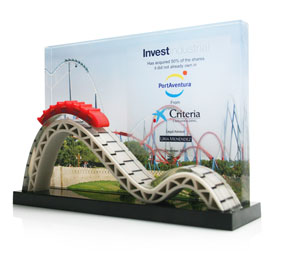
A rollercoaster-themed deal toy commemorating Investindustrial’s acquisition of Port Aventura from CriteriaCaixa in 2009

A deal toy (also deal gift, lucite tombstone or financial tombstone) is a customized memento or gift that is intended to mark and commemorate the closing of a business deal in finance or investment banking. These plaques or other types of trophies are typically presented at the closing ceremony or dinner to the issuer and senior third-party advisers of the major financial transactions as a souvenir.[1]

History

[edit]

The deal toy is the marriage of a design with the tombstone advertisement, a term that dates to the late 19th century, when printers used it to refer to "column-width newspaper ads run without any illustration or typographical ornamentation." Restrictions imposed by the Securities Act of 1933 meant that the tombstone ad became the format that companies and banks used to publicize financial transactions such as initial public offerings. From at least the late 1960s, law firms and banks produced Lucite slabs that encased the tombstone ads announcing new partner classes. By the early 1970s, deal closings were being similarly immortalized.[2][3]

As a result of the banking crisis of 2008, investment banks closed fewer deals, and deal toy budgets were reined in accordingly.[4]

Purpose

[edit]
Deal toys from various industries

Deal toys are designed to commemorate a financial transaction.[5] This memento is described as an ad hoc creation to a financial offering or other major investment banking transaction and is most often presented at the closing ceremony of the deal.[6]

This souvenir typically includes the names or logos of the firms for which the transaction is completed (the recipients), description of the transaction (type, size and, date of the deal) as well as the names and or logos of the key financial advisors and financiers involved in that transaction. Because the recipients of the award are the clients of the advisors and financiers, the award also acts as a marketing tool for the presenter long after the transaction has passed.

As deal toys became used within the investment banking industry, they also became a point of pride—and competition—with firms frequently seeking to outdo each other with creative and elaborate designs.[7]

The banking crisis of 2008 caused many financial firms to rein in spending generally, and on deal toys specifically.[4] Though many[which?] financial firms have recently eased restrictions on tombstone budgets, they largely have not been restored to pre-crisis levels. Average order size, which had ranged between 50-60 pieces prior to 2008, had by 2013 stabilized at around 20-30. Order quantities can still reach approximately 50 or 60 for larger transactions.[4]

Status

[edit]

Deal toys are generally considered to be prized by the recipient, indicating achievement. Deal toys possessed by an individual can also serve as a reflection of his or her status, as they indicate the number of transactions with which they have been involved. They are displayed to help persuade potential clients to work with a firm on their transaction.[8]

See also

[edit]

References

[edit]
[edit]
Revisions and contributorsEdit on WikipediaRead on Wikipedia
from Grokipedia
A deal toy, also known as a financial tombstone or deal gift, is a custom-made commemorative item designed to celebrate the closing of a major business transaction, such as a merger, acquisition, or financing arrangement. These objects, often crafted from durable materials like Lucite (a brand of acrylic), crystal, metal, or wood, typically feature embedded symbolic elements—such as miniature models of company logos, deal documents, or thematic sculptures—that encapsulate the transaction's details and significance. Presented to key participants including investment bankers, lawyers, executives, and clients, deal toys serve as tangible symbols of professional success, desk ornaments, and networking tools that foster long-term relationships in the financial industry. Deal toys trace their origins to the 1970s on , evolving from earlier "tombstone advertisements"—narrow newspaper notices from the late that publicly announced financial deals to attract business. By the 1960s, law firms and banks began encasing replicas of these announcements or documents in Lucite blocks as paperweights, marking the transition to the modern, three-dimensional deal toy format. The term "deal toy" is often attributed to early adopters like , which distributed miniature crystal banks to commemorate transactions, while the "tombstone" nickname persists from the flat, engraved style reminiscent of gravestones. Over decades, deal toy design has advanced from simple engraved plaques to intricate, bespoke creations that incorporate advanced techniques like and multi-material assemblies, reflecting the global scale and creativity of contemporary . Today, they are produced by specialized firms in financial hubs like New York, , and , with an emphasis on through eco-friendly materials, and remain a staple in (M&A) culture for boosting morale and branding. etching is also commonly used in their production.

Definition and Overview

Definition

A deal toy is a customized physical memento or gift designed to commemorate the successful closing of a business transaction, particularly in , , , or strategic partnerships. These items serve as tangible symbols of achievement, distributed among key participants such as bankers, lawyers, executives, and clients involved in the deal. Typically, deal toys are small, desk-displayable objects measuring 4 to 8 inches in height or width, crafted to fit comfortably on an office shelf or desk while incorporating deal-specific details like company names, logos, transaction type, value, and closing date. This personalization ensures each piece reflects the unique aspects of the agreement, often embedded in materials like acrylic or for durability and visual appeal. Unlike generic promotional swag such as branded pens or mugs, deal toys are personalized artifacts tied exclusively to a specific transaction and produced in limited quantities, usually 15 to 30 units per deal, to maintain their exclusivity and commemorative value. The term "deal toy" emerged as a colloquial expression in culture during the , evolving from "financial tombstones," which originally referred to plain advertisements announcing completed deals in the late , resembling grave markers in their stark design.

Terminology and Variations

Deal toys are also referred to by several alternative terms, including "financial tombstone," "deal gift," "tombstone award," "lucite tombstone," and "deal cube." The term "financial tombstone" originates from 19th-century newspaper advertisements, known as "tombstone ads," which announced significant financial transactions in a plain, rectangular text format resembling a gravestone due to regulatory restrictions on imagery and details. These ads marked deals as key milestones, evolving into the commemorative objects used today. Deal toys exhibit a range of variations in form to suit different commemorative needs. Basic forms include slabs or plaques, which feature flat surfaces engraved or embedded with deal details for a straightforward presentation. More elaborate 3D replicas, such as scaled models of buildings or assets involved in the transaction, add dimensional depth to symbolize the deal's scale. Interactive elements, like spinning mechanisms that rotate embedded components, introduce dynamic features for enhanced visual appeal. Hybrid awards combine materials, such as crystal-embedded versions where engraved elements are set within acrylic or other bases for a premium, multifaceted effect. Contextual adaptations distinguish deal toys in finance from broader business applications. In finance, they often take the form of M&A tombstones, focusing on with formal, document-like embeds. Beyond finance, they extend to celebrations like IPOs or partnerships in sectors such as and , incorporating thematic icons relevant to the industry. Production quantities for deal toys typically range from 20 to 30 units for standard transactions, increasing to 50 or more for major deals to accommodate distribution among stakeholders.

History

Ancient and Pre-Modern Origins

In ancient , circa 3000 BCE, clay seals and tokens emerged as early symbolic tools for marking trade agreements and property transfers, functioning as proofs of transaction completion. Cylinder seals, intricately carved stones rolled across clay surfaces, served as personal signatures to authenticate documents, packages, and business deals, ensuring legitimacy and ownership. Complementing these, small clay tokens—often stored in sealed bullae envelopes—recorded quantities of exchanged goods like grain or livestock, fostering trust in economic interactions without written contracts. From circa 2000 to 500 BCE, practices in and further developed the tradition of exchanging engraved or crafted items as ritualistic gifts to seal partnerships and celebrate alliances. Egyptian pharaohs, such as , distributed commemorative scarabs—small, engraved beetle-shaped amulets inscribed with royal achievements—as diplomatic presents to foreign rulers and traders, symbolizing enduring bonds and prosperity. These objects blended utility as seals with ceremonial value, often exchanged alongside luxury textiles during expeditions to regions like the . In , the custom of xenia (guest-friendship) prompted hosts and traders to offer finely engraved cups, metal vessels, and woven textiles to partners, reinforcing social and commercial ties through reciprocal hospitality. Such gifts, depicted in Homeric epics, emphasized mutual respect and long-term collaboration in Mediterranean networks. In medieval and Europe, spanning the 12th to 16th centuries, guilds and prominent banking families like the Medici extended these traditions by commissioning medals, artworks, and ceremonial objects to commemorate successful ventures and forge alliances. Florentine guilds, organized into arti, sponsored elaborate sculptures and tabernacles at sites like , featuring works by artists such as and Ghiberti to honor patron saints and guild achievements in commerce and crafts. The Medici, as influential bankers, minted bronze medals for pivotal events—including the 1478 Pazzi Conspiracy survival and dynastic marriages—to symbolize political triumphs and strategic partnerships, distributing them as tokens of loyalty and power. These pre-modern artifacts and rituals—ranging from Mesopotamian seals to medals—established a foundational role for physical objects as enduring emblems of trust, accomplishment, and interpersonal bonds, prefiguring the commemorative function of modern deal toys in the financial industry.

Emergence in Modern Finance

The practice of commemorating financial deals emerged in the through "tombstone advertisements," simple newspaper notices listing participants in major transactions as public announcements of success. These ads, named for their stark, marker-like appearance reminiscent of gravestones, first appeared in the late 1800s alongside birth and notices in financial publications, serving as a formalized way to broadcast completed deals without promotional content due to regulatory constraints. Precursors to the modern Journal, such as early financial gazettes in the 1860s, featured these announcements to signal credibility and attract future business. A pivotal milestone in this tradition occurred with the 1869 completion of the , celebrated through the ceremony at Promontory Summit, Utah, where symbolic spikes and gifts marked the historic union of East and West Coast rail lines. Tiffany & Co. crafted commemorative silver presentation items, including a two-handled oval tray, as gifts to honor key figures in the project, blending industrial achievement with tangible mementos. By the early 1900s, tombstone ads expanded to cover major mergers and securities offerings, reflecting the growing scale of American finance amid industrialization. The 1930s brought a material innovation with the invention of Lucite, DuPont's trademarked patented in 1937, which offered exceptional clarity, durability, and resistance to environmental damage for encasing objects. Initially developed for general awards and industrial applications, Lucite's properties made it ideal for preserving documents and artifacts, though its adaptation to financial commemorations began later. By the 1950s, early experiments in embedding items in acrylic appeared in corporate settings, paving the way for finance-specific uses. The late 1960s marked the shift toward physical deal toys, as investment banks and law firms began encasing printed tombstone ads or partnership announcements in Lucite blocks as keepsakes distributed at closing dinners. This practice, initially sporadic, gained traction in the early 1970s within closings, transforming ephemeral newspaper notices into durable, personalized mementos that symbolized deal success.

Evolution in the Late 20th and 21st Centuries

In the late , deal toys underwent a significant transformation amid a surge in (M&A) activity, evolving from simple Lucite blocks to more imaginative and thematic shapes that reflected the nature of the deals being commemorated. This shift was driven by investment banks' desire for distinctive, display-worthy mementos that stood out in competitive environments, with designs incorporating elements like rockets for space-related transactions and skyscrapers for real estate ventures. Firms began competing on extravagance, using durable acrylic to embed , documents, and symbolic objects, marking a departure from the plain tombstones of earlier decades and aligning with the era's economic optimism. By the pre-2008 period, deal toys reached a peak of popularity during bullish markets, with orders distributed among deal teams and clients. This era saw heightened creativity, exemplified by the 2000 AOL-Time Warner merger, where custom toys featured integrated tech motifs like miniature computers and bold color schemes to symbolize the digital-media convergence. The toys' role in celebrating high-profile deals underscored their importance amid and the tech boom. The profoundly impacted the industry, as plummeting deal volumes led to reduced orders, alongside simpler designs and budget constraints to reflect austerity measures. Banks like temporarily eliminated deal toys altogether, contributing to a sharp revenue drop for producers, yet the tradition endured as an essential symbol of achievement even in lean times. The 2010s and 2020s brought a resurgence, adapting to fewer but larger deals through technological integrations such as LED lighting for illuminated effects and NFC chips enabling digital links to deal documents via smartphones. also emerged as a key focus, with producers incorporating recycled acrylic, FSC-certified wood, and bioplastics to align with environmental priorities in corporate gifting. These innovations, including for intricate customizations, have supported industry growth, with major producers serving a significant portion of leading investment banks as of the mid-2020s.

Purpose and Significance

Commemorative Role

Deal toys function primarily as commemorative artifacts distributed during closing ceremonies or dinners that mark the culmination of significant financial transactions, such as mergers, acquisitions, or public offerings. These events, attended by key participants including bankers, executives, clients, and legal advisors, often feature speeches that recognize individual and team contributions to the deal's success. Essential to their design are inscriptions detailing the transaction's value (e.g., "$X billion"), the names and logos of involved parties, a description of the deal, and the closing date, which collectively serve as enduring, verifiable records of professional achievements. By awarding these items to deal team members, firms enhance employee and foster a sense of accomplishment for efforts expended on high-pressure negotiations, with recipients frequently keeping the toys as desk ornaments or office displays to symbolize their career milestones. Furthermore, deal toys provide marketing value when exhibited in firm lobbies, reception areas, or client meetings, where they visually underscore a company's track record of successful deals and help build credibility with prospective partners.

Business and Symbolic Value

Deal toys serve as prestigious status symbols within the financial and legal professions, where they are often prized by bankers and lawyers as tangible "trophies" that reflect significant career milestones and expertise in high-stakes transactions. These items are frequently displayed in offices or boardrooms to signal a professional's involvement in major deals, affirming their firm's track record and strategic acumen to clients, colleagues, and visitors. By showcasing such accomplishments, deal toys enhance personal and corporate prestige, motivating teams and inspiring confidence in future endeavors. Beyond individual recognition, deal toys play a key role in relationship building by personalizing expressions of gratitude to clients, partners, and team members involved in a transaction. These custom pieces act as enduring reminders of collaborative efforts, fostering loyalty and encouraging repeat business through their thoughtful presentation at closing events. In this way, they transform abstract business successes into concrete tokens of appreciation, strengthening professional networks and social bonds among deal participants. Culturally, deal toys embody deeper symbolic meanings that capture the essence of the transaction, such as in mergers through intertwined or in initial public offerings via motifs of growth and vision. These representations highlight themes of success, trust, and collaboration, with materials like denoting clarity and metals signifying enduring partnerships. By distilling complex deals into artistic forms, they serve as metaphors for the strategic and interpersonal dynamics at play, reinforcing the narrative of achievement within corporate culture. Deal toys also hold collectible appeal, as professionals acquire them for personal collections that chronicle their career trajectories and participation in transactions. Rare pieces from iconic deals, such as those from the technology sector expansions, often gain informal value among enthusiasts as cherished mementos of industry-shaping events. This collectibility extends their utility beyond immediate commemoration, turning them into informal archives of professional legacy.

Design and Production

Materials and Techniques

Deal toys are primarily crafted from durable and visually appealing materials that ensure longevity and aesthetic enhancement on executive desks. Lucite, a brand of cast acrylic, serves as the most common material due to its clarity, versatility in embedding objects, and shatter-resistant properties, making it ideal for commemorating high-value transactions. Crystal glass is frequently used for its elegant, refractive qualities that add a premium feel, often in shapes like pyramids or orbs to symbolize achievement. Alternative materials include metals such as or aluminum for a modern, industrial look; wood for a natural, warm aesthetic; and for cost-effective, detailed sculpting. Sustainable options have gained prominence, incorporating recycled acrylic to reduce environmental impact, FSC-certified or wood for renewability, and biodegradable resins to align with corporate ESG goals. Core production techniques emphasize precision and customization to integrate deal-specific elements without compromising structural integrity. 3D laser engraving, also known as 3D etching, allows for intricate internal designs within or Lucite blocks, creating floating logos or replicas visible from multiple angles. Digital UV printing applies vibrant, high-resolution graphics directly to surfaces, ensuring fade-resistant colors on acrylic or metal components. Embedding techniques in Lucite involve suspending metal plates, printed advertisements, or 3D models—such as miniature globes or arrows—within the cast material during the curing process, preserving them as time capsules of the deal. Casting into custom molds forms unique shapes like arrows or buildings, using poured acrylic or that hardens into durable, desk-stable pieces. Recent advancements have introduced interactive and efficient elements to deal toy fabrication. Integration of LED lights within embeddings provides subtle illumination, highlighting key details and adding a dynamic glow for presentation impact. facilitates rapid prototyping of complex replicas, such as product models or architectural landmarks, which can then be embedded or used standalone for quicker turnaround times. Durability is further enhanced by and finishing processes; for instance, Lucite's inherent shatter resistance outperforms glass, while polishing techniques yield a high-gloss surface that resists scratches and maintains visual appeal over years of display.

Customization and Manufacturing Process

The customization and manufacturing process of deal toys begins with the design phase, where clients submit detailed briefs outlining the transaction's key elements, such as company logos, deal value, and thematic motifs. In-house creative teams at specialized firms then develop bespoke concepts, often incorporating deal-themed shapes like merged corporate buildings to symbolize mergers and acquisitions. These designs are typically created using 3D modeling software to visualize complex structures, followed by client reviews and iterative approvals to ensure alignment with branding and commemorative intent. Once approved, production proceeds with a standard turnaround of 2-4 weeks, encompassing steps such as molding or the base form, or transaction details, assembly of components, and rigorous quality checks for clarity and durability. This timeline scales with order quantities, commonly ranging from 20 to 60 units per deal, allowing for efficient replication while maintaining customization. Manufacturers prioritize streamlined workflows to meet tight closing dates in fast-paced financial environments. Prominent manufacturers in the deal toy industry include Polaris Custom Awards, which specializes in financial tombstones with ; Cristaux International, known for creative designs; Laser Crystal, focusing on laser-etched pieces; and The Corporate Presence, a provider since 1981 offering comprehensive customization. These firms facilitate global shipping to accommodate international clients, ensuring timely delivery to multiple stakeholders. Costs for deal toys typically range from $50 to $200 per unit, influenced by design complexity, material choices, and production techniques, with bulk orders of 25 or more units qualifying for discounts to reduce per-piece expenses. Following the , which prompted firms to curb lavish spending, manufacturers emphasized operational efficiency, such as optimized prototyping and scalable processes, to deliver high-value items at controlled costs without sacrificing quality.

Modern Usage and Examples

Contemporary Applications

In contemporary practices as of 2025, deal toys have expanded beyond traditional sectors to encompass a broader range of industries, including tech startups for commemorating rounds and acquisitions, for marking transactions and developments, and corporate milestones such as partnerships and expansions. In tech startups, these mementos often feature innovative designs like circuit board etchings or AI-themed sculptures to symbolize achievements. applications highlight building replicas or -themed tombstones to celebrate acquisitions and housing deals. For corporate milestones, deal toys underscore restructurings, alliances, and growth initiatives, serving as tangible symbols of collaborative success. Modern adaptations integrate to enhance functionality, such as embedding QR codes that link to digital announcements or deal memorials, allowing recipients to access interactive content via scans. Hybrid digital-physical formats combine physical artifacts with blockchain-verified digital assets, like QR-enabled frames that connect to secure online records of the transaction, amplifying their commemorative impact. Additionally, sustainable materials are increasingly adopted by ESG-focused firms, incorporating recycled acrylic, reclaimed wood, or recyclable aluminum to align with environmental principles and appeal to eco-conscious stakeholders. Post-pandemic trends show a stabilization in production quantities, typically ranging from 25 to 50 units per deal for cost efficiency, following a brief shift toward virtual alternatives during periods in the early . Physical deal toys have since resurged, with budgets per unit averaging $50–$150 depending on materials and complexity, reflecting a return to in-person celebrations. The global reach of deal toys has grown, particularly in emerging markets like the region, where rising M&A activity—reaching $572 billion in the first half of 2025—drives demand for customized mementos incorporating local motifs such as dragons or cherry blossoms. Manufacturers now support international customization with rapid global shipping, enabling firms in , , and to integrate region-specific designs for transactions.

Notable Examples

One prominent example in finance is the deal toy commemorating the 2000 AOL-Time Warner merger, a landmark $165 billion transaction that symbolized the dot-com era's convergence of media and internet sectors; such toys for this deal are noted among historically significant financial mementos. Another iconic finance case is the deal toy for the 2017 Dow-DuPont merger, valued at $130 billion and creating a giant, highlighting elaborate designs typical of major consolidations. In modern non-finance applications, a 2020s tech funding round for Sierra Energy Corporation featured a crystal deal toy etched with wind turbines and solar panels, celebrating Series A investment for waste-to-energy technology commercialization. Similarly, the acquisition of hotel properties was marked by a bicycle-themed deal toy, incorporating Dutch cultural motifs to reflect the transaction's regional focus. Creative variations include a 3D-printed and hand-painted model embedded in Lucite for an acquisition, emphasizing in the design to mirror the industry's innovation. In sustainable energy partnerships, deal toys from the 2020s often feature QR codes embedded in crystal or Lucite, linking to digital deal memorials, as seen in energy transactions that integrate eco-friendly materials like recycled acrylic. Collectible highlights encompass rare pre-2008 pieces, such as those from the AOL-Time Warner era, valued for their elaborate Lucite encasements and custom etchings produced during market peaks, with early examples dating back to the partnership announcements that evolved into modern deal toys.

References

Add your contribution
Related Hubs
Contribute something
User Avatar
No comments yet.