Recent from talks
Nothing was collected or created yet.
Dear Boss letter
View on Wikipedia
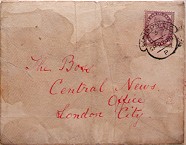
The "Dear Boss" letter was a message allegedly written by the notorious unidentified Victorian serial killer known as Jack the Ripper. Addressed to the Central News Agency of London and dated 25 September 1888, the letter was postmarked and received by the Central News Agency on 27 September. The letter itself was forwarded to Scotland Yard on 29 September.[1]
Although many dispute its authenticity,[2] the "Dear Boss" letter is regarded as the first piece of correspondence signed by one Jack the Ripper, ultimately resulting in the unidentified killer being known by this name.[3]
Content
[edit]The "Dear Boss" letter was written in red ink, was two pages long and contains several spelling and punctuation errors. The overall motivation of the author was evidently to mock investigative efforts and to allude to future murders.[4] The letter itself reads:
Dear Boss,
I keep on hearing the police have caught me but they wont fix me just yet. I have laughed when they look so clever and talk about being on the right track. That joke about Leather Apron gave me real fits. I am down on whores and I shant quit ripping them till I do get buckled. Grand work the last job was. I gave the lady no time to squeal. How can they catch me now. I love my work and want to start again. You will soon hear of me with my funny little games. I saved some of the proper red stuff in a ginger beer bottle over the last job to write with but it went thick like glue and I cant use it. Red ink is fit enough I hope ha. ha. The next job I do I shall clip the ladys ears off and send to the police officers just for jolly wouldn't you. Keep this letter back till I do a bit more work, then give it out straight. My knife's so nice and sharp I want to get to work right away if I get a chance. Good Luck.
Yours truly
Jack the Ripper
Dont mind me giving the trade name
PS Wasnt good enough to post this before I got all the red ink off my hands curse it. No luck yet. They say I'm a doctor now. ha ha[5]


Media publication
[edit]Initially, the letter was considered to be just one of many hoax letters purporting to be from the murderer.[6] However, following the discovery of the body of Catherine Eddowes in Mitre Square on 30 September, investigators noted a section of the auricle and earlobe of her right ear had been severed,[7] giving credence to the author's promise within the letter to "clip the lady's ears off". In response, the Metropolitan Police published numerous handbills containing duplicates of both this letter and the "Saucy Jacky" postcard in the hope that a member of the public would recognise the handwriting of the author.[n 1] Numerous local and national newspapers also reprinted the text of the "Dear Boss" letter in whole or in part. These efforts failed to generate any significant leads.[10]
Perpetrator pseudonym
[edit]Following the publication of the "Dear Boss" letter and the "Saucy Jacky" postcard, both forms of correspondence gained worldwide notoriety. These publications were the first occasion in which the name "Jack the Ripper" had been used to refer to the killer. The term captured the imagination of the public. In the weeks following their publication, hundreds of hoax letters claiming to be from "Jack the Ripper" were received by police and press alike, most of which copied key phrases from these letters.[3]
Authenticity
[edit]In the years following the Ripper murders, police officials stated that they believed both the "Dear Boss" letter and the "Saucy Jacky" postcard were elaborate hoaxes most likely penned by a local journalist.[n 2] Initially, these suspicions received little publicity, with the public believing the press articles that the unknown murderer had sent numerous messages taunting the police and threatening further murders. This correspondence became one of the enduring legends of the Ripper case. However, the opinions of modern scholars are divided upon which, if any, of the letters should be considered genuine. The "Dear Boss" letter is one of three named most frequently as potentially having been written by the killer, and a number of authors have tried to advance their theories as to the Ripper's identity by comparing handwriting samples of suspects to the writing within the "Dear Boss" letter.[3]
Like many documents related to the Ripper case, the "Dear Boss" letter disappeared from the police files shortly after the investigation into the murders had ended.[12] The letter may have been kept as a souvenir by one of the investigating officers. In November 1987, the letter was returned anonymously to the Metropolitan Police, whereupon Scotland Yard recalled all documents relating to the Whitechapel Murders from the Public Record Office, now The National Archives, at Kew.[13]
Journalist's confession
[edit]In 1931, a journalist named Fred Best was reported to have confessed that he and a colleague at The Star newspaper named Tom Bullen[14] had written the "Dear Boss" letter, the "Saucy Jacky" postcard, and other hoax messages purporting to be from the Whitechapel Murderer—whom they together had chosen to name Jack the Ripper—in order to maintain acute public interest in the case and generally maintain high sales of their publication.[15][n 3]
Calligraphy and linguistic analysis
[edit]In 2018, a forensic linguist based at the University of Manchester named Andrea Nini stated his conviction that both the "Dear Boss" letter and the "Saucy Jacky" postcard had been written by the same individual.[9] Commenting upon his conclusions, Dr Nini stated: "My conclusion is that there is very strong linguistic evidence that these two [pieces of correspondence] were written by the same person. People in the past had already expressed this tentative conclusion, on the basis of similarity of handwriting, but this had not been established with certainty."[17]
Notes
[edit]- ^ The "Saucy Jacky" postcard was a postcard addressed to the Central News Agency postmarked 1 October 1888. The author of this postcard is believed to be the same individual[8] who authored the "Dear Boss" letter.[9]
- ^ A third letter, dated 6 October and posted to an unknown eyewitness (believed to be either Israel Schwartz or Joseph Lawende) is also believed to have been authored by the same individual responsible for the "Dear Boss" letter and the "Saucy Jacky" postcard. Written in red ink and also signed Jack the Ripper, the author of this letter threatens to murder the recipient if he assists police with their enquiries. The letter concludes by threatening the recipient: PS You see I know your address.[11]
- ^ Chief Inspector John Littlechild is known to have stated in 1913 that senior Scotland Yard investigators had "generally believed" Bullen, whose full name was Thomas J. Bulling, to be responsible for the letters.[16]
References
[edit]- ^ "Jack the Ripper Letters Suggest Newspaper Hoax". BBC News. 1 February 2018. Retrieved 27 January 2020.
- ^ "Did Francis Craig Write the Famous Jack the Ripper Letters?". The Telegraph. 31 July 2015. Retrieved 27 January 2020.
- ^ a b c Sugden, Philip (2002). The Complete History of Jack the Ripper. New York: Carroll & Graf. pp. 260–270. ISBN 978-0-7867-0932-8.
- ^ "Treasures from The National Archives: Jack the Ripper". nationalarchives.gov.uk. 1 January 2009. Retrieved 31 January 2020.
- ^ Casebook: Jack the Ripper article on the Ripper letters
- ^ Jack the Ripper: An Encyclopedia ISBN 978-1-553-45428-1 p. 159
- ^ Jack the Ripper: An Encyclopedia ISBN 978-1-844-54982-5 p. 56
- ^ Jack the Ripper: Case Solved? ISBN 978-1-326-38968-0 pp. 56-57
- ^ Sex, Lies, and Handwriting: A Top Expert Reveals the Secrets Hidden in Your Handwriting ISBN 978-0-743-28810-1 p. 25
- ^ Jack the Writer: A Verbal & Visual Analysis of the Ripper Correspondence ISBN 978-1-608-05751-1 p. 50
- ^ Jack the Ripper: The Definitive Casebook ISBN 978-1-445-61786-2 p. 85
- ^ "Jack the Ripper Letters | Dear Boss Letter | From Hell Letter | Saucy Jack Postcard". whitechapeljack.com. Archived from the original on 2010-10-03.whitechapeljack.com
- ^ The Dreadful Acts of Jack the Ripper and Other True Tales of Serial Murder ISBN 978-1-981-58780-3 p. 4
- ^ Joe Nickell, Real or Fake: Studies in Authentication, University Press of Kentucky, Lexington, 2009. pp.44-7.
- ^ "A Look at Some of the Known Letter Writers". jack-the-ripper.org. 2 April 2010. Retrieved 5 August 2023.
- ^ "Jack the Ripper Letter Mystery Solved by Manchester Researcher". manchester.ac.uk. 29 January 2018. Retrieved 28 January 2020.
Cited works and further reading
[edit]- Begg, Paul (2004). Jack the Ripper: The Facts. United States of America: Barnes & Noble Books. pp. 197–216. ISBN 978-0-760-77121-1.
- Begg, Paul; Fido, Martin (2015) [2010]. The Complete Jack The Ripper A-Z - The Ultimate Guide to The Ripper Mystery. Marylebone: John Blake Publishing Ltd. ISBN 978-1-844-54797-5.
- Evans, Stewart; Skinner, Keith (2001). Jack the Ripper: Letters From Hell. Stroud, Gloucestershire: Sutton Publishing. ISBN 978-0-7509-2549-5.
- Gibson, Dirk C. (2013). Jack the Writer: A Verbal & Visual Analysis of the Ripper Correspondence. Bentham Science Publishers. ISBN 978-1-608-05751-1.
- Sugden, Philip (2002). The Complete History of Jack the Ripper. New York: Carroll & Graf. ISBN 978-0-7867-0932-8.
- Trow, M. J. (2019). Interpreting the Ripper Letters: Missed Clues and Reflections on Victorian Society. Barnsley: Pen & Sword Books Limited. ISBN 978-1-526-73929-2.
- Whittington-Egan, Richard (2013). Jack the Ripper: The Definitive Casebook. Stroud: Amberley Publishing. ISBN 978-1-445-61786-2.
External links
[edit]- The "Dear Boss" letter at casebook.org
- Jack the Ripper letters: "Dear Boss" at whitechapeljack.com
- "Dear Boss" letter: How Jack the Ripper got his name Archived 14 July 2017 at the Wayback Machine at britishnewspaperarchive.co.uk
Dear Boss letter
View on GrokipediaDear Boss,The letter's arrival coincided with heightened public panic over the unsolved murders of Mary Ann Nichols and Annie Chapman earlier that month, and its mocking tone—referencing the press nickname "Leather Apron" for a suspect—fueled sensational media coverage that amplified the Ripper's notoriety.[2] Forwarded to Scotland Yard on 29 September, it was not immediately publicized, but after the double murder of Elizabeth Stride and Catherine Eddowes on 30 September—where Eddowes's earlobe was partially severed—police released copies of the letter on posters across London on 3 October to solicit public help in identifying the handwriting.[1] This dissemination marked a pivotal moment in the case, transforming the killer from a shadowy figure into a self-proclaimed celebrity persona that dominated headlines and endures in popular culture.[3] Authenticity remains hotly debated among historians and criminologists, with most experts concluding the letter is a hoax rather than a genuine missive from the murderer.[2] Over 200 similar letters flooded authorities during the 1888 killings, but the Dear Boss epistle stands out as the origin of the Ripper's signature name and style; forensic linguistic analysis in 2018 linked it stylistically to the "Saucy Jacky" postcard and tentatively to another early letter, suggesting fabrication by a single individual, possibly a journalist seeking to prolong the story's shelf life.[3] Despite theories implicating news agency employees like Fred Best or Tom Bulling, no definitive proof has emerged, leaving the letter's true origins as enigmatic as the Ripper himself.[2]
I keep on hearing the police have caught me but they wont fix me just yet. I have laughed when they look so clever and talk about being on the right track. That joke about Leather Apron gave me real fits. I am down on whores and I shant quit ripping them till I do get buckled. Grand work the last job was. I gave the lady no time to squeal. How can they catch me now. I love my work and want to start again. You will soon hear of me with my funny little games. I saved some of the proper red stuff in a ginger beer bottle over the last job to write with but it went thick like glue and I cant use it. Red ink is fit enough I hope ha. ha. The next job I do I shall clip the ladys ears off and send to the police officers just for jolly wouldn't you. Keep this letter back till I do a bit more work, then give it out straight. My knife's so nice and sharp I want to get to work right away if I get a chance.
Good Luck.
Yours truly
Jack the Ripper
Dont mind me giving the trade name
PS Wasnt good enough to post this before I got all the red ink off my hands curse it No luck yet. They say I'm a doctor now. ha ha[1]
Historical Context
The Whitechapel Murders of 1888
The Whitechapel murders of 1888 refer to a series of brutal killings in London's East End, with five victims commonly accepted as the work of a single perpetrator known retrospectively as Jack the Ripper. These "canonical five" began with Mary Ann Nichols, found on August 31 in Buck's Row, Whitechapel, her throat slashed and abdomen mutilated with deep knife wounds. Annie Chapman was discovered on September 8 in the backyard of 29 Hanbury Street, her throat cut, intestines placed over her shoulder, and uterus removed, indicating possible anatomical knowledge by the assailant.[4] The so-called "double event" occurred on September 30, when Elizabeth Stride was found in Dutfield's Yard off Berner Street with her throat slit but minimal further mutilation, possibly due to interruption, followed hours later by Catherine Eddowes in Mitre Square, whose body was extensively disemboweled, with facial incisions and missing kidney and uterus.[4] The final canonical murder was Mary Jane Kelly on November 9 in her room at 13 Miller's Court, where the disfigurement was extreme, including removal of her heart and breasts, rendering her face unrecognizable.[4] All victims were prostitutes in their forties or younger, killed at night in dimly lit, secluded spots within a one-mile radius of Whitechapel.[5] Whitechapel in 1888 epitomized the squalor of Victorian London's East End, a densely overcrowded district plagued by extreme poverty and social decay. Immigrants from Ireland, Eastern Europe, and elsewhere swelled the population to over 80,000 in a maze of slums, where families crammed into single rooms lacking sanitation, and unemployment rates exceeded 30 percent among working-class residents.[5] Prostitution was rampant as a survival mechanism for destitute women, with estimates suggesting up to 1,200 sex workers operated in Whitechapel alone, often resorting to streetwalking due to economic desperation and limited alternatives in an era of rigid gender roles and industrial upheaval.[6] The area teemed with crime, including theft and violence, exacerbated by alcoholism and poor health conditions, creating an atmosphere of fear and neglect that isolated the vulnerable.[5] The Metropolitan Police faced formidable challenges in investigating these crimes, operating in a vast, labyrinthine jurisdiction with inadequate lighting, unreliable witnesses from a transient population, and nascent forensic techniques limited to basic post-mortems without fingerprints or blood typing. Commissioner Sir Charles Warren's force, stretched thin with approximately 14,000 officers covering London's sprawling metropolis of over 5 million inhabitants,[7] struggled with jurisdictional overlaps between the Metropolitan Police and the City of London Police, while public distrust of authorities fueled misinformation.[5] Initial media coverage in newspapers like The Star and The Pall Mall Gazette sensationalized the atrocities, dubbing the unknown killer a monstrous fiend and amplifying details of the mutilations, which sparked widespread public panic, vigilante patrols, and demands for better street lighting and police reforms.[8] This frenzy of press interest soon gave rise to hoax letters purportedly from the murderer.[9]Early Ripper Correspondence
Following the discovery of Mary Ann Nichols' body on August 31, 1888, Scotland Yard and local newspapers began receiving a surge of anonymous tips and letters related to the Whitechapel murders. These early communications included purported confessions, warnings, and leads on suspects, such as notes identifying local figures like "Leather Apron" (a nickname for suspected shoemaker John Pizer) as the killer. One notable precursor example, dated September 17, 1888, was a letter addressed to the "Boss" and received by the Metropolitan Police, in which the anonymous writer mocked police efforts and signed off with a taunting reference to future violence; it was later uncovered in police archives and considered a hoax.[1][10] By mid-September 1888, after the murder of Annie Chapman on September 8, the volume of such correspondence had escalated, with police estimating hundreds of letters claiming to originate from the perpetrator or offering investigative insights. The Metropolitan Police routinely classified the vast majority as hoaxes, often penned by opportunists seeking notoriety or simply to burden investigators amid the growing panic.[11][12] Sensationalist journalism significantly amplified this phenomenon, as outlets competed for readership by dramatizing the crimes and publicizing select letters to heighten suspense. The Star, a prominent evening paper, exemplified this by running vivid reports on the "Whitechapel horrors" and reprinting excerpts from early anonymous missives, which inadvertently spurred further submissions from the public eager to engage with the unfolding narrative.[13]The Letter Itself
Receipt and Initial Handling
The Dear Boss letter, dated September 25, 1888, was received by the Central News Agency in London on September 27, 1888.[14] It featured an E.C. postmark from the London East Central postal district, indicating it had been mailed locally two days prior.[14] Written in red ink on ordinary postal paper in a bold, clerkly hand, the letter was immediately forwarded by the agency to Scotland Yard for review amid the intensifying Whitechapel murder investigation.[14] Authorities initially regarded it as a potential hoax but treated it with sufficient seriousness to disseminate copies publicly in hopes of identifying the writer.[14] The letter reached the Metropolitan Police on September 29, 1888, where it was assessed by investigators as part of broader efforts to trace communications related to the killings.[15] This processing marked the letter's formal entry into the official investigation files at Scotland Yard.[15]Full Text and Key Elements
The Dear Boss letter, received by the Central News Agency on September 27, 1888, and subsequently forwarded to Scotland Yard, contains the following full transcription, preserving the original spelling, punctuation, and formatting as documented in historical records:[16]Dear Boss, I keep on hearing the police have caught me but they wont fix me just yet. I have laughed when they look so clever and talk about being on the right track. That joke about Leather Apron gave me real fits. I am down on whores and I shant quit ripping them till I do get buckled. Grand work the last job was. I gave the lady no time to squeal. How can they catch me now. I love my work and want to start again. You will soon hear of me with my funny little games. I saved some of the proper red stuff in a ginger beer bottle over the last job to write with but it went thick like glue and I cant use it. Red ink is fit enough I hope ha. ha. The next job I do I shall clip the ladys ears off and send to the police officers just for jolly wouldn't you. Keep this letter back till I do a bit more work, then give it out straight. My knife's so nice and sharp I want to get to work right away if I get a chance. Good Luck. Yours truly Jack the Ripper Dont mind me giving the trade name PS Wasnt good enough to post this before I got all the red ink off my hands curse it No luck yet. They say I'm a doctor now. ha ha[16][17]This letter exemplifies a taunting and mocking tone toward law enforcement, with the author deriding police efforts as misguided and expressing delight in evading capture.[16] It includes deliberate references to investigative misdirections, such as the "Leather Apron" suspect—a nickname for John Pizer, an early person of interest in the Whitechapel murders—and claims superiority in outwitting detectives.[17] Stylistic features prominent in the text include phonetic spelling errors and informal contractions, such as "wont" for "won't," "shant" for "shan't," "ladys" for "lady's," and "cant" for "can't," which contribute to a crude, uneducated persona.[16] The content features explicit threats of continued violence against "whores," boasting about a recent murder where the victim had "no time to squeal," and outlining future plans, including mutilating ears and using blood as ink (though red ink was substituted due to coagulation).[17] A postscript adds further sarcasm, mocking rumors of the killer being a doctor and complaining about ink stains.[16] The letter concludes with the signature "Jack the Ripper," marking the first known use of this moniker, followed by a note excusing the "trade name" and a separate postscript.[17]
