Hubbry Logo
Diamond RockDiamond RockMain
Open search
Diamond Rock
Community hub
Diamond Rock
logo
8 pages, 0 posts
0 subscribers
Be the first to start a discussion here.
Diamond Rock
Diamond Rock
from Wikipedia

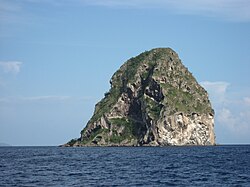
Diamond Rock (French: Rocher du Diamant) is a 175-meter-high (574-foot)[1] basalt island located south of "Grande Anse du Diamant" before arriving from the south at Fort-de-France, the main port of the Caribbean island of Martinique. The uninhabited island is about 2 kilometres (1.2 miles) from Pointe Diamant and its area is 5.3 ha ( 13.1 acres ) .

Key Information

The island gets its name from the reflections that its sides cast at certain hours of the day, which evoke images of a precious stone. It is notable for having been commissioned into the Royal Navy as the stone frigate HMS Diamond Rock in February 1804 during the Napoleonic Wars. In mid-1805, a Franco-Spanish squadron captured the rock in the Battle of Diamond Rock and held it until the British recaptured it in the invasion of Martinique in 1809. Diamond Rock was returned to French control as part of a postwar trade of Martinique in 1815, and it remains part of Martinique.

HMS Diamond Rock

[edit]
A cannon being hauled from Centaur onto the rock via pulley ropes
The British camp on Diamond Rock

Diamond Rock occupies a strategic position at the north end of the Saint Lucia Channel. Possession of the rock permits interdiction of navigation between Martinique and its southern neighbour, Saint Lucia.

In September 1803 Commodore Sir Samuel Hood sailed to the rock aboard Centaur (Captain Murray Maxwell). Hood had received the assignment to blockade the bays at Fort Royal and Saint Pierre, Martinique.

Centaur was lying at anchor in Fort Royal Bay, Martinique, on the morning of 1 December when lookouts sighted a schooner with a sloop in tow about six miles (9.7 km) off making for Saint Pierre. Hood sent his advice boat, Sarah, after the sloop, and had Maxwell sail Centaur in pursuit of the schooner. After a pursuit of some 24 leagues (120 km; 63 nmi), Centaur captured the schooner, which turned out to be the privateer Ma Sophie, out of Guadeloupe. She had a crew of 45 men, and was armed with eight guns, which she had jettisoned during the chase.[2][a]

Hood took Ma Sophie into service as a tender, charging her captain, Lieutenant William Donnett, with watching the channel between Diamond Rock and Martinique for enemy vessels. Donnett made frequent visits to the rock to gather the thick, broad-leaved grass to be woven into sailors' hats, and a spinach-like plant called callaloo, that when boiled and served daily, kept the crews of Centaur and Ma Sophie from scurvy and was a nice addition to a menu too long dominated by salt beef.[3]

Aided by calm weather, the British were able to run lines ashore and hoist two 18-pounder cannons to the summit of the rock.[1][4] The British hastily built fortifications and supplied the position with food and water for a garrison of two lieutenants and 120 men under the command of Lieutenant James Wilkes Maurice, Hood's first lieutenant.[b] Hood officially commissioned the island as the "sloop" HMS Diamond Rock (a "stone frigate"). A six-gun sloop, designated HMS Fort Diamond, supported the fort.[5] In honour of his admiral, Maurice designated as "Hood Battery" the one 24-pounder that he placed to fire from a cave halfway up the side of the rock. The British also placed two 24-pounder guns in batteries ("Centaur" and "Queen's") at the base of the rock, and a 24-pounder carronade to cover the only landing-place.[c] One account puts two 24-pounders on the summit, but all other accounts put 18-pounders there.[d] At some point during this, Ma Sophie exploded for unknown reasons, killing all but one of her crew.[9]

With work complete by 7 February, Hood decided to formalise the administration of the island, and wrote to the Admiralty, announcing that he had commissioned the rock as a sloop-of-war, under the name Diamond Rock.[10] Lieutenant Maurice, who had impressed Hood with his efforts while establishing the position, was rewarded by being made commander.[11]

While HMS Diamond Rock was in commission as a stone frigate, Royal Navy ships were required, when passing the island, to show due respect, personnel on the upper deck standing at attention and facing the rock whilst the bridge saluted.[12] Caves on the rock served as sleeping quarters for the men; the officers used tents. A court martial would reprimand Lieutenant Roger Woolcombe at Plymouth on 7 December 1805 for "conduct unbecoming a gentleman" for having messed (eaten) at the top of the rock with part of the ship's company.[13] The sailors used pulleys and ropes to raise supplies to the summit. To augment their uncertain food supply, the garrison had a small herd of goats and a flock of guinea hens and chickens that survived on the meager foliage. The British also established a hospital in a cave at the base of the rock that became a popular place to put sailors and marines recovering from fevers or injuries.[14]

Just before Centaur left the rock, a party of slaves made a clandestine visit to the rock at night to trade fruits and bananas. They brought the news that a French lieutenant colonel of engineers had arrived at their plantation to survey the heights opposite for a mortar battery with which to shell the rock. One of the slaves had been sold by his English owner to the French when the owner left the islands. He did not like his new master and claimed the protection of the British flag. Hood granted him that protection, and promised that the man could serve in the Royal Navy as a free man in return for guiding a landing party to his now-former master's house. A 23-man landing party, including the guide, and under Lieutenant Reynolds, landed at midnight, walked the four kilometers to the plantation house, and took the engineer and 17 soldiers prisoner, before returning safely to Centaur. Apparently the lieutenant colonel was the only engineer on Martinique, and so no mortar battery materialized.[15]

On 23 June 1804, whilst Fort Diamond was on a provisioning expedition at Roseau Bay, St. Lucia, a French boarding party from a schooner came up to her in two rowboats, boarding her at night while most of the crew were asleep below decks. A subsequent court-martial aboard HMS Galatea at English Harbour, Antigua, convicted Acting Lieutenant Benjamin Westcott of allowing his vessel to be captured.[16] The board dismissed him from the Royal Navy, never to be permitted to serve in the navy again.[4][17] He became an American citizen three years later.

For 17 months, the fort was able to harass French shipping trying to enter Fort-de-France.[4][18] The guns on the rock completely dominated the channel between it and the main island, and because of their elevation, were able to fire far out to sea. This forced vessels to give the rock a wide berth, with the result that the currents and strong winds would make it impossible for them to reach Fort Royal in a single tack, allowing them to be intercepted by the other blockading ships.[19] During this time the French troops on Martinique made several unsuccessful attempts to retake the rock.

Napoleonic Wars

[edit]
The French fleet under Captain Cosmao attacking Diamond Rock. Painting by Auguste Étienne François Mayer.

When Admiral Villeneuve embarked on his 1805 voyage to Martinique, he was under orders from Napoleon to recapture Diamond Rock. The French-Spanish combined naval force of 16 ships[20] under French Captain Cosmao-Kerjulien attacked Diamond Rock. Between 16 May and 29 May, the French fleet completely blockaded the rock. On the 25th, the French were able to cut out from under Maurice's guns a British sloop that arrived from St. Lucia with some supplies.[21]

The actual assault came on 31 May, and the French were able to land some troops on the rock. Maurice had anticipated the landing and had moved his men from the indefensible lower works to positions further up, and on the summit. Once the French landed, the British fire trapped the landing party in two caves near sea level.[22]

Unfortunately for the garrison, their stone cistern had cracked due to an earth tremor. This meant they were short of water and after exchanging fire with the French, they were also almost out of ammunition.[23] After enduring a fierce bombardment, Maurice surrendered to the superior force on 3 June 1805,[20] having resisted two French seventy-fours, a frigate, a corvette, a schooner, and eleven gunboats.[1] The British lost two men killed and one wounded, and the French 20 dead and 40 wounded (English account), or 50 dead and wounded (French account), and three gunboats.[e]

The French took the garrison of 107 men as prisoners, splitting them between their two 74-gun ships of the line, Pluton and the ex-British Berwick.[26] The French repatriated the prisoners to Barbados by 6 June.[27] The subsequent court-martial of Commander Maurice for the loss of his "ship" (i.e. the fort) exonerated him, his officers, and men and commended him for his defence.[24] Maurice took dispatches to England, where he arrived on 3 August, and was given command of the brig-sloop Savage.

The rock remained in French hands until 1809, when the British recaptured it in the invasion of Martinique.[28] When Martinique was traded back to France in 1815, Diamond Rock was included, and it has not traded hands since.

Battle of Diamond Rock in literature

[edit]

There is a now-obscure poem of some forty four-line stanzas based on the incident, titled "The Diamond Rock".[29]

The author "Sea Lion" (the pseudonym of Geoffrey Bennett, a career naval officer), based his 1950 novel The Diamond Rock on the 1804 event, as did Dudley Pope in his 1976 novel Ramage's Diamond.

A song called "The Island of Diamond Rock" released in January 2024, by Keyes, has the British classification of the island as a ship as its main subject.[30]

Natural history

[edit]

The rock is a volcanic plug, a remnant of the strong volcanic activity that affected the region some one million years ago. However, a Captain Hansen of the Norwegian steamship Talisman reported that on 13 May 1902, he observed what he took to be a volcanic eruption from a hole in the rock. This was at the time of the devastating volcanic eruption of Mount Pelée that destroyed Saint Pierre. Hansen did not investigate further.[31]

Like the other 47 islets that circle Martinique, the rock has its own ecological characteristics. It is sunnier than the main island, drier, and subject to a long seasonal dry period. Today[when?] it is covered in undergrowth and cacti.

Relatively inaccessible and inhospitable, the island is uninhabited, which has permitted it to remain a sanctuary for a species that had been believed to be extinct.[32] A nature survey has suggested that Diamond Rock is probably the last refuge for a species of reptile once endemic to Martinique, the couresse grass snake (Liophis cursor).[33][34] This snake was last seen on Martinique in 1962 and has not been encountered since then. It is now considered to be extinct.[35]

Important Bird Area

[edit]

The rock has been recognised as an Important Bird Area (IBA) by BirdLife International because it supports breeding populations of brown boobies, brown noddies and bridled terns.[36]

Diving around the island

[edit]

Below water, the Diamond Rock cavern, a deep triangular cave, is a popular attraction for scuba divers. The cave is said to contain prolific quantities of beautiful sea fans and corals, though strong currents make diving around the island a risky venture.[citation needed]

One of the rock's cannon that the French had toppled from the summit has been reported to have been found on a dive.[37]

See also

[edit]

Notes

[edit]

Citations

[edit]
  1. ^ a b c Tour Of The Caribbean – No Flint Grey and the Stone Ship (1925) Old and Sold Antiques Digest
  2. ^ "No. 15669". The London Gazette. 24 January 1804. p. 111.
  3. ^ Boswall (1833), p. 210.
  4. ^ a b c The Diamond Rock Affair Genealogy of The Westcotts of Honiton
  5. ^ "Letter from Lieutenant Benjamin Westcott to parents, 1804". Afinitas.org. Retrieved 2011-06-02.
  6. ^ a b Rowbotham (1949).
  7. ^ Boswall (1833), pp. 212–3..
  8. ^ Aspinall (1969), p. 131.
  9. ^ Boswall (1833), p. 212.
  10. ^ Adkins & Adkins (2011), p. 127.
  11. ^ Adkins & Adkins (2011), p. 130.
  12. ^ L'affaire du Rocher du Diamant (31 mai – 2 juin 1805): "les Anglais considéraient le rocher comme un bâtiment de la Royal Navy. Dés lors, la tradition voulait qu'à chaque fois qu'un vaisseau britannique passe au large, il tire un coup de canon afin de saluer His Majesty's sloop-of-war Diamond Rock."
  13. ^ Byrne (1989), p. 101.
  14. ^ Boswall (1833), p. 214.
  15. ^ Boswall (1833), p. 215.
  16. ^ Byrne (1989), p. 180.
  17. ^ "Lieutenant Benjamin Westcott, 1804". Afinitas.org. Retrieved 2011-06-02.
  18. ^ "The Unsinkable HMS "Diamond Rock"". Maxingout.com. Retrieved 2011-06-02.
  19. ^ Boswall (1833), p. 213.
  20. ^ a b The Trafalgar Campaign: The Atlantic and the West Indies Rickard, J. Military History Encyclopedia on the Web
  21. ^ Adkins & Adkins (2011), p. 155.
  22. ^ Adkins & Adkins (2011), p. 156.
  23. ^ Adkins & Adkins (2011), p. 157.
  24. ^ a b Naval Chronicle, Vol. 15, pp.123–9.
  25. ^ Naval Chronicle, Vol. 15, pp. 129–136.
  26. ^ Adkins & Adkins (2011), p. 158.
  27. ^ Marley (1997), pp. 366–7.
  28. ^ Adkins. The War for all the Oceans. p. 327.
  29. ^ Breen (1849), pp. 1–8.
  30. ^ The Island of Diamond Rock by Keyes. on Apple Music, 2024-01-17, retrieved 2024-04-19
  31. ^ Garesché (1902), p. 200.
  32. ^ Michel Brueil, L'herpertofaune de la réserve biologique domaniale de la Montagne Pelée, ONF Martinique, 1997, p. 22 Lire en ligne. Consulté le 8 juin 2008.
  33. ^ État des lieux publié par la DIREN, p. 6-10. Lire en ligne Archived 2008-11-23 at the Wayback Machine. Consulté le 8 juin 2008.
  34. ^ (in English) Fiche de la Couleuvre couresse sur iucnredlist.org. Consulté le 8 juin 2008.
  35. ^ "Diamond Rock (Le Rocher du Diamant)". Wondermondo. 21 December 2012.
  36. ^ "Diamond Rock". BirdLife Data Zone. BirdLife International. 2021. Retrieved 19 February 2021.
  37. ^ Fine (2005), p. 75.

References

[edit]
Revisions and contributorsEdit on WikipediaRead on Wikipedia
from Grokipedia
Diamond Rock (French: Rocher du Diamant) is a 175-metre-high uninhabited basaltic islet located approximately 2 kilometres off the southern coast of Martinique near the commune of Le Diamant in the Caribbean Sea. Rising steeply from deep surrounding waters with perpendicular cliffs and limited landing points, the rock features no natural freshwater sources, jagged terrain, and overhanging caves, making it naturally defensible yet challenging to occupy. Its strategic position in the Fours Channel, between Martinique and Saint Lucia, allowed visibility for miles from the summit, ideal for monitoring shipping lanes. During the Napoleonic Wars, in January 1804, Commodore Sir Samuel Hood's British squadron occupied the islet amid renewed hostilities with France, formally claiming it on 10 January and commissioning it as the sloop-of-war HMS Diamond Rock on 3 February to circumvent naval regulations requiring service on commissioned vessels. Under Commander James Wilkes Maurice, a garrison of about 120 sailors and marines fortified it with hauled-up heavy guns—including 24-pounders and a 32-pounder carronade—along with cisterns and rope systems, transforming it into an effective "stone frigate" that blockaded the French base at Fort-de-France for 15 months, intercepting contraband and providing early warnings to the Royal Navy. This unconventional outpost, the Royal Navy's first stationary sloop, demonstrated innovative amphibious tactics but surrendered on 2 June 1805 after a three-day assault by a superior French force of over 2,500 troops and warships, which suffered around 600 casualties to the defenders' minimal losses due to depleted water and ammunition.

Geography and Geology

Location and Topography

Diamond Rock, known in French as Rocher du Diamant, is an uninhabited located in the , approximately 3 kilometers (1.9 miles) southeast of Pointe du Diamant on the southwestern coast of , an overseas department of . Its geographic coordinates are roughly 14°26′36″N 61°04′12″W. The rock lies south of Grande Anse du Diamant bay, positioned as a prominent visible from the mainland. Topographically, Diamond Rock rises steeply from the to a maximum elevation of 175 meters (574 feet) above , forming a rugged, with a circumference of about 1,500 meters. Its distinctive shape resembles a faceted diamond or , characterized by sheer cliffs and minimal vegetation, making it drier and sunnier than the adjacent mainland. The islet's hardscrabble terrain consists primarily of exposed rock faces, with no significant soil cover or human infrastructure.

Geological Origins and Composition

Diamond Rock originated as a during intense volcanic activity in the approximately one million years ago. It formed when solidified within an ancient volcanic conduit, creating a hardened remnant after surrounding softer materials eroded away. The rock's primary composition is , an extrusive characterized by its dark color and fine-grained texture from rapid cooling of lava. This basaltic material aligns with the petrological profile of volcanic features in , derived from mantle-derived melts in the subduction zone setting of the Caribbean plate boundary. Erosional processes over geological timescales have isolated the plug, exposing its steep, columnar structure rising 175 meters above and approximately 300 meters in basal diameter. The durability of has preserved the formation against ongoing marine and atmospheric weathering, though its surfaces exhibit salt encrustation from sea spray.

Historical Significance

Early Human Interaction and Colonial Context

Martinique, the main island adjacent to Diamond Rock, was populated by (Carib) peoples by the time of European contact, having displaced earlier () groups through warfare and migration from mainland around the 13th century. These indigenous inhabitants practiced slash-and-burn agriculture, fishing, and inter-island raiding, with a population estimated at 10,000–20,000 across the by 1493. Diamond Rock, however, a sheer 175-meter lacking fresh water and accessible landing sites, shows no signs of pre-Columbian occupation or use; its isolation likely limited it to distant observation or mythological reference by coastal Carib communities, though no ethnohistorical records confirm such interactions. European awareness of the region began with Christopher Columbus's second voyage, which sighted on November 14, 1493, naming it in honor of St. Martin, though no landing occurred there. French colonization commenced in 1635 when Pierre Belain d'Esnambuc established a settlement at present-day St. Pierre, claiming the island for Cardinal Richelieu's Compagnie des Îles de l'Amérique; initial relations with the Caribs involved but rapidly deteriorated into conflict, culminating in their near-total expulsion or extermination by 1660 through warfare, disease, and forced relocation. Diamond Rock, termed Rocher du by the French for its salt-crusted surfaces that sparkled like a gem in sunlight—a name possibly echoing pre-colonial indigenous perceptions of its sheen—remained uninhabited and served primarily as a maritime landmark aiding navigation into Bay. Under French rule, evolved into a centered on and , importing over 200,000 enslaved Africans between 1635 and 1848 to sustain labor-intensive operations on estates that covered much of the island's . The rock's strategic position, approximately 1 kilometer offshore from Le Diamant commune, positioned it within the contested theater where European powers vied for control of trade routes and naval dominance; intermittent British raids, such as the 1693 attack on nearby settlements, underscored the vulnerability of French holdings, though Diamond Rock itself saw no documented fortifications or settlements prior to the . French maps from the onward depicted it consistently as a navigational and vantage point, reflecting its integration into colonial maritime awareness without direct human exploitation.

British Occupation as HMS Diamond Rock

In January 1804, during the , the British Royal Navy under Commodore Sir Samuel Hood occupied Diamond Rock to establish a strategic outpost for blockading the French-held island of . The uninhabited islet, located approximately 1 mile off the southern coast near Le Diamant, offered commanding visibility up to 40 miles across key shipping lanes, enabling surveillance of (then Fort Royal) harbor and the channel between and . The rock was formally commissioned as the sloop-of-war HMS Diamond Rock on or around early 1804, marking it as the Royal Navy's first "stone frigate"—a stationary without hull or sails but afforded full naval status, including the requirement for passing vessels to it. Commanded by James Wilkes Maurice, the garrison comprised about 120 personnel, including roughly 76 seamen, 20 , 12 boys, and specialists such as blacksmiths, masons, carpenters, and a ; officers included a and , maintaining a 's . Crew quarters were established in natural caves expanded for barracks and storage, with routines mimicking shipboard life: watches, gunnery and drills, and even recreational played within cavernous spaces. Fortifications were rapidly constructed to arm the position, including a 3,000-gallon cistern for rainwater collection (supplemented by shipments from Saint Lucia), a 400-foot-long covered way with stone parapets, rope ladders, safety lines, and a rudimentary "Mail Coach" pulley elevator for hauling supplies up the sheer cliffs. Batteries mounted several heavy guns: two 24-pounders at sea level, two 18-pounders at the 574-foot summit (Diamond Battery), one 32-pounder carronade midway (Hood’s Battery), and additional pieces in positions named Queen’s, Centaur’s, Maurice’s, and a hospital battery, totaling up to eight guns capable of enfilading approaching vessels. These defenses, combined with armed launches, cutters, and dinghies for patrols, effectively sealed the Fours Channel, preventing French privateers and supply ships from operating freely and relaying intelligence to British forces. Logistics relied on initial four-month provisions of salt meat, biscuits, and from supply vessels, augmented by local foraging for , , wild , and melons traded from Martinique canoes despite the . posed ongoing challenges, rationed to one per man daily in extremities, while a September 2, 1804, hurricane damaged powder magazines and water stores. An early French reconnaissance attempt in May 1804 failed due to adverse currents, underscoring the rock's defensibility until larger-scale assaults. Over 16 months, HMS Diamond Rock disrupted French naval movements at minimal cost in men and munitions compared to a floating vessel, which would have been vulnerable to storms or maneuvers in the treacherous waters.

Battle of Diamond Rock and Surrender

The British occupation of , commissioned as the sloop-of-war HMS Diamond Rock under Commander James Maurice with approximately 120 personnel including seamen, marines, and boys, had effectively blockaded the harbor of for over 17 months since January 1804. In May 1805, French Vice-Admiral arrived at with a combined Franco-Spanish fleet comprising 18 ships-of-the-line, seven frigates, three corvettes, one brig, and transports carrying 4,500 troops and 19,000 seamen. On 14 May, French gunfire damaged the British water cistern, compromising the garrison's primary water source and reducing rations to one pint per man per day. The main assault commenced on 31 May 1805, when two French ships-of-the-line, a , a , and a opened a lasting over two hours, supported by 222 guns in total from the attacking squadron. The British, numbering about 108 effective fighters, abandoned their exposed lower batteries and withdrew to fortified upper caves, continuing resistance with muskets, two cannons, and a . French forces landed approximately 200 troops initially under heavy musket fire, with additional reinforcements arriving; British fire sank two longboats and damaged others during the landings. Intense close-quarters fighting persisted for three days, with the garrison inflicting significant casualties on the attackers despite their numerical superiority of around 560 landed troops backed by 3,000 personnel overall. On 2 June 1805, facing exhaustion, depleted ammunition, and severe dehydration, Maurice raised a flag of truce and surrendered to avoid further pointless loss of life. The capitulation terms granted the British honors, and the French supplied water to the prisoners before transporting them aboard the ships Pluton and Berwick. British casualties were light, with two killed and one seriously wounded, reflecting the defensive advantages of the terrain despite the overwhelming odds. French losses were substantially higher, estimated at 50 to 100 killed and over 300 wounded. Maurice was later court-martialed upon his return but acquitted, as the surrender was deemed justified given the circumstances. The French held the rock only briefly before British forces under Admiral Nelson recaptured , restoring control later that year.

Post-Napoleonic Developments

In 1809, British forces under Admiral and Lieutenant General George Beckwith reoccupied Diamond Rock as part of the successful invasion of , capturing the colony in under a month; French Governor Villaret de Joyeuse capitulated on February 24, restoring British control over the islet until the wars' end. With the Napoleonic Wars' conclusion, Diamond Rock was returned to French sovereignty in 1815 alongside Martinique, marking the end of Anglo-French contention over the territory. Thereafter, the barren, waterless rock—rising 175 meters and covered in cacti and scrub—saw no sustained human settlement or redevelopment, its wartime batteries and caves abandoned to erosion and overgrowth. It functioned chiefly as a maritime landmark off Martinique's southwest coast, integrated into French colonial administration without incident.

Ecology and Biodiversity

Terrestrial Flora and Fauna

Diamond Rock's terrestrial flora is sparse and adapted to arid, rocky conditions with shallow, nutrient-poor soils, strong winds, and limited freshwater, favoring xerophytic species such as cacti (Cereus sp.), the tree Tabebuia heterophylla, and the shrub Capparis flexuosa. The vegetation includes hedges and undergrowth, with cacti dominating due to the islet's inability to retain water effectively. Fauna is limited but significant for conservation, primarily comprising seabirds in an designation. The rock supports globally significant breeding populations of bridled terns (Onychoprion anaethetus) and regionally important colonies of brown noddies (Anous stolidus), alongside nesting sites for red-billed tropicbirds ( aethereus) and the main roosting area in for magnificent frigatebirds (Fregata magnificens). Reptilian diversity includes the endemic Martinique ground snake (Erythrolamprus cursor, known locally as couresse), a colubrid potentially persisting as the species' last refuge on the mongoose-free islet, where it coexists with introduced rodents; the snake was last reliably sighted on mainland in 1962, with unconfirmed reports from Diamond Rock prompting calls for surveys amid probable extinction risks from habitat isolation and invasives. No native mammals or amphibians are documented, reflecting the islet's harsh terrestrial environment. The site is state-protected with landing prohibited to safeguard these species.

Marine Ecosystems and Conservation

The waters surrounding Diamond Rock host diverse benthic habitats, including coral reefs, sponge-dominated assemblages, and volcanic formations that support high marine biodiversity. Martinique's littoral zones, encompassing areas near Diamond Rock, exhibit sponge aggregations with elevated biomass and , where sponges often dominate over other , contributing to structure and nutrient cycling. Common reef species include barrel sponges, soft corals, gorgonians, and a variety of fish such as angelfish, , barracudas, eels, and kingfish, alongside invertebrates like and spider crabs. Sea turtles frequent the calmer bays and reefs in the region, drawn to the habitat's productivity. Diamond Rock itself is classified as a protected natural area within , prohibiting direct access to the islet to preserve its ecological integrity, though surrounding waters remain accessible for regulated activities like . This status aligns with broader efforts to map and conserve marine benthic habitats, including those around Diamond Rock, using and surveys to document and rarity. However, specific conservation measures targeted at Diamond Rock's marine environment are limited in documentation, with ongoing challenges from regional factors such as coastal development and climate impacts on health noted in Martinique-wide studies. Diving tourism, while promoting awareness, necessitates monitoring to prevent habitat disturbance, as the site's steep drop-offs and caves amplify vulnerability to unregulated human activity.

Modern Access and Recreation

Tourism and Viewing Opportunities

Diamond Rock, a protected uninhabited volcanic , prohibits public landing to preserve its , limiting access to sea-based viewing. Boat tours departing from Le Diamant provide the primary means of approach, allowing visitors to circumnavigate the 175-meter-high rock and observe its sheer cliffs rising 1,500 meters in circumference. excursions, such as full-day trips offered by operators like Catamaran Diamond Rock, sail the leeward coast, combining rock viewing with potential sightings and coastal scenery. These tours typically last 4-8 hours, include onboard meals for longer itineraries, and may feature stops in adjacent clear waters, though direct submersion near the rock is regulated. Sunset cruises emphasize the rock's dramatic silhouette against the horizon, enhancing photographic opportunities during golden hour. From shore, the Diamond Rock Vista Point in Le Diamant offers elevated land-based vistas, accessible by , providing unobstructed sights without maritime travel.

Diving and Underwater Exploration

Diamond Rock, located approximately 1 kilometer off the southwestern coast of , features dramatic underwater topography formed by volcanic activity, including arches, caves, and a prominent fault line resembling an underwater cathedral accessible to certified divers. Depths around the rock vary from shallow reefs at 5-8 meters suitable for beginners to walls descending beyond 15 meters for advanced divers, with visibility often exceeding 20 meters due to the site's offshore position minimizing coastal sediment influence. The surrounding marine environment supports diverse coral formations, including brain and flower corals, alongside large elephant ear sponges and sea fans that provide habitat for species such as sargassum triggerfish, moray eels, and shrimp. Sea turtles, particularly green (Chelonia mydas) and hawksbill (Eretmochelys imbricata) varieties, are frequently observed in the area, drawn to the protected waters for foraging on sponges and seagrasses. The site lies within a marine protected zone, where anchoring is restricted to permanent buoys to preserve reef integrity, and divers encounter additional fauna like squid and occasional pelagic species during drift dives along the rock's exposed southern face. Access to these dive sites typically involves short boat trips of 15-20 minutes from centers in Le Diamant or Les Anses d'Arlet, with operations adhering to French regulations limiting baptisms (introductory dives) to 6 meters depth and 25 minutes duration. Currents can intensify on the seaward side, necessitating site selection based on weather—calmer leeward areas like "La Piscine" at 5-8 meters serve novices—while advanced dives explore deeper tunnels amid the rock's pillars. No major shipwrecks are documented directly at Diamond Rock, distinguishing it from other sites; instead, exploration emphasizes geological formations and biodiversity rather than historical artifacts.

Cultural and Literary Legacy

Depictions in Literature and Media

The occupation and battles involving Diamond Rock as HMS Diamond Rock have been portrayed in historical naval fiction, emphasizing the ingenuity of commissioning an as a . Showell Styles' 1963 novel H.M.S. Diamond Rock, published by Faber & Faber, centers on the British seizure of the Rocher du Diamant in January 1804 under Commodore Samuel Hood, detailing the construction of batteries, daily hardships, and repulse of French attacks until the eventual surrender on June 2, 1805; the work relies on primary accounts from participants like Lieutenant James Atkinson. Dudley Pope featured the episode in his Lord Ramage series with Ramage's Diamond (1976, McBooks Press edition), where the fictional Captain Lord Ramage aids in fortifying the rock to blockade French shipping near , incorporating real events such as the installation of 18- and 24-pounder guns and skirmishes that disrupted enemy convoys. The French recapture is visualized in Auguste Étienne François Mayer's oil painting Prise du rocher du Diamant près de la Martinique, 2 juin 1805, completed circa 1830, which depicts Villaret-Joyeuse's squadron bombarding the British positions with over 500 shots from ships including the 74-gun Pluton and frigates, leading to the rock's capitulation after a 40-hour engagement.

References

Add your contribution
Related Hubs
User Avatar
No comments yet.