Hubbry Logo
Stalk-eyed flyStalk-eyed flyMain
Open search
Stalk-eyed fly
Community hub
Stalk-eyed fly
logo
8 pages, 0 posts
0 subscribers
Be the first to start a discussion here.
Stalk-eyed fly
Stalk-eyed fly
from Wikipedia

Stalk-eyed flies
Temporal range: Eocene–Recent
Diopsis stuckenbergi
Scientific classification Edit this classification
Kingdom: Animalia
Phylum: Arthropoda
Class: Insecta
Order: Diptera
(unranked): Cyclorrhapha
Section: Schizophora
Superfamily: Diopsoidea
Family: Diopsidae
Billberg, 1820
Subfamilies
Synonyms
  • Centrioncidae[1]

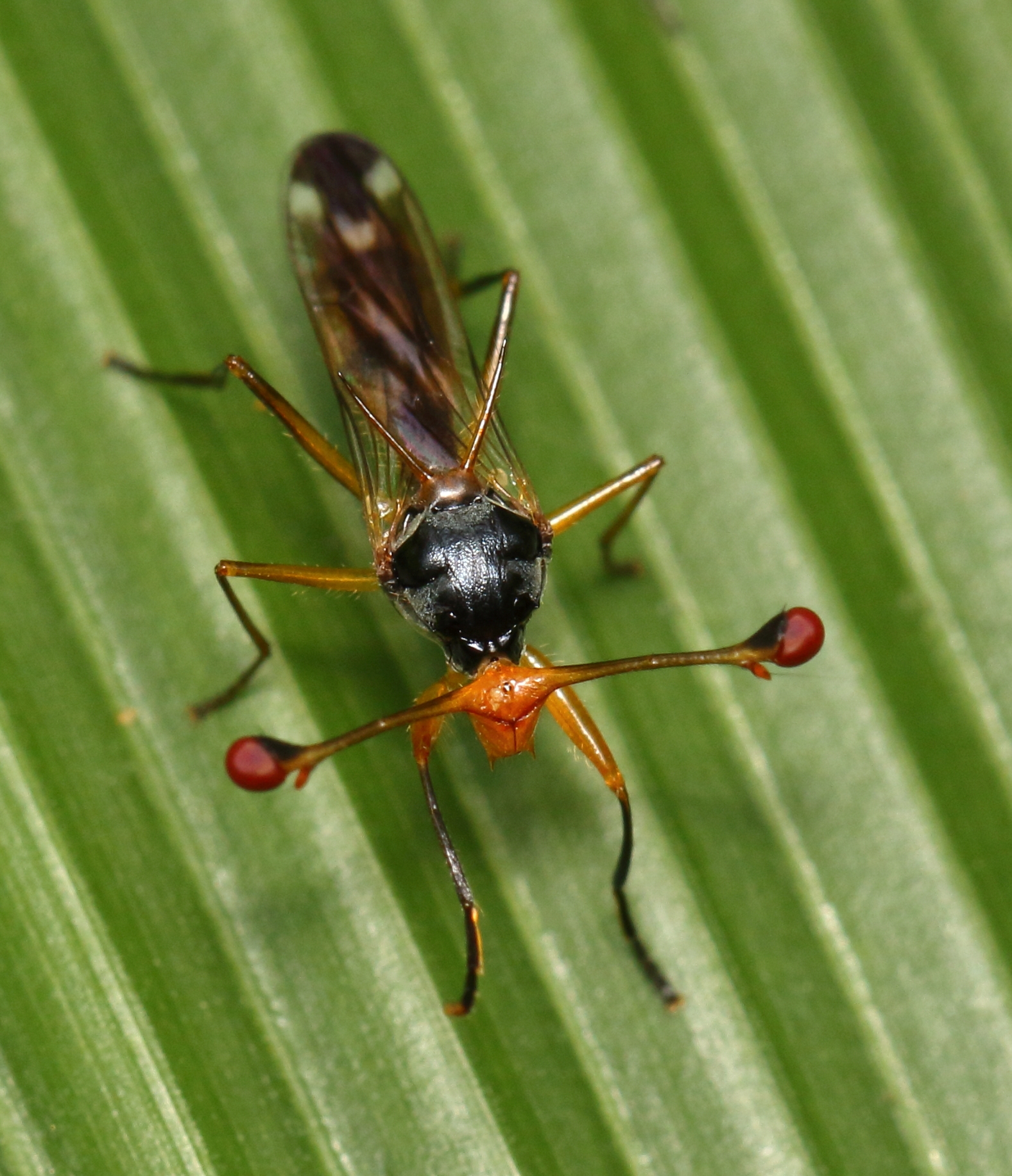
Stalk-eyed flies are insects of the fly family Diopsidae. The family is distinguished from most other flies by most members of the family possessing "eyestalks": projections from the sides of the head with the eyes at the end. Some fly species from other families such as Drosophilidae, Platystomatidae, Richardiidae, and Tephritidae have similar heads, but the unique character of the Diopsidae is that their antennae are located on the stalk, rather than in the middle of the head as in all other flies. Stalked eyes are present in all members of the subfamily Diopsinae, but are absent in the Centrioncinae, which retain unstalked eyes similar to those of other flies.[2] The stalked eyes are usually sexually dimorphic, with eyestalks present but shorter in females.[3]

The stalk-eyed flies are up to a centimeter long, and they feed on both decaying plants and animals. Their unique morphology has inspired research into how the attribute may have arisen through forces of sexual selection and natural selection. Studies of the behavior of the Diopsidae have yielded important insights into the development of sexual ornamentation, the genetic factors that maintain such a morphological feature, sexual selection, and the handicap principle.

Distribution and habitat

[edit]
A diopsid from Cameroon

More than 100 species in the Diopsidae are known, with the greatest diversity found in the Old World tropics.[4] They are distributed throughout the region, with the best-known species being from Southeast Asia and Southern Africa. Also, two species in North America have been described and a European species has recently been found in Hungary.[5]

Adult diopsids are typically found on low-lying vegetation in humid areas, often near streams and rivers, where they feed on fungi and bacteria, which they scavenge from decaying vegetation. The larvae are saprophagic or phytophagous, eating decaying and fresh plant matter. Diopsis macrophthalma Dalman, 1817, is a pest of rice and sorghum in tropical Africa.

The peculiar morphology of stalk-eyed flies makes it easy to identify their fossils (e.g. in amber); one fossil genus is Prosphyracephala, known from Eocene aged Baltic amber.[6] This genus has stalked eyes and is the earliest diverging member of the Diopsinae.[3]

Morphology

[edit]

The Diopsidae are small to medium-sized flies, ranging from about 4.0 to about 12.0 mm in length. Their heads are subtriangular, with transverse eye stalks in all genera except the African genus Centrioncus and Teloglabrus. The head is usually sparsely haired, with vibrissae (whiskers) absent.[7]

The posterior portion of the fly's metathorax, or scutellum, has a pair of stout processes, and often the laterotergite (one of a number of lateral flanges) of the postnotum (a small dorsal sclerite on the insect thorax posterior to the notum) has a dome-like swelling or spine-like process. The anterior femora of the legs are stout, with ventral spines. Adult males have lost tergites seven and eight, and the seventh sternite forms a complete ventral band.[7]

Stalk-eyed flies, as the name implies, typically possess eyestalks (in all but the two genera listed above). Their eyes are mounted on projections from the sides of the head, and the antennae are located on the eyestalks, unlike stalk-eyed flies from other families. Though both males and females of most species have eyestalks, they are much longer in males, a sexual dimorphism thought to be due to sexual selection.[8] A rather remarkable feature of stalk-eyed flies is their ability, shortly after they emerge from their pupae, to ingest air through their oral cavity and pump it through ducts in the head to the tips of the eye stalks, thereby elongating them while they are still soft and transparent.[9]

Taxonomy

[edit]

True stalk-eyed flies are members of the family Diopsidae, first described by Fothergill,[10] with the genus Diopsis named by Carl Linnaeus in 1775.[11] The family Diopsidae is contained within the order Diptera and suborder Cyclorrhapha;[12] it is divided into two subfamilies:

  1. Centrioncus Speiser, 1910
  2. Teloglabrus Feijen, 1983

The African genus Centrioncus (once placed in Sepsidae, but then moved to Diopsidae) was once recommended to be treated as a separate family, Centrioncidae, a sister group of the diopsids,[13] but since then this lineage has usually been treated as a subfamily.[14]

Diopsinae

[edit]
Stalk-eyed fly (Diasemopsis)
Male Teleopsis dalmanni

The Global Biodiversity Information Facility includes:[15]

  1. Cladodiopsis Séguy, 1949
  2. Cobiopsis Feijen, 1989
  3. Cyrtodiopsis Frey, 1928
  4. Diasemopsis Rondani, 1875
  5. Diopsina Curran, 1928
  6. Diopsis Linnaeus, 1775
  7. Eosiopsis Feijen, 2008
  8. Eurydiopsis Frey, 1928
  9. Madagopsina Feijen, Feijen & Feijen, 2017
  10. Megalabops Frey, 1928
  11. Pseudodiopsis Hendel, 1917
  12. Sinodiopsis Feijen, 1989
  13. Sphyracephala Say, 1828
  14. Teleopsis Rondani, 1875

Vision

[edit]

Despite the unusual morphology of the eye, each compound eye sees a region of space extending over more than a hemisphere in all directions. Thus, extensive binocular overlap occurs, with about 70% of the ommatidia of each eye having a binocular partner ommatidium in the opposite eye which views in the same direction.[16][17] The binocular field is most extensive in the frontoventral quadrant, where it reaches over 135°, and is smallest in the dorsal region. The behavior of stalk-eyed flies is very much determined by vision. During the day, temporary territories may be defended by threatening behavior. At dusk, the animals gather in small groups on selected thread-like structures, returning to the same site each day. When males of about equal size encounter one another within such a group, they may engage in ritualized fights (or occasionally contact fights). Competitors are driven away by the dominant male. Conspecifics are most likely to elicit a threat or flight reaction when they are at a distance of about 50 mm, and reactions to model flies and reflections in a mirror also occur at about this distance.[16]

Mating

[edit]

Stalk-eyed flies roost at night on root hairs hanging by streams. Mating usually takes place in the early morning in the vicinity of their roosts. Females show a strong preference for roosting and mating with males with longer eyestalks, and males compete with each other to control lekking aggregations through ritualized contest. This contest involves males facing one another and comparing their relative eye spans, often with the front legs spread apart, possibly to emphasize their eye-stalk lengths.[18] Male stalk-eyed flies with long eyestalks gain mating advantages both because of female choice and because they are better able to compete with rival males.[4][19]

Sexual selection

[edit]

Though the evolution of exaggerated male traits as a result of female mate choice was at one point controversial, the Diopsidae are now regarded as a classic example of animals that exhibit sexually selected traits.[8][20][21] One view maintains that male ornaments co-evolve with female preferences. The selection of an ornamented mate causes genes that influence expression of the selected male trait and genes coding for female preference for this trait to be passed on to offspring.[22][23] This process creates linkage disequilibrium between selected alleles, with the magnitude of resulting genetic correlations influencing evolutionary outcomes. If the genetic correlation is high relative to the heritability of the male ornament, then a runaway process can occur leading to extreme sexually selected traits, such as the incredible eye spans observed in male stalk-eyed flies. Otherwise, the trait and preference for the trait increase until natural selection against further trait elaboration balances sexual selection.[22]

Close-up of a male Teleopsis dalmanni

The extreme morphology exhibited by stalk-eyed flies (especially males) has been studied in an effort to support the hypothesis that exaggerated male traits could evolve through female mate choice and that the selection on male ornaments should cause a correlated response in female preferences. Researchers noted that the flies roosted along stream banks in peninsular Malaysia and that the males with the largest eye spans were accompanied by more females than males with shorter eye spans. From January to October, the researchers counted males and females on 40 root hairs along a single 200-m stretch of stream bank to confirm this observation.[24]

Sexual selection experiments

[edit]

Researchers collected stalk-eyed flies and observed their behavior under laboratory conditions. In the lab, each individual was scored for eye spans, body length, age, and fecundity.[25] Observations of pairs of males differing in eye span but matched in body length were conducted to quantify mate choice in the presence and absence of male interactions. Test males with the longest or shortest eye-span to body-length ratios were mated with 25 randomly chosen females. Wilkinson and Reillo then tested female choice in the presence and absence of male competition and in the presence of males with abnormally long and abnormally short eye spans.[24]

Males dispersed themselves, while females clustered in certain areas of the cage. As observed prior to the study, researchers found that the average number of females per male increased with male eye span in field collected aggregations of stalk-eyed flies. Under laboratory conditions, researchers found that female preferences for male characteristics changed as the males sexual characteristics changed. After 13 generations of artificial selection, they found that long eye-span male line females (i.e. females whose fathers had long eye spans) preferred long eye spans in both the selected males and in males that were not bred through artificial selection, while short eye-span male line females (i.e. females whose fathers had short eye spans) found short eye spans to be the most attractive, even over males with long eye spans. Because researchers kept the females separate from males prior to mate selection, the finding supported the hypothesis that the change in female mate choice was genetically based and not learned. Thus, stalk-eyed flies have been able to evolve a sexual trait in males that corresponds directly to traits that affect mating choices made by females.[24]

Handicap selection

[edit]

However, the evolution of extreme morphology in male flies and the corresponding evolution of female preference for these characteristics as an effect of sexual selection is only half the picture.[26] Handicap models of sexual selection predict that male sexual ornaments have strong condition-dependent expression, and this allows females to evaluate male genetic quality.[27][28][29][30][31]

Genetic variation underlies the response to environmental stress, such as variable food quality, of male sexual ornaments, such as the increased eye span, in the stalk-eyed fly.[26] Some male genotypes develop large eye spans under all conditions, whereas other genotypes progressively reduce eye spans as environmental conditions deteriorate. Several nonsexual traits, including female eye span and male and female wing length, also show condition-dependent expression, but their genetic response is entirely explained by scaling with body size. Unlike these characteristics, male eye span still reveals genetic variation in response to environmental stress after accounting for differences in body size. Thus, it could be inferred that these results strongly support the conclusion that female mate choice yields genetic benefits for offspring as eye span acts as a truthful indicator of male fitness. Eye span is, therefore, selected not only on the basis of attractiveness, but also because it demonstrates good genes in mates.[26]

Furthermore, some populations of stalk-eyed fly females carry a meiotic drive gene on their X chromosomes that causes female-biased sex ratios.[32] In these populations, males which carry a gene to suppress X-chromosome meiotic drive have longer eyestalks. Thus, females that mate with these males gain a direct genetic benefit by producing male offspring in a female-biased population. In other words, the gene for long eye-stalks is linked to a gene that makes males sire more male offspring.[33] Alternatively, long stalks may signal fertility, perhaps by encouraging females to use the sperm of a long-stalked male so as to produce more fertile sons.[33]

References

[edit]
[edit]
Revisions and contributorsEdit on WikipediaRead on Wikipedia
from Grokipedia
Stalk-eyed flies are small to medium-sized acalyptrate flies (body length 3–13 mm) belonging to the Diopsidae within the order Diptera, distinguished by their unique morphology featuring compound eyes positioned at the ends of elongated, rigid peduncles or stalks that protrude laterally from the head, providing an eye span ranging from 1.5 to 19 mm in stalk-eyed . These stalks, which house the eyes and antennae apically, are a defining trait primarily in the subfamilies Diopsinae and Sphyracephalinae, while the Centrioncinae lacks such projections and has more rounded heads. The comprises approximately 200 described across 17 genera worldwide, with notable in eye span among many , where males often possess longer stalks than females, serving as ornamental traits under . Diopsidae are predominantly distributed in tropical and subtropical regions of the , with the highest diversity (157 ) in the Afrotropical region, including endemics in and the , and additional presence in the Oriental, Australasian, and Holarctic realms, though absent from islands. They inhabit shady, humid environments such as understories, stream margins, marshes, and areas of low vegetation near water, with some like those in the Sphyracephalinae preferring wet, habitats and Centrioncinae occurring in forests. In agricultural settings, particularly in and , certain such as Diopsis longicornis are associated with gramineous crops like and . Biologically, stalk-eyed flies exhibit a life cycle typical of flies, with elongate eggs laid singly or in clusters on host , fusiform larvae that are either saprophagous (feeding on decaying matter) or phytophagous (as stem-borers causing damage like "dead hearts" in crops), and sub-cylindrical puparia. The complete life cycle from egg to spans about 42.7 days under optimal conditions (23–26°C, 72–79% relative ), with females capable of laying 30–60 eggs, often 1–2 per plant after a 15-day preoviposition period. is influenced by the exaggerated eye stalks, which in males provide advantages in mate competition through displays and fights, while gregarious behaviors such as clustering on leaves aid in anti-predator strategies and social interactions. Generation times vary regionally, with up to three broods per year in but univoltine (one generation) patterns in East and , contributing to lifespans up to one year. Notably, Diopsidae serve as important model organisms in , particularly for studying , , and due to their exaggerated traits and dimorphism, with research highlighting how eye span correlates with and genetic factors. Economically, while most are benign, pests like D. longicornis inflict significant yield losses (2–97%) in rice fields across tropical , though natural controls often mitigate the need for chemical interventions.

Overview

Description

Stalk-eyed flies belong to the family Diopsidae within the order Diptera, comprising approximately 200 described species that are primarily distributed in tropical regions of the Old World. These flies are distinguished by their characteristic lateral eyestalks, which extend the compound eyes away from the head capsule, with eyestalk length exhibiting significant variation both between species and often between sexes due to sexual dimorphism. Adults are small to medium-sized, with body lengths typically ranging from 4 to 12 mm. The larvae are saprophagous or phytophagous, feeding on decaying or fresh matter such as rotting . The life cycle begins with females laying eggs near suitable host for larval development. Larvae feed within material and pupate, often within the plant or in nearby depending on the . Upon adult eclosion, the initially short eyestalks rapidly elongate through a process involving the ingestion and pumping of air into the stalks via head ducts, achieving full length within the first 24 hours.

Research significance

Stalk-eyed flies, particularly species such as Cyrtodiopsis whitei and Teleopsis dalmanni, have been prominent model organisms in since the 1990s for examining and the genetic mechanisms driving exaggerated traits like eyespan. These flies facilitate controlled experiments on inheritance patterns and trait evolution due to their well-defined lekking behaviors and measurable sexual ornaments, enabling insights into how influences and reproductive success. Studies on stalk-eyed flies have made key contributions to theories of condition-dependent signaling and the , which posit that costly sexual traits honestly signal male genetic quality and health. In Teleopsis dalmanni, for example, male eyespan exhibits heightened sensitivity to environmental stressors and nutritional status compared to non-sexual traits, supporting the idea that such ornaments impose metabolic costs that only high-quality individuals can bear. This work has informed broader models of across taxa, highlighting how exaggerated traits evolve under female preference despite potential survival trade-offs. Economically, species like Diopsis macrophthalma represent significant agricultural pests, inflicting damage on and crops in tropical through larval stem-boring that reduces yields. This impact has spurred research into varietal resistance, oviposition preferences, and strategies to mitigate crop losses in subsistence farming regions. While post-2020 genomic studies have progressed, particularly on X-linked and its effects on structure in Teleopsis species, broader applications remain underexplored. Recent 2024-2025 studies have further explored how influences male aggressive behavior to compensate for shorter eyestalks and provided single-cell RNA-sequencing atlases of testis development in Teleopsis dalmanni. These flies hold untapped potential for , especially in elucidating pathways through germline transformation techniques that enable targeted analysis during eyestalk .

Taxonomy and phylogeny

Classification

The family Diopsidae is placed within the superfamily Diopsoidea of the suborder Acalyptratae in the order Diptera. This superfamily encompasses a small but diverse group of acalyptrate flies, predominantly tropical in distribution, with Diopsidae sharing close phylogenetic ties to families such as Gobryidae. The suborder Acalyptratae itself represents a large of schizophoran flies characterized by reduced calypters on the wings. Diopsidae was originally established as a by Billberg in 1820, initially under the name Natio Diopsides, with as the . Early relied on morphological traits, but modern revisions have integrated molecular data to refine relationships; for instance, a 2006 study using DNA sequences confirmed the placement of the genus Cladodiopsis within Diopsidae, resolving prior uncertainties about its position relative to other genera. These advancements highlight how phylogenetic analyses have stabilized the family's boundaries amid historical flux in dipteran . Approximately 240 species are currently described in Diopsidae, distributed across 17 genera, though this number is likely underestimated due to ongoing discoveries, especially in Southeast Asian biodiversity hotspots. Phylogenetic trees derived from combined morphological and molecular datasets consistently affirm the of the family, with the distinctive eyestalks—projections bearing the compound eyes—serving as a primary synapomorphy for most subfamilies (Diopsinae and Sphyracephalinae), while Centrioncinae exhibits rounded heads without such projections; this morphological diversity underscores the family's evolutionary cohesion within Diopsoidea. The family comprises three subfamilies, as detailed in subsequent taxonomic sections.

Subfamilies and genera

The family Diopsidae is classified into three main subfamilies: Centrioncinae, Sphyracephalinae, and Diopsinae. The subfamily Centrioncinae includes two genera—Centrioncus and Teloglabrus—encompassing approximately 22 species, some of which exhibit reduced or absent eyestalks as a diagnostic trait distinguishing them from other diopsids. The subfamily Sphyracephalinae, characterized by shorter eyestalks compared to Diopsinae, includes genera such as Sphyracephala and Cladodiopsis, with around 70 species primarily in Afrotropical and Oriental regions. In contrast, the subfamily Diopsinae, characterized by prominent eyestalks in adults, contains 11 genera, including Diopsis, Cyrtodiopsis, and Teleopsis, with around 130 species. Among the key genera, Diopsis is notable for over 40 species primarily distributed in and , where several act as agricultural pests on crops like and . Cyrtodiopsis, largely confined to , serves as an important model genus in genetic studies of and trait due to its variable eyestalk morphology. Species diversity in Diopsidae is concentrated in the Indo-Malayan region, accounting for about 70% of known species, with ongoing discoveries including new Teleopsis species described after 2010, such as T. neglecta and T. sorora from .

Morphology and physiology

Body structure

Stalk-eyed flies (family Diopsidae) possess the characteristic body plan of true flies in the order Diptera, comprising a distinct head, , and . The is compact and muscular, bearing a pair of membranous forewings that are typically clear and used for flight, while the hindwings are reduced to club-shaped that function as gyroscopic stabilizers during locomotion. The is segmented and somewhat clavate in shape, varying slightly across genera, and contains the primary reproductive and digestive structures. Legs are slender and adapted for perching on , with the fore femora often equipped with a double row of peg-like teeth or spines that facilitate gripping stems and leaves. Sexual dimorphism is evident in body size and eyestalk length, particularly within the subfamily Diopsinae, where males are generally larger than females—reaching body lengths of up to 10 mm—and exhibit eyestalks that can extend up to twice the body length in extreme cases, such as in Cyrtodiopsis whitei. Females, by comparison, are smaller overall with proportionally shorter eyestalks. This dimorphism arises during development and contributes to differences in overall morphology, though wing length may also show minor sexual variation in some species. Following pupation, adult stalk-eyed flies emerge with deflated eyestalks that rapidly expand and elongate through head capsule inflation, a process that repositions the eyes laterally within hours of eclosion. Adults can live up to several months, with lifespans exceeding 6 months reported in conditions for some , during which time the body structure supports active flight and perching behaviors. Morphological variations occur across subfamilies; for instance, Centrioncinae , known as forest flies, lack elongated eyestalks or have very short ones, retaining a more compact head similar to other acalyptrate flies, whereas Diopsinae display the hallmark extreme stalk elongation.

Eyestalks and vision

The eyestalks of stalk-eyed flies (family Diopsidae) consist of chitinous extensions projecting laterally from the frons of the head capsule, serving as supports for the compound eyes and antennae. These stalks house the bulbous compound eyes, each comprising approximately 1,500 to 2,600 ommatidia in species such as Cyrtodiopsis whitei and Cyrtodiopsis dalmanni. The ommatidia form a mosaic-like that enables , with the stalks allowing independent positioning of the eyes. Muscles attached to the head permit adjustment of the eyestalk orientation, providing a horizontal approaching 360° when combined with the natural panoramic coverage of the compound eyes. This configuration enhances through increased separation between the eyes, promoting extensive binocular overlap—up to 70% of ommatidia in some —which facilitates precise distance judgment via and disparity cues. The interommatidial angle, typically around 1–3°, supports high-resolution detection in the frontal , while the overall setup heightens sensitivity to motion, aiding in predator avoidance by allowing rapid detection of approaching threats from multiple directions. Eyestalks contribute to territorial disputes by enabling visual assessment of rivals' size and posture. Developing and maintaining eyestalks imposes significant physiological costs, as their growth demands substantial allocation during the larval stage, diverting resources from other body structures and linking eyestalk length to overall condition. tissues within the stalks serve as energy reserves, but their volume varies by ; for instance, Sphyracephala detrahens stores more in eyestalks for resistance compared to Cyrtodiopsis dalmanni, where resources prioritize structural elongation over storage, increasing vulnerability to nutritional stress. This energetic can reduce flight and survival under resource limitation. Notable exceptions occur within the family, particularly in the subfamily Centrioncinae, where eyestalks are reduced or absent, resulting in unstalked eyes positioned more conventionally on the head, similar to other acalyptrate flies. Fossil evidence indicates that stalked eyes evolved early, with well-preserved specimens from Eocene amber deposits dating to approximately 50 million years ago, including species like †Prosphyracephala succini that exhibit dimorphic eyestalks akin to modern forms.

Distribution and ecology

Geographic distribution

Stalk-eyed flies (family Diopsidae) exhibit a predominantly tropical distribution, with the majority of species confined to the Afrotropical and Oriental regions, reflecting their adaptation to warm, humid climates. The family's range spans from across to , with limited occurrences in the Australian and Palaearctic regions, but none in the Neotropics. In , the genus Diopsis accounts for much of the family's diversity, with over 50 distributed across tropical and subtropical zones from to southern regions like and Swaziland. These flies are particularly abundant in forested and areas. represents a hotspot of , especially for genera like Cyrtodiopsis and Teleopsis, with high in and on , where multiple sympatric occur in close proximity. For instance, Teleopsis are well-documented in Bornean forests, contributing to the region's elevated diversity. Outside the core tropics, the family is scarce; a single species, Sphyracephala subbifasciata, occurs in the Nearctic region of , ranging from southeastern through the to and . In , records are limited to a few species in the northern , potentially reflecting occasional introductions via human activity such as . Recent surveys indicate potential range shifts in some populations, though specific climate-driven extensions remain understudied for this family.

Habitat preferences and diet

Stalk-eyed flies (family Diopsidae) exhibit a strong preference for humid environments in tropical and subtropical regions, favoring shady, moist habitats such as riverine forests, woodlands, lake shores, and marshy areas along stream and pool margins. These flies are commonly found in rainforests and similar ecosystems where high humidity supports their lifecycle, often perching on vegetation, trunks, or bark in shaded spots at heights of 0.5 to 3 meters above the ground. Their association with water edges underscores an adaptation to environments that prevent , with adults clustering on vertical surfaces near rivers for resting and social interactions. Adults are primarily saprophagous, feeding on microbes, fungi, , and other from decaying plants and animals, including the surfaces of rotting fruits and . This diet reflects their role as decomposers in ecosystems, where they contribute to nutrient recycling by breaking down organic litter. In contrast, larvae are mostly saprophagous as well, consuming decaying , fruits, fungi, and plant litter, though certain genera like Diopsis are phytophagous, with larvae boring into the stems of grasses and cereal crops such as and . In agricultural settings, Diopsis species play a dual ecological role, acting as pests that disrupt production while fulfilling functions in natural habitats. Larvae of these species tunnel into stems, weakening and causing "dead hearts" that lead to substantial yield losses, estimated at 10-30% in sub-Saharan African rice fields without control measures. Larval development typically involves 2-3 instars within moist or , where high humidity is essential; immature stages, particularly eggs and early instars, are highly vulnerable to , limiting their survival in drier conditions.

Behavior

Locomotion and territoriality

Stalk-eyed flies (family Diopsidae) are generally weak fliers, characterized by slow and sluggish aerial maneuvers with horizontal speeds rarely exceeding 0.3 m/s during straight trajectories or turns. Their wing beat frequency averages around 200 Hz across species, with in this trait negatively correlated to the degree of male eye span exaggeration. Due to the aerodynamic costs imposed by their elongated eyestalks, these flies often rely on , such as walking with rapid saccadic head rotations to maintain visual fixation during turns, rather than sustained flight. Males exhibit territorial behavior by defending linear perches, such as rootlets, often along streams or in similar humid environments, using a series of visual displays and ritualized contests to resolve disputes without frequent physical contact. These interactions typically begin with face-to-face orientations where males align their eyestalks parallel to each other, accompanied by bobbing and spreading to assess relative eye span—a key signal of fighting that predicts contest winners in species with pronounced . Escalation to physical jabbing or hooking occurs only if displays fail to induce retreat, emphasizing the role of non-contact signaling in maintenance. Activity patterns in stalk-eyed flies are predominantly crepuscular, with males engaging in contests over resources or aggregations primarily at and dawn before forming nocturnal roosting groups on . Their locomotion and territorial defense are heavily influenced by vision, leveraging a wide binocular exceeding 135° in the frontoventral direction to detect s and conspecifics at distances up to 1 m, enabling rapid threat assessment and navigation on perches.

Social interactions

Stalk-eyed flies exhibit notable group behaviors outside of , particularly in their formation of nocturnal roosting aggregations. These aggregations typically occur on vertical stems such as exposed rootlets or low in moist undergrowth, where individuals cluster together for resting during the night. In like Cyrtodiopsis dalmanni, such roosts can include multiple males and females, with reports of groups comprising 1 to 4 males and up to 24 females in related like C. whitei, providing a communal site that facilitates social proximity. These clusters, often ranging from small groups to dozens of individuals across diopsid , occur at established roosting sites. Male-male contests form a key aspect of non-reproductive in stalk-eyed flies, primarily over control of roosting sites. In sexually dimorphic species such as Cyrtodiopsis whitei and Teleopsis dalmanni, s assess rivals by orienting parallel to one another, aligning their eyestalks for direct comparison of span length while bobbing their abdomens. s with larger eyestalks dominate these encounters, winning 77–83% of staged contests independent of body size, as the exaggerated trait signals competitive ability without escalating to physical harm. Contests resolve when the subordinate retreats, maintaining group cohesion while establishing hierarchies at aggregation sites; in Teleopsis dalmanni, resource ownership from prior wins further biases outcomes in favor of larger-spanned s. Recent research as of 2024 indicates that s with shorter eyestalks, often associated with , compensate by exhibiting higher aggression levels in contests. Females in stalk-eyed flies display less territorial behavior compared to males, often joining aggregations at established roosting or lek sites controlled by dominant males. In species like Cyrtodiopsis dalmanni, females aggregate in these leks near male territories, forming clusters on rootlets without aggressive defense, which allows for social grouping during crepuscular periods. This non-territorial aggregation pattern contrasts with male site defense, enabling females to benefit from proximity to multiple males while minimizing conflict. Social interactions among stalk-eyed flies rely predominantly on visual signals, with eyestalk orientation and displays serving as primary cues for assessment and communication. These behaviors can transition into displays at dawn, but remain distinct in their focus on group maintenance and rivalry.

Reproduction and

Mating systems

Stalk-eyed flies (family Diopsidae) primarily exhibit polygynous systems, in which males aggregate at specific sites to display and attract females for without providing resources. In many , such as Cyrtodiopsis dalmanni and C. whitei, males form leks at nocturnal roosting locations like rootlets under stream embankments, where they perch in close proximity to compete for female attention through visual displays. Courtship rituals in these leks involve males extending their eyestalks laterally and performing rapid head movements to emphasize eye span size relative to body length, signaling genetic quality to approaching females. These displays typically last 5–30 minutes, culminating in copulation if the female is receptive. Females in lekking species often mate multiply, with each copulation providing limited sperm (50–150 per mating) due to small spermatophores, necessitating repeated inseminations to achieve full fertility. Sperm competition is intensified by male accessory glands, which produce secretions that enhance sperm viability and displacement of rival sperm in the female's reproductive tract. Following , females oviposit eggs into slits in tissues, such as sheaths or stems, typically near bodies to support larval development. variations occur across Diopsidae.

Female choice and male competition

In stalk-eyed flies, particularly like Cyrtodiopsis dalmanni, females strongly prefer males with longer and more symmetric eyestalks during mate selection, as this trait signals superior genetic quality and condition. This preference is typically assessed visually from a short distance, allowing females to compare relative eyestalk lengths without close contact. Experimental manipulations of eyestalk length have demonstrated that females consistently choose males with exaggerated eyestalks over those with shorter ones. Male competition for access to females is intense and often mediated by eyestalk length, with longer-stalked males dominating rivals through initial visual displays where they face off and extend their eyestalks for comparison. If displays fail to resolve the contest, interactions escalate to physical fights involving grappling and mandible engagement in some species, where body size and condition further influence outcomes. Males with shorter eyestalks may compensate by increasing aggression, but longer-stalked individuals generally secure better territories or mating opportunities. Eyestalk exaggeration is highly condition-dependent, with length positively correlating to male nutritional status and overall during development, making it an honest signal of viability. in eyestalks has been proposed as an additional quality indicator, though empirical studies show mixed support, with size often proving a more reliable cue than alone. In lekking systems typical of these flies, females visit aggregations of displaying males and evaluate multiple suitors based on relative eyestalk length before , often copulating with several to maximize offspring fitness.

Experimental evidence

One of the foundational experiments demonstrating the genetic basis of on eyestalk length was conducted by Wilkinson in , using artificial selection on the stalk-eyed fly Cyrtodiopsis dalmanni. Males from replicate lines were selected for increased or decreased eye span relative to body length over 10 generations, resulting in a symmetrical genetic response with realized of approximately 0.35; high-selection lines developed eye spans up to three times body length, while low-selection lines reduced to about 0.11 times body length, confirming substantial additive underlying this exaggerated trait. Building on this, Wilkinson and Reillo (1994) examined correlated responses in female mate preference using the same selected lines after 13 generations. In laboratory choice trials, females from long-eye-span lines and unselected controls preferred males with longer eye spans, whereas females from short-eye-span lines preferred shorter eye spans, indicating a positive between male trait expression and female preference strength. Field observations in Malaysian populations further supported this, showing that larger relative eye span in males predicted higher female aggregation at roosting sites, though not directly egg production. Studies on in eyestalks have yielded mixed results regarding its role as a viability indicator. While some suggested symmetric males might sire more due to perceived developmental stability, experimental manipulations of larval condition in C. dalmanni revealed that eyestalk did not reliably reflect environmental stress or genetic , unlike ornament size itself, which was highly condition-dependent. More recent work has integrated genomic approaches with experimental evolution to explore sexual selection dynamics. Cotton et al. (2014) analyzed wild Teleopsis dalmanni populations and found that male eye span negatively correlated with X-linked meiotic drive, providing evidence that eye span signals genetic factors influencing sperm competition and sex ratio distortion, with drive-carrying males exhibiting reduced eye spans by up to 10%. In a 2023 experimental evolution study on T. dalmanni, Wilkinson et al. manipulated female mating opportunities over 11 generations to isolate pre- and post-copulatory sexual selection effects on X chromosome drive. Under enforced monogamy (no selection), drive frequency and female-biased sex ratios increased significantly (p < 0.01), but polyandry treatments (simulating natural selection) stabilized or reduced drive spread; notably, non-driving (X^{ST}) males evolved longer eye spans under post-copulatory selection alone (p = 0.042), while driving (X^{SR}) males showed shorter spans (p = 0.004), highlighting how female preference constrains drive evolution and links ornament size to genetic quality. These experiments collectively underscore the , where exaggerated eyestalks serve as costly signals of male genetic viability under .

Evolutionary aspects

Origin of eyestalks

The fossil record of stalk-eyed flies (family Diopsidae) provides evidence that eyestalks evolved after the period, with the oldest known specimens preserved in Eocene Baltic dating to approximately 44 million years ago. These fossils, belonging to the extinct genus Prosphyracephala succini (a basal member of the subfamily Diopsinae), exhibit well-developed eyestalks in both sexes, accompanied by where males possess longer eye spans relative to body size compared to females. This early presence of dimorphic eyestalks suggests that the trait originated near the base of the Diopsinae lineage, supporting a post- emergence during the epoch. Hypotheses regarding the origin of eyestalks propose that they initially evolved under favoring expanded visual capabilities, particularly wide in cluttered, vegetated habitats. This functional advantage likely contributed to the trait's development, with evident in early fossils indicating that for mate attraction and competition may have played a role from near the outset. Within Diopsidae, comparative shows variability: while eyestalks are prominent in Diopsinae, they are reduced or absent in the subfamily Centrioncinae, where eyes remain unstalked and resemble those of other flies, indicating secondary loss in certain lineages. Parallels exist in other arthropods, such as the stalked compound eyes of mantis shrimps (Stomatopoda), which similarly enhance visual fields but evolved independently.

Handicap principle

The handicap principle, proposed by Amotz Zahavi, asserts that exaggerated sexual traits function as honest signals of genetic quality because only high-fitness individuals can afford their production and maintenance costs, thereby ensuring reliability in . In stalk-eyed flies, male eyestalks exemplify this by imposing viability costs, including heightened predation risk from compromised flight maneuverability due to increased and substantial energetic investment in developmental growth. These costs prevent low-quality males from exaggerating the trait deceptively, allowing females to assess heritable viability through eyespan length. Eyestalk length has a polygenic basis with condition-dependent expression, where environmental stressors like poor nutrition amplify underlying , revealing individual quality. In certain species, such as Teleopsis dalmanni, X-linked systems contribute to inheritance patterns, as driving X chromosomes reduce eyespan, making longer eyestalks a marker of non-driving, higher-quality genotypes. This condition dependence is mediated by insulin signaling pathways, which integrate nutritional inputs to allocate resources toward trait development, ensuring eyespan reflects overall physiological state. Supporting evidence includes findings that males with longer eyestalks maintain higher viability under stress, signaling superior condition without direct measures of parasite resistance in all studies. Theoretical models confirm signaling equilibria in stalk-eyed flies when trait costs offset mating advantages, sustaining honesty by eroding benefits for low-quality signalers. Critiques contrast the with sensory bias, where female preferences for long eyestalks stem from ancestral adaptations for detecting elongated objects rather than viability assessment, and runaway selection, which drives via genetic covariation between preference and trait without mandatory costs. Recent genomic studies, including single-cell RNA sequencing in T. dalmanni as of 2024, have advanced understanding of and condition-dependent trait expression, though challenges remain in fully resolving the loci involved.

References

Add your contribution
Related Hubs
User Avatar
No comments yet.