



Community hub
Recent from talks
Contribute something
Nothing was collected or created yet.
Dirac bracket
View on WikipediaThe Dirac bracket is a generalization of the Poisson bracket developed by Paul Dirac[1] to treat classical systems with second class constraints in Hamiltonian mechanics, and to thus allow them to undergo canonical quantization. It is an important part of Dirac's development of Hamiltonian mechanics to elegantly handle more general Lagrangians; specifically, when constraints are at hand, so that the number of apparent variables exceeds that of dynamical ones.[2] More abstractly, the two-form implied from the Dirac bracket is the restriction of the symplectic form to the constraint surface in phase space.[3]
This article assumes familiarity with the standard Lagrangian and Hamiltonian formalisms, and their connection to canonical quantization. Details of Dirac's modified Hamiltonian formalism are also summarized to put the Dirac bracket in context.
Inadequacy of the standard Hamiltonian procedure
[edit]The standard development of Hamiltonian mechanics is inadequate in several specific situations:
- When the Lagrangian is at most linear in the velocity of at least one coordinate; in which case, the definition of the canonical momentum leads to a constraint. This is the most frequent reason to resort to Dirac brackets. For instance, the Lagrangian (density) for any fermion is of this form.
- When there are gauge (or other unphysical) degrees of freedom which need to be fixed.
- When there are any other constraints that one wishes to impose in phase space.
Example of a Lagrangian linear in velocity
[edit]An example in classical mechanics is a particle with charge q and mass m confined to the x - y plane with a strong constant, homogeneous perpendicular magnetic field, so then pointing in the z-direction with strength B.[4]
The Lagrangian for this system with an appropriate choice of parameters is

where A is the vector potential for the magnetic field, B; c is the speed of light in vacuum; and V(r) is an arbitrary external scalar potential; one could easily take it to be quadratic in x and y, without loss of generality. We use

as our vector potential; this corresponds to a uniform and constant magnetic field B in the z direction. Here, the hats indicate unit vectors. Later in the article, however, they are used to distinguish quantum mechanical operators from their classical analogs. The usage should be clear from the context.
Explicitly, the Lagrangian amounts to just

which leads to the equations of motion
![{\displaystyle {\begin{aligned}m{\ddot {x}}&=-{\frac {\partial V}{\partial x}}+{\frac {qB}{c}}{\dot {y}},\\[1ex]m{\ddot {y}}&=-{\frac {\partial V}{\partial y}}-{\frac {qB}{c}}{\dot {x}}.\end{aligned}}}](https://wikimedia.org/api/rest_v1/media/math/render/svg/e2a5ad703c6af3f24d36b0b40c6b4da504880694)
For a harmonic potential, the gradient of V amounts to just the coordinates, −(x,y).
Now, in the limit of a very large magnetic field, qB/mc ≫ 1. One may then drop the kinetic term to produce a simple approximate Lagrangian,

with first-order equations of motion
![{\displaystyle {\begin{aligned}{\dot {x}}&=-{\frac {c}{qB}}{\frac {\partial V}{\partial y}}\,,\\[1ex]{\dot {y}}&={\hphantom {-}}{\frac {c}{qB}}{\frac {\partial V}{\partial x}}.\end{aligned}}}](https://wikimedia.org/api/rest_v1/media/math/render/svg/a2bca19a46de5623b559619205e8330cb367eadb)
Note that this approximate Lagrangian is linear in the velocities, which is one of the conditions under which the standard Hamiltonian procedure breaks down. While this example has been motivated as an approximation, the Lagrangian under consideration is legitimate and leads to consistent equations of motion in the Lagrangian formalism.
Following the Hamiltonian procedure, however, the canonical momenta associated with the coordinates are now
![{\displaystyle {\begin{aligned}p_{x}&={\frac {\partial L}{\partial {\dot {x}}}}=-{\frac {qB}{2c}}y\,,\\[1ex]p_{y}&={\frac {\partial L}{\partial {\dot {y}}}}={\hphantom {-}}{\frac {qB}{2c}}x\,,\end{aligned}}}](https://wikimedia.org/api/rest_v1/media/math/render/svg/811e92fff86862b184a1cdd0ee3c33b2bafca010)
which are unusual in that they are not invertible to the velocities; instead, they are constrained to be functions of the coordinates: the four phase-space variables are linearly dependent, so the variable basis is overcomplete.
A Legendre transformation then produces the Hamiltonian

Note that this "naive" Hamiltonian has no dependence on the momenta, which means that equations of motion (Hamilton's equations) are inconsistent.
The Hamiltonian procedure has broken down. One might try to fix the problem by eliminating two of the components of the 4-dimensional phase space, say y and py, down to a reduced phase space of 2 dimensions, that is sometimes expressing the coordinates as momenta and sometimes as coordinates. However, this is neither a general nor rigorous solution. This gets to the heart of the matter: that the definition of the canonical momenta implies a constraint on phase space (between momenta and coordinates) that was never taken into account.
Generalized Hamiltonian procedure
[edit]In Lagrangian mechanics, if the system has holonomic constraints, then one generally adds Lagrange multipliers to the Lagrangian to account for them. The extra terms vanish when the constraints are satisfied, thereby forcing the path of stationary action to be on the constraint surface. In this case, going to the Hamiltonian formalism introduces a constraint on phase space in Hamiltonian mechanics, but the solution is similar.
Before proceeding, it is useful to understand the notions of weak equality and strong equality. Two functions on phase space, f and g, are weakly equal if they are equal when the constraints are satisfied, but not throughout the phase space, denoted f ≈ g. If f and g are equal independently of the constraints being satisfied, they are called strongly equal, written f = g. It is important to note that, in order to get the right answer, no weak equations may be used before evaluating derivatives or Poisson brackets.
The new procedure works as follows, start with a Lagrangian and define the canonical momenta in the usual way. Some of those definitions may not be invertible and instead give a constraint in phase space (as above). Constraints derived in this way or imposed from the beginning of the problem are called primary constraints. The constraints, labeled φj, must weakly vanish, φj (p,q) ≈ 0.
Next, one finds the naive Hamiltonian, H, in the usual way via a Legendre transformation, exactly as in the above example. Note that the Hamiltonian can always be written as a function of qs and ps only, even if the velocities cannot be inverted into functions of the momenta.
Generalizing the Hamiltonian
[edit]Dirac argues that we should generalize the Hamiltonian (somewhat analogously to the method of Lagrange multipliers) to
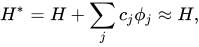
where the cj are not constants but functions of the coordinates and momenta. Since this new Hamiltonian is the most general function of coordinates and momenta weakly equal to the naive Hamiltonian, H* is the broadest generalization of the Hamiltonian possible so that δH * ≈ δH when δϕj ≈ 0.
To further illuminate the cj, consider how one gets the equations of motion from the naive Hamiltonian in the standard procedure. One expands the variation of the Hamiltonian out in two ways and sets them equal (using a somewhat abbreviated notation with suppressed indices and sums):

where the second equality holds after simplifying with the Euler-Lagrange equations of motion and the definition of canonical momentum. From this equality, one deduces the equations of motion in the Hamiltonian formalism from

where the weak equality symbol is no longer displayed explicitly, since by definition the equations of motion only hold weakly. In the present context, one cannot simply set the coefficients of δq and δp separately to zero, since the variations are somewhat restricted by the constraints. In particular, the variations must be tangent to the constraint surface.
One can demonstrate that the solution to

for the variations δqn and δpn restricted by the constraints Φj ≈ 0 (assuming the constraints satisfy some regularity conditions) is generally[5]
![{\displaystyle {\begin{aligned}A_{n}&=\sum _{m}u_{m}{\frac {\partial \phi _{m}}{\partial q_{n}}},\\[1ex]B_{n}&=\sum _{m}u_{m}{\frac {\partial \phi _{m}}{\partial p_{n}}},\end{aligned}}}](https://wikimedia.org/api/rest_v1/media/math/render/svg/1d66ec713063be6bf47e5b07ffd4badf5b1fc5a1)
where the um are arbitrary functions.
Using this result, the equations of motion become
![{\displaystyle {\begin{aligned}&{\dot {p}}_{j}=-{\frac {\partial H}{\partial q_{j}}}-\sum _{k}u_{k}{\frac {\partial \phi _{k}}{\partial q_{j}}},\\[1ex]&{\dot {q}}_{j}={\hphantom {-}}{\frac {\partial H}{\partial p_{j}}}+\sum _{k}u_{k}{\frac {\partial \phi _{k}}{\partial p_{j}}}\\[1ex]&\phi _{j}(q,p)=0,\end{aligned}}}](https://wikimedia.org/api/rest_v1/media/math/render/svg/ebfe2f210c0ff9e70e28c69d54ba2cbe52412616)
where the uk are functions of coordinates and velocities that can be determined, in principle, from the second equation of motion above.
The Legendre transform between the Lagrangian formalism and the Hamiltonian formalism has been saved at the cost of adding new variables.
Consistency conditions
[edit]The equations of motion become more compact when using the Poisson bracket, since if f is some function of the coordinates and momenta then

if one assumes that the Poisson bracket with the uk (functions of the velocity) exist; this causes no problems since the contribution weakly vanishes. Now, there are some consistency conditions which must be satisfied in order for this formalism to make sense. If the constraints are going to be satisfied, then their equations of motion must weakly vanish, that is, we require

There are four different types of conditions that can result from the above:
- An equation that is inherently false, such as 1=0.
- An equation that is identically true, possibly after using one of our primary constraints.
- An equation that places new constraints on our coordinates and momenta, but is independent of the uk.
- An equation that serves to specify the uk.
The first case indicates that the starting Lagrangian gives inconsistent equations of motion, such as L = q. The second case does not contribute anything new.
The third case gives new constraints in phase space. A constraint derived in this manner is called a secondary constraint. Upon finding the secondary constraint one should add it to the extended Hamiltonian and check the new consistency conditions, which may result in still more constraints. Iterate this process until there are no more constraints. The distinction between primary and secondary constraints is largely an artificial one (i.e. a constraint for the same system can be primary or secondary depending on the Lagrangian), so this article does not distinguish between them from here on. Assuming the consistency condition has been iterated until all of the constraints have been found, then ϕj will index all of them. Note this article uses secondary constraint to mean any constraint that was not initially in the problem or derived from the definition of canonical momenta; some authors distinguish between secondary constraints, tertiary constraints, et cetera.
Finally, the last case helps fix the uk. If, at the end of this process, the uk are not completely determined, then that means there are unphysical (gauge) degrees of freedom in the system. Once all of the constraints (primary and secondary) are added to the naive Hamiltonian and the solutions to the consistency conditions for the uk are plugged in, the result is called the total Hamiltonian.
Determination of the uk
[edit]The uk must solve a set of inhomogeneous linear equations of the form

The above equation must possess at least one solution, since otherwise the initial Lagrangian is inconsistent; however, in systems with gauge degrees of freedom, the solution will not be unique. The most general solution is of the form

where Uk is a particular solution and Vk is the most general solution to the homogeneous equation
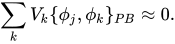
The most general solution will be a linear combination of linearly independent solutions to the above homogeneous equation. The number of linearly independent solutions equals the number of uk (which is the same as the number of constraints) minus the number of consistency conditions of the fourth type (in previous subsection). This is the number of unphysical degrees of freedom in the system. Labeling the linear independent solutions Vka where the index a runs from 1 to the number of unphysical degrees of freedom, the general solution to the consistency conditions is of the form
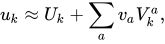
where the va are completely arbitrary functions of time. A different choice of the va corresponds to a gauge transformation, and should leave the physical state of the system unchanged.[6]
The total Hamiltonian
[edit]At this point, it is natural to introduce the total Hamiltonian

and what is denoted
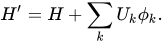
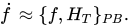
The time evolution of a function on the phase space, f, is governed by
Later, the extended Hamiltonian is introduced. For gauge-invariant (physically measurable quantities) quantities, all of the Hamiltonians should give the same time evolution, since they are all weakly equivalent. It is only for non gauge-invariant quantities that the distinction becomes important.
The Dirac bracket
[edit]Above is everything needed to find the equations of motion in Dirac's modified Hamiltonian procedure. Having the equations of motion, however, is not the endpoint for theoretical considerations. If one wants to canonically quantize a general system, then one needs the Dirac brackets. Before defining Dirac brackets, first-class and second-class constraints need to be introduced.
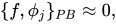
We call a function f(q, p) of coordinates and momenta first class if its Poisson bracket with all of the constraints weakly vanishes, that is,
for all j. Note that the only quantities that weakly vanish are the constraints ϕj, and therefore anything that weakly vanishes must be strongly equal to a linear combination of the constraints. One can demonstrate that the Poisson bracket of two first-class quantities must also be first class. The first-class constraints are intimately connected with the unphysical degrees of freedom mentioned earlier. Namely, the number of independent first-class constraints is equal to the number of unphysical degrees of freedom, and furthermore, the primary first-class constraints generate gauge transformations. Dirac further postulated that all secondary first-class constraints are generators of gauge transformations, which turns out to be false; however, typically one operates under the assumption that all first-class constraints generate gauge transformations when using this treatment.[7]
When the first-class secondary constraints are added into the Hamiltonian with arbitrary va as the first-class primary constraints are added to arrive at the total Hamiltonian, then one obtains the extended Hamiltonian. The extended Hamiltonian gives the most general possible time evolution for any gauge-dependent quantities, and may actually generalize the equations of motion from those of the Lagrangian formalism.
For the purposes of introducing the Dirac bracket, of more immediate interest are the second class constraints. Second class constraints are constraints that have a nonvanishing Poisson bracket with at least one other constraint.
For instance, consider second-class constraints ϕ1 and ϕ2 whose Poisson bracket is simply a constant, c,

Now, suppose one wishes to employ canonical quantization, then the phase-space coordinates become operators whose commutators become iħ times their classical Poisson bracket. Assuming there are no ordering issues that give rise to new quantum corrections, this implies that
![{\displaystyle [{\hat {\phi }}_{1},{\hat {\phi }}_{2}]=i\hbar c,}](https://wikimedia.org/api/rest_v1/media/math/render/svg/40049a0631ab2720e3dfc7a03b22328ce2cacb93)
where the hats emphasize the fact that the constraints are on operators.
On one hand, canonical quantization gives the above commutation relation, but on the other hand ϕ1 and ϕ2 are constraints that must vanish on physical states, whereas the right-hand side cannot vanish. This example illustrates the need for some generalization of the Poisson bracket which respects the system's constraints, and which leads to a consistent quantization procedure. This new bracket should be bilinear, antisymmetric, satisfy the Jacobi identity as does the Poisson bracket, reduce to the Poisson bracket for unconstrained systems, and, additionally, the bracket of any second-class constraint with any other quantity must vanish.
At this point, the second class constraints will be labeled . Define a matrix with entries


In this case, the Dirac bracket of two functions on phase space, f and g, is defined as

where M−1ab denotes the ab entry of M 's inverse matrix. Dirac proved that M will always be invertible.
It is straightforward to check that the above definition of the Dirac bracket satisfies all of the desired properties, and especially the last one, of vanishing for an argument which is a second-class constraint.
When applying canonical quantization on a constrained Hamiltonian system, the commutator of the operators is supplanted by iħ times their classical Dirac bracket. Since the Dirac bracket respects the constraints, one need not be careful about evaluating all brackets before using any weak equations, as is the case with the Poisson bracket.
Note that while the Poisson bracket of bosonic (Grassmann even) variables with itself must vanish, the Poisson bracket of fermions represented as a Grassmann variables with itself need not vanish. This means that in the fermionic case it is possible for there to be an odd number of second class constraints.
Illustration on the example provided
[edit]Returning to the above example, the naive Hamiltonian and the two primary constraints are


Therefore, the extended Hamiltonian can be written

The next step is to apply the consistency conditions {Φj, H*}PB ≈ 0, which in this case become
![{\displaystyle {\begin{aligned}\{\phi _{1},H\}_{PB}+\sum _{j}u_{j}\{\phi _{1},\phi _{j}\}_{PB}=-{\frac {\partial V}{\partial x}}+u_{2}{\frac {qB}{c}}\approx 0\\[1ex]\{\phi _{2},H\}_{PB}+\sum _{j}u_{j}\{\phi _{2},\phi _{j}\}_{PB}=-{\frac {\partial V}{\partial y}}-u_{1}{\frac {qB}{c}}\approx 0.\end{aligned}}}](https://wikimedia.org/api/rest_v1/media/math/render/svg/7ebeb18dd4b5303a81dde291998cbebc5b3cf24c)
These are not secondary constraints, but conditions that fix u1 and u2. Therefore, there are no secondary constraints and the arbitrary coefficients are completely determined, indicating that there are no unphysical degrees of freedom.
If one plugs in with the values of u1 and u2, then one can see that the equations of motion are
![{\displaystyle {\begin{aligned}{\dot {x}}&=\{x,H\}_{PB}+u_{1}\{x,\phi _{1}\}_{PB}+u_{2}\{x,\phi _{2}\}\\[2pt]&=-{\frac {c}{qB}}{\frac {\partial V}{\partial y}},\\[1.2ex]{\dot {y}}&={\frac {c}{qB}}{\frac {\partial V}{\partial x}},\end{aligned}}}](https://wikimedia.org/api/rest_v1/media/math/render/svg/2e8c60640c204c71d5be0ac8c7cf43e41f0a0cfc)

which are self-consistent and coincide with the Lagrangian equations of motion.
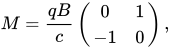
A simple calculation confirms that ϕ1 and ϕ2 are second class constraints since

hence the matrix looks like
which is easily inverted to

where εab is the Levi-Civita symbol. Thus, the Dirac brackets are defined to be

If one always uses the Dirac bracket instead of the Poisson bracket, then there is no issue about the order of applying constraints and evaluating expressions, since the Dirac bracket of anything weakly zero is strongly equal to zero. This means that one can just use the naive Hamiltonian with Dirac brackets, instead, to thus get the correct equations of motion, which one can easily confirm on the above ones.
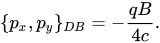
To quantize the system, the Dirac brackets between all of the phase space variables are needed. The nonvanishing Dirac brackets for this system are
![{\displaystyle {\begin{aligned}&\{x,y\}_{DB}=-{\frac {c}{qB}}\\[4pt]&\{x,p_{x}\}_{DB}=\{y,p_{y}\}_{DB}={\tfrac {1}{2}}\end{aligned}}}](https://wikimedia.org/api/rest_v1/media/math/render/svg/09734117e28e63544f022f29e40fc380418620ca)
while the cross-terms vanish, and
Therefore, the correct implementation of canonical quantization dictates the commutation relations,
![{\displaystyle {\begin{aligned}&[{\hat {x}},{\hat {y}}]=-i{\frac {\hbar c}{qB}}\\&[{\hat {x}},{\hat {p}}_{x}]=[{\hat {y}},{\hat {p}}_{y}]=i{\frac {\hbar }{2}}\end{aligned}}}](https://wikimedia.org/api/rest_v1/media/math/render/svg/dc0ebd0805eb4a57e45eb5422914639cb1a263e6)
with the cross terms vanishing, and
![{\displaystyle [{\hat {p}}_{x},{\hat {p}}_{y}]=-i{\frac {\hbar qB}{4c}}~.}](https://wikimedia.org/api/rest_v1/media/math/render/svg/a337f37b9eff8f35b213d6e098044d383c772a25)
This example has a nonvanishing commutator between x̂ and ŷ, which means this structure specifies a noncommutative geometry. (Since the two coordinates do not commute, there will be an uncertainty principle for the x and y positions.)
Further illustration for a hypersphere
[edit]Similarly, for free motion on a hypersphere Sn, the n + 1 coordinates are constrained, xi xi = 1. From a plain kinetic Lagrangian, it is evident that their momenta are perpendicular to them, xi pi = 0. Thus the corresponding Dirac Brackets are likewise simple to work out,[8]

The (2n + 1) constrained phase-space variables (xi, pi) obey much simpler Dirac brackets than the 2n unconstrained variables, had one eliminated one of the xs and one of the ps through the two constraints ab initio, which would obey plain Poisson brackets. The Dirac brackets add simplicity and elegance, at the cost of excessive (constrained) phase-space variables.
For example, for free motion on a circle, n = 1, for x1 ≡ z and eliminating x2 from the circle constraint yields the unconstrained

with equations of motion
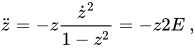
an oscillation; whereas the equivalent constrained system with H = p2/2 = E yields
![{\displaystyle {\begin{aligned}{\dot {x}}^{i}&=\{x^{i},H\}_{DB}=p^{i},\\[4pt]{\dot {p}}^{i}&=\{p^{i},H\}_{DB}=-x^{i}~p^{2},\end{aligned}}}](https://wikimedia.org/api/rest_v1/media/math/render/svg/5f7100a6a20b4d9f7e569bf1fa5721f98eba3b2c)
whence, instantly, virtually by inspection, oscillation for both variables,

See also
[edit]References
[edit]- ^ Dirac, P. A. M. (1950). "Generalized Hamiltonian dynamics". Canadian Journal of Mathematics. 2: 129–014. doi:10.4153/CJM-1950-012-1. S2CID 119748805.
- ^ Dirac, Paul A. M. (1964). Lectures on quantum mechanics. Belfer Graduate School of Science Monographs Series. Vol. 2. Belfer Graduate School of Science, New York. ISBN 9780486417134. MR 2220894.
{{cite book}}: ISBN / Date incompatibility (help); Dover, ISBN 0486417131. - ^ See pages 48-58 of Ch. 2 in Henneaux, Marc and Teitelboim, Claudio, Quantization of Gauge Systems. Princeton University Press, 1992. ISBN 0-691-08775-X
- ^ Dunne, G.; Jackiw, R.; Pi, S. Y.; Trugenberger, C. (1991). "Self-dual Chern-Simons solitons and two-dimensional nonlinear equations". Physical Review D. 43 (4): 1332–1345. Bibcode:1991PhRvD..43.1332D. doi:10.1103/PhysRevD.43.1332. PMID 10013503.
- ^ See page 8 in Henneaux and Teitelboim in the references.
- ^ Weinberg, Steven, The Quantum Theory of Fields, Volume 1. Cambridge University Press, 1995. ISBN 0-521-55001-7
- ^ See Henneaux and Teitelboim, pages 18-19.
- ^ Corrigan, E.; Zachos, C. K. (1979). "Non-local charges for the supersymmetric σ-model". Physics Letters B. 88 (3–4): 273. Bibcode:1979PhLB...88..273C. doi:10.1016/0370-2693(79)90465-9.
Dirac bracket
View on GrokipediaIntroduction
Overview and motivation
The Dirac bracket represents a modification of the standard Poisson bracket tailored for constrained Hamiltonian systems, particularly those involving second-class constraints, where the dimensionality of the phase space exceeds the number of physical degrees of freedom due to these restrictions.[3] In such systems, the constraints define a reduced subspace on which the dynamics must evolve, ensuring that the equations of motion remain consistent and preserve the symplectic structure adapted to the constraints.[4] This adaptation allows for a well-defined bracket that incorporates the effects of the constraints directly into the Poisson structure, facilitating the treatment of systems that cannot be handled by unconstrained Hamiltonian mechanics.[3] The primary motivation for introducing the Dirac bracket arises from the limitations of the conventional Hamiltonian procedure when applied to singular Lagrangians, such as those linear in velocities or exhibiting gauge symmetries, which lead to an inability to uniquely solve for velocities from the momenta definitions and result in inconsistent equations of motion.[4] For instance, in gauge theories like electromagnetism or general relativity, the presence of redundancies in the phase space variables causes the standard approach to break down, as the Hessian matrix of the Lagrangian becomes singular and non-invertible.[5] These issues manifest in constrained systems where second-class constraints enforce relations that cannot be trivially incorporated, necessitating a generalized framework to maintain the integrity of the dynamics and enable proper quantization.[4] Central to this formalism is the distinction between strong equality (=0), which holds everywhere in phase space, and weak equality (≈0), which is satisfied only on the constraint surface where the physical dynamics are confined.[3] Constraints are thus imposed weakly to restrict the evolution to this surface, avoiding over-constraining the system while ensuring time preservation through consistency conditions.[4] Paul Dirac introduced this generalized approach in his 1950 paper, motivated by the need for a consistent canonical quantization procedure applicable to constrained systems beyond the scope of standard quantum mechanics.[3]Historical development
The Dirac bracket was first introduced by Paul Dirac in his seminal 1950 paper, where he proposed a generalized framework for Hamiltonian dynamics in systems subject to constraints, aiming to address challenges in the quantization of singular Lagrangians.[3] This work built upon Dirac's earlier explorations of constrained systems and provided a systematic method to modify the Poisson bracket into the Dirac bracket, ensuring consistency in the presence of second-class constraints. The bracket's formulation allowed for the preservation of canonical structure while accommodating restrictions that arise when the Lagrangian is not regular, marking a pivotal advancement in handling non-standard mechanical systems. The development of the Dirac bracket drew influence from prior investigations into constrained Lagrangians, particularly those where velocities appear linearly in the Lagrangian, leading to singular formulations. Notably, Léon Rosenfeld's 1930 analysis of the Hamiltonian formulation of general relativity highlighted issues with singular Lagrangians in gauge theories, where constraints arose due to the structure of the theory, necessitating special treatments.[6] These earlier efforts underscored the need for a generalized bracket to maintain dynamical consistency, setting the stage for Dirac's comprehensive approach. In the 1960s and 1970s, the Dirac bracket gained widespread adoption among researchers, including Peter Bergmann and Dirac's collaborators, who applied it extensively to general relativity and relativistic field theories. Bergmann's work, in particular, integrated the bracket into the Hamiltonian formulation of gravity, facilitating the identification of constraints in curved spacetime and advancing canonical quantization efforts.[7] This period saw the bracket become a cornerstone for analyzing gauge symmetries in complex systems, bridging classical mechanics and quantum field theory. The procedure was further formalized and rigorously developed in the 1992 textbook by Marc Henneaux and Claudio Teitelboim, which provided a detailed exposition of the Dirac bracket within the broader context of gauge system quantization. This work solidified its role as a fundamental tool in theoretical physics, influencing subsequent applications in diverse areas. As a bridge to quantum mechanics, the Dirac bracket enables the promotion of classical constraints to operator algebras, preserving the structure of canonical commutation relations.Fundamentals of Constrained Hamiltonian Systems
Poisson bracket in standard Hamiltonian mechanics
In standard Hamiltonian mechanics, the Poisson bracket serves as a fundamental binary operation on the phase space of a system, which consists of generalized coordinates and their conjugate momenta . For two smooth functions and on this phase space, the Poisson bracket is defined as This structure encodes the symplectic geometry of the phase space, enabling the description of dynamics without explicit reference to coordinates in certain formulations.[8][9][10] The Poisson bracket generates the equations of motion through its action on the Hamiltonian , which represents the total energy of the system. Hamilton's equations take the compact form where the time derivatives follow directly from the bracket's definition, yielding and . More generally, the time evolution of any function on phase space is given by , assuming possible explicit time dependence. This framework unifies the treatment of conservative systems in phase space.[8][9][10] Key properties of the Poisson bracket underpin its role in Hamiltonian mechanics. It satisfies antisymmetry, , and the Jacobi identity, , ensuring consistency with the Lie algebra structure of phase space transformations. Additionally, it obeys bilinearity and the Leibniz rule, . The fundamental brackets , , and reflect the canonical symplectic form, often represented by the matrix , which governs the Poisson bracket in vector notation as . These properties preserve the symplectic structure during dynamics.[8][9][10] Canonical transformations, which map to new variables while preserving the form of Hamilton's equations, are precisely those that leave the Poisson bracket invariant. Such transformations satisfy , , and , ensuring the symplectic structure is maintained and the dynamics remain equivalent in the new coordinates. This invariance allows for flexible reformulations of Hamiltonian systems without altering their physical content. However, in systems with constraints, the standard Poisson bracket encounters limitations that necessitate generalizations like the Dirac bracket.[8][9][10]Classification of constraints
In constrained Hamiltonian systems, constraints are categorized based on their origin and algebraic properties with respect to the Poisson bracket. Primary constraints arise directly from the structure of the Lagrangian when the momenta cannot be expressed as independent functions of the velocities , leading to relations of the form , where denotes weak equality (equality up to terms of higher order in the constraints).[1] These constraints reflect the immediate limitations imposed by the singular nature of the Lagrangian in the Legendre transformation to phase space.[1] Secondary constraints emerge from the requirement that primary constraints must remain satisfied under time evolution, i.e., their Poisson bracket with the Hamiltonian must vanish weakly: . This condition may generate additional independent relations , which in turn must satisfy their own consistency requirements, potentially yielding further constraints. The process continues until no new constraints appear, forming a chain of secondary constraints that ensure the dynamical consistency of the system.[1] Constraints are further classified as first-class or second-class based on their Poisson brackets among themselves and with the Hamiltonian, using the standard Poisson bracket . First-class constraints satisfy and for all constraints (primary or secondary); this property implies that they generate gauge symmetries and infinitesimal transformations that leave the action invariant.[1] In contrast, second-class constraints violate at least one of these conditions, such that the matrix of Poisson brackets is invertible (non-singular) on the constraint surface.[1] The invertibility of the second-class constraint matrix distinguishes them from first-class ones, where the corresponding submatrix has vanishing determinant (zero eigenvalues). This invertibility fixes the Lagrange multipliers associated with second-class constraints uniquely through consistency conditions, eliminating gauge freedoms and reducing the physical phase space dimension by twice the number of second-class constraints. Consequently, second-class constraints require special treatment in the Hamiltonian formalism, as the standard Poisson bracket structure fails to preserve the constraints under evolution without modification, necessitating a projected bracket to enforce strong equality and eliminate unphysical directions.[1]Challenges in Standard Hamiltonian Formalism
Systems with linear velocities in Lagrangian
In systems where the Lagrangian contains terms linear in the velocities, the standard procedure for transitioning to Hamiltonian mechanics encounters significant difficulties. Consider a general Lagrangian of the formwhere the coefficients introduce the linear velocity dependence, form the Hessian matrix, and is the potential energy.[11] The presence of these linear terms can render the Hessian singular or degenerate, particularly in cases where the quadratic contributions are negligible or absent, leading to an ill-defined phase space structure.[11] The core issue arises during the Legendre transform, which defines the canonical momenta as . For Lagrangians linear or singular in velocities, this relation fails to provide an invertible mapping from momenta back to velocities, i.e., cannot be uniquely expressed as functions of and .[11] Consequently, the standard Hamiltonian becomes either undefined or independent of some momenta, imposing primary constraints that restrict the dynamics to a reduced phase space. These constraints emerge directly from the noninvertibility, as the momenta satisfy relations that must hold weakly on the constraint surface.[11] A representative example is the motion of a charged particle in a uniform magnetic field, where the strong-field limit approximates the Lagrangian as linear in velocities. In the symmetric gauge, the vector potential is , yielding
neglecting the kinetic term for the approximation.[12] The canonical momenta are then
which cannot be inverted for and , confirming the failure of the Legendre transform.[12] This results in primary constraints
that define a constrained surface in phase space, with the Hamiltonian reducing to .[12] These constraints are second-class, as their Poisson bracket is nonzero.[12]