Hubbry Logo
Direct simulation Monte CarloDirect simulation Monte CarloMain
Open search
Direct simulation Monte Carlo
Community hub
Direct simulation Monte Carlo
logo
7 pages, 0 posts
0 subscribers
Be the first to start a discussion here.
Direct simulation Monte Carlo
from Wikipedia

Direct simulation Monte Carlo (DSMC) method uses probabilistic Monte Carlo simulation to solve the Boltzmann equation for finite Knudsen number fluid flows.

The DSMC method was proposed by Graeme Bird,[1][2][3] emeritus professor of aeronautics, University of Sydney. DSMC is a numerical method for modeling rarefied gas flows, in which the mean free path of a molecule is of the same order (or greater) than a representative physical length scale (i.e. the Knudsen number Kn is greater than 1). In supersonic and hypersonic flows rarefaction is characterized by Tsien's parameter, which is equivalent to the product of Knudsen number and Mach number (KnM) or M/Re, where Re is the Reynolds number.[4][5] In these rarefied flows, the Navier-Stokes equations can be inaccurate. The DSMC method has been extended to model continuum flows (Kn < 1) and the results can be compared with Navier Stokes solutions.

The DSMC method models fluid flows using probabilistic simulation molecules to solve the Boltzmann equation. Molecules are moved through a simulation of physical space in a realistic manner that is directly coupled to physical time such that unsteady flow characteristics can be modeled. Intermolecular collisions and molecule-surface collisions are calculated using probabilistic, phenomenological models. Common molecular models include the hard sphere model, the variable hard sphere (VHS) model, and the variable soft sphere (VSS) model. Various collision models are presented in.[6]

Currently, the DSMC method has been applied to the solution of flows ranging from estimation of the Space Shuttle re-entry aerodynamics to the modeling of microelectromechanical systems (MEMS).

DSMC Algorithm

[edit]

The direct simulation Monte Carlo algorithm is like molecular dynamics in that the state of the system is given by the positions and velocities of the particles, , for . Unlike molecular dynamics, each particle in a DSMC simulation represents molecules in the physical system that have roughly the same position and velocity. This allows DSMC to rescale length and time for the modeling of macroscopic systems (e.g., atmospheric entry). Specifically, the system volume is , where is the number density and each collision between simulation particles represents collisions among molecules in the physical system. As a rule of thumb there should be 20 or more particles per cubic mean free path for accurate results.[citation needed]

The evolution of the system is integrated in time steps, , which are typically on the order of the mean collision time for a particle. At each time step all the particles are moved and then a random set of pairs collide. In the absence of external fields (e.g., gravity) the particles move ballistically as . Any particle that reaches a boundary or a surface has its position and velocity reset accordingly (e.g., periodic boundary conditions). After all the particles have moved, they are sorted into cells and some are randomly selected to collide. based on probabilities and collision rates obtained from the kinetic theory of gases. After the velocities of all colliding particles have been reset, statistical sampling is performed and then the process is repeated for the next time step.


Collisions

[edit]

On each timestep the particles are sorted into spatial cells and only particles in the same cell are allowed to collide. Typically the dimension of a cell is no larger than a mean free path. All pairs of particles in a cell are candidate collision partners, regardless of their actual trajectories.

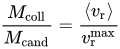
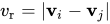
The details of how collisions are calculated in DSMC depend on the molecular interaction model; here we take the hard spheres model, which is the simplest. In the hard spheres model, the collision probability for the pair of particles, and , is proportional to their relative speed, where is the number of particles in the cell and the summations are over particles within the cell. Because of the double sum in the denominator it can be computationally expensive to use this collision probability directly. Instead, the following rejection sampling scheme can be used to select collision pairs:

  1. A pair of candidate particles, and , is chosen at random and their relative speed, , is computed.
  2. The pair is accepted as collision partners if , where is the maximum relative speed in the cell and is a uniform deviate in [0, 1).
  3. If the pair is accepted, the collision is processed; the velocities of the particles are reset but positions are unchanged.
  4. After the collision is processed or if the pair is rejected, return to step 1.
This procedure is correct even if the value of is overestimated, although it is less efficient in the sense that more candidates are rejected.

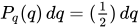
After the collision pair is chosen, their post-collision velocities, and , are evaluated. Writing the relative velocity in terms of spherical angles, and these angles are selected by a Monte Carlo process with distributions given by the collision model. For the hard spheres model these angles are uniformly distributed over the unit sphere. The azimuthal angle is uniformly distributed between 0 and , so it is selected as where is a uniform deviate in [0, 1). The polar angle is distributed according to the probability density, Using the change of variable , we have so The post-collision velocities are set as Note that by conservation of linear momentum and energy the center of mass velocity and the relative speed are unchanged in a collision. That is, and This process is repeated for every pair of colliding particles.

From the collision frequency, , given by kinetic theory the total number of hard sphere collisions in a cell during a time is where is the particle diameter and is the volume of the cell. Since collision candidates go through a rejection sampling procedure the ratio of total accepted to total candidates for hard sphere particles is The number of collision candidates selected in a cell over a time step is This approach for determining the number of collisions is known as the No-Time-Counter (NTC) method. If is set excessively high then the algorithm processes the same number of collisions (on average) but the simulation is inefficient because many candidates are rejected.


An alternative, more accurate and time-efficient algorithm is Majorant Frequency (MF) method, proposed by Mikhail Ivanov and Sergey Rogasinsky in 1988.[7]

References

[edit]
[edit]
Revisions and contributorsEdit on WikipediaRead on Wikipedia
from Grokipedia
Direct Simulation Monte Carlo (DSMC) is a particle-based for modeling the dynamics of rarefied gases and nonequilibrium flows, where representative computational molecules are advanced through ballistic motion and intermolecular collisions are simulated probabilistically using sampling to approximate solutions to the . Developed by Graeme A. Bird (1929–2018), an emeritus professor of aeronautical engineering at the , the DSMC method was first introduced in 1961 as a technique for analyzing high flows in rarefied gas environments, where continuum assumptions fail. Over the subsequent decades, it evolved into the dominant simulation approach for dilute gas flows, with foundational principles detailed in Bird's 1994 book Molecular Gas Dynamics and the Direct Simulation of Gas Flows. At its core, DSMC operates by dividing the simulation domain into collision cells, initializing a sufficient number of particles (typically around 20 per cell for statistical accuracy) to represent the macroscopic gas properties, and iterating through steps of free molecular motion, boundary interactions, and collision processing, all within time steps on the order of the mean collision time to ensure statistical decoupling and fidelity to kinetic theory. This approach inherently captures fluctuations and nonequilibrium effects, such as those in chemical reactions and modes, by relying on generators for collision partner selection and outcome determination under the molecular chaos assumption. DSMC has become indispensable in for predicting flows in hypersonic re-entry vehicles, planetary aerocapture, and satellite plume interactions, where it provides accurate solutions across transitional regimes from rarefied to near-continuum conditions. Beyond traditional applications, extensions of the method address multi-scale problems like micron-scale gas flows, granular media, and even astrophysical environments such as lunar exospheres, with ongoing advancements incorporating complex chemistry, dense gases, and on supercomputers to handle large-scale simulations. As of 2025, DSMC continues to evolve with updates to like and refined collision models for planetary entry applications. Its reliability is validated against experimental data, such as measurements from the 1960s, underscoring its role as a benchmark for nonequilibrium gas dynamics over nearly six decades.

Introduction

Definition and Purpose

Direct Simulation Monte Carlo (DSMC) is a particle-based simulation technique that directly solves the by modeling the trajectories and collisions of simulated particles representing individual molecules in rarefied gas flows, particularly in non-continuum regimes where traditional approximations fail. Developed by Graeme A. Bird in 1963, DSMC enables the statistical simulation of gas dynamics at the molecular level without solving the full kinetic equations deterministically. The primary purpose of DSMC is to model gas flows in conditions where the KnKn, defined as the ratio of the molecular to a scale of the system, exceeds 0.1, rendering the Navier-Stokes equations invalid due to significant non-continuum effects such as slip and temperature jumps at boundaries. These conditions arise in low-density environments, high-speed flows, or microscale systems, such as upper atmospheric re-entry or technology applications, where the becomes comparable to or larger than the system dimensions, leading to rarefied gas dynamics. In DSMC simulations, a scaling factor FNF_N (often denoted as the number of real molecules per simulated particle) is employed to represent vast numbers of actual molecules efficiently with a manageable set of computational particles, ensuring that macroscopic properties like and are obtained through statistical averaging. To maintain accuracy, the simulation requires a time step τ\tau smaller than the mean collision time to decouple molecular motion from collisions effectively, a cell size no larger than one-third of the local to minimize spatial errors, and approximately 20 particles per cell for reliable statistical convergence.

Historical Development

The Direct Simulation Monte Carlo (DSMC) method originated in 1963 when Graeme A. Bird introduced it as a particle-based technique for modeling rarefied gas dynamics, particularly aimed at problems involving high-speed flows around vehicles. Bird's initial work focused on hard-sphere interactions to approximate solutions to the without direct , enabling efficient computation of non-equilibrium flows. This approach quickly gained traction for its ability to handle Knudsen numbers where continuum methods failed, with early applications in re-entry vehicle simulations. Key milestones in DSMC's development include Bird's 1976 book Molecular Gas Dynamics, which formalized the method's theoretical underpinnings and practical implementation for engineering analyses. This was followed by his 1994 book Molecular Gas Dynamics and the Direct Simulation of Gas Flows, which updated collision modeling procedures and incorporated refinements for more complex gas mixtures. During the , Bird developed the No-Time-Counter (NTC) method for efficient collision sampling, reducing computational overhead by selecting collision pairs probabilistically without explicit time tracking. Advancements in collision sampling continued with the Majorant Frequency (MF) scheme introduced by Mikhail S. Ivanov and Sergey V. Rogasinsky in 1988, which improved efficiency for variable-density flows by using a uniform upper-bound collision rate. Early DSMC implementations emphasized the hard-sphere model, but gaps in realism for polyatomic gases led to the adoption of variable models like the Variable Hard Sphere (VHS) in the , better matching and coefficients for gases. Post-1990s progress integrated DSMC with for large-scale simulations and hybrid DSMC-CFD approaches to bridge rarefied and continuum regimes, as reviewed in works validating these methods against experiments up to 2016. Since 2023, methodological advancements have included new collision schemes such as BT-family algorithms, DSMC-PIC couplings for plasma dynamics, and multiscale simulations for and reactive flows, with ongoing refinements targeting nanoscale applications like microflows in devices.

Theoretical Foundations

Boltzmann Equation

The Boltzmann equation serves as the foundational statistical description for the evolution of distributions in rarefied gases, providing the theoretical basis that direct simulation Monte Carlo methods aim to approximate through stochastic particle simulations. It originates from a reduction of the Liouville equation, which governs the conservation of phase-space density for an ensemble of particles under Hamiltonian dynamics. By integrating the Liouville equation over all but one particle's coordinates and momenta, assuming a dilute gas where interactions are dominated by binary collisions, the single-particle distribution function emerges. This derivation relies on the Stosszahlansatz, or molecular chaos assumption, which posits that pre-collision velocities of interacting particles are uncorrelated, decoupling the many-particle correlations into products of single-particle distributions. The resulting Boltzmann transport equation for a dilute gas is ft+vf+afv=(ft)coll,\frac{\partial f}{\partial t} + \mathbf{v} \cdot \nabla f + \mathbf{a} \cdot \frac{\partial f}{\partial \mathbf{v}} = \left( \frac{\partial f}{\partial t} \right)_{\text{coll}}, where f(r,v,t)f(\mathbf{r}, \mathbf{v}, t) denotes the distribution function, giving the number of particles per unit volume in position r\mathbf{r} with v\mathbf{v} at time tt; vf\mathbf{v} \cdot \nabla f accounts for spatial ; and afv\mathbf{a} \cdot \frac{\partial f}{\partial \mathbf{v}} represents the effect of external forces (with a\mathbf{a}) on the velocity distribution. The left-hand side describes the streaming of particles in absent collisions, while the right-hand side captures collisional changes. The collision integral on the right-hand side is expressed as (ft)coll=(ff1ff1)gσ(g,θ)dΩdv1,\left( \frac{\partial f}{\partial t} \right)_{\text{coll}} = \int \left( f' f_1' - f f_1 \right) g \sigma(g, \theta) \, d\Omega \, d\mathbf{v}_1, where the integral is over the velocity v1\mathbf{v}_1 of a colliding partner particle and the solid angle dΩd\Omega subtended by the scattering impact parameter; g=vv1g = |\mathbf{v} - \mathbf{v}_1| is the magnitude of the relative velocity between the particles; σ(g,θ)\sigma(g, \theta) is the differential cross-section for scattering through angle θ\theta; ff and f1f_1 are the pre-collision distributions evaluated at v\mathbf{v} and v1\mathbf{v}_1; and ff', f1f_1' are the post-collision distributions at the velocities v\mathbf{v}', v1\mathbf{v}_1' after elastic scattering, conserving momentum and energy. The term ff1gσ(g,θ)f' f_1' g \sigma(g, \theta) represents the gain of particles into the state (r,v)(\mathbf{r}, \mathbf{v}) from collisions, while ff1gσ(g,θ)-f f_1 g \sigma(g, \theta) accounts for the loss from collisions out of that state. This form assumes reversibility of collisions and detailed balance in equilibrium. The equation rests on key assumptions, including the neglect of quantum mechanical effects such as wave-particle duality or Bose/Fermi statistics, treating particles as classical point masses with short-range interactions. It is valid for dilute gases across a range of Knudsen numbers, but direct solutions are particularly necessary when Kn ≳ 0.01, encompassing transition and free-molecular flow regimes where continuum assumptions fail. Direct numerical solution poses significant challenges due to the high dimensionality of the six-dimensional (r\mathbf{r}, v\mathbf{v}, tt), compounded by the computationally intensive fivefold integral in the collision term over v1\mathbf{v}_1 and Ω\Omega. In the continuum limit of small (Kn ≪ 1), the Chapman-Enskog expansion systematically perturbs the distribution function around a local Maxwell-Boltzmann equilibrium, f=f(0)(1+ϕ)f = f^{(0)} (1 + \phi), where ϕ\phi is a small correction proportional to spatial gradients. This asymptotic procedure yields the Euler equations at zeroth order, Navier-Stokes equations with transport coefficients (, thermal conductivity, ) at first order, and higher-order Burnett or super-Burnett equations for rarer cases, bridging kinetic theory to macroscopic hydrodynamics.

Rarefied Gas Dynamics

Rarefied gas flows arise when the of gas molecules becomes comparable to or exceeds the scale of the system, leading to significant deviations from continuum assumptions. The λ\lambda is defined as λ=12nσ\lambda = \frac{1}{\sqrt{2} n \sigma}
Add your contribution
Related Hubs
User Avatar
No comments yet.