Hubbry Logo
Direct sumDirect sumMain
Open search
Direct sum
Community hub
Direct sum
logo
7 pages, 0 posts
0 subscribers
Be the first to start a discussion here.
Direct sum
Direct sum
from Wikipedia

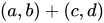
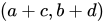
The direct sum is an operation between structures in abstract algebra, a branch of mathematics. It is defined differently but analogously for different kinds of structures. As an example, the direct sum of two abelian groups and is another abelian group consisting of the ordered pairs where and . To add ordered pairs, the sum is defined to be ; in other words, addition is defined coordinate-wise. For example, the direct sum , where is real coordinate space, is the Cartesian plane, . A similar process can be used to form the direct sum of two vector spaces or two modules.

Direct sums can also be formed with any finite number of summands; for example, , provided and are the same kinds of algebraic structures (e.g., all abelian groups, or all vector spaces). That relies on the fact that the direct sum is associative up to isomorphism. That is, for any algebraic structures , , and of the same kind. The direct sum is also commutative up to isomorphism, i.e. for any algebraic structures and of the same kind.

The direct sum of finitely many abelian groups, vector spaces, or modules is canonically isomorphic to the corresponding direct product. That is false, however, for some algebraic objects like nonabelian groups.

In the case where infinitely many objects are combined, the direct sum and direct product are not isomorphic even for abelian groups, vector spaces, or modules. For example, consider the direct sum and the direct product of (countably) infinitely many copies of the integers. An element in the direct product is an infinite sequence, such as (1,2,3,...) but in the direct sum, there is a requirement that all but finitely many coordinates be zero, so the sequence (1,2,3,...) would be an element of the direct product but not of the direct sum, while (1,2,0,0,0,...) would be an element of both. Often, if a + sign is used, all but finitely many coordinates must be zero, while if some form of multiplication is used, all but finitely many coordinates must be 1.

In more technical language, if the summands are , the direct sum is defined to be the set of tuples with such that for all but finitely many i. The direct sum is contained in the direct product , but is strictly smaller when the index set is infinite, because an element of the direct product can have infinitely many nonzero coordinates.[1]

Examples

[edit]

The xy-plane, a two-dimensional vector space, can be thought of as the direct sum of two one-dimensional vector spaces: the x and y axes. In this direct sum, the x and y axes intersect only at the origin (the zero vector). Addition is defined coordinate-wise; that is, , which is the same as vector addition.

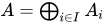
Given two structures and , their direct sum is written as . Given an indexed family of structures , indexed with , the direct sum may be written . Each Ai is called a direct summand of A. If the index set is finite, the direct sum is the same as the direct product. In the case of groups, if the group operation is written as the phrase "direct sum" is used, while if the group operation is written the phrase "direct product" is used. When the index set is infinite, the direct sum is not the same as the direct product since the direct sum has the extra requirement that all but finitely many coordinates must be zero.

Internal and external direct sums

[edit]

A distinction is made between internal and external direct sums though both are isomorphic. If the summands are defined first, and the direct sum is then defined in terms of the summands, there is an external direct sum. For example, if the real numbers are defined, followed by , the direct sum is said to be external.

If, on the other hand, some algebraic structure is defined, and is then defined as a direct sum of two substructures and , the direct sum is said to be internal. In that case, each element of is expressible uniquely as an algebraic combination of an element of and an element of . For an example of an internal direct sum, consider (the integers modulo six), whose elements are . This is expressible as an internal direct sum .

Types of direct sums

[edit]

Direct sum of abelian groups

[edit]

The direct sum of abelian groups is a prototypical example of a direct sum. Given two such groups and their direct sum is the same as their direct product. That is, the underlying set is the Cartesian product and the group operation is defined component-wise: This definition generalizes to direct sums of finitely many abelian groups.

For an arbitrary family of groups indexed by their direct sum[2] is the subgroup of the direct product that consists of the elements that have finite support, where, by definition, is said to have finite support if is the identity element of for all but finitely many [3] The direct sum of an infinite family of non-trivial groups is a proper subgroup of the product group


Direct sum of modules

[edit]

The direct sum of modules is a construction that combines several modules into a new module.

The most familiar examples of that construction occur in considering vector spaces, which are modules over a field. The construction may also be extended to Banach spaces and Hilbert spaces.

Direct sum in categories

[edit]

An additive category is an abstraction of the properties of the category of modules.[4][5] In such a category, finite products and coproducts agree, and the direct sum is either of them: cf. biproduct.

General case:[2] In category theory the direct sum is often but not always the coproduct in the category of the mathematical objects in question. For example, in the category of abelian groups, the direct sum is a coproduct. That is also true in the category of modules.

Direct sums versus coproducts in category of groups

[edit]

However, the direct sum (defined identically to the direct sum of abelian groups) is not a coproduct of the groups and in the category of groups. Therefore, for that category, a categorical direct sum is often called simply a coproduct to avoid any possible confusion.

Direct sum of group representations

[edit]

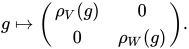
The direct sum of group representations generalizes the direct sum of the underlying modules by adding a group action. Specifically, given a group and two representations and of (or, more generally, two -modules), the direct sum of the representations is with the action of given component-wise, that is, Another equivalent way of defining the direct sum is as follows:

Given two representations and the vector space of the direct sum is and the homomorphism is given by where is the natural map obtained by coordinate-wise action as above.

Furthermore, if are finite dimensional, then, given a basis of , and are matrix-valued. In this case, is given as

Moreover, if and are treated as modules over the group ring , where is the field, the direct sum of the representations and is equal to their direct sum as modules.

Direct sum of rings

[edit]

Some authors speak of the direct sum of two rings when they mean the direct product , but that should be avoided[6] since does not receive natural ring homomorphisms from and . In particular, the map sending to is not a ring homomorphism since it fails to send 1 to (assuming that in ). Thus, is not a coproduct in the category of rings, and should not be written as a direct sum. (The coproduct in the category of commutative rings is the tensor product of rings.[7] In the category of rings, the coproduct is given by a construction similar to the free product of groups.)

The use of direct sum terminology and notation is especially problematic in dealing with infinite families of rings. If is an infinite collection of nontrivial rings, the direct sum of the underlying additive groups may be equipped with termwise multiplication, but that produces a rng, a ring without a multiplicative identity.

Direct sum of matrices

[edit]

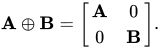
For any arbitrary matrices and , the direct sum is defined as the block diagonal matrix of and if both are square matrices (and to an analogous block matrix, if not).

Alternatively, the forms or may also be encountered in the literature and are isomorphic to the aforementioned block form.

Direct sum of topological vector spaces

[edit]

A topological vector space (TVS) such as a Banach space, is said to be a topological direct sum of two vector subspaces and if the addition map is an isomorphism of topological vector spaces (meaning that this linear map is a bijective homeomorphism) in which case and are said to be topological complements in That is true if and only if when considered as additive topological groups (so scalar multiplication is ignored), is the topological direct sum of the topological subgroups and If this is the case and if is Hausdorff then and are necessarily closed subspaces of

If is a vector subspace of a real or complex vector space , there is always another vector subspace of called an algebraic complement of in such that is the algebraic direct sum of and , which happens if and only if the addition map is a vector space isomorphism.

In contrast to algebraic direct sums, the existence of such a complement is no longer guaranteed for topological direct sums.

A vector subspace of is said to be a (topologically) complemented subspace of if there exists some vector subspace of such that is the topological direct sum of and A vector subspace is called uncomplemented if it is not a complemented subspace. For example, every vector subspace of a Hausdorff TVS that is not a closed subset is necessarily uncomplemented. Every closed vector subspace of a Hilbert space is complemented. But every Banach space that is not a Hilbert space necessarily possess some uncomplemented closed vector subspace.

Homomorphisms

[edit]

[clarification needed]

The direct sum comes equipped with a projection homomorphism for each j in I and a coprojection for each j in I.[8] Given another algebraic structure (with the same additional structure) and homomorphisms for every j in I, there is a unique homomorphism , called the sum of the gj, such that for all j. Thus the direct sum is the coproduct in the appropriate category.


See also

[edit]

Notes

[edit]

References

[edit]
Revisions and contributorsEdit on WikipediaRead on Wikipedia
from Grokipedia
In , the direct sum is a fundamental construction that combines two or more mathematical objects, such as vector spaces, modules, groups, or matrices, in a manner where their consists solely of the (or identity), ensuring unique decompositions of elements. This operation is defined analogously across different contexts but emphasizes of non-zero elements from the summands, distinguishing it from a general sum where overlaps may occur. For vector spaces over a field, the direct sum of subspaces S1,S2,,SnS_1, S_2, \dots, S_n of a larger space SS, denoted S1S2SnS_1 \oplus S_2 \oplus \cdots \oplus S_n, requires that every element in the sum can be uniquely expressed as a combination of elements from each subspace, with the only way to obtain the zero vector being through all-zero summands. This property holds if and only if the intersection of any one subspace with the sum of the others is trivial (containing only zero). In the category of modules over a ring (which includes vector spaces as modules over fields and abelian groups as Z\mathbb{Z}-modules), the direct sum iIVi\bigoplus_{i \in I} V_i consists of formal linear combinations with finitely many non-zero terms from each ViV_i, serving as the categorical coproduct. For abelian groups, it coincides with the direct product for finite families but restricts to finite support for infinite ones. The direct sum extends to matrices as the block-diagonal concatenation, where a matrix A=diag(A1,A2,,An)A = \mathrm{diag}(A_1, A_2, \dots, A_n) represents the direct sum of the blocks AiA_i. In , it is realized as the in categories with zero morphisms, such as the category of abelian groups or RR-modules, where it satisfies a : homomorphisms from the direct sum factor uniquely through the inclusions. This construction is pivotal in decomposing structures into independent components, with applications in , homology, and linear algebra for simplifying computations and proving decomposability.

Definition and Motivation

General Concept

In , the direct sum provides a universal construction for combining a of algebraic objects—such as groups, modules, or vector spaces—into a single object that inherits their operations componentwise. For a of R-modules {M_i}{i \in I} over a ring R, the direct sum \bigoplus{i \in I} M_i is defined as the subset of the Cartesian product \prod_{i \in I} M_i consisting of all tuples (m_i){i \in I} where m_i = 0 for all but finitely many i; addition and scalar multiplication are then defined componentwise: (m_i) + (n_i) = (m_i + n_i) and r(m_i) = (r m_i) for r \in R. This structure ensures that \bigoplus{i \in I} M_i forms an R-module, with canonical inclusion maps \iota_i: M_i \to \bigoplus_{j \in I} M_j sending m_i to the tuple with m_i in the i-th position and 0 elsewhere. When the index set I is finite, the direct sum coincides with the full Cartesian product equipped with these operations. The direct sum is characterized by its , which captures its role as the "freest" or most natural way to combine the objects . Specifically, for any R-module N and any family of R-module f_i: M_i \to N, there exists a unique R-module homomorphism f: \bigoplus_{i \in I} M_i \to N such that f \circ \iota_i = f_i for each i \in I. This property holds analogously in the category of abelian groups (where the direct sum applies to abelian groups with componentwise addition) and in the category of vector spaces over a field (incorporating componentwise ). It ensures that the direct sum is unique up to and serves as the in these categories, facilitating decompositions and constructions throughout . The notation \oplus for the direct sum emphasizes its algebraic nature, distinguishing it from the disjoint union in , which merely tags elements of the sets with indices to make them disjoint without imposing any operations. While the underlying set of a finite direct sum is isomorphic to a , the —componentwise operations—elevates it beyond a mere set-theoretic combination, assuming familiarity with Cartesian products as ordered tuples. For instance, in vector spaces, this construction underpins the of spaces into sums of subspaces.

Historical Context

The concept of the direct sum emerged in the late 19th century within the developing field of , particularly through Leopold Kronecker's work on abelian groups. In 1870, Kronecker established the fundamental for finite abelian groups, demonstrating that every such group decomposes uniquely (up to ) as a direct sum of cyclic groups of order. This decomposition provided an early algebraic tool for understanding the structure of groups, laying groundwork for later generalizations. Around the turn of the , the direct sum gained prominence in , pioneered by and . In their collaborative efforts beginning in 1896 and extending through the early 1900s, Frobenius and Schur developed for finite groups, showing that complex representations of finite groups decompose as direct sums of irreducible representations. Their work, detailed in seminal papers such as Frobenius's 1896 contributions and Schur's 1901 dissertation, integrated direct sums into the analysis of group actions on vector spaces, influencing subsequent advancements in linear algebra and symmetry studies. The formalization of direct sums in module theory occurred in the 1920s, driven by Emmy Noether's abstract algebraic framework. Noether introduced modules over rings as a of vector spaces and abelian groups, where direct sums served as a key construction for building larger structures from simpler ones; her lectures from this period, influencing texts like Bartel van der Waerden's Moderne Algebra (1930), emphasized direct sums in the study of ideals and chain conditions. In her 1929 paper on hypercomplex quantities and , Noether further utilized direct sums to decompose algebras into semisimple components. In the mid-20th century, the direct sum evolved into a categorical construct, as articulated by in (1971). Mac Lane presented direct sums as biproducts in abelian categories, unifying their role across algebraic structures through universal properties of coproducts and products. This categorical perspective generalized earlier uses and facilitated applications in . Additionally, the distinction between direct sums and direct products in infinite cases—where the direct sum consists of elements with finite support—was explicitly clarified in A.G. Kurosh's The Theory of Groups (English edition, 1955), highlighting their differing behaviors for infinite families of groups.

Basic Examples

Vector Spaces

In the context of vector spaces over a field FF, the direct sum of two vector spaces VV and WW, denoted VWV \oplus W, is defined as the V×WV \times W equipped with componentwise and : (v1,w1)+(v2,w2)=(v1+v2,w1+w2)(v_1, w_1) + (v_2, w_2) = (v_1 + v_2, w_1 + w_2) and α(v,w)=(αv,αw)\alpha (v, w) = (\alpha v, \alpha w) for αF\alpha \in F. This construction extends to a finite family of vector spaces {Vi}i=1n\{V_i\}_{i=1}^n as the set of nn-tuples with componentwise operations, forming a vector space isomorphic to the of bases from each ViV_i. For finite direct sums, the dimension is additive: if dimV=m\dim V = m and dimW=k\dim W = k, then dim(VW)=m+k\dim(V \oplus W) = m + k. A concrete example is R2RR\mathbb{R}^2 \cong \mathbb{R} \oplus \mathbb{R}, where the {(1,0),(0,1)}\{(1,0), (0,1)\} corresponds to the inclusions of the one-dimensional subspaces along each axis. The direct sum generalizes to an arbitrary family {Vi}iI\{V_i\}_{i \in I} over an II, possibly infinite, as the set of all tuples (vi)iI(v_i)_{i \in I} where viViv_i \in V_i and only finitely many viv_i are nonzero, with componentwise operations. This contrasts with the iIVi\prod_{i \in I} V_i, which allows tuples with infinitely many nonzero components; for infinite II, the direct sum is a proper subspace of the . The structure is characterized by canonical projection and inclusion maps: the projection πV:VWV\pi_V: V \oplus W \to V given by πV(v,w)=v\pi_V(v, w) = v, and the inclusion iV:VVWi_V: V \to V \oplus W given by iV(v)=(v,0)i_V(v) = (v, 0), satisfying πViV=idV\pi_V \circ i_V = \mathrm{id}_V. These maps ensure the direct sum satisfies the universal property of the coproduct in the category of vector spaces over FF.

Abelian Groups

In the context of , the direct sum of a family of abelian groups {Gi}iI\{G_i\}_{i \in I} is defined as the set of all tuples (gi)iI(g_i)_{i \in I} where giGig_i \in G_i for each ii and gi=0g_i = 0 for all but finitely many ii, equipped with componentwise addition: (gi)+(hi)=(gi+hi)(g_i) + (h_i) = (g_i + h_i). This construction yields an abelian group, often denoted iIGi\bigoplus_{i \in I} G_i. For finite index sets II, the direct sum coincides with the iIGi\prod_{i \in I} G_i. A basic example is the direct sum ZZ\mathbb{Z} \oplus \mathbb{Z}, which is isomorphic to Z2\mathbb{Z}^2, the of rank 2 consisting of all pairs of under componentwise addition. More generally, s arise as direct sums of cyclic groups: a on a of nn generators is isomorphic to ZZ\mathbb{Z} \oplus \cdots \oplus \mathbb{Z} (nn copies), where elements are finite linear combinations of the basis elements. For infinite cases, the direct sum n=1Z\bigoplus_{n=1}^\infty \mathbb{Z} forms the on countably infinitely many generators, comprising all sequences of with only finitely many nonzero entries. The direct sum operation preserves key invariants of abelian groups. The rank of iIGi\bigoplus_{i \in I} G_i, defined as the dimension of QZ(iIGi)\mathbb{Q} \otimes_{\mathbb{Z}} (\bigoplus_{i \in I} G_i) as a Q\mathbb{Q}-vector space (or equivalently, the cardinality of a maximal Z\mathbb{Z}-linearly independent subset), is the sum of the ranks of the individual GiG_i. Similarly, the torsion subgroup, consisting of elements of finite order, satisfies t(iIGi)=iIt(Gi)t\left(\bigoplus_{i \in I} G_i\right) = \bigoplus_{i \in I} t(G_i), as an element in the direct sum has finite order if and only if each nonzero component does, and only finitely many components are nonzero. While the external direct sum is always well-defined as above, it relates to internal direct sums within a single group G=HKG = H \oplus K when HH and KK are subgroups with H[K](/page/K)={0}H \cap [K](/page/K) = \{0\} and H+K=GH + K = G.

Internal and External Direct Sums

Internal Direct Sum

In the context of abelian groups or modules over a ring, the internal direct sum of two subobjects AA and BB of an object MM is defined as the decomposition M=A+BM = A + B where the AB={0}A \cap B = \{0\}. This condition ensures that every element of MM can be expressed uniquely as a sum a+ba + b with aAa \in A and bBb \in B. A key characterization of the internal direct sum arises from the existence of projection maps pA:MAp_A: M \to A and pB:MBp_B: M \to B such that pA+pB=idMp_A + p_B = \mathrm{id}_M and pApB=0p_A p_B = 0. Equivalently, in the endomorphism ring End(M)\mathrm{End}(M), there exist orthogonal idempotents eAe_A and eBe_B with eA+eB=1e_A + e_B = 1 and eAeB=0e_A e_B = 0, where im(eA)=A\mathrm{im}(e_A) = A and im(eB)=B\mathrm{im}(e_B) = B. These projections satisfy A=ker(pB)A = \ker(p_B) and B=ker(pA)B = \ker(p_A), confirming the directness of the sum. In vector spaces, consider R2\mathbb{R}^2 with subspaces A={(x,0)xR}A = \{(x, 0) \mid x \in \mathbb{R}\} (the x-axis) and B={(0,y)yR}B = \{(0, y) \mid y \in \mathbb{R}\} (the y-axis). Here, R2=A+B\mathbb{R}^2 = A + B and AB={0}A \cap B = \{0\}, so R2\mathbb{R}^2 is the internal direct sum ABA \oplus B. The projection pA((x,y))=(x,0)p_A((x, y)) = (x, 0) and pB((x,y))=(0,y)p_B((x, y)) = (0, y) illustrate the . For infinite families of subobjects {Ai}iI\{A_i\}_{i \in I} in MM, the internal direct sum iIAi=M\bigoplus_{i \in I} A_i = M holds if M=iIAiM = \sum_{i \in I} A_i and the intersection of any AjA_j with the sum of the others is trivial, i.e., AjijAi={0}A_j \cap \sum_{i \neq j} A_i = \{0\} for all jIj \in I. Every element mMm \in M then admits a unique expression as a finite sum m=k=1naikm = \sum_{k=1}^n a_{i_k} with aikAika_{i_k} \in A_{i_k}. In the setting of modules over a ring RR, if M=iIAiM = \bigoplus_{i \in I} A_i internally, then for every mMm \in M, there exist unique aiAia_i \in A_i (finitely many nonzero) such that m=iIai,m = \sum_{i \in I} a_i, with the sum understood as finite support. This uniqueness follows from the trivial intersections and spanning property.

External Direct Sum

The external direct sum provides a construction that combines a family of algebraic structures into a new, larger structure without presupposing any embedding into a common ambient object. For a family of modules {Ai}iI\{A_i\}_{i \in I} over a ring RR, where II may be finite or infinite, the external direct sum iIAi\bigoplus_{i \in I} A_i is defined as the set of all tuples (ai)iI(a_i)_{i \in I} with aiAia_i \in A_i for each iIi \in I and ai=0a_i = 0 for all but finitely many ii (i.e., elements have finite support). The module operations are defined componentwise: for tuples (ai)(a_i) and (bi)(b_i), addition is (ai+bi)iI(a_i + b_i)_{i \in I} and scalar multiplication by rRr \in R is (rai)iI(r a_i)_{i \in I}. When II is infinite, the restriction to tuples with finite support ensures that the operations are well-defined, as infinite sums would otherwise not converge or be meaningfully interpretable in the module ; without this, the construction would resemble the instead. For finite II, the finite support condition is automatic, and the external direct sum coincides with the equipped with componentwise operations. A key result linking external and internal direct sums is the isomorphism theorem: if MM is a module that decomposes internally as the sum of submodules {Ai}iI\{A_i\}_{i \in I} such that iIAi=M\sum_{i \in I} A_i = M and jiAj={0}\bigcap_{j \neq i} A_j = \{0\} for each ii (with the sum direct), then MM is to the external direct sum iIAi\bigoplus_{i \in I} A_i. This is realized via the ϕ:iIAiM\phi: \bigoplus_{i \in I} A_i \to M defined by ϕ((ai)iI)=iIai\phi((a_i)_{i \in I}) = \sum_{i \in I} a_i, which is an RR-module homomorphism that is bijective under the given conditions, as every element of MM has a unique expression as a finite sum of elements from the AiA_i. For example, consider the external direct sum of the cyclic abelian groups Z/2Z\mathbb{Z}/2\mathbb{Z} and Z/3Z\mathbb{Z}/3\mathbb{Z}, which consists of tuples (a,b)(a, b) with aZ/2Za \in \mathbb{Z}/2\mathbb{Z}, bZ/3Zb \in \mathbb{Z}/3\mathbb{Z}, and componentwise addition; this is isomorphic to Z/6Z\mathbb{Z}/6\mathbb{Z} as groups. In contrast, an internal direct sum might arise in groups, such as decomposing a larger group into subfactors with trivial intersections, the external abstractly. ϕ:iIAiM((ai)iI)iIai\begin{align*} \phi: \bigoplus_{i \in I} A_i &\to M \\ ((a_i)_{i \in I}) &\mapsto \sum_{i \in I} a_i \end{align*}

Direct Sums in Algebraic Structures

Modules over a Ring

In the context of modules over an arbitrary ring RR, the direct sum provides a way to combine modules while preserving the module structure. For a family of left RR-modules {Mi}iI\{M_i\}_{i \in I}, the external direct sum iIMi\bigoplus_{i \in I} M_i consists of all tuples (mi)iI(m_i)_{i \in I} where miMim_i \in M_i and mi=0m_i = 0 for all but finitely many ii, equipped with componentwise addition (mi)+(ni)=(mi+ni)(m_i) + (n_i) = (m_i + n_i). The is defined componentwise as r(mi)=(rmi)r \cdot (m_i) = (r m_i) for rRr \in R, ensuring that the direct sum inherits the RR-module from each summand. This construction extends naturally to right modules or when RR is non-commutative, with the same componentwise operations. Free modules over RR are precisely the direct sums of copies of RR itself. For finite index sets, the free module of rank nn is isomorphic to Rn=i=1nRR^n = \bigoplus_{i=1}^n R, where the standard basis elements eie_i satisfy the free module axioms. Infinite direct sums, such as iIR\bigoplus_{i \in I} R for infinite II, yield free modules of infinite rank, which play a key role in resolutions and presentations of other modules. Direct sums interact naturally with homomorphisms via an adjunction-like property. For left RR-modules {Mi}iI\{M_i\}_{i \in I} and NN, there is a canonical isomorphism of abelian groups HomR(iIMi,N)iIHomR(Mi,N),\operatorname{Hom}_R\left( \bigoplus_{i \in I} M_i, N \right) \cong \prod_{i \in I} \operatorname{Hom}_R(M_i, N), where a homomorphism ϕ:MiN\phi: \bigoplus M_i \to N corresponds to the family (ϕi)(\phi_i) with ϕi=ϕιi\phi_i = \phi \circ \iota_i and ιi\iota_i the inclusion of MiM_i, and the finite support ensures the map is well-defined. This contrasts with the direct product Mi\prod M_i, where HomR(Mi,N)\operatorname{Hom}_R(\prod M_i, N) generally does not simplify to a product of Homs without additional finiteness assumptions on the homomorphisms. Projective modules, characterized by the lifting property for surjections or as direct summands of s, are preserved under direct sums. Specifically, if each MiM_i is projective, then Mi\bigoplus M_i is projective, as it admits a surjection from a free module that splits componentwise. This closure property is crucial for constructing projective resolutions in over general rings. A concrete example arises with cyclic modules, generated by a single element. Over the ring Z\mathbb{Z}, every finitely generated abelian group (i.e., Z\mathbb{Z}-module) decomposes uniquely as a direct sum of a free part and a torsion part, where the torsion is a direct sum of cyclic groups Z/nZ\mathbb{Z}/n\mathbb{Z}. Similarly, over a like the kk for a field kk, finitely generated modules decompose into direct sums of cyclic modules of the form k/(f(x))k/(f(x)). The case of Z\mathbb{Z}-modules recovers the structure of abelian groups.

Group Representations

In the context of group representations, the direct sum provides a means to combine multiple representations into a single one while preserving the structure. Given representations ρi:GGL(Vi)\rho_i: G \to \mathrm{GL}(V_i) for iIi \in I, where GG is a group and each ViV_i is a over a field kk, the direct sum representation ρ:GGL(V)\rho: G \to \mathrm{GL}(V) is defined on the space V=iIViV = \bigoplus_{i \in I} V_i by the formula ρ(g)(vi)iI=(ρi(g)vi)iI\rho(g)(v_i)_{i \in I} = (\rho_i(g) v_i)_{i \in I} for all gGg \in G and (vi)iIV(v_i)_{i \in I} \in V. This construction ensures that the direct sum inherits the linearity and properties from the individual components, making it a fundamental operation in . A key result facilitating the decomposition of representations into direct sums is Maschke's theorem, which asserts that over a field kk of characteristic zero or where the order of the finite group GG is invertible in kk, every finite-dimensional representation of GG is semisimple. This means it decomposes uniquely (up to isomorphism) as a direct sum of irreducible representations. Specifically, for any representation VV of GG, there exists a finite set of irreducible representations {πj}\{ \pi_j \} and positive integers mjm_j such that VjmjπjV \cong \bigoplus_j m_j \pi_j, emphasizing the role of direct sums in achieving complete reducibility. Character theory further illuminates the behavior of direct sums, as characters are additive under this operation. The character χV\chi_V of a representation VV, defined by χV(g)=tr(ρ(g))\chi_V(g) = \mathrm{tr}(\rho(g)) for gGg \in G, satisfies χVW(g)=χV(g)+χW(g)\chi_{V \oplus W}(g) = \chi_V(g) + \chi_W(g) for any representations VV and WW. This additivity allows characters to serve as efficient tools for analyzing decompositions, since the character of a direct sum directly encodes the contributions from each summand without requiring explicit computation of the action. A prominent example of such a decomposition is the regular representation of a GG, which acts on the group algebra k[G]k[G] by left multiplication: ρreg(g)h=gh\rho_{\mathrm{reg}}(g) \cdot h = g h for g,hGg, h \in G. By Maschke's theorem, this representation decomposes as a direct sum j(dimπj)πj\bigoplus_j (\dim \pi_j) \pi_j, where the sum runs over all distinct irreducible representations πj\pi_j of GG, each appearing with multiplicity equal to its dimension. This decomposition underscores the completeness of the set of irreducibles and yields the orthogonality relation j(dimπj)2=G\sum_j (\dim \pi_j)^2 = |G|. In general, for an irreducible representation π\pi and a semisimple representation ρ\rho of GG, the multiplicity mm of π\pi in the direct sum decomposition of ρ\rho is given by m=dimHomG(π,ρ).m = \dim \mathrm{Hom}_G(\pi, \rho). This formula, arising from and the semisimplicity of representations, quantifies how many copies of π\pi appear in ρ\rho and is central to projection techniques in .

Rings

In ring theory, the direct sum of two rings RR and SS, denoted RSR \oplus S, is the R×SR \times S equipped with componentwise addition and multiplication: for elements (r,s),(r,s)RS(r, s), (r', s') \in R \oplus S, the sum is (r+r,s+s)(r + r', s + s') and the product is (rr,ss)(r r', s s'). This structure forms a ring with (0R,0S)(0_R, 0_S) and multiplicative identity (1R,1S)(1_R, 1_S), assuming RR and SS are unital rings. The units in RSR \oplus S are precisely the pairs (u,v)(u, v) where uu is a unit in RR and vv is a unit in SS, reflecting the componentwise nature of the operations. in RSR \oplus S are direct sums of ideals from the components; specifically, if IRI \subseteq R and JSJ \subseteq S are ideals, then IJ={(i,j)iI,jJ}I \oplus J = \{(i, j) \mid i \in I, j \in J\} is an ideal in RSR \oplus S. In particular, the subsets R×{0S}R \times \{0_S\} and {0R}×S\{0_R\} \times S are ideals, serving as the kernels of the natural projection homomorphisms onto SS and RR, respectively. The (RS)/(R×{0S})(R \oplus S) / (R \times \{0_S\}) is isomorphic to SS, via the projection . A example is the direct sum ZZ\mathbb{Z} \oplus \mathbb{Z}, where elements are pairs of integers with componentwise operations. This ring contains zero divisors, such as (1,0)(1, 0) and (0,1)(0, 1), since their product is (0,0)(0, 0), illustrating that RSR \oplus S is never an when both RR and SS are nonzero. Moreover, (1,0)(1, 0) and (0,1)(0, 1) are nontrivial idempotents, as (1,0)2=(1,0)(1, 0)^2 = (1, 0) and (0,1)2=(0,1)(0, 1)^2 = (0, 1), highlighting the decomposition into orthogonal components.

Categorical Aspects

Direct Sums in Categories

In category theory, particularly in categories equipped with zero morphisms, the direct sum of a finite family of objects {Ai}iI\{A_i\}_{i \in I}, denoted iIAi\bigoplus_{i \in I} A_i, is defined as an object that simultaneously serves as both the categorical product and coproduct of the family. This structure, known as a biproduct, comes equipped with projection morphisms πi:iIAiAi\pi_i: \bigoplus_{i \in I} A_i \to A_i and injection morphisms ιi:AiiIAi\iota_i: A_i \to \bigoplus_{i \in I} A_i that satisfy the key relation πjιi=δij\pi_j \circ \iota_i = \delta_{ij}, where δij\delta_{ij} denotes the Kronecker delta—the identity morphism on AiA_i if i=ji = j, and the zero morphism otherwise. The biproduct thus encodes the universal properties of both products (mediating projections) and coproducts (mediating inclusions) in a unified way. The biproduct structure is captured by commutative diagrams involving these morphisms. For a finite family, say two objects AA and BB, the injections ιA:AAB\iota_A: A \to A \oplus B and ιB:BAB\iota_B: B \to A \oplus B form the coproduct legs, while the projections πA:ABA\pi_A: A \oplus B \to A and πB:ABB\pi_B: A \oplus B \to B form the product legs; these satisfy commutative squares such as the one where πAιA=idA\pi_A \circ \iota_A = \mathrm{id}_A and πAιB=0\pi_A \circ \iota_B = 0, ensuring the diagrams commute universally for any mediating morphisms. Similarly, for the full family, the identity on the direct sum decomposes as kιkπk=idAi\sum_k \iota_k \circ \pi_k = \mathrm{id}_{\bigoplus A_i}, reinforcing the dual nature of the construction. Direct sums, as biproducts, exist prominently in abelian categories, where the category is preadditive (enriched over abelian groups) and satisfies axioms ensuring kernels, cokernels, and exactness properties. Canonical examples include the category of modules over a ring, the category of abelian groups, and the category of vector spaces over a field, all of which are abelian and admit finite biproducts. In the category of abelian groups, for instance, the direct sum iIAi\bigoplus_{i \in I} A_i—comprising tuples with only finitely many nonzero entries—serves as the coproduct for arbitrary index sets II, but is the biproduct (coinciding with the product) only when II is finite. In categories where exist, the direct sum coincides with the product up to : for objects AA and BB, the πA,πB:ABA×B\langle \pi_A, \pi_B \rangle: A \oplus B \to A \times B induced by the projections is an , reflecting that the underlying sets and morphisms align in these settings. This underscores the direct sum's role as a balanced dual construction in abelian categories.

Comparison with Coproducts

In , the of a family of objects {Ai}iI\{A_i\}_{i \in I} in a category C\mathcal{C} is an object AA together with s ιi:AiA\iota_i: A_i \to A for each ii, such that for any object BB and s fi:AiBf_i: A_i \to B, there exists a unique f:ABf: A \to B satisfying fιi=fif \circ \iota_i = f_i for all ii. This construction is a colimit characterized by the inclusion maps and the universal property. In the Set\mathbf{Set}, the is the , where elements from different summands are distinguished by tags to ensure injectivity of the inclusions. In the category of abelian groups Ab\mathbf{Ab}, the direct sum iIAi\bigoplus_{i \in I} A_i coincides with the coproduct, as the inclusions embed each AiA_i into the direct sum, and the universal property holds via componentwise maps. Similarly, in the category of vector spaces Vectk\mathbf{Vect}_k over a field kk, the direct sum serves as the coproduct, with the same universal property satisfied by linear inclusions. These categories exhibit biproducts, where the direct sum is both a product and coproduct. In contrast, the category of groups Grp\mathbf{Grp} has a different : the free product. For groups GG and HH, the coproduct GHG * H is generated by GG and HH with inclusions ιG:GGH\iota_G: G \to G * H and ιH:HGH\iota_H: H \to G * H, but elements from GG and HH do not necessarily commute, forming alternating reduced words. For instance, the coproduct ZZ\mathbb{Z} * \mathbb{Z} is the on two generators, which is non-abelian and infinite, unlike the abelian direct sum ZZZ2\mathbb{Z} \oplus \mathbb{Z} \cong \mathbb{Z}^2. The free product introduces no relations between elements from distinct factors beyond those internal to each group, allowing non-commuting products like ιG(g)ιH(h)ιH(h)ιG(g)\iota_G(g) \iota_H(h) \neq \iota_H(h) \iota_G(g) in general, whereas in the direct sum (defined for abelian groups), the operation is componentwise, ensuring ιG(g)ιH(h)=ιH(h)ιG(g)=(g,h)\iota_G(g) \iota_H(h) = \iota_H(h) \iota_G(g) = (g, h). Although a direct sum construction exists in Grp\mathbf{Grp} via the underlying abelian structure, it fails the universal property because maps from non-abelian groups do not factor uniquely through it. Coincidence occurs only in the subcategory Ab\mathbf{Ab}, obtained by abelianization of Grp\mathbf{Grp}.

Specialized Direct Sums

Matrices

The direct sum of two square matrices AMm(F)A \in M_m(\mathbb{F}) and BMn(F)B \in M_n(\mathbb{F}), where F\mathbb{F} is a field, is defined as the block-diagonal matrix ABMm+n(F)A \oplus B \in M_{m+n}(\mathbb{F}) given by AB=(A00B),A \oplus B = \begin{pmatrix} A & 0 \\ 0 & B \end{pmatrix}, where the zero blocks are of appropriate dimensions to fill the off-diagonal positions. This construction extends naturally to the direct sum of finitely many matrices A1AkA_1 \oplus \cdots \oplus A_k, forming a block-diagonal matrix with the AiA_i along the diagonal. Key properties of the direct sum follow from the block-diagonal structure. The eigenvalues of ABA \oplus B (counted with algebraic multiplicities) are the union of the eigenvalues of AA and BB. The determinant satisfies det(AB)=det(A)det(B)\det(A \oplus B) = \det(A) \cdot \det(B), as the determinant of a block-diagonal matrix is the product of the determinants of its diagonal blocks. Similarly, the trace is additive: tr(AB)=tr(A)+tr(B)\operatorname{tr}(A \oplus B) = \operatorname{tr}(A) + \operatorname{tr}(B), since the trace sums the diagonal entries, which are confined to the blocks. The matrix ABA \oplus B arises as the representation of the direct sum of linear transformations TA:FmFmT_A: \mathbb{F}^m \to \mathbb{F}^m and TB:FnFnT_B: \mathbb{F}^n \to \mathbb{F}^n on the direct sum space FmFn\mathbb{F}^m \oplus \mathbb{F}^n, with respect to the natural basis. In general, ABA \oplus B is similar to any matrix representation of this direct sum operator in a basis adapted to the decomposition. In , direct sums of matrices appear in representations of operators. For instance, the σx,σy,σz\sigma_x, \sigma_y, \sigma_z, which generate the representation of SU(2), combine via direct sums to form block-diagonal matrices describing uncoupled multi-spin systems in the direct sum decomposition of Hilbert spaces. This structure is evident in the block-diagonal form of operators like NM=(N00M)N \oplus M = \begin{pmatrix} N & 0 \\ 0 & M \end{pmatrix} for higher-dimensional representations. These properties extend to infinite block-diagonal operators on Hilbert spaces, where the direct sum corresponds to orthogonal direct sums of subspaces, preserving analogous eigenvalue, determinant (via Fredholm index), and trace behaviors for compact or trace-class operators.

Topological Vector Spaces

In the context of topological vector spaces, the direct sum of a finite collection of such spaces V1,,VnV_1, \dots, V_n is the underlying algebraic direct sum endowed with the , which is the coarsest topology making the inclusion maps ik:Vkj=1nVji_k: V_k \to \bigoplus_{j=1}^n V_j, defined by ik(v)=(0,,v,,0)i_k(v) = (0, \dots, v, \dots, 0) with vv in the kk-th position, continuous. This topology ensures that addition and are continuous, as they are componentwise operations compatible with the product structure. For normed spaces, equivalent norms on the direct sum VWV \oplus W can be defined to induce the while preserving completeness. Common choices include the \ell^\infty-norm (v,w)=max(v,w)\|(v, w)\| = \max(\|v\|, \|w\|) or the 1\ell^1-norm (v,w)=v+w\|(v, w)\| = \|v\| + \|w\|, both of which render the inclusions isometric and thus continuous. These norms guarantee that the direct sum is a whenever VV and WW are Banach spaces, since Cauchy sequences converge componentwise in each factor. For an infinite family of topological vector spaces {Vi}iI\{V_i\}_{i \in I}, the topological direct sum is the algebraic direct sum consisting of elements with finite support, equipped either with the (where basic open sets require openness in every coordinate) or, more commonly in the locally convex setting, the inductive limit topology obtained as the finest locally convex topology making all finite direct sum inclusions continuous. The latter construction is particularly relevant for spaces like (LF)-spaces, where completeness is preserved under certain regularity conditions on the inductive system. A representative example is the p\ell^p-direct sum of Banach spaces iIEi)p\bigoplus_{i \in I} E_i)_p for 1p1 \leq p \leq \infty, defined as the space of all families (xi)iI(x_i)_{i \in I} with xiEix_i \in E_i such that iIxip<\sum_{i \in I} \|x_i\|^p < \infty (or supixi<\sup_i \|x_i\| < \infty for p=p = \infty), equipped with the norm (xi)p=(iIxip)1/p\|(x_i)\|_p = \left( \sum_{i \in I} \|x_i\|^p \right)^{1/p} for p<p < \infty, and (xi)=supixi\|(x_i)\|_\infty = \sup_i \|x_i\| for p=p = \infty. This space is Banach whenever each EiE_i is, with the algebraic direct sum (finite support elements) dense in it. In the setting of Fréchet spaces, the direct sum nXn\bigoplus_n X_n' of the strong duals XnX_n' (which are (DF)-spaces) of a sequence of Fréchet spaces {Xn}n\{X_n\}_n is isomorphic to the strong dual of their nXn\prod_n X_n. This duality relation underscores the role of direct sums in preserving topological properties across products and their duals in the category of Fréchet spaces. For infinite direct sums of Banach spaces to be Banach under the inductive limit topology, a uniform boundedness condition on the family of inclusion operators into finite partial sums is required, ensuring the overall space is complete.

Properties and Applications

Homomorphisms and Universal Properties

In the context of modules over a ring, the direct sum satisfies universal properties with respect to . Specifically, for a family of modules {Ai}iI\{A_i\}_{i \in I} and another module BB, there is a natural Hom(iIAi,B)iIHom(Ai,B)\operatorname{Hom}(\oplus_{i \in I} A_i, B) \cong \prod_{i \in I} \operatorname{Hom}(A_i, B), where the sends a f:AiBf: \oplus A_i \to B to the family (fιi)iI(f \circ \iota_i)_{i \in I} with ιi:AiAi\iota_i: A_i \to \oplus A_i the inclusions, and the inverse constructs ff by applying each component map on the corresponding summand. This holds for arbitrary index sets II, as elements of the direct sum have only finitely many nonzero components, allowing homomorphisms to be defined componentwise without additional restrictions. The converse situation involves homomorphisms into the direct sum. For finite index sets, there is also a natural Hom(B,iIAi)iIHom(B,Ai)\operatorname{Hom}(B, \oplus_{i \in I} A_i) \cong \prod_{i \in I} \operatorname{Hom}(B, A_i), arising because finite direct sums coincide with direct products in the category of modules. However, for infinite II, this fails in general; instead, Hom(B,iIAi)\operatorname{Hom}(B, \oplus_{i \in I} A_i) embeds into iIHom(B,Ai)\prod_{i \in I} \operatorname{Hom}(B, A_i), but equality requires additional conditions on BB, such as finite . These isomorphisms reflect the bifinite nature of direct sums as both coproducts and products when II is finite, a property shared with biproducts in additive categories. Any homomorphism f:iIAiBf: \oplus_{i \in I} A_i \to B factors uniquely through the component maps, meaning ff is determined by the family {fi:AiB}\{f_i: A_i \to B\} via f=(fiπi)f = (f_i \circ \pi_i), where πi\pi_i are the projections, though projections exist explicitly only for finite sums. For finite direct sums, the adjointness relation simplifies to Hom(AB,C)Hom(A,C)×Hom(B,C)\operatorname{Hom}(A \oplus B, C) \cong \operatorname{Hom}(A, C) \times \operatorname{Hom}(B, C), emphasizing the product structure in the codomain. In , these properties extend to derived functors. For modules over a ring, under suitable conditions such as finite direct sums, Extn(iIMi,N)iIExtn(Mi,N)\operatorname{Ext}^n(\oplus_{i \in I} M_i, N) \cong \oplus_{i \in I} \operatorname{Ext}^n(M_i, N) for n0n \geq 0, derived from the additivity of Ext in the first argument and the fact that projective resolutions of direct sums are direct sums of resolutions when the summands are projective. For infinite sums, the isomorphism becomes a product Extn(Mi,N)Extn(Mi,N)\operatorname{Ext}^n(\oplus M_i, N) \cong \prod \operatorname{Ext}^n(M_i, N).

Decompositions and Invariants

The structure theorem for finitely generated abelian groups asserts that every such group GG decomposes as a direct sum GZnTG \cong \mathbb{Z}^n \oplus T, where nn is the rank of GG (the maximal number of linearly independent elements) and TT is the torsion subgroup of GG, which is finite. This decomposition separates the free part from the torsion elements, providing a complete classification up to isomorphism. The torsion subgroup TT admits a primary decomposition TpTpT \cong \bigoplus_p T_p, where the direct sum runs over primes pp and each TpT_p is the pp-primary component, isomorphic to a direct sum of cyclic groups of orders powers of pp. This decomposition leverages the to break down the exponents into factors, ensuring uniqueness up to and ordering of summands within each TpT_p. For example, the group Z/12Z\mathbb{Z}/12\mathbb{Z} has torsion subgroup isomorphic to itself, with primary components Z/4ZZ/3Z\mathbb{Z}/4\mathbb{Z} \oplus \mathbb{Z}/3\mathbb{Z}. Alternatively, TT can be expressed using invariant factors as Ti=1kZ/diZT \cong \bigoplus_{i=1}^k \mathbb{Z}/d_i \mathbb{Z}, where the positive integers d1d2dkd_1 \mid d_2 \mid \cdots \mid d_k are unique up to isomorphism. These invariant factors are obtained by grouping the primary components across primes, multiplying compatible exponents, and provide another canonical form equivalent to the primary decomposition. For instance, the invariant factors of Z/12Z\mathbb{Z}/12\mathbb{Z} are simply 1212, reflecting its cyclic nature. In the context of linear algebra over a field, the rational canonical form of an on a finite-dimensional decomposes the space into a direct sum of cyclic invariant subspaces, with the matrix representation being a block diagonal matrix of companion matrices corresponding to the invariant factors of the module structure induced by the endomorphism. Each is the matrix of multiplication by the on the cyclic module it generates, and the overall form is unique up to ordering of blocks. The Krull-Schmidt theorem guarantees unique direct sum decompositions for certain modules: over an artinian ring, every finitely generated module of finite length decomposes uniquely (up to isomorphism and permutation of summands) into a direct sum of indecomposable modules. This uniqueness relies on the local finiteness of rings of indecomposables, ensuring that any two such decompositions are equivalent. For modules over a , the torsion submodule admits a MtorspMpM_{\text{tors}} \cong \bigoplus_p M_p, where each MpM_p is the pp-primary submodule (the pp-localized torsion component, obtained by localizing at the (p)(p) and taking the kernel of multiplication by units outside (p)(p)). In general, for an MM, this extends to MZrpMpM \cong \mathbb{Z}^r \oplus \bigoplus_p M_p when MM is finitely generated, with MpM_p as above.

References

Add your contribution
Related Hubs
User Avatar
No comments yet.