


Community hub
Recent from talks
Contribute something
Nothing was collected or created yet.
Dusky dolphin
View on Wikipedia
| Dusky dolphin | |
|---|---|

| |
Scientific classification 
| |
| Kingdom: | Animalia |
| Phylum: | Chordata |
| Class: | Mammalia |
| Order: | Artiodactyla |
| Infraorder: | Cetacea |
| Family: | Delphinidae |
| Genus: | Aethalodelphis |
| Species: | A. obscurus
|
| Binomial name | |
| Aethalodelphis obscurus (J. E. Gray, 1828)
| |
| Subspecies | |
| |

| |
| Range of the dusky dolphin | |
| Synonyms[3] | |
| |

The dusky dolphin (Aethalodelphis obscurus) is a small oceanic dolphin found in coastal waters of the Southern Hemisphere. It is most closely related to the Pacific white-sided dolphin. The dolphin's range is patchy, major populations occurring around South America, southwestern Africa, New Zealand, and several oceanic islands, with some sightings around southern Australia. It has a somewhat stocky body with a short beak and a curved dorsal fin and flippers. Like its closest relative, the dusky dolphin has a multi-coloured pigmentation of black, grey, and white.
The species prefers cool currents and inshore waters. It lives in a fission–fusion society where groups change size based on social and environmental conditions. The dolphin feeds on several fish and squid species and has flexible hunting tactics, including daytime bait ball herding and nightime feeding in deep scattering layers. Mating is polygynandrous, and several males will chase after a single female, the fittest being able to catch her and reproduce. Females raise their young in nursery groups. The dusky dolphin is known for its acrobatics, displaying leaping behaviours which vary in complexity and may or may not create splashes.
The dusky dolphin is classified as Least Concern by the IUCN Red List as many populations appear to be healthy and stable. It has been caught in gill nets and killed to be used as bait. It is a popular tourist attraction and the object of whale watching tours. Both vessels and mussel farms can interfere with the dolphin's activities.
Taxonomy
[edit]The dusky dolphin was described as Delphinus obscurus by John Edward Gray in 1828 based on stuffed skins with skulls shipped from the Cape of Good Hope to the British Museum in 1827.[4] Gray later wrote that a similar dolphin was described as Delphinus superciliosus by French surgeons and naturalists René Lesson and Prosper Garnot in 1826 based on a specimen near Tasmania.[5]: 10 Lesson and Garnot did not keep the specimen for their description but only an illustration of it, and later taxonomists did not consider this significant enough for a new species.[4][5]: 10–11 Meanwhile, Charles Darwin described a "Delphinus fitzroyi" from a specimen harpooned off Argentina in 1838, which was later identified as this species, and thus become a junior synonym.[4] The dusky dolphin was placed in the genus Lagenorhynchus by the American biologist Frederick W. True in 1889.[6][4] Lagenorhynchus consists of the Greek lagenos (bottle/flask) and rhynchos (beak/snout); obscurus is Latin for "dark".[7]: 983, 1008
The genus Lagenorhynchus included the dusky dolphin, Pacific white-sided dolphin, Atlantic white-sided dolphin, white-beaked dolphin, hourglass dolphin, and Peale's dolphin,[5]: 3 though genetic evidence indicates that this grouping is not a natural (monophyletic) taxon.[8][9][10][11] A 2019 study proposed moving four species (the dusky dolphin, Pacific white-sided dolphin, hourglass dolphin, and Peale's dolphin) to the resurrected genus Sagmatias.[7]: 977 A 2025 phylogenomic study found that Sagmatias as defined by the 2019 study is also not monophyletic and instead suggested that the dusky and Pacific white-sided dolphin be classified under a new genus, Aethalodelphis, which is Greek for "sooty or dusky dolphin".[11] This is considered valid by the Society for Marine Mammalogy (SMM) as of 2025.[12]
The dusky dolphin is most closely related to the Pacific white-sided dolphin,[13] and these two sister species diverged around two million years ago. Dusky dolphin populations may have originated somewhere in the South Pacific or southern Indian Ocean and dispersed to their current range following the spread of favoured food like anchovies.[14] Possible hybrids of dusky dolphins with other species have been suggested based on observations and photographic evidence, including with a common dolphin[15] and a southern right whale dolphin.[16]
The following cladogram is based on a phylogenomic study by Galatius and colleagues (2025):[11]
Subspecies
[edit]Three dusky dolphin subspecies are recognised by the SMM:
- The African dusky dolphin (A. o. obscurus, Gray, 1828)
- Fitzroy's dolphin (A. o. fitzroyi, Waterhouse, 1838)
- The Peruvian/Chilean dusky dolphin (A. o. posidonia, Philippi, 1893)[12]
A fourth subspecies, the New Zealand dusky dolphin (L. o. superciliosus, Rice, 1998), has been proposed but is not accepted by the SMM.[7]: 1012 [17] Dusky dolphin subspecies are divided based on geography but also differ in skull length and tooth number.[5]: 14
Description
[edit]
The dusky dolphin is a small cetacean;[18] specimens from New Zealand have been recorded at 167–178 cm (5.48–5.84 ft) in length and 69–78 kg (152–172 lb) in weight for females and 165–175 cm (5.41–5.74 ft) in length and 70–85 kg (154–187 lb) in weight for males.[4] Peruvian dolphins may be larger, but this is based on small sample sizes;[18] a female was measured at 204.5 cm (6.71 ft) and a male was measured at 206 cm (6.76 ft).[19] Newborns have an average length of 91.2 cm (2.99 ft) and a weight of 9.6 kg (21 lb) off Peru.[20]: 40
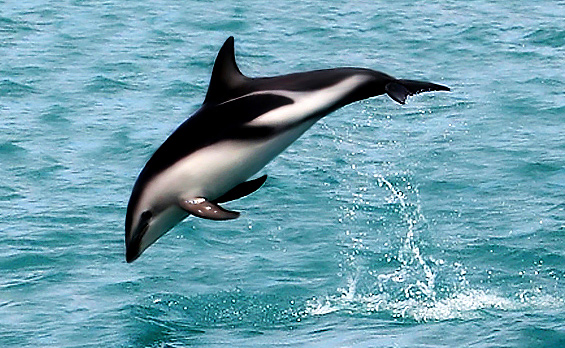
The species has a somewhat stocky build, with a short, pointed beak, curved dorsal fin and flippers, and between 108 and 144 small, conical teeth.[18] It has a distinctive colouration that resembles the Pacific white-sided dolphin, with a dark-grey or black upper side, orbital (eye) region, and beak; a light-grey face, chest area, and flank patch; and a white underside. The flank patch has an extension or blaze that reaches over the back and towards the blowhole.[4][13][18] The dorsal fin is darker in front and lightens towards the back; the flippers are light-grey with darker edges.[18] The dusky dolphin differs from the Pacific white-sided dolphin in having a more slender skull[20]: 37 and a shorter blaze.[13]
Distribution
[edit]
The dusky dolphin has a discontiguous range in the Southern Hemisphere;[18] including the coasts of western and southeastern South America, southwestern Africa, New Zealand, and some oceanic islands in the south Atlantic and Indian Ocean. It has also been sighted off southern Australia.[13]
Dusky dolphins can be found throughout New Zealand waters and are most common along the eastern coasts, between East Cape on the North Island and Timaru/Oamaru on the South Island. They are sighted year-round in the stable, cold waters off the coast of the northern Canterbury Region.[21] Off South America, they range from southern Peru to Cape Horn in the Pacific and then up to around 36°S in the Atlantic, along with the Falkland Islands,[13] where they are thought to be less abundant.[22] Off Africa, the dusky dolphin ranges from Lobito Bay, Angola, in the north to False Bay, South Africa, in the south.[13] Within Australian waters, dusky dolphins have been recorded off Kangaroo Island, eastern Tasmania, and in the Bass Strait,[23] although they are uncommon and may be transients from New Zealand.[24] Dusky dolphins are also found around the islands of Tristan da Cunha, Prince Edward, Crozet, Île Amsterdam, and Île Saint-Paul.[4][18]
Ecology and behaviour
[edit]
Dusky dolphins live mostly in coastal waters within the continental shelf and prefer cool, upwelling waters, as well as cold currents.[18][13][21] Dolphins off Argentina and New Zealand move to and from shore between day and night and between seasons.[13] Seasonal migrations have been recorded between Kaikōura and Admiralty Bay, New Zealand.[25][26] Around Kaikōura, the majority of individuals have only been seen once in the area over a 30-year period, suggesting high levels of immigration and emigration.[25] Dusky dolphins were recorded swimming up to 10 metres per second (36 km/h; 22 mph)[27] and diving up to 130 m (430 ft).[13]
Most studies of foraging and social behaviour in the species have been conducted at Kaikōura, Admiralty Bay, and San Jorge Gulf, Argentina.[26][28]: 565 Dusky dolphins live in a fission–fusion society and individuals move in and out of groups depending on social and environmental conditions.[26][29][30]: 1 At Kaikōura, group sizes can reach 1,000 dolphins,[28]: 565 while in Admiralty Bay, they peak at around 50 dolphins.[26] Groups form for different activities, including foraging, resting, travelling, and socialising.[30]: 3 At Kaikōura, groups are larger when resting and smaller when foraging,[28]: 565 but the reverse is true at San Jorge Gulf.[30]: 5 [31] At Admiralty Bay, foraging leads to larger aggregations; resting does not appear to correlate with group size.[26] Most associations between individuals are weak but long-term bonds do occur.[29]
Dusky dolphins can be found in mixed groups with other cetacean species, including common dolphins, southern right whales, Risso's dolphins, southern right whale dolphins, and pilot whales.[32]: 882 [20]: 41 [33] Off Argentina, they have been found around bottlenose dolphins, but seem to ignore them.[32]: 882 Dusky dolphins also feed with non-cetacean species such as South American sea lions, kelp gulls, cormorants, terns, shearwaters, petrels, albatrosses, and Magellanic penguins off Argentina, and Australasian gannets, shearwaters, terns, gulls, spotted shags, New Zealand fur seals, spiny dogfish, and common threshers off New Zealand.[34][35]: 123
Vocalisations and echolocation
[edit]Like other oceanic dolphins, dusky dolphins produce three basic types of sounds: echolocative click trains, burst pulses and tonal whistles.[36][37]: 77 Their echolocation signals are quick and broadband, much like in other whistle-producing species,[37]: 95 and have two peaks: between 40 and 50 kHz at low frequency and between 80 and 110 kHz at high frequency.[38] Burst pulses are similar to echolocation signals but the pauses between clicks are shorter, at 0.5–10 milliseconds.[37]: 81 Off New Zealand and Argentina, they often consist of 2–14 clicks in succession and appear to be important for communication.[36] Whistling is more common when dusky dolphins mingle with other dolphin species such as common dolphins.[37]: 78
Foraging
[edit]
Dusky dolphins mainly feed on fish and squid. Fish species eaten include anchovies, lantern fish, pilchards, sculpins, hakes, horse mackerel, hoki, and red cod; the squids they prey on include those of the genera Nototodarus, Todarodes, and Loligo.[13] Dusky dolphins are generally coordinated hunters, and their flexible foraging strategies can change depending on the environment.[39]: 103 In the Kaikōura Canyon, where deep oceanic waters meet the coast, they forage at night in deep scattering layers. Dolphins travel to the hunting site individually and form groups when in the layer. The number of individuals in these groups ranges up to five members and decreases to single dolphins as the layer descends down the water column.[40]
In San Jorge Gulf, between October and January, and Admiralty Bay, between August and November, dusky dolphins herd schools of fish into bait balls during the day.[35]: 116–119 [34] They use the water surface as a barrier for the fish as they circle around them.[32]: 885–886 [35]: 119–120 and may also scare them with sound or by flashing their white bellies.[35]: 121 The larger the group, the more effective dolphins are in herding the school.[41]: 219 These hunts may also involve other species, including other dolphins, seabirds, sharks, and pinnipeds.[41]: 213 [42]: 65 Common dolphins seem to participate in herding with dusky dolphins. By contrast, pinnipeds, sharks, and other predatory fish take food without helping in the hunt,[42]: 65 and foraging by diving birds like gannets can make herding more strenuous for dolphins.[41]: 219 From May to October in San Jorge Gulf and between May and July at Admiralty Bay, dusky dolphins hunt deeper below the surface.[34][43]
Reproduction and parenting
[edit]
Dusky dolphins reach sexual maturity between four and eight years depending on the region.[44]: 170 They have a polygynandrous mating system in which both males and females mate with multiple partners.[44]: 151–152 Hence, males have large testes for sperm competition.[44]: 164 [45]: 310–311 Mating groups typically consist of multiple males and one female; at Kaikōura, groups usually have a total of five members but can vary from two to fifteen.[46] They can be found in both shallow and deep water but more often congregate near shore.[44]: 162
Within a mating group, the males pursue a female in a high-speed chase. Females appear to prefer males with great speed and agility over size, strength, or aggression, and try to evade males that are less energetic and lack social skills.[44]: 164, 170, 175 Males also form alliances to capture females.[44]: 167–169 Off Kaikōura, dusky dolphins have been found to have scars and notches on their dorsal fins, thought to be caused by aggression between males and towards females during mating.[47] A study in the same area did not observe aggression in mating groups; males did not fight among themselves nor control who could be part of the group but did interfere with copulations.[48] During mating, female dusky dolphins usually take the top position.[44]: 170 Dusky dolphins also engage in non-reproductive sexual behaviour, including homosexual behaviour, perhaps for greeting, communication, or strengthening social bonds, and there is no high-speed chasing.[44]: 175
Female dusky dolphins off the coast of Peru were found to have gestation periods of over 12 months.[4] Calves are born during the spring (August to October) off Peru and in summer (November to February) off Argentina, South Africa, and New Zealand.[18] Females with calves tend to congregate in nursery groups, which may provide them more time to rest and facilitate socialisation among the young. Calves learn to hunt from their mothers, and nursery groups typically forage in shallow water because deeper water is too dangerous for young, particularly because of predators.[49]: 183, 188–191 Nursery groups keep away from mating groups, as adult males will aggressively chase mothers and leave calves dazed and vulnerable.[44]: 174 [49]: 185 Conversely, females with calves will associate with non-breeding adults in large groups.[45]: 318 Near Peru, calves may be weaned around 12 months, and the female can breed again less than four months after that.[4]
Aerial behaviour
[edit]
Dusky dolphins perform several kinds of leaping displays, which are classed into noisy, clean, acrobatic, and coordinated. Noisy leaps end in splashes upon re-entry and include back slaps, head slaps, side slaps, tail slaps and belly flops. For clean leaps, the dolphin leaps with the body vertical and lands with little to no splashing. These include headfirst re-entries and "humpings", both of which involve the dolphin leaving the water, arching its back and then flipping the tail before plunging headfirst. For humpings, the dolphin is arched after the nose enters the water and before the tail leaves. Acrobatic leaps are complex and consist of head-over-tail flips or somersaults and spins, both of which can cause splashes. Coordinated leaps are synchronised between two or more individuals.[32]: 879 [28]: 569 [50]: 1563
These leaps probably have several functions. One study in Admiralty Bay found that clean leaping may play a role in hunting prey, with coordinated leaps marking the end of the hunts and also perhaps serving a social function. Noisy leaps appear to cause more activity among the group.[28]: 573–575 The ability to make these leaps is apparently not inborn but learnt. Calves appear to learn jump styles in the following order: noisy leaps, clean leaps, coordinated leaps, and acrobatic leaps.[49]: 190–191 [50]: 1570
Mortality and health
[edit]Dusky dolphins may live 26–30 years.[20]: 39 They are preyed on by orcas and sharks and may swim into shallower water near shore where there is less risk of being attacked from below or the sides.[32]: 887–888 Dusky dolphins are also susceptible to internal parasitism by nematode, cestode, and trematode species.[42]: 67 [51][52] Off Peru, parasites include those of the genera Nasitrema and Anisakis, and the species Phyllobothrium delphini, Braunina cordiformis, and Pholeter gasterophilus;[51] a study of dolphins off Patagonia found that the most common parasites were Anisakis simplex, Braunina cordiformis, and species of the genus Hadwenius.[52] Dusky dolphins may suffer tattoo-like skin lesions caused by a poxvirus,[53] as well as genital diseases such as ovarian cysts, uterine tumours, vaginal stones and testicular lesions.[54] In a sample of dusky dolphins off Peru, 66% of them had genital warts caused by a papillomavirus.[55]
Interactions with humans
[edit]
Dusky dolphins are popular attractions for dolphin watching tours. In Patagonia, dolphin watching started as an alternative to whale watching, the dusky and Commerson's dolphins being the main attractions since 1997. In 2001, 90% of boat trips encountered dusky dolphins, up from 25% two years before.[56] Dusky dolphin watching is also popular in New Zealand, whose dolphin-watching industry started in the late 1980s as a side attraction to sperm whale watching. By 2010, the number of official whale- and dolphin-watching tour operators in the country had risen to around 75.[57]: 235–236
The presence of vessels has the potential to disrupt dusky dolphin activities. Dolphins may lose energy interacting with or avoiding vessels—energy they could use for socialising and feeding. Boats also create noise pollution, which makes it harder for dolphins to communicate.[58][59] As such, authorities have imposed regulations on tours, including limits on the number of permits as well as guidelines on approaching the animals.[57]: 241 [60] Dusky dolphins can also benefit from encounters with boats by riding the waves they produce (bow-riding), which saves energy while travelling.[61]
The building of mussel farms in Admiralty Bay seems to have led to a decline in the number and group size of dolphins passing through, and they herd prey less when near the farms.[62][63] These farms are also obstacles for echolocation. Dolphins rarely enter mussel farms, and when they do they quickly swim through them.[64]
Status
[edit]The dusky dolphin is classified as Least Concern by the IUCN Red List as many populations appear to be healthy and stable.[1] The dusky dolphin is listed in Appendix II of the Convention on the Conservation of Migratory Species of Wild Animals, meaning that it has an "unfavourable conservation status" and may require international cooperation organised by tailored agreements.[65][66] The total population is unknown;[20]: 24 off New Zealand, dusky dolphins may number around 12,000,[25] and over 6,500 dolphins have been counted from Valdés Peninsula to Puerto Deseado, Argentina.[67] One study found that dusky dolphins in Golfo Nuevo had an increasing population trend, with an average population growth of over 4% between 2004 and 2022.[68]
Dusky dolphins may fall victim to the illegal fisheries that kill small cetaceans off Peru and Chile. The expansion of these fisheries could have started in Peru when the anchoveta fishery collapsed in 1972.[1] Dusky dolphins are killed in large numbers (10,000–15,000 per year) for use as shark bait or for human consumption. This has led to a status of Vulnerable for the Peruvian subspecies.[69] Off New Zealand, gill nets have also been a threat, though bycatches seem to have decreased since the 1970s and 1980s.[13] Compared to marine mammals living more to the north, dusky dolphins are less contaminated by marine pollutants like DDT and persistent organic pollutants.[57]: 224
See also
[edit]References
[edit]- ^ a b c Alafaro-Shiguieto, J.; Crespo, E.; Elwen, S.; Lundquist, D.; Mangel, J. (2020) [errata version of 2019 assessment]. "Lagenorhynchus obscurus". IUCN Red List of Threatened Species. 2019 e.T11146A175604493. doi:10.2305/IUCN.UK.2019-3.RLTS.T11146A175604493.en. Retrieved 17 June 2024.
- ^ "Appendices |". cites.org. Archived from the original on 5 December 2017. Retrieved 14 January 2022.
- ^ "Lagenorhynchus obscurus Gray 1828 (dolphin)". The Paleobiology Database. Retrieved 20 March 2025.
- ^ a b c d e f g h i Brownell, R. L. Jr.; Cipriano, F. (1998). "Dusky Dolphin Lagenorhynchus obscurus (Gray, 1828)". In Ridgway, S. H.; Harrison, R. (eds.). Handbook of Marine Mammals: The Second Book of Dolphins and the Porpoises. Vol. 6: The Second Book of Dolphins and the Porpoises. Elsevier. pp. 85–95. ISBN 0-12-588506-7.
- ^ a b c d Harlin-Cognato, A. D. (2010). "Dusky Dolphins' Place in the Delphinid Family Tree". In Würsig, B.; Würsig, M. (eds.). The Dusky Dolphin: Master Acrobat off Different Shores. Academic Press. pp. 1–19. ISBN 978-0-12-373723-6.
- ^ True, F. W. (1889). "Contribution to the natural history of the cetaceans: a review of the family Delphinidae". Bulletin of the United States National Museum (36): 1–191. doi:10.5479/si.03629236.36.1. hdl:2027/hvd.32044066292764. Archived from the original on 30 October 2019. Retrieved 22 September 2019.
- ^ a b c Vollmer, Nicole L.; Ashe, Erin; Brownell, Robert L.; Cipriano, Frank; Mead, James G.; Reeves, Randall R.; Soldevilla, Melissa S.; Williams, Rob (2019). "Taxonomic revision of the dolphin genus Lagenorhynchus". Marine Mammal Science. 35 (3): 957–1057. Bibcode:2019MMamS..35..957V. doi:10.1111/mms.12573. ISSN 1748-7692. S2CID 92421374. Archived from the original on 11 November 2021. Retrieved 13 July 2021.
- ^ LeDuc, R. G.; Perrin, W. F.; Dizon, A. E. (1999). "Phylogenetic relationships among the delphinid cetaceans based on full cytochrome b sequences". Marine Mammal Science. 15 (3): 619–648. Bibcode:1999MMamS..15..619L. doi:10.1111/j.1748-7692.1999.tb00833.x.
- ^ May-Collado, L.; Agnarsson, I. (2006). "Cytochrome b and Bayesian inference of whale phylogeny". Molecular Phylogenetics and Evolution. 38 (2): 344–354. Bibcode:2006MolPE..38..344M. doi:10.1016/j.ympev.2005.09.019. PMID 16325433.
- ^ McGowen, M. R.; Tsagkogeorga, G; Álvarez-Carretero, S; dos Reis, M; Struebig, M; Deaville, R; Jepson, P. D.; Jarman, S; Polanowski, A; Morin, P. A.; Rossiter, S. J. (2020). "Phylogenomic resolution of the cetacean tree of life using target sequence capture". Systematic Biology. 69 (3): 479–501. doi:10.1093/sysbio/syz068. PMC 7164366. PMID 31633766.
- ^ a b c Galatius, A; Kinze, C. C.; Olsen, M. T.; Tougaard, J; Gotzek, D; McGowen, M. R. (2025). "Phylogenomic, morphological and acoustic data support a revised taxonomy of the lissodelphinine dolphin subfamily". Molecular Phylogenetics and Evolution. 205 108299. Bibcode:2025MolPE.20508299G. doi:10.1016/j.ympev.2025.108299. PMID 39914763.
- ^ a b "List of Marine Mammal Species and Subspecies". Society for Marine Mammalogy. 13 November 2016. Archived from the original on 27 November 2020. Retrieved 14 July 2021.
- ^ a b c d e f g h i j k Waerebeek, K. V.; Wursi, B. (2008). "Dusky Dolphin Lagenorhynchus obscurus". In Perrin, W. F.; Wursig, B.; Thewissen, J. G. M. (eds.). Encyclopedia of Marine Mammals (2nd ed.). Academic Press. pp. 335–337. ISBN 978-0-12-373553-9.
- ^ Harlin-Cognato, A. D.; Markowitz, T; Würsig, B; Honeycutt, R. L. (2007). "Multi-locus phylogeography of the dusky dolphin (Lagenorhynchus obscurus): passive dispersal via the west-wind drift or response to prey species and climate change". BMC Evolutionary Biology. 7 (1): 131. Bibcode:2007BMCEE...7..131H. doi:10.1186/1471-2148-7-131. PMC 1973136. PMID 17683557.
- ^ Reyes, Julio C. (1996). "A possible case of hybridism in wild dolphins". Marine Mammal Science. 12 (2): 301–307. Bibcode:1996MMamS..12..301R. doi:10.1111/j.1748-7692.1996.tb00581.x.
- ^ Yazdi, Parissa (2002). "A possible hybrid between the dusky dolphin (Lagenorhynchus obscurus) and the southern right whale dolphin (Lissodelphis peronii)" (PDF). Aquatic Mammals. 28: 211–217. Archived from the original (PDF) on 9 December 2022. Retrieved 3 February 2011.
- ^ "List of Proposed, Un-named Marine Mammal Species and Subspecies". Society for Marine Mammalogy. Archived from the original on 14 December 2023. Retrieved 14 July 2021.
- ^ a b c d e f g h i Jefferson, Thomas A.; Webber, Marc A.; Pitman, Robert L. (2015). Marine Mammals of the World: A Comprehensive Guide to Their Identification (2nd ed.). Academic Press. pp. 293–296. ISBN 978-0-12-409542-7.
- ^ Manzanilla-Naim, S. (1989). "The 1982–1983 El Niño event recorded in dentinal growth layers in teeth of Peruvian dusky dolphins (Lagenorhynchus obscurus)". Canadian Journal of Zoology. 67 (9): 2120–2125. Bibcode:1989CaJZ...67.2120M. doi:10.1139/z89-301.
- ^ a b c d e Cipriano, F.; Webber, M. (2010). "Dusky Dolphin Life History and Demography". In Würsig, B.; Würsig, M. (eds.). The Dusky Dolphin: Master Acrobat off Different Shores. Academic Press. pp. 21–48. ISBN 978-0-12-373723-6.
- ^ a b Gaskin, D. E. (1972). Whales, Dolphins and Seals with Special Reference to the New Zealand Region. Heinemann Educational. pp. 124–126. ISBN 0-423-62285-4.
- ^ Weir, C. R.; Black, A. (2018). "Records of the dusky dolphin (Lagenorhynchus obscurus) in the Falkland Islands, including associations with Peale's dolphin (L. australis)". Marine Biodiversity Records. 11 (18) 18. Bibcode:2018MBdR...11...18W. doi:10.1186/s41200-018-0153-2.
- ^ Menkhorst, Peter (2001). A Field Guide to Mammals of Australia. South Melbourne, Victoria: Oxford University Press. pp. 226–227. ISBN 0-19-550870-X.
- ^ Gill, Peter C.; Ross, Graham J. B.; Dawbin, William H.; Wapstra, Hans (2000). "Confirmed sightings of dusky dolphins (Lagenorhynchus Obscurus) in southern Australian waters". Marine Mammal Science. 16 (2): 452–459. Bibcode:2000MMamS..16..452G. doi:10.1111/j.1748-7692.2000.tb00937.x.
- ^ a b c Orbach, D. N.; Pearson, H. C.; Engelhaupt, A.; Deutsch, S.; Srinivasan, M.; Weir, J. S.; Yin, S.; Würsig, B. (2018). "Long-term assessment of spatio-temporal association patterns of dusky dolphins (Lagenorhynchus obscurus) off Kaikōura, New Zealand". Aquatic Mammals. 44 (6): 608–619. Bibcode:2018AqMam..44..608O. doi:10.1578/AM.44.6.2018.608.
- ^ a b c d e Pearson, H. C. (2009). "Influences on dusky dolphin (Lagenorhynchus obscurus) fission-fusion dynamics in Admiralty Bay, New Zealand". Behavioral Ecology and Sociobiology. 63 (10): 1437–1446. Bibcode:2009BEcoS..63.1437P. doi:10.1007/s00265-009-0821-7.
- ^ Davis, R. W.; Fiori, L; Würsig, B; Orbach, D. N. (2024). "Drag reduction and locomotory power in dolphins: Gray's paradox revealed". Journal of the Royal Society Interface. 21 (218) 20240227. doi:10.1098/rsif.2024.0227. PMC 11463224. PMID 39257283.
- ^ a b c d e Pearson, H. C. (2017). "Unravelling the function of dolphin leaps using the dusky dolphin (Lagenorhynchus obscurus) as a model species". Behaviour. 154 (5): 563–581. doi:10.1163/1568539X-00003434. JSTOR 26363105.
- ^ a b Pearson, H. C.; Markowitz, T. M.; Weir, J. S.; Würsig, B. (2017). "Dusky dolphin (Lagenorhynchus obscurus) social structure characterized by social fluidity and preferred companions". Marine Mammal Science. 33 (1): 251–276. Bibcode:2017MMamS..33..251P. doi:10.1111/mms.12370.
- ^ a b c Degrati, M.; Coscarella, M. A.; Crespo, E. A.; Dans, S. L. (2019). "Dusky dolphin group dynamics and association patterns in Península Valdés, Argentina". Marine Mammal Science. 35 (2): 416–433. Bibcode:2019MMamS..35..416D. doi:10.1111/mms.12536.
- ^ Degrati, M; Dans, S; Pedraza, S. N.; respo, E. A.; Garaffo, G. V. (2008). "Diurnal behavior of dusky dolphins, Lagenorhynchus obscurus, in Golfo Nuevo, Argentina". Journal of Mammalogy. 89 (5): 1241–1247. doi:10.1644/07-MAMM-A-110.1. hdl:11336/100653.
- ^ a b c d e Würsig, B.; Würsig, M. (1980). "Behavior and ecology of the dusky dolphin, Lagenorhynchus obscurus, in the South Atlantic" (PDF). Fishery Bulletin. 77: 871–890. Archived (PDF) from the original on 1 April 2011. Retrieved 3 February 2011.
- ^ Curcio, N. S.; Svendsen, G. M.; Bartes, S; Romero, M. A.; Arias, M; González, R. A.; Dans, S. L. (2023). "Group dynamics and activity patterns of two dolphin species, the common dolphin (Delphinus delphis) and dusky dolphin (Lagenorhynchus obscurus) in direct sympatry". Journal of Mammalogy. 104 (5): 1096–1111. doi:10.1093/jmammal/gyad045.
- ^ a b c Vaughn, R. L.; Shelton, D. E.; Timm, L. L.; Watson, L. A.; Würsig, B. (2007). "Dusky dolphin (Lagenorhynchus obscurus) feeding tactics and multi-species associations". New Zealand Journal of Marine and Freshwater Research. 41 (4): 391–400. Bibcode:2007NZJMF..41..391V. doi:10.1080/00288330709509929.
- ^ a b c d Dahood, A. D.; Beniot-Bird, K. J. (2010). "Dusky Dolphins Foraging in Daylight". In Würsig, B.; Würsig, M. (eds.). The Dusky Dolphin: Master Acrobat off Different Shores. Academic Press. pp. 115–132. ISBN 978-0-12-373723-6.
- ^ a b Vaughn-Hirshorn, R. L.; Hodge, K. B.; Würsig, B.; Sappenfield, R. H.; Lammers, M. O.; Dudzinski, K. M. (2012). "Characterizing dusky dolphin sounds from Argentina and New Zealand". The Journal of the Acoustical Society of America. 132 (1): 498–506. Bibcode:2012ASAJ..132..498V. doi:10.1121/1.4728191. PMID 22779496.
- ^ a b c d Au, W. W. L.; Lammer, M. O.; Yin, S. (2010). "Acoustics of Dusky Dolphins (Lagenorhynchus obscurus)". In Würsig, B.; Würsig, M. (eds.). The Dusky Dolphin: Master Acrobat off Different Shores. Academic Press. pp. 75–98. ISBN 978-0-12-373723-6.
- ^ Au, W. W. L.; Würsig, B. (2004). "Echolocation signals of dusky dolphins (Lagenorhynchus obscurus) in Kaikōura, New Zealand". The Journal of the Acoustical Society of America. 115 (5 Pt 1): 2307–2313. Bibcode:2004ASAJ..115.2307A. doi:10.1121/1.1690082. PMID 15139642.
- ^ Dahood, A. D.; Beniot-Bird, K. J. (2010). "Dusky Dolphins Foraging at Night". In Würsig, B.; Würsig, M. (eds.). The Dusky Dolphin: Master Acrobat off Different Shores. Academic Press. pp. 99–114. ISBN 978-0-12-373723-6.
- ^ Benoit-Bird, K. J.; Würsig, B.; McFadden, C. J. (2004). "Dusky dolphin (Lagenorhynchus obscurus) foraging in two different habitats: active acoustic detection of dolphins and their prey" (PDF). Marine Mammal Science. 20 (2): 215–231. Bibcode:2004MMamS..20..215B. doi:10.1111/j.1748-7692.2004.tb01152.x. Archived (PDF) from the original on 27 November 2010. Retrieved 3 February 2011.
- ^ a b c Vaughn, R.; Würsig, B.; Packard, J. (2009). "Dolphin prey herding: Prey ball mobility relative to dolphin group and prey ball sizes, multispecies associates, and feeding duration". Marine Mammal Science. 26 (1): 213–225. doi:10.1111/j.1748-7692.2009.00317.x.
- ^ a b c Dans, S. L.; Crespo, E. A.; Koen-Alonso, M.; Markowitz, T. M.; Vera, B. B.; Dahood, A. D. (2010). "Dusky Dolphins Trophic Ecology: Their Role in the Food Web". In Würsig, B.; Würsig, M. (eds.). The Dusky Dolphin: Master Acrobat off Different Shores. Academic Press. pp. 49–74. ISBN 978-0-12-373723-6.
- ^ Degrati, M.; Dans, S. L.; Garaffo, G. V.; Crespo, E. A. (2012). "Diving for food: a switch of foraging strategy of dusky dolphins in Argentina". Journal of Ethology. 30 (3): 361–367. doi:10.1007/s10164-012-0333-1. hdl:11336/72954.
- ^ a b c d e f g h i Markowitz, T. M.; Markowitz, W. J.; Morton, L. M. (2010). "Mating Habits of New Zealand Dusky Dolphins". In Würsig, B.; Würsig, M. (eds.). The Dusky Dolphin: Master Acrobat off Different Shores. Academic Press. pp. 151–176. ISBN 978-0-12-373723-6.
- ^ a b Markowitz, T. M.; Markowitz, W. J.; Würsig, B; Orbach, D. N. (2023). "Sociosexual Behavior of Nocturnally Foraging Dusky and Spinner Dolphins". In Würsig, B; Orbach, D. N. (eds.). Sex in Cetaceans. Springer. pp. 307–325. ISBN 978-3-031-35650-6.
- ^ Orbach, D. N.; Packard, J. M.; Würsig, B. (2014). "Mating group size in dusky dolphins (Lagenorhynchus obscurus): costs and benefits of scramble competition". Ethology. 120 (8): 804–815. Bibcode:2014Ethol.120..804O. doi:10.1111/eth.12253.
- ^ Kügler, A; Orbach, D. N. (2014). "Sources of notch and scar patterns on the dorsal fins of dusky dolphins (Lagenorhynchus obscurus)". Aquatic Mammals. 40 (3): 260–273. Bibcode:2014AqMam..40..260K. doi:10.1578/AM.40.3.2014.260.
- ^ Orach, D. N.; Eaton, J.; Fiori, L.; Piwetz, S.; Wier, J. S.; Würsig, M.; Würsig, B. (2020). "Mating patterns of dusky dolphins (Lagenorhynchus obscurus) explored using an unmanned aerial vehicle". Marine Mammal Science. 36 (4): 1097–1110. Bibcode:2020MMamS..36.1097O. doi:10.1111/mms.12695.
- ^ a b c Weir, J.; Deutsch, S.; Pearson, H. C. (2010). "Dusky Dolphin Calf Rearing". In Würsig, B.; Würsig, M. (eds.). The Dusky Dolphin: Master Acrobat off Different Shores. Academic Press. pp. 177–194. ISBN 978-0-12-373723-6.
- ^ a b Deutsch, S.; Pearson, H.; Würsig, B. (2014). "Development of leaps in dusky dolphin (Lagenorhynchus obscurus) calves". Behaviour. 151 (11): 1555–1577. doi:10.1163/1568539X-00003200. JSTOR 24526341.
- ^ a b Van Waerebeek, K.; Reyes, J. C.; Alfaro, J. (1993). "Helminth parasites and phoronts of dusky dolphins Lagenorhynchus obscurus (Gray, 1828) from Peru" (PDF). Aquatic Mammals. 19 (3): 159–169. Archived from the original (PDF) on 4 September 2011. Retrieved 3 February 2011.
- ^ a b Dans, S. L.; Reyes, L. M.; Pedraza, S. N.; Raga, J. A.; Crespo, E. A. (1999). "Gastrointestinal helminths of the dusky dolphin, Lagenorhynchus obscurus (Gray, 1828), off Patagonia, in the southwestern Atlantic". Marine Mammal Science. 15 (3): 649–660. Bibcode:1999MMamS..15..649D. doi:10.1111/j.1748-7692.1999.tb00834.x.
- ^ Van Bressem, M-F; Van Waerebeek, K; Reyes, J. C.; Dekegal, D (1993). "Evidence of poxvirus in dusky dolphin (Lagenorhynchus obscurus) and Burmeister's porpoise (Phocoena spinipinnis) from Coastal Peru". Journal of Wildlife Diseases. 29 (1): 109–113. doi:10.7589/0090-3558-29.1.109. PMID 8383251.
- ^ Van Bressem, M-F; Van Waerebeek, K; Siebert, U; Wünschmann, A; Chávez-Lisambart, L; Reyes, J. C. (2000). "Genital diseases in the Peruvian dusky dolphin (Lagenorhynchus obscurus)". Journal of Comparative Pathology. 122 (4): 266–277. doi:10.1053/jcpa.1999.0369. PMID 10805980.
- ^ Van Bressem, M-F; Van Waerebeek, K; Piérard, G. E.; Desaintes, C (1996). "Genital and lingual warts in small cetaceans from coastal Peru". Diseases of Aquatic Organisms. 26: 1–10. doi:10.3354/dao026001.
- ^ Coscarella, M. A.; Dans, S. L.; Crespo, E. A.; Pedraza, S. N. (2003). "Potential impact of unregulated dolphin watching activities in Patagonia". Journal of Cetacean Research and Management. 5: 77–84. doi:10.47536/jcrm.v5i1.829.
- ^ a b c Markowitz, T. M.; Dans, S. L.; Crespo, E. A.; Lundquist, D. L.; Duprey, N. M. T. (2010). "Human Interactions with Dusky Dolphins: Harvest, Fisheries, Habitat Alteration, and Tourism". In Würsig, B.; Würsig, M. (eds.). The Dusky Dolphin: Master Acrobat off Different Shores. Academic Press. pp. 211–244. ISBN 978-0-12-373723-6..
- ^ Lundquist, D.; Gemmell, N. J.; Würsig, B. (2012). "Behavioural responses of dusky dolphin groups (Lagenorhynchus obscurus) to tour vessels off Kaikōura, New Zealand". PLOS ONE. 7 (7) e41969. Bibcode:2012PLoSO...741969L. doi:10.1371/journal.pone.0041969. hdl:1969.1/180588. PMC 3402466. PMID 22844536.
- ^ Dans, S. L.; Crespo, E. A.; Pedraza, S. N.; Degrati, M.; Garaffo, G. (2008). "Dusky dolphin and tourist interaction: Effect on diurnal feeding behavior". Marine Ecology Progress Series. 369: 287–296. Bibcode:2008MEPS..369..287D. doi:10.3354/meps07629.
- ^ "Argentina". Whale Watching Handbook. Retrieved 4 March 2025.
- ^ Fiori, L; Davies, R. W.; Würsig, B; Orbach, D. N. (2024). "Energetic savings of bow-riding dolphins". Scientific Reports. 14 (1): 30056. Bibcode:2024NatSR..1430056F. doi:10.1038/s41598-024-81920-y. PMC 11615280. PMID 39627448.
- ^ Pearson, H. C.; Vaughn-Hirshorn, R. L.; Srinivasan, M.; Würsig, B. (2012). "Avoidance of mussel farms by dusky dolphins (Lagenorhynchus obscurus) in New Zealand". New Zealand Journal of Marine and Freshwater Research. 46 (4): 567–574. Bibcode:2012NZJMF..46..567P. doi:10.1080/00288330.2012.712977.
- ^ Piwetz, S.; Pearson, H. C.; Honkus, K. A.; Würsig, B. (2024). "Dusky dolphin (Lagenorhynchus obscurus) habitat use in a mussel farming region and changes over time". New Zealand Journal of Marine and Freshwater Research. 59 (2): 418–440. doi:10.1080/00288330.2024.2334287. hdl:11122/14950.
- ^ Markowitz, Tim M.; Harlin, April D.; Würsig, Bernd; McFadden, Cynthia J. (2004). "Dusky dolphin foraging habitat: overlap with aquaculture in New Zealand". Aquatic Conservation: Marine and Freshwater Ecosystems. 14 (2): 133–149. Bibcode:2004ACMFE..14..133M. doi:10.1002/aqc.602.
- ^ "Appendix II Archived 11 June 2011 at the Wayback Machine" of the Convention on the Conservation of Migratory Species of Wild Animals (CMS). As amended by the Conference of the Parties in 1985, 1988, 1991, 1994, 1997, 1999, 2002, 2005 and 2008. Effective: 5 March 2009.
- ^ "Appendix I & II of CMS". the Convention on the Conservation of Migratory Species of Wild Animals. Retrieved 5 January 2025.
- ^ Schiavini, A; Pedraza, S. N.; Crespo, E. A.; González, R; Dans, S. L. (1999). "Abundance of dusky dolphins (Lagenorhynchus obscurus) off North and Central Patagonia, Argentina, in spring and a comparison with incidental catch in fisheries". Marine Mammal Science. 15 (3): 828–840. Bibcode:1999MMamS..15..828S. doi:10.1111/j.1748-7692.1999.tb00845.x.
- ^ Coronel-Montigel, B. M.; Loizaga, R; Degrati, M (2025). "Understanding the population dynamics of dusky dolphins (Lagenorhynchus obscurus) in Golfo Nuevo, Patagonia, through long-term monitoring". Aquatic Conservation: Marine and Freshwater Ecosystems. 35 (2) e70072. Bibcode:2025ACMFE..35E0072C. doi:10.1002/aqc.70072.
- ^ Mangel, J.; Alfaro-Shigueto, J. (2019). "Lagenorhynchus obscurus ssp. posidonia". IUCN Red List of Threatened Species. 2019 e.T134820643A151580809. doi:10.2305/IUCN.UK.2019-3.RLTS.T134820643A151580809.en. Retrieved 17 June 2024.
External links
[edit]
- ARKive – images and movies of the dusky dolphin (Lagenorhynchus obscurus)
- Whale and Dolphin Conservation Society


| Authority control databases: National |
|---|
