Hubbry Logo
Atlantic white-sided dolphinAtlantic white-sided dolphinMain
Open search
Atlantic white-sided dolphin
Community hub
Atlantic white-sided dolphin
logo
8 pages, 0 posts
0 subscribers
Be the first to start a discussion here.
Atlantic white-sided dolphin
from Wikipedia

Atlantic white-sided dolphin
Size compared to an average human
CITES Appendix II (CITES)[2]
Scientific classification Edit this classification
Kingdom: Animalia
Phylum: Chordata
Class: Mammalia
Order: Artiodactyla
Infraorder: Cetacea
Family: Delphinidae
Genus: Leucopleurus
Gray, 1866
Species:
L. acutus
Binomial name
Leucopleurus acutus
(Gray, 1828)
  Atlantic white-sided dolphin range

The Atlantic white-sided dolphin (Leucopleurus acutus) is a distinctively coloured dolphin found in the cool to temperate waters of the North Atlantic Ocean.

Description

[edit]
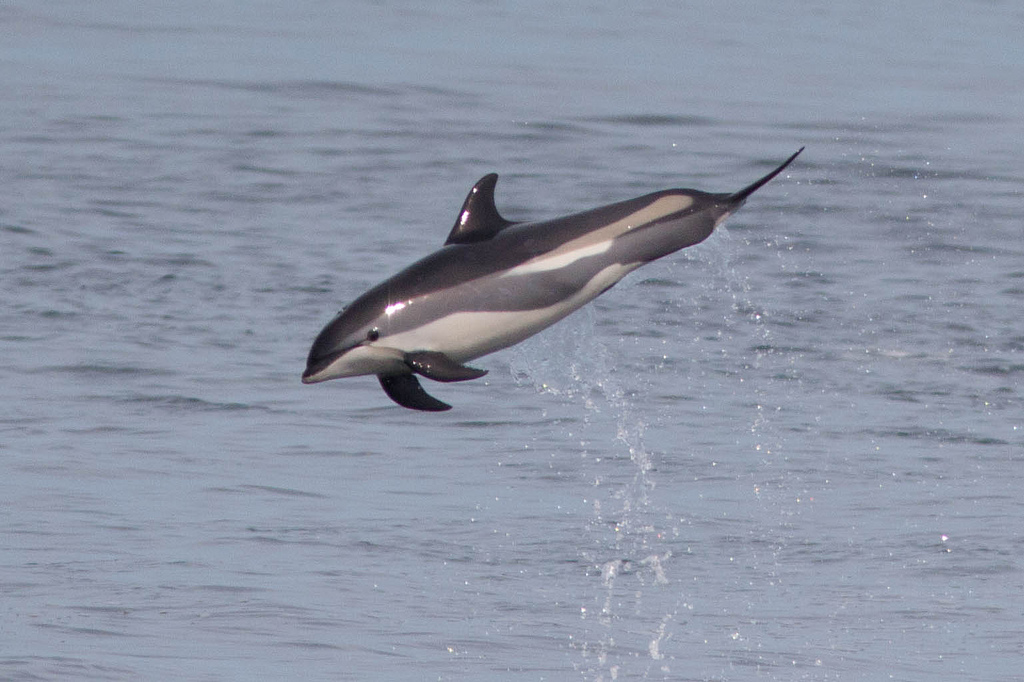
An Atlantic white-sided dolphin off the coast of Cape Ann, Massachusetts

The Atlantic white-sided dolphin is a relatively small dolphin. At birth, calves measure just over a meter long; adult males grow to about 2.8 m (9.2 ft), and females to about 2.5 m (8.2 ft),[3] weighing between 180–230 kg (400- 510 lb) once fully grown.[3] Females reach sexual maturity between the ages of 6 and 12 years, and males between 7 and 11 years old.[4][5] The gestation period is 11 months and lactation lasts for about 18 months — both typical figures for dolphins.[3] Atlantic white-sided dolphins are known to live for at least 17 years.[3]

The key distinguishing feature is the dolphin's coloration—a white to pale-yellow patch is found behind the dorsal fin on both sides of the body.[3] The white-sided dolphin's color variations are unique amongst the standard hues of white, grey, black and blue seen on other pelagic cetaceans.[3] Their body's coloration is well-demarcated, with the chin, throat and belly being white; the flippers, dorsal fin and back are dark-grey to black (with the exception of the yellow patch), and there is a further white patch below the dorsal fin (lying above a lighter, grayish stripe running from the beak, above the eye, down to the tail stock).[3]

Dolphin pod sizes vary by location, with groups averaging 60 in number having been seen close to the Newfoundland coastline, but somewhat smaller east of Iceland.[3] From the analysis of the stomach contents of stranded animals, fishes, such as herring and mackerel, and squid appear to be the species' main prey.[3] The Atlantic white-sided dolphin is fairly acrobatic, and keen to interact with boats; however, it is not as wildly gregarious as the white-beaked, bottlenose or common dolphins.[3]

Geographic range and distribution

[edit]

The species is endemic to the northern Atlantic Ocean.[3] The distribution limits are the Norwegian Sea in the northeast, the Davis Strait in the northwest, coastal North Carolina in the southwest and the Celtic Sea in the southeast (with possible range extension south to the Azores).[3] Areas of particularly high population density include the shores of Newfoundland and Cape Cod, the triangular area of sea between the United Kingdom, Iceland and Greenland and the northern North Sea.[6][7][8] In 2008, sightings of Atlantic white-sided dolphins, as well as the melon-headed whale, were documented off South Carolina after a few strandings had taken place in the area at the time.[9] Along the North American east coast the species tends to occur in continental shelf waters, around 100m in depth,[10] and seem to show a preference toward areas of steep slopes and canyons.[11][12] They are associated with the colder, slightly less saline waters in the northern Atlantic, compared to for example common dolphins that are found in warmer, slightly more saline waters of the North Atlantic, though it is unclear whether this is due to preferences or if these factors influence prey supply.[13][14]

Behaviour

[edit]

Foraging

[edit]

The diet of Atlantic white-sided dolphins mainly consists of herring, hake and squid.[3] However, as opportunistic carnivores, they consume a large variety of prey, including smaller mackerel and various bottom-dwelling fish.[3] They have been observed cooperatively hunting at the surface.[3] It has been suggested that larger groups split while feeding.[11]

Social behaviour

[edit]

Like all species of the dolphin family, Atlantic white-sided dolphins are very social animals, often traveling in large pods and displaying aerial behaviors as they travel.[15] The pod's size can vary, from several dozen to several hundred individuals, though the average size is around 50.[16] However, studies have shown there to be little familial relation between members of a group, appearing more as a social pod traveling for "safety in numbers". Researchers in different parts of their range have found that individuals were, mostly, unrelated to one another.[17][18] Juveniles spend at least some time in separate social groups, away from their parents, prior to weaning.[3] Atlantic white-sided dolphins jump and breach more frequently when in larger groups, as this behaviour might have a social context.[15] They have a wide vocal repertoire which includes squeals, whistles, clicks and buzzes.[16][19] It is suggested that vocalisation is used for communication as noise production increases during socialising.[19]

Despite being docile creatures, even known to interact with various species of cetacean in a nonviolent manner, most notably with the long-finned pilot whale (Globicephala melas),[20] they have also been known to display violent behavior towards harbor porpoises, attacking them until they eventually succumb to their wounds (a similar behavior as observed in bottlenose dolphins).[21][22]

Migration

[edit]

Atlantic white-sided dolphins do not undertake specific seasonal migration.[11] However, they do move within their home range following prey distribution.[11] For example, in the waters off eastern North America this species moves southwards in winter and spring.[3][7]

Reproduction

[edit]

Most of the calves are born around June and July.[3] The gestation period is 11 months and lactation around 18 months.[3] The birth interval varies between 1–3 years.[10]

Females reach sexual maturity around the age of 6–12 years.[4] Males reach sexual maturity around 7–11 years.[5] The reproduction is most likely seasonal, beginning in February, as some studies have identified dormant testes in some males.[5]

Taxonomy

[edit]
3d model of skeleton

The Atlantic white-sided dolphin was named by John Edward Gray in 1828. The specific name acutus comes from the Latin for 'pointed' and refers to the sharply pointed dorsal fin.[3] It was traditionally placed in the genus Lagenorhynchus, but there was consistent molecular evidence that supports the Atlantic white-sided dolphin and the white-beaked dolphin as basal members of the family Delphinidae and not closely related.[23][24] In 2025 the Atlantic white-sided dolphin was therefore moved to its own genus, Leucopleurus.[25][26]

Population status

[edit]

The estimations for the U.S. shelf and shelf-edge water suggest that the population size is about 300,000.[3] Additional 120,000 individuals have been estimated to spend summer in the Gulf of St.Lawrence.[3] In the eastern North America waters the numbers increase southwards in winter and spring in association with cold waters from the Gulf of Maine.[3] Two projects attempted to estimate the population trends - multinational Small Cetacean Abundance in the North Sea and Adjacent Waters (SCANS) survey project and the North Atlantic Sightings Survey (NASS). SCANS surveys, however, failed to produce species specific estimation as it combined both white-sided and white-beaked dolphins. NASS surveys did not indicate any population trends.

Threats

[edit]
Hvalba, Faroe Islands in August 2006

Whaling

[edit]

Historically, Atlantic white-sided dolphins were killed in drives conducted from Norway and Newfoundland.[27] These have ceased in recent years, although they still occur to a lesser extent from the Faroe Islands, where the meat and blubber are in high regard as food.[28] Reported catches in the years vary, though individual years suddenly stand out, such as in 2002, where the number reported killed was 773,[29] and in 2017, when 488 were killed.[28] In September 2021, a large pod of 1,428 animals was herded in Skálafjördur and killed.[30]

Annual number taken of white-sided dolphin in the Faroe Islands in the period 1980-2009 [29]
Year No/yr drive/yr Year No/yr drive/yr Year No/yr drive/yr
1980 8 1 1993 377 6 2001 546 7
1983 10 1 1994 263 7 2002 773 10
1985 32 1 1995 157 4 2003 186 5
1986 185 4 1996 357 7 2004 333 5
1987 76 2 1997 350 10 2005 312 4
1988 603 4 1998 438 4 2006 622 8
1990 55 2 1998 438 4 2008 1 1
1992 47 3 2000 265 3 2009 171 5

Entanglement and by catch

[edit]

Atlantic white-sided dolphins have also been killed in incidental catch situations in the fishing industry. Such occurrences have been reported in Canada, United States, United Kingdom and Ireland.[1] Between 1977 and 1988, 13 Atlantic white-sided dolphins were reported as being incidentally caught in the Northeastern United States by U.S fisheries observers, 11 of these in Mackerel fisheries.[31] They have also been reported to get caught in pelagic or near surface trawl or drift nets.[11][16]

Noise

[edit]

Anthropogenic underwater noise is a potential disturbance to Atlantic white-sided dolphins as they use sounds to communicate and catch prey.[19] A survey done in the UK showed that the sighting rate of Atlantic white-sided dolphins declines when airguns were firing compared to when they were not.[19]

Pollution

[edit]

Persistent organic pollutants (POPs) such as PCBs and organochlorine pesticides (e.g. DDT, DDE) and polybrominated diphenyl ether (PBDE) flame retardants have been identified in body tissues of Atlantic white-sided dolphins throughout their range.[6][32][33][34] Males had higher levels of PCBs suggesting that females pass some of the contamination to offspring during lactation[30]. Similarly to other species, studies have identified heavy metals in Atlantic white-sided dolphins including cadmium levels higher than in other dolphin species in southern latitudes.[35] The full effect of this contamination is currently unknown.

Conservation status

[edit]

The International Union of the Conservation of Nature (IUCN) currently classifies Atlantic white-sided dolphins as Least Concern.[1]

The North and Baltic Sea populations of the Atlantic white-sided dolphin are listed on Appendix II [36] of the Convention on the Conservation of Migratory Species of Wild Animals (CMS). They are listed on Appendix II[36] as they have an unfavourable conservation status or would benefit significantly from international co-operation organised by tailored agreements.[37] These species of dolphin are known to fall victims to in a polluted environment, a study from 1997 confirmed that the British and Irish populations of Atlantic white-sided dolphins to succumb to these effects.[6][38] [clarification needed]

In addition, the Atlantic white-sided dolphin is covered by the Agreement on the Conservation of Small Cetaceans of the Baltic, North East Atlantic, Irish and North Seas (ASCOBANS).[39]

See also

[edit]

References

[edit]
[edit]
Revisions and contributorsEdit on WikipediaRead on Wikipedia
from Grokipedia
The (Lagenorhynchus acutus) is a medium-sized species of endemic to the temperate and subpolar waters of the , where it primarily inhabits areas up to depths of 100 meters. Distinguished by its robust body, short dark beak, tall falcate , and characteristic white flank patches bordered above by a tan or band, adults typically reach lengths of 2.5 to 2.8 meters and weights of 230 to 350 kilograms. Their lifespan averages 17 to 20 years, with maximum recorded ages around 28 years. Highly social animals, they form fluid pods of 20 to 50 individuals that can coalesce into superpods exceeding 1,000 members, often displaying energetic surface behaviors including breaching and bow-riding vessels. The species preys mainly on small schooling fish such as and , supplemented by squid and occasionally crustaceans. Despite localized threats from fisheries and historical hunting, Atlantic white-sided dolphins maintain a wide distribution and abundant populations, earning a Least Concern status on the .

Taxonomy and phylogeny

Classification history

The Atlantic white-sided dolphin was first described scientifically in 1828 by British zoologist , who named it Delphinus acutus based on specimens collected from the North . Gray subsequently established the genus Lagenorhynchus in 1846 and transferred the species to it as Lagenorhynchus acutus, recognizing its distinct morphological features such as the white flank patches and robust body form distinguishing it from other delphinids. This classification persisted through much of the 19th and 20th centuries, with Lagenorhynchus encompassing six dolphin species characterized by similar cranial and vertebral traits, though early synonymies included brief placements under Leucopleurus proposed by Gray in 1866 for species with pronounced flank markings. Morphological analyses in the late began questioning the of Lagenorhynchus, noting inconsistencies in osteological characters like beak length and shape across species. Molecular phylogenetic studies from the early 2000s, using and nuclear markers, provided stronger evidence of , revealing that L. acutus clusters more closely with southern hemisphere Cephalorhynchus species than with northern Lagenorhynchus congeners like the (L. albirostris). These findings indicated in cold-water adaptations rather than shared ancestry, challenging the genus's validity. A comprehensive taxonomic revision published in 2019 by Vollmer et al. synthesized morphological, genetic, and ecological data to propose splitting Lagenorhynchus, retaining the genus solely for L. albirostris and reassigning L. acutus to the revived Leucopleurus Gray, as Leucopleurus acutus. This revision emphasized L. acutus's phylogenetic affinity to Cephalorhynchus based on sequences and 28S rRNA, while noting its larger size and oceanic habitat as derived traits. Adoption has been uneven: the for Marine Mammalogy and recognize Leucopleurus acutus, reflecting the molecular evidence's weight over traditional morphology. However, agencies like NOAA Fisheries continue using Lagenorhynchus acutus pending broader consensus, citing the need for additional genomic data to resolve basal relationships within Delphinidae. No further revisions have gained traction as of 2024, though ongoing phylogenomic studies may refine the classification.

Recent taxonomic revisions

In 2019, a taxonomic revision of the Lagenorhynchus was proposed based on integrated analyses of mitochondrial and nuclear DNA sequences, morphology, and vocalizations, revealing the to be polyphyletic and necessitating reassignment of five of its six to other genera. The Atlantic white-sided dolphin (L. acutus) was recommended for transfer to the resurrected Leucopleurus, originally described by Gray in 1846, due to its distinct phylogenetic clustering with certain southern hemisphere rather than the northern L. albirostris (), which was retained in Lagenorhynchus. This proposal addressed longstanding inconsistencies in Lagenorhynchus phylogeny, where molecular data had repeatedly shown non-monophyly since the early 2000s. Subsequent adoption varied; the updated its classification to Leucopleurus acutus in 2022, reflecting acceptance of the evidence-based reassignments. However, some authoritative bodies, including NOAA Fisheries stock assessments as late as 2021, retained the traditional Lagenorhynchus acutus , citing the need for broader consensus before formal implementation in conservation and management contexts. A 2025 phylogenomic study reinforced the 2019 revision through expanded genomic sampling, morphological comparisons, and acoustic analyses of the , confirming Leucopleurus acutus as a valid placement and highlighting in rostral morphology that had previously obscured relationships. No further revisions specific to L. acutus have been proposed since, though ongoing genomic efforts continue to refine delphinid phylogenies.

Physical description

Morphology and coloration

The Atlantic white-sided dolphin possesses a robust, stocky body form typical of the Lagenorhynchus, characterized by a relatively short rostrum that transitions smoothly into the forehead. It features a prominent falcate , sickle-shaped pectoral fins, and a thick tailstock supporting small flukes. The beak is short but distinct, containing 30 to 40 pairs of pointed teeth in each jaw. Coloration is complex and distinctive, aiding in species identification. The dorsal surface, including the back, upper sides, upper jaw, , flippers, and flukes, is black to dark gray, often forming a "cape" pattern. A dark line extends from the eye toward the flipper, with black rings encircling the eyes. The sides are lighter gray, while the ventral surface is white, extending from the chin to the genital area and . A key distinguishing feature is the pale yellow to ochre patch on the flanks, located behind the and often extending anteriorly as a stripe from near the eye toward the tail, contrasting with the gray sides. This pattern varies slightly with age and condition but remains prominent in adults.

Size and sexual dimorphism

Adult Atlantic white-sided dolphins (Lagenorhynchus acutus) attain lengths of 2.3 to 2.8 meters, with males averaging larger than females at maximum lengths of approximately 2.8 meters for males and 2.5 meters for females. Weights range from 180 to 235 kilograms, showing corresponding sexual dimorphism where males are heavier, often exceeding 230 kilograms while females typically weigh around 180 kilograms at maturity. This size disparity constitutes marked sexual dimorphism, unusual among pelagic dolphins, as evidenced by samples from Faroese hunts indicating mature females at 206 cm and 180 kg. Newborn calves measure 1.08 to 1.22 meters in length and weigh about 25 kilograms. is reached at lengths of 230–240 cm for males and 201–222 cm for females, typically around 8–9 years of age. These metrics derive from direct measurements in strandings, hunts, and interactions, underscoring consistent male bias in asymptotic size across North Atlantic populations.

Habitat and distribution

Geographic range

The Atlantic white-sided dolphin (Lagenorhynchus acutus) is endemic to the , where it occupies cold-temperate to subpolar waters. Its distribution spans latitudes from approximately 35° N to 80° N, encompassing both sides of the ocean basin. In the western North Atlantic, the species ranges from coastal northward to central West Greenland and , with occasional sightings as far south as during winter months. In the eastern North Atlantic, populations are found from the and southern eastward to the , with concentrations around and the . The dolphin's range does not extend into the proper or southward into subtropical waters, reflecting its preference for cooler oceanic environments along continental shelves and slopes. Sightings beyond these core areas are rare and typically represent seasonal extensions or .

Preferred environments and depth preferences

The (Lagenorhynchus acutus) inhabits temperate and subpolar waters of the , with a strong preference for habitats that support abundant prey resources such as and . These environments typically feature cooler water masses, with sightings correlated to sea surface temperatures (SST) ranging from 5°C to 16°C in offshore regions like the , reflecting adaptations to cold-temperate conditions conducive to pelagic schooling fish. While not strictly limited to coastal zones, the species shows seasonal affinities for productive shelf areas, such as and the during summer months (June–September), where oceanographic fronts enhance foraging opportunities. In terms of depth preferences, Atlantic white-sided dolphins are predominantly associated with waters shallower than the 100-m isobath over continental shelves, from coastal regions to shelf breaks, where bottom influences prey aggregation. Observations extend occasionally to depths of 200–270 m, particularly along shelf edges or during movements into habitats, but the core distribution remains tied to shallower, shelf-dominated rather than deep oceanic basins. This bathymetric preference aligns with their foraging behavior, targeting epipelagic and mesopelagic prey accessible without extreme diving, as evidenced by maximum recorded dive durations of around 4 minutes.

Behavior and ecology

Social organization and group dynamics

Atlantic white-sided dolphins (Lagenorhynchus acutus) form dynamic groups ranging from small pods of 5–50 individuals to large aggregations of several hundred, occasionally exceeding 1,000 animals during periods of high prey density or migration. Group sizes vary regionally, with smaller units common in coastal Icelandic waters and larger herds observed in open North Atlantic pelagic zones. These formations exhibit fission-fusion dynamics, where individuals join and leave groups fluidly, influenced by opportunities and environmental factors rather than fixed kin bonds. Genetic analyses of mass-stranded specimens reveal low mean relatedness within groups (average pairwise relatedness ≈0.05), indicating transient, opportunistic associations over stable familial units. However, evidence of age-structuring emerges during breeding seasons, with subadult and adult cohorts segregating temporarily, potentially to facilitate mate or reduce risks—a pattern aligning with promiscuous mating systems observed in other delphinids. This positions L. acutus toward the fluid end of the spectrum among odontocetes, contrasting with more rigid structures in coastal bottlenose dolphins. Group cohesion is evident in synchronized behaviors such as synchronized surfacing, breaching, and aerial displays, which intensify in larger pods and may serve signaling or antipredator functions. Dolphins frequently associate with conspecifics or mixed-species groups including pilot whales (Globicephala melas) and common dolphins (Delphinus delphis), enhancing foraging efficiency or vigilance against predators like orcas. Mass stranding events, documented sporadically in the North Atlantic (e.g., 194 individuals in Massachusetts, 2019), underscore periodic tight-knit coordination, possibly disoriented by echolocation disruptions over complex bathymetry. Vocal repertoires, including whistles and burst pulses, facilitate intra- and intergroup communication in these variable formations.

Foraging strategies and diet

Atlantic white-sided dolphins (Lagenorhynchus acutus) are primarily piscivorous, with diets dominated by small to medium-sized schooling fish species that inhabit pelagic and neritic waters. Stomach content analyses from incidentally caught and stranded individuals reveal a preference for gadiforms, clupeids, and scombrids, supplemented occasionally by cephalopods such as shortfin squid (Illex illecebrosus). Prey selection reflects opportunistic feeding on abundant, seasonally available schools, with individual prey items typically measuring 10–30 cm in length. In the western North Atlantic, particularly off New England and the U.S. Northeast shelf, silver hake (Merluccius bilinearis) and other hake species constitute the bulk of the diet, alongside Atlantic mackerel (Scomber scombrus) and Atlantic herring (Clupea harengus), based on examinations of over 50 stomachs from bycaught dolphins between 1979 and 1994. In contrast, Northeast Atlantic samples from Irish waters emphasize smaller gadiforms like poor cod (Trisopterus minutus) and pouting (Trisopterus luscus), with herring and mackerel as secondary prey, derived from 12 stomach contents analyzed in a 2015 study. These regional differences correlate with local prey densities and seasonal migrations, underscoring the dolphin's adaptability to varying oceanographic conditions. Foraging occurs predominantly in groups of 10–50 individuals, with observed behaviors including synchronized surface lunges, milling to concentrate prey, and brief dives to 20–50 m targeting epipelagic schools during daylight hours. Acoustic studies indicate reliance on echolocation clicks for prey detection, often in association with seabirds or larger predators like (Thunnus thynnus), which flush fish into accessible positions. Direct observations in coastal waters from 1995–1999 documented foraging in 12% of sightings, typically involving rapid directional changes and cooperative herding of fish schools, though quantitative dive data remain limited due to challenges in tagging this fast-swimming species.

Reproduction and life history

Females reach between 6 and 8 years of age, typically at lengths of 201-222 cm, while males mature between 8 and 9 years. is determined through examination of gonadal development in stranded and bycaught specimens, with females generally maturing earlier than males. The period averages 10-12 months, resulting in the birth of a single calf, usually during summer months from May to , peaking in and July in the northwest Atlantic. Newborn calves measure approximately 1 meter in length. lasts about 18 months, after which calves are weaned, and the interbirth interval ranges from 2 to 3 years. Little is known about the , though breeding appears seasonal, aligned with calving peaks. Maximum reported is 27 years for females and 22 years for males, based on age determinations from growth layers in teeth and earplugs of harvested or stranded individuals.

Movement patterns and migration

Atlantic white-sided dolphins (Lagenorhynchus acutus) exhibit seasonal shifts in distribution across their North Atlantic range, primarily tracking concentrations of prey species such as (Clupea harengus) and (Scomber scombrus). In the western North Atlantic, sightings peak north of 40°N latitude during summer and fall, with dolphins more commonly observed south of this boundary in winter and spring, reflecting a latitudinal migration tied to shelf waters and availability. These movements are not characterized by long-distance transoceanic migrations but rather by regional adjustments within continental shelf habitats up to the 100-m isobath. Satellite studies provide insights into individual movement , revealing predominantly localized ranging. For example, a tagged individual in the displayed dive patterns and travels confined to shelf-edge areas over several weeks, consistent with opportunistic foraging rather than directed migration. In the eastern North Atlantic, tagging efforts around the involving 23 individuals similarly documented short-term movements within sub-polar waters, underscoring high site fidelity to productive feeding grounds during non-breeding periods. Recent stock assessments indicate alterations in these patterns, including earlier northward arrivals along the U.S. east coast in spring, potentially linked to warming ocean temperatures and shifts in prey . Such changes may reflect broader ecological responses to variability, though long-term data remain limited, complicating predictions of population-level connectivity. Genetic analyses suggest moderate across the Atlantic basin, supporting occasional inter-regional exchanges despite predominant regional residency.

Population and demographics

Abundance estimates

The western North Atlantic stock of Atlantic white-sided dolphins is estimated at 93,233 individuals (CV=0.71), with a minimum of 54,443, derived from NOAA shipboard and aerial surveys primarily conducted in and updated in subsequent analyses. Earlier estimates for this stock from the 1970s and 1980s ranged from approximately 18,000 to 67,000 individuals, reflecting survey coverage limitations and methodological differences such as line-transect sampling adjustments for availability . In the northeast Atlantic, abundance surveys off and east of yielded 163,688 individuals (95% CI: 112,673–237,800) for 2008–2013 and 187,482 individuals (95% CI: 118,412–296,964) for 2014–2018, using combined visual and acoustic line-transect methods during the North Atlantic Sightings Surveys. These regional figures indicate stability or slight increases in surveyed areas, though full North Atlantic totals remain unquantified due to incomplete coverage of shelf-edge and pelagic habitats; the species is not considered depleted under management thresholds. Smaller regional estimates, such as around 15,000 in the UK and from 2005 surveys, highlight patchier densities in peripheral waters. The abundance of Atlantic white-sided dolphins (Lagenorhynchus acutus) in the western North Atlantic is estimated at 93,233 individuals (CV=0.71), based on line-transect surveys conducted primarily in U.S. waters from 2011 to 2017, with the minimum population estimate at 51,463. Earlier estimates for the same stock varied, including 48,819 (CV=0.61) in 2013 and 63,368 (CV=0.27) in 2009, reflecting differences in survey coverage and methodologies rather than confirmed population changes. Global abundance remains unknown due to incomplete survey data across the species' North Atlantic range, and no robust trend analyses have been performed owing to insufficient long-term monitoring; available evidence points to population stability in surveyed areas without detected declines or increases. Historical demographic signals from genetic data suggest a rapid population expansion following the approximately 9,000–14,000 years ago, consistent with post-glacial recolonization of northern latitudes. Genetic analyses of Atlantic white-sided dolphins, primarily from tissue samples of stranded individuals (n=42, 1990–2006) off western , reveal high nuclear and mitochondrial diversity, with 23 mtDNA haplotypes observed and no evidence of or population bottlenecks in recent history. Phylogeographic studies using sequences indicate weak structure across the North Atlantic, with high inferred from low FST values (e.g., 0.01–0.03 between western and eastern samples), supporting broad connectivity and a largely panmictic despite geographic separation. However, subtle differentiation has been detected between far northeastern populations (e.g., ) and those in the or western Atlantic, potentially reflecting limited contemporary admixture or historical isolation. Strandings data further highlight kin-structured social groups, where related individuals (e.g., mother-offspring or siblings) co-occur at rates exceeding random expectation, indicating philopatric tendencies within a highly dispersive . Overall, the genetic profile suggests a large capable of sustaining connectivity, though ongoing and environmental pressures could erode diversity if unmitigated.

Interactions and threats

Natural predators and ecological role

The primary natural predators of the Atlantic white-sided dolphin (Lagenorhynchus acutus) are killer whales (Orcinus orca) and large sharks, which exploit the species' occurrence in cool, pelagic waters of the North Atlantic. Documented evidence of predation events is limited, reflecting the dolphin's offshore distribution, large group sizes (often numbering in the hundreds), and evasive behaviors such as synchronized surfacing and rapid directional changes, which likely reduce vulnerability. In the North Atlantic food web, L. acutus functions as a at a estimated between 4.0 and 4.2, based on stable nitrogen isotope analysis (δ¹⁵N) from tissue samples across the northeast Atlantic. It preys opportunistically on mid-sized —including (Clupea harengus), (Scomber scombrus), (Mallotus villosus), and silver (Merluccius bilinearis)—as well as cephalopods like short-finned (Illex illecebrosus) and crustaceans such as , with average prey lengths around 20 cm and seasonal shifts tied to prey aggregations. This diet supports top-down regulation of schooling , which comprise commercially significant , thereby contributing to trophic balance and potentially mitigating boom-bust cycles in prey populations through size-selective that targets juveniles and subadults. As abundant consumers (with western North Atlantic estimates exceeding 200,000 individuals in surveyed areas), L. acutus facilitates energy transfer from primary and secondary producers to apex predators, enhancing overall resilience in cold-temperate waters. Their position also positions them as bioindicators of pelagic health, with dietary flexibility reflecting responses to environmental variability, such as shifts in prey distribution linked to oceanographic changes.

Historical human exploitation

The Atlantic white-sided dolphin (Lagenorhynchus acutus) has faced direct human exploitation mainly through traditional drive hunts in the North Atlantic, where pods are herded toward shore using boats and then killed on beaches. In the , this practice, similar to the grindadráp for long-finned pilot whales, targeted white-sided dolphins for their meat and , used as and for production. Systematic records of such hunts date back to at least 1872, with documented catches totaling 8,796 individuals from 148 pods between 1872 and 2009. These events typically involved entire pods, reflecting the species' social structure, and occurred opportunistically when schools were sighted near coastal waters. Comparable drive fisheries exploited Atlantic white-sided dolphins in , , and , though less extensively documented than in the . In these regions, hunts provided subsistence resources, with dolphins valued for their nutritional yield despite smaller body sizes compared to larger cetaceans. Historical accounts indicate that such exploitation was sporadic and localized, driven by coastal communities' reliance on marine mammals before modern alternatives, but lacked the scale of commercial operations targeting or toothed whales. No evidence suggests widespread industrial-scale harvesting of this , distinguishing it from more heavily pursued cetaceans like sperm whales.

Anthropogenic threats and bycatch

The primary anthropogenic threat to Atlantic white-sided dolphins (Lagenorhynchus acutus) is in commercial fisheries, particularly entanglement in fishing gear such as bottom trawls and sink gillnets. In the western North Atlantic, observed occurs year-round in the , with most incidents outside the summer months (May–August) and concentrated offshore near the continental shelf edge. Between 2017 and 2021, U.S. Northeast bottom trawl fisheries accounted for the majority of estimated interactions, with an average annual mortality and serious injury rate of 28 individuals (CV=0.19), primarily from this gear type (estimated 14.8 deaths). Northeast sink gillnet fisheries contributed minimally, with only 0.2 mean annual deaths. These bycatch levels represent less than 10% of the stock's potential biological removal (PBR) threshold of 544 individuals, indicating no significant population-level impact from U.S. fisheries alone. However, uncertainties persist due to low observer coverage (0.08–0.19 in bottom trawls) and unquantified Canadian fishery interactions, which could elevate total anthropogenic mortality. Historical data from foreign mackerel fisheries reported 44 incidental takes, underscoring past vulnerabilities in pelagic operations, though recent management measures like gear modifications have reduced rates. Entanglement risks extend to various gear types, including driftnets and trawls, with dolphins susceptible during foraging in mixed-species aggregations. Secondary threats include chemical pollution from persistent organic pollutants, which bioaccumulate in cetaceans and may impair and immune function, though specific impacts on white-sided dolphins remain understudied and unlinked to declines. Vessel strikes pose a theoretical in shipping lanes overlapping with offshore habitats, but documented cases are rare and not quantified for this , unlike larger whales. Overall, while remains the most empirically supported direct threat, abundance stability suggests current levels do not imperil the .

Emerging risks from climate and noise

poses risks to Atlantic white-sided dolphins through alterations in ocean temperature and associated shifts in prey distribution. Observed rapid warming in the Northeast U.S. has driven poleward redistribution and community restructuring among odontocetes, including Atlantic white-sided dolphins, with composition changes reflecting suitability adjustments to warmer waters. Projections indicate that warming may disrupt populations like , a key component of the supporting small schooling fish prey such as and , potentially leading to trophic mismatches if dolphin ranges lag behind prey shifts. However, direct correlations between temperature increases and Atlantic white-sided dolphin abundance remain inconclusive in some regional assessments. Anthropogenic underwater noise represents an emerging threat by interfering with the species' acoustic-based foraging and social communication. Atlantic white-sided dolphins rely on echolocation and whistles for prey detection and group coordination, making them vulnerable to masking from sources like shipping traffic and seismic airguns. In core habitats such as , passive acoustic monitoring detected airgun noise on 50–91% of days and broadband ship noise on 15–65% of days, indicating frequent overlap that could elevate stress responses or displace animals from productive foraging areas. While threshold levels for permanent hearing damage (e.g., via temporary threshold shifts) are documented for delphinids, species-specific impacts on Atlantic white-sided dolphins require further empirical study beyond general cetacean guidelines. Compounding effects may arise as climate-driven range expansions northward coincide with intensified human activities, such as expanded shipping routes or offshore , amplifying noise exposure in newly occupied habitats. , while broadly affecting marine ecosystems through impacts on calcifying prey, lacks direct evidence of significant effects on this species' physiology or distribution as of recent assessments.

Conservation and management

IUCN status and assessments

The Atlantic white-sided dolphin (Lagenorhynchus acutus) is classified as Least Concern (LC) on the global of Threatened Species, with the assessment dated 1 April 2019. This category indicates that the species does not qualify for a more threatened status, based on its wide distribution across the North and estimated large population size, exceeding 100,000 mature individuals in surveyed areas, with no evidence of significant ongoing decline. The assessment considers potential threats including in fisheries and historical exploitation, but concludes these factors do not currently elevate risk. A regional assessment for , published in 2023, similarly designates the species as Least Concern. This evaluation accounts for localized pressures such as entanglement in fishing gear but affirms stable population trends in European waters. Both assessments underscore the need for continued monitoring of levels and habitat impacts to maintain this status.

Monitoring and protection measures

Monitoring of Atlantic white-sided dolphin populations primarily occurs through systematic surveys and observer programs coordinated by agencies such as the (NMFS) under NOAA. In the Western North Atlantic stock, abundance estimates derive from line-transect surveys conducted by the Northeast Fisheries Science Center (NEFSC), with the most recent vessel-based surveys in 2011 and 2017 yielding a estimate of approximately 168,000 individuals, supplemented by aerial surveys for finer-scale . Bycatch rates are tracked via the Northeast Observer Program and At-sea Monitoring Program, which deploy onboard observers to document incidental takes in fisheries like the silver trawl , where observed has remained below the stock's Potential Biological Removal (PBR) level of 1,010 animals annually as of the 2023 Stock Assessment Report. Passive acoustic monitoring (PAM) has emerged as a complementary tool, leveraging the species' characteristic echolocation clicks—peaking at around 25 kHz—to detect presence and in areas with low visibility, such as during offshore wind farm construction. Protected Species Mitigation and Monitoring Plans (PSMMPs) for projects like Sunrise Wind and South Fork Wind mandate real-time PAM alongside visual protected species observers (PSOs) to minimize disturbance from pile driving and vessel operations, with shutdown zones enforced if dolphins approach within specified radii (e.g., 50-100 meters depending on activity). These measures, authorized under Incidental Harassment Authorizations (IHAs) per the Marine Mammal Protection Act (MMPA), require post-activity reporting to assess efficacy and refine thresholds. Protection measures emphasize regulatory frameworks to curb and disruption rather than targeted recovery actions, given the ' classification as a non-strategic stock under the MMPA, indicating sustainable levels relative to minimum population estimates. In U.S. waters, gear modifications and time-area closures in high- fisheries are implemented based on observer data, while the Take Reduction Team process under the MMPA coordinates multi-stakeholder efforts to reduce entanglements below PBR. Internationally, in European waters, the requires member states to monitor distribution and threats, with the Joint Nature Conservation Committee (JNCC) maintaining core range predictions and advocating for limits under the ; reported in pelagic trawls remains low but prompts calls for enhanced electronic monitoring to verify self-reported data. No commercial harvest occurs, and the benefits from general prohibitions on directed takes in North Atlantic waters.

Debates on conservation necessity

The Atlantic white-sided dolphin (Lagenorhynchus acutus) is classified as Least Concern by the , reflecting assessments that its global population, estimated at hundreds of thousands of individuals with no observed declines, faces no imminent risk of despite localized threats like and directed hunts. This status is supported by stable sighting rates in surveys such as SCANS-III (2016) and NASS (2015), which yielded abundance estimates ranging from approximately 15,000 to 131,000 in surveyed Northeast Atlantic regions, though high coefficients of variation (often >0.7) indicate substantial uncertainty. Debates on the necessity of enhanced conservation measures center on the Faroese and drive hunt (grindadráp), where Atlantic white-sided dolphins are occasionally targeted alongside pilot whales. Conservation groups, including Whale and Dolphin Conservation and OceanCare, contend that large takes—such as the 1,428 dolphins killed on September 12, 2021, part of 7,603 documented from 1992 to 2021—could impact genetically differentiated subpopulations in the far Northeast Atlantic, potentially warranting precautionary units and stricter quotas or bans due to data gaps in fine-scale population structure and cumulative effects from elsewhere. These advocates highlight risks of overestimating favorable status, as abundance models may overlook subregional vulnerabilities amid broader threats like prey depletion and contaminants. In contrast, Faroese regulators and some scientific evaluations argue that such hunts represent a negligible fraction (typically <1% annually, even in peak events) of the species' abundant, resilient , with no of adverse effects on or distribution from long-term monitoring. Following the 2021 event, authorities implemented a quota of 500 individuals per year starting in , framing the practice as culturally integral and ecologically sustainable given the 's wide-ranging, pelagic nature and lack of -level declines in adjacent waters. NOAA Fisheries similarly prioritizes ongoing stability through mitigation under the Mammal Act without advocating escalated protections, emphasizing that strandings and health trends do not signal broader peril. These positions underscore tensions between empirical stability indicators and precautionary arguments rooted in advocacy for and uncertainty resolution, with peer-reviewed assessments like IUCN's leaning toward minimal intervention absent decline data, while NGO-driven critiques prioritize potential substock risks that remain unquantified.

References

Add your contribution
Related Hubs
User Avatar
No comments yet.