


Community hub
Recent from talks
Contribute something
Nothing was collected or created yet.
English Racing Automobiles
View on Wikipedia

English Racing Automobiles (ERA) was a British racing car manufacturer active from 1933 to 1954.
Prewar history
[edit]
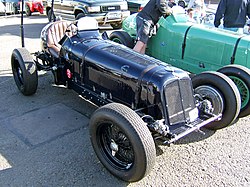
ERA was founded by Humphrey Cook, Raymond Mays, and Peter Berthon in November 1933 and established in Bourne, Lincolnshire, next to Eastgate House, the family home of Raymond Mays between Eastgate and Spalding Road. Their ambition was to manufacture and campaign a team of single seater racing cars capable of upholding British prestige in Continental European racing.
With the cost of full Grand Prix racing prohibitive, they instead aimed ERA's efforts at the smaller voiturette—1500cc supercharged—class of motor racing, the Formula 2 equivalent of the day. Humphrey Cook financed the operation—using the wealth from the family drapery business, Cook, Son & Co., of St Paul's Churchyard, London. Berthon was responsible for the overall design of the cars, while Mays became its principal driver—having already successfully raced several other makes including Vauxhall, Bugatti and Riley.[1] A new chassis was conceived by British designer Reid Railton (who had also successfully designed the Bluebird land speed record cars for Malcolm Campbell) and was constructed by Thomson & Taylor at Brooklands.[1] The engine was based on the well-proven Riley six-cylinder unit, albeit this was modified in a number of significant ways. A stronger forged crankshaft with a large centre Hyatt roller bearing was made and an entirely new aluminium cylinder head designed. The engine was supercharged using a bespoke supercharger designed by Murray Jamieson who had worked with Mays and Berthon on the White Riley. The ERA engine was designed around three capacities— a base 1488cc for the 1500cc racing class, one of 1088cc for the 1100cc class and also was capable of being expanded up to 1980cc for the 2000cc class.[2] It ran on methanol and in its 1500cc form was capable of producing around 180–200 bhp and in excess of 250–275 bhp in 2000cc form.[1]
The panel-beating brothers George and Jack Gray hand-fashioned the new car’s single-seater bodywork, to a design credited to a Mr Piercy who had previously designed the bodywork for Campbell’s '‘Bluebird’' record breaker.[1]
A-Type
[edit]
The unveiling of the first ERA—chassis R1A—to the press and public took place at Brooklands on 22 May 1934 following testing at Syston Park. After initial chassis handling problems, which required a number of modifications, soon ERA had a winning formula. By the end of the year ERAs had scored notable victories against many more established marques. In 1935, in a major race at the Nürburgring, ERAs took first, third, fourth and fifth places. The car was available in engine sizes running from 1.1 to 2.0 Litres.[3] Four were built, two with 1.1-litre supercharged engines, one 1.5- and one 2-litre.[4]
Through the remainder of the decade, with drivers of the calibre of Dick Seaman in the team, ERA dominated voiturette racing.
B-Type
[edit]
In 1935, production of the B-Type began (minimally changed). The A and B models were offered with three engine sizes.[3]
Two Siamese princes, Chula Chakrabongse and Bira Birabongse, whose trio of ERAs became famous as "Hanuman", "Romulus" and "Remus", ran their own team, operating from The White Mouse Garage, Hammersmith.[5] Prince Chula owned the team, having bought Romulus as a present for his cousin, Prince Bira, who was the team's driver.[6]
13 B-Type ERAs were produced,[4][7] three of which were later modified to subsequent (type C or in one case type D) specifications.
C-Type
[edit]
1937 saw the emergence of the C-Type. The same ladder-frame chassis and aluminum panel bodywork were kept on from the A and B models. However, the C model had a slightly different range of engines. None of the C stage cars had the smallest engine option, having instead 1.5 or 2.0 liter, with an added 1.75 liter intermediate engine option. Changes were also made in the suspension and control arms. Hydraulic dampers were installed on the rear suspension while a completely new front suspension appeared, replacing the elliptic leaf springs and friction dampers with a trailing arm with transverse torsion bars and hydraulic dampers.[3] Three type B ERAs were modified to type C standard, cars R4B, R8B, and R12B.[4]
D-Type
[edit]The D-Type was the designation for the number R4B ERA after modification in 1938. R4B had previously become R4C before being modified to this standard.[3]
E-Type
[edit]
The more modern E-Type ERA appeared just before the Second World War but was not fully developed, with only one car, GP1, actually racing.
Postwar history
[edit]The Second World War brought a halt to motor racing in Europe, and the team's Bourne site was sold to the Bus operator Delaine who occupied adjacent premises. The original building is still in use today by Delaine as an office block. By the time racing resumed in the late 1940s Berthon and Mays had moved on to the British Racing Motors (BRM) project.
E-Type
[edit]
ERA restarted operations in Dunstable under new ownership in 1947 when Leslie Johnson bought the company, together with ERA E-Type GP2, the second of two built in 1939, which had been raced by Reg Parnell and Leslie Brooke. Refitted with a Zoller supercharger and driven by Johnson, GP2 tied with Parnell's Maserati 4CLT for fastest lap in the 1948 British Empire Trophy and finished fifth. In the same race GP1, upgraded by the works with Murray Jamieson-designed Roots-type supercharging and driven by Reg Parnell's mechanic Wilkie Wilkinson (who had supervised modification of the E-Types), retired with a broken connecting rod.[8]
After posting the fastest time in the opening practice session for the 1948 British Grand Prix, Johnson retired GP2 from third place on the first lap when a driveshaft universal joint failed. In practice for the Coupe du Salon at Montlhéry he broke the lap record but retired GP2 from the race with a fractured fuel tank after three laps.[8]
In 1949 at Goodwood GP2 broke a back axle universal joint in practice but Johnson took the car to fifth in the Richmond Trophy and third in the Chichester Cup. In the first day's practice for the Jersey International Road Race, he was second-fastest to Luigi Villoresi's record-breaking lap in a Maserati but on the second day the engine bearings failed and the car did not race. At Silverstone's 1950 Grand Prix d'Europe the supercharger disintegrated after two laps.[8]
Meanwhile, GP1, driven by Fred Ashmore, failed to finish the 1948 Jersey International Road Race owing to fuel starvation and defective steering.
In the 1949 BRDC/Daily Express International Trophy, Peter Walker took GP1 to within 1.2 seconds of Giuseppe Farina's Maserati in practice and finished fifth in the race, despite gearbox and steering problems, a leaking radiator, and the exhaust burning the driver's foot. Walker was fastest in practice for Ireland's Wakefield Trophy road race, but a snatching brake forced him down the escape road at the first corner. Here GP1's race ended when it was hit by an Alta that had already collided with Salvadori's Maserati 4CL.[8]
Finally in 1950, GP1 was gutted by fire in a crash at the British Empire Trophy race on the Isle of Man, caused by driveshaft failure when the car was at high speed with Walker at the wheel.[8]
G-Type
[edit]The 2-litre G-Type raced in the 1952 World Championship, the first season to be run under Formula Two rules. The fundamental design was laid down by Robert Eberan-Eberhorst, one of the world's leading theorists of racing car design, who had replaced Ferdinand Porsche at Auto Union and designed the Auto Union Type D Grand Prix car. His protégé and successor David Hodkin completed the G-Type design.[9] The frame was constructed of two longitudinal magnesium tubes with four crossmembers. Suspension was by double wishbone with coil springs at the front and de Dion tube at the rear. The car was powered by a Bristol engine with modifications to Hodkin's specifications.
Stirling Moss drove, but the engine was unreliable and the race results were disappointing. Moss said: "It was, above all, a project which made an awful lot of fuss about doing very little. By this time I was very disillusioned by the Clever Professor approach to racing car design. I would eventually learn that even the most brilliant concept could fail if the team concerned lacks the manpower and organization and money to develop the inevitable bugs out of it."
Johnson sold the project to Bristol—who used the car as the basis for an assault on Le Mans that would bring them several class wins in the mid-1950s—and focused the company on research and development (R&D) engineering.[10] He eventually sold it to Zenith Carburettor Ltd, which was then purchased by Solex, another carburettor firm.
Chassis design for the Jowett Jupiter
[edit]In 1949 von Eberhorst, working for ERA, designed the space-frame chassis for the Jowett Jupiter.
Legacy
[edit]Although renamed Engineering Research and Application Ltd, and still primarily an R&D operation, ERA still did a small amount of race preparation. In the 1980s it put its name to the ERA Mini Turbo, a turbocharged version of the Mini.
Today
[edit]ERAs in competition
[edit]

The vast majority of prewar ERAs are still in existence, and they have continuous and verifiable provenance. They still compete in historic events despite the youngest being nearly seventy years old. The cars are particularly associated with the Shelsley Walsh hillclimb thanks in large part to Mays, who won the first two British Hill Climb Championships in 1947 and 1948; indeed an ERA has for many years held the hill record for a prewar car.[11][12][13][14]
Mays exhibition
[edit]There is a permanent exhibition about Raymond Mays' contribution to motor racing, including his ERA days, at Bourne Civic Society's heritage centre in Bourne. It is open on weekend and bank holiday afternoons.
ERA trademark
[edit]The ERA trademark is currently owned by Tiger Racing [15]
Complete Formula One World Championship results
[edit]| Year | Chassis | Engine | Tyres | Driver | 1 | 2 | 3 | 4 | 5 | 6 | 7 | 8 |
|---|---|---|---|---|---|---|---|---|---|---|---|---|
| 1950 | GBR | MON | 500 | SUI | BEL | FRA | ITA | |||||
| ERA E-Type | ERA 1.5 L6s | D |  Leslie Johnson Leslie Johnson
|
Ret | ||||||||
| ERA E-Type | ERA 1.5 L6s | D | Peter Walker
|
Ret* | ||||||||
| ERA E-Type | ERA 1.5 L6s | D | Tony Rolt
|
Ret* | ||||||||
| ERA B-Type ERA C-Type |
ERA 1.5 L6s | D | Cuth Harrison
|
7 | Ret | Ret | ||||||
| ERA C-Type ERA A-Type |
ERA 1.5 L6s | D | Bob Gerard
|
6 | 6 | |||||||
| 1951 | SUI | 500 | BEL | FRA | GBR | GER | ITA | ESP | ||||
| ERA B-Type | ERA 1.5 L6s | D | Bob Gerard
|
11 | ||||||||
| ERA B-Type | ERA 1.5 L6s | D | Brian Shawe-Taylor
|
8 | ||||||||
| 1952 | SUI | 500 | BEL | FRA | GBR | GER | NED | ITA | ||||
| ERA G-Type | Bristol BS1 2.0 L6 | D | Stirling Moss
|
Ret | Ret | Ret | ||||||
- * Indicates shared drive
Bibliography
[edit]- ERA Gold Portfolio, 1934–1994, Brooklands Books - compilation of historic and contemporary articles on ERA and includes the full text of John Lloyd's The Story of ERA
- ERA: The History of English Racing Automobiles, David Weguelin, White Mouse Press: expensive and scarce but hugely detailed and profusely illustrated book covering the contemporary and historic career of all the cars.
References
[edit]- ^ a b c d Bissett, Mark (16 April 2015). "Peter Whitehead in Australia: ERA R10B: 1938". primotipo.com. Retrieved 30 April 2016.
- ^ RILEY MOTOR CARS -ERA Specifications rileyrob.co.uk, accessed 11 July 2019
- ^ a b c d Jeremy McMullen: 1935 ERA B Type conceptcarz.com accessed 27 May 2019
- ^ a b c The Cars- '...most of the cars manufactured and associated with English Racing Automobiles starting from 1934... englishracingautomobiles.co.uk accessed 27 May 2019
- ^ B. Bira: Siam's prince of racing motorsportmagazine.com/archive, August 1999 Page 63, accessed 2 June 2019
- ^ grand prix history: era grandprixhistory.org accessed 2 June 2019
- ^ English Racing Automobiles: Fifty Years September 1984, Page 44 motorsportmagazine.com, accessed 1 June 2019
- ^ a b c d e Smith, Norman (20 April 1951), "Case History of the E-Type E.R.A., A Promising Venture Which Ended Unhappily", Autosport
- ^ Taylor, S. 1999. Tunnel Vision. Motor Sport. LXXV/8 (August 1999). 80-85
- ^ Maréchal, Christian: "Learning Curves" Classic and Sportscar magazine, June 1996.
- ^ "1934 ERA R2A - Images, Specifications and Information". Ultimatecarpage.com.
- ^ "1934 Era R2A". conceptcarz.com.
- ^ "THE CARS". www.englishracingautomobiles.co.uk.
- ^ "ERA Club: ERA R2A - The 1100cc Works Car". www.eraclub.co.uk.
- ^ "About Tiger Racing". Archived from the original on 18 November 2016. Retrieved 27 November 2020.
External links
[edit]
English Racing Automobiles
View on GrokipediaERA's early models, including the A-Type (four produced) and the more refined B-Type (thirteen built), were powered by 1,488 cc supercharged engines delivering up to 175 horsepower, enabling top speeds exceeding 130 mph.[3] Notable successes included Richard Seaman's 1936 win at Donington Park and his 1935 Coppa Acerbo victory in R1B, as well as Prince Bira's 16 victories aboard the B-Type R2B "Romulus" from 1935 to 1939.[3] The later C-Type and sole D-Type (R4D) incorporated 2-litre engines for enhanced power, with R4D achieving 26 race wins postwar after modifications.[3] Despite financial challenges and the shift to 3-litre formula racing, ERA's technical innovations, such as advanced braking and suspension systems, established it as a benchmark for British engineering in motorsport.[4] Postwar Revival and Legacy
Production halted during World War II, but surviving ERAs were rebuilt and campaigned successfully in the inaugural Formula One World Championship seasons, with entries at events like the 1950 British Grand Prix.[3] By the mid-1950s, as modern single-seaters evolved, ERA transitioned into historic racing, where the cars' durability— with 20 of the original 22 still extant today—has ensured ongoing popularity.[2] The ERA Club, established in 1936 to support the marque, continues to preserve these vehicles through ownership records, events, and annual trophies like the Rivers Fletcher for 1.5-litre ERAs.[4] Today, restored examples command high values at auctions and remain competitive in vintage racing series, symbolizing an era of British ingenuity in pre-war motorsport.[3]
Founding and background
Origins and key figures
English Racing Automobiles (ERA) was founded in November 1933 by three key figures: financier Humphrey Cook, racing driver and designer Raymond Mays, and engineer Peter Berthon.[5][6] The company was established in Bourne, Lincolnshire, to develop competitive British racing cars.[7] Raymond Mays, a prominent British racing driver, brought extensive experience from the 1920s, where he competed successfully in hill climbs with Brescia Bugattis, setting multiple records in events such as those at Shelsley Walsh and Kop Hill.[8] His frustrations with the dominance of foreign manufacturers in international motorsport inspired the creation of a British voiturette racer capable of challenging established competitors.[9] Humphrey Cook provided the essential financial backing, drawing from his family's prosperous drapery business in London, which enabled the venture's launch amid the economic challenges of the early 1930s.[9][10] Motivated by a desire to restore British prestige in racing, Cook sought to counter the growing technical superiority of German and Italian teams on global circuits.[9][11] Peter Berthon, an experienced engineer and Mays' longtime collaborator, played a crucial role in adapting Riley's straight-six engine components for ERA's designs, including tuning the supercharged unit that Mays had raced earlier in 1933.[3][12] This adaptation formed the foundation of ERA's powertrain, leveraging proven British engineering to achieve competitive performance.[1]Establishment and facilities
English Racing Automobiles (ERA) was established in Bourne, Lincolnshire, with workshops constructed on the orchard adjoining Raymond Mays' family home, Eastgate House, to facilitate initial operations beginning in 1934. This location was chosen for its proximity to Mays' residence, enabling cost-effective setup and close collaboration among the founders during the company's formative phase. The facilities included essential equipment such as lathes, milling machines, grinders, a heat-treatment furnace, and a Heenan and Froude dynamometer capable of testing up to 8,000 rpm, all housed in a newly built factory completed by April 1934 after initial work in a converted old maltings building on the property.[13][14][15] The initial team was assembled from a core group of engineering and design experts, including chassis designer Reid Railton, who contributed to the foundational structure of the vehicles. Bodywork was hand-crafted by the panel-beating brothers George and Jack Gray, who fashioned the lightweight aluminum panels directly at the Bourne workshops. This small, specialized team operated from the modest facilities, focusing on high-quality construction for a limited number of racing cars rather than mass production.[16][14] Funding for ERA's establishment came primarily from Humphrey Cook, a wealthy gentleman racer who inherited a fortune from his family's drapery business and invested over £200,000 to support the venture as its managing director. This financial backing allowed for the development of a works team of three cars in the early years but constrained overall output due to Cook's selective sponsorship model, resulting in only a handful of vehicles produced initially. The structure emphasized targeted investment in competitive racing prototypes over broader commercial expansion.[17][16]Prewar era
A-Type development
The development of the A-Type, English Racing Automobiles' (ERA) first model, was spearheaded by founding figures Raymond Mays, Humphrey Cook, and Peter Berthon, who aimed to create a competitive British voiturette racer. The prototype chassis R1A was publicly unveiled at the Brooklands circuit on 22 May 1934, following initial private testing at Syston Park.[14] Only four A-Type chassis—R1A through R4A—were constructed that year, reflecting the company's limited initial funding from private backers. These cars utilized modified Riley six-cylinder engines in displacements of 1.1 L, 1.5 L, or 2.0 L, all supercharged to meet voiturette class regulations.[18] The powerplant featured a custom Murray Jamieson Roots-type supercharger, delivering up to approximately 180 bhp in its 1.5 L configuration, with methanol fuel enhancing performance.[19][14] The A-Type's chassis, designed by Reid Railton, employed a conventional steel ladder-frame construction with H-section front axles and an Armstrong-Siddeley four-speed pre-selector gearbox, prioritizing simplicity and track readiness over advanced suspension.[19] Aluminum panel bodywork completed the lightweight, open-wheeled design, making it a purpose-built single-seater for hillclimbs and short-circuit events.[3] The first A-Type (R1A) was promptly entered in competition by Mays himself at Brooklands shortly after its debut, marking ERA's racing entry.[14] Early 1934 track sessions exposed handling deficiencies, including poor stability under cornering loads, prompting immediate modifications such as revised road springs and reinforced components based on feedback from Brooklands and Isle of Man outings.[14] These adjustments improved responsiveness, setting the stage for the model's competitive viability despite the small production run.[18]B-Type and C-Type evolution
The B-Type, introduced in 1935 as the first production model for private customers, represented a direct evolution of the A-Type with minimal structural alterations but enhanced reliability through a boxed chassis that increased rigidity and addressed early durability concerns identified in works cars. Engineers like Giulio Ramponi refined components based on racing feedback, resulting in 13 units built (R1B through R14B, omitting R13 for superstition), which proved more robust for consistent competition use.[3][20] These cars featured a Riley-derived supercharged straight-six engine, typically in 1.5-liter form producing around 170 bhp via a Roots-type supercharger, though some early examples used a 1.1-liter variant for lighter classes. The B-Type's adaptations for privateer owners included simplified maintenance features and optional supercharger tweaks, such as later Zoller installations on select chassis for improved low-end torque delivery. This model solidified ERA's reputation in hillclimbs and sprints, where private entrants like Richard Seaman (R1B) and H.R.H. Prince Birabongse Bhanudej Bhanubandh of Siam (R2B "Romulus") achieved notable successes, including multiple class wins at events like Shelsley Walsh. Ownership by Siamese royalty extended to R5B "Remus" and later conversions, with R12B initially acquired by Prince Chula Chakrabongse in 1937 before upgrade.[3][21][22] In 1937, the C-Type emerged through conversions of three existing B-Type chassis (R4C, R8C, and R12C), incorporating significant refinements like independent trailing-arm front suspension inspired by Porsche designs and hydraulic drum brakes to enhance handling and braking reliability on demanding circuits. Engine options expanded to include 1.5-liter and 2-liter supercharged units, the latter achieving up to 210 bhp with a revised Zoller supercharger setup that optimized torque across the rev range for better acceleration in mid-speed corners. These updates catered to privateer demands for versatility in voiturette racing, maintaining the B-Type's hillclimb prowess while enabling stronger performances in grands prix, as seen with R12C "Hanuman"—purchased and named by the Siamese princes— which competed successfully under Prince Bira before wartime storage.[3][23][24]D-Type and E-Type introduction
As the 1930s progressed, English Racing Automobiles sought to extend their voiturette successes into full Grand Prix competition, leading to the development of the D-Type in 1938. This model involved the single conversion of the existing R4B chassis—originally constructed in 1935 as a works car—from its prior C-Type configuration by lightening the box-section frame and installing a 2-liter supercharged inline-six engine derived from the Riley design, producing approximately 240 bhp. The adaptation focused on enhancing power and structural rigidity for the demands of unrestricted Grand Prix racing, marking ERA's transitional step toward more advanced machinery while building on the proven mechanical layout of earlier types.[25][26] The E-Type, introduced in late 1938, represented ERA's boldest prewar innovation as the marque's inaugural purpose-built Grand Prix car, designated GP1. Designed primarily by Peter Berthon with chassis contributions from Reid Railton—who emphasized a lowered center of gravity through revised tubular side members and a dropped propshaft—the E-Type aimed to rival German and Italian dominance by incorporating Mercedes-Benz-inspired elements like a de Dion rear axle and independent front suspension via trailing links and torsion bars. Its sleek, aerodynamic aluminum body reduced frontal area for better speed, while the powerplant was a supercharged 2-liter inline-six based on the Riley unit, engineered to deliver around 250 bhp at high rpm despite challenges with block durability.[27][28] Owing to escalating geopolitical tensions and resource constraints, production was limited to this single example, which made its competitive debut—and sole prewar outing—at the 1939 Grand Prix de l'Albi, where driver Arthur Dobson led early laps before a crash caused by fuel tank rupture ended the run. The E-Type demonstrated potential with speeds exceeding 170 mph but was sidelined by reliability issues in prior non-race tests, such as withdrawals at Brooklands and Reims. With the onset of World War II, GP1 was carefully stored, preserving it for postwar revival.[27][28]Postwar revival
Resumption under new ownership
Following World War II, the original founders of English Racing Automobiles (ERA), Raymond Mays and Peter Berthon, withdrew from the company to pursue the British Racing Motors (BRM) project, leaving ERA dormant as its Bourne facilities were repurposed.[29] In late 1947, wealthy racing enthusiast and driver Leslie Johnson acquired the company from prewar sponsor Humphrey Cook, relocating operations to a new facility in Dunstable, Bedfordshire.[23] Johnson's purchase included key prewar assets, such as the stored E-Type chassis, enabling a gradual resumption of activities.[30] The company was subsequently renamed Engineering Research and Application Ltd. in the early 1950s, though it continued to operate under the ERA branding for its racing endeavors.[31] Postwar challenges, including acute shortages of raw materials and the need to adapt to evolving international racing regulations—such as the introduction of Formula One with its initial 4.5-liter displacement limits—constrained development.[23][16] Initial efforts under Johnson thus centered on restoring and preparing surviving prewar cars for competition, leveraging their 1.5-liter supercharged engines suited to smaller displacement classes.[18] Johnson's personal investment provided crucial funding, allowing ERA to undertake limited new construction projects despite these constraints, marking a tentative revival of the marque's engineering legacy.[29]Continued E-Type and G-Type
Following the resumption of racing after World War II, the E-Type was adapted from its prewar configuration to fit the 1947 Formula One regulations, which permitted 1.5-liter supercharged engines or larger unsupercharged units. The two existing prewar E-Type chassis, designated GP1 and GP2, were updated with a 1.5-liter supercharged inline-six ERA engine, retaining the original twin-tube chassis but with minor reinforcements for postwar durability. These modifications allowed the cars to compete in the 1.5-liter class, emphasizing reliability over the higher-capacity prewar designs.[23][18] GP1, raced primarily by Peter Walker from 1948 to 1950, showed promising performance despite its age, securing two second-place finishes and a third at the Goodwood Woodcote Cup meetings in 1949. GP2 was campaigned by owner Leslie Johnson during the same period, appearing at events like the 1950 British Grand Prix at Silverstone, though both cars struggled against more modern machinery due to handling limitations and occasional mechanical unreliability. By 1950, the E-Types were retired from Grand Prix racing as Formula One shifted toward naturally aspirated engines, marking the end of their competitive era.[32][18][23] In 1952, ERA introduced the G-Type as a purpose-built Formula Two car to capitalize on the World Championship's adoption of the category, featuring a lighter chassis constructed from large-diameter magnesium tubes for improved rigidity and reduced weight in line with postwar safety and performance standards. Only two examples were completed due to chronic funding shortages, powered by a naturally aspirated 2-liter (1971 cc) Bristol inline-six engine with dry-sump lubrication, representing a departure from ERA's traditional supercharged approach. The design, influenced by Robert Eberan-Eberhorst's Auto Union experience, included an offset driving position to lower the center of gravity but suffered from persistent overheating and reliability problems, such as engine seizures and steering failures.[18][23][20] Stirling Moss piloted the lead G-Type (chassis R1G) in several 1952 events, including the Belgian, British, and Dutch Grands Prix, but retirements plagued its results, with no podiums achieved amid competition from superior Ferrari 500s. The second chassis saw limited use before the project folded; ERA sold the rights and components to the Bristol Aeroplane Company later that year, which repurposed elements into their 450 sports racer. This limited production underscored ERA's postwar financial constraints, shifting focus away from pure racing development.[18][33]Jowett Jupiter collaboration
In the postwar era, English Racing Automobiles (ERA) entered into a collaboration with Jowett Cars Ltd., contributing to the design of a lightweight tubular chassis for the Jupiter sports car project, which began in 1949. ERA's involvement, led by engineer Robert Eberan von Eberhorst, focused on developing the chassis based on its racing heritage, but the partnership disintegrated early, with production shifting to Jowett. This extended to influencing the 1952 R1 racing variant.[34][35] The R1 chassis featured a twin-tube structure made from chrome-molybdenum steel, significantly lightened for competition use while incorporating independent front suspension with torsion bars derived from ERA's prewar and postwar racing experience. Jowett constructed three such chassis for the R1 to support their ambitions in sports car racing. This setup emphasized rigidity and low weight, adapting ERA's technical innovations for a hybrid road-racing application distinct from their pure Grand Prix machines.[35][36] The R1 chassis was integrated with Jowett's 1,486 cc flat-four engine, tuned to produce around 80 bhp through modifications like twin carburetors and a performance camshaft, enabling agile handling and competitive speeds in the 1.5-litre class. Earlier Jupiter models using similar chassis technology, raced by Tommy Wisdom, had already demonstrated success at the 24 Hours of Le Mans in 1950 and 1951, securing class victories and finishing 16th overall in 1950. The R1 continued this legacy, with one example achieving a class win at Le Mans in 1952 driven by Marcel Becquart and Gordon Wilkins.[34][37][38] The collaboration concluded by 1954 amid Jowett's financial collapse and bankruptcy, limiting production and marking the end of this brief but influential partnership; only three R1 cars were ultimately completed by Jowett, with ERA's contributions highlighting a rare crossover between their racing chassis expertise and a production sports car lineage.[35][39]Technical innovations
Engine and supercharging
English Racing Automobiles (ERA) primarily relied on modified Riley inline-six engines for its prewar models, with displacements ranging from 1.1 liters to 2 liters to suit various voiturette racing classes. These engines featured overhead valves and hemispherical combustion chambers derived from the Riley Nine design, providing a strong foundation for high-revving performance. Supercharging was central to ERA's philosophy, emphasizing forced induction to maximize power density in the naturally aspirated-dominated era; early prototypes used a vertically mounted Roots-type blower, while production cars predominantly employed Zoller vane-type superchargers for efficient boost delivery.[3][23][24] In the A-Type and B-Type models, the 1.5-liter Riley engine, boosted by a single Zoller supercharger, delivered approximately 170 horsepower, enabling competitive speeds in 1,500 cc events. The C-Type evolved this further with a 2-liter variant, where the Zoller unit pushed output to around 240 horsepower, prioritizing high-rev capability up to 7,000 rpm for outright voiturette dominance. Other supercharger options, such as Jamieson Roots or Wade units, were experimented with in select chassis like R4B/C/D (Zoller) and R10B (two-stage Wade), allowing tuners to optimize for specific tracks or fuel types like methanol.[3][23][27] Postwar, ERA shifted toward larger-capacity powertrains to meet Formula One demands, retaining the inline-six layout for the E-Type but increasing displacement to 2 liters with enhanced supercharging. Early postwar E-Types used a single K300 Roots blower or Zoller at up to 32 psi boost, yielding 260 horsepower, though reliability issues with cracking blocks limited full potential. A notable innovation was the adoption of two-stage supercharging, such as the Roots or Wade setups, which improved low-end torque by providing progressive boost buildup—essential for corner exits in longer grand prix races—while addressing the single-stage units' lag at lower rpms.[27][40][23] The G-Type marked a departure from supercharging, pairing the chassis with a naturally aspirated 2-liter Bristol six-cylinder engine modified for dry-sump lubrication, producing 197 horsepower at around 5,500 rpm. This unit, derived from prewar BMW designs, emphasized smooth power delivery and reliability over peak output, suiting the Formula Two regulations of the early 1950s. However, forced induction's fuel mixture challenges persisted in supercharged models; the volatile methanol-alcohol blends required precise tuning, and mishandling led to incidents like the 1950 Isle of Man fire that gutted E-Type GP1 during practice, highlighting the era's risks with high-boost systems.[23]Chassis and bodywork design
The chassis design of prewar English Racing Automobiles (ERA) models was pioneered by engineer Reid Railton, who developed a conventional steel ladder-frame structure for the initial A-Type, utilizing channel sections for robustness in the 1.5-liter voiturette class.[3] This design evolved in subsequent B-, C-, and D-Types through boxing of the frame rails and lightening via drilling, enhancing torsional rigidity while maintaining a compact footprint suitable for tight circuits.[41] Suspension systems in early models (A- and B-Types) employed live axles fore and aft, suspended by semi-elliptical leaf springs and controlled by Hartford friction dampers, providing a balance of simplicity and roadholding for the era's unpaved tracks, while later C- and D-Types introduced independent front suspension using torsion bars for improved handling.[3] Wheelbases typically measured 96 inches across these models, with minor variations up to 102 inches in some modified examples to optimize weight distribution.[20] Bodywork for the prewar ERAs consisted of lightweight aluminum panels hand-beaten over wooden formers, often featuring cycle wings to minimize drag and comply with the 750 kg minimum weight formula that governed voiturette racing.[41] These single-seater designs prioritized low profiles and exposed radiators for cooling efficiency, with the E-Type introducing a more streamlined Grand Prix body inspired by continental rivals, incorporating a narrower frontal area and smoother contours to reduce aerodynamic resistance during high-speed runs.[28] The prewar cars achieved dry weights around 750 kg, aligning precisely with regulatory limits while allowing for supercharger and fuel additions without excess ballast.[21] In the postwar era, ERA's chassis evolved toward lighter, more advanced constructions under collaborations like the Jowett Jupiter project, where a tubular steel spaceframe replaced the ladder design to enhance performance in sports car racing.[42] This tubular layout, developed by a team led by Eberan von Eberhorst at ERA's Dunstable works, offered superior stiffness-to-weight ratios and facilitated lower engine mounting for improved handling.[43] Suspension advanced to independent front setup with unequal-length wishbones and torsion bars, while the rear retained a live axle but incorporated anti-roll bars for enhanced cornering stability in the lighter 1.5-liter formula cars.[34] Postwar models, including Jupiter variants, achieved curb weights around 810-860 kg, a reduction that supported quicker acceleration and better agility compared to prewar counterparts.[44] Aluminum body panels persisted, often with cycle wings adapted for road-legal prototypes, maintaining the marque's emphasis on minimalism and performance.[28]Racing history
Prewar voiturette successes
English Racing Automobiles (ERA) achieved significant success in the 1.5-litre voiturette class during the mid-1930s, particularly through works entries and privateer efforts that showcased the reliability and performance of their A- and B-Type models. In the 1935 Eifelrennen at the Nürburgring, ERAs secured a strong result in the voiturette race, with Raymond Mays winning in his A-Type (R3A), followed by Tim Rose-Richards in third place with another A-Type (R2A), and Richard "Dick" Seaman finishing fourth in his B-Type (R1B) after leading early laps before retiring due to oil pressure issues.[45] This performance highlighted ERA's competitive edge against established rivals like Maserati, as Mays' victory marked the marque's first major international triumph on a demanding circuit.[46] ERA's dominance was especially pronounced in British hillclimb events from 1934 to 1939, where the cars' lightweight chassis and supercharged engines excelled on twisty, uphill courses. Raymond Mays, a key figure in ERA's development and a prolific driver, set multiple records at Shelsley Walsh, including a class-winning time of 38.90 seconds on May 28, 1938, in his ERA R4D, and an outright record of 37.86 seconds on September 10, 1938. Mays achieved numerous fastest times of the day at Shelsley Walsh during this period, contributing to ERA's tally of over 20 hillclimb victories across British venues like Bouley Bay and Craigantlet, underscoring the cars' adaptability to short, technical challenges.[47][48] Internationally, privateer entries expanded ERA's reach, with around 18 cars built before the war, many acquired by independent teams that amplified the marque's success. Prince Birabongse Bhanudej (known as "B. Bira"), driving his privately entered B-Type (R2B "Romulus"), represented ERA at the 1936 Coppa Ciano voiturette race in Livorno, Italy, where he competed against factory Maseratis despite the absence of the official works team.[49][50] Bira's efforts, supported by his cousin Prince Chula's White Mouse Stable, helped sustain ERA's presence in European events. Key drivers like Dick Seaman and Pat Fairfield were instrumental in these triumphs, leveraging the ERA's versatile design to perform across diverse tracks from high-speed circuits to hilly sprints. Seaman, in his B-Type, secured victories in the 1935 Coppa Acerbo Junior at Pescara, the Prix de Berne, and the Masaryk Circuit Grand Prix, establishing him as a rising star before his move to Mercedes-Benz.[51] Fairfield, ERA's first private customer with an A-Type (R4A), achieved notable results including wins at the Manin Beg Trophy and Nuffield Trophy, demonstrating the car's effectiveness in both European and South African races.[52][14] Their successes, often in privately run cars, emphasized ERA's influence on the privateer scene and its role in elevating British engineering in the voiturette formula.[22]Postwar Grand Prix efforts
Following World War II, English Racing Automobiles (ERA) resumed Grand Prix activities under private ownership, with efforts centered on updating prewar designs for the evolving 4.5-litre Formula One regulations. The E-Type GP2, rebuilt with a Zoller supercharger, marked the marque's return in 1948. Driven by owner Leslie Johnson, it achieved 5th place and shared the fastest lap at the non-championship British Empire Trophy on the Isle of Man street circuit.[18] Later that year, at the non-championship 1948 British Grand Prix at Silverstone, Johnson qualified on the front row but retired on lap 1 due to transmission failure. In the inaugural Formula One World Championship round, the 1950 British Grand Prix, Johnson qualified 12th in the same car but retired on lap 1 due to supercharger failure, highlighting persistent reliability challenges against dominant Alfa Romeo 158s.[18] By 1950, ERA fielded entries at the British Grand Prix including Peter Walker in the E-Type GP1, who retired after two laps with gearbox issues (relieved by Tony Rolt). In 1951, Brian Shawe-Taylor drove a C-Type to 8th place. Funding constraints from private backers restricted ERA to sporadic appearances, often relying on privateer drivers like Walker and Shawe-Taylor, who brought enthusiasm but lacked the resources for consistent competitiveness.[18] In a bid for revival, ERA introduced the G-Type in 1952, powered by a 2-litre Bristol engine and featuring an innovative magnesium tube chassis designed by Robert Eberan von Eberhorst. Stirling Moss practiced the car for the British Grand Prix at Silverstone, qualifying 16th, but the entry was withdrawn before the race start owing to overheating and reliability concerns.[18] Moss later raced the G-Type in other non-championship events, securing a 3rd-place podium at the Daily Mail Trophy at Boreham despite engine woes, but retirements plagued further outings, including the Belgian Grand Prix (engine failure) and Dutch Grand Prix (engine seizure on lap 73).[18] Overall, postwar ERA efforts yielded just two podium finishes in non-championship races amid fierce competition from Alfa Romeo's supercharged V12s and Ferrari's developing V6s, with mechanical unreliability and financial limitations curtailing broader participation and preventing any championship points.[18]Formula One World Championship results
English Racing Automobiles (ERA) participated in five rounds of the Formula One World Championship between 1950 and 1952, entering a total of ten cars across these events. The team's postwar efforts aligned with the 1949-1951 1.5-litre supercharged formula, utilizing updated pre-war chassis like the B-Type, C-Type, and E-Type powered by ERA's own inline-six engines. Despite some competitive qualifying showings and minor race finishes, ERA scored no championship points, with their best results being two sixth-place finishes in 1950. By 1952, facing the new 2-litre unsupercharged regulations, the team introduced the G-Type chassis with a Bristol inline-six, but reliability issues persisted, leading to no further World Championship appearances after that season.[53][54][55] The following table summarizes ERA's complete World Championship results, including drivers, chassis, engines, qualifying positions, and race outcomes. All entries were privateer or works-supported, and no podiums or points were achieved.| Year | Race | Driver | Chassis | Engine | Qualifying | Finish | Notes |
|---|---|---|---|---|---|---|---|
| 1950 | British Grand Prix | Leslie Johnson | E-Type | ERA 1.5 L s/c I6 | 12th | Ret (Lap 1) | Supercharger failure[53][54] |
| 1950 | British Grand Prix | Peter Walker / Tony Rolt | E-Type | ERA 1.5 L s/c I6 | 10th | Ret (Lap 2) | Gearbox; Rolt relieved but retired[53][54] |
| 1950 | British Grand Prix | Bob Gerard | B-Type | ERA 1.5 L s/c I6 | 17th | 6th | +3 laps[53][54] |
| 1950 | British Grand Prix | Cuth Harrison | C-Type | ERA 1.5 L s/c I6 | 15th | 7th | +3 laps[53][54] |
| 1950 | Monaco Grand Prix | Bob Gerard | A-Type | ERA 1.5 L s/c I6 | 16th | 6th | +6 laps[55][56] |
| 1950 | Monaco Grand Prix | Cuth Harrison | C-Type | ERA 1.5 L s/c I6 | 14th | Ret (Lap 0) | Accident at start[55][56] |
| 1950 | Italian Grand Prix | Cuth Harrison | C-Type | ERA 1.5 L s/c I6 | 21st | Ret (Lap 51) | Radiator leak[57] |
| 1951 | British Grand Prix | Bob Gerard | B-Type | ERA 1.5 L s/c I6 | 20th | 11th | +8 laps[58] |
| 1951 | British Grand Prix | Brian Shawe-Taylor | C-Type | ERA 1.5 L s/c I6 | 19th | 8th | +6 laps[58] |
| 1952 | Dutch Grand Prix | Stirling Moss | G-Type | Bristol 2.0 L I6 | 18th | DNF (Lap 73) | Engine failure[59][60] |