Hubbry Logo
James Earl RudderJames Earl RudderMain
Open search
James Earl Rudder
Community hub
James Earl Rudder
logo
8 pages, 0 posts
0 subscribers
Be the first to start a discussion here.
James Earl Rudder
James Earl Rudder
from Wikipedia

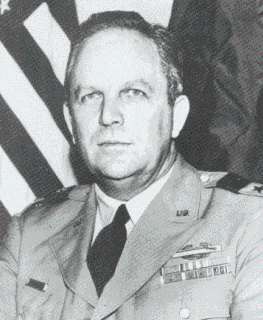
James Earl Rudder (May 6, 1910 – March 23, 1970) was a United States Army major general. As a lieutenant colonel, he commanded the Pointe du Hoc battle during the Invasion of Normandy. He also commanded the 2nd Ranger Battalion at the Battle of the Hürtgen Forest, and led a series of delaying actions and ambushes during the Battle of the Bulge. General Rudder also at various times served as Texas Land Commissioner, the 16th president of Texas A&M University, third president of the Texas A&M University System, mayor of Brady, Texas, and a high school and college teacher and coach. Rudder went by his middle name.

Key Information

Early life

[edit]

James Earl Rudder was born on May 6, 1910, in Eden, Texas, the fifth son to survive to adulthood of Dee Forest and Annie Rudder (nee Powell).[1] Rudder attended Eden High School, where he was a member of the first football team at the school, graduating in 1927.[2] After graduating from high school, Rudder clerked at the local drug store, where the football coach for John Tarleton Agricultural College found him.[3] Rudder enrolled at Tarleton, with a declared major of civil engineering in the fall semester of 1927.[4] After spending three years at Tarleton, Rudder transferred to the Agricultural and Mechanical College of Texas.[5]

Military career

[edit]
Texas historical marker in the German observation bunker at Pointe du Hoc

After attending John Tarleton Agricultural College and then graduating from Texas A&M in 1932 with a degree in industrial education,[6] Rudder had been commissioned a second lieutenant of infantry in the United States Organized Reserve Corps. After being called into active duty in 1941, Rudder took part in the D-Day landings as commanding officer of the United States Army's 2nd Ranger Battalion.

His U.S. Army Rangers stormed the beach at Pointe du Hoc, scaling 100-ft (30-m) cliffs under enemy fire to reach and destroy a German gun battery. The battalion's casualty rate for this perilous mission was greater than 50%. Rudder himself was wounded twice during the course of the fighting. By the time of preparations for D-Day, the Wehrmacht-run battery at the top of the Pointe was marked on the Allied D-Day maps as a Rangers D-Day target - confirmed in records found in the early 21st century.[1] By the time of the invasion, Pointe du Hoc's artillery pieces had been moved to another nearby site, replaced by telephone poles. By 0900 hours on D-Day, a two-man patrol from the Rangers located the Pointe's missing guns. Sergeant Lomell and Staff Sgt. Jack E. Kuhn, using thermite grenades, disabled two of the five artillery pieces and destroyed the sighting mechanism of another. While retrieving more grenades to finish the job, a second patrol, led by Staff Sgt. Frank A. Rupinski, also located the artillery pieces, and disabled the remainder using thermite grenades. They started a fire in the powder charges and left the area, accomplishing the goal of destroying the artillery pieces that had been targeted at Utah Beach, but were also in range of Omaha Beach.[7] Rudder ordered his men to dig in, and they fought off German counterattacks for two days until relieved.[8] He and his men helped successfully establish a beachhead for the Allied forces. The siege was replicated in the 1962 epic film The Longest Day.

Seven months later, Rudder was reassigned to the 109th Infantry Regiment, which saw key service in the Battle of the Bulge. Rudder earned military honors, including the Distinguished Service Cross, Bronze Star with Oak Leaf Cluster, Purple Heart with Oak Leaf Cluster, French Legion of Honor with Croix de Guerre and Palm, and Order of Leopold (Belgium) with Croix de Guerre and Palm. He was a full colonel by the war's end, and was promoted to brigadier general of the United States Army Reserve in 1954 and major general in 1957.

Political and academic career

[edit]
Rudder's statue on the Texas A&M University campus in College Station, Texas

After returning home from the war, Rudder was asked to run for mayor of his hometown of Brady, Texas. He did not campaign, yet defeated the incumbent.[9] He served as mayor of Brady for six years, from 1946 to 1952, then chose to move on.[10] In 1953, he became vice president of Brady Aviation Company. On January 1, 1955, he assumed the office of Texas Land Commissioner after Bascom Giles was convicted and sent to prison for defrauding veterans. At that time, the Veterans Land Board was under scrutiny for mismanagement and corruption. Rudder undertook the task of reforming policies, expediting land applications, and closely supervising proper accounting procedures. He also oversaw the proper leasing of state lands by employing more field inspectors for oil and gas sites and adding a seismic exploration staff. In addition, he improved working conditions for his staff and instigated a program to preserve the many deteriorating General Land Office documents.

Rudder won the 1956 state land commissioner election as a Democrat. He became vice president of Texas A&M University in 1958 and was named its president in 1959. He was president of the entire A&M System from 1965 until his death in 1970. In 1967, President Lyndon B. Johnson presented him with the Army Distinguished Service Medal, the Army's highest peacetime service award. Rudder and his wife Margaret were Johnson's White House guests on multiple occasions.[11]

Since his death in 1970, an annual service has been held in Normandy, France, in Rudder's honor.

While president of Texas A&M, Rudder is credited for transforming it from a small, all-male land-grant college to the university of today. Specifically, he made membership in the Corps of Cadets optional, allowed women to attend, and led efforts to integrate the campus. While the changes were hugely unpopular to the former students (it has been said only a president with Rudder's heroic military record could pull off such drastic changes), these changes freed Texas A&M to become the largest university in the United States by enrollment. Many reminders of Rudder are on campus, including Rudder Tower, next to the Memorial Student Center. A special training unit within the Corps of Cadets, known as "Rudder's Rangers",[12] is named in his honor. Cadets within the Corps of Cadets at A&M are expected to be able to recite an excerpt from the inscription on Rudder Tower, a "Campusology" that reads:

In memory of James Earl Rudder, 1910–1970, Class of 1932, Heroic Soldier, Commissioner of the General Land Office of Texas, Sixteenth President of Texas A&M University ... Third President of the Texas A&M University System. Earl Rudder was architect of the dream that produced this center. In this, as in all he did, he demonstrated uncommon ability to inspire men and lead them to exceptional achievement.

Personal life

[edit]

Rudder married his wife, Margaret (Williamson), in 1937. They had five children.[13][14] Margaret died in 2004.[15]

He was a Freemason, and a member of Parsons Lodge No. 222 in downtown Austin, Texas.[citation needed]

Death

[edit]

Rudder died on March 23, 1970, after suffering a cerebral hemorrhage.

Rudder was posthumously selected as an inaugural member of the U.S. Army Ranger Hall of Fame in 1992.[16]

Tributes

[edit]
James Earl Rudder Memorial Park in Eden, Texas

References

[edit]

Further reading

[edit]
[edit]
Revisions and contributorsEdit on WikipediaRead on Wikipedia
from Grokipedia

James Earl Rudder (May 6, 1910 – March 23, 1970) was a officer and university president renowned for leading the in the daring cliff-scaling assault on during the D-Day invasion of on June 6, 1944, where his force neutralized German artillery threatening Allied landings. Born in rural , Rudder graduated from , served in as a highly decorated , and rose to the rank of .
After the war, Rudder held public roles including Texas Land Commissioner, where he reorganized the General Land Office and managed resource operations, before returning to Texas A&M as in 1958 and president from 1959 until his death. Under his leadership, the institution experienced unprecedented expansion, with enrollment surging from about 7,000 to over 26,000 students, the introduction of graduate programs, and the admission of women, marking its transition from an all-male military college to a comprehensive modern university while preserving core traditions. His tenure as chancellor of the from 1965 onward further amplified these developments, cementing his legacy as a transformative figure in American higher education.

Early Life and Education

Family Background and Childhood

James Earl Rudder was born on May 6, 1910, in Eden, a rural community in Concho County, , approximately 45 miles southeast of San Angelo. He was the son of Dee Forest Rudder and Annie Clark Powell Rudder, and the eleventh of thirteen children in a large family. Prior to Rudder's birth that year, his father had worked as a farmer before relocating the family from the countryside into a modest frame house in Eden amid economic pressures common to early 20th-century rural Texas. The Rudder family's agrarian roots and sizable household exposed young to immediate responsibilities, including chores that demanded diligence and cooperation among siblings. Dee Rudder imparted to his children an enduring rooted in practical labor and resilience, while Annie Rudder provided a foundation of moral guidance that emphasized and . These influences, drawn from the self-reliant of Concho County's agricultural landscape, cultivated habits of perseverance and accountability that marked Rudder's formative years. Though specific childhood leadership roles are sparsely documented, the tight-knit family dynamics and community ties in Eden— a trading center for surrounding farms—fostered early interpersonal skills and a sense of . This environment, characterized by deprivation yet strong relational bonds, reinforced traditional values of discipline and mutual support without formal structures.

Academic Preparation and Texas A&M Attendance

James Earl Rudder, born on May 6, 1910, in the small town of , completed his secondary education locally before pursuing higher learning.<grok:render type="render_inline_citation"> 18 </grok:render> He initially attended John Tarleton Agricultural College for two years, an institution focused on practical agricultural and vocational training, before transferring to the Agricultural and Mechanical College of (Texas A&M) in 1930.<grok:render type="render_inline_citation"> 3 </grok:render><grok:render type="render_inline_citation"> 4 </grok:render> This early college experience reflected Rudder's rural roots and interest in applied fields, though financial constraints and the era likely influenced his path. At Texas A&M, Rudder immersed himself in the university's mandatory of Cadets, a organization that enforced strict discipline, hierarchical command structures, and leadership training through daily drills, uniform regulations, and unit responsibilities—hallmarks of the institution's all-male, military-oriented ethos since its founding in 1876.<grok:render type="render_inline_citation"> 6 </grok:render> The , which prepared cadets for potential , fostered skills in organization and decision-making under pressure, qualities evident in Rudder's later command roles. Athletically, he distinguished himself as the intramural wrestling champion in the 175-pound class, demonstrating physical resilience and competitive drive within the Corps' emphasis on toughness.<grok:render type="render_inline_citation"> 8 </grok:render> Rudder earned a degree in Industrial Education from Texas A&M on May 28, 1932, equipping him with knowledge in vocational instruction and technical skills suited to engineering-adjacent applications.<grok:render type="render_inline_citation"> 8 </grok:render><grok:render type="render_inline_citation"> 6 </grok:render> Upon graduation, he received a commission as a of in the United States Reserve, a standard outcome for qualified seniors that placed him in the reserve officer pool amid rising national tensions.<grok:render type="render_inline_citation"> 6 </grok:render><grok:render type="render_inline_citation"> 2 </grok:render> The formative rigors of A&M's life, including its regimental system and accountability culture, laid a groundwork for Rudder's authoritative yet principled approach to , as observed in his subsequent .<grok:render type="render_inline_citation"> 6 </grok:render>

Pre-Military Professional Experience

Teaching and Athletic Coaching Roles

Following his graduation from in 1932 with a in industrial , Rudder entered civilian employment in Texas public , focusing on teaching and athletic coaching during the . In 1933, he took a position at Brady High School in , where he taught while serving as head coach for both football and teams. These roles required him to build and motivate under-resourced programs in rural , drawing on his own experiences of economic hardship to emphasize resilience and teamwork among students facing limited opportunities. Rudder's effectiveness in developing athletic squads at Brady garnered recognition, leading to his recruitment by his . In 1938, he returned to John Tarleton Agricultural College in —where he had begun his postsecondary studies—as a teacher of , head football coach, and . In this capacity, he expanded the institution's sports initiatives, fostering discipline and competitive spirit in a junior college setting amid ongoing national recovery efforts. These pre-war positions honed Rudder's ability to lead diverse groups through practical instruction and team-building, skills rooted in the era's demands for self-reliance. In June 1941, as loomed and U.S. mobilization accelerated, Rudder was called from the Army Reserve to , ending his civilian coaching tenure.

Military Career

World War II Service

Rudder, who had been commissioned as a in the United States Organized Reserve Corps following his graduation from A&M in , was called to in amid the escalating global conflict. Initially serving in various roles, his experience as a coach and instructor positioned him for leadership in specialized units. By early 1943, as a major, he was selected to command the newly activated at , , on April 1, 1943, reflecting the Army's need for officers capable of forging elite combat forces from volunteers. The battalion emphasized a Ranger ethos of voluntary service, physical endurance, and aggressive tactics, modeled after British Commandos to conduct daring raids and assaults. Promoted to in 1943, Rudder oversaw intensive training that transformed the into a cohesive, high-capability unit. The 2nd Rangers departed for on November 21, 1943, where they underwent advanced preparation, including grueling exercises at the Commando Training Center in , , to hone cliff-scaling, amphibious, and small-unit tactics under live-fire conditions. Subsequent staging in integrated them into Allied invasion planning for , focusing on neutralizing coastal defenses to facilitate the . This preparation underscored the Rangers' role as , selected for missions demanding precision and sacrifice over massed infantry approaches. In the strategic context of , Ranger missions targeted fortified positions like gun batteries that could enfilade beach assaults, accepting anticipated high casualties—often exceeding 70%—to achieve disruption and secure flanks for follow-on forces. Rudder's leadership in this phase elevated him to , driven by battlefield imperatives rather than prior reputation, as the unit's voluntary, merit-based selection process prioritized proven resilience amid the Allied push to liberate .

Pointe du Hoc Assault and D-Day Leadership

Lieutenant Colonel James Earl Rudder led Force A, comprising approximately 225 Rangers from Companies D, E, and F of the , in the amphibious assault on beginning at approximately 0710 hours on June 6, 1944. The objective was to scale sheer 100-foot cliffs under fire to destroy six 155mm guns emplaced there, which posed a direct threat to Allied landings at nearby Omaha and Utah Beaches by commanding overlapping fields of fire across the sector. Strong tidal currents and rough seas delayed the approach from the planned H-hour of 0630, causing seasickness among the troops and drifting eastward of the target point. The Rangers executed the cliff ascent using rocket-propelled grapnels to fire ropes to the summit, supplemented by extension ladders lashed to landing craft and knotted climbing ropes, tactics honed through prior training on English cliffs. German defenders atop the cliffs responded with machine-gun fire, grenades, and mortar rounds, severing many ropes and causing falls that inflicted heavy initial casualties during the 30- to 40-minute climb. Small teams reached the top piecemeal, advancing inland via bomb craters and shell holes toward casemates while suppressing enemy positions with Thompson submachine guns and Bangalore torpedoes. Rudder, directing from a command post initially on the beach and later relocated to the cliff top despite sustaining two wounds, coordinated the effort and signaled for reinforcements via radio with the code "TILT" at 0725. Upon securing the summit, patrols discovered the coastal gun pits abandoned and booby-trapped, with the artillery pieces relocated inland approximately 250 yards south of the coastal road; five of the six 155mm guns were located and disabled by 0900 using grenades to render them inoperable, though ammunition dumps remained a . Rudder's Rangers repelled multiple German counterattacks through June 7-8, holding the vantage despite dwindling numbers and ammunition shortages, until relief by elements of the 116th Infantry Regiment. The force suffered a 70% casualty rate, with 77 killed, 152 wounded, and 38 missing, leaving fewer than 75 effectives by June 7. Demonstrating decisive command prior to execution, Rudder had relieved Major Cleveland Lytle of assault leadership on the night of after Lytle expressed doubts about the mission's viability during a briefing, citing intelligence suggesting the guns' relocation, thereby ensuring committed execution amid the operation's inherent risks of cliff scaling and exposure to enfilading fire. This choice underscored the causal imperative of neutralizing the battery, as intact guns could have inflicted prohibitive losses on beach assault waves, validating the high-casualty gamble through the ultimate prevention of that threat.

Later WWII Campaigns and Decorations

Following the successful assault on during the on June 6, 1944, Rudder led the in subsequent advances across northern , including the capture of Brest and other Atlantic ports held by German forces through August and September 1944. In November 1944, the battalion entered the sector in , enduring brutal conditions and fierce resistance from entrenched German paratroopers, with Rudder directing operations that inflicted significant casualties on the enemy amid high attrition rates from weather, terrain, and combat. On December 7, 1944, Rudder transferred from the Rangers to command the depleted 109th Infantry Regiment of the 28th Infantry Division, which had incurred over 5,000 casualties in prior engagements. His regiment faced immediate trials during the German Ardennes offensive, known as the , commencing December 16, 1944; Rudder orchestrated defensive positions, ambushes, and delaying tactics that disrupted enemy advances near and along the Our River line, contributing to the containment of the counteroffensive by late January 1945 despite severe manpower shortages and harsh winter conditions. Rudder's prior experience with Ranger-scale operations enabled adaptive in scaling maneuvers to regimental levels, emphasizing decentralized initiative amid fluid fronts. For gallantry in these campaigns, Rudder was awarded the with , recognizing sustained leadership under fire beyond the Distinguished Service Cross received for . He also earned the for exceptional meritorious conduct in command roles. By May 1945, Rudder held the rank of colonel, reflecting his wartime progression from .

Post-War Military Assignments and Promotions

Following , James Earl Rudder was released from active duty in April 1946 with the rank of colonel. He transitioned to the , where he applied his wartime experience to peacetime administrative roles focused on unit readiness and training during the demobilization and buildup periods. In 1954, Rudder received a promotion to and assumed command of the 90th Infantry Division (Reserve), overseeing the training and organizational restructuring of reserve forces to ensure combat effectiveness amid evolving national defense needs. This assignment highlighted his acumen in mentoring officers and implementing institutional improvements in reserve operations. He advanced to in 1961, recognizing his sustained contributions to reserve command structures. Rudder retired from the Army Reserve on June 30, 1967, at the rank of , capping a reserve career that emphasized disciplined training legacies from his Ranger command. His post-war service reinforced the value of specialized preparation in reserve contexts, as evidenced by his later induction into the Ranger Hall of Fame for exemplary leadership in soldier development.

Public Service in Texas Government

Tenure as Texas Land Commissioner

James Earl Rudder was appointed Texas Land Commissioner on January 4, 1955, by Governor following the resignation and imprisonment of predecessor Bascom Giles amid a major involving in the Veterans Land Program. Rudder, a Democrat, implemented sweeping administrative changes within minutes of assuming office, including policy reforms to expedite land applications, enhanced accounting procedures under close personal supervision, and measures to root out ongoing mismanagement. These efforts restored public confidence in the General Land Office (GLO) by August 1956, as evidenced by improved oversight and elimination of corrupt practices that had previously undermined leasing integrity. Rudder's tenure emphasized fiscal efficiency during a period of sustained demand for Texas's oil, gas, and mineral resources. He increased field inspectors for oil and gas sites to ensure compliance with leasing terms and added a dedicated seismic staff to better assess subsurface potential, thereby bolstering revenue collection from royalties. These steps contributed to growth in the Permanent School Fund through heightened coastal mineral revenues, prioritizing competitive and transparent processes over insider dealings prevalent under prior leadership. Additionally, Rudder improved staff working conditions and launched a preservation program for deteriorating GLO archives, applying museum and library standards to safeguard historical land records against further loss. Running on the strength of these reforms, Rudder won election as Land Commissioner in November 1956, securing a full term. He resigned effective February 1, 1958 (or January 31 per some records), to accept the vice presidency at , leaving the GLO with restructured operations focused on accountability and resource maximization. His administration's emphasis on empirical oversight—such as rigorous audits and site inspections—demonstrated causal links between strengthened enforcement and increased state revenues, without reliance on unsubstantiated ideological claims.

Administrative Reforms and Resource Management

As Texas Land Commissioner from January 1955 to February 1958, Rudder prioritized reorganizing the General Land Office through policy reforms that expedited land applications and enforced rigorous accounting oversight to enhance transparency and efficiency in state land transactions. These measures addressed prior mismanagement concerns, introducing modern procedural standards that streamlined operations without imposing excessive regulatory burdens, aligning with a pragmatic approach to conserving state assets. Rudder revised the Veterans Land Program, updating its framework to facilitate fairer distribution of land purchases for eligible veterans while safeguarding fiscal integrity against previous legal challenges that had undermined the program's stability. This overhaul corrected vulnerabilities exposed in court rulings, such as attempts to relinquish or alter interest rates on state-financed purchases, thereby bolstering the program's long-term viability and . In resource management, Rudder focused on coastal mineral exploration, advocating for leases that protected state revenues from submerged lands amid disputes with oil companies over terms and rights. His administration handled cases like Shell Oil Company v. Rudder (1957), where the Texas Supreme Court upheld state authority in lease cancellations for non-compliance, leading to revenue gains through renegotiated agreements despite industry resistance to stricter enforcement. These efforts emphasized balanced development, prioritizing empirical oversight of extraction activities to prevent depletion without halting economic activity. Overall, Rudder's reforms yielded measurable fiscal improvements, including uplifted leasing revenues from state lands, which demonstrated the efficacy of data-informed administration over ideological overreach. This tenure honed his executive capabilities, paving a direct path to his subsequent leadership at , where similar principles of efficient resource stewardship were applied on an institutional scale.

Leadership at Texas A&M University

Appointment and Initial Challenges

James Earl Rudder, a Texas A&M alumnus of the class of 1932 and decorated World War II commander, was selected as vice president of the college in 1958 due to his proven administrative success as Texas Land Commissioner, where he had reformed resource management practices. On June 27, 1959, the Board of Directors appointed him president, effective July 1, succeeding M. T. Harrington, who advanced to chancellor of the Texas A&M System; this merit-based elevation reflected Rudder's reputation for decisive leadership amid demands for technical prowess post-Sputnik. Upon taking office, Rudder confronted an underfunded, all-male military institution with enrollment stagnation and physical decay; admissions had declined by 477 students, or 7 percent, from 1950 to 1953, exacerbating budgetary shortfalls in a era when the 1957 Sputnik launch intensified U.S. scrutiny on engineering and scientific training at land-grant colleges like A&M. Initial measures emphasized fiscal restraint, reallocating limited funds toward maintenance and core operations while curtailing non-essential expansions, particularly deprioritizing humanities growth in favor of bolstering engineering faculty to align with national defense education imperatives. These pragmatic shifts encountered pushback from entrenched traditionalists protective of the college's military-centric identity and resistance to perceived dilutions of its agrarian , requiring Rudder to secure buy-in from long-serving staff through evidence-based appeals to institutional survival. By commissioning feasibility studies that projected viability through targeted investments, Rudder demonstrated enrollment upticks within his first years, stabilizing numbers at around 7,000 students by 1960 and averting deeper fiscal peril without compromising the college's foundational emphasis on practical, technical disciplines.

Institutional Expansion and Modernization

Under Rudder's leadership as president from 1959 to 1970, Texas A&M's enrollment tripled from 7,500 students in 1959 to over 20,000 by 1969, driven by strategic recruitment and infrastructural investments that directly enabled this expansion. Key new facilities included the Data Processing Center, constructed in 1959 for $167,000 and expanded in 1966 for $475,000 to handle growing administrative and computational needs, as well as the J. Earl Rudder Tower and Theater Complex, which incorporated a theater arts center and conference facilities to replace outdated venues like Guion Hall. These developments, funded through state appropriations and university bonds, alleviated overcrowding and positioned the institution for advanced academic pursuits, with causal evidence in the parallel rise of research output as physical capacity supported larger labs and classrooms. A pivotal modernization was the introduction of coeducation in 1963, when Texas A&M first admitted women on a limited basis, alongside expanded graduate programs that emphasized engineering and sciences to meet national demands for technical expertise amid competition and the . Rudder justified these shifts by arguing that broadening access beyond an all-male, mandatory Corps of Cadets model would attract superior talent and increase output of engineers critical for defense and economic security, a rationale rooted in his military background and the era's geopolitical pressures rather than social experimentation. This evolution from a primarily undergraduate, military-oriented to a comprehensive university facilitated federal research grants, such as the establishment of Texas Sea Grant programs leveraging A&M's coastal and agricultural strengths for marine resource studies. The institutional growth under Rudder yielded measurable economic benefits for , as expanded and programs strengthened alumni networks that drove innovations in , , and sectors central to the state's . By fostering ties between campus research and industry—evident in land-grant extensions that disseminated practical advancements—these changes amplified Texas A&M's role as a powerhouse for , with quantifiable impacts including heightened federal funding inflows that sustained long-term research momentum.

Integration, Military Tradition, and Academic Reforms

Under Rudder's presidency, Texas A&M admitted its first African American students in the summer of 1963, with three enrolling quietly ahead of the , followed by full in the fall term. This process encountered minimal resistance, attributed to the institution's military-oriented culture, which prioritized discipline and merit over identity-based disruptions; unlike coeducation efforts, which drew alumni protests, integration aligned with practical necessities for national competitiveness without challenging the campus's masculine ethos. Rudder emphasized unity through shared standards of achievement, handling any opposition by reinforcing eligibility based on qualifications rather than quotas, enabling the university to expand enrollment from 7,500 in 1959 to over 14,000 by 1965 while maintaining operational cohesion. To preserve the Corps of Cadets as a of A&M's identity amid growth pressures, Rudder ended compulsory participation in 1965, shifting to a voluntary model that countered critiques of potential dilution by attracting only committed members and sustaining the organization's rigor. This reform retained mandatory ROTC enrollment for Corps participants, including freshmen opting in, ensuring training remained integral without imposing it universally, which had previously limited enrollment to those willing to conform. By 1970, the Corps comprised about 25% of students yet upheld its traditions of and , avoiding the erosion seen in other institutions that mandated participation amid demographic shifts; Rudder's approach balanced preservation with adaptability, fostering empirical unity over enforced . Academic reforms under Rudder focused on elevating standards for competitiveness, including the 1961 "Century Study" that recommended stricter admissions criteria and enhancements to prioritize research and technical fields inherent to A&M's land-grant mission. These changes emphasized STEM disciplines through faculty expansion and facilities investment, transforming departments like into full colleges and boosting graduate programs, which contributed to sustained national rankings in without sacrificing core traditions. Critics noted the pace as insufficiently rapid for broader diversification advocates or overly aggressive for tradition-bound , yet outcomes demonstrated resilience: enrollment diversification coincided with research funding growth from $2 million to $10 million annually by mid-decade, affirming merit-driven progress over ideological mandates.

System-Wide Presidency and Broader Contributions

In 1965, James Earl Rudder assumed the presidency of the , overseeing its coordination of multiple campuses, agricultural experiment stations, and extension services until his death in 1970. Drawing on his military background, Rudder prioritized decentralized administration to ensure operational efficiency and minimize bureaucratic layers, allowing individual components like regional universities and research units to adapt swiftly to local needs without excessive central oversight. This approach facilitated streamlined resource allocation across the system, which at the time encompassed the flagship campus, emerging branches such as Texas A&M at Galveston (established 1962), and affiliated agencies focused on and . Rudder actively supported the expansion of programs, integral to the system's land-grant mandate, by endorsing new research and outreach centers that delivered practical innovations to farmers and ranchers. For instance, under his tenure, initiatives advanced , crop yields, and livestock management, directly bolstering the state's dominant agricultural sector, which accounted for over 20% of Texas's economy in the mid-1960s. He also prioritized veteran education efforts, integrating support for returning servicemen through tailored admissions, scholarships, and military-aligned curricula, reflecting his commitment to accessible postsecondary opportunities for those with service records. System-wide research initiatives under Rudder's guidance laid foundational expansions in output, with federally and state-funded projects in , , and natural resources growing from baseline levels in the early to support like improved systems and applications. These efforts correlated with Texas's economic diversification, enhancing productivity in energy and farming sectors without relying on unsubstantiated projections of later decades' metrics. Rudder's emphasis on applied tied institutional growth to tangible state benefits, such as technology transfers that reduced agricultural losses and spurred .

Personal Life and Character

Marriage, Family, and Home Life

James Earl Rudder married Margaret E. Williamson, a high school teacher from Menard, Texas, on June 12, 1937, shortly after meeting her while serving as a coach at Brady High School. The couple welcomed their first child, James Earl Rudder Jr., in 1940, followed by four more: Anne Margaret, Linda, Jane, and Robert Dee. Margaret Rudder maintained the household and supported the growing family during Rudder's wartime deployments, including his command of the 2nd Ranger Battalion in Europe from 1941 onward, ensuring continuity amid his prolonged absences. Following Rudder's relocation to College Station in for his role at , the family settled into a modest residence that became known as the Rudder House, later designated with a local historical marker for its association with the prominent educator and administrator. This home life emphasized , traditional values, and familial solidarity, serving as a personal anchor amid Rudder's demanding public responsibilities. Rudder's personal conduct reflected a commitment to , with no documented instances of marital , financial impropriety, or familial upheaval throughout his career, distinguishing his private sphere from the turbulence often accompanying high-profile figures.

Personal Traits, Interests, and Values

Rudder exhibited decisiveness in confronting inefficiencies, as seen in his rapid implementation of reforms to address mismanagement in state programs, prioritizing swift action over prolonged deliberation. His humility manifested in a modest demeanor, consistent with accounts portraying him as an unpretentious soldier from rural origins who avoided self-aggrandizement despite wartime acclaim. An aversion to characterized his approach, reflected in initiatives to streamline administrative processes, such as adding field inspectors to decentralize oversight and reduce centralized . Rudder's values emphasized duty and , evident in his commitment to civic roles like serving as of , from 1946 to 1952, where he focused on community obligations without seeking personal gain. He demonstrated skepticism toward centralized authority by tackling entrenched , insisting on rigorous standards that rewarded competence over connections. This principled stance against political favoritism appeared in decisions to overhaul mismanaged systems, rejecting undue influences in favor of equitable, evidence-based administration. Imbued with traditions, Rudder upheld conservative values of and institutional integrity, drawing from his agrarian upbringing in , which fostered anti-elitist perspectives wary of distant, unaccountable power structures.

Final Years, Death, and Legacy

Health Decline and Death

In early 1970, James Earl Rudder, then 59 years old, experienced a sudden when diagnosed with a severe on March 22. He was promptly admitted to St. Luke's Episcopal Hospital in , , where his condition deteriorated rapidly. Rudder died the following day, March 23, 1970, from circulatory collapse precipitated by the , amid an era when antibiotic and supportive therapies for such acute renal complications were less advanced than today, often leading to swift systemic failure without modern dialysis or aggressive intervention. Despite this abrupt decline, Rudder had maintained his demanding role as president of the through 1969, overseeing ongoing administrative and expansion initiatives without evident prior incapacitation. No public record indicates a formal resignation; his service concluded with his death.

Immediate Tributes and Honors

Following Rudder's death from a cerebral hemorrhage on March 23, 1970, his body lay in state in the rotunda of A&M University's Administration Building on the morning of March 25, allowing students, faculty, and visitors to pay respects. Memorial services commenced at 2:00 p.m. that day in G. Rollie White Coliseum, drawing thousands, including former President , Governor Preston Smith, and military dignitaries; Smith described Rudder as "a great Texan whose loss will be mourned by all." Interment followed at College Station Cemetery, accompanied by full military honors for a major general, including a rifle salute and casket team from the U.S. Army. The Texas Senate responded promptly with Resolution 2, introduced by Senator Moore, formally mourning Rudder's passing on March 23 and recognizing his contributions to education and . U.S. congressional records also featured extensions of remarks honoring his distinguished career in military leadership and university administration. These tributes centered on Rudder's verified achievements in command and Texas A&M's expansion, with no contemporaneous debates noted regarding the scale of recognition relative to his record.

Long-Term Impact and Historical Assessment

Under Rudder's as president from 1959 to 1970, A&M transitioned from a regional -oriented institution with approximately 7,000 students to a comprehensive emphasizing and broader access, laying foundations for its expansion to over 70,000 students today. Key reforms included voluntary Corps of Cadets membership in and coeducation starting in 1963, which diversified enrollment while sustaining traditions amid resistance. These shifts boosted capabilities, as evidenced by initiatives like the establishment of the Cyclotron Institute, enhancing nuclear science funding and positioning A&M as a land-grant leader in applied disciplines. The enduring outcomes include strong pipelines, with A&M graduates historically overrepresented in command (e.g., multiple four-star generals) and corporate executives, attributable to Rudder's cultivation of discipline and initiative over expansive ideological shifts. Rudder's wartime command of the at exemplified small-unit tactics under extreme conditions, influencing U.S. Army by validating cliff-scaling assaults and decentralized as core to Ranger ethos. This legacy, commemorated in Ranger training curricula, underscores causal links between his operational innovations and modern emphasis on adaptability and tenacity, distinct from conventional approaches. His Ranger Hall of Fame induction affirms this tactical imprint, fostering a prioritizing elite resilience over mass mobilization. Assessments note criticisms such as Rudder's focus on military heritage potentially reinforcing Texas-centric insularity and limiting national political ascent beyond state roles like Land Commissioner (1957–1959), contrasting peers who leveraged academia for broader influence. Reforms faced vocal opposition, including boos at integration announcements and pushback on coeducation, highlighting tensions between and modernization. Yet, empirical counters prevail: A&M's post-Rudder shows superior graduate placement in high-responsibility fields, with recent metrics like 87% NCAA Success Rates reflecting sustained efficacy of his self-reliant model. Unlike contemporaries at less -bound institutions, Rudder's pragmatic retention of virtues like duty yielded cohesive outcomes, prioritizing verifiable institutional strength over politically attuned diversification.

References

Add your contribution
Related Hubs
User Avatar
No comments yet.