


Community hub
Recent from talks
Contribute something
Nothing was collected or created yet.
Earth Similarity Index
View on Wikipedia
The Earth Similarity Index (ESI) is a proposed characterization of how similar a planetary-mass object or natural satellite is to Earth. It was designed to be a scale from zero to one, with Earth having a value of one; this is meant to simplify planet comparisons from large databases.
The scale has no quantitative meaning for habitability.
Formulation
[edit]The ESI, as proposed in 2011 by Schulze-Makuch et al. in the journal Astrobiology, incorporates a planet's radius, density, escape velocity, and surface temperature into the index.[1] Thus the authors describe the index as having two components: (1) associated with the interior which is associated with the mean radius and bulk density, and (2) associated with the surface which is associated with the escape velocity and surface temperature. An article on the ESI formulation derivation is made available by Kashyap Jagadeesh et al.(2017).[2] ESI was also referenced in an article published in Revista Cubana de Física.[3]
For exoplanets, in almost every case only the planet's orbital period along with either the proportional dimming of the star due to the planet's transit or the radial velocity variation of the star in response to the planet is known with any degree of certainty, and so every other property not directly determined by those measurements is speculative. For example, while surface temperature is influenced by a variety of factors including irradiance, tidal heating, albedo, insolation and greenhouse warming, as these factors are not known for any exoplanet, quoted ESI values use planetary equilibrium temperature as a stand-in.[1]
A webpage maintained by one of the authors of the 2011 Astrobiology article, Abel Méndez at the University of Puerto Rico at Arecibo, lists his calculations of the index for various exoplanetary systems.[4] Méndez's ESI is calculated as
- ,
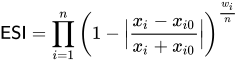
where and are properties of the extraterrestrial body and of Earth respectively, is the weighted exponent of each property, and is the total number of properties. It is comparable to, and constructed from, the Bray–Curtis Similarity Index.[4][5] The weight assigned to each property, , are free parameters that can be chosen to emphasize certain characteristics over others or to obtain desired index thresholds or rankings. The webpage also ranks what it describes as the habitability of planets and moons according to three criteria: the location in the habitable zone, ESI, and a speculation as to a capacity to sustain organisms at the bottom of the food chain, a different index collated on the webpage identified as the "Global Primary Habitability scale".[6]


The 2011 Astrobiology article and the ESI values found in it received press attention at the time of the article's publication. As a result, Mars was reported to have the second-highest ESI in the Solar System with a value of 0.70.[7] A number of exoplanets listed in that article were reported to have values in excess of this.
Other ESI values that have been reported by third parties include the following sources:[7][4]
No relation to habitability
[edit]Although the ESI does not characterize habitability, given the point of reference is the Earth, some of its functions match those used by habitability measures. As with the definition of the habitable zone, the ESI uses surface temperature as a primary function (and the terrestrial point of reference). A 2016 article uses ESI as a target selection scheme and obtains results showing that the ESI has little relation to the habitability of an exoplanet, as it takes no account of the activity of the star, planetary tidal locking, nor the planet's magnetic field (i.e. ability to protect itself) which are among the keys to habitable surface conditions.[8]
It has been noted that ESI fails to differentiate between Earth similarity and Venus similarity, where planets with a lower ESI have a greater chance at habitability.[9]
Planets with an Earth-like size
[edit]
The classification of exoplanets is difficult in that many methods of exoplanet detection leave several features unknown. For example, with the transit method, measurement of radius can be highly accurate, but mass and density are often estimated. Likewise with radial velocity methods, which can provide accurate measurements of mass but are less successful measuring radius. Planets observed via a number of different methods therefore can be most accurately compared to Earth.
Similarity of non-planets to Earth
[edit]
The index can be calculated for objects other than planets, including natural satellites, dwarf planets and asteroids. The lower average density and temperature of these objects give them lower index values. Only Titan (a moon of Saturn) is known to hold on to a significant atmosphere despite an overall lower size and density. While Io (a moon of Jupiter) has a low average temperature, surface temperature on the moon varies wildly due to geologic activity.[10]
See also
[edit]References
[edit]- ^ a b Schulze-Makuch, D.; Méndez, A.; Fairén, A. G.; von Paris, P.; Turse, C.; Boyer, G.; Davila, A. F.; Resendes de Sousa António, M.; Catling, D. & Irwin, L. N. (2011). "A Two-Tiered Approach to Assess the Habitability of Exoplanets". Astrobiology. 11 (10): 1041–1052. Bibcode:2011AsBio..11.1041S. doi:10.1089/ast.2010.0592. PMID 22017274.
- ^ Kashyap Jagadeesh M.; Gudennavar, S. B.; Doshi U. & Safonova M. (2017). "Indexing of exoplanets in search for potential habitability: application to Mars-like worlds". Astrophysics and Space Science. 362 (8): 1572–946X. arXiv:1608.06702. Bibcode:2017Ap&SS.362..146K. doi:10.1007/s10509-017-3131-y. S2CID 119097653.
- ^ Gonzalez, A.; Cardenas, R. & Hearnshaw, J. (2013). "Possibilities of life around Alpha Centauri B.". Revista Cubana de Física. 30 (2): 81. arXiv:1401.2211. Bibcode:2014arXiv1401.2211G.
- ^ a b c "Earth Similarity Index (ESI)". Planetary Habitability Laboratory.
- ^ Rushby, A. (2013). "A multiplicity of worlds: Other habitable planets". Significance. 10 (5): 11–15. doi:10.1111/j.1740-9713.2013.00690.x.
- ^ Sample, I. (December 5, 2011). "Habitable exoplanets catalogue ranks alien worlds on suitability for life". The Guardian. Retrieved April 9, 2016.
- ^ a b "Most liveable alien worlds ranked". BBC. November 23, 2011. Retrieved April 10, 2016.
- ^ Armstrong, D. J.; Pugh, C. E.; Broomhall, A.-M.; Brown, D. J. A.; Lund, M. N.; Osborn, H. P.; Pollacco, D. L. (2016). "The host stars of Kepler's habitable exoplanets: superflares, rotation and activity". Monthly Notices of the Royal Astronomical Society. 5 (3): 3110–3125. arXiv:1511.05306. Bibcode:2016MNRAS.455.3110A. doi:10.1093/mnras/stv2419.
- ^ Elizabeth Tasker (July 9, 2014). "No, that new exoplanet is not the best candidate to support life". The Conversation. Retrieved November 5, 2018.
- ^ Keszthelyi, L.; et al. (2007). "New estimates for Io eruption temperatures: Implications for the interior". Icarus. 192 (2): 491–502. Bibcode:2007Icar..192..491K. doi:10.1016/j.icarus.2007.07.008.
External links
[edit]


Earth Similarity Index
View on GrokipediaOverview
Definition
The Earth Similarity Index (ESI) is a unitless quantitative measure designed to assess the physical resemblance of a planetary body to Earth, with values ranging from 0, indicating no similarity, to 1, indicating identical properties. It focuses on four key physical properties: the planet's radius, bulk density, escape velocity, and surface equilibrium temperature, which serve as proxies for overall Earth-likeness in terms of size, structural composition, atmospheric retention, and thermal conditions. Introduced in 2011 by Dirk Schulze-Makuch and colleagues in the journal Astrobiology, the ESI functions as an initial screening tool to prioritize exoplanets for further habitability investigations amid vast astronomical datasets.[3]Development and Purpose
The Earth Similarity Index (ESI) was developed in 2011 by Dirk Schulze-Makuch and colleagues, including Abel Méndez, as a straightforward metric to quantify the physical similarity of planetary bodies to Earth.[3] This index emerged from collaborative efforts in astrobiology to address the rapid increase in discovered exoplanets, providing a preliminary tool for evaluating potential habitability without requiring extensive spectroscopic data.[3] The primary motivation for creating the ESI was to offer an objective, efficient method for prioritizing exoplanets for detailed follow-up observations, particularly as missions like NASA's Kepler telescope began yielding thousands of candidates.[3] At the time, with over 700 exoplanets known and projections for exponential growth, researchers sought a simple screening mechanism to identify Earth-like worlds amid vast datasets, focusing on key physical parameters such as radius, bulk density, escape velocity, and surface temperature to gauge overall resemblance to Earth.[3] This approach complemented more complex habitability assessments by enabling quick comparisons across diverse planetary environments. Initially, the ESI was applied to solar system bodies, such as Mars and Venus, and to early catalogs of confirmed exoplanets to demonstrate its utility in ranking objects by Earth-likeness.[3] These applications highlighted its role in bridging planetary science and astrobiology, allowing for consistent evaluation of both nearby and distant worlds. Over time, the ESI has evolved in its usage within the astrobiology community, gaining adoption by the Planetary Habitability Laboratory (PHL) at the University of Puerto Rico at Arecibo, which integrates it into the Habitable Worlds Catalog for ongoing assessments of potentially habitable exoplanets.[4] It has also been incorporated into NASA's astrobiology resources as a standard reference for comparing exoplanetary properties to Earth.[5]Formulation
Mathematical Expression
The Earth Similarity Index (ESI) is formulated as the geometric mean of two sub-indices: the interior similarity index (S_I) based on radius and bulk density, and the surface similarity index (S_S) based on escape velocity and surface temperature, each normalized relative to Earth's values. The overall index is given by where the sub-indices are weighted geometric means: with weights , , , and .[1] The individual similarity scores for each parameter (normalized such that Earth's value ) are This yields values between 0 (no similarity) and 1 (identical to Earth). The formulation uses geometric means to multiplicatively combine factors, ensuring a low score in any key parameter significantly reduces the overall ESI, and weights emphasize temperature due to its critical role in habitability. For exoplanets where density or escape velocity are unknown, simplified versions using only radius and temperature may be applied, but the full model is preferred when data allow.[4]Parameters and Normalization
The Earth Similarity Index (ESI) relies on four key physical parameters to quantify a body's similarity to Earth: radius (), bulk density (), escape velocity (), and surface temperature (). These are selected for their roles in structural composition, atmospheric retention, and conditions for liquid water.- Radius (): Normalized to Earth's mean radius km. Influences surface gravity and atmosphere retention. Derived from transit photometry or combined with mass estimates.
- Bulk density (): Normalized to Earth's g/cm³. Reflects internal composition (rocky vs. gaseous). Requires mass and radius.
- Escape velocity (): Normalized to Earth's km/s. Indicates ability to retain atmosphere. Computed from mass and radius: .
- Surface temperature (): Normalized to Earth's K. For exoplanets, often estimated as equilibrium temperature from stellar insolation, assuming albedo ~0.3 and no atmosphere initially; , where , are stellar values, semi-major axis, albedo. Later adjustments may include greenhouse effects.
Evaluation
Calculation Process
The calculation of the Earth Similarity Index (ESI) begins with collecting key planetary parameters from astronomical observations, followed by normalization, aggregation, and uncertainty assessment. This process relies on data from methods such as transits, radial velocity (RV) measurements, and stellar characterization, typically sourced from catalogs like the NASA Exoplanet Archive.[4][6] The first step is to determine the planetary radius . For transiting exoplanets, is derived from the observed transit depth, which measures the fractional dimming of the host star's light during the planet's passage across the stellar disk. The transit depth is given by the relation where is the depth and is the stellar radius, obtained from stellar spectroscopy or interferometry. Solving for requires accurate stellar parameters to convert the relative radius ratio to an absolute value. For non-transiting planets, is estimated indirectly from the planet's mass (measured via RV semi-amplitude or transit timing variations) using theoretical mass-radius models tailored to rocky or terrestrial compositions, such as those based on equation-of-state calculations for silicate-iron mixtures.[7] The second step involves estimating the planet's bulk density (if mass is available) as , and escape velocity . The planet's surface temperature is often approximated as the blackbody equilibrium temperature assuming no atmosphere or greenhouse effects. This is computed using where is the effective temperature of the host star (from spectral analysis), is the planet's semi-major axis (derived from the orbital period via Kepler's third law, , with stellar mass from spectroscopy), and is the planetary Bond albedo (commonly assumed to be 0.3 for Earth analogs if unknown). This formula assumes a rapidly rotating planet or orbital averaging for insolation; more advanced models may incorporate eccentricity or atmospheric redistribution factors. Once the parameters are obtained—radius , bulk density , escape velocity , and surface temperature —the third step normalizes each relative to Earth's values to obtain dimensionless ratios x (Earth x = 1): (R_\oplus = 6371 km), (\rho_\oplus = 5.514 g/cm³), (v_\oplus = 11.19 km/s), (T_\oplus = 288 K). The individual similarity score for each normalized parameter x is then which ranges from 1 (identical to Earth) to 0 (completely dissimilar). This formulation emphasizes proportional differences in a scale-invariant manner.[4][6] The fourth step aggregates the individual similarities into sub-indices and the overall ESI using weighted geometric means, prioritizing temperature due to its critical role in habitability. The interior sub-index (reflecting structural composition) is , with weights , (\sum w = 2.5). The surface sub-index (reflecting atmospheric retention and thermal conditions) is , with , (\sum w = 6.8). The overall ESI is then . If data for density or mass are unavailable, approximations or sub-indices may be used, but full ESI requires all parameters. The geometric means ensure balanced contributions while weights adjust emphasis, penalizing deviations more severely in critical parameters. Uncertainties in ESI are handled through error propagation, often via Monte Carlo simulations sampling input parameter distributions to yield confidence intervals, accounting for correlated errors in transit and RV data.[6][8] In practice, the ESI computation is facilitated by dedicated tools. The Planetary Habitability Laboratory (PHL) offers an online calculator that accepts input parameters like radius, mass, and flux to automatically compute ESI, incorporating default Earth references and basic error estimates. Open-source Python implementations, such as the PESIC (Planetary ESI Calculator) package, provide programmatic access for batch processing exoplanet catalogs, including visualization of parameter contributions and sensitivity analysis. These tools streamline the process for researchers analyzing large datasets from missions like Kepler or TESS.[4]Score Interpretation
The Earth Similarity Index (ESI) quantifies physical resemblance to Earth on a scale from 0 (no similarity) to 1 (identical), with a score of 1 serving as the theoretical maximum achievable only by Earth itself. Planets with an ESI exceeding 0.8 are deemed Earth-like, marking them for prioritization in exoplanet research, particularly rocky bodies positioned in their star's habitable zone.[4][5] Scores between 0.6 and 0.8 reflect moderate similarity, comparable to Mars (ESI ≈ 0.70), and suggest candidates worthy of additional scrutiny despite deviations in key parameters like radius or temperature.[4] An ESI below 0.6 denotes low similarity, commonly observed in gas giants or worlds with extreme physical traits far removed from Earth's conditions. The Planetary Habitability Laboratory (PHL) employs a stricter threshold of ESI ≥ 0.97 to designate planets suitable for terrestrial naming conventions within their catalogs.[9]Limitations
Lack of Direct Habitability Correlation
The Earth Similarity Index (ESI) evaluates planetary similarity to Earth based solely on physical parameters such as radius and surface temperature, deliberately excluding biological and atmospheric factors essential for habitability.[1] This narrow focus means that a high ESI score does not guarantee conditions conducive to life, as it overlooks critical elements like atmospheric composition, the presence of liquid water, magnetic field protection against radiation, and geological activity that could sustain a biosphere.[1] For instance, Venus achieves an ESI of approximately 0.78 due to its comparable size and temperature range, yet its runaway greenhouse effect renders it uninhabitable by trapping excessive heat and creating surface conditions far exceeding Earth's.[4] In contrast, Mars has an ESI around 0.70, reflecting similarities in size but hampered by a thin, CO2-dominated atmosphere that fails to retain heat or shield against solar radiation, leading to a cold, dry environment unsuitable for complex life as known on Earth.[4] The developers of the ESI explicitly cautioned that it serves merely as an initial screening tool for Earth-likeness, not a direct proxy for habitability, emphasizing the need for complementary assessments of chemical and biological viability.[1] This distinction highlights the gap between physical resemblance and the multifaceted requirements for life, where even Earth-like bulk properties cannot compensate for absent protective or nurturing mechanisms.[1] As of 2025, this perspective remains unchanged, with no significant revisions to the ESI's foundational limitations; however, researchers have increasingly integrated it with metrics like the Habitable Zone Distance (HZD) to better contextualize potential habitability by incorporating stellar proximity and energy flux.[10] Such combinations underscore that while ESI identifies physically similar candidates, true habitability demands evaluation of dynamic environmental factors beyond static physical metrics.[10]Scope and Criticisms
The Earth Similarity Index (ESI) is fundamentally limited in its scope by relying primarily on just two parameters—planetary radius and surface temperature—for many exoplanet assessments, as density and escape velocity often cannot be determined without precise mass measurements, while effects from the host star's type, such as tidal forces or radiation levels, are entirely excluded from the formulation. This narrow focus simplifies initial screening but overlooks key physical processes that influence planetary evolution and surface conditions.[4] The index is also highly sensitive to observational uncertainties in input parameters, particularly radius estimates derived from transit photometry, where typical errors of 5–15% can skew ESI scores by 10–20% for planets near Earth-like values due to the metric's exponential weighting scheme. Such sensitivities amplify when combining radius with equilibrium temperature, which itself carries uncertainties from stellar flux models. Critiques of the ESI highlight its oversimplification of complex planetary systems, with researchers arguing that the metric's reliance on Earth-centric thresholds biases results toward worlds resembling our planet while potentially dismissing viable alternatives; for instance, Barnes et al. (2015) advocate for multi-parameter frameworks that integrate orbital dynamics, tidal heating, and atmospheric retention to better evaluate habitability prospects beyond basic physical matches. This Earth-optimal bias is inherent to the index's design, which normalizes all parameters against terrestrial standards without accounting for diverse evolutionary pathways. Additionally, the original 2011 formulation predates advanced observational capabilities, such as those from the James Webb Space Telescope (JWST), which since 2022 have revealed detailed exoplanet atmospheric compositions that the ESI does not incorporate, rendering the metric outdated for comprehensive assessments involving volatile retention or greenhouse effects.Applications
Exoplanets with High ESI
The Earth Similarity Index (ESI) has been applied to numerous confirmed exoplanets, with rankings maintained by the Planetary Habitability Laboratory (PHL) through its Habitable Worlds Catalog (HWC, launched in January 2024) and cross-referenced with data from the NASA Exoplanet Archive as of November 2025.[9] The HWC lists up to 70 potentially habitable worlds out of over 5,000 known exoplanets, prioritizing those with high ESI in habitable zones. Among recent top candidates, Teegarden's Star b has an ESI of 0.97, orbiting an M-type red dwarf 12.5 light-years away; its Earth-like size (radius ≈1.1 R⊕) and incident flux (≈0.5 F⊕) contribute to this score, though tidal locking is possible due to its 4.9-day orbit.[11] TRAPPIST-1e, with an ESI of 0.85, remains a key example in the TRAPPIST-1 system 40 light-years distant, featuring seven Earth-sized planets around an M8 V red dwarf; this world receives stellar flux similar to Earth's (≈1.0 F⊕) and has a radius of about 0.92 R⊕, making it a prime target for further study. TOI-700 d, assigned an ESI of 0.93, orbits an M2 V star 101 light-years away and is an Earth-sized planet (radius ≈1.0 R⊕) in the habitable zone, receiving ≈0.85 F⊕, positioning it as one of the most Earth-analogous worlds detected by TESS.[12]| Exoplanet | ESI | Host Star Type | Distance (light-years) | Key Characteristics |
|---|---|---|---|---|
| Teegarden's Star b | 0.97 | M7 V (red dwarf) | 12.5 | Radius ≈1.1 R⊕, flux ≈0.5 F⊕, orbital period 4.9 days |
| TOI-700 d | 0.93 | M2 V (red dwarf) | 101 | Radius ≈1.0 R⊕, flux ≈0.85 F⊕, orbital period 37.4 days |
| TRAPPIST-1e | 0.85 | M8 V (red dwarf) | 40 | Radius 0.92 R⊕, flux ~1.0 F⊕, orbital period 6.1 days |
Non-Planetary Bodies
The Earth Similarity Index (ESI) extends its utility beyond exoplanets by providing a standardized metric to evaluate physical similarities to Earth for Solar System objects, including planets, moons, and dwarf planets. This application serves as a benchmark for understanding how Earth-like conditions manifest in our local cosmic neighborhood, facilitating comparisons that inform broader astronomical assessments. By calculating ESI for these well-studied bodies, researchers can calibrate the index against known geophysical and atmospheric data, enhancing its reliability for hypothetical or distant objects like exomoons.[1] Representative examples among Solar System planets illustrate varying degrees of similarity. Venus, with its comparable size and density but extreme surface conditions, achieves an ESI of 0.78. Mars follows at 0.70, reflecting its rocky composition and moderate size despite thinner atmosphere and lower temperatures. Saturn's moon Titan, notable for its thick nitrogen-rich atmosphere, scores approximately 0.50, while Mercury, the smallest inner planet with high density but intense solar proximity, registers 0.60. These values highlight how ESI captures trade-offs in planetary parameters like radius, density, escape velocity, and surface temperature.[1] For moons and dwarf planets, ESI further demonstrates its versatility in assessing non-planetary bodies. Jupiter's moon Europa, with its icy surface and potential subsurface ocean, yields an approximate ESI of 0.45, underscoring limited similarities in size and density to Earth despite its frigid environment. Pluto, classified as a dwarf planet, has an ESI of 0.49, influenced by its small size, low density, and distant orbit. Such calculations enable benchmarking against familiar objects, for instance, in hypothetically comparing ESI for undetected exomoons to Europa or Titan as analogs.[1]| Body | Type | ESI Value |
|---|---|---|
| Venus | Planet | 0.78 |
| Mars | Planet | 0.70 |
| Mercury | Planet | 0.60 |
| Titan | Moon | ≈0.50 |
| Europa | Moon | ≈0.45 |
| Pluto | Dwarf Planet | 0.49 |