


Community hub
Recent from talks
Contribute something
Nothing was collected or created yet.
Eastern Time Zone
View on Wikipedia
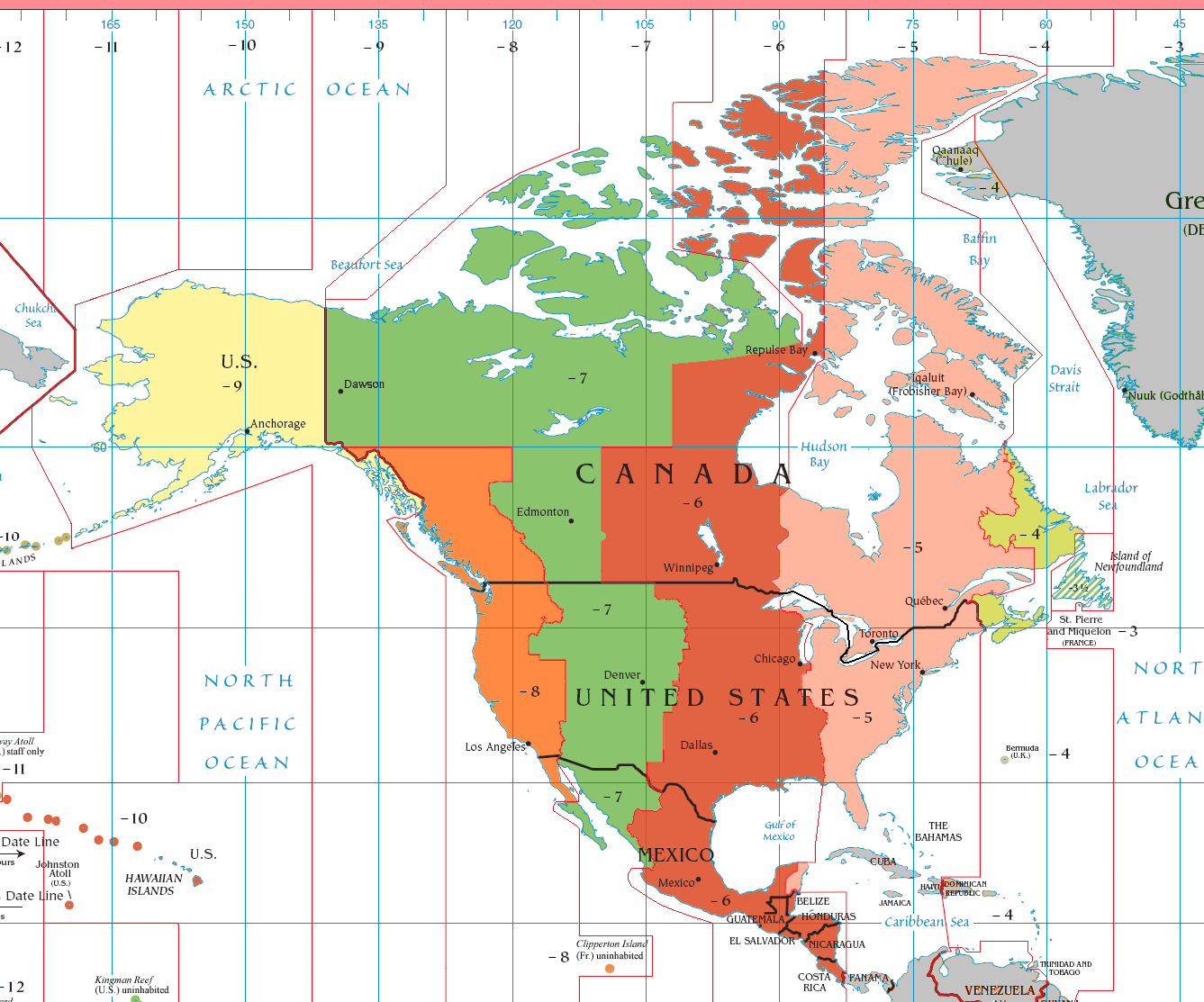
The Eastern Time Zone (ET[1]) is a time zone encompassing part or all of 23 states in the eastern United States, parts of eastern Canada, some Caribbean islands and the state of Quintana Roo in Mexico. Most areas in the time zone observe daylight saving time and thus alternate between:
Key Information


- Eastern Standard Time (EST), which is five hours behind Coordinated Universal Time (UTC−05:00) and observed during late autumn/winter, and
- Eastern Daylight Time (EDT), which is four hours behind Coordinated Universal Time (UTC−04:00) and observed during spring/summer/early autumn.
Areas in the Eastern Time Zone which do not observe daylight saving time use Eastern Standard Time. Observation of daylight saving time starts on the second Sunday in March, at 2:00 a.m. EST, clocks are advanced to 3:00 a.m. EDT, creating a 23-hour day. On the first Sunday in November, at 2:00 a.m. EDT, clocks are moved back to 1:00 a.m. EST, which results in a 25-hour day.[2][3]
The time in this zone is based on the mean solar time of the 75th meridian west of the Royal Observatory, Greenwich.
History
[edit]The boundaries of the Eastern Time Zone have moved westward since the Interstate Commerce Commission (ICC) took over time-zone management from railroads in 1938. The easternmost and northernmost counties in Kentucky were added to the zone in the 1940s, and in 1961 most of the state went Eastern. In 2000, Wayne County, on the Tennessee border, switched from Central to Eastern Time.[4] Within the United States, the Eastern Time Zone is the most populous region, with nearly half of the country's population.
In March 2019, the Florida Legislature passed a bill requesting authorization from Congress for year-round daylight saving time, which would effectively put Florida on Eastern Daylight Time year-round (except for west of the Apalachicola River, which would be on Central Daylight Time year-round).[5] A similar bill was proposed for the Canadian province of Ontario by its legislative assembly in late 2020,[6] which passed though was placed on hold until Quebec and New York agreed to make the same change, which had not happened as of 2024.[7]
Daylight saving time
[edit]For those in the United States, daylight saving time for the Eastern Time Zone was introduced by the Uniform Time Act of 1966, which specified that daylight saving time would run from the last Sunday of April until the last Sunday in October.[8] The act was amended to make the first Sunday in April the beginning of daylight saving time beginning in 1987.[8] Later, the Energy Policy Act of 2005 extended daylight saving time in the United States, beginning in 2007.[8]
Canada
[edit]In Canada, the following provinces and territories are part of the Eastern Time Zone:[9]
Within Canada, as with the United States, the Eastern Time Zone is the most populous time zone. Most of Canada observes daylight saving time synchronously with the United States, with the exception of Saskatchewan, Yukon,[10] and several other very localized areas. Southampton Island in Nunavut uses Eastern Standard Time throughout the year.[9]
United States
[edit]The boundary between time zones is set forth in Title 49 of the Code of Federal Regulations with the boundary between the Eastern and Central Time Zones being specifically detailed in Part 71.[11]
Washington, D.C., and 17 states are located entirely within the Eastern Time Zone. They are:
Five states are divided between the Eastern Time Zone and the Central Time Zone. The following locations observe Eastern Time:
- Florida: The majority of the state, except the western half of the panhandle. The eastern half of the panhandle, including Big Bend regions east of the Apalachicola River and portions of Gulf County south of the Intracoastal Waterway observe Eastern Time.
- Indiana: The majority of the state, except Northwest Indiana and the Evansville metropolitan area.
- Kentucky: The eastern half of the state, including its three largest metropolitan areas: Louisville, Lexington, and Northern Kentucky
- Michigan: The entire state except for the four Upper Peninsula counties that border Wisconsin: Gogebic, Iron, Dickinson, and Menominee
- Tennessee: All of East Tennessee including the major cities of Chattanooga, Knoxville and the Tri-Cities region, with the exception of Bledsoe, Cumberland, and Marion counties[12]
Additionally, Phenix City, Alabama, and several nearby communities in Russell County, Alabama, unofficially observe Eastern Time.[13] This is due to their close proximity to Columbus, Georgia, which is on Eastern Time. In addition Smiths Station in Lee County along with Valley and Lanett in Chambers County observe Eastern Time.[14]
Mexico
[edit]Quintana Roo is the only Mexican state to observe Eastern Standard Time (Zona Sureste; Southeast Zone), after successful lobbying effort by tourism interests to move from Central Time.[15] Quintana Roo does not observe daylight saving time.
Caribbean islands
[edit]The Bahamas and Haiti officially observe Eastern Time with daylight saving time. Cuba generally follows the U.S. with Eastern Standard Time in the winter, and Eastern Daylight Time in the summer, but the exact day of change varies year to year. The Cayman Islands, Jamaica, and Navassa Island use Eastern Standard Time year-round.
The Turks and Caicos Islands followed Eastern Time with daylight saving until 2015, when the territory switched to the Atlantic Time Zone. The Turks and Caicos Islands switched back to the pre-2015 schedule in March 2018.[16] A 2017 consultation paper highlighted the advantage for business and tourism of being in the same time zone as the eastern United States as an important factor in the decision.[17]
See also
[edit]References
[edit]- ^ "Time Zone Abbreviations - Worldwide List". timeanddate.com. Retrieved July 29, 2025.
- ^ Law, Gwillim (September 21, 2007). "United States Time Zones".
- ^ "Daylight Saving Time Starts Sunday". Government of Ontario. March 7, 2008. Retrieved September 21, 2010.
- ^ "Why Louisville?". Louisville magazine. Archived from the original on July 20, 2018. Retrieved February 10, 2018.
- ^ Klas, Mary Ellen (March 6, 2018). "Legislature approves year-round daylight saving time—but it's not a done deal yet". Miami Herald. Retrieved March 30, 2018.
- ^ Patton, Jessica (October 7, 2020). "Ontario MPP puts forward bill to make Daylight Saving Time standard time". Global News. Retrieved October 9, 2020.
- ^ Dutt, Suzanna (November 2, 2024). "Daylight saving time ends in Ontario". INsauga. Retrieved October 17, 2025.
- ^ a b c Prerau, David (2006). "Early adoption and U.S. Law". Daylight Saving Time. Web Exhibit. Retrieved April 23, 2007.
- ^ a b "Time zones and daylight saving time". nrc.canada.ca. National Research Council Canada. October 25, 2022. Retrieved January 24, 2025.
- ^ "Yukon to end seasonal time change". yukon.ca. March 4, 2020. Retrieved May 13, 2022.
- ^ The specification for the Eastern Time Zone is set forth at 49 C.F.R. § 71.4, and is listed in text Archived January 13, 2012, at the Wayback Machine and PDF Archived January 14, 2012, at the Wayback Machine formats. The boundary between Eastern and Central is set forth at 49 C.F.R. § 71.5, and is listed in text and PDF formats.
- ^ McDearman, Brian (August 13, 2006). "Parts of Eastern Alabama split between 2 time zones". Decatur Daily. AP. Archived from the original on March 10, 2016. Retrieved March 22, 2009.
- ^ Emily. "Our Community". Phenix City, Alabama. Retrieved January 10, 2022.
- ^ "Do you know which Alabama towns are in a different time zone?". February 6, 2017.
- ^ "On Mexican Time: Changing Time Zones To Accommodate Tourism". Forbes. Retrieved January 29, 2015.
- ^ "DST Dates Confirmed". Timeanddate.com. July 25, 2017. Retrieved January 10, 2019.
- ^ "Consultation paper Daylight Saving" (PDF). April 2017. pp. 6–7. Archived from the original (PDF) on January 10, 2019. Retrieved January 10, 2019.
External links
[edit]- Official U.S. time, including for the Eastern Time Zone
- North American Time Zone border data and images
- World time zone map Archived December 24, 2015, at the Wayback Machine
- U.S. time zone map Archived February 15, 2009, at the Wayback Machine
- History of U.S. time zones and UTC conversion Archived August 8, 2011, at the Wayback Machine
- Canada time zone map
- Federal Regulations defining time zones (archived May 28, 2010)
Eastern Time Zone
View on GrokipediaDefinition and Scope
Standard and Daylight Offsets
The Eastern Time Zone, abbreviated as ET, observes an offset of five hours behind Coordinated Universal Time during standard time periods, corresponding to Eastern Standard Time (EST) or UTC−05:00.[1][3] For example, on Sunday, February 1, 2026, the time in New York would be approximately 3:32 PM EST (UTC-5), as February falls within the standard time period, with daylight saving time beginning on March 8, 2026. This offset applies from the second Sunday in November to the second Sunday in March in regions that follow the standard North American daylight saving time schedule.[2] When daylight saving time is in effect, the Eastern Time Zone advances clocks by one hour, resulting in an offset of four hours behind UTC, designated as Eastern Daylight Time (EDT) or UTC−04:00.[1][8] This adjustment typically occurs from the second Sunday in March to the first Sunday in November, aligning with federal legislation in the United States and similar rules in Canada.[2] Not all jurisdictions within the Eastern Time Zone observe daylight saving time; for instance, certain areas in Indiana and Florida have historically opted out, though compliance has increased following the Energy Policy Act of 2005, which standardized DST observance across most U.S. states.[2] These offsets facilitate synchronization across a broad longitudinal span, from approximately 67.5° W to 79° W longitude in North America, ensuring consistent timekeeping for economic, transportation, and communication activities despite variations in local solar time.[1] The one-hour shift during EDT aims to extend evening daylight in warmer months, though its efficacy in energy conservation remains debated, with empirical studies showing mixed results on electricity usage reductions.[8]Geographical Coverage
The Eastern Time Zone (ET) primarily covers the eastern seaboard and adjacent inland areas of North America, spanning from approximately 67.5° W to 87.5° W longitude, though boundaries are irregular due to political divisions rather than strict longitudinal adherence. It includes territories observing Eastern Standard Time (EST, UTC−05:00) during standard time and Eastern Daylight Time (EDT, UTC−04:00) during daylight saving time periods, with some exceptions observing EST year-round.[2][9] In the United States, ET encompasses all of 17 states and the District of Columbia, plus parts of five others, affecting roughly half the nation's population. Fully within ET are Connecticut, Delaware, Georgia, Maine, Maryland, Massachusetts, New Hampshire, New Jersey, New York, North Carolina, Ohio, Pennsylvania, Rhode Island, South Carolina, Vermont, Virginia, and West Virginia, along with the District of Columbia. Partial coverage includes eastern Florida (excluding the Panhandle and certain northern counties such as Escambia and Santa Rosa), most of Indiana (excluding northwestern and southwestern counties like Lake and Gibson), eastern Kentucky, most of Michigan (excluding Upper Peninsula counties like Gogebic and Iron), and eastern Tennessee. These boundaries were formalized following the Uniform Time Act of 1966, with adjustments for local economic and geographic factors.[2][9] In Canada, ET covers most of Ontario (east of 90° W longitude, including exceptions like Atikokan and Shebandowan), most of Quebec (excluding the Magdalen Islands and Blanc-Sablon, which use Atlantic Time), and the majority of Nunavut's Qikiqtaaluk Region (excluding Resolute and certain communities on Central Time). Southampton Island in Nunavut observes EST year-round without daylight saving time. These alignments facilitate synchronization with U.S. eastern regions for trade and broadcasting.[2][10] Mexico's Quintana Roo state, including Cancún, observes EST year-round, adopted in 2015 to align with U.S. tourism patterns despite its geographical proximity to Central Time. In the Caribbean, the Bahamas and Haiti observe ET with daylight saving time transitions, while the Cayman Islands and Jamaica maintain EST year-round. Panama observes EST year-round across the country. These adoptions reflect historical ties to U.S. time standards for commerce and aviation, rather than solar time alignment.[2][3]Historical Development
Pre-Standardization Period
Prior to the adoption of standardized time zones, communities in the eastern United States and Canada determined local time based on solar noon, the moment when the sun reached its highest point overhead, resulting in hundreds of distinct local times across North America.[11] This method yielded variations of roughly four minutes per degree of longitude, as the Earth's rotation shifted solar positions eastward.[12] In the eastern region, spanning from the Atlantic coast to the Appalachian Mountains, cities maintained independent clocks often synchronized to church steeples, public observatories, or astronomical calculations, with no uniform reference.[13] These discrepancies created practical challenges in densely populated areas; for instance, New York City's solar noon preceded Washington, D.C.'s by approximately 12 minutes and 10 seconds due to their longitudinal separation.[14] Similarly, Philadelphia's local time lagged New York's by five minutes while preceding Baltimore's by the same interval.[15] Such offsets, though minor in isolation, accumulated across networks, complicating commerce, navigation, and early telegraph operations introduced in the 1840s, which required precise coordination for message transmission.[6] The rapid expansion of railroads after the 1830s amplified these issues, as lines like the Pennsylvania Railroad spanned hundreds of miles and intersected dozens of local times, leading to erroneous timetables and safety risks from misaligned departures.[16] To mitigate confusion, individual railroads often imposed proprietary "railroad times" for scheduling; the Pennsylvania Railroad, operating extensively in the East, standardized on Philadelphia time for its operations.[15] By the late 1870s, the United States featured over 144 distinct time systems, with some regions observing up to 50 railroad-specific schedules, underscoring the inefficiency of solar-based localism amid industrial interdependence.[17] [18]Standardization and Early Adoption
The push for standardized time zones in North America arose from the scheduling chaos caused by disparate local solar times, particularly as railroads expanded, with over 100 different local times in use across the United States by the late 19th century.[6] On November 18, 1883, major U.S. and Canadian railroads voluntarily implemented a system of four continental time zones to synchronize operations, designating the Eastern zone—spanning roughly from the Atlantic coast to the Mississippi River—as Eastern Standard Time, based on the mean solar time at the 75th meridian west longitude, equivalent to five hours behind Greenwich Mean Time.[16] [6] This railroad-led standardization was rapidly adopted in many communities, as telegraph networks disseminated the new times and businesses aligned with rail schedules for efficiency; by the end of 1883, most major Eastern cities including New York, Boston, and Philadelphia had switched to the new Eastern time, reducing daily discrepancies that had previously required constant schedule adjustments.[11] However, adoption was not universal, with some localities—such as Detroit—initially retaining local solar time due to resistance against external imposition, though economic pressures from rail and commerce eventually compelled widespread compliance within a decade.[13] Federal legalization came with the Standard Time Act of 1918, signed into law on March 19 by President Woodrow Wilson, which codified the four railroad zones (expanding to five with Alaska) and explicitly defined the Eastern zone's boundaries and offsets, naming it "United States Standard Eastern Time" to enforce uniformity amid World War I mobilization needs.[5] [19] The act also introduced daylight saving time as a temporary wartime measure, advancing clocks one hour in the Eastern zone from March 31 to October 27 in 1918, though this was repealed in 1919, leaving standard time zones intact but DST observance optional at state and local levels until later federal interventions.[5][6]Implementation by Region
United States
The Eastern Time Zone covers the eastern seaboard and adjacent inland areas of the United States, encompassing the entirety of 17 states—Connecticut, Delaware, Georgia, Maine, Maryland, Massachusetts, New Hampshire, New Jersey, New York, North Carolina, Ohio, Pennsylvania, Rhode Island, South Carolina, Vermont, Virginia, and West Virginia—along with the District of Columbia, and portions of six others: the eastern panhandle of Florida, most of Michigan, including Detroit as a major city in the Lower Peninsula, northern and southwestern Indiana, northern Kentucky, and eastern Tennessee.[9][20] This zone aligns with UTC−05:00 during standard time (Eastern Standard Time, EST) and UTC−04:00 during daylight saving time (Eastern Daylight Time, EDT), serving approximately 120 million residents and major economic centers including New York City, Washington, D.C., and Atlanta.[3] The boundaries follow state lines in most cases but deviate in split states, such as Michigan where only four western Upper Peninsula counties adhere to Central Time while the rest use Eastern, a configuration set by federal approval in 1973 to match regional commerce.[9] Implementation stems from the voluntary adoption of standard time zones by U.S. and Canadian railroads on November 18, 1883, which divided North America into four primary zones including Eastern to synchronize rail schedules and reduce accidents from inconsistent local solar times.[11] Federal codification occurred via the Standard Time Act of 1918, which authorized the Interstate Commerce Commission (later transferred to the Department of Transportation in 1966) to define zone boundaries, with states and counties able to petition adjustments for economic or geographic reasons under 15 U.S.C. §§ 260–264.[5] Notable shifts include Indiana's 2006 statewide embrace of daylight saving time across its Eastern and Central counties, ending prior patchwork observance that dated to the 1970s energy crisis exemptions.[5] Kentucky maintains Eastern Time in its eastern two-thirds, with western counties on Central Time, a division upheld since the 1883 railroad standards to reflect longitude-based solar alignment.[9] Daylight saving time observance in the Eastern Time Zone follows the Uniform Time Act of 1966, which mandates advancement of clocks by one hour from the second Sunday in March (at 2:00 a.m. EST to 3:00 a.m. EDT) until the first Sunday in November, promoting uniformity after wartime experiments in 1918–1919 and 1942–1945 revealed coordination benefits for commerce despite inconsistent state adoptions pre-1966.[5] Unlike Arizona (Mountain Time, exempt except Navajo Nation) or Hawaii, no Eastern Time areas are statutorily exempt from DST; all comply, as confirmed by Department of Transportation oversight, which has approved over 100 county boundary changes since 1966 but none opting out in this zone.[5][21] This uniformity supports interstate efficiency, though empirical studies post-2007 Energy Policy Act extension (adding four weeks of DST) indicate minimal energy savings—around 0.03% reduction in electricity use per a 2008 DOE analysis—while raising costs in sectors like candy manufacturing due to mismatched school and work hours.[5]Canada
The Eastern Time Zone encompasses most of the provinces of Ontario and Quebec, as well as eastern portions of Nunavut territory.[22][23] In these areas, standard time is Eastern Standard Time (EST, UTC−05:00), with most regions advancing clocks to Eastern Daylight Time (EDT, UTC−04:00) during the observance period.[10] Daylight saving time transitions occur at 02:00 local time on the second Sunday in March (spring forward) and revert on the first Sunday in November (fall back), a schedule harmonized across Canada and aligned with the United States since federal coordination began in 2007, though ultimate authority rests with provincial and territorial governments.[10][24] In Ontario, Eastern Time applies to the province's central and eastern regions east of roughly 90° W longitude, covering densely populated areas including Toronto (population 2.8 million as of 2021), Ottawa (1.0 million), and Hamilton (0.8 million), which together account for over half of the province's 14.2 million residents. Northwestern districts, such as Thunder Bay and Kenora, instead follow Central Time due to historical railway scheduling and geographical alignment with Manitoba. Quebec adheres to Eastern Time across nearly the entire province, including Montreal (1.8 million) and Quebec City (0.5 million), serving its 8.7 million inhabitants, except for the isolated Lower North Shore communities west of Natashquan River to the Newfoundland border, which use Atlantic Time without daylight saving. These exceptions stem from local preferences for synchronization with neighboring Atlantic regions rather than broader economic ties to Eastern centers.[10] Nunavut's Eastern Time coverage is limited to the eastern Kitikmeot and Qikiqtaaluk regions east of 85° W longitude, including communities like Pangnirtung and Iqaluit (population 7,700 as of 2021), but excludes western areas aligned with Central or Mountain zones. Southampton Island (Coral Harbour) uniquely maintains EST year-round without DST transitions, a policy adopted in 2006 to preserve community routines amid extreme seasonal daylight variations, diverging from the territory's general observance.[10] No other Canadian provinces or territories, such as those in the Maritimes or Newfoundland and Labrador, use Eastern Time; the latter's mainland Labrador follows Atlantic Time (UTC−04:00).[22] This distribution reflects Canada's decentralized timekeeping, prioritizing local commerce, transportation, and indigenous consultations over uniform national application.[10]Mexico
The state of Quintana Roo is the only region in Mexico that observes the Eastern Time Zone, officially designated as Zona Sureste (Southeast Zone), operating on Eastern Standard Time (EST, UTC-5) year-round without daylight saving time adjustments.[25][26] This zone encompasses the entire state, including major tourist destinations such as Cancún, Playa del Carmen, and Cozumel, covering an area of approximately 50,212 square kilometers with a population of about 1.86 million as of 2020.[27] Quintana Roo adopted Zona Sureste on February 1, 2015, when clocks were advanced by one hour from Central Standard Time (CST, UTC-6) at 2:00 a.m. local time, following approval by Mexico's federal Chamber of Deputies and Senate as part of a reform to the country's time zone law.[28][27] The change aimed to synchronize the state's time with the Eastern Time Zone observed in much of the United States and Caribbean, facilitating easier coordination for tourism, aviation, and commerce, given Quintana Roo's heavy reliance on visitors from EST-aligned regions.[26] Prior to 2015, the state had briefly used UTC-5 in the early 1980s for similar commercial reasons but reverted to Central Time until the permanent shift.[27] Unlike the majority of Mexico, which adheres to Central Time, Quintana Roo's fixed EST observance has remained unaffected by the national abolition of daylight saving time on October 30, 2022, as the state had not participated in DST since its 2015 transition.[29][25] This policy enhances predictability for international travelers, aligning Quintana Roo's solar time more closely with economic partners while avoiding the disruptions associated with clock changes elsewhere in the country.[26] No other Mexican states or territories currently observe Eastern Time, confining its use within Mexico to this southeastern peninsula.[27]Caribbean and Other Territories
The Bahamas observes Eastern Standard Time (EST, UTC-5) from the first Sunday in November to the second Sunday in March, and Eastern Daylight Time (EDT, UTC-4) during the intervening period, aligning with the standard North American DST schedule.[30][31] This practice facilitates synchronization with major trading partners like the United States.[32] Haiti similarly uses EST outside DST and EDT during it, with transitions on the second Sunday in March (clocks forward) and the first Sunday in November (clocks back), though observance has varied historically, including a suspension from 2016 to resumption in subsequent years.[33][34] The Turks and Caicos Islands, a British Overseas Territory, follow EST/EDT with the same DST transitions as the Bahamas and Haiti, maintaining alignment with eastern North American commerce and tourism flows.[35][36][37] Cuba operates on Cuba Standard Time (CST, UTC-5) standard offset, advancing to Cuba Daylight Time (CDT, UTC-4) during its DST period, which generally mirrors Eastern Time but with occasional divergences in start and end dates based on national policy; as of 2025, DST aligns closely with U.S. observance.[38][39][40] Jamaica and the Cayman Islands, the latter a British Overseas Territory, adhere to EST year-round without DST, reflecting equatorial proximity where seasonal daylight variation is minimal and DST yields negligible benefits.[3]| Territory | Standard Time | DST Observance | Transition Dates (2025) |
|---|---|---|---|
| Bahamas | EST (UTC-5) | Yes, to EDT (UTC-4) | Start: Mar 9; End: Nov 2[30] |
| Haiti | EST (UTC-5) | Yes, to EDT (UTC-4) | Start: Mar 9; End: Nov 2[33] |
| Turks and Caicos Islands | EST (UTC-5) | Yes, to EDT (UTC-4) | Start: Mar 9; End: Nov 2[35] |
| Cuba | CST (UTC-5) | Yes, to CDT (UTC-4) | Start: Mar 9; End: varies, often Nov[38] |
| Jamaica | EST (UTC-5) | No | N/A[3] |
| Cayman Islands | EST (UTC-5) | No | N/A[3] |
Daylight Saving Time in the Eastern Time Zone
Origins and Evolution of DST
The modern practice of daylight saving time (DST) traces its conceptual roots to a 1784 satirical essay by Benjamin Franklin, who suggested Parisians rise earlier to utilize morning daylight, though without proposing clock adjustments.[42] Serious advocacy emerged in 1907 when British builder William Willett published a pamphlet proposing incremental 20-minute clock advances in spring and reversals in autumn to extend evening leisure hours, motivated by his observations of underused summer daylight during golf outings.[43] The first experimental DST implementation occurred on July 1, 1908, in Port Arthur (now part of Thunder Bay), Ontario, Canada, where clocks advanced one hour for the summer to conserve energy amid a local power shortage, predating national adoptions elsewhere.[44] Germany pioneered nationwide DST on April 30, 1916, advancing clocks by one hour from May to October as a World War I fuel-conservation measure to reduce artificial lighting needs in factories.[45] This prompted rapid adoption across Europe, including the United Kingdom on May 21, 1916. In the United States, which encompasses much of the Eastern Time Zone (ETZ), Congress enacted DST via the Calder Act on March 19, 1918, effective March 31, 1918, to October 27, 1918, aligning with wartime energy rationing; eastern cities like New York and Boston shifted clocks forward at 2 a.m., extending evenings for industrial productivity.[46] The policy proved unpopular among farmers and was repealed in 1919, reverting to local discretion and resulting in patchwork observance across ETZ states such as New York (observing) versus rural Pennsylvania areas (often not).[47] Canada's ETZ provinces, including Ontario and Quebec, largely synchronized with U.S. adoption in 1918 for wartime coordination, with Toronto and Montreal implementing one-hour advances to support transatlantic shipping and manufacturing in the shared ETZ.[48] During World War II, President Franklin D. Roosevelt ordered year-round "War Time" DST starting February 9, 1942, effectively advancing ETZ clocks permanently by one hour until September 30, 1945, to maximize daylight for defense production in eastern industrial hubs.[49] Postwar, federal relinquishment to states and localities led to inconsistencies; for instance, while New York City consistently observed DST from 1945 onward, some ETZ-adjacent counties in Kentucky and Florida opted out until the 1960s, complicating commerce and broadcasting across the zone.[6] The Uniform Time Act of 1966 standardized DST nationwide, mandating observance from the last Sunday in April to the last Sunday in October for willing jurisdictions, with opt-out provisions requiring congressional approval; this brought uniformity to ETZ areas, reducing scheduling disruptions in finance and media centered in New York.[5] Energy crises prompted further evolution: the 1973–1974 Arab oil embargo led to the Emergency Daylight Saving Time Energy Conservation Act, imposing year-round DST from January 6, 1974, to October 27, 1974, across the U.S. ETZ, though public backlash over dark winter mornings prompted reversion.[50] Extensions followed in 1975–1986, starting earlier in February or late January. The Energy Policy Act of 2005 shifted U.S. DST to the second Sunday in March through the first Sunday in November, effective 2007, harmonizing with Canada's ETZ provinces via federal-provincial agreement to facilitate cross-border trade and aviation; this elongated DST by about a month, affecting over 140 million ETZ residents in synchronized clock shifts.[47][10] Despite ongoing debates, this framework persists, with rare exemptions like certain Florida counties proposing but failing permanent standard time adoption.[51]Current Observance Rules
In jurisdictions observing daylight saving time (DST) within the Eastern Time Zone, the period begins at 2:00 a.m. Eastern Standard Time (EST, UTC−05:00) on the second Sunday in March, when clocks are advanced one hour to 3:00 a.m. Eastern Daylight Time (EDT, UTC−04:00).[52][47] This shift creates a 23-hour day and extends evening daylight by shifting the clock forward. The practice ends at 2:00 a.m. EDT on the first Sunday in November, when clocks are set back one hour to 1:00 a.m. EST, resulting in a 25-hour day and a return to standard time.[52][47] These rules, codified in the United States by the Energy Policy Act of 2005 and effective since March 2007, align the Eastern Time Zone's observance with much of North America to standardize commerce and transportation.[53] Canada's provinces and territories using Eastern Time, including Ontario and Quebec, follow the identical schedule under federal guidelines harmonized with the U.S., ensuring cross-border consistency for economic activities.[54] Mexico's portions of the Eastern Time Zone, such as Quintana Roo, do not observe DST following the country's nationwide abolition in October 2022, remaining on permanent standard time (UTC−05:00).[55] In the United States, all states and territories in the Eastern Time Zone—such as New York, Pennsylvania, Georgia, Michigan, and Florida—uniformly observe these transitions without exceptions, unlike non-observing areas in other zones like most of Arizona or Hawaii.[53][7] Certain Caribbean territories nominally in the Eastern Time Zone, including Puerto Rico and the U.S. Virgin Islands, maintain Atlantic Standard Time (UTC−04:00) year-round without DST shifts.[53] For 2026, DST in the Eastern Time Zone will commence on March 8 and conclude on November 1, reflecting the second-Sunday-in-March to first-Sunday-in-November framework.[56] Proposals to alter these rules, such as making EDT permanent via the Sunshine Protection Act, have advanced in the U.S. Senate but remain unpassed in the House as of October 2025, preserving the biannual changes amid ongoing debates over efficacy.[57] Local time authorities, including the National Institute of Standards and Technology, disseminate these adjustments to synchronize atomic clocks and public systems.[58]Controversies and Empirical Critiques of DST
Energy Savings Claims and Evidence
Daylight Saving Time (DST) was advocated in the early 20th century partly on the grounds of energy conservation, with proponents arguing that shifting clocks forward in summer would extend evening daylight, thereby reducing the need for artificial lighting and associated electricity use.[59] This rationale gained prominence during World War II and the 1970s energy crises, leading to extensions of DST periods in the United States, including regions in the Eastern Time Zone.[60] A 2008 U.S. Department of Energy analysis of the Energy Policy Act of 2005, which extended DST by four weeks (two in spring and two in fall), estimated total annual electricity savings of approximately 1.3 billion kilowatt-hours, equivalent to about 0.03% of U.S. electricity consumption or 0.5% savings during the extended period itself.[60] [61] The report attributed most benefits to reduced residential lighting but noted negligible impacts on overall energy use, with no significant effects on gasoline consumption or heating.[62] These findings apply to DST-observing areas like the Eastern Time Zone, where population density amplifies potential scale, though the marginal gains were deemed insufficient to justify broader extensions. Contrasting evidence from a natural experiment in Indiana, which largely falls within the Eastern Time Zone and adopted statewide DST in 2006 after partial opt-outs, showed an approximate 1% increase in residential electricity consumption following implementation.[63] [64] Researchers attributed this to lighting savings being offset by higher cooling demand in warmer evenings (1-2% increase in July-September) and heating demand in cooler mornings (2-4% in October), resulting in an estimated $9 million in additional annual household electricity costs for the state.[63] Such results highlight how behavioral adjustments and climate factors in temperate zones like the Eastern Time Zone can negate purported benefits. A 2018 meta-analysis of 44 studies across multiple countries found an average electricity reduction of 0.34% on DST days, but emphasized publication bias inflating estimates and heterogeneity by region and era, with modern analyses often showing smaller or null effects due to efficient lighting technologies like LEDs diminishing marginal lighting savings.[65] [66] Recent U.S.-focused critiques, including those accounting for air conditioning prevalence in Eastern states, suggest net consumption increases in warmer periods, as extended evening activities boost cooling loads without corresponding reductions elsewhere.[67] Overall, empirical data indicates that DST yields negligible or context-dependent energy impacts, challenging the policy's foundational conservation claims.[59]Health, Safety, and Circadian Impacts
The biannual transitions to and from Daylight Saving Time (DST) in the Eastern Time Zone disrupt circadian rhythms by imposing an abrupt one-hour shift in social clock time relative to solar noon, leading to a misalignment known as social jet lag. This desynchronization affects the suprachiasmatic nucleus, the body's master clock, which synchronizes physiological processes to the light-dark cycle; the spring forward exacerbates morning darkness and delays evening light exposure, suppressing melatonin production and prolonging alertness into later hours.[68][69] Empirical chronobiological analyses confirm that such shifts induce measurable alterations in sleep architecture, including reduced slow-wave sleep and increased wakefulness, with effects persisting for days to weeks, particularly in individuals with evening chronotypes who experience amplified phase delays.[70][71] Health consequences stem primarily from this circadian perturbation, which triggers acute stress responses, elevated cortisol, and sleep deprivation equivalent to crossing one time zone. Multiple studies link the spring DST transition to a transient spike in acute myocardial infarction risk, with one analysis reporting a 24% increase on the Monday following the change due to sleep loss and sympathetic nervous system activation.[72][73] Similar patterns emerge for ischemic strokes, with elevated incidence in the week post-transition, attributed to disrupted vascular regulation and inflammation.[74] However, larger-scale reviews, including a Mayo Clinic examination of hospital data, indicate these effects may be minimal overall, with no sustained differences in mortality rates, suggesting individual vulnerability factors like preexisting conditions amplify risks.[75] In the Eastern Time Zone, autumn back transitions show a relative mortality reduction compared to other zones, possibly due to better alignment with solar time in eastern locales, though spring shifts pose heightened risks westward within the zone where solar misalignment is greater.[76] Safety risks, particularly roadway incidents, rise acutely after the spring DST onset from fatigue-induced impairments in reaction time and vigilance. A comprehensive review of U.S. crash data found fatal motor vehicle accidents increase by approximately 6% in the week following the clock advance, with morning hours and locations farther west in time zones—like western portions of the Eastern Time Zone—exhibiting amplified effects due to compounded circadian desynchrony and reduced morning light.[77][78] This correlates with objective measures of driving fatigue persisting up to four weeks post-transition, including slower brake responses and lane deviations.[79] Fall transitions yield mixed outcomes: pedestrian fatalities decline from extended evening light, but motorist crashes net increase, resulting in an overall balance of 29 additional fatal vehicle occupant deaths against 26 fewer pedestrian incidents annually.[80] These patterns hold empirically across regions observing DST, including the Eastern Time Zone, underscoring transient but verifiable causal links via sleep debt rather than confounding seasonal factors.[81]Economic and Policy Debates
Economic debates surrounding Daylight Saving Time (DST) in the Eastern Time Zone center on its purported benefits to commerce and energy efficiency versus documented costs from productivity losses and minimal empirical savings. Proponents argue that DST extends evening daylight, boosting sectors like retail and recreation; for instance, a 2020 analysis claimed potential advantages in reduced motor vehicle fatalities and energy use during year-round DST experiments, though these findings draw from limited historical data such as the U.S. 1974 trial.[82] However, rigorous empirical studies consistently refute significant energy conservation, with a 2017 meta-analysis of 44 papers estimating an average electricity reduction of only 0.34% under DST, often offset by increased air conditioning demand in warmer months.[83] In the Eastern Time Zone, encompassing financial hubs like New York and Toronto, claims of enhanced investor mood and stock market gains from extended daylight remain speculative, with causal links unproven amid broader market influences.[84] Critiques highlight transition costs, particularly the spring forward shift disrupting sleep and circadian rhythms, leading to measurable economic drags. A 2024 study quantified U.S.-wide productivity losses from DST at approximately $672 million annually across metropolitan areas, driven by reduced output in knowledge-based industries prevalent in Eastern Time Zone cities like Washington, D.C., and Boston.[85] Further evidence from Indiana's 2006 DST adoption showed a 1% net increase in residential electricity use, suggesting that behavioral adaptations—such as earlier evening activities—negate lighting savings without proportional gains elsewhere.[86] Sectoral benefits, such as purported gains for golf courses or outdoor leisure, fail first-principles scrutiny when weighed against aggregate data indicating no overall GDP uplift and heightened health-related absenteeism costs post-transition.[87] Policy discussions in the U.S. and Canada, affecting Eastern Time Zone jurisdictions, increasingly favor abolishing biannual switches amid stalled permanent DST bids. The U.S. Sunshine Protection Act, reintroduced in 2021 to enact year-round DST, passed the Senate Commerce Committee but faltered in full Congress, reflecting divides over health risks versus commerce claims; opponents cite empirical welfare losses equivalent to €754 per capita in Europe from DST persistence.[88][87] In Canada, where Ontario and Quebec observe DST aligned with U.S. Eastern Time, 2025 parliamentary bills propose ending changes, supported by 93% of British Columbians in a 2019 referendum favoring permanent DST—though national consensus leans toward standard time for alignment with solar noon in policy analyses.[89][90] Gallup polls indicate over 50% of Americans now prefer year-round standard time, up from prior support, underscoring empirical critiques of DST's net disutility in productivity and safety metrics over outdated energy rationales.[91] Federal prohibitions on unilateral permanent DST by states complicate Eastern Time Zone uniformity, as exemptions require contiguous adoption, amplifying cross-border trade frictions with non-observing areas.[92]Technical and Practical Usage
Time Synchronization and Standards
The Eastern Time Zone's temporal standard is legally defined by the United States Department of Transportation (DOT) under the Uniform Time Act of 1966, which designates the eastern zone boundaries and mandates adherence to Eastern Standard Time (EST) as UTC−05:00 during non-daylight periods.[5] [93] This zone encompasses regions west of 67°30′ W longitude and east of specified meridians, including most of the eastern seaboard states, ensuring uniform civil time reckoning across jurisdictions.[94] Eastern Daylight Time (EDT), observed seasonally, shifts the offset to UTC−04:00, with transitions governed by federal rules unless states opt out via congressional approval.[1] Timekeeping accuracy in the zone relies on synchronization to Coordinated Universal Time (UTC), maintained through atomic clocks at institutions like the National Institute of Standards and Technology (NIST) and the United States Naval Observatory (USNO), which contribute to the international UTC ensemble via UTC(US).[95] [96] NIST's atomic fountains, such as NIST-F2, achieve uncertainties below 1 second in 300 million years, providing the foundational reference for all U.S. time signals. Devices and networks then apply the fixed UTC offset for local ET display, preventing drift from solar or mechanical inconsistencies. Primary synchronization methods include:- Network Time Protocol (NTP): Widely used for computers, servers, and IoT devices, NTP queries stratum-1 servers at NIST or USNO, achieving sub-millisecond accuracy over the internet by exchanging timestamps and adjusting for latency; operating systems like Windows and Linux enable automatic periodic syncs to these UTC sources.[97] [98] [99]
- Radio signals: NIST's WWVB station in Colorado broadcasts low-frequency signals (60 kHz) receivable across North America, enabling radio-controlled clocks to decode UTC-encoded messages and self-adjust, with synchronization typically completing within minutes of signal acquisition. Shortwave stations like WWV provide voice and digital time announcements for manual or automated calibration.[95]
- GPS and satellite services: Global Positioning System receivers derive UTC directly from atomic clocks on satellites, offering ubiquitous, high-precision sync (within 10–50 nanoseconds) for navigation, telecommunications, and financial systems in the ET region.[96]
- Telephone and ACTS: NIST's Automated Computer Time Service (ACTS) delivers UTC via modem calls, useful for isolated or legacy systems, formatting responses to include offsets for local conversion to EST/EDT.[98]