Hubbry Logo
Electric bellElectric bellMain
Open search
Electric bell
Community hub
Electric bell
logo
8 pages, 0 posts
0 subscribers
Be the first to start a discussion here.
Electric bell
Electric bell
from Wikipedia
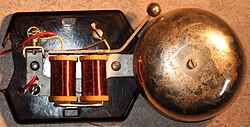
Older electric doorbell

An electric bell is a mechanical or electronic bell that functions by means of an electromagnet. When an electric current is applied, it produces a repetitive buzzing, clanging or ringing sound. Electromechanical bells have been widely used at railroad crossings, in telephones, fire and burglar alarms, as school bells, doorbells, and alarms in industrial areas, since the late 1800s, but they are now being widely replaced with electronic sounders. An electric bell consists of one or more electromagnets, made of a coil of insulated wire around an iron bar, which attract an iron strip armature with a clapper.

Types

[edit]

Interrupter bells

[edit]

How they work

[edit]
How an interrupter-type electric bell works.

The most widely used form is the interrupter bell, which is a mechanical bell that produces a continuous sound when current is applied. See animation, above. The bell or gong (B), which is often in the shape of a cup or half-sphere, is struck by a spring-loaded arm (A) with a metal ball on the end called a clapper, actuated by an electromagnet (E). In its rest position the clapper is held away from the bell a short distance by its springy arm. When the switch (K) is closed, an electric current passes from the battery (U) through the winding of the electromagnet. It creates a magnetic field that attracts the iron arm of the clapper, pulling it over to give the bell a tap. This opens a pair of electrical contacts (T) attached to the clapper arm, interrupting the current to the electromagnet. The magnetic field of the electromagnet collapses, and the clapper springs away from the bell. This closes the contacts again, allowing the current to flow to the electromagnet again, so the magnet pulls the clapper over to strike the bell again. This cycle repeats rapidly, many times per second, resulting in a continuous ringing.

The tone of the sound generated depends on the shape and size of the bell or gong resonator. Where several bells are installed together, they may be given distinctive rings by using different size or shapes of gong, even though the strike mechanisms are identical.

Another type, the single-stroke bell, has no interrupting contacts. The hammer strikes the gong once each time the circuit is closed. These are used to signal brief notifications, such as a shop door opening for a customer, rather than continuous warnings.

Buzzers

[edit]

An electric buzzer uses a similar mechanism to an interrupter bell, but without the resonant bell. They are quieter than bells, but adequate for a warning tone over a small distance, such as across a desktop.

A buzzer or beeper is an audio signalling device, which may be mechanical, electromechanical, or piezoelectric. Typical uses of buzzers and beepers include alarm devices, timers and confirmation of user input such as a mouse click or keystroke.

With the development of low cost electronics from the 1970s onwards, most buzzers have now been replaced by electronic 'sounders'. These replace the electromechanical striker of a bell with an electronic oscillator and a loudspeaker, often a piezoelectric transducer.

Single-stroke bells

[edit]
Single-stroke bell for railway signalling

The first commercial electric bells were used for railway signalling, between signal boxes. Complex bell codes were used to indicate the types of train passing between signal boxes, and the destinations to which they should be routed.

These were single-stroke bells: applying current to an electromagnet pulled the bell's clapper against the bell or gong and gave one chime. The bell did not ring continuously, but only with a single ring, until current was applied again. To sustain the tone, these bells were usually much larger than are used today with interrupter bells. Bells, gongs and spiral chimes could all be used, giving a distinct tone for each instrument.

A simple development of the single-stroke bell was the sprung bell. This had previously been used, mechanically actuated, for servant-call bells in large houses. Instead of working a clapper, the electromagnet shook the whole bell, which was mounted on a flexible spiral spring. The inertia of the heavy bell on the light spring would continue ringing for some seconds after the stroke. Although the sound would rapidly die away, the visible trembling of the bell could indicate which bell had been rung, amongst a panel of several.

Telephones

[edit]
Polarised bell, circa 1903

Landline telephone bells were powered by 60 to 500 volts RMS at between 16 and 25 Hertz AC. and a different design, the polarised bell, was used. These have an armature containing a permanent magnet, so that this is alternately attracted and repelled by each half-phase and different polarity of the supply. In practice, the armature is arranged symmetrically with two poles of opposite polarity facing each end of the coil, so that each may be attracted in turn. No contact breaker is required, so such bells are reliable for long service.[1] In some countries, notably the UK, the clapper struck two different sized bells in turn giving a very distinctive ring.

Fire alarms

[edit]
Fire alarm bell

Fire alarm bells are divided into two categories: vibrating, and single-stroke. On a vibrating bell, the bell will ring continuously until the power is cut off. When power is supplied to a single-stroke bell, the bell will ring once and then stop. It will not ring again until power is turned off and on again. These were frequently used with coded pull stations.[clarification needed]

Power sources

[edit]

Electric bells are typically designed to operate on low voltages of from 5 to 24 V AC or DC. Before widespread distribution of electric power, bells were necessarily powered by batteries, either wet-cell or dry-cell type.[2] Bells used in early telephone systems derived current by a magneto generator cranked by the subscriber. In residential applications, a small bell-ringing transformer is usually used to power the doorbell circuit. So that bell circuits can be made with low-cost wiring methods, bell signal circuits are limited in voltage and power rating.[3] Bells for industrial purposes may operate on other, higher, AC or DC voltages to match plant voltages or available standby battery systems.[4]

History

[edit]

The interrupter bell evolved from various oscillating electromechanical mechanisms which were devised following the invention of the electromagnet by William Sturgeon in 1823.[5] One of the first was the oscillating electric wire invented by James Marsh in 1824.[6][5] This consisted of a wire pendulum dipping into a mercury trough, suspended between the poles of an electromagnet. When current was passed through the wire, the force of the magnet made the wire swing sideways, out of the mercury, which broke the current to the magnet, so the wire fell back. The modern electric bell mechanism had its origin in vibrating "contact breaker" or interrupter mechanisms devised to break the primary current in induction coils.[5] Vibrating "hammer" interrupters were invented by Johann Philipp Wagner (1839) and Christian Ernst Neeff (1847), and was developed into a buzzer by Froment (1847).[5][6] John Mirand around 1850 added a clapper and gong to make the standard electric bell[5][6] for use as a telegraph sounder. Other types were invented around that time by Siemens and Halske and by Lippens.[5] The polarized (permanent magnet) bell used in telephones, which appeared about 1860,[6] had its beginning in the polarized relay and telegraph developed by Werner Siemens around 1850.[6]

See also

[edit]

References

[edit]
Revisions and contributorsEdit on WikipediaRead on Wikipedia
from Grokipedia
An electric bell is an electromechanical device that produces sound through the action of an , which repeatedly attracts and releases an armature to strike a or when an flows through its circuit. The core mechanism relies on the magnetic effect of electric current: as current passes through a coil of insulated wire wrapped around a soft iron core, it generates a that pulls the iron armature toward the core, causing a attached to the armature to hit the and produce a . Simultaneously, this movement opens a , interrupting the current, demagnetizing the , and allowing a spring to return the armature, which closes the contact and restarts the cycle for continuous operation while the circuit remains powered. The invention of the electric bell stemmed from advancements in , beginning with William Sturgeon's creation of the first practical in 1825, a horseshoe-shaped device capable of lifting weights far exceeding its own mass using a single-cell battery. This breakthrough enabled subsequent developments in oscillating electromechanical devices, culminating in 1831 when American physicist demonstrated an electromagnetic bell at , using a battery and long wire to ring a distant bell via remote electrical signaling, a precursor to telegraphic applications. By the mid-19th century, refinements in interrupter mechanisms and vibrating armatures had transformed these prototypes into reliable signaling tools, as detailed in early texts. Electric bells encompass various types suited to different needs, including vibrating or continuous-ringing bells for sustained alarms, single-stroke bells that produce one chime per activation, and buzzers that generate a tone without a . Key components typically include the , armature with clapper, spring for retraction, adjustable contact screw, and , often powered by batteries or low-voltage circuits with switches. These devices found widespread applications in residential doorbells for visitor announcements, and signaling systems for breaks or emergencies, and early communication networks, evolving into modern electronic variants while retaining their foundational electromagnetic principles.

Operating Principles

Electromagnetic Basics

The operation of an electromagnet in an electric bell relies on the magnetic effect of electric current, where an passing through a coil of wire generates a . The core of the is typically made of soft iron, a ferromagnetic material with high magnetic permeability that enhances the field strength when current flows through the surrounding coils. Upon applying current, the magnetic field lines concentrate within the core, creating north and south poles that exert an attractive force on nearby ferrous materials, such as the bell's armature. This attraction is fundamental to the bell's actuation mechanism. Key components of the electromagnetic system in an electric bell include the itself (consisting of the soft iron core and insulated wire coils), the armature (often shaped as a or striker attached to the armature), the or bell (a resonant metal dome or cup struck by the armature to produce ), and a mounting frame that holds these elements in fixed positions while allowing armature movement. The armature is positioned adjacent to the with a small air gap, enabling it to pivot or move when attracted. These components work together to convert into mechanical motion and acoustic output. The magnetic force FF attracting the armature to the can be derived from the across the air gap. The magnetic flux density BB in the gap is approximately B=μ0NIgB = \frac{\mu_0 N I}{g}, where μ0\mu_0 is the permeability of free space (4π×1074\pi \times 10^{-7} ), NN is the number of coil turns, II is the current, and gg is the air gap length (assuming the gap dominates the ). The force is then given by the formula F=B2A2μ0F = \frac{B^2 A}{2 \mu_0}, where AA is the cross-sectional area of the pole face. Substituting BB yields: F=μ0(NI)2A2g2F = \frac{\mu_0 (N I)^2 A}{2 g^2} This equation shows that the force is proportional to the square of the ampere-turns NIN I and the area AA, while inversely proportional to the square of the gap gg, emphasizing the need for a small air gap in electric bells to achieve sufficient striking force. In application to bell operation, this force accelerates the armature across the gap to impact the gong, with typical values producing impulses strong enough for audible resonance without excessive power draw (e.g., currents of 0.5–2 A in household bells). Both (AC) and (DC) can generate the initial for armature attraction in an electric bell, as the instantaneous depends on the current magnitude at any moment. However, DC provides a steady field for consistent pull, while AC's oscillating nature results in a time-averaged attraction equivalent to that of DC using the same RMS current for typical 50–60 Hz supplies.

Interrupter and Single-Stroke Mechanisms

The interrupter mechanism in an electric bell relies on a feedback loop involving electromagnetic attraction and mechanical interruption to produce continuous ringing. When electrical current flows through the coil windings, it energizes the electromagnet, generating a magnetic field that attracts a hinged armature—typically a soft iron strip—toward the core. As the armature moves, its attached hammer strikes the gong, but the motion simultaneously separates a pair of adjustable contacts integrated into the armature assembly, breaking the circuit and de-energizing the electromagnet. A spring connected to the armature then pulls it back to its original position, remaking the electrical contact and allowing current to flow again, which restarts the cycle. This rapid oscillation, often occurring at 100-200 cycles per second to generate a sustained tone, continues as long as the power is supplied. In contrast, the single-stroke mechanism delivers a solitary chime without such a self-sustaining loop, using direct electromagnetic actuation for brief notifications. Current applied to the coil creates a that pulls the armature and its attached hammer toward the , causing a single impact on the . Lacking interrupter contacts, the armature remains in the attracted position until the current is externally interrupted, preventing repeated cycles; the spring returns the armature only after power cessation, readying it for the next . This design ensures one discrete strike per activation, producing a clear, non-repeating ring. Wiring differences between the two mechanisms stem from their operational needs: the interrupter incorporates make-break contacts directly on the armature for internal circuit interruption, forming a closed loop that sustains without external timing. Single-stroke bells, however, connect via simple series wiring to an external switch or , where brief current application—often controlled by a momentary push or timed —triggers the isolated strike without feedback elements. Acoustically, both mechanisms leverage the of the , a tuned metal dome whose natural vibrational aligns closely with the hammer's impact rate to amplify and prolong the sound wave propagation. In interrupter bells, the matches the gong's resonant mode, exciting sustained harmonics for a continuous tone; single-stroke designs rely on the gong's inherent to produce a decaying but resonant chime after one impulse.

Types

Interrupter Bells

Interrupter bells operate through a self-sustaining electromagnetic cycle that repeatedly strikes a resonant to produce continuous sound. The core components include an formed by a coil wrapped around an iron core, which attracts a soft iron armature pivoted on a spring-loaded arm ending in a . When current flows through the coil, the pulls the armature toward it, causing the to strike the ; this motion simultaneously opens the circuit at adjustable contacts, interrupting the current and allowing the spring to return the armature, which then closes the circuit again to repeat the process. The resonant , typically dome-shaped or cup-like and made of tuned metal such as , vibrates mechanically upon impact to amplify and sustain the sound. The pivoted armature is designed for rapid , with the clapper often featuring a rounded or nylon-tipped end to ensure clean strikes without the gong's . An adjustable contact screw, connected to the spring supporting the armature, allows precise tuning of the contact gap, which influences the rate and thus the pitch of the ringing sequence by controlling the timing of circuit interruptions. In common residential applications, such as doorbells, interrupter bells often incorporate two-tone chimes using dual gongs of different sizes or tunings—typically one for a higher note (e.g., F# at approximately 740 Hz) and one for a lower note (e.g., at approximately 587 Hz)—activated selectively via separate pushbuttons to distinguish between front and rear entrances. The sound produced is a clear, melodic resulting from the mechanical vibration of the , with the repetition frequency of strikes determined by the spring tension and the mass of the armature, enabling a sustained, attention-grabbing chime. Maintenance of interrupter bells primarily involves addressing contact wear, where repeated arcing and mechanical stress erode the contact points, leading to intermittent operation or complete failure over time. Regular cleaning of the contacts to remove oxidation, along with occasional of the pivoted armature and mechanism with a , non-conductive , helps prevent sticking and ensures reliable cycling; improper can accelerate wear, while over-lubrication may attract and impair electrical function.

Buzzers

Electric buzzers represent a simplified variant of electromagnetic signaling devices, distinguished by their use of a laminated armature or vibrating diaphragm that generates sound through direct mechanical against the device's frame, eliminating the need for an external gong or clapper mechanism. This design typically incorporates a laminated core and armature assembly made from thin metal strips to minimize losses and enhance rapid , allowing the armature to function as a reed that vibrates upon energization of surrounding coils. The absence of resonant components results in a non-melodic output, focusing instead on a continuous or buzzing tone derived from the armature's contact with the frame. In operation, electric buzzers adapt an interrupter mechanism—similar to that in other electromagnetic devices—to create intermittent current flow, but with components tuned for a buzzing typically ranging from 1 to 4 kHz in electromagnetic models, producing a sustained hum or buzz rather than distinct strikes. For applications, the interrupter rapidly opens and closes the circuit, causing the laminated armature to vibrate at rates around 120 times per second under influence, directly generating the audible signal through frame contact. This vibration can be adjusted via air gap settings or tension in the armature mounting to optimize the buzzing intensity and pitch. Historically, mechanical electromagnetic buzzers dominated early 20th-century designs but were largely supplanted by piezoelectric electronic versions starting in the , as the latter offered greater compactness, lower power consumption, and simpler integration into small devices without moving parts. The invention of practical piezoelectric buzzers, exemplified by early patents like US4122365A in 1978, accelerated this shift by enabling solid-state operation using the piezoelectric effect in ceramic elements. In applications, mechanical buzzers served as alert indicators in early appliances, such as timers, clocks, and entry systems, providing a simple, non-melodic auditory cue for events like cycle completion or visitor announcements without requiring complex tonal resonance. Their robust, low-voltage design made them suitable for basic signaling in pre-electronic era devices, including early telephones and industrial controls.

Single-Stroke Bells

Single-stroke bells are electromechanical devices designed to produce a single chime upon each electrical activation, featuring a coil wound around a soft iron core that generates an to attract an armature or connected to a striker . Unlike continuous-ringing mechanisms, these bells lack self-interrupting contacts, relying instead on an external brief current to energize the coil and drive the striker against the . The armature, often pivoted or configured as a , is returned to its rest position by a spring once the current ceases, ensuring a clear, isolated tone without . Operation involves applying a short DC pulse, typically lasting 0.1 to 1 second and drawing around 70 mA, which pulls the armature forward to strike the once before de-energizing. This pulse-actuated mechanism allows for precise, sequential signaling, where multiple pulses can form coded patterns similar to for communication purposes. The circuit connects directly through the coil without internal breaks, enabling reliable single strikes that repeat only upon re-application of power. In railway signaling, single-stroke bells are mounted atop block instruments in signal boxes to transmit bell codes between operators, such as "call attention" (one beat) or "train on line" (two beats), facilitating safe train movements on single lines under the Absolute Block system. Gong diameters vary—commonly 4 inches, 6 inches, or 10 inches—to produce distinct tones for different signals, aiding quick identification in noisy environments. These bells, with coils wound to resistances like 250–310 ohms, integrate with polarized relays for activation via line batteries. The primary advantages include precise control for discrete signaling sequences, reducing miscommunication in critical applications like rail operations, and minimal mechanical wear due to the absence of vibrating contacts or continuous cycling. Durable or similar contacts in the external circuit further enhance longevity compared to interrupter-based designs.

Polarized Bells

Polarized bells incorporate a permanent magnet within the electromagnet core to polarize the armature, enabling efficient operation on alternating current without requiring the armature to fully de-energize between cycles. The design typically features a pair of soft-iron electromagnet cores connected by a yoke or strap that supports two gongs, with the pivoted armature positioned between the cores and equipped with a striker. High-impedance windings, often with resistances ranging from 1,000 to several thousand ohms, surround the cores to match the characteristics of long transmission lines. In operation, an AC supply—typically at frequencies of 16 to 25 Hz and voltages between 60 and 500 V RMS—flows through the windings, generating alternating that interacts with the permanent magnet's field. This causes the polarized armature to oscillate rapidly between the two poles of the , with the permanent magnetization ensuring the armature remains responsive to each half-cycle without returning to a neutral position. The armature's striker alternately contacts the two gongs, producing a clear, intermittent ringing tuned for audibility over distances, while the high allows low-power signaling suitable for extended lines. These bells trace their development to around 1860, adapting the polarized relay developed by around 1850 for to early signaling needs. The design's efficiency with AC from hand-cranked magnetos or central generators enabled reliable ringing over long distances without excessive power loss, becoming a standard in systems by the late . The dual-gong setup generates a distinctive two-tone ring, with tones selected for distinctiveness and penetration in various environments.

Applications

Residential Use

In residential settings, electric bells are most commonly implemented as doorbells to alert occupants of visitors at the entrance. Traditional wired doorbells consist of a switch connected via low-voltage wiring to a chime unit inside the , powered by a that steps down household voltage to a safe 8-24 volts AC. When the button is pressed, current flows through the circuit, activating an electromagnetic in the chime that strikes metal tone bars to produce audible tones, often a two-note "ding-dong" sequence facilitated by an interrupter mechanism. Wireless doorbell variants offer greater installation flexibility for homes without existing wiring, using a battery-powered transmitter at the that sends a signal to a receiver-chime unit indoors. These systems typically operate on batteries lasting several months to years, depending on usage, and transmit signals over ranges of 100-150 feet, suitable for most residences. The chime unit, often plugged into a standard outlet, replicates traditional sounds electronically upon receiving the signal. Since the 2010s, smart doorbells have become popular adaptations, integrating video cameras, motion sensors, and app connectivity while retaining the electromagnetic core of traditional chimes for audible alerts. Devices like the Ring Video Doorbell, introduced in 2013, connect to existing wired chime systems or use wireless protocols, allowing homeowners to view live video feeds and receive notifications on smartphones without replacing the core bell mechanism. This hybrid approach combines the reliability of electromagnetic ringing with digital features for enhanced . Installation of wired systems involves running two low-voltage wires from the outdoor to the indoor chime and , typically mounted near the electrical panel, ensuring compatibility with 8-24V outputs for consistent operation. Variations include multi-note tunes achieved through multiple solenoids in the chime unit, where each strikes specific tone bars to create distinct melodies, such as separate chimes for front and rear . These configurations provide customized auditory cues tailored to household needs.

Commercial and Emergency Use

Electric bells play a critical role in commercial and emergency signaling, particularly in fire alarm systems where both coded single-stroke bells and continuous vibrating bells are employed to alert occupants and coordinate evacuations. Single-stroke bells produce distinct, intermittent tones that can be coded to indicate specific zones or alarm sequences, often integrated with manual pull stations to trigger zoned alerts in large buildings such as offices, hospitals, and schools. Continuous vibrating bells, meanwhile, provide a steady, urgent ringing for general evacuation signals, ensuring broad audibility in multi-story structures. In railway and industrial settings, single-stroke electric bells signal train arrivals at stations or warn of approaching locomotives at crossings, delivering a clear, one-time gong strike to prompt immediate attention without overwhelming noise. These bells are mounted on signal poles or masts to cover pedestrian and vehicular paths effectively. In factories and warehouses, they alert workers to machine startups, shift changes, or hazards, using durable vibrating or gong mechanisms suited to harsh environments. Emergency standards, such as those outlined in , mandate that bell tones in commercial buildings achieve sufficient audibility, typically requiring a sound pressure level of at least 15 dBA above the average ambient noise or 5 dBA above the maximum sound level lasting 60 seconds, to ensure reliable detection across occupied spaces. These codes emphasize zoned notification for targeted alerts, with bells often operating at 120V to maintain volume in large facilities. Mounting requirements specify placement with tops at least 90 inches above the floor to optimize sound dispersion while avoiding obstructions. Since the , electric bells in applications have seen partial replacement by electronic sirens and sounders, which offer louder outputs—often exceeding 100 dBA—and programmable tones for more versatile, code-compliant signaling in modern systems. This shift has improved reliability in high-noise environments but retained traditional bells for specific zoned or legacy installations where simplicity and distinct tones remain advantageous.

Power Sources

Low-Voltage Supplies

Modern electric bells in residential settings, such as doorbells, commonly operate on low-voltage (DC) supplies ranging from 5 to 24 volts, sourced from batteries or wall adapters. This range supports efficient performance in doorbells, where rechargeable lithium-ion batteries (typically 3.7V nominal, configured for 5-12V systems) or DC adapters provide stable power without requiring extensive wiring. For instance, many smart video doorbells, such as those from Reolink, accept 24V DC inputs from adapters to ensure continuous operation and compatibility with systems. In commercial and emergency applications like fire alarms, 24V DC notification appliance circuits (NAC) are standard, complying with for supervised low-voltage systems. Alternating current (AC) supplies for electric bells are typically stepped down to 6-16 volts via isolation transformers connected to mains power (110-240V), delivering the necessary voltage for wired installations. Standard transformers rated at 10-30 VA are prevalent, providing sufficient power for multiple bells or chimes while maintaining compatibility with devices like Ring or Nest models that require 8-24V AC at 50/60 Hz. Some fire alarm bells operate directly at 120V AC for higher-power applications. In polarized bells, often used in legacy systems, the AC frequency is optimized at 16-25 Hz to enhance and audible output without excessive . Safety in low-voltage supplies is prioritized through isolation transformers, which separate the high-voltage mains from the low-voltage circuit, preventing electric shocks by eliminating direct conductive paths. These transformers ensure the output remains below 50V, complying with standards for user safety in accessible areas like doorbells. During operation, electric bells draw currents of 0.5-2 A, depending on the model and load, allowing transformers to handle intermittent demands without overheating— for example, a 30 VA unit at 16V supports up to approximately 1.9 A. Efficiency is a key feature of low-voltage designs, with mechanical electric bells consuming 5-20 watts during activation to produce sound, while electronic variants may use 1-5 watts; this minimizes energy use in intermittent applications. This power draw enables battery life extension in wireless setups and reduces overall in AC systems. Many contemporary installations incorporate LED indicators, which operate at under 40 mA, providing visual confirmation of power status or activation with negligible additional consumption. Interrupter bells, in particular, utilize from these supplies to create sustained ringing while maintaining efficiency.

Historical Sources

In the early development of electric bells during the mid-19th century, wet cell batteries served as the primary power sources for initial prototypes, delivering low-voltage sufficient to energize the electromagnetic mechanisms. These cells, such as the invented in 1836, consisted of a in dilute separated by a porous barrier from a in solution, producing approximately 1.1 volts and up to 2 volts in practical configurations for bell operation. Widely adopted in telegraph systems where bells signaled message receipt, the provided a stable output by chemically absorbing polarizing gas, making it suitable for intermittent bell ringing in early communication devices. For remote or battery-independent applications, particularly in , hand-cranked magneto generators emerged as an alternative, generating through the motion of permanent magnets around a coil to ring bells without chemical cells. These devices, often integrated into early and signaling systems from the onward, produced short bursts of high-voltage AC—typically 50-100 volts—adequate to overcome wire resistance and activate distant bells, relying on manual operation by the user. This method addressed the need for current in electromagnetic bells by inducing voltage via mechanical means, proving essential for field or non-stationary setups. The transition to mains electricity began post-1880s following the establishment of urban DC power grids, such as those pioneered by , which supplied 110-volt systems adaptable for bell circuits via simple resistors, gradually supplanting batteries in residential and commercial installations. By the late , as AC grids proliferated, early transformers enabled safer low-voltage derivation for bells, marking a shift from localized power to centralized distribution. However, early batteries faced significant limitations, including high maintenance demands like frequent electrolyte replenishment and zinc re-amalgamation to prevent , alongside voltage drops over extended wiring due to internal resistance and line losses, which diminished reliability compared to modern efficient supplies.

History

Early Inventions

The foundational inventions leading to the electric bell emerged from early 19th-century experiments in , which enabled controlled mechanical attraction and vibration through electric currents. In 1823, English inventor discovered the ease with which soft iron could be magnetized and created an initial iron-cored , demonstrating its attractive force by supporting nine pounds of metal—approximately 20 times its own weight—with a simple battery setup. This breakthrough, refined into a practical horseshoe-shaped design by 1825 using varnished wire coils around a curved iron bar, established the core principle of electromagnetic pull essential for bell mechanisms. A year earlier, in 1824, chemist James Marsh of developed an oscillating wire device that prefigured the clapper action in electric bells. The apparatus featured a thin wire suspended from a flexible metallic joint, with its lower end dipping into a mercury cup for and positioned between the poles of a strong . Upon applying current from a battery, the wire deflected laterally due to the interaction with the (per Ampère's law), breaking the mercury contact and ceasing the current; elasticity then pulled it back to restore contact, initiating a repeated vibratory cycle that produced audible oscillation. This self-interrupting motion highlighted electromagnetic principles for sustained mechanical response, though it remained a laboratory curiosity rather than a complete bell. In 1831, American physicist Joseph Henry demonstrated an early electromagnetic bell at the Albany Academy, using a battery-powered electromagnet connected by a long wire to ring a distant bell remotely. This vibrating mechanism, which attracted and released an armature to strike the bell repeatedly, served as a precursor to telegraphic signaling and practical electric bells. By circa 1850, inventor John Mirand advanced these concepts into the first practical electric bell, integrating a clapper and gong with an electromagnet equipped with a self-acting break contact for continuous ringing. Mirand's design transformed the intermittent vibration seen in Marsh's wire into reliable signaling, suitable for applications like telegraph sounders. However, early prototypes, including Sturgeon's and Marsh's, grappled with inherent limitations: the relatively weak magnetic fields necessitated high currents from bulky voltaic batteries to achieve sufficient attraction, often requiring setups with large surface areas (e.g., 130 square inches of zinc plating), and no standardized interrupter existed to efficiently cycle the current without manual intervention or complex mercury-based contacts. These challenges spurred further refinements in the decades that followed.

Later Developments

In the mid-19th century, advancements in electric bell design included the introduction of polarized bells around 1860, which incorporated a to enhance sensitivity and directionality in signaling. These bells were particularly suited for early systems, where they served as ringers activated by alternating currents. This development built upon the polarized invented by in the 1850s for , which used a permanent magnet and electromagnetic coils to distinguish current directions and improve relay performance in long-distance communication. Following these innovations, the commercialization of electric bells accelerated in the late , with emerging post-1880s to meet growing demand in telegraph offices and residential settings. By 1896, retailers like began offering affordable electric bells, such as the three-inch "Standard" model, complete with batteries and wiring kits for homes without full electrical infrastructure, marking a shift toward widespread domestic . This period saw bells transition from specialized telegraph sounders—evolving from early interrupter designs like John Mirand's 1850 clapper mechanism—to reliable household devices. In the , electric bells underwent standardization, particularly in operating voltages, to align with expanding residential . By the and 1930s, as household became common, bells were designed for low voltages of 6 to 24 volts, typically stepped down via transformers from 120-volt mains, ensuring safety and compatibility in mass-market installations. From the onward, traditional electromagnetic bells began to be replaced by compact electronic alternatives using piezoelectric elements, which generate through crystal vibration under voltage, offering quieter operation and smaller form factors for modern appliances and door chimes. Japanese manufacturers pioneered these piezoelectric buzzers in the 1970s-1980s, driving their integration into . More recently, post-2010 developments have introduced hybrid smart bells that integrate legacy electromagnetic mechanisms with (IoT) capabilities, allowing compatibility with existing wiring while adding features like remote notifications and video integration. Devices such as those from Ring, launched in 2013, exemplify this by triggering traditional chimes alongside app-based alerts, bridging analog reliability with digital connectivity for enhanced .

References

Add your contribution
Related Hubs
User Avatar
No comments yet.