Hubbry Logo
Larix deciduaLarix deciduaMain
Open search
Larix decidua
Community hub
Larix decidua
logo
8 pages, 0 posts
0 subscribers
Be the first to start a discussion here.
Larix decidua
Larix decidua
from Wikipedia

Larix decidua
European larch
European larch in l'A Bran, (1798 m) Val d'Annivier.

Secure  (NatureServe)[2]
Scientific classification Edit this classification
Kingdom: Plantae
Clade: Tracheophytes
Clade: Gymnospermae
Division: Pinophyta
Class: Pinopsida
Order: Pinales
Family: Pinaceae
Genus: Larix
Species:
L. decidua
Binomial name
Larix decidua
Distribution:
  Larix decidua var. decidua
  Larix decidua var. carpatica
  Larix decidua subsp. polonica
Synonyms[3]
List
    • Abies larix (L.) J.St.-Hil.
    • Larix caducifolia Gilib.
    • Larix europaea DC.
    • Larix excelsa Link
    • Larix gracilis A.Dietr.
    • Larix larix (L.) H.Karst.
    • Larix pyramidalis Salisb.
    • Larix sudetica Domin
    • Larix vulgaris Fisch. ex Spach
    • Peuce larix (L.) Rich.
    • Picea larix (L.) Peterm.
    • Pinus laeta Salisb.
    • Pinus larix L.

Larix decidua, the European larch, is a species of larch native to the mountains of central Europe, in the Alps and Carpathian Mountains, with small disjunct lowland populations in northern Poland. Its life span has been confirmed to be close to 1000 years,[4] with ages of around 2000 years likely.[5]

Description

[edit]

Larix decidua is a medium-size to large deciduous coniferous tree reaching 25–45 metres (82–148 ft) tall, with a trunk up to 1.5 metres (5 ft) diameter (exceptionally, to 53.8 metres (176 ft 6 in)[6] and 11.20 m girth (3.56 m diameter[7]). The crown is conic when young, becoming broad and often irregular with age; the main branches are level to upswept, with the side branches often pendulous. The shoots are dimorphic, with growth divided into long shoots (typically 10–50 cm (4–20 in) long) and bearing several buds, and short shoots only 1–2 mm long with only a single bud. The leaves are needle-like, light green, 2–4 centimetres (341+58 in) long which turn bright yellow before they fall in the autumn, leaving the pale yellow-buff shoots bare until the next spring.[citation needed]

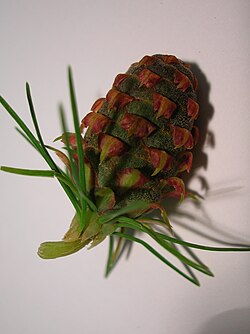
The cones are erect, ovoid-conic, 2–6 centimetres (342+38 in) long, with 10-90 erect or slightly incurved (not reflexed) seed scales; they are bright pinkish-red at pollination, then green variably flushed red to purplish when immature, and turn brown and opening to release the seeds when mature, 4–6 months after pollination. The old cones commonly remain on the tree for many years, turning dull grey-black.[citation needed]

It is very cold tolerant, able to survive winter temperatures down to at least −50 °C (−58 °F), and is among the tree line trees in the Alps, reaching 2,400 m (7,900 ft) altitude, though most abundant from 1,000–2,000 m (3,300–6,600 ft). It only grows on well-drained soils, avoiding waterlogged ground and is not shade tolerant.[citation needed]

It is closely related to Siberian larch Larix sibirica and similar in morphology; the two are best distinguished by the dense pubescence on the cone scales of L. sibirica, compared to the glabrous or only thinly pubescent cone scales of L. decidua.[8]

Subtaxa

[edit]

The following varieties are accepted by Plants of the World Online:[3]

  • Larix decidua var. deciduaEuropean larch or Alpine larch. Most of the range, except as below. Cones 2.5–6 cm; shoots yellow-buff.
  • Larix decidua var. carpatica DominCarpathian larch. In the Carpathian Mountains. Differs little from nominate var. decidua.
  • Larix decidua var. polonica (Racib. ex Wóycicki) Ostenf. & SyrachPolish larch. Disjunct in lowland northern and central Poland. Cones 2–3 cm; shoots very pale yellow-buff, almost white.

The Polish larch, being disjunct and growing in a different lowland habitat with a more continental rather than montane sub-oceanic climate, is widely treated at the higher rank of subspecies rather than variety, Larix decidua subsp. polonica (Racib. ex Wóycicki) Domin.[9][10][11][8] The Russian botanist Evgenij Bobrov considered it to be an ancient natural hybrid between European larch and Siberian larch L. sibirica,[12] but this has been shown to be incorrect, with it derived from only L. decidua.[13]

Ecology

[edit]
A siskin eating a European larch seed

The seeds are an important food for some birds, notably siskin, redpoll, and citril finch, while the buds and immature cones are eaten by capercaillie.[citation needed]

Larch needles (including L. decidua and L. sibirica) are the only known food for caterpillars of the case-bearer moth Coleophora sibiricella; its cone scales are used as food by the caterpillars of the tortrix moth Cydia illutana.[citation needed]

It is susceptible to larch canker Lachnellula willkommii.[citation needed]

Cultivation

[edit]
European larch morphology features from book: Prof. Dr. Otto Wilhelm Thomé Flora von Deutschland, Österreich und der Schweiz, 1885, Gera, Germany.

Larix decidua is widely cultivated as an ornamental tree for planting in gardens and parks. It was first cultivated in Britain in or shortly before 1629.[14] John Evelyn encouraged its wider planting and use.[15] Three successive Dukes of Atholl planted it widely[16] and the fourth Duke wrote "Observations on Larch" in 1807 further encouraged its cultivation, which he practiced on a large scale.[17] One of the larches planted by the second Duke of Atholl at Dunkeld in 1737 is still standing,[18] as are two slightly older specimens planted in 1725 at Kailzie, near Peebles in southern Scotland.[19][20]

European larch is now widely naturalised in northern Europe, including Britain,[21] Scandinavia, and in Germany north of its native range. It is also widely cultivated in southern Canada and the northeastern United States, and is naturalised in Maine, Michigan, New York, Pennsylvania, Connecticut, New Hampshire, Vermont, and Rhode Island. In the northern Appalachian Mountains it is often used for the reforestation of surface mines.[22] European larch can grow on drier soils and tolerate warmer climates than tamarack (Larix laricina) or Siberian larch (Larix sibirica), being better suited to non-boreal climates.[23]

Hybrids

[edit]

European larch readily hybridises with Japanese larch L. kaempferi when the two are planted together; the hybrid, named Dunkeld larch or hybrid larch (Larix × marschlinsii Coaz, syn. L. × eurolepis), is extensively used in forestry, and is also naturalised in Britain, Ireland, and elsewhere.[14][24] It is faster-growing than either parent, and more resistant to larch canker Lachnellula willkommii.[14][25] Hybrids with several other larches have been made, but are rare;[9][14] the hybrid with Larix laricina has also been named, as Larix × pendula (Solander) Salisbury.[14]

Bonsai

[edit]

The European larch is a popular bonsai species, with many unique specimens available in European circles, and is popularly used in bonsai forest groups.[26]

Invasive species

[edit]

In New Zealand, Larix decidua is classed as a wilding conifer, an invasive species which spreads into the high country, where it had been planted by the New Zealand Forest Service for erosion control.[citation needed]

Uses

[edit]

The wood is tough and durable, but also flexible in thin strips, and is particularly valued for yacht building; wood used for this, known as 'boatskin larch',[14][27] must be free of knots, and can only be obtained from old trees that were pruned when young to remove side branches. Small larch poles are widely used for rustic fencing.[citation needed]

Because of its fast juvenile growth and its pioneer character, larch has found numerous applications in forestry and agroforestry. It is used as a 'preparatory species' to afforest open land, abandoned farmland or disturbed land, and as a 'nurse species' prior to the introduction of more demanding species.[28]

[edit]

References

[edit]
[edit]
Revisions and contributorsEdit on WikipediaRead on Wikipedia
from Grokipedia
_Larix decidua Mill., commonly known as the European larch or common larch, is a in the genus Larix of the pine family . Native to the subalpine and montane forests of the and in , it is one of the few that sheds its needles each autumn, revealing a striking rusty-orange to yellow foliage display before leafing out again in spring. This medium- to large-sized typically reaches heights of 25–40 meters (82–131 feet) with a straight trunk up to 1 meter (3 feet) in diameter, a pyramidal crown, and soft, bright green needles (1–4 cm long) borne in clusters of 30–40 on short spurs. Its small, ovoid cones (2–4 cm long) start purple and mature to light brown, remaining on the branches for several years. In its native range, L. decidua thrives at elevations of 1,000–2,400 meters (3,300–7,900 feet) on moist, well-drained loamy soils with a of 4.0–7.8, often in association with species like Norway spruce (), silver fir (), and Swiss stone pine (). It prefers full sun and is intolerant of shade, dense stands, or waterlogged conditions, though it tolerates poor, acidic soils and windy exposures. The species has been widely introduced and naturalized in parts of , , southern , and the northeastern United States, where it forms plantations and escapes into the wild in states such as , , and New York. Its rapid juvenile growth—up to 1 meter per year—makes it a in forest succession following disturbances like avalanches or fires. Ecologically, L. decidua plays a key role in stabilizing slopes and preventing in mountainous regions due to its deep and dense layer, which moderates behavior while enriching nutrients. It supports diverse mycorrhizal associations and provides habitat for birds and , though it is susceptible to pathogens like larch canker (Lachnellula willkommii) in humid climates. Economically, the tree's durable, resinous —strong, heavy, and decay-resistant—is prized for timber production, including pulp, framing, flooring, posts, and veneers; it has been cultivated for these purposes since Roman times. Ornamentally, its dramatic fall color and weeping cultivars (e.g., L. decidua 'Pendula') enhance landscapes in USDA hardiness zones 2–7, with moderate growth rates and ease of propagation from seed or cuttings when dormant.

Taxonomy

Classification

Larix decidua is classified within the kingdom Plantae, phylum Tracheophyta, class Pinopsida, order Pinales, family Pinaceae, genus Larix, and species decidua. The genus name Larix derives from the classical Latin term for the larch tree, rooted in ancient Etruscan or Celtic origins referring to its resinous nature. The specific epithet decidua comes from the Latin deciduus, meaning "falling off," which highlights the species' distinctive deciduous habit among conifers, where needles are shed annually. Within the genus Larix, which includes 10 to 12 species of deciduous conifers native to northern temperate regions, L. decidua occupies a position in the Eurasian clade. Its closest relatives are Larix sibirica (Siberian larch), another Eurasian species, and Larix kaempferi (Japanese larch) from the Asian clade, with phylogenetic analyses of chloroplast DNA revealing low sequence divergence among these taxa and supporting a monophyletic origin for major geographic groups. Molecular clock estimates based on genes such as matK indicate that divergences within Larix clades occurred approximately 10-15 million years ago during the Miocene. Historically, L. decidua was classified under other genera, with synonyms including Pinus larix L. and Abies larix (Poir.) J. Presl., reflecting early Linnaean placements within pine and fir genera due to superficial similarities in cone structure. The current was established by in 1768 as Larix decidua Mill., adhering to the principles of priority and stability outlined in the International Code of Nomenclature for , fungi, and (ICN), which resolved earlier nomenclatural ambiguities by designating Larix as the valid genus for deciduous larches. Other synonyms, such as Larix europaea DC. and Larix larix (L.) Karst., persist in older literature but were superseded under ICN rules favoring the earliest legitimate description.

Subspecies and Varieties

Larix decidua is classified into three primary , each associated with distinct geographic regions and exhibiting subtle morphological and genetic differences: subsp. decidua (Alpine larch), subsp. carpatica (Carpathian larch), and subsp. polonica (Polish larch). These taxa are sometimes treated as varieties rather than full due to ongoing taxonomic debate, with some authorities emphasizing continuous variation across populations while others highlight discrete genetic clusters supported by molecular studies. Subsp. decidua is the most widespread, occurring primarily in the central and western from to , where it forms pure stands or mixes with other at elevations of 1,000–2,400 m. It is distinguished by relatively longer needles measuring 3–4 cm and larger, ovoid cones up to 6 cm long, with pale yellow-buff shoots. Subsp. carpatica is confined to the eastern in , , and , typically at 800–1,800 m, and shows intermediate traits with slightly shorter needles and cones averaging 3–5 cm. Subsp. polonica, the rarest, is restricted to lowland and hilly ancient woodlands in central , often as small remnant stands or isolated trees, and features more compact growth with shorter shoots and needles around 2–3 cm, alongside smaller cones of 2.5–4 cm; it is assessed as Endangered by the IUCN due to habitat loss and low population numbers. Genetic distinctions among these subspecies have been confirmed through nuclear microsatellite (SSR) markers and allozyme analyses, revealing low to moderate differentiation overall but significant structure, particularly between subsp. polonica and the others, with subsp. polonica showing reduced genetic diversity (effective allele number ~4–6 per locus) indicative of a bottleneck. In eastern distribution limits, natural hybridization occurs with Larix sibirica (Siberian larch), producing intermediate forms in overlap zones of the Carpathians and Poland, as evidenced by shared allozyme variants and pollen flow studies; these hybrids exhibit hybrid vigor but complicate taxonomic boundaries. The IUCN assesses the overall species L. decidua as Least Concern in its 2013 evaluation, while recognizing subsp. polonica separately as Endangered, underscoring the need for targeted conservation of peripheral taxa.

Description

Morphology

Larix decidua is a that attains heights of 25 to 45 meters and trunk diameters of 1 to 1.5 meters at maturity. Young trees exhibit a symmetrical, narrowly conical crown with horizontal branching and drooping branchlets, which broadens and becomes more irregular with age. The bark on young trees is thin and smooth, transitioning to pinkish-brown, deeply fissured, and scaly with broad ridges on older trunks. The needles measure 2 to 4 cm in length, are bright green during the , and are arranged in dense rosettes or fascicles of 30 to 65 on short shoots, with fewer on long shoots. In autumn, they turn vibrant golden-yellow before shedding, a distinctive feature among . The tree produces separate male and female cones on the same branches; male cones are small, cylindrical to ovoid, 5 to 10 mm long, and yellow, while female cones are upright, ovoid, 2 to 4 cm long with 25 to 50 rounded, light brown scales that have erose edges and are pubescent. The is deep-rooted, with extensive lateral adapted to the thin, rocky soils of mountainous regions. The wood features a straight grain and high content, contributing to its durability, strength, and resistance to decay. variations may influence minor aspects such as needle and size, but the overall morphology remains consistent.

Reproduction and Growth

Larix decidua is monoecious, bearing both male microstrobili and female megastrobili on the same , with occurring via wind during March to June in its native range. The small, yellow male cones release , while the larger, erect female cones, which develop into woody structures 2–4 cm long, capture on their ovuliferous scales. Following fertilization, seeds mature by to December, featuring a membranous that facilitates wind dispersal, with effective distances ranging from 2–48 m in dense forests to several hundred meters in open or snowy conditions. Trees typically begin reproduction around 10 years of age, though significant seed crops are more common after 20–30 years. Large mast seed crops occur irregularly every 3–10 years, alternating with years of lower production, which helps in synchronizing reproduction and reducing . Seeds remain viable within intact cones for 1–2 years and can be stored under controlled conditions (e.g., 3–5°C and low moisture) for 3–7 years with minimal loss of capacity. is epigeal and often enhanced by cold stratification at 0–5°C for 20–60 days, achieving rates up to 75% under optimal conditions (20–30°C alternating temperatures), though fresh seeds may germinate without pretreatment. Growth in L. decidua is rapid during early stages, with annual height increments peaking at 20–45 cm in young trees under favorable conditions, supporting initial in open or disturbed sites. Growth rates slow after approximately 50 years as trees mature, transitioning from fast juvenile development to more stable radial expansion. Mature trees reach heights of 30–50 m and diameters up to 1 m, with maximum lifespans of 500–800 years in optimal alpine environments, though average longevity in managed stands is 100–150 years. Phenological cycles are adapted to temperate montane climates, with bud burst occurring in early spring (around late to early May, driven by cumulative air and temperatures exceeding 170–250°C since ). Needle expansion follows rapidly, reaching full foliage by mid-May to early June, enabling during the short of 100+ days. In autumn, needle begins in early , triggered by shortening photoperiods and cooling temperatures (cumulative thresholds around 2,600°C from ), turning the foliage vivid yellow before shedding by late to December. This habit allows nutrient and during harsh winters.

Distribution and Habitat

Native Range

Larix decidua, commonly known as European larch, is native to the mountainous regions of , with its primary distribution centered in the , , and . The species occurs discontinuously across countries including , , , , , , , , , , and , forming extensive forests in these areas. Its elevational range spans from approximately 180 m in lowland areas of Poland to 2,500 m in the central and southwestern , though it is most commonly found between 1,000 and 2,400 m. The tree thrives in a cool temperate to characterized by cold, snowy winters and cool, moist summers. Mean annual temperatures range from 4°C to 10°C, with summer means of 15–20°C and winter lows reaching -50°C. Annual precipitation typically falls between 600 and 1,200 mm, supporting its growth in regions with relatively dry air and abundant sunny days. Larix decidua prefers well-drained, acidic to neutral loamy soils, with a range of 4.0 to 7.8, and it acts as a on screes, tracks, and disturbed sites. It occupies altitudinal zones from subalpine forests to the , often in mixed stands with other . The Larix decidua subsp. carpatica is primarily distributed in the Carpathians, including the Tatra and southeastern ranges. Historically, the species expanded northward following the around 10,000 years ago, migrating from refugia in and the during post-glacial warming.

Introduced Ranges

Larix decidua has been introduced to various regions beyond its native central European range for timber production, , and ornamental purposes. In Britain, it was first planted in the early , with records indicating establishment around 1629, and has since become widespread in plantations across the country. In , introductions occurred in the mid-18th century, particularly in , where it was sourced from earlier British plantings and adapted to northern boreal conditions. In , the species arrived in the 1700s, with early seeds brought by explorer Peter Kalm in 1751; it is now commonly planted in and the , including , for its fast growth in cool climates. Additional introductions include , where it was widely planted in the for forestry, and in southern and , where trials since the early 2000s have tested its potential for in arid, cool sites. The species has naturalized in parts of these areas, forming self-sustaining populations outside cultivation. The success of Larix decidua in introduced ranges stems from its adaptability to cool, temperate climates similar to its native alpine habitats, allowing it to thrive on well-drained, acidic soils in mountainous or boreal environments. Escapes from plantations have led to feral populations, particularly in disturbed sites like edges and clearings, where its light-seeded cones facilitate wind dispersal and rapid colonization. In and , natural regeneration occurs sporadically in suitable moist, upland areas, though it rarely forms dense stands without human assistance. Despite its establishment, Larix decidua exhibits minor invasive potential in some introduced regions, such as displacing in alpine meadows through competitive growth and seed production. It is listed as invasive in the and , with naturalization noted in Ireland, , , and the , but overall assessed as low risk due to limited spread beyond plantations. In the , it is monitored under invasive alien species regulations, though not classified as a high-threat species. In , it is categorized as a wilding with potential to invade high-country grasslands, prompting control efforts. Climate change is facilitating recent poleward and upslope expansion of Larix decidua in , with 52% of monitored sites showing population advances and infilling as warming extends suitable growing seasons. Models predict northern range shifts, though southern populations may contract due to increased stress.

Ecology

Ecological Interactions

Larix decidua serves as a in subalpine and montane ecosystems, rapidly colonizing open, disturbed sites such as those created by landslides or fires, where it stabilizes soils on steep slopes through its root system and facilitates toward more shade-tolerant forests dominated by species like Picea abies (Norway spruce) and Abies alba (silver fir). Recent observations indicate accelerated upward expansion into treeless alpine zones due to climate warming, potentially altering these dynamics, alongside increased drought-induced mortality risks that may limit its pioneer role. Its high light demand and shade intolerance make it well-suited to early successional stages, where it forms pure stands in open conditions before being outcompeted in closed-canopy environments. The species forms ectomycorrhizal symbioses with various fungi, including Suillus grevillei, which enhance nutrient uptake, particularly and , in nutrient-poor alpine soils, thereby improving the tree's resilience in harsh environments. These associations contribute to and functioning by facilitating nutrient cycling in oligotrophic habitats. In food webs, L. decidua interacts with wildlife through and herbivory; its winged seeds are consumed and dispersed by birds such as siskins (Spinus spinus) and finches like the lesser redpoll (Acanthis cabaret), while its needles serve as a food source for herbivores including the larch budmoth (Zeiraphera diniana). The tree's structure provides winter cover and habitat for birds and small mammals, despite its nature, supporting in alpine regions. As a highly productive species, L. decidua contributes to with annual volume increments of approximately 8-14 m³/ha, accumulating significant in subalpine forests and playing a key role in maintaining hotspots by enhancing complexity and in these dynamic ecosystems.

Pests and Diseases

Larix decidua is periodically affected by outbreaks of the larch budmoth (Zeiraphera diniana), a defoliating that causes significant needle loss every 8-10 years across its native Alpine range, leading to reduced growth and occasional mortality in severe cases. These cyclic outbreaks, reconstructed from historical tree-ring data, have persisted for centuries but show signs of disruption due to climatic warming, which may alter outbreak frequency and intensity. Another key pest is the Ips acuminatus, which infests weakened trees during periods of , boring into the bark and to cause dieback, particularly in drought-stressed stands where tree defenses are compromised. Among diseases, caused by the Lachnellula willkommii is a major threat, producing sunken on branches and stems that girdle tissues, leading to branch dieback and decline, especially in susceptible provenances planted outside their range. from species affects young trees on moist sites, causing basal decay, wilting, and mortality by invading roots and lower stems, often exacerbated by or injury. In introduced ranges, such as parts of and the , (causing sudden larch death) has emerged as a severe , inducing and rapid mortality in infected trees, with spread facilitated by wet conditions and human activities. Abiotic stresses further compound vulnerabilities; L. decidua exhibits heightened sensitivity to drought under climate change, with trees at lower elevations showing reduced radial growth and increased mortality during prolonged dry spells, as warmer temperatures amplify water deficits. Young shoots are particularly prone to frost damage in spring, where late frosts can kill emerging buds and needles, delaying growth and reducing vigor in frost-prone sites. Fire tolerance is low due to the species' thin bark, which offers limited insulation against cambial heating, making mature trees susceptible to lethal crown or stem damage in surface fires. Management strategies leverage natural resistance observed in subspecies such as L. decidua subsp. polonica (Sudetan larch), which demonstrates lower susceptibility to larch canker compared to other provenances, supporting its use in breeding programs for enhanced disease tolerance. In the , forest health monitoring through the ICP Forests program tracks pest and disease incidence in L. decidua stands via systematic crown condition assessments and defoliation surveys, enabling early detection and targeted interventions.

Cultivation

History and Propagation

The cultivation of Larix decidua, the European larch, began in Britain around 1629, when seeds were introduced primarily for timber production, marking one of the earliest documented uses of the species outside its native Alpine range. By the mid-18th century, widespread planting expanded in central and other parts of , driven by the tree's rapid growth and valuable wood properties, which made it a key species in early initiatives. In the , L. decidua became integral to European , with extensive plantations established across the continent, including in the Baltic regions from the mid-19th century onward, to support timber demands and landscape restoration. Post-World War II reforestation efforts further promoted its use in large-scale programs, particularly in , where it aided in rehabilitating war-damaged landscapes and boosting wood supplies. Propagation of L. decidua primarily relies on seed , which requires cold stratification to break and enhance rates; seeds are typically moist-chilled for 4-6 weeks at around 4°C before in nurseries. For clonal propagation, cuttings taken from juvenile shoots root successfully under mist systems, allowing replication of superior genotypes, while onto rootstocks is commonly employed to propagate hybrids and maintain desirable traits from mature trees. For outplanting, a spacing of 2 x 2 meters (2,500 plants per ) promotes straight growth and facilitates management. Site preparation for L. decidua cultivation emphasizes deep, moist, well-drained soils with a range of 5-7, as the species performs best on fertile loams but tolerates a broader spectrum from acidic to slightly alkaline conditions. Plantations are managed on rotations of 80-120 years to achieve mature timber yields, aligning with the tree's longevity and growth patterns in managed forests. Recent advances in L. decidua propagation include the establishment of seed orchards in the 2010s, particularly in , to support genetic improvement programs focused on disease resistance and growth efficiency through controlled breeding of plus trees. techniques, such as and in vitro shoot multiplication from explants like buds and embryos, have enabled production of disease-free stock and rapid clonal multiplication, with methods preserving genetic lines for long-term conservation.

Hybrids and Cultivars

Larix decidua has been involved in several artificial hybrids aimed at improving growth rates, disease resistance, and adaptability to varying environmental conditions. The most prominent is Larix × marschlinsii (also referred to as L. × eurolepis), a cross between L. decidua and L. kaempferi (Japanese larch), first intentionally bred in the early 1900s at , . This hybrid, known as Dunkeld larch, exhibits hybrid vigor (), with growth rates typically 20-30% faster than either parent species, alongside improved stem straightness and resistance to pathogens such as larch canker. Another notable hybrid is L. × polonica, resulting from crosses between L. decidua and L. sibirica (Siberian larch), with breeding programs established to produce interspecific seed for enhanced frost tolerance and yield in northern European plantations. Several cultivars of L. decidua have been selected for specific ornamental traits, though their development emphasizes compact growth suitable for controlled environments like . The cultivar 'Pendula' features a weeping with pendulous branches, creating a cascading form that contrasts with the ' typical pyramidal shape. 'Pyramidalis' is distinguished by its narrow, upright pyramidal growth, making it ideal for space-limited landscapes while maintaining the ' deciduous needle display. These selections derive from natural variations propagated through or seed orchards to preserve desirable morphology. Breeding efforts for L. decidua prioritize enhanced frost tolerance, higher timber yield, and overall resilience to climate stressors, often incorporating hybrids to achieve these goals. Genetic studies utilizing simple sequence repeat (SSR) markers, initiated around 2015, have revealed substantial diversity within populations, enabling the identification of superior genotypes for these traits. Hybrids like L. × marschlinsii contribute to adaptive by providing 20-30% greater timber volume in responsive stands, supporting strategies for climate-resilient amid shifting environmental conditions.

Uses

Timber and Wood Products

The wood of Larix decidua, known as European larch, exhibits a density ranging from 0.45 to 0.55 g/cm³, depending on whether measured as basic, oven-dry, or air-dry values. It possesses high strength, with a modulus of rupture (MOR) typically between 80 and 100 MPa for small clear specimens, making it suitable for demanding structural applications. The heartwood is pale yellow to medium reddish-brown, while the sapwood is nearly white and clearly demarcated, contributing to its aesthetic appeal in finished products. Durability is enhanced by natural resins and phenolic compounds in the heartwood, providing moderate resistance to decay (durability class 3–4 per EN 350), though the sapwood remains perishable without treatment. Primary industrial applications leverage these properties for timber, utility poles, and railway sleepers, where the wood's and resistance to mechanical stress are advantageous. It is also processed into veneers for paneling and furniture, as well as particleboard for interior applications, benefiting from its and fine texture. Historically, L. decidua wood was used in , including for boat planking, frames, and masts in vessels like Roman boats and later warships such as HMS Atholl. Harvesting occurs on rotations of 60–100 years in European plantations, particularly in the , to achieve optimal timber quality and volume. models rely on volume growth equations tailored to site index, such as power-law functions relating cumulative volume to age, enabling projections of annual increments exceeding 10 m³/ha under favorable conditions. As a major species in the , L. decidua supports significant timber production across , with a growing stock of approximately 288 million m³ reported in 2010 and ongoing harvests contributing to regional exports.

Ornamental and Other Applications

_Larix decidua is widely planted in parks and gardens as an ornamental , prized for its striking golden-yellow autumn foliage that emerges from bright green needles during the . This provides year-round interest, with its pyramidal form in youth transitioning to a more open, sculptural structure in maturity, making it suitable for specimen plantings or group displays in large landscapes. In , Larix decidua has been cultivated as a subject since the , valued for its needles that allow distinct seasonal changes, including vibrant spring buds and bare winter branches that highlight its branching structure. Certain cultivars, such as the upright 'Fastigiata' or weeping 'Pendula', are particularly favored for hedges, screens, or accents due to their compact or columnar habits that enhance privacy and aesthetic appeal. The resin of Larix decidua, known as Venice turpentine, has been traditionally used in the production of varnishes and paints for its adhesive and protective qualities. Needles are employed in herbal teas, providing a source of that supports immune health, particularly in traditional remedies from its native regions. Essential oils derived from the needles and exhibit properties, attributed to compounds like larixol, which contribute to applications in and antiseptics. Ecologically, Larix decidua serves as a nurse species in projects, pioneering disturbed sites to improve conditions and facilitate succession by shade-tolerant species due to its light-demanding nature. It is also planted in windbreaks to mitigate and protect agricultural areas, offering effective shelter even in its deciduous state through dense branching. As a biomass source for , its wood yields a calorific value of 18-20 MJ/kg, supporting sustainable fuel production from thinnings or residues. In Alpine , Larix decidua symbolizes protection against evil spirits and enchantment, with traditions involving its use in charms for infants and during rituals to ward off harm. In some European regions, it serves as an alternative to trees, appreciated for its soft and festive golden tones when harvested young.

Conservation

Status and Threats

Larix decidua is classified as Least Concern on the global , with an assessment from 2013 indicating a stable population trend. Nationally, it holds vulnerable status in certain peripheral ranges, such as , where the subspecies L. decidua subsp. polonica is assessed as endangered due to limited distribution and ongoing decline. The primary threats to L. decidua stem from , including increased droughts that are shifting the species' treeline upward and reducing viability at lower elevations. , driven by the expansion of skiing infrastructure in the , has resulted in the loss and isolation of forest stands, limiting natural regeneration and . Historical overharvesting during the 18th and 19th centuries depleted some native stands, though regulated practices have since mitigated this pressure in core areas. Core populations in the central European Alps remain stable, but those in the are vulnerable to warming-induced stress. projections aligned with IPCC scenarios forecast losses, particularly in southern regions where increases exacerbate limitations. within L. decidua is generally high across its range but notably low in isolated peripheral stands, increasing vulnerability to environmental stressors; this has been systematically monitored through the EUFORGEN network since the mid-1990s. Pests such as the larch bud moth can intensify threats by weakening trees already compromised by and pressures.

Conservation Measures

Conservation measures for Larix decidua emphasize protection within its native montane habitats, particularly in the and Carpathians, where reserves preserve and prevent hybridization with non-native larches. Key protected sites include the Gorce Mountains in to safeguard a genetically unique subpopulation of L. decidua subsp. polonica with high allelic diversity and no from exotic . Similarly, Tatra National Park in and harbors significant stands of the species, integrated into broader conservation frameworks that limit and alien introductions. In Ukrainian Polissia, L. decidua occurs across 20 landscape parks, 12 monuments, and several reserves, where mature trees (up to 200 years old) are monitored for vitality and protected from disturbances. Restoration initiatives focus on enhancing natural regeneration and targeted to counter climate-induced threats like and shifting ranges. In the , programs promote soil preparation, animal browsing protection, and supplemental planting at elevations above 1,500 m, where L. decidua thrives as a in disturbed sites such as post-fire or areas. Post-disturbance efforts in the Western prioritize proximity to seed sources and low-severity site management to boost establishment rates. These activities align with EU-funded projects that integrate L. decidua into mixed-species plantings for improved ecosystem resilience. Research efforts center on genomic characterization to support adaptation, including assessments of across populations to identify resilient traits. Studies in Romanian seed orchards using nuclear simple sequence repeat markers revealed high heterozygosity (expected heterozygosity = 0.764) and constructed core collections retaining all alleles from diverse clones, aiding breeding for enhanced . EUFORGEN guidelines advocate for ongoing silvicultural to refine regeneration techniques and monitor , ensuring long-term adaptability. Ex situ conservation complements in situ efforts through arboreta, clonal archives, and seed banking to secure genetic resources against localized losses. Botanic gardens and arboreta, such as those in the Global Survey of Ex Situ Conifer Collections, maintain living collections of L. decidua for propagation and study, emphasizing provenance-specific material. Seed storage in genebanks follows protocols for viability over at least 30 years, with applied to pollen and embryogenic tissues; while not explicitly listed in the Millennium Seed Bank, related European initiatives at and include L. decidua in broader banking for restoration potential. Policy frameworks under the Forest Strategy for 2030 drive these measures by mandating biodiversity-friendly management, including the planting of 3 billion trees with species like L. decidua selected for local adaptation, and strict of old-growth forests covering 3% of EU land (as of 2025). Sustainable certifications such as FSC promote closer-to-nature practices, prohibiting monocultures and encouraging mixed stands to bolster L. decidua resilience, with national regulations restricting seed transfers to prevent genetic contamination in reserves.

References

Add your contribution
Related Hubs
User Avatar
No comments yet.