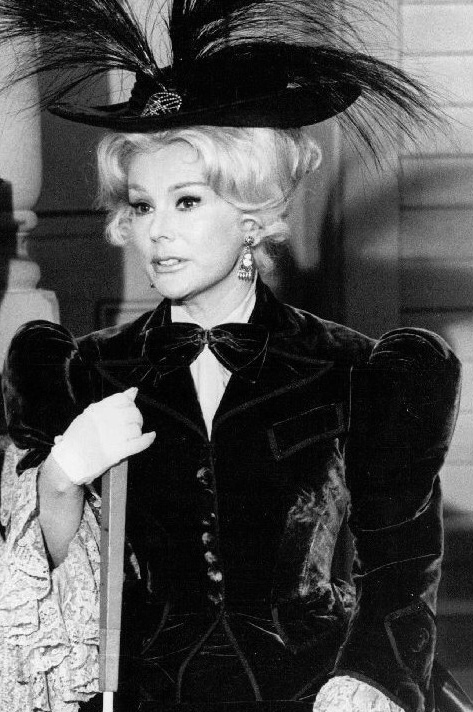

Eva Gabor
View on Wikipedia
Eva Gabor (/ˌeɪvə ɡəˈbɔːr, - ˈɡɑːbɔːr/ AY-və gə-BOR, - GAH-bor; February 11, 1919 – July 4, 1995) was a Hungarian-American actress and socialite. Gabor voiced Duchess and Miss Bianca in the Disney animated films The Aristocats (1970), The Rescuers (1977), and The Rescuers Down Under (1990). She was popular in her role on the 1965–1971 television sitcom Green Acres as Lisa Douglas, the wife of Eddie Albert's character Oliver Wendell Douglas. In addition to acting, she was also a businesswoman who marketed wigs, clothing, and beauty products. Her elder sisters, Zsa Zsa and Magda Gabor, were also actresses and socialites.
Key Information


Early life
[edit]Gabor was born in Budapest, Hungary, the youngest of three daughters of Vilmos Gábor, a soldier, and his wife, trained jeweler Jolie (born Janka Tilleman). Her parents were both from Hungarian Jewish families.[1][2][3] She was the first of the sisters to immigrate to the U.S., shortly after her first marriage to a Swedish osteopath, Dr. Eric Drimmer, whom she married in 1937 when she was 18 years old.[4]
Early career
[edit]Her first movie role was in the U.S. in 1941's Forced Landing at Paramount Pictures. During the 1950s, she appeared in several feature films, including The Last Time I Saw Paris, starring Elizabeth Taylor; and Artists and Models, which featured Dean Martin and Jerry Lewis. These roles were bit parts. In 1953, she was given her own television talk show, The Eva Gabor Show, which ran for one season (1953–54). Through the rest of the 1950s and early 1960s she appeared on television and in movies. She appeared in one episode of the mystery series Justice and was on the game show What's My Line? as the "mystery challenger." Her film appearances during this era included a remake of My Man Godfrey, Gigi, and It Started with a Kiss.
Green Acres
[edit]
In 1965, Gabor got the role of Lisa Douglas, whose attorney husband Oliver Wendell Douglas (Eddie Albert) decides to leave the "rat race" of city life. He buys a farm in a rural community, forcing Lisa to leave her beloved big-city urban life. The Paul Henning sitcom Green Acres aired on CBS. Green Acres was set in Hooterville, the same backdrop for Petticoat Junction (1963–70), and would occasionally cross over with its sister sitcom. Despite proving to be a ratings hit, staying in the top 20 for its first four seasons, Green Acres, along with another sister show, The Beverly Hillbillies, was cancelled in 1971 in the CBS network's "rural purge" — a policy to get rid of the network's rural-based television shows.
In 1966, Eva Gabor and Johnny Carson played Twister on The Tonight Show Starring Johnny Carson.[5][6][7]
Later career
[edit]
In 1972, Gabor launched her eponymous fashion collection with Luis Estévez, a Cuban-born American fashion designer.[8][9][10]
Gabor later did voice-over work for Disney movies, providing the European-accented voices of Duchess in The Aristocats, and Miss Bianca in The Rescuers and The Rescuers Down Under, as well as the Queen of Time in the Sanrio film Nutcracker Fantasy. She was a panelist on the Gene Rayburn-hosted Match Game. From 1983 to 1984, she was on the Match Game-Hollywood Squares Hour starring Gene Rayburn and Jon Bauman.[11]
Eva appeared as Aunt Renee in the fourth season of “Hart to Hart”, and in 1983, she reunited with Eddie Albert on Broadway as the Grand Duchess Olga Katrina in You Can't Take It with You. In 1990, she attempted a TV series comeback in the CBS sitcom pilot Close Encounters; the pilot aired as a special that summer, but did not make it to series status. She toured post-communist Hungary after a 40-year absence on an episode of Lifestyles of the Rich and Famous.
Personal life
[edit]Eva Gabor was married five times. She had no biological children:
- Eric Valdemar Drimmer, a Swedish-born masseur turned osteopath and psychologist. They wed in London on June 3, 1937, and divorced in Los Angeles, on February 25, 1942 (the divorce was finalized on March 6); Gabor claimed cruelty, saying, "I wanted to have babies and lead a simple family life but my husband objected to me having children".[12]
- Charles Isaacs, an American investment broker.[13] They married on September 27, 1943, and divorced on April 2, 1949.
- John Elbert Williams, MD, a plastic surgeon. They married on April 8, 1956, and divorced on March 20, 1957.[14]
- Richard Brown, a textile manufacturer, who later became a writer and director.[15][16] They married at the Flamingo Hotel in Las Vegas, Nevada, on October 4, 1959, and divorced in Santa Monica, California, in June 1973.[15][16][17]
- Frank Gard Jameson Sr., an aerospace executive and former vice president of Rockwell International.[18] They married in the Vivian Webb Chapel of The Webb Schools, Claremont, California on September 21, 1973. Gabor became stepmother to Jameson's four children. The couple, however, divorced in 1983.[19][18]
Gabor also had a long term on-and off affair with actor Glenn Ford which began during the filming of Don't Go Near the Water in 1957. They dated between their marriages and almost married in the early 1970s.[20]
After her final marriage, Gabor was involved in a relationship with TV producer Merv Griffin until her death.[21][22][23] Reuters reported that this was a platonic relationship to hide Griffin's suspected homosexuality.[24]
Death
[edit]
Gabor died in Los Angeles on Independence Day 1995, from respiratory failure and pneumonia, following a fall in a bathtub in Mexico,[25] where she had been on vacation.[26] Her funeral was held on July 11, 1995, at Good Shepherd Catholic Church in Beverly Hills.[27]
The youngest sister, Eva predeceased her elder sisters and her mother. Eldest sister Magda and mother Jolie Gabor both died two years later, in 1997. Elder sister Zsa Zsa died from cardiac arrest on December 18, 2016.[28][29]
Theatre roles
[edit]| Opening date | Closing date | Title | Role | Theatre |
|---|---|---|---|---|
| January 24, 1950 | July 14, 1951 | The Happy Time | Mignonette | Plymouth |
| March 26, 1956 | March 31, 1956 | Little Glass Clock | Gabrielle | John Golden |
| January 31, 1958 | February 8, 1958 | Present Laughter | Joanna Lyppiatt | Belasco |
| March 18, 1963 | November 9, 1963 | Tovarich | Tatiana (succeeded Vivien Leigh October 21) |
Winter Garden |
| April 4, 1983 | January 1, 1984 | You Can't Take It with You | The Grand Duchess Olga Katrina (succeeded Colleen Dewhurst) |
Plymouth Royale |
Film roles
[edit]| Year | Title | Role | Notes |
|---|---|---|---|
| 1941 | Forced Landing | Johanna Van Deuren | |
| New York Town | Minor Role | Uncredited | |
| Pacific Blackout | Marie Duval | ||
| 1942 | Star Spangled Rhythm | Eva Gabor | Uncredited |
| 1945 | A Royal Scandal | Countess Demidow | |
| 1946 | The Wife of Monte Cristo | Mme. Lucille Maillard | |
| 1949 | Song of Surrender | Countess Marina | |
| 1952 | Love Island | Sarna | |
| 1953 | Paris Model | Gogo Montaine | |
| 1954 | The Mad Magician | Claire Ormond | |
| Captain Kidd and the Slave Girl | Judith Duvall | ||
| The Last Time I Saw Paris | Lorraine Quarl | ||
| 1955 | Artists and Models | Sonia / Mrs. Curtis | |
| 1957 | The Truth About Women | Louise Tiere | |
| My Man Godfrey | Francesca Gray | ||
| Don't Go Near the Water | Deborah Aldrich | ||
| 1958 | Gigi | Liane d'Exelmans | |
| 1959 | It Started with a Kiss | Marquesa Marion de la Rey | |
| 1963 | A New Kind of Love | Felicienne Courbeau | |
| 1964 | Youngblood Hawke | Fannie Prince | |
| 1970 | The Aristocats | Duchess | Voice |
| 1977 | The Rescuers | Miss Bianca | |
| 1979 | Nutcracker Fantasy | Queen of Time | |
| 1987 | The Princess Academy | Countess Von Pupsin | |
| 1990 | The Rescuers Down Under | Miss Bianca | Voice |
Television roles
[edit]| Year | Title | Role | Notes |
|---|---|---|---|
| 1951 | Tales of Tomorrow | Laura | Episode: "The Invader", an American anthology SciFi series performed and broadcast live |
| 1953 | The Eva Gabor Show | Herself | Host |
| 1954–1955 | Justice | 2 episodes: "The Blackmailer", and "The Intruder" | |
| 1957 | What's My Line? | Mystery Guest | Season No. 9, episode No. 12, overall episode No. 389 |
| 1959 | Five Fingers | Maria Vodnay | Episode: "Station Break" |
| 1960–1961 | Harrigan and Son | Lillian Lovely | Two appearances |
| 1965–1971 | Green Acres | Lisa Douglas | Lead role |
| 1968 | Here's Lucy | Eva Von Gronyitz | Episode: "Lucy and Eva Gabor" |
| 1969 | Wake Me When the War Is Over | Baroness Marlene | |
| 1973–1982 | Match Game | Recurring panelist | |
| 1975 | Tattletales | With husband Frank Jameson | |
| Ellery Queen | Magda Szomony | Episode: "The Adventure of the Blunt Instrument" | |
| 1977 | The Love Boat | Beverly Blanchard | Episode No. 10: "Dear Beverly/The Strike/Special Delivery" |
| 1981 | Jack London's Tales of the Klondike | Loraine, the Hungarian gold digger | Episode: "Scorn of Women" |
| 1981 | Fantasy Island | Anastasia Dexter | Episode: "My Late Lover/Sanctuary" |
| 1982 | Hart to Hart | Renee | Episode: "With This Hart I Thee Wed" |
| Madame's Place | Herself | Episode: "Everyone Has Their Dream Role" | |
| 1983 | The Edge of Night | Cast member | |
| 1986 | Bridges to Cross | Maria Talbot | |
| 1990 | Return to Green Acres | Lisa Douglas | |
| Close Encounters | Eva Hill | ||
| 1993 | The Legend of the Beverly Hillbillies | Herself | |
| 1995 | This Is Your Life |
See also
[edit]
- Gabor sisters
- Eva Gabor portrait by Americo Makk
Further reading
[edit]- Gabor, Eva (1954). Orchids & Salami: A Gay and Impudent Memoir. (Foreword by Lawrence Langner)[30][31][32][33][34]
- Turtu, Anthony; Reuter, Donald F. (2001). Gaborabilia. Three Rivers Press. ISBN 978-0-6098-0759-0.
References
[edit]- ^ "Reflecting on the life of Zsa Zsa Gabor". New York Social Diary. Archived from the original on December 22, 2016. Retrieved July 16, 2016.
- ^ "Jews in the News: Bonni Tischler, Steven Spielberg and Vilmos Gabor". Tampa Jewish Federation. July 11, 2016. Archived from the original on October 5, 2016. Retrieved July 16, 2016.
- ^ Bennetts, Leslie (September 6, 2007). "It's a Mad, Mad, Zsa Zsa World". Vanity Fair. Archived from the original on February 6, 2015. Retrieved July 16, 2016.
- ^ Johnson, Irving (February 29, 1948). "Those Gabor Girls". The American Weekly; San Antonio Light. p. 62. Archived from the original on June 10, 2016. Retrieved May 28, 2016.
- ^ Belvedere, Matthew J. (May 4, 2016). "The surprising story of how Johnny Carson saved Twister". CNBC. Archived from the original on December 16, 2023. Retrieved December 19, 2023.
- ^ "How Johnny Carson Saved Twister". History. June 1, 2023. Archived from the original on December 16, 2023. Retrieved December 19, 2023.
- ^ "Twister". The Strong National Museum of Play. Archived from the original on December 16, 2023. Retrieved December 19, 2023.
- ^ Christy, Marian (February 17, 1975). "Mama Gabor: Ageless Mother of 3". The Newport Daily News.
- ^ McDowell, Colin (1984). McDowell's Directory of Twentieth Century Fashion. London: Muller. p. 137. ISBN 978-0-5841-1167-5.
In 1968, he moved to California, where in 1972, he designed collections for Eva Gabor to sell under her name.
- ^ "Hispanic Designers: Luis Estevez". National Museum of American History. Archived from the original on January 19, 2012. Retrieved February 2, 2025.
- ^ Pixie, Pranking (July 4, 2012). "Pixie Pranks and Disney Fun: Every Disney Hero Has a Voice ~ Eva Gabor Duchess & Bianca". Pixie Pranks and Disney Fun. Archived from the original on February 10, 2018. Retrieved February 9, 2018.
- ^ "Eva Gabor Obtains Divorce". The New York Times. February 25, 1945.
- ^ "Eva Gabor in Hospital". The New York Times. December 2, 1946.
- ^ "Eva Gabor Wed to Surgeon". The New York Times. April 9, 1956.
- ^ a b "Eva Gabor Wed in Las Vegas". The New York Times. October 5, 1959.
- ^ a b "Notes on People". The New York Times. June 26, 1973.
Divorced: Eva Gabor, widely exposed television talk show adornment, from her fourth husband, Richard Brown, the writer‐director, on grounds of "irreconcilable differences," in a Santa Monica, Calif., court.
- ^ "Palm Springs History - Gabor Family Zsa Zsa Magda Jolie Eva". Palm Springs Life. August 21, 2015. Archived from the original on May 29, 2016. Retrieved December 19, 2023.
- ^ a b "Aeronautics Executive Jameson Dies". Los Angeles Times. May 18, 1993. Archived from the original on March 6, 2016. Retrieved July 16, 2016.
- ^ "Notes on People". The New York Times. September 22, 1973.
Eva Gabor and Frank Jameson, a business executive, were married yesterday in a chapel on the grounds of the Webb School of California. It was the fifth marriage for Miss Gabor and the second for Mr. Jameson.
- ^ Ford, Peter (May 12, 2011). Glenn Ford: A Life. Madison: University of Wisconsin Press. pp. 177, 189 and 256. ISBN 978-0-29928-154-0.
- ^ Jacobs, Jody (July 12, 1985). "Merv Griffin's Birthday Party, Anyone?". Los Angeles Times. Archived from the original on December 16, 2023. Retrieved December 19, 2023.
- ^ "Griffin, Eva Gabor May Marry Soon, Zsa Zsa Says". Deseret News. Salt Lake City. June 6, 1988. Archived from the original on December 16, 2023. Retrieved December 19, 2023.
- ^ "Eva Gabor Merv Griffin Photos and Premium High Res Pictures". Getty Images. Archived from the original on December 16, 2023. Retrieved December 19, 2023.
- ^ Richmond, Ray. "Merv Griffin died a closeted homosexual". Reuters. Archived from the original on August 10, 2018. Retrieved August 10, 2018.
- ^ "Eva Gabor dies at 74". United Press International. Retrieved December 19, 2023.
- ^ "Eva Gabor, 74, the Actress; Youngest of Celebrated Sisters". The New York Times. Associated Press. July 5, 1995. Archived from the original on November 25, 2018. Retrieved February 16, 2017.
- ^ Wayne, Gary (May 20, 1998). "Church of the Good Shepherd". Seeing Stars. Archived from the original on May 18, 2016. Retrieved July 16, 2016.
- ^ "Zsa Zsa Gabor Death Certificate" (PDF). Archived from the original (PDF) on March 4, 2023. Retrieved April 24, 2021.
- ^ McFadden, Robert D. (December 18, 2016). "Zsa Zsa Gabor, Actress Famous for Her Glamour (and Her Marriages), Dies at 99". The New York Times. ISSN 0362-4331. Archived from the original on December 13, 2017. Retrieved December 14, 2017.
- ^ "Orchids and Salami: A Gay and Impudent Memoir by Gabor, Eva - 1954 by Gabor, Eva". Biblio. Archived from the original on December 16, 2023. Retrieved December 16, 2023.
- ^ Gabor, Eva (1954). Orchids and Salami. W.H. Allen. Archived from the original on February 12, 2024. Retrieved December 26, 2023.
- ^ "Orchids & Salami – Eva Gabor's Autobiography". The Gaboratory. January 15, 2018. Archived from the original on December 16, 2023. Retrieved December 19, 2023.
- ^ "Book Reviews, Sites, Romance, Fantasy, Fiction". Kirkus Reviews. Archived from the original on December 16, 2023. Retrieved December 19, 2023.
- ^ Millstein, Gilbert (January 24, 1954). "The Clan Gabor; ORCHIDS AND SALAMI. By Eva Gabor. Foreword by Lawrence Langner. 219 pp. New York: Doubleday & Co. $2.75". The New York Times. ISSN 0362-4331. Archived from the original on December 16, 2023. Retrieved December 19, 2023.
External links
[edit]
- Eva Gabor at IMDb
- Eva Gabor at the TCM Movie Database
- Eva Gabor at the Internet Broadway Database
- Eva Gabor at the Internet Off-Broadway Database (archived)
- Walk of Fame - Eva Gabor
- "Eva Gabor and New York stockbroker, Richard Brown wed", tcm.turner.com

| International | |
|---|---|
| National | |
| Academics | |
| Artists | |
| People | |
| Other | |
Eva Gabor
View on GrokipediaEarly Years
Family Background and Childhood
Eva Gabor was born on February 11, 1919, in Budapest, Hungary, to Vilmos Gábor, a soldier who rose to the rank of colonel, and Jolie Gábor (née Janka Tilleman), a trained jeweler and entrepreneur.[6][7] The family enjoyed an affluent and cultured lifestyle, supported by Vilmos's military career and Jolie's business acumen in the jewelry trade, which allowed for a comfortable existence in pre-World War II Hungary.[7] Of Jewish heritage—Vilmos had changed his surname from the more overtly Jewish Grün to Gábor amid rising anti-Semitism—the Gabors maintained a sophisticated household that emphasized social graces and cultural refinement.[7][8] As the youngest of three daughters, with older sisters Magda (born 1915) and Zsa Zsa (born 1917), Eva grew up in a close-knit but competitive sibling dynamic, where the girls were often compared and encouraged to shine in social settings.[9][7] Jolie, a dominant influence, instilled in her daughters a focus on beauty, poise, and performance, promising them lives of wealth, fame, and advantageous marriages while grooming them as "divas" from a young age.[8][7] This early exposure to entertainment came through family social circles in Budapest, where the sisters participated in cultural events and Jolie's ambitious aspirations exposed them to the performing arts, fostering Eva's lifelong interest in acting—she later recalled aspiring to perform from the age of four.[9][2] Eva's childhood education in Budapest reflected the family's affluent status, involving private and boarding schools that emphasized multilingualism and the arts to prepare the sisters for high society.[7] By age 15, she began formal acting studies, though her parents initially opposed it as unsuitable, highlighting the tension between their cultured expectations and her budding passion for performance.[9] Family travels and social engagements further sparked her interest in the performing arts, immersing her in Europe's vibrant cultural scene before geopolitical tensions disrupted their lives.[7]Immigration to the United States
Eva Gabor's first marriage to Swedish osteopath Dr. Eric Drimmer in 1937 played a pivotal role in facilitating the family's immigration, as Drimmer's professional status and connections aided in securing visas amid growing political tensions in Europe. The union, met with initial opposition from Eva's parents due to Drimmer's age and background, provided a legal pathway out of Hungary for Eva, allowing her to emigrate ahead of her family. Though the marriage ended in divorce in 1942 after a tumultuous period marked by Drimmer's controlling nature, it enabled Eva's early departure and success in America.[10][6] In 1939, shortly after their marriage, Eva and Drimmer arrived in the United States, disembarking in New York before quickly relocating to Hollywood, California, where Eva signed a contract with Paramount Pictures to launch her acting career. The family's Jewish heritage exposed them to intensifying antisemitism in Hungary, exacerbated by the country's alignment with Nazi Germany and the enactment of anti-Jewish laws in the late 1930s. As World War II erupted, these threats escalated. Zsa Zsa fled Budapest in 1941 and emigrated to the U.S. separately. Later, amid the Nazi occupation in 1944, Jolie and Magda were arrested but released with assistance from Portuguese ambassador Carlos Sampaio Garrido, a former associate of Magda's, who leveraged diplomatic channels to help them transit through Portugal and escape. They entered the U.S. in late 1945 (Jolie via New York) and 1946 (Magda via Brazil), reuniting with Eva and Zsa Zsa and escaping the encroaching Nazi occupation and subsequent Soviet advance.[11][12][10][13] Upon Zsa Zsa's arrival in New York City in 1941, she grappled with profound adaptation challenges, including language barriers that isolated her in daily interactions and professional pursuits, as well as acute financial hardships stemming from her refugee status and limited resources. Eva, already in California, supported her sister during this transitional phase. The full family endured homesickness, cultural dislocation, and uncertainty amid ongoing reports of devastation in Europe. These struggles tested their resilience, with Jolie eventually opening a short-lived jewelry business in New York after her 1945 arrival to provide stability.[14][10] Following their initial East Coast adjustment, the Gabors shifted to California, drawn by Eva's burgeoning opportunities in entertainment and the region's vibrant social milieu, which better aligned with their aspirations and offered a fresh start away from wartime echoes. This relocation in the early 1940s for Eva and Zsa Zsa, and mid-1940s for Jolie and Magda, positioned the family to leverage their charisma and talents, laying the groundwork for their iconic presence in American culture.[10][12]Career Beginnings
Stage and Theatre Debut
Upon immigrating to the United States in 1939, Eva Gabor pursued acting opportunities, drawing on informal coaching from her mother Jolie Gabor and sisters Magda and Zsa Zsa, who shared the family's entertainment inclinations and social connections.[3] These early experiences, combined with the Gabor family's prominent socialite status, helped secure her entry into professional theater circles in the city.[3] Gabor's breakthrough on Broadway came in 1950 with her debut in the comedy The Happy Time by Samuel A. Taylor, where she portrayed Mignonette in the production that ran for 18 months at the Plymouth Theatre.[15] Critics praised her performance for its sparkling comedic timing and charm, marking her as a capable light comedienne and leading to expanded opportunities in the performing arts.[2] She followed this success with roles that showcased her versatility in comedy and light drama, including Gabrielle in the short-lived original production Little Glass Clock (1956) at the John Golden Theatre.[15] In 1958, Gabor appeared as Joanna Lyppiatt in the revival of Noël Coward's Present Laughter at the Ethel Barrymore Theatre, earning recognition for her sophisticated handling of witty dialogue.[15] Later, in 1963, she took over the role of Tatiana in the musical Tovarich at the Broadway Theatre, succeeding Vivien Leigh and continuing the production's run while highlighting her adaptability in ensemble comedic settings.[15]Early Film and Television Work
Eva Gabor made her film debut in the low-budget adventure Forced Landing (1941), portraying the character Johanna Van Deuren in a story set in the Dutch East Indies involving a pilot's crash and intrigue.[16] Following this initial role, she appeared in supporting parts throughout the 1940s, including as Countess Demidow in A Royal Scandal (1945) and Countess Marina in Song of Surrender (1949), often as elegant supporting figures that highlighted her sophisticated demeanor.[17] She also had roles in films like Pacific Blackout (1942) and Love Island (1952). By the mid-1950s, Gabor secured more prominent supporting roles that solidified her screen presence, such as Lorraine Quarl, a worldly divorcee entangled in post-World War II romance, in The Last Time I Saw Paris (1954) opposite Elizabeth Taylor and Van Johnson.[18] She continued in this vein as Liane d'Exelmans, a glamorous socialite and discarded mistress, in the musical Gigi (1958), directed by Vincente Minnelli and based on Colette's novella, where her portrayal added a layer of continental allure to the ensemble.[19] These roles frequently typecast her as glamorous European women, leveraging her Hungarian accent and inherent charm to embody sophisticated, often flirtatious socialites who brought an air of Old World elegance to Hollywood narratives.[17] Transitioning to television, during the 1950s, she made notable guest appearances on popular anthology and panel programs, including as a mystery guest on What's My Line? in the August 8, 1954, broadcast, which helped establish her as a charismatic television personality beyond scripted roles.[20]Television Fame
The Eva Gabor Show
The Eva Gabor Show was a short-lived talk-variety program that aired as a 15-minute weekly series from 1953 to 1954, featuring Gabor as host in a format centered on celebrity interviews and light-hearted entertainment.[21] The program often showcased glimpses into the private lives of high-society figures, with Gabor conducting in-home interviews that highlighted their lifestyles and personalities, aligning with her own glamorous socialite image.[22] This blend of conversational segments and casual commentary allowed Gabor to draw on her European sophistication and Hollywood connections, occasionally incorporating fashion advice reflective of her personal style expertise.[23] Gabor was deeply involved in the production, handling much of the organizing and preparation herself, which underscored her hands-on approach to scripting segments and selecting styling elements that emphasized elegance and charm.[23] Celebrity guests, including her sisters Zsa Zsa and Magda Gabor, appeared to discuss their experiences in entertainment and society, adding a familial touch to the episodes.[17] However, the show faced production hurdles, such as the intensive demands of daily airing and coordinating high-profile appearances, which Gabor later described as challenging despite the valuable on-air experience it provided.[23] Despite its innovative format, the series struggled with viewership in a competitive early television landscape and was canceled after one season, though it garnered some positive notices for Gabor's poised hosting.[3] The program's modest ratings reflected the era's transitional phase for daytime talk shows, but it served as a key platform that honed Gabor's television presence and paved the way for subsequent guest spots and scripted roles.[24]Green Acres
Eva Gabor was cast as Lisa Douglas in the CBS sitcom Green Acres, a rural comedy created by Paul Henning that aired from September 15, 1965, to April 27, 1971, where she played the sophisticated, city-bred wife of New York lawyer Oliver Wendell Douglas, portrayed by Eddie Albert.[4] The series followed the couple's relocation from Manhattan to a dilapidated farm in the fictional town of Hooterville, highlighting the contrast between urban elegance and rustic life.[25] Gabor's portrayal of Lisa emphasized her character's glamorous Hungarian background, drawing on Gabor's own thick Hungarian accent to amplify the fish-out-of-water humor as Lisa struggled with farm chores while preferring high-society pursuits like fashion and socializing.[26] This comedic dynamic, often involving Lisa's malapropisms and reluctance to adapt, became a hallmark of the show, endearing her to audiences through episodes that satirized cultural clashes.[27] Green Acres achieved significant commercial success, peaking at No. 6 in the Nielsen ratings during its second season and maintaining strong viewership that placed it in the top 25 for multiple years in the 1960s.[25] The series contributed to CBS's dominance in rural-themed programming, running for six seasons with 170 episodes and fostering a shared universe with spin-offs like Petticoat Junction.[28] Behind the scenes, Gabor and Albert developed a strong professional rapport, evident in relaxed on-set moments that mirrored their on-screen chemistry and helped sustain the show's lighthearted tone amid demanding production schedules.[29] The series ended abruptly in 1971 as part of CBS executive Fred Silverman's "rural purge," a network-wide shift away from rural comedies toward urban, socially relevant programming, despite its consistent popularity.[30] Although Green Acres received no Emmy nominations during its original run, Gabor's performance earned posthumous recognition, including a 2004 TV Land Award nomination for Favorite "Fish Out of Water" shared with Albert.[31] The role cemented Gabor's legacy as a comedic actress, with Lisa Douglas remaining an iconic figure in television history for her blend of glamour and absurdity, influencing later fish-out-of-water narratives.[9]Later Professional Life
Voice Acting Roles
Eva Gabor transitioned from her prominent live-action television roles to voice acting in the late 1960s, leveraging her distinctive Hungarian accent to portray sophisticated characters in animated features.[4] Her first major Disney role came in 1970 with The Aristocats, where she voiced the elegant Persian cat Duchess, a widowed aristocrat navigating Parisian high society with her kittens.[32] Gabor's refined delivery, infused with her characteristic European lilt, perfectly captured the character's poise and glamour, making Duchess a standout in the film.[19] The role marked the beginning of her notable contributions to Disney animation, extending her career through the 1970s and into the 1990s.[2] Gabor reprised her voice talents for the role of Miss Bianca, the adventurous Hungarian delegate of the Rescue Aid Society, in The Rescuers (1977) and its sequel The Rescuers Down Under (1990).[33] The character drew inspiration from Gabor's own glamorous persona. For the sequel, animators studied her mannerisms during recording sessions to infuse Bianca with authentic elegance and charm. Her accent enhanced the mouse's worldly sophistication, portraying Bianca as a bold yet refined heroine who volunteers for daring rescues alongside Bernard.[4] Beyond Disney, Gabor provided voice work in other animated projects, such as the Queen of Time in the 1979 Japanese-Dutch film Nutcracker Fantasy, where her poised timbre suited the ethereal royal figure. Overall, her Hungarian inflection consistently elevated anthropomorphic roles, lending an air of continental allure to animal characters that resonated with audiences.[4] These performances not only showcased her versatility but also introduced her iconic voice to younger generations through enduring animated classics.[34]Business Ventures and Fashion Line
In 1972, Eva Gabor partnered with fashion designer Luis Estévez to launch her eponymous clothing line, Eva Gabor Collections, which specialized in glamorous eveningwear, dresses, and accessories aimed at affluent women seeking elegant, high-society attire.[35] The collaboration, spanning 1972 to 1974, emphasized sophisticated designs that complemented Gabor's own polished public persona, with Estévez handling creative direction while Gabor lent her celebrity endorsement to broaden market appeal.[35] This venture marked Gabor's entry into ready-to-wear fashion, distributed through select retailers and promoted via her social connections in elite circles.[35] Building on her iconic hairstyle, Gabor founded Eva Gabor International in 1968, establishing a prominent wig and hairpiece line that quickly became her most enduring business endeavor.[36] The company innovated with lightweight, capless synthetic wigs—featuring lace bases and weighing under two ounces—priced between $35 and $110, which were washable and styleable like natural hair.[37] By the late 1980s, it had grown into the world's largest wig producer, manufacturing approximately 1.3 million units annually and generating an estimated $30 million in yearly revenue through sales in beauty salons, mail-order catalogs, and department stores.[37] Marketing strategies leveraged Gabor's glamorous television image, including personal appearances and advertisements that positioned the products as accessible solutions for women dealing with hair loss or desiring quick style transformations, resulting in a 40% sales increase in the first half of 1988 at major retailers.[37] Gabor expanded her portfolio into related beauty items, such as hair extensions and accessories, while maintaining retail partnerships that distributed her products globally.[36] These ventures financially complemented her acting career by capitalizing on her established fame, allowing her to diversify income streams without detracting from on-screen commitments; the wig line, in particular, drew from her experience wearing elaborate hairpieces in film and television roles.[37] Her socialite status facilitated valuable networking with retailers and influencers, enhancing distribution and brand visibility.[37]Personal Life
Marriages and Relationships
Eva Gabor was married five times over the course of her life, with each union reflecting her pursuit of companionship amid a high-profile existence, though none resulted in children. She once quipped about her experiences, stating, "Marriage is too interesting an experiment to be tried only once or twice," a sentiment that underscored her resilient and independent outlook on love.[2][38] Her first marriage, at age 20, was to Swedish-born osteopath Eric Valdemar Drimmer in June 1939 in London; the couple divorced in February 1942.[39][40] Drimmer, who had immigrated to the United States with Gabor, later died in 1944 during a wartime bomb raid in England.[40] Gabor's second marriage came in September 1943 to American investment broker Charles Isaacs, a union that lasted until their divorce in April 1949; Isaacs passed away shortly after in 1953.[41] In April 1956, she wed plastic surgeon John Elbert Williams in a Beverly Hills ceremony, but the marriage ended after just one year in March 1957 due to personal incompatibilities.[10] Her fourth and longest marriage was to textile manufacturer and later writer Richard Brown, whom she wed in October 1959 at the Flamingo Hotel in Las Vegas; they shared numerous social engagements before divorcing in 1972.[42][3] Gabor's fifth marriage, in September 1973 at the Webb School chapel in Claremont, California, was to aerospace executive Frank Jameson, ending in divorce around 1983.[12] Following this, she maintained a close, decade-long companionship with television host and producer Merv Griffin beginning in the early 1980s, which lasted until her death; the pair never married.[43]Family and Socialite Activities
Eva Gabor maintained a close-knit bond with her sisters, Zsa Zsa and Magda, and their mother, Jolie, often speaking to them daily despite underlying rivalries and frequent media mix-ups between the siblings. The three Gabor sisters became synonymous with Hollywood glamour, frequently making joint public appearances at high-profile events and garnering extensive media coverage as a collective symbol of elegance and eccentricity.[44][2] Jolie Gabor profoundly shaped the family's dynamics, instilling in her daughters from an early age the aspirations to achieve wealth, fame, and unions with royalty, which influenced their ambitious lifestyles and interpersonal relationships. Eva also stayed connected to the broader family through her role as aunt to Francesca Hilton, the daughter of Zsa Zsa and Conrad Hilton, maintaining ties within this extended network.[12][9] As a prominent socialite, Gabor frequented galas and charity events in Hollywood and New York, embodying the opulent lifestyle associated with her status, complete with luxuries like a Rolls-Royce. She cultivated friendships among the elite, including a warm rapport with Frank Sinatra, with whom she appeared at functions such as his 1971 honorary mayoral inauguration in Cathedral City and hosted gatherings that brought together influential figures. Throughout her life, Gabor actively participated in philanthropic endeavors, contributing to various causes alongside her social commitments.[44][45][9]Death
Final Years and Illness
In the decade leading up to her death, Eva Gabor resided in a sprawling mansion in Bel Air, Los Angeles, where she upheld her signature socialite routine of daily phone calls to her sisters and mother, elegant dinners with longtime companion Merv Griffin, and occasional public outings despite the physical limitations of aging.[44] She expressed a mix of pride and mild frustration in early 1990s interviews about her career trajectory, highlighting her pioneering role as the family's first professional actress while acknowledging the public tendency to eclipse her accomplishments with those of her more flamboyant sister Zsa Zsa.[44] Gabor's on-camera appearances tapered off after the 1980s, shifting toward selective voice work and guest spots, including reprising her iconic role as Lisa Douglas in the 1990 television movie Return to Green Acres and voicing the adventurous Miss Bianca in Disney's The Rescuers Down Under that same year.[46] Her final credited role came in 1994 as a guest on the crime drama Burke's Law, after which health concerns curtailed further commitments.[47] Throughout this period, she remained nominally active in business as chairwoman of Eva Gabor International, the prominent wig manufacturing firm she had helped build into a multimillion-dollar enterprise.[37] Gabor's health deteriorated markedly in her mid-70s, compounded by the natural effects of age on mobility and vitality. On June 21, 1995, during a vacation in Mexico, she slipped and fell in her bathtub, fracturing her hip in the incident.[2] She was rushed back to Cedars-Sinai Medical Center in Los Angeles for emergency surgery on June 21, but postoperative complications, including severe pneumonia and respiratory distress, severely weakened her condition and confined her to the hospital in her final weeks.[38][46]Funeral and Legacy
Eva Gabor died on July 4, 1995, at Cedars-Sinai Medical Center in Los Angeles, from respiratory failure and pneumonia at the age of 76.[48] She had been hospitalized since June 21 after suffering a fall in a bathtub while vacationing in Mexico, which resulted in a broken hip.[38] Her death came shortly after she had undergone surgery related to the injury.[47] A private memorial service was held for Gabor on July 11, 1995, at Good Shepherd Roman Catholic Church in Beverly Hills.[49] Attended by family members including her sisters Magda and Zsa Zsa, as well as co-stars and friends such as Eddie Albert—who delivered a eulogy—the service reflected her close-knit Hollywood circle.[50] She was cremated, and her ashes were interred at Westwood Village Memorial Park Cemetery in Los Angeles.[48] Gabor's legacy endures through the continued popularity of Green Acres reruns, which have introduced her portrayal of the glamorous socialite Lisa Douglas to new generations and solidified her status as a comedic icon of 1960s television.[4] As a Hungarian immigrant who rose to prominence in American entertainment, she exemplified the allure of Old World sophistication blended with Hollywood wit, influencing portrayals of elegant yet humorous female characters in media.[3] Though she received no major industry awards during her lifetime, Gabor is remembered as a cultural touchstone of 20th-century glamour and levity, often cited in discussions of trailblazing women in comedy and socialite archetypes.[3]Filmography
Notable Films
Eva Gabor began her film career in Hollywood with a supporting role in the 1941 action-adventure Forced Landing, portraying Johanna Van Deuren, the love interest to the protagonist in this low-budget Paramount production directed by Gordon Wiles.[51] Her debut showcased her early screen presence as a glamorous European émigré, though the film received limited attention and no major box office success.[16] In the 1950s, Gabor transitioned to more prominent supporting roles that emphasized her elegant, worldly persona, often drawing on her real-life socialite background to portray sophisticated women in romantic and comedic contexts.[52] She appeared as Gogo Montaine in the 1953 fashion-themed comedy Paris Model, a minor but stylish part in a film that highlighted mid-century Parisian glamour. The following year, in The Last Time I Saw Paris (1954), Gabor played Lorraine Quarl, a vivacious divorcee entangled in post-World War II romance, contributing to the ensemble alongside Elizabeth Taylor and Van Johnson; the film earned moderate box office returns of approximately $3.5 million in rentals.[53] Gabor's role as Francesca Gray, Godfrey's witty old friend, in the 1957 screwball comedy remake My Man Godfrey allowed her to blend humor with her characteristic poise, supporting leads June Allyson and David Niven in a story of eccentric high society. This period marked her involvement in higher-profile projects, including Gigi (1958), where she portrayed Liane d'Exelmans, a courtesan in Vincente Minnelli's lavish musical adaptation of Colette's novella; the film was a major success, grossing $7.3 million in U.S. rentals and securing nine Academy Awards, including Best Picture, with Gabor's role adding flirtatious charm to the Belle Époque setting.[54] That same year, she had a brief uncredited appearance as a stripper sitting at the bar in Orson Welles's noir thriller Touch of Evil, enhancing the border-town intrigue with her exotic allure alongside Charlton Heston and Janet Leigh. Continuing into the 1960s, Gabor's film work often featured her in comedic supporting parts that leveraged her Hungarian accent and refined demeanor for lighthearted effect. In It Started with a Kiss (1959), she played Marquesa Marion de la Rey, a glamorous marquesa in a romantic farce starring Glenn Ford and Debbie Reynolds, which performed solidly at the box office with $2.8 million in domestic rentals. She followed with Felicienne Courbeau, a chic friend in the fashion world, in the 1963 romantic comedy A New Kind of Love, opposite Paul Newman and Joanne Woodward; her interactions highlighted themes of modern romance and style, contributing to the film's $4.5 million gross. In Youngblood Hawke (1964), Gabor embodied Fannie Prince, a supportive literary agent in the drama based on Herman Wouk's novel, adding emotional depth to the story of ambition and downfall. By the late 1960s and 1970s, Gabor's live-action film roles became sparser but retained her signature elegance in comedic vehicles. Her contributions across these films consistently positioned her as the epitome of continental charm, often in ensemble casts where her poise provided contrast to more chaotic characters, cementing her niche in Hollywood's supporting roster.[4]| Year | Film Title | Role | Key Notes |
|---|---|---|---|
| 1941 | Forced Landing | Johanna Van Deuren | Film debut; supporting romantic lead in action-adventure.[51] |
| 1953 | Paris Model | Gogo Montaine | Glamorous supporting role in fashion comedy. |
| 1954 | The Last Time I Saw Paris | Lorraine Quarl | Sophisticated divorcee; $3.5M rentals. |
| 1957 | My Man Godfrey | Francesca Gray | Witty old friend in screwball remake. |
| 1958 | Gigi | Liane d'Exelmans | Courtesan in Oscar-winning musical; $7.3M rentals.[54] |
| 1958 | Touch of Evil | Stripper sitting at bar (uncredited) | Brief ensemble role in noir thriller. |
| 1959 | It Started with a Kiss | Marquesa Marion de la Rey | Marquesa in romantic farce; $2.8M rentals. |
| 1963 | A New Kind of Love | Felicienne Courbeau | Friend in fashion world; $4.5M gross. |
| 1964 | Youngblood Hawke | Fannie Prince | Literary agent in dramatic adaptation. |